

Archaeological undergraduate education has relied on the field school as a means for students to gain practical field experiences prior to entering the job market (Aitchison Reference Aitchison2004; Baxter Reference Baxter2009; Cobb and Croucher Reference Cobb, Croucher and Mytum2012; Emerson Reference Emerson2021; Perry Reference Perry2004; Walker and Saitta Reference Walker and Saitta2002). In the United States, field schools are immersive courses during which students participate in archaeological excavations and other methods for approximately three to eight weeks. Field schools have varying schedules and structures based on the needs of the students, the instructor's research goals, and site logistics. A commonality among nearly all field schools is that they allow students to learn and practice the field methods used by professional archaeologists. Student participation in authentic field-based science experiences is an established pedagogical practice associated with positive learning outcomes and affective growth, highlighting the importance of the field school as a teaching tool (Cartrette and Melroe-Lehrman Reference Cartrette and Melroe-Lehrman2012; Cooper et al. Reference Cooper, Jabanoski and Kaplan2019; Flaherty et al. Reference Flaherty, Walker, Forrester and Ben-David2017; Graham et al. Reference Graham, Frederick, Byars-Winston, Hunter and Handelsman2013; Jacobson et al. Reference Jacobson, McDuff and Monroe2015; Mogk and Goodwin Reference Mogk and Goodwin2012; Munge et al. Reference Munge, Thomas and Heck2018; National Research Council 2014; O'Connell et al. Reference O'Connell, Hoke, Berkowitz, Branchaw and Storksdieck2020; Richards et al. Reference Richards, Adsit and Ford2012; Sheppard et al. Reference Sheppard, Donaldson and Huckleberry2010; Whitmeyer and Mogk Reference Whitmeyer and Mogk2009).
Despite the discipline's long-standing use of the field school, few scholars have investigated the factors that contribute to learning gains and engagement (but see Baxter Reference Baxter2009; Brookes Reference Brookes2008; Colaninno, Chick, and Feldmann Reference Colaninno, Chick and Feldmann2020; Everill Reference Everill2015; Lightfoot Reference Lightfoot2009; Mytum Reference Mytum and Mytum2012; Perry Reference Perry2004). Although participation in a field school likely results in positive outcomes, some students may experience negative impacts. When investigating research participation in field-based disciplines—including archaeology—scholars found that students, trainees, and early career professionals frequently experience sexual harassment during field research (Clancy et al. Reference Clancy, Nelson, Rutherford and Hinde2014; Hodgetts et al. Reference Hodgetts, Supernant, Lyons and Welch2020; Meyers et al. Reference Meyers, Horton, Boudreaux, Carmody, Wright and Dekle2018; Nelson et al. Reference Nelson, Rutherford, Hinde and Clancy2017; Radde Reference Radde2018; VanDerwarker et al. Reference VanDerwarker, Brown, Gonzalez and Radde2018; Voss Reference Voss2021a). Although these studies have not explicitly investigated the frequency of sexual harassment at field schools, students may experience or witness harassing behavior in this setting. For this reason, it is important to investigate ways to reduce and prevent sexual harassment and assault in archaeology in general and at field schools in particular (Voss Reference Voss2021b).
Previously, we reported actionable steps field school directors can implement to reduce and prevent sexual harassment and assault (Colaninno, Lambert, et al. Reference Colaninno, Lambert, Beahm and Drexler2020) based on the research-informed recommendations of the National Academies of Sciences, Engineering, and Medicine (NASEM) and other scholars (Barthelemy et al. Reference Barthelemy, McCormick and Henderson2016; Clancy et al. Reference Clancy, Nelson, Rutherford and Hinde2014, Reference Clancy, Lee, Rodgers and Richey2017; Holland et al. Reference Holland, Rabelo and Cortina2016; Meyers et al. Reference Meyers, Horton, Boudreaux, Carmody, Wright and Dekle2018; National Academies of Sciences, Engineering, and Medicine [NASEM] 2018; Nelson et al. Reference Nelson, Rutherford, Hinde and Clancy2017; St. John et al. Reference St. John, Riggs and Mogk2016). These steps include the following:
(1) Provide field school participants with evidence-based sexual harassment and assault training.
(2) Create a climate and culture that fosters a respectful working and learning environment.
(3) Diffuse supervisory hierarchies and other organizational structures that concentrate power in a single individual.
(4) Create clear and transparent reporting mechanisms.
(5) Provide supports for those who experience or witness sexual harassment and assault.
When we presented those recommendations, we did not have data documenting the practices and policies that field directors implement. The research we present here highlights steps that field directors take to prevent and reduce sexual harassment as detailed in their syllabus and other documents given to students, as well as means of improving the policy and language presented in these documents. Based on our findings, we propose several recommendations to improve field school policies and syllabus language.
Throughout the article, we use the phrase “safe and inclusive field schools,” with the assertion that an environment where individuals experience behavior that they perceive as unwelcoming or harassing is an environment that is unsafe and excludes students from learning. Unwelcomed and harassing behavior can include sexual harassment, which encompasses three forms of behavior: gender harassment, unwanted sexual attention, and sexual coercion (Fitzgerald et al. Reference Fitzgerald, Gelfand and Drasgow1995). Gender harassment is nonsexualized acts that persecute an individual based on gender, including gender put-downs, inappropriate comments, and offensive remarks, among other actions (Leskinen et al. Reference Leskinen, Cortina and Kabat2011). Unwanted sexual attention occurs when a person experiences unreciprocated sexual advances. Sexual coercion includes sexual attention with the conditioning of employment or educational opportunities dependent upon sexual cooperation (NASEM 2018).
Sexual violence is any act or attempted act to obtain sexual contact by means of force, aggression, or coercion, including rape. Sexual assault is a form of sexual violence that occurs when a person touches another person in a sexual nature without that person's consent or when a person is physically forced into a sexual act (Fedina et al. Reference Fedina, Holmes and Backes2018). Sexual assault is less frequently reported compared to sexual harassment (Cortina et al. Reference Cortina, Swan, Fitzgerald and Waldo1998; Tenbrunsel et al. Reference Tenbrunsel, Rees and Diekmann2019).
A student's sense of safety and inclusivity is dependent on factors beyond sexual harassment and assault (Davis et al. Reference Davis, Meehan, Klehm, Kurnick and Cameron2021; Eifling Reference Eifling2021; Emerson Reference Emerson2021; Peixotto et al. Reference Peixotto, Klehm and Eifling2021). Sense of safety may be influenced by interaction with wildlife, equipment usage, excavation techniques, and localized conditions, whereas sense of inclusivity may be impacted by expressions of racial stereotypes or differential treatment based on race, ethnicity, social class, and other visible and nonvisible factors (Davis et al. Reference Davis, Meehan, Klehm, Kurnick and Cameron2021; Eifling Reference Eifling2021; Klehm et al. Reference Klehm, Hildebrand and Meyers2021; Mary et al. Reference Mary, Pasquini and Vandevelde2019; White Reference White2021). We focus on understanding how a student's sense of safety and inclusivity is impacted by field school sexual harassment and assault policies as detailed in field school documents. Recent literature identified the pervasiveness of sexual harassment and assault in archaeology and its insidious effect of excluding many from the discipline, amplifying the need for additional research (Clancy et al. Reference Clancy, Nelson, Rutherford and Hinde2014; Hodgetts et al. Reference Hodgetts, Supernant, Lyons and Welch2020; Mary et al. Reference Mary, Pasquini and Vandevelde2019; Meyers et al. Reference Meyers, Horton, Boudreaux, Carmody, Wright and Dekle2018; Nelson et al. Reference Nelson, Rutherford, Hinde and Clancy2017; Radde Reference Radde2018; VanDerwarker et al. Reference VanDerwarker, Brown, Gonzalez and Radde2018; Voss Reference Voss2021a).
We conducted content analysis on 24 sets of field school documents provided to students attending field school, many of which were syllabi. The syllabus is a critical document that instructors use to present their teaching perspectives, the tone of the class, and policy details (Fornaciari and Lund Dean Reference Fornaciari and Dean2014; Harnish and Bridges Reference Harnish and Robert Bridges2011; Thompson Reference Thompson2007). The syllabus is one of the first forms of communication the instructor has with students and sets the culture of communication and mutual respect essential for safe learning (Harnish and Bridges Reference Harnish and Robert Bridges2011; Singham Reference Singham2005; Thompson Reference Thompson2007). The syllabus is a fundamental teaching tool through which instructors present what students can expect from them, and what they expect from students (Fornaciari and Lund Dean Reference Fornaciari and Dean2014).
METHODS: DOCUMENT ANALYSIS
The syllabi and associated documents examined were collected as a component of a field director survey administered from March 11 to May 31, 2020, to over 200 field directors holding field schools in the United States. Following the completion of the survey, respondents were given the option to upload documents associated with their field schools for content analysis. A total of 68 respondents completed the survey—initial results of which have been reviewed elsewhere (Colaninno, Beahm, et al. Reference Colaninno, Beahm, Drexler, Lambert and Sturdevant2020)—and 24 field directors uploaded field school documents. Survey respondents included faculty and professional archaeologists from a variety of institutions including universities, research extensions of university systems, museums, and nonprofit organizations, although the majority of respondents (93%) are affiliated with a university or college. Survey respondents primarily identified as male (64%), with less (35%) identifying as female. Those who provided documents likely represent similar demographic characteristics as the overall sample of survey respondents.
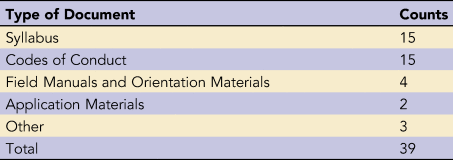
The 24 sets of field school materials included 39 documents because several directors provided multiple documents (Table 1). The majority of documents are syllabi and student codes of conduct, although directors also submitted field manuals, orientation materials, application materials, and other documents (Table 1). We refer to the suite of documents provided to students as syllabi because these documents provide foundational information about the field school course, functioning like a syllabus. We limited our analysis to field schools held in the United States.
Summary of Field School Documents Analyzed.

Notes: Codes of conduct include safety plans, sexual harassment and assault policies, and Title IX policies or excerpts thereof. Other documents include e-mailed information on policies and other documents. These 39 documents are derived from 24 field schools.
The deployment of the field school director survey coincided with the onset of the COVID-19 pandemic and in-person institutional closures. This may have affected the survey response rate; however, a 29% response rate is within established levels of published empirical studies in organizational research (Baruch and Holtom Reference Baruch and Holtom2008). As with the survey response rate, 24 sets of documents provide a sample size robust enough for the qualitative analysis we conducted (Mason Reference Mason2010; Merriam Reference Merriam2009:80).
Prior to analysis, we removed identities from all documents and assigned a numerical code to each that the research team could not use to trace back to identify the director. This step guarded against the research team imposing preconceived biases based on an individual field director or the director's gender, age, or institutional affiliation. The research team then conducted a content analysis, examining the text of these documents to elicit meaning and gain an understanding of field school policies and practices (Bowen Reference Bowen2009; Merriam Reference Merriam2009:205–206). We do not quote excerpts directly from the analyzed documents so as to maintain the confidentiality of those field directors who submitted documents.
Coding Scheme
Before the document analysis, we developed an a priori coding frame—that is, a coding frame established before the examination of the documents. This frame, based on recommendations derived from the 2018 NASEM report (Colaninno, Lambert, et al. Reference Colaninno, Lambert, Beahm and Drexler2020; NASEM 2018), consists of the following: (1) preparation, (2) climate and culture, (3) supervisory hierarchies, (4) reporting, and (5) support.
Preparation refers to the steps that field school directors take to prepare themselves, their staff, and students to recognize, address, and avert situations that may lead to sexual harassment and assault, such as bystander intervention training (Banyard Reference Banyard, Moynihan and Plante2007; Cobb and Croucher Reference Cobb and Croucher2020; Coker et al. Reference Coker, Cook-Craig, Williams, Fisher, Clear, Garcia and Hegge2011, Reference Coker, Fisher, Bush, Swan, Williams, Clear and DeGue2015; Holland et al. Reference Holland, Rabelo and Cortina2016; Mytum, ed. Reference Mytum2012) and course readings. We defined field school climate and culture as steps that field directors take to intentionally create an environment that supports civil and respectful treatment of all participants. This can be done through explicitly communicated behavioral expectations, modeled equitable professional behavior, and facilitated opportunities for feedback (Croucher et al. Reference Croucher, Cobb and Brennan2008; Emerson Reference Emerson2021).
Supervisory hierarchies are the ways that field directors create and manage power structures (Hawkins and Rees Reference Hawkins and Rees2018; Mary et al. Reference Mary, Pasquini and Vandevelde2019). Reporting refers to steps that students and staff should take to report incidents of sexual harassment or assault and that should be easily accessible to all field school participants. We define support as those mechanisms that help students and staff through the reporting process (Klein and Martin Reference Klein and Martin2021; Pappas Reference Pappas2016; Phillips et al. Reference Phillips, Webber, Imbeau, Quaife, Hagan, Maar and Abourbih2019). Greater details on these recommendations are presented elsewhere (Colaninno, Lambert, et al. Reference Colaninno, Lambert, Beahm and Drexler2020).
Given the range of documents and the unanticipated relevance of nonharassment text, we broadened the coding to a hierarchical coding frame that included primary (main) codes and secondary codes, or subcategories of main codes (Merriam Reference Merriam2009:178–188). The hierarchical coding frame allowed us to derive meaning from and view the interrelatedness of excerpts. We reviewed and reconciled our coding frame based on the preliminary coding of two sets of documents by the entire team (Merriam Reference Merriam2009:178–181). After the research team established the primary and secondary codes, three researchers independently reviewed each set of documents, which we then discussed in biweekly team meetings to refine and revise problematic codes and cross-check the application of the coding frame (Merriam Reference Merriam2009:213–220).
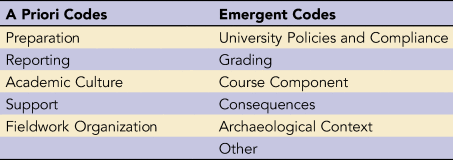
The final coding frame included 11 primary codes and 40 secondary codes (Supplemental Table 1; Table 2). We modified and expanded our initial code of climate and culture to archaeological culture—a primary code used to denote aspects of the field school culture and climate not related to expectancies centered exclusively on fieldwork. Secondary codes of archaeological culture included attire; behavior; alcohol, marijuana, and controlled substance use; recognition of diversity; comparison to cultural resource management; and references to archaeological professional organizations’ ethical and professional guidelines.
A Priori and Emergent Codes Applied to the Text of Field School Documents.

We modified and expanded the initial supervisory hierarchies code to fieldwork organization. This primary code applied to text indicating how the field director structured and operationalized fieldwork. Secondary codes within the fieldwork organization primary code noted how students should communicate during fieldwork, who functioned as the student's primary supervisor(s), how tasks were distributed, what behavioral expectations while conducting field research were, and what safety plans existed. Preparation, reporting, and support remained unmodified from our original code frame.
Newly emerged codes included “university-required syllabus text,” “grading criteria,” “field school course components,” “stated consequences,” and “other” (Table 2). The “other” code was assigned to text that could have implications related to harassment, safety, and accessibility but that did not fit within the primary codes. These included secondary codes such as student insurance requirements, student acceptance policies, volunteers, and additional expenses to students.
The university-required syllabus code included text generated by institutions that detailed their position, policies, and obligations regarding Title VII and Title IX, academic honesty, accessibility services, discrimination, and statements of diversity. Frequently, field school directors expanded on institution-generated text to include nonjargoned definitions and examples of policy violations. Such text was included within this primary code but assigned a unique secondary code.
Text detailing grading criteria and assessment was coded using the grading primary code. Text describing components of the field school as a course—such as the course description, learning objectives, assignments, and required laboratory analyses—was coded as course component. Some documents detailed consequences to students, staff, and supervisors in the case they engaged in harassing behaviors. We coded this text as a primary code of consequences.
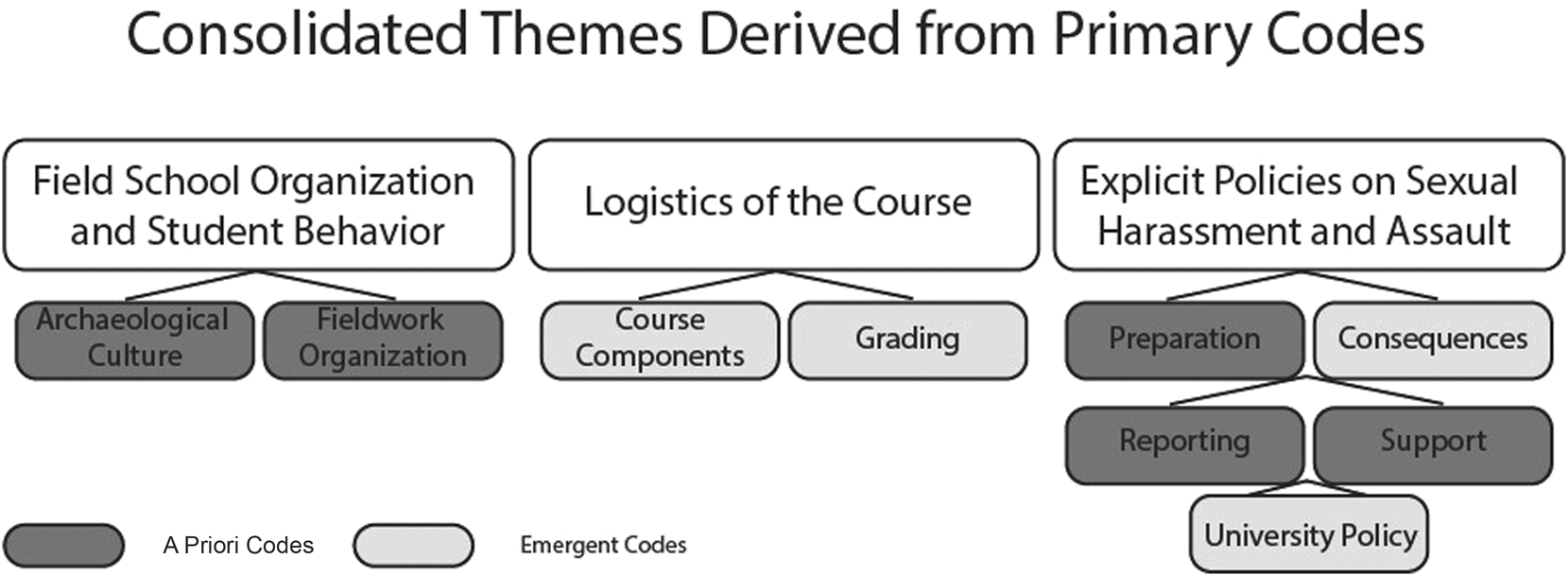
After we coded all documents, the research team pulled text excerpts assigned to each primary and secondary code (Merriam Reference Merriam2009:181–183). All team members reviewed the excerpts in the context of the coding frame for safety and inclusivity implications and recommendations to strengthen aspects of the syllabus based on established literature. Following this review, we consolidated the primary codes into three themes: (1) field school organization and expected student behavior, (2) logistics of the course, and (3) explicit policies on sexual harassment and assault. Figure 1 represents the consolidated, operationalized codes.
Consolidated themes with operationalized primary codes used for data analysis.

RESULTS: CONTENT ANALYSIS
Syllabi Document Analysis
Our analysis resulted in primary themes that apply to the ways that students and staff perceive power structures within the field school, their ability to report incidents of unwelcomed behavior and/or sexual harassment and assault, and explicit and implicit behavioral expectations.
Field School Organization and Behavior
We identified two approaches field directors take toward leadership and decision-making hierarchies. Some directors organize their field schools so that power is concentrated in the director. In some cases, the director shares authority with others, such as lab directors and staff, but power is concentrated in a single or a few individuals. Under this model, student complaints are brought to the attention of the director. Students are directed to go outside this structure only if complaints of harassment have not been resolved to their satisfaction.
Other directors distribute the power among participating field school members. Their decision-making process emphasizes teamwork and shared leadership and responsibilities. Some directors also work with field school staff, personnel, and students to establish a set of shared guidelines and values that steer everyone's behavior. Students are encouraged to express concerns and issues they have to personnel with whom they feel most comfortable.
Many field directors provide ample text on their expectations of student behavior. We observed a dichotomy in the way they conveyed these expectations. Some directors emphasize the importance of professionalism and the professional nature of the discipline, using words such as “respectful,” “courteous,” “cooperation,” and “civility.”
Other field school directors focus their syllabus text on preventing or eliminating unwanted behavior. Among these syllabi, students are directed not to whine or complain. These syllabi tend to focus less on students conducting themselves with professionalism and more on students having the right attitude. Words and phrases associated with this approach include “energy,” “enthusiastic,” “no complaining,” and “sense of humor.”
Another theme that emerged was the concept of individual responsibility for one's behavior. Several syllabi noted that students are singularly responsible for their own behavior. This language also appears in university codes of conduct.
Logistics of the Course
One feature common to field schools is subjective grading primarily based on student attitude and work ethic. This can comprise a large percentage, if not the majority, of the student's final grade. Only one syllabus in our sample provided a rubric by which the director assessed subjective grading criteria.
Explicit Policies on Sexual Harassment and Assault
Overall, most syllabi included text defining a sexual harassment and assault policy and/or included university-required text on their home institution's Title VII and Title IX policies. Several field directors provided nonjargoned definitions of the various forms of sexual harassment, as well as examples of actions that would be considered sexual harassment or assault.
Field directors had a number of policies and instructions regarding how targeted students should address unwanted behaviors, as well as to whom to report. Many directors asked students to report issues of harassment directly to them, whereas others provided contact information for their institution's Title IX coordinator. Some syllabus text also instructed students experiencing harassment to approach the student harassing them directly to resolve the issue.
There tended to be multiple statements regarding punitive actions for particular student behavior with varying degrees of consequences. Directors noted that they might take punitive action if students violated academic integrity (cheating and plagiarism), failed to act according to the standards of archaeological professionalism, or committed acts deemed to be sexual harassment or assault. Syllabus text indicated that when students plagiarized, cheated, or acted outside the guidelines of professional archaeology, the consequence would often be immediate dismissal. If a student was accused of sexual harassment or assault, most field directors stated that the incident would be investigated. Many directors also stated that they had a zero-tolerance policy for harassment and assault, but they did not define zero tolerance.
DISCUSSION
Our findings indicate that in the field school syllabus, directors are taking steps to prevent and reduce sexual harassment and assault. Many syllabi include practices that could create an environment that supports student learning and equitable participation. However, some common practices and policies can be improved. We discuss aspects of each theme and suggest adjustments and improvements in the ways field directors structure the policies and language in syllabi.
Field School Organization and Behavior Recommendations
Field school instructional organization traditionally has been hierarchical, with field directors holding much of the authority (Mary et al. Reference Mary, Pasquini and Vandevelde2019). Our analysis indicates that some directors have moved away from this model, whereas others continue to use it for instruction as well as for reporting sexual harassment and assault. The NASEM report emphasized that organizations using rigid hierarchical power structures tend to be those where sexual harassment and assault occur more frequently, and instances of harassment go overlooked, underreported, and unchecked (Buchanan et al. Reference Buchanan, Settles, Hall and O'Connor2014; Frank et al. Reference Frank, Brogan and Schiffman1998; Ilies et al. Reference Ilies, Hauserman, Schwochau and Stibal2003; NASEM 2018; Schneider et al. Reference Schneider, Pryor, Fitzgerald, Einarsen, Hoel, Zapf and Cooper2011). We recommend that directors move away from concentrated hierarchical power structures and toward more egalitarian or flattened forms of supervision and leadership, particularly regarding the mechanisms students have for reporting sexual harassment and assault (Flood et al. Reference Flood, Hannan, Smith, Turner, West and Dawson2000; Nelson et al. Reference Nelson, Rutherford, Hinde and Clancy2017). We also suggest that field directors encourage open communication among all participants. Several syllabi detailed supervisory hierarchies—that is, the supervisor to whom students go for excavation instructions and review of work. Although this type of supervisory structure—with clear, singular lines of communication—may be appropriate for fieldwork, field directors should clarify that students can communicate with any individual inside and outside the field school when it comes to the student's sense of safety and ability to report inappropriate behavior.
Evidence of restricted and open communication policies were observed in field school social media policies. Recently, social media use by the archaeological community has grown (Huffer Reference Huffer2018; Kelpšienė Reference Kelpšienė2019; Perry and Beale Reference Perry and Beale2015; Walker Reference Walker2014). It is common for people to share daily events through social media, and field school students likely want to share their field school experiences. Such practices have raised concerns with field directors because students may unintentionally disclose a site location or post culturally sensitive excavations or objects (Richardson Reference Richardson2013, Reference Richardson2018). Prior to coding syllabi, we anticipated that field directors would include social media policies.
Detailed social media policies are rarely provided, and when these policies are included, they range widely. Several directors include brief statements about the need for students to be civil and respectful in posts related to field school activities. Others integrate social media into field school activities, working with students to develop posts for the project's social media accounts. In these cases, field school personnel review and approve posts before sharing. Directors may have such policies to help students build the skills to convey archaeological concepts to the public. In other cases, social media policies restrict students from having devices with them during fieldwork and from sharing any information about field school on social media.
We encourage field school directors to develop policies that help teach students best practices for sharing archaeologically sensitive content through social media (Perry and Beale Reference Perry and Beale2015) while not restricting students’ ability to communicate with people outside their field school. Policies that restrict students’ abilities to communicate may lead students to perceive that they should not share information about their field school experience (Dykstra-DeVette and Tarin Reference Dykstra-DeVette and Tarin2019). Without clarification, students may not only feel that sharing field school experiences is discouraged but lose their sense of connection to outside communities. Although social media policies are a needed item for field school syllabi, field directors should develop these policies with an eye toward maintaining students’ ability to communicate freely while considering the protection of archaeological resources and the rights, preferences, and requests of descendant communities.
Several field school syllabi and associated documents, particularly university codes of conduct, note the individuality of student behavior—that is, students are solely and singularly responsible for their behavior. Fieldwork, in nearly all cases, is conducted in teams, and field schools involve teamwork, group work, and collaboration. For this reason, group dynamics and groupthink can influence the behavior of field school participants over individuality (Rose Reference Rose2011; Turner and Pratkanis Reference Turner and Pratkanis1998; Turner et al. Reference Turner, Pratkanis, Probasco and Leve1992). Within the US legal system and at many institutions, individuals—not a group—are held accountable for their behavior. This, in combination with language used by directors’ home institution, may lead directors to emphasize the individualistic nature of behavior rather than situating behavior within the context of group dynamics. We recommend that field directors stress the importance of shared responsibilities in creating a working and living environment that values and respects every member of the team.
In many cases, field directors include phrases that emphasize the need for students to bring and wear professional field clothing. Some directors noted that students should not wear items such as tank tops, swimsuits tops, and stringy tank tops. Although such excerpts were limited, their occurrence indicates that clothing policies focus more heavily on the attire of those students who identify as women. To create more inclusive practices, we suggest that field directors clearly define professional and protective field attire and generate text that equitability applies restrictions of clothing regardless of a student's gender identity (Awasthi Reference Awasthi2017).
Logistics of the Course Recommendations
An unexpected area where we found room to strengthen field school syllabus text is grading criteria. Many field school directors base large percentages of a student's grade on subjective criteria centered on attitude and behavior. The subjectivity of field school grading gives the field director additional power over students. At field schools where expected student behaviors include no whining, no complaining, and having the right attitude, students may perceive that complaints about harassment can have a negative impact on their grade. Such practices may discourage students from reporting and present a means for others to perpetrate harassment. A student's attitude may reflect difficult circumstances either outside of or at the field school. If attitude is prescribed by the director and assessed without an established rubric or input from the student, and if it is affected by situations that include harassment, students may be less likely to report harassment. They may fear that they are not demonstrating the positive attitude the field director will use to assess their grade. Directors should reinforce the idea that reporting either experienced or witnessed unwanted behavior will not have an adverse effect on a student's grade.
Field school directors should consider developing rubrics to assess students on those grading criteria that are subjective and provide opportunities for formative and summative assessment (Moskal Reference Moskal2000; Panadero and Jonsson Reference Panadero and Jonsson2013; Ragupathi and Lee Reference Ragupathi, Lee, Sanger and Gleason2020; Smit and Birri Reference Smit and Birri2014). These were rarely included in the field school syllabi. With subjective grading criteria, field directors should provide periodic reviews and recommendations for how students could improve performance. Field directors should also disassociate student attitude and rephrase this to the assessment of a student's demonstration of equitable professional standards. Equitable professional standards should consider ethical codes of conduct for the field (Register of Professional Archaeologists 2020), as well as an understanding of how professionalism privileges individuals from majority groups while disadvantaging those from minoritized groups (Ferguson and Dougherty Reference Ferguson and Dougherty2021; Gray Reference Gray2019).
Explicit Policies on Sexual Harassment and Assault
We previously suggested that field school directors should allow and encourage students to report experienced and witnessed sexual harassment and assault to individuals with authority both at the field school and at the director's home institution (Colaninno, Lambert, et al. Reference Colaninno, Lambert, Beahm and Drexler2020). Our analysis found that including multiple individuals to whom or agencies to which students can report sexual harassment and assault is common practice. When field directors include contact information for multiple individuals, many rely on Title IX coordinators, departmental contacts, and local law enforcement, whereas others include outside organizations to provide students with resources outside mandatory reporting systems and policing, such as sexual assault advocacy groups.
In other cases, field directors do encourage students to report questionable incidents directly to them without providing alternative means for reporting. With this policy, the field director has complete control over how to handle any complaint—which may not be what is best for the individual(s) involved. The director's ability to resolve complaints unilaterally may not necessarily result in a balanced outcome for the individual experiencing harassment. Furthermore, if the person committing the offensive behavior supervises the student and has authority in assigning the student's grade, the student may not feel comfortable reporting. It should not be mandatory that students follow the field school hierarchy when reporting harassment. We recommend that field school directors include multiple people to whom students can report. Among these, field directors should include people from multiple genders and levels of authority. Field directors should also help students understand which people are university-designated mandatory reporters and that those individuals have an obligation to report cases to university authorities (Mancini et al. Reference Mancini, Pickett, Call and Roche2016; Weiss and Lasky Reference Weiss and Lasky2017).
Several syllabi included their home institution's sexual harassment and assault policy in the context of Title VII and Title IX, and some directors expanded on these policies to provide nonjargoned definitions and examples of sexual harassment and assault. During our analysis, we noted that text related to university policies was difficult to understand given its compliance-based nature. Scholars have noted that institutional policies related to sexual harassment and assault tend to be written beyond the reading level of undergraduate students (Duncan et al. Reference Duncan, Yeatts, Kapusta, Allen, Wilson and Tilley2019; Taylor Reference Taylor2018). When directors expanded on university-required text, this text was easier to understand, and it would be more accessible to students.
Expanded policy text often includes definitions and nonjargoned descriptions of sexual harassment (gender harassment, unwanted sexual attention, and sexual coercion), sexual assault, sexual violence, dating violence, and consent (Fitzgerald et al. Reference Fitzgerald, Gelfand and Drasgow1995). Several directors provided examples of behavior that would constitute each type of sexual harassment. Research suggests that undergraduate students do not have a clear understanding of behaviors that are sexual harassment (Sipe et al. Reference Sipe, Douglas Johnson and Fisher2009) and that their level of understanding varies by demographic factors (Weller et al. Reference Weller, Parkison, Cox and Plummer2019). Consequently, we recommend that field directors incorporate definitions of sexual harassment, assault, and consent in their syllabus. Within the text, directors should provide the definition and examples of gender harassment—the most common form of sexual harassment—before all other forms. We reviewed expanded Title IX text that provided the definition of sexual assault—the most uncommonly reported form—before all others. As a result, the definition of the most common form of harassment is buried in the text. This may discourage students from recognizing gender harassment as harassment; a known barrier to reporting (Sipe et al. Reference Sipe, Douglas Johnson and Fisher2009).
A policy absent from nearly all syllabi is an amnesty clause. Many colleges and universities have an amnesty policy that prohibits institutions from seeking punitive actions against a student who reports experienced or witnessed sexual harassment or assault that includes that student's involvement with other policy violations, such as alcohol or drug use (Richards and Kafonek Reference Richards and Kafonek2016). Research demonstrates that when sexual violence is accompanied by alcohol and drug use, victims and witnesses are less likely to report (Kilpatrick et al. Reference Kilpatrick, Resnick, Ruggiero, Conoscenti and McCauley2007). Although students may be protected under their university's amnesty clause while participating in field school, they may not feel comfortable reporting out of fear of punishment or a lower grade. We recommend that directors include their home institution's amnesty clause in their syllabus. Such statements may help students feel more secure when reporting and underscore the importance of reporting.
In several syllabi, field school directors included text regarding punitive steps they will take if students violate a field school or university policy. We noted inequity in stated punitive actions. Not all policy violations have the potential to be as complex as sexual harassment and assault. Plagiarism likely involves one student, and finding evidence of plagiarism is relatively straightforward. Sexual harassment involves a minimum of two people, who may have conflicting accounts, and the account in question may not have been witnessed by others. Sexual assault, if reported, may also involve law enforcement, adding further complexity (Grubb and Turner Reference Grubb and Turner2012; Sleath and Bull Reference Sleath and Bull2017). Although some actions that violate policy may be more definitive than others, we recommend that directors detail equitable punitive steps for all policy violations or provide text explaining why different policy violations result in different outcomes. If plagiarism warrants immediate dismissal, whereas sexual assault warrants an investigation, students may perceive that sexual misconduct is less serious than other violations. We suggest that directors consider starting all policy violations with an investigation.
Many field directors stated that accusations of sexual harassment and assault will result in a full investigation, with little text dedicated to what an investigation entails. Investigations into allegations of sexual harassment and assault may take months to resolve—longer than the duration of the field school—and may involve extensive interviews that revive traumatic experiences. Students may choose not to report given the complexity of the investigation, the potential for an intrusive investigation, and the expectation that they will have to remain at the field school with the person(s) they accused (Spencer et al. Reference Spencer, Stith, Durtschi and Toews2020). Clarifying investigation procedures and providing clear supportive measures for students during the investigation may help students feel comfortable reporting. It is important for field directors to work with their institution's Title IX offices to provide both realistic accounts of what an investigation would entail and details about institutional and external supports available for students. Communication and coordination with Title IX offices is even more important as interpretations of Title IX laws continue to change with changing political administrations (Ellman-Golan Reference Ellman-Golan2017).
Several directors have a zero-tolerance policy regarding sexual harassment and assault but provide little text detailing the operationalization of such a policy. Having clear procedures and protections for students during an investigation, informed by institutional Title IX policies, is essential for students to feel comfortable reporting.
Other Observations
Given that this research focuses on student safety and inclusivity at field schools, albeit in the context of reducing and preventing sexual harassment and assault, we noted syllabi text that conveys exclusionary practices. Researchers have remarked that field schools are expensive and that their costs can render them inaccessible (Heath-Stout and Hannigan Reference Heath-Stout and Hannigan2020). The costs of field schools are apparent in syllabi. Some directors may require that students purchase handheld equipment; others recommend that students buy costly clothing items and outdoor gear; and some require that students purchase airline tickets. As archaeologists consider ways to make the discipline accessible and to diversify the voices of those who can contribute to our understanding of the past (Heath-Stout Reference Heath-Stout2020), we must think about how to make field schools affordable and accessible to all students. In many cases, students have to be in a privileged position to participate in a field school. Because the field school is a gatekeeper for which students can and cannot go on to practice archaeology, we must make efforts to neutralize barriers to field school entry.
Recommended Policy and Language Changes
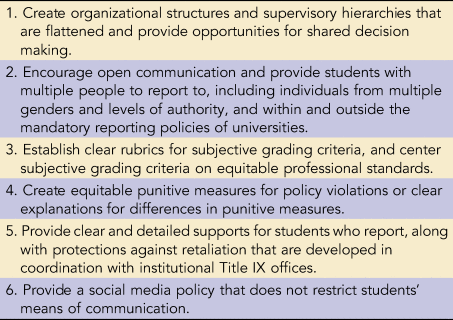
Recommended Policy Changes. Several of the suggested recommendations may require field directors to make policy changes to their syllabi (Table 3). The following are the policy changes we recommend:
(1) Create organizational structures and supervisory hierarchies that are flattened and provide opportunities for shared decision making.
(2) Encourage open communication and provide students with multiple people to report to—including individuals from multiple genders, and levels of authority, and within and outside the mandatory reporting policies of universities.
(3) Establish clear rubrics for subjective grading criteria and center subjective grading criteria on equitable professional standards.
(4) Create equitable punitive measures for policy violations or clear explanations for differences in punitive measures.
(5) Provide clear and detailed supports for students who report, along with protections against retaliation that are developed in coordination with institutional Title IX offices.
(6) Provide a social media policy that does not restrict students’ means of communication.
Recommended Policy Changes for the Field School Syllabus.

Recommended Language Changes
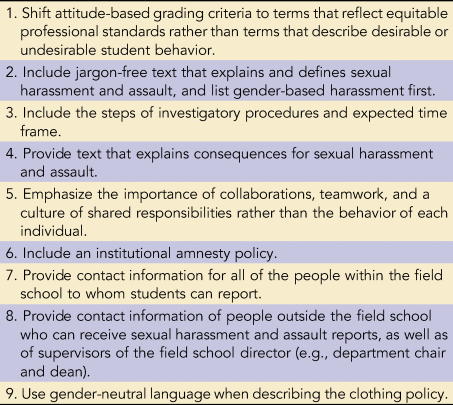
These are as important as policy changes (Fornaciari and Lund Dean Reference Frank, Brogan and Schiffman2014; Harnish and Bridges Reference Harnish and Robert Bridges2011; Thompson Reference Thompson2007). We suggest that field directors consider making the following changes:
(1) Shift attitude-based grading criteria to terms that reflect equitable professional standards rather than terms that describe desirable or undesirable student behavior.
(2) Include jargon-free text that explains and defines sexual harassment and assault, and list gender-based harassment first.
(3) Include the steps of investigatory procedures and expected time frames.
(4) Provide text that explains consequences for sexual harassment and assault.
(5) Emphasize the importance of collaborations, teamwork, and a culture of shared responsibilities rather than the behavior of each individual.
(6) Include an institutional amnesty policy.
(7) Provide contact information for all of the people within the field school to whom students can report.
(8) Provide contact information for people outside the field school who can receive sexual harassment and assault reports, as well as of supervisors of the field school director (e.g., department chair and dean).
(9) Use gender-neutral language when describing the clothing policy (Table 4).
Recommended Language Changes for the Field School Syllabus.

Applications to Other Fieldwork Contexts
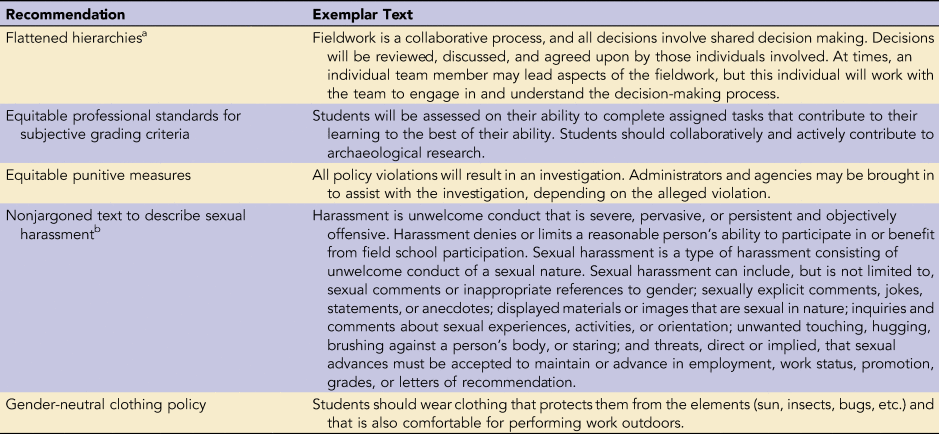
Several recommendations we suggest align with the current policies and practices highlighted by anthropological and archaeological professional organizations (American Anthropological Association 2018; Register of Professional Archaeologists 2020; Society for American Archaeology 2016, 2019; Society for Historical Archaeology 2021; Southeastern Archaeological Conference 2021). Furthermore, these professional organizations, among others (Emerson Reference Emerson2021; Hawkins and Rees Reference Hawkins and Rees2018; Perry Reference Perry2018), provide exemplar text, recommendations, and sample codes of conduct that field directors can modify. We provide some exemplar text in Table 5. These documents, in addition to our recommendations, may be applicable to other fieldwork settings, including cultural resource management, volunteer opportunities, and public archaeology events. As many directors structure their field schools to align with the professional practices of cultural resource management, implementing these recommendations at field schools and professional archaeological settings has the potential to bring about needed changes in all fieldwork contexts.
Exemplar Text for Selected Policy and Language Change.

a Flattened hierarchies text derived from Perry Reference Perry2018.
b Exemplar texts for nonjargoned description of sexual harassment are modified from those created by the Mississippi State University Office of Civil Rights Compliance.
Limitations
This research is based on text from field school syllabi and other documents. Because of this, we cannot determine how field directors implement their stated policies and practices. Researchers have noted that instructors often present tyrannical policies in their syllabi, but orally communicate and implement these policies with a caring and compassionate tone (Thompson Reference Thompson2007). This practice establishes the instructor's authority while giving them the flexibility to walk back policies to accommodate their students’ individual circumstances rather than appearing lenient (Thompson Reference Thompson2007). It is also possible that field directors may state one policy in their syllabus but implement that policy differently in practice. Additionally, field directors might implement practices that strongly encourage a safe and inclusive field school but not detail these policies in their syllabus. Further research is needed to investigate how field school directors implement various formal and informal policies, how they communicate these policies to staff and students, and what their reasoning is for implementing those policies.
Research into sexual harassment and assault, particularly in the context of higher education, has focused on how women—predominately cisgender, heterosexual, white women—experience harassment and assault (NASEM 2018). People of color; people of the LGBTQ+ community; people with diverse learning, cognitive, and physical abilities; people who are nongender conforming; and people who identify as men may experience harassment and assault differently from white, heterosexual women (Berdahl and Moore Reference Berdahl and Moore2006; Brown et al. Reference Brown, Peña and Rankin2017; Garvey et al. Reference Garvey, Sanders and Flint2017; Gay-Antaki and Liverman Reference Gay-Antaki and Liverman2018; Kalof et al. Reference Kalof, Eby, Matheson and Kroska2001; Rankin Reference Rankin2005; Settles et al. Reference Settles, O'Connor and Yap2016).
CONCLUSIONS
When students do not feel safe, they cannot learn. And when field schools are unsafe, aspiring archaeologists become disadvantaged and discouraged, and they may chose to leave the discipline. Sexual harassment, in addition to other harmful and exclusionary practices, has been a pervasive and persistent issue in higher education, field-based research disciplines, and archaeology for decades (Clancy et al. Reference Clancy, Nelson, Rutherford and Hinde2014; Marín-Spiotta et al. Reference Marín-Spiotta, Barnes, Berhe, Hastings, Mattheis, Schneider and Williams2020; Mary et al. Reference Mary, Pasquini and Vandevelde2019; Meyers et al. Reference Meyers, Horton, Boudreaux, Carmody, Wright and Dekle2018; NASEM 2018; VanDerwarker et al. Reference VanDerwarker, Brown, Gonzalez and Radde2018; Voss Reference Voss2021a). Unfortunately, archaeology as a discipline has taken few systematic measures to reflect on the ways we exclude and harm some aspiring archaeologists while privileging others (Leighton Reference Leighton2020; Voss Reference Voss2021a). Archaeologists must come to terms with the broad history of sexual harassment and assault within our discipline—how it has shaped our field and how the structures we have built protect and perpetuate the power of those who have a voice in our discipline to the exclusion of others. It is imperative that our field build a discipline that promotes multiple and diverse perspectives that contribute to interpretations of the past, not just a discipline consisting of the few who were not subjected to or who survived the gauntlet of harassment and exclusion.
The recommendations we provide build on our prior recommendations to improve field school safety and inclusivity (Colaninno, Lambert, et al. Reference Colaninno, Lambert, Beahm and Drexler2020), as well as interventions others have proposed (Voss Reference Voss2021b). Many field school directors are taking steps to provide field school organizational structures, reporting mechanisms, and transparency that help prevent and reduce sexual harassment and assault. Several field school syllabi include course readings, explicit policies, and thoughtful organizational structures that address and combat these issues. Although we see strong practices and policies, our analysis suggests areas for improvement. This content analysis of field school documents should further consider field school directors’ reasoning for including the practices and policies they do, how they implement these policies and practices while the field school is ongoing, and how students perceive the effectiveness of these practices and policies. As we continue to investigate ways of improving field schools, we hope to identify not only how field directors can improve field school pedagogy to support inclusive learning but also areas in which directors are supporting field learning opportunities for a diversity of students.
Acknowledgments
This article was presented at the Annual Meeting of the Society for American Archaeology. This research is supported by the National Science Foundation Award No. 1937392 and conducted under the approval of the Southern Illinois University Edwardsville Institutional Review Board #603 (original protocol approved November 26, 2019; amended protocol approved May 18, 2020). We would like to thank the 24 anonymous field directors who volunteered their time and field school documents. We would like to thank Drs. Maureen Meyers and Robbi Ethridge, as well as the Southeastern Archaeological Conference Executive Committee and Task Force on Sexual Harassment and Assault for collaborating with us, and the Mississippi State University Office of Civil Rights Compliance for providing the example of nonjargoned text used in Table 5. This article benefited from the thoughtful comments of four anonymous reviewers and Dr. Siavash Samei. Morgan Tallman and Cassidy J. Rayburn provided support throughout this research, and Cristal Campocasso translated the Spanish abstract. The authors are responsible for all the thoughts, opinions, data, and any errors presented.
Data Availability Statement
Primary data sources used for this research were voluntarily submitted by field school directors. The Institutional Review Board protocol approved for this research prohibits the sharing of these documents. These data are not made available to protect the identity of the field directors.
Supplemental Material
For supplemental material accompanying this article, visit https://doi.org/10.1017/aap.2021.32.
Supplemental Table 1. Themes, Primary Codes, and Secondary Codes.