Introduction
Mental health first aid (MHFA) has been defined as ‘the help provided to a person developing a mental health problem or in a mental health crisis. The first aid is given until appropriate professional treatment is received or until the crisis resolves’ (Jorm et al. Reference Jorm, Wright and Morgan2007a , Reference Jorm, Morgan and Wright2008; Langlands et al. Reference Langlands, Jorm, Kelly and Kitchener2008a ). MHFA is especially important for young people because adolescence and early adulthood is the peak age of onset for many mental disorders (Kessler et al. Reference Kessler, Berglund, Demler, Jin, Merikangas and Walters2005; De Girolamo et al. Reference De Girolamo, Dagani, Purcell, Cocchi and Mcgorry2012). Moreover, young people themselves show a strong preference for getting initial help from their family and friends (Wright et al. Reference Wright, Harris, Wiggers, Jorm, Cotton, Harrigan, Hurworth and McGorry2005; Jorm & Wright, Reference Jorm and Wright2007; Yap et al. Reference Yap, Reavley and Jorm2013a ), underscoring the importance of equipping these informal sources of support with the requisite skills to provide appropriate MHFA to young people.
Notably however, MHFA is inherently contingent upon the ability to first recognize that an individual is in fact developing a mental health problem or is in a mental health crisis. Evidence to date suggests that young people's ability to recognize and accurately label mental disorders in a hypothetical peer described in a vignette is far from adequate (Wright & Jorm, Reference Wright and Jorm2009; Yap et al. Reference Yap, Reavley and Jorm2013c ).
We are not aware of any research to date that has specifically examined the association between accurate labelling of mental disorders and MHFA. However, it might be inferred from research evidence examining the association between labelling and help seeking, that young people's ability to accurately identify a mental disorder in a peer may be associated with their first-aid responses. For instance, findings from two studies involving clinical samples suggest that accurate labelling of mental disorder may decrease the delay in treatment seeking by young people (Thompson et al. Reference Thompson, Issakidis and Hunt2008), and increase the chances of accurate diagnosis and appropriate treatment when they do present to health services (Haller et al. Reference Haller, Sanci, Sawyer and Patton2009). Similarly, three vignette-based studies of young people which directly examined the association between labelling and help-seeking preferences have found that the use of accurate labels for various mental disorders is associated with increased intentions to seek appropriate professional help (Wright et al. Reference Wright, Jorm, Harris and Mcgorry2007, Reference Wright, Jorm and Mackinnon2012; Yap et al. Reference Yap, Reavley and Jorm2013c ).
Nonetheless, it remains unclear whether accurate labelling of a mental disorder in a peer will lead to more appropriate (helpful) or inappropriate (unhelpful) first-aid responses. The use of psychiatric terms by the public to label mental disorders has been the subject of continuing debate (Read et al. Reference Read, Haslam, Sayce and Davies2006, Reference Read, Haslam and Davies2009; Jorm & Griffiths, Reference Jorm and Griffiths2008), mainly due to concerns that labelling may fuel stigma (Scheff, Reference Scheff1966; Gove, Reference Gove1975; Link et al. Reference Link, Cullen, Struening, Shrout and Dohrenwend1989; Jorm & Griffiths, Reference Jorm and Griffiths2008). However, national surveys of Australian youth (Wright et al. Reference Wright, Jorm and Mackinnon2011; Yap et al. Reference Yap, Reavley, Mackinnon and Jorm2013b ) have found that accurate labelling of mental disorders was mostly related with less stigmatizing attitudes. Given previous findings that stigmatizing attitudes prospectively predicted the first-aid actions young people took to help their close friend or family member experiencing a mental health problem (Yap & Jorm, Reference Yap and Jorm2011), the direction of the associations between accurate labelling and the helpfulness of mental health first-aid responses of young people remains to be determined.
The current study
Using data from two national surveys of Australian youth (conducted in 2006 and 2011), the current study aimed to address the above-mentioned gaps in our knowledge. In particular, we examined the associations between accurate psychiatric labelling and the quality of spontaneously reported mental health first-aid intentions and beliefs about the helpfulness of various prompted responses. More importantly, we examined these associations separately for five vignettes: depression, depression with suicidal thoughts, social phobia, post-traumatic stress disorder (PTSD) and psychosis.
Methods
Participants
The 2011 survey involved computer-assisted telephonic interviews with 3021 young people aged between 15 and 25 who were contacted by random-digit dialling of both landlines and mobile phones covering the whole of Australia (see Reavley & Jorm, Reference Reavley and Jorm2011 for more details of the methodology).
The 2006 sample of 3746 young Australians aged 12–25 years was conducted via landlines only, but all the other recruitment protocols were the same as for the 2011 survey (see Jorm & Wright, Reference Jorm and Wright2008 for more details; and Appendix A for more detail on the sociodemographic characteristics of the samples from both surveys).
Survey questions
The 2011 interview was based on a case vignette of a young person (John or Jenny) with a mental disorder. On a random basis, respondents were read one of six vignettes – depression, depression with suicidal thoughts, depression with alcohol abuse, social phobia, PTSD or psychosis (early schizophrenia) – portraying a person aged 15 years (for participants aged 15–17 years) or 21 years (for participants aged 18–25 years) of the same sex as the respondent (see Appendix B for the vignettes used).
All the respondents were then asked a series of questions that assessed the sociodemographic characteristics, mental health literacy, stigma, exposure to mental disorders, beliefs about interventions and prevention, psychological distress (using the K6 screening scale; Kessler et al. Reference Kessler, Andrews, Colpe, Hiripi, Mroczek, Normand, Walters and Zaslavsky2002) and exposure to mental health campaigns.
The 2006 survey asked the same questions but included only four vignettes: depression, psychosis, social phobia and depression with alcohol abuse (see Jorm et al. Reference Jorm, Wright and Morgan2007a for more details).
This paper focused on labelling of the disorder in the vignette and mental health first-aid intentions and beliefs, so these are described in detail here. The depression with alcohol abuse vignette was not included in this paper because it comprises of two comorbid disorders, whereas each of the other five vignettes of interest in this paper represent a single diagnostic group.
Labelling of the disorder portrayed in the vignette
Young people were asked: ‘What, if anything, do you think is wrong with John /Jenny?’ Interviewers recorded verbatim responses according to pre-coded response categories (depression, schizophrenia, psychosis, mental illness, stress, nervous breakdown, psychological/mental/emotional problem, has a problem, cancer, nothing, don't know) derived from a content analysis of responses to the same questions in earlier surveys (Jorm et al. Reference Jorm, Korten, Jacomb, Rodgers and Pollitt1997; Wright et al. Reference Wright, Harris, Wiggers, Jorm, Cotton, Harrigan, Hurworth and McGorry2005). A content analysis of responses that did not fit these pre-coded categories led to post-coding of 53 other categories for the 2011 survey (Reavley & Jorm, Reference Reavley and Jorm2011), and 56 for the 2006 survey (Wright & Jorm, Reference Wright and Jorm2009). These categories included the most accurate responses for the anxiety disorder vignettes: anxiety/anxious, social anxiety/social phobia/anxiety disorder (for both surveys), post-traumatic stress/stress disorder/syndrome and trauma/traumatized/adverse life event (for the 2011 survey). Accurate labelling was defined as those labels that approximated the DSM-IV diagnostic label (American Psychiatric Association, 1994) upon which the vignettes were based and validated (Jorm et al. Reference Jorm, Korten, Jacomb, Rodgers and Pollitt1997; Wright et al. Reference Wright, Harris, Wiggers, Jorm, Cotton, Harrigan, Hurworth and McGorry2005). However, given the low rates of using the exact DSM-IV labels ‘social phobia’ and ‘PTSD, we expanded our definition of ‘accurate’ label for social phobia to include any mention of anxiety, anxious, social anxiety/phobia and anxiety disorder; and for PTSD, any mention of post-traumatic stress/stress disorder/syndrome, trauma, traumatized and high levels of distress associated with some adverse life event. ‘Depression’ or ‘depressed’ were the only accurate labels accepted for both depression vignettes. Mentions of psychosis/psychotic, schizophrenia/schizophrenic were accepted as accurate labels for the psychosis vignette.
First-aid intentions and beliefs
To assess respondents’ spontaneously reported first-aid intentions, they were asked: ‘Imagine John/Jenny is someone you have known for a long time and care about. You want to help him/her. What would you do?’. To assess respondents’ prompted first-aid beliefs, the interviewer said, ‘I am going to read out a list of things you could do to try and help John/Jenny. I want you to tell me whether you think it would be helpful, harmful or neither for John/Jenny if you were to do these things’. The list included: ‘Listen to his/her problems in an understanding way. Talk to him/her firmly about getting his/her act together. Suggest he/she seek professional help. Make an appointment for him/her to see a general practitioner (GP). Ask him/her whether he/she is feeling suicidal. Suggest he/she have a few drinks to forget his/her troubles. Rally friends to cheer him/her up. Ignore him/her until he/she gets over it. Keep him/her busy to keep his/her mind off problems. Encourage him/her to become more physically active.’ Responses were coded as ‘helpful’ = 1 and all other responses = 0.
Scoring open-ended first-aid responses according to the MHFA action plan
To assess the quality of the respondents’ spontaneously reported first-aid intentions in both surveys, we used a scoring scheme based on the second edition MHFA action plan (Kitchener et al. Reference Kitchener, Jorm and Kelly2010). This action plan was developed through a series of Delphi studies to develop MHFA guidelines (Kelly et al. Reference Kelly, Jorm, Kitchener and Langlands2008; Langlands et al. Reference Langlands, Jorm, Kelly and Kitchener2008a , Reference Langlands, Jorm, Kelly and Kitchener b ; Kingston et al. Reference Kingston, Jorm, Kitchener, Hides, Kelly, Morgan, Hart and Lubman2009). The scoring scheme gives points according to the following six components: Approach the person, Assess and assist with any crisis, Listen non-judgementally, Give support and information, Encourage appropriate professional help and encourage other supports. Responses were coded on a 0–2 scale according to the quality of the response for each of the six actions: 0 = no mention or inadequate response, 1 = superficial response and 2 = specific details. Extra points were given only where specific detail was given for an action. The ratings were then summed to give a total score out of 12 (see Yap & Jorm, Reference Yap and Jorm2012a for more details).
A research assistant was trained in the use of the scoring criteria and she rated the responses blinded to participant characteristics. To assess the reliability of her ratings, they were compared with expert consensus ratings. Pearson correlations were: Approach = 0.92, Assess = 0.94, Listen = 0.96, Give support = 0.83, Encourage professional = 0.88, Encourage other = 0.83 and Total = 0.99.
Statistical analysis
The data were first analysed by using percent frequencies and 95% confidence intervals (CI) for age, sex, the use of accurate psychiatric labels and first-aid beliefs for both surveys. Means and standard deviations were also computed for the quality scores of first-aid intentions.
We then conducted a series of regressions to explore whether accurate psychiatric labelling predicted the quality of first-aid intentions and all ten beliefs, separately for each of the vignettes in both surveys. Given that the age and sex of the respondents have been found to be associated with mental health literacy (Jorm et al. Reference Jorm, Wright and Morgan2007b ; Jorm & Wright, Reference Jorm and Wright2008; Yap et al. Reference Yap, Wright and Jorm2011a , Reference Yap, Reavley and Jorm2013a ), all regressions controlled for these covariates. Owing to the skew in the data, we dichotomized the component scores of first-aid intentions such that 0 = no mention and 1 = some response. We then conducted binary logistic regressions to examine whether accurate psychiatric labelling predicted the quality of each component of the action plan for first-aid intentions. A linear regression predicting the total quality score with accurate labelling was also conducted. Next, we conducted logistic regressions to examine whether accurate labelling predicted each of the ten first-aid beliefs. In each regression, one of the first-aid intentions or beliefs was the dichotomous dependent variable (except for the linear regressions where the total score was a continuous variable), and all the predictor variables were entered simultaneously. Age in years was a continuous variable; whereas sex (reference: males) and accurate labelling (reference: no use of accurate psychiatric label) were dichotomous.
All analyses were conducted using Intercooled Stata 12 (StataCorp, 2011). In regression analyses, sample weights were used for the 2011 sample that took account of the number of in-scope persons in the household, phone type, age group, sex and geographical location. Similar sample weights were used for the 2006 sample except that they did not include phone type. The p < 0.05 significance level was used. However, interpretation of the findings focused on those that reflected consistent patterns involving dependent variables that are conceptually similar.
Ethics
Oral consent was obtained from all the respondents before commencing the interview. Respondents aged below 18 could only commence their interviews after their parents provided oral consent. This study was approved by the University of Melbourne Human Research Ethics Committee.
Results
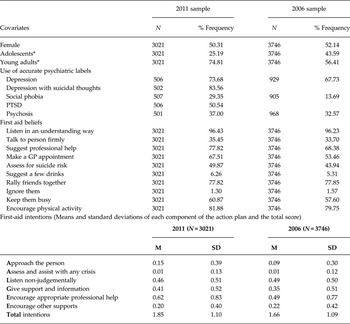
Table 1 shows the descriptive statistics for all variables in both surveys.
Descriptive statistics for all variables

% Frequency, percent frequency; CI, confidence interval.
* In regression analyses, age in years is used as a continuous variable; but for simplicity age is presented here as two groups. Note that adolescents refers to respondents aged 12–17 years in the 2006 survey but in the 2011 survey it refers to respondents aged 15–17 years. Young adults refer to respondents aged 18 and above in both surveys.
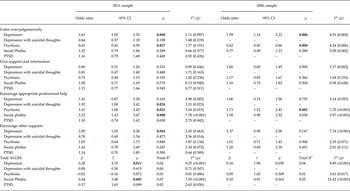
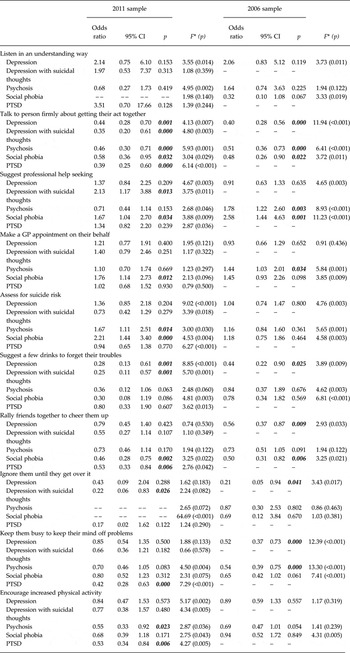
Given that most respondents in both surveys (86–99%) scored zero on the Approach and Assess components, analyses were not conducted on these individual components. Table 2 shows the findings from the regressions predicting the quality of spontaneously reported first-aid intentions with accurate labelling for both samples. Accurate psychiatric labelling was associated with higher quality scores on all components and the overall quality in some vignettes, except giving support or information. Table 3 shows the findings from the logistic regressions predicting prompted beliefs about the helpfulness of various first-aid responses with accurate labelling in both surveys. Accurate labelling was associated with all first-aid beliefs in some vignettes, except with Listening in an understanding way.
Summary of logistic regressions predicting the quality of spontaneously mentioned first-aid intentions with accurate psychiatric labelling of mental disorders in both surveys

Note: Analyses were not conducted for the Approach and Assess components due to their low frequency. All the regression models were adjusted for age in years and sex. Findings significant at the p < 0.05 level are shown in bold and italics. A dash ‘–’ indicates that the vignette was not examined in the corresponding survey.
* The F and accompanying p value are for the whole model including covariates. The degrees of freedom in models for the 2011 survey were as follows: Depression, Social Phobia and PTSD = 3, 503; Depression with suicidal thoughts and Psychosis = 3, 498. The degrees of freedom for the 2006 survey were: Depression = 3, 926; Psychosis = 3, 965; and Social Phobia = 3, 902.
CI, Confidence interval.
Summary of logistic regressions predicting prompted first-aid beliefs with accurate psychiatric labelling of mental disorders in both surveys

CI, confidence interval.
Note: All the regression models were adjusted for age in years and sex. The p values of the odds ratio significant at the p < 0.05 level are shown in bold and italics. A dash ‘-’ indicates that the vignette was not examined in the corresponding survey. A double dash ‘– –’ indicates that the predictor variable was omitted due to a zero in one of the cells.
* The F and accompanying p value are for the whole model including covariates. The degrees of freedom in models for the 2011 survey were as follows: Depression, Social Phobia and PTSD = 3,503; Depression with suicidal thoughts and Psychosis = 3,498. The degrees of freedom for the 2006 survey were: Depression = 3,926; Psychosis = 3,965; and Social Phobia = 3,902.
Discussion
Overall, accurate labelling of the mental disorder presented in the vignette was associated with higher quality of mental health first-aid intentions and beliefs. These associations were found over and above the effects of respondent age and sex, which have been found to influence young people's first-aid intentions and beliefs (Yap et al. Reference Yap, Reavley and Jorm2012).
Quality of mental health first-aid intentions
On using the second edition MHFA action plan (Kitchener et al. Reference Kitchener, Jorm and Kelly2010) as a standard for scoring the quality of spontaneously reported first-aid intentions, we found that generally the quality of young people's first-aid intentions was quite poor, replicating previous research (Yap & Jorm, Reference Yap and Jorm2012a ). Unfortunately, like the previous report, two of the six action plan components could not be evaluated in the current study because they were reported too infrequently. The Approach component involves an intentional and conscious action of approaching or engaging the recipient in a sensitive manner, which is explicitly taught in the MHFA course. It is likely that young people's more common responses, including listening, giving support and information and encouraging professional help, may implicitly involve them approaching the recipient in some way; but the respondents did not receive any scores for Approach because such intentions were not explicitly stated. On the other hand, the Assess component involves assessing for risk of harm to self and others, and has been previously found to be poorly endorsed by young people (Jorm et al. Reference Jorm, Wright and Morgan2007a ; Yap et al. Reference Yap, Reavley and Jorm2013c ). Hence, it is not surprising that not many young people reported this first-aid intention.
Accurate psychiatric labelling and first-aid intentions and beliefs
Overall, the associations that accurate labelling of mental disorders had with the quality of first-aid intentions were similar to the associations with first-aid beliefs, and the findings were largely consistent across the vignettes and both the 2006 and 2011 surveys.
In both surveys, young people who used accurate psychiatric labels in the Depression with Suicidal Thoughts (2011 survey only), Social Phobia and Psychosis vignettes were more likely to spontaneously report some intention to encourage appropriate professional help seeking if they had a close friend with a problem similar to the character described in the vignette. Similarly, in the same vignettes, respondents were more likely to believe that suggesting professional help would be helpful. Moreover, in the Psychosis (2006 survey) and Social Phobia (2011 survey) vignettes, the respondents were also more likely to believe in the helpfulness of facilitating help seeking by making a doctor's appointment on behalf of the vignette character. In the 2011 survey, respondents who accurately labelled psychosis and social phobia were also more likely to endorse the helpfulness of assessing for suicide risk.
One stark exception to the consistency of findings across intentions and beliefs and across surveys is the set of associations between accurate labelling and listening. For first-aid intentions, spontaneously reported intentions were scored for the component of ‘Listening non-judgmentally’, whereas for beliefs, respondents were asked about their perceived helpfulness of ‘Listening in an understanding way’. There were two notable differences in these findings. First, accurate labelling was not associated with beliefs about the helpfulness of listening for any of the five vignettes, but it was associated with the intention to listen non-judgementally for depression and psychosis. Second, unlike other intentions and beliefs, where significant associations between labelling and first-aid intentions or beliefs were consistent across vignettes, the intention to ‘Listen non-judgmentally’ was associated with labelling in the depression and psychosis vignettes in opposite directions. That is, respondents who labelled depression accurately were more likely to report the intention to listen non-judgementally, whereas respondents who labelled psychosis accurately were less likely. Notably, these findings were replicated in both surveys, suggesting their robustness. This pattern of findings may be explained by the associations between the use of accurate psychiatric labels for psychotic versus non-psychotic disorders and different stigmatizing attitudes. In previous reports of these associations involving the 2006 sample (Wright et al. Reference Wright, Jorm and Mackinnon2011) and the 2011 sample (Yap et al. Reference Yap, Reavley, Mackinnon and Jorm2013b ), accurate labelling of psychosis was associated with increased stigmatizing attitudes about dangerousness and unpredictability, an association that was specific to the psychosis vignette. On the other hand, accurate labelling of all vignettes (five in the 2011 survey and three in the 2006 survey) was associated with reduced stigmatizing attitudes about mental illness being a personal weakness. Taken together, these findings suggest that accurate labelling may reduce the likelihood of young people having the intention to listen non-judgementally to a peer experiencing early psychosis, in part because they may perceive the peer as more dangerous and unpredictable. It is possible that young people find the positive symptoms of psychosis (delusions, hallucinations and paranoia) rather extreme and difficult to understand or accept, which may contribute to both the perception of dangerousness and unpredictability, as well as judgemental attitudes. Further research is required to test these possibilities. A better understanding of the associations between accurate psychiatric labelling, stigmatizing attitudes and help seeking and first-aid behaviours is crucial for public health educational campaigns to reduce stigma and improve appropriate treatment of mental disorders in young people. This may be particularly important for psychosis given the complexity of these associations specific to this disorder.
On using the MHFA guidelines for depression (Langlands et al. Reference Langlands, Jorm, Kelly and Kitchener2008a ) and the views of healthcare professionals (Jorm et al. Reference Jorm, Morgan and Wright2008) as a standard for evaluating the quality of the respondents’ first-aid beliefs, it is noteworthy that accurate labelling of disorders was consistently associated with beliefs that were more similar to professionals’ beliefs. Specifically, young people who accurately labelled the disorder described in the depression with suicidal thoughts, psychosis and social phobia vignettes were more likely to endorse the first-aid responses rated as helpful by >70% of health professionals (Jorm et al. Reference Jorm, Morgan and Wright2008) – namely, suggesting professional help seeking, making a doctor's appointment and assessing for suicide risk. However, the latter two actions were not as highly endorsed by professionals for Social Phobia, ranging from 46–85% for making an appointment and 40–64% for suicide risk assessment, depending on the profession, respondent age and vignette presented. Although listening in an understanding way was also highly endorsed by professionals, it was unrelated to accuracy of labelling by young people. This is probably because most respondents (96%) rated it as helpful, hence providing limited variance to test for group differences.
Young people who used accurate psychiatric labels were also less likely to endorse first-aid responses that were rated as harmful by >70% of healthcare professionals (Jorm et al. Reference Jorm, Morgan and Wright2008) – namely, suggesting that the person have a few drinks and ignoring them for both depression vignettes, and talking firmly for all vignettes. These findings are promising given extant evidence that alcohol misuse (Bonomo et al. Reference Bonomo, Coffey, Wolfe, Lynskey, Bowes and Patton2001, Reference Bonomo, Bowes, Coffey, Carlin and Patton2004; Weitzman, Reference Weitzman2004) and social interactions marked by criticism directed at the recipient (i.e. expressed emotion; Butzlaff & Hooley, Reference Butzlaff and Hooley1998) are detrimental to the mental health of the recipient. Moreover, among these three responses identified as harmful by professionals, talking firmly had the highest rates of endorsement by respondents, ranging from 21–62%, depending on respondent age, sex and vignette (Yap et al. Reference Yap, Reavley and Jorm2012). Hence, it is encouraging to note that accurate labelling was associated with reduced likelihood of endorsing this unhelpful response across all the five vignettes, suggesting the promise of improving the accuracy of psychiatric labelling by young people for improving their first-aid responses.
Young people who used accurate psychiatric labels were also less likely to endorse other responses which are not highly endorsed as helpful by professionals – namely, bringing friends together in the depression, social phobia and PTSD vignettes (endorsed as helpful by 0–31% of professionals, varying by profession, respondent age and vignette presented; Jorm et al. Reference Jorm, Morgan and Wright2008) and keeping the person busy in the depression, psychosis and PTSD vignettes (endorsed as helpful by 2–20% of professionals; Jorm et al. Reference Jorm, Morgan and Wright2008). Notably, not only are these actions for which there were large discrepancies between the beliefs of professionals and young people (Jorm et al. Reference Jorm, Morgan and Wright2008), but they are also commonly endorsed as helpful by young people (61% for distraction and 78% for rallying friends; Yap et al. Reference Yap, Reavley and Jorm2012), and were actual actions taken by a substantial majority (66–67%) to help a close friend or family member with a mental health problem (Yap et al. Reference Yap, Wright and Jorm2011b ). Finally, young people who accurately labelled psychosis and PTSD were less likely to believe in the helpfulness of encouraging more physical activity, an action which received limited professional agreement with regard to its helpfulness (21–82%; Jorm et al. Reference Jorm, Morgan and Wright2008).
Strengths and limitations
Given that the accuracy of psychiatric labelling varies widely across disorders (Wright & Jorm, Reference Wright and Jorm2009; Yap et al. Reference Yap, Reavley and Jorm2013c ), it is a particular strength of this study to include five different vignettes in the 2011 survey, three of which are replicated from the 2006 survey. This design allowed the demonstration that associations between accurate psychiatric labelling and first-aid intentions and beliefs are mostly consistent across disorders, except in the intention to listen non-judgementally to a hypothetical peer with psychosis. Another strength of the study is the assessment of unprompted labels used to identify the mental disorder described in a vignette, because unprompted labels approximate in a better manner the naturalistic process of identifying a mental health problem in someone else.
Nonetheless, the findings should be interpreted in the light of the study limitations. First, the cross-sectional nature of the study precludes any causal interpretations; longitudinal and experimental studies are required to elucidate causality in a better manner. First-aid intentions and beliefs were assessed in this study, but it remains unclear whether the accuracy of psychiatric labelling is associated with actual first-aid actions taken to help a real peer with a mental health problem. Furthermore, hypothetical vignettes were used in the survey and might not truly reflect the actual experience of conceptualizing a problem in real life, whether it be in oneself or others.
However, a recent report using data from a followed-up subsample from the 2006 survey has found that young people's first-aid intentions and beliefs prospectively predicted the first-aid actions they actually took when a peer or family member developed a mental health problem (Yap & Jorm, Reference Yap and Jorm2012a ). These findings are consistent with the theory of planned behaviour (Ajzen, Reference Ajzen1991), which has garnered much supporting evidence indicating that changing behavioural intentions has the potential to engender behavioural change (Armitage & Conner, Reference Armitage and Conner2001; Webb & Sheeran, Reference Webb and Sheeran2006).
Another caveat to this study's findings relates to the definition of ‘accurate’ labelling of the disorders: it is unclear whether some labels accepted as ‘accurate’ actually reflect a recognition of mental disorder by the respondent (or just a normative reaction). Nonetheless, findings from this and other related studies (Wright et al. Reference Wright, Harris, Wiggers, Jorm, Cotton, Harrigan, Hurworth and McGorry2005, Reference Wright, Jorm, Harris and Mcgorry2007, Reference Wright, Jorm and Mackinnon2012; Yap et al. Reference Yap, Reavley, Mackinnon and Jorm2013b , Reference Yap, Reavley and Jorm c ) suggest that the definitions of accurate labelling used have meaningful associations with help-seeking and MHFA preferences. Finally, despite using reputable long-standing methodologies to obtain representative national samples as far as possible, including the use of random-digit dialling and sample weights in analyses, our survey samples differed on some sociodemographic characteristics compared with their population peers. This limitation should be noted when generalizing the current findings to the wider population of young people.
Implications and conclusions
This study revealed that the associations between accurate labelling of mental disorders and first-aid intentions and beliefs seem to generalize across disorders, except for the intention to listen non-judgementally to a peer with psychosis. Findings suggest that improving young people's ability to accurately identify and label depression (with or without suicidal thoughts), social phobia and PTSD in a peer may contribute to more helpful mental health first-aid responses. Improving young people's ability to accurately label psychosis may also have the potential to contribute to more helpful first-aid responses, but particular attention needs to be paid to the judgemental attitudes held by young people towards peers with psychosis.
Acknowledgements
The authors would like to thank Ms Anna Ross for her assistance with data scoring and Mr Stefan Cvetkovski for his statistical advice.
Financial Support
Funding for the 2006 survey was provided by the National Health and Medical Research Council (Programme Grant number 179805); beyondblue; and the Colonial Foundation. Funding for the 2011 survey was provided by the Department of Health and Ageing; and the National Health and Medical Research Council (AFJ, Australia Fellowship number 566652).
Conflict of Interest
None.
Ethical Standards
The authors assert that all the procedures contributing to this work comply with the ethical standards of the relevant national and institutional committees on human experimentation and with the Helsinki Declaration of 1975, as revised in 2008.
Appendix A: Sociodemographic characteristics of the survey samples
The 2011 survey sampling strategy used resulted in a gender split that was close to the Australian population. However, the landline sample included more respondents aged between 15 and 21 years relative to the Australian population: 7.2% more 15–17 years old and 8.1% more 18–21 years old. Similarly, the mobile sample included only a small percentage of 15–17 years old (9.2%; which is 18.7% less than the Australian population); but had 11.6% more 18–21 years old and 7.2% more 22–25 years old. Educational attainment was not measured in both surveys because it is highly correlated with age in this population.
Compared with the Australian Bureau of Statistics Estimated Residential Population counts (Australian Bureau of Statistics, 2006), the 2006 interviewed sample showed a slight skew towards the middle age group (14–21 years old; e.g. 4.2% more 18–19 years old), and away from the youngest (1.4% less 12–13 years old) and oldest age groups (22–25 years; e.g. 3.6% less 24–25 years old). Generally, males were marginally over-represented among 12–17 years old, and marginally underrepresented in other age groups, particularly 25 years old.
The surveys included two measures of ethnicity: self-identification as Aboriginal or Torres Strait Islander, and whether they spoke a language other than English at home. Non-indigenous young people were over-represented in both the 2011 (97.1% v. 96.3% in the population; Australian Bureau of Statistics, 2011) and 2006 samples (96.5% v. 96.8% in the population; Australian Bureau of Statistics, 2006). In the 2011 sample, 77.6% spoke only English at home, which is similar to the 76.0% found in the 2011 Census of Population and Housing (Australian Bureau of Statistics, 2011). In the 2006 sample, however, young people who spoke only English at home were over-represented: 83.4% compared with 78.2% in the population.
Appendix B: Vignettes
The 2011 survey included all the vignettes; the 2006 survey included only the Depression, Depression and substance abuse, Social phobia and Psychosis/early schizophrenia vignettes.
15-Year-old vignettes
Scenario 1 – Depression
1A. Male
V1A15 John is a 15-year-old who has been feeling unusually sad and miserable for the last few weeks. He is tired all the time and has trouble sleeping at night. John does not feel like eating and has lost weight. He cannot keep his mind on his studies and his marks have dropped. He puts off making any decisions and even day-to-day tasks seem too much for him. His parents and friends are very concerned about him.
1B. Female
V1B15 Jenny is a 15-year-old who has been feeling unusually sad and miserable for the last few weeks. She is tired all the time and has trouble sleeping at night. Jenny does not feel like eating and has lost weight. She cannot keep her mind on her studies and her marks have dropped. She puts off making any decisions and even day-to-day tasks seem too much for her. Her parents and friends are very concerned about her.
Scenario 2 – Depression with suicidal thoughts
2A. Male
V2A15 John is a 15-year-old who has been feeling unusually sad and miserable for the last few weeks. He is tired all the time and has trouble sleeping at night. John does not feel like eating and has lost weight. He cannot keep his mind on his studies and his marks have dropped. He puts off making any decisions and even day-to-day tasks seem too much for him. His parents and friends are very concerned about him. John feels he will never be happy again and believes his family would be better off without him. John has been so desperate, he has been thinking of ways to end his life.
2B. Female
V2B15 Jenny is a 15-year-old who has been feeling unusually sad and miserable for the last few weeks. She is tired all the time and has trouble sleeping at night. Jenny does not feel like eating and has lost weight. She cannot keep her mind on her studies and her marks have dropped. She puts off making any decisions and even day-to-day tasks seem too much for her. Her parents and friends are very concerned about her. Jenny feels she will never be happy again and believes her family would be better off without her. Jenny has been so desperate, she has been thinking of ways to end her life.
Scenario 3 – Psychosis/early schizophrenia
3A. Male
V3A15 John is a 15-year-old who lives at home with his parents. He has been attending school irregularly over the past year and has recently stopped attending altogether. Over the past 6 months he has stopped seeing his friends and begun locking himself in his bedroom and refusing to eat with the family or to have a bath. His parents also hear him walking about in his bedroom at night while they are in bed. Even though they know he is alone, they have heard him shouting and arguing as if someone else is there. When they try to encourage him to do more things, he whispers that he will not leave home because he is being spied upon by the neighbour. They realize he is not taking drugs because he never sees anyone or goes anywhere.
3B. Female
V3B15 Jenny is a 15-year-old who lives at home with her parents. She has been attending school irregularly over the past year and has recently stopped attending altogether. Over the past 6 months she has stopped seeing her friends and begun locking herself in her bedroom and refusing to eat with the family or to have a bath. Her parents also hear her walking about in her bedroom at night while they are in bed. Even though they know she is alone, they have heard her shouting and arguing as if someone else is there. When they try to encourage her to do more things, she whispers that she will not leave home because she is being spied upon by the neighbour. They realize she is not taking drugs because she never sees anyone or goes anywhere.
Scenario 4 – Social phobia
4A. Male
V4A15 John is a 15-year-old living at home with his parents. Since starting his new school last year he has become even more shy than usual and has made only one friend. He would really like to make more friends but is scared that he will do or say something embarrassing when he is around others. Although John's work is OK he rarely says a word in class and becomes incredibly nervous, trembles, blushes and seems like he might vomit if he has to answer a question or speak in front of the class. At home, John is quite talkative with his family, but becomes quiet if anyone he does not know well comes over. He never answers the phone and he refuses to attend social gatherings. He knows his fears are unreasonable but he cannot seem to control them and this really upsets him.
4B. Female
V4B15 Jenny is a 15-year-old living at home with her parents. Since starting her new school last year she has become even more shy than usual and has made only one friend. She would really like to make more friends but is scared that she will do or say something embarrassing when she is around others. Although Jenny's work is OK she rarely says a word in class and becomes incredibly nervous, trembles, blushes and seems like she might vomit if she has to answer a question or speak in front of the class. At home, Jenny is quite talkative with her family, but becomes quiet if anyone she does not know well comes over. She never answers the phone and she refuses to attend social gatherings. She knows her fears are unreasonable but she cannot seem to control them and this really upsets her.
Scenario 5 – Depression and substance abuse
5A. Male
V5A15 John is a 15-year-old who has been feeling unusually sad and miserable for the last few weeks. He is tired all the time and has trouble sleeping at night. John does not feel like eating and has lost weight. He cannot keep his mind on his studies and his marks have dropped. He puts off making any decisions and even day-to-day tasks seem too much for him. John has been drinking a lot of alcohol over the last year, and recently lost his weekend job because of his hangovers. His parents and friends are very concerned about him.
5B. Female
V5B15 Jenny is a 15-year-old who has been feeling unusually sad and miserable for the last few weeks. She is tired all the time and has trouble sleeping at night. Jenny does not feel like eating and has lost weight. She cannot keep her mind on her studies and her marks have dropped. She puts off making any decisions and even day-to-day tasks seem too much for her. Jenny has been drinking a lot of alcohol over the last year, and recently lost her weekend job because of her hangovers. Her parents and friends are very concerned about her.
Scenario 6 – PTSD
6A. Male
V6A15 John is a 15-year-old living at home with his parents. Recently, his sleep has been disturbed and he has been having vivid nightmares. He has been increasingly irritable, and cannot understand why. He has also been jumpy, on edge and tending to avoid going out, even to see friends. Previously, he had been highly sociable. These things started happening around 2 months ago. John has a part-time job in a newsagent shop and has found work difficult since a man armed with a knife attempted to rob the cash register while he was working 4 months ago. He sees the intruder's face clearly in his nightmares. He refuses to talk about what happened and his family says they feel that he is shutting them out.
6B. Female
V6B15 Jenny is a 15-year-old living at home with her parents. Recently, her sleep has been disturbed and she has been having vivid nightmares. She has been increasingly irritable, and cannot understand why. She has also been jumpy, on edge and tending to avoid going out, even to see friends. Previously she had been highly sociable. These things started happening around 2 months ago. Jenny has a part-time job in a newsagent shop and has found work difficult since a man armed with a knife attempted to rob the cash register while she was working 4 months ago. She sees the intruder's face clearly in her nightmares. She refuses to talk about what happened and her family says they feel that she is shutting them out.
21-Year-old vignettes
Scenario 1 – Depression
1A. Male
V1A21 John is a 21-year-old who has been feeling unusually sad and miserable for the last few weeks. He is tired all the time and has trouble sleeping at night. John does not feel like eating and has lost weight. He cannot keep his mind on his studies and his marks have dropped. He puts off making any decisions and even day-to-day tasks seem too much for him. His parents and friends are very concerned about him.
1B. Female
V1B21 Jenny is a 21-year-old who has been feeling unusually sad and miserable for the last few weeks. She is tired all the time and has trouble sleeping at night. Jenny does not feel like eating and has lost weight. She cannot keep her mind on her studies and her marks have dropped. She puts off making any decisions and even day-to-day tasks seem too much for her. Her parents and friends are very concerned about her.
Scenario 2 – Depression with suicidal thoughts
2A. Male
V2A21 John is a 21-year-old who has been feeling unusually sad and miserable for the last few weeks. He is tired all the time and has trouble sleeping at night. John does not feel like eating and has lost weight. He cannot keep his mind on his studies and his marks have dropped. He puts off making any decisions and even day-to-day tasks seem too much for him. His parents and friends are very concerned about him. John feels he will never be happy again and believes his family would be better off without him. John has been so desperate, he has been thinking of ways to end his life.
2B. Female
V2B21 Jenny is a 21-year-old who has been feeling unusually sad and miserable for the last few weeks. She is tired all the time and has trouble sleeping at night. Jenny does not feel like eating and has lost weight. She cannot keep her mind on her studies and her marks have dropped. She puts off making any decisions and even day-to-day tasks seem too much for her. Her parents and friends are very concerned about her. Jenny feels she will never be happy again and believes her family would be better off without her. Jenny has been so desperate, she has been thinking of ways to end her life.
Scenario 3 – Psychosis/early schizophrenia
3A. Male
V3A21 John is a 21-year-old who lives at home with his parents. He has been attending his course irregularly over the past year and has recently stopped attending altogether. Over the past 6 months he has stopped seeing his friends and begun locking himself in his bedroom and refusing to eat with the family or to have a bath. His parents also hear him walking about in his bedroom at night while they are in bed. Even though they know he is alone, they have heard him shouting and arguing as if someone else is there. When they try to encourage him to do more things, he whispers that he will not leave home because he is being spied upon by the neighbour. They realize he is not taking drugs because he never sees anyone or goes anywhere.
3B. Female
V3B21 Jenny is a 21-year-old who lives at home with her parents. She has been attending her course irregularly over the past year and has recently stopped attending altogether. Over the past 6 months she has stopped seeing her friends and begun locking herself in her bedroom and refusing to eat with the family or to have a bath. Her parents also hear her walking about in her bedroom at night while they are in bed. Even though they know she is alone, they have heard her shouting and arguing as if someone else is there. When they try to encourage her to do more things, she whispers that she will not leave home because she is being spied upon by the neighbour. They realize she is not taking drugs because she never sees anyone or goes anywhere.
If at any time you would like me to read out the scenario again, let me know.
Scenario 4 – Social phobia
4A. Male
V4A21 John is a 21-year-old living at home with his parents. Since starting his new course last year he has become even more shy than usual and has made only one friend. He would really like to make more friends but is scared that he will do or say something embarrassing when he is around others. Although John's work is OK he rarely says a word in class and becomes incredibly nervous, trembles, blushes and seems like he might vomit if he has to answer a question or speak in front of the class. At home, John is quite talkative with his family, but becomes quiet if anyone he does not know well comes over. He never answers the phone and he refuses to attend social gatherings. He knows his fears are unreasonable but he cannot seem to control them and this really upsets him.
4B. Female
V4B21 Jenny is a 21-year-old living at home with her parents. Since starting her new course last year she has become even more shy than usual and has made only one friend. She would really like to make more friends but is scared that she will do or say something embarrassing when she is around others. Although Jenny's work is OK she rarely says a word in class and becomes incredibly nervous, trembles, blushes and seems like she might vomit if she has to answer a question or speak in front of the class. At home, Jenny is quite talkative with her family, but becomes quiet if anyone she does not know well comes over. She never answers the phone and she refuses to attend social gatherings. She knows her fears are unreasonable but she cannot seem to control them and this really upsets her.
Scenario 5 – Depression and substance abuse
5A. Male
V5A21 John is a 21-year-old who has been feeling unusually sad and miserable for the last few weeks. He is tired all the time and has trouble sleeping at night. John does not feel like eating and has lost weight. He cannot keep his mind on his studies and his marks have dropped. He puts off making any decisions and even day-to-day tasks seem too much for him. John has been drinking a lot of alcohol over the last year, and recently lost his weekend job because of his hangovers. His parents and friends are very concerned about him.
5B. Female
V5B21 Jenny is a 21-year-old who has been feeling unusually sad and miserable for the last few weeks. She is tired all the time and has trouble sleeping at night. Jenny does not feel like eating and has lost weight. She cannot keep her mind on her studies and her marks have dropped. She puts off making any decisions and even day-to-day tasks seem too much for her. Jenny has been drinking a lot of alcohol over the last year, and recently lost her weekend job because of her hangovers. Her parents and friends are very concerned about her.
Scenario 6 – PTSD
6A. Male
V6A21 John is a 21-year-old living at home with his parents. Recently, his sleep has been disturbed and he has been having vivid nightmares. He has been increasingly irritable, and cannot understand why. He has also been jumpy, on edge and tending to avoid going out, even to see friends. Previously he had been highly sociable. These things started happening around 2 months ago. John has a part-time job in a newsagent shop and has found work difficult since a man armed with a knife attempted to rob the cash register while he was working 4 months ago. He sees the intruder's face clearly in his nightmares. He refuses to talk about what happened and his family says they feel that he is shutting them out.
6B. Female
V6B21 Jenny is a 21-year-old living at home with her parents. Recently, her sleep has been disturbed and she has been having vivid nightmares. She has been increasingly irritable, and cannot understand why. She has also been jumpy, on edge and tending to avoid going out, even to see friends. Previously she had been highly sociable. These things started happening around 2 months ago. Jenny has a part-time job in a newsagent shop and has found work difficult since a man armed with a knife attempted to rob the cash register while she was working 4 months ago. She sees the intruder's face clearly in her nightmares. She refuses to talk about what happened and her family says they feel that she is shutting them out.