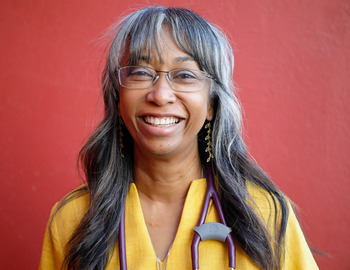
We are very pleased that Professor Liesl Zühlke (Fig 1) is the focus of our fifth in a series of interviews in Cardiology in the Young entitled, “ Global Leadership in Paediatric and Congenital Cardiac Care”.Reference Tretter and Jacobs1–Reference Tretter and Jacobs4
Liesl J. Zühlke, MBChB, MPH, PhD.

Professor Liesl Zühlke is the focus of our fifth in a series of interviews in Cardiology in the Young entitled, “Global Leadership in Paediatric and Congenital Cardiac Care”. Professor Zühlke (nee Hendricks) was born in Cape Town, South Africa. She would attend medical school in her hometown at University of Cape Town, graduating in 1991. Professor Zühlke then went on to complete a Diploma in Child Health at College of Medicine in Cape Town followed by completion of her Paediatric and Paediatric Cardiology training in 1999 and 2007, respectively. She would subsequently complete her Masters of Public Health (Clinical Research Methods) at the University of Cape Town, completing her dissertation in 2011 on computer-assisted auscultation as a screening tool for cardiovascular disease, under the supervision of Professors Landon Myer and Bongani Mayosi.
Professor Zühlke began her clinical position as a paediatric cardiologist in the Department of Paediatrics and Child Health at the Red Cross War Memorial Children’s Hospital in Cape Town, South Africa in 2007. In this role, she has been instrumental in developing a transitional clinic at the paediatric hospital, is a team member of the combined cardio-obstetric and grown-up congenital heart disease clinics, each of which are rare in South Africa, with very few similar clinics in Africa. Professor Zühlke would continue her research training, completing her Doctorate at the University of Cape Town in 2015, with her dissertation on the outcomes of asymptomatic and symptomatic rheumatic heart disease under the supervision of Professor Bongani Mayosi and Associate Professor Mark Engel. In 2015, in affiliation with the University of Cape Town and the Department of Paediatrics and the Institute of Child Health, she established The Children’s Heart Disease Research Unit, with the goals to conduct, promote and support paediatric cardiac research on the African continent, facilitate Implementation Science and provide postgraduate supervision and training in paediatric cardiac research. In 2018, she would subsequently complete her Master of Science at the London School of Economics in Health Economics, Outcomes and Management of cardiovascular sciences. Professor Zühlke currently serves as the acting Deputy-Dean of Research at the Faculty of Health Sciences, University of Cape Town.
Professor Zühlke has achieved the highest leadership positions within cardiology in South Africa, including President of the Paediatric Cardiac Society of South Africa and President of the South African Heart Association. She is internationally regarded as a leader in research related to rheumatic heart disease. Professor Zühlke’s work includes patient, family and health advocacy on a global scale, being involved in the development of policies that have been adopted by major global organisations such as the World Health Organization. In addition to her clinical and research efforts, she is highly regarded by students, colleagues and graduates as an effective teacher, mentor and advisor. This article presents our interview with Professor Zühlke, an interview that covers her experience as a thought leader in the field of Paediatric Cardiology, specifically in her work related to rheumatic heart disease, Global Health and paediatric and congenital cardiac care in resource-limited settings.
Dr Tretter: Tell us about your upbringing, and any role models or events which led both to your pursuit of medicine in general, and specifically to the field of paediatric cardiology.
Professor Zühlke: I was born in Athlone, Cape Town, South Africa in an area called the Cape Flats. It was here where mixed ancestry people were relocated during Apartheid, following the Group Areas Act in 1950 following the forced removal of people from racially “white” areas. My parents moved there when they were very young, the day they were married. Initially, these areas were associated with poverty, unemployment and despair associated with the displacement. My parents had humble backgrounds, my mother was a primary school teacher and my father was a bricklayer. Neither one of them finished high school, primarily because of financial reasons. Likewise, neither of my grandparents on either side of my family finished more than a few months of school. But, I had a very happy childhood, a strong focus on the importance of education and family, a better life for the next generation, despite the fact that we had to navigate a world dominated by Apartheid, where we did not feel like true citizens of the country. I was surrounded by family members who were very engaged and energised, being strong members of their church and society and going out of their way to foster big dreams in myself and my two sisters. I am told that I first said that I was going to be a doctor when I was 3 years of age, never changing my mind after that. At the time, it was a very unusual thing for a little girl from the Cape Flats to suggest she wanted to be a doctor. All the extended family was builders, teachers or nurses. As a young child, I did not fully appreciate what these goals actually meant. It was a very big aspiration for our entire family and often seemed barely attainable. But my parents and grandparents, who were real role models, really supported me in every kind of way. For example, when it came down to the crunch for me to go to high school, they made incredible sacrifices, financial and otherwise so that I was able to attend a school outside our area in order for me to achieve those goals.
I also remember watching a cardiac surgery operation performed by Dr Christiaan Barnard on television, thinking that this was one of the most fascinating things I had ever seen.Reference Massad5 So, I think that this exciting time of the heyday of cardiac transplantation in South Africa, made cardiology and cardiothoracic surgery always seem very exciting to me. My sisters told me I used to cut open my dolls, transplant pieces of meat into the dolls and sew them back up again. So, there is probably a surgeon deep down within me as well. When I was in medical school, I worked as a laboratory technician within the cardiac intensive care unit. I would perform blood gases and other blood tests in the back of the intensive care unit. This was how I financed myself through medical school, but it also further developed my fascination with cardiology. I loved paediatrics, but on the end of my very first day of my paediatric cardiology rotation, which was right at the end of my paediatric rotation, I was so sure this is what I wanted to do that I went to the head of the department and said that I wanted a job.
Dr Tretter: Wow! That is an amazing story of both dedication and perseverance from yourself and your family. I am curious to know what your sisters pursued for careers.
Professor Zühlke: My older sister works now as a patient liaison for the Smile Foundation, a non-profit organisation which provides surgical intervention for those with facial anomalies. Prior to that, she worked for the government in the land redistribution department, working to reclaim land for individuals who were displaced during Apartheid. My younger sister is a journalist and was the South African editor of the Oprah magazine for many years, but now works more in health journalism.
Dr Tretter: So, you were all raised to be hard working, altruistic and to value education.
Professor Zühlke: Absolutely. My parents always wanted to finish high school but could never do so. But when I was near the end of medical school, they decided to obtain their high school diplomas. They were over 50 years of age at that point, and we used to study together in the evenings!
Dr Tretter: That is awesome and such a meaningful accomplishment.
Now to change gears, you are regarded as a thought leader in rheumatic heart disease, both on the African continent and internationally, with a focus of your research and clinical career helping to improve the understanding, screening, management and outcomes of those suffering from this disease. This work has led to two important policy statements. Could you please describe the historical context of where we were at with our understanding of this disease when you initially started your MPH in 2009 and completed your PhD in 2015, and where your impactful work has brought us?
Professor Zühlke: One of the big things that had happened just prior to my having gone into research in 2008 was the Awareness Surveillance Advocacy Prevention (A.S.A.P.) Programme and the declaration for eliminating rheumatic heart disease in our lifetime.Reference Robertson, Volmink and Mayosi6 This programme was started by Professor Bongani Mayosi. Professor Mayosi is one of those amazing, unique individuals that you come across who changes the trajectory of your life, and he certainly was that for me and in fact, for some many researchers in Cape Town and Africa. He also changed the trajectory of what was happening in rheumatic heart disease. In 2005, a paper was published which showed the prevalence of rheumatic heart disease in the world, and Sub-Saharan Africa was reported to have the highest prevalence.Reference Carapetis, Steer, Mulholland and Weber7 This publication got Professor Mayosi and others in the Pan-African society of Cardiology (PASCAR) thinking about how to change this untenable situation. So, they met in 2006, and this statement was published in 2007.Reference Robertson, Volmink and Mayosi6 The statement highlighted the four pillars of awareness, surveillance, advocacy and prevention for rheumatic heart disease. It emphasised that everyone should do what they could within each of those four pillars. So, if you are a single provider working in a remote area of Uganda, and you can only work on spreading some awareness of the disease, then that is what you must do. But the four pillars would eventually coalesce, and together we would be able to really change the field in rheumatic heart disease. I came along then in 2008, initially being involved in the screening programme, as part of my PhD and then leading the REMEDY study. Over that period, one could already see these four pillars starting to merge, grow and strengthen in different parts of Africa and different parts of the world.
So, if one looks back at the past approximately 15 years, it is amazing to see what the rheumatic heart disease community have accomplished working together towards these goals. Unfortunately, what happens is that one recognises that there is more rheumatic heart disease than was initially estimated.Reference Wyber, Zühlke and Carapetis8 In addition, we have now progressed from practice and clinical evidence to instituting and affecting policy. All these policy documents came from clinical work (and recognition of the problem), substantial amounts of data, research from bench to bedside and from accumulated evidence. So, we are finally able to say: here are the clear needs identified, and here are the evidence-based recommendations (or the gaps in these). An important moment was when we were able to present contemporary prospectively collected data for 14 Low- and Middle-Income Countries, 12 of which were from Africa. The initial publication in 2005 suggested that the mortality rate from rheumatic heart disease was 1.25% per year.Reference Carapetis, Steer, Mulholland and Weber7 The REMEDY Study showed that it was actually 16.9%, with the majority of the deaths happening within the first 12 months of enrolment.Reference Zühlke, Karthikeyan and Engel9 We are now able to more carefully consider the critical scientific questions and the interventions required. These data underpin the African Union communique and the more recent World Health Organization resolution on rheumatic fever and rheumatic heart disease. Furthermore, these rheumatic heart disease resolutions represented two things: 1. a huge amount of evidence that has been amassed over this period in all four of the pillars, and 2. finally, a unified voice around rheumatic heart disease from multiple rheumatic heart disease-endemic countries. The REMEDY Study represented 14 countries Reference Zühlke, Karthikeyan and Engel9–Reference Prendergast, Perkins and Engel12 but the INVICTUS Study involves over 30 countries!Reference Karthikeyan, Connolly and Ntsekhe13 So, this is really a whole different landscape now, I was only one small part of this universal effort. But each of those areas of work that we have contributed to have impacted the field to help move things forward.
Dr Tretter: What do you perceive as the next steps towards further improved global care for prevention, screening and treatment of rheumatic heart disease? What are the major barriers towards this progress?
Professor Zühlke: There are so many ways that one can approach rheumatic heart disease. It is well known as being siloed between infectious diseases, autoimmune disease and non-communicable disease, and then under management: the genetics, prevention, treatment, rehabilitation etc. We now understand that we need context-specific responses, with different needs and interventions being prioritised in different countries. In South Africa, we were able to demonstrate in 2014 that there was for the first time a population-level decrease in mortality.Reference Zühlke, Watkins and Engel14,Reference Zühlke, Engel, Watkins and Mayosi15 This decrease in mortality was not just related to what we were doing, but largely due to the significant progress in our country related to socioeconomic improvements, poverty alleviation and access to healthcare. Therefore, the thing that we need to do in South Africa is to focus more on the people who already have the disease (management) instead of those who have a sore throat (prevention) as they are now able to more easily access antibiotics and consequently the incidence of acute rheumatic fever – the antecedent to rheumatic heart disease – has rapidly declined. In other countries, the major focus needs to be on primary prevention because the rates of acute rheumatic fever are still exceptionally high, patients present with severe disease and they may not have the same access to surgery or tertiary level care once people get the disease.Reference Coates, Sliwa and Watkins16,Reference Okello and Beaton17
So, what we have seen more and more of is that combining forces, creating new collaborations and facilitating coalescing groups, have really made in-roads into the disease. However, we now need to be quite strategic, consider carefully what is required per country or per region, and put significant investment into that. The minute that one says “investment”, one thinks about the obvious barrier of funding. But even here, I think we are starting to see a difference. I was involved in something called RHD Action (https://rhdaction.org/), which was funded by Medtronic Foundation, the founder members were the World Heart Federation, and Reach (a scientific and technical initiative to assist country-level interventions to manage and control rheumatic heart disease), with the country partners based in Uganda and Tanzania. This was the first significant global funding that was provided to an “on the ground”, implementation programme. Following this, we have seen increased interest in funding similar implementation programmes, in addition to research programmes for rheumatic heart disease, from multiple organisations and health agencies, both in country and global funders. Part of this increased interest relates to the recognition that rheumatic heart disease is a preventable disease. There is low-hanging fruit, and one can do something about it. We are using our policies to leverage funding. Funders are looking at this community and recognising that this is an energised group who wants to eradicate a preventable disease.
Within the cardiac community, cardiac surgeons have now gotten on board as well as there are significant unmet surgical needs in rheumatic heart disease-endemic countries.Reference Zilla, Bolman and Yacoub18 So, finally, we are attacking this disease on all fronts. I foresee in the next 5–10 years, we will make significant progress in all these areas. We need to look at research into primordial prevention, reviewing housing, education and other risk factors. We need to work on a vaccine, and we need to understand what is happening around primary prevention, which is different in different countries. Around screening, we have some very exciting new information about screening and the role of screening in management and prevention programmes, as well as health worker training.Reference Yadeta, Hailu and Haileamlak19 We also have important new information about how Benzathine Penicillin for subclinical carditis can change the field. For treatment, we have an improved understanding of the medical treatment of the cardiac failure associated with rheumatic heart disease, and we are exploring and improving the surgical treatments related to the different effected cardiac valves. Overall, we are moving fast in the right direction, with so many up-and-coming young physicians and scientists who are interested in this field. So, I feel we are really making significant progress towards the care of people with rheumatic heart disease.
Dr Tretter: So, for countries that may not be as far ahead as South Africa towards tackling rheumatic heart disease, what advice would you have for them?
Professor Zühlke: One of the things I would say is to collaborate with the Ministries of Health and get them on board from the start. We were fortunate enough to have had multiple meetings with our Ministry of Health; however, we did not integrate rheumatic heart disease sufficiently into other programmes from the start. That is something that only happened a bit later, early involvement of the Ministry of Health is such a crucial component to ensure sustainability. Primary prevention should be a part of all paediatric clinics. Secondary prevention should be incorporated into chronic care. This strategy allows for sustainability and for stakeholders to feel involved, and these are simple things that can be done. A good example is that the Integrated Management of Childhood Illness, a systematic approach to children’s health which was developed by the United Nations Children’s Fund and the World Health Organization. The South African version, used in all primary care clinics, initially did not include the treatment of sore throat in children less than 5 years of age. However, by working with our Ministry of Health, we changed this approach to include treatment in any child 3 years of age or older. This change involved no additional monies or investment; instead, it was a simple change of this clinical guideline for children and meant that children with sore throat aged 3 and above would be treated. IMCI is used in every primary care clinic across the country, so this was a very important step. Thus engage the Ministry of Health early on and to constantly consider how one can bring small things, which do not cost much, but can be integrated into systems that already exist. Then, I would use the guidance of the Awareness Surveillance Advocacy Prevention (A.S.A.P.) Programme, and start where you can start within these four pillars.Reference Robertson, Volmink and Mayosi6 The final, and most important step, is to involve the patients. Rheumatic heart disease patients, by the very settings in which this disease occurs, can often be voiceless, but if you prioritise and facilitate engagement with your patient community, you can achieve great things together. When you involve the patients and families, you are better informed, the interventions are joint decisions and ultimately the patients may engage with Ministries of Health or even funders to stress the patient voice. Most importantly, patients speak to and encourage each other and become amazing advocates for the cause.Reference Zühlke, Perkins and Cembi20
Dr Tretter: That is great insight, thank you. Discuss with us your experience in organising international, collaborative research studies, which involve partnering programmes that practice in heterogeneous settings with variable access to necessary resources and variability in established medical care programmes? What have you learned from these experiences that you wish you had understood from the outset? What advice would you give to those seeking to design and implement global health studies focusing on paediatric and congenital cardiac diseases?
Professor Zühlke: These collaborative research studies have brought me the biggest joy in my work. These studies have shown me very clearly how much capacity there is for wanting to make a difference, for working, for service and for the commitment to our patients. I think that it is profound, especially when one works in paediatric and congenital cardiac care, to see people in their environments, and realise how much you can learn from other settings, even though you come from a higher income country. We always worked as a team, and I learned much more from our colleagues and patients in countries like Ethiopia or Sudan than they ever learned from us. If one approach these joint activities or studies with this spirit, it will be much more beneficial to everyone involved.
The lessons that one learns from situations and environments that are not your own are very useful lessons. For example, during the REMEDY Study, there was political strife within Sudan leading to their division into two countries. How they dealt with this, and how we had to deal with this from a research perspective was quite encouraging. Or, how one deals with data collection in countries who do not have reliable internet or even electricity, and how one deals with quality assurance and quality compliance with paper-based records, is quite challenging. But, these were important issues to deal with and learn from. I don’t think that it is always like this, we were fortunate, the rheumatic heart disease group often refer to ourselves as family. You must respect your colleagues’ context, their culture and their way of working. You therefore appreciate their time and commitment to the study even more so that you can reflect on all those things afterwards.Reference Prendergast, Perkins and Engel12,Reference Zühlke, Perkins and Cembi20
What have I learned that I wished I had understood from the outset? I was lucky because I came into this from the perspective of an early-career researcher. So, I took the approach that I was there to learn, and that I was fortunate to be in that position. Here was an issue that we all were dealing with, and they were dealing with so much more rheumatic and congenital heart disease than we were in South Africa. So, I was always coming at it from that point of view, leaving with so much respect for those working in different kinds of situations than I was. And, it didn’t have to be about differential resources, it was just different. So, I was happy to have had every experience, because it was so amazing to get to know it through first-hand experience. I would think that when people design and implement any kind of global health study, they should take the time to consider the local contexts, needs and issues are prior to conducting the programme. The best way to do that is to work very closely with the people that we are talking about. So, do not do global health from across the world. You must try to imbed yourself in the local environment. And, if you cannot be there, especially now during the pandemic, then make sure that you are building local capacity, and the people on the ground are the ones taking the lead. Even if they do not have all the tools to do that yet, if you share the tools, they will get there – much faster and further than you probably will imagine! How we see ourselves when we are in global health, and we come from a higher income country or better resourced area, is critical to the responsibility and the relationship formed with those on the ground. And, the relationship must be about trust, local capacity building and empowering and strengthening others. That must be the reason why one is doing it. If you are doing it for yourself, then don’t do it. Professor Mayosi, our mentor, took that approach, he ensured that we focus on issues affecting Africa and our people, with African solutions to African problems.
Dr Tretter: In no way am I an expert in this. But as I started to develop interest in global health early on in my undergraduate education, one of the most impactful messages that have kept with me is the idea of grassroots leadership. It’s not going to be the isolated short-term medical mission trips that will make lasting, large scale change, but it is in providing the support, resources and mentorship to raise up the leaders within these resource-limited settings that will be most impactful and sustainable long-term.Reference Dearani, Neirotti and Kohnke21–Reference Dearani, Jacobs and Bolman23
This relates to my next question. As you are well aware, the initiative that I am most passionate about for Heart University (www.heartuniversity.org) is the educational content that we are creating with Children’s HeartLink for “Paediatric and Congenital Cardiac Care in Resource-Limited Settings”.Reference Tretter, Windram and Faulkner24,Reference Tretter, Ramachandran and Zheleva25 This truly has been an eye-opening and educational experience for me to learn about the unique situations encountered in resource-limited settings, and how you and other leaders in these settings have taken innovative approaches towards improving care for your paediatric and adult patients.Reference Tretter, Windram and Faulkner24,Reference Jacobs, Tchervenkov and Stellin26–Reference St Louis, Kurosawa and Jonas30 What is striking to me is that approximately 90% of children with congenital heart disease are born in low- and middle-income countries,Reference Musa, Hjortdal and Zheleva31,Reference Zuhlke, Lawrenson and Comitis32 meaning that the easy access towards the necessary resources to provide for my patients that I am accustomed to in the United States of America is far from reality for the overwhelming majority of providers across the globe. I think it is fair to say that many paediatric cardiologists practicing in high- and middle-to-high income countries are relatively naïve to these limitations experienced by a majority of providers in these resource-limited settings. As a global leader and expert in paediatric and congenital cardiac care, and specifically as one practicing in an upper middle-income country, but with a mixed health care setting with many situations experienced by those in resource-limited settings, what do you think are the top priorities towards improving care in resource-limited settings?
Professor Zühlke: Top priorities for me would be raising awareness of the issue of paediatric and congenital heart disease, and I think this can be done in every setting. Children are the invisible section of the population. So, it is such an important goal to constantly remind those that help make change, be it funders, be it administrators, hospitals and eventually medical personnel, that this is a real issue. We have multiple competing priorities in both our own country, and other low- and middle-income countries. So, one must raise awareness that paediatric and congenital heart disease is an issue, because if you don’t, then you are not going to be able to deal with it.
The second priority is about human resources and human resources for health. This is where Heart University comes in to provide not only the necessary medical education but also the motivation for people to want to be specialists in paediatric and congenital cardiac care. Personally, our fellows have been engaged in taking the training modules and watching the recorded webinars available on Heart University as an adjunct to their local training. This is something remarkable that has developed over the past 2 years, where one can attend all these virtual conferences and training, opportunities which were not as easily available and attended prior to these virtual online offerings and take advantage of new networking opportunities.
I think the commitment towards growing the workforce who will look after these children is an important priority and is quite a difficult one to achieve, especially on our continent. One of the advances that have happened at our institution is developing and training teams of people rather than only specifically trained individuals in one discipline. For example, if you are the only surgeon in a country and there are no cardiac anaesthesiologists, cardiac intensivists or respiratory physiologist etc., it is going to make practicing your craft very difficult and before you know it you may go back to a country where you can use your training. So, our focus has been on training groups of people and, providing them the resources to build units and the support to grow those units going forward.
The other issue is diagnostics and essential services, and how we use these in a different way. For example, echocardiography is an essential service for making the diagnosis of congenital heart disease. But previously, echocardiography was in the hands of the few paediatric cardiologists in the some centres, and the big expensive echocardiographic machine was locked away at nights and weekends for security. We see that changing already with hand-held echocardiography and task-shifting, allowing its use in more remote locations. So that kind of disruptive innovation is how we are going to make the diagnosis earlier and in more patients. Eventually, these disruptive innovations will spill over into medical and surgical innovations. This type of “thinking outside of the box” will help us do things better for more people.
Dr Tretter: We heard so many excellent examples during our recent Heart University webinar in collaboration with Children’s HeartLink on “Learning from Innovations in Pediatric Cardiac Care in Resource-Limited Settings” of how leaders like yourself have worked with available resources to improve the care of their patients (Link to Webinar Recordings). There are clearly efforts towards international collaboration. However, it seems that there is room for improvement with wider global involvement. You have experience both within the continent of Africa and on a more global level of organising and implementing these types of initiatives towards improving global health care in our field. What do you think are the major next steps towards a global collaborative effort in improving the care of our patients? What do you perceive to be the major barriers?
Professor Zühlke: Connection is such an important thing. This is where initiatives such as your own and those by other groups have been very helpful at bringing people together. And once you bring people together, you often see things in a very different light. So, we know that conferences, for example, have typically been one of those places where people are brought together and have a discussion, often resulting in new collaborations. But, I think we can take that much further. For example, funders can insist that they will not fund just one country or one group, but instead require that there is a mixture of high to low-income countries involved in a collaborative effort and ensuring that the application includes investigators from the country where the research is based. This should also extend to the requirement to include capacity building and community involvement in applications. We see this in newer requests for applications, but we should see this more and more. Countries in the world that have a global health department or programme should not see that as somebody going to another country to do an elective. They should see that as growing long-lasting connections. So, they should really think about how they will create departments to grow these global collaborations and connections. Academic departments can do this, but the next question is how they create these connections. Do they just link them by sending individuals to the country or region for a given period, or do you meet both virtually and in person on a regular basis to share cases or plan surgeries? Because these kinds of sustainable, intimate networks do not cost a lot of money but have such long legs on what they can achieve. I would say that academic departments, clinical departments, funders and global agencies can create these types of links. If you are in paediatric cardiac care, how do you internalise global health? If you are in New York, you may deal with poverty and food instability just like we do here in South Africa. Think global, act local is a great start. Even though we have the same problems, we may think about it and act on it differently. Understanding this and learning from each other is the essence of global health.
The barriers are that we come with our intrinsic agendas, and sometimes those driving or funding research have conflicting or not supporting agenda. We must carefully consider the external agendas and whether that is the right funder or programme for our country and region. I feel very strongly about African-led research, around African-problems and using African-solutions to deal with those. But that also applies more generally. If you are in inner-city New York, you probably have very context-specific solutions that do not apply to Cincinnati, Ohio, both of which are very different environments. So, what do we mean about global health and global involvement? Do we mean more countries and more people? I don’t think so. Instead, I think that what one needs to do is to think of what is required in this specific place, at this specific time. You must put aside your own background and ask “What is needed here”. If you don’t do that, it becomes a barrier. If you do that, then you will improve care on a much larger scale than what you can do in your own area.
Dr Tretter: You have been involved in work which has both highlighted the barriers towards access to care and unmet surgical needs, as well as work resulting in significant changes in operative policy focusing on palliative versus curative surgery in the continent of Africa.Reference Zilla, Bolman and Yacoub18,Reference Forcillo, Watkins and Brooks33–Reference Zilla, Yacoub and Zühlke35 For those who currently may be practicing in such settings, please briefly summarise the approaches that should be taken to replicate what you have accomplished.
Professor Zühlke: So, I’m not a surgeon, but we work very closely with our surgical colleagues in our cardiac care team. The team approach is obviously the best approach. We had the situation related to pulmonary artery bands where we reviewed our outcomes data for palliative pulmonary artery bands and realised that we were losing far too many patients especially in the follow-up period. We realised that if we restructured our service and focused on definitive rather than palliative procedures, we would probably ultimately have better outcomes. It fit better with what we needed to do in Africa, because we cannot do two operations on a given patient, we must do one good operation whenever possible. Those decisions came out of group discussions, group data, group reapproaches and looking at our numbers very critically. These are the kind of things that we and others have done to improve care in our specific region.
If you watch the talk given by Dr Balu Vaidyanathan from Amrita Institute in Kochi, India on the Heart University and Children’s HeartLink webinar “Learning from Innovations in Pediatric Cardiac Care in Resource-Limited Settings” (Link to Webinar Recording), there was a problem in his region with neonatal transport. They looked at the issues, identified the bottle necks and critical areas that needed intervention, planned on how to intervene, implemented the intervention and reviewed the progress on a regular basis. This process is something that people should follow, and the way to do it is with a team approach and careful audit of clinical practice.
Understanding where the barriers are is fundamental to doing something about it. Looking at where your gaps in health care are, is the place to start to make needed change. What we are talking about is starting with simple audits and moving into more complex interrogations of scientific questions. It doesn’t sound ground-breaking but is often the only thing that you can do when in a resource-limited area with competing priorities. Everybody can do this, and these simple steps can be the starting point towards major improvements. Those working in low and middle-income countries, especially in paediatric cardiac care, have so much to contribute to the field, we see varied pathologies, significant burden of disease and later or more complex presentations.
Dr Tretter: You are an accomplished clinician scientist with an extensive background in formal research training and experience. In 2016, you established the Children’s Heart Disease Research Unit at University of Cape Town, aiming to conduct, promote and support research related to children’s heart disease on the African continent. With this, you have become a sought after mentor. What advice do you give to mentees aiming to follow your footsteps in pursuing an academic career aiming to make global change in paediatric and congenital cardiac care? More specifically, can you please speak to those aiming to do so in a resource-limited environment?
Professor Zühlke: Being a mentor is one of the greatest pleasures of my professional life, to communicate your absolute passion for the area that you love. I can talk about why I love paediatric cardiology for hours, because that is how it is. That is an absolute pleasure, and it is a pleasure to see people growing into where they can be the best, where they can truly make an impact. This is regardless of the setting or the resources. We have seen so many examples of that, of people who work in the most difficult circumstances achieving some of the most amazing things, not only for themselves, but for their departments and their mentees. So, it has less to do with resources, but more with their commitment and their heart. We do not ever have to say that we can be “as good as” my colleague in a well-known international university or centre. We are as good as we are, right where we are. And, we have got something exceptionally unique to impart right where we are. We need to focus on excellence, and on applying that excellence for our communities.
I mentioned my mentor Professor. Bongani Mayosi before, who passed away 2 years ago. He believed in “Lift as you rise”. This was one of his favourite sayings. He said strongly that our job here on earth is to lift as we rise, to bring other people to a realisation of what they can achieve and what they can do and allow that impact to grow. Like with so many of his mentees, it has also become a personal mantra. I think that you can make a huge change, just where you are. I personally never started out to do anything on a global scale. I just wanted to do what I loved doing, and some of these other things just seemed to happen. People must never underestimate the power of a committed individual.
Dr Tretter: That is an excellent saying to live by, to lift as you rise. I think this a very important quality in a leader.
You are the first and still only full-time female consultant of colour in the department of cardiology at your university, which is typical for departments of cardiology globally. You have co-authored papers which have discussed this phenomenon,Reference Small, Timoteo and Buchanan36 and have also played an active role in mentoring females, specifically those of colour or non-traditional backgrounds within this discipline. Regardless of these perceived barriers you have accomplished much, holding the highest leadership positions within cardiology in South Africa, not to mention your countless accomplishments of health advocacy on a global level. What advice do you have for females, and specifically those of colour or considered under-represented in medicine, who aspire to be leaders like you in medicine?
Professor Zühlke: You know full well that this is common in cardiology, paediatric cardiology but even more so in adult cardiology and cardiothoracic surgery. Both are still very much male-dominant environments, especially when you look at subspecialties such as interventional cardiology or the field of cardiothoracic surgery. But I think that this is starting to change. For example, we have seen that the paediatric cardiology trainees across South Africa are largely female. It is very encouraging to see this. I think it is very important that women working in areas that are underrepresented should do that in an authentic way, bringing our unique strengths, understanding and resilience to the field. We do not need to be “like” men to be great cardiologists. Furthermore, we must support and encourage each other. But, that also applies across the genders, so he for she and she for he. I know women can achieve tremendously in this field, and any field that they want to pursue, if they do it as themselves and in a way that empowers younger women (and men) to make the decisions about a career based on what they love and can do, rather than a fear of not being able to accomplish some of their hopes such as a family or a current male-dominated environment.
I encountered wonderful women physicians when I was a student, leaders in their field, but they often did it in a way that did not support each other or by being unapproachable or harsh. That is not the way to change the landscape. Obviously, it is often not an easy road to combine all the roles. We just need to spend some time looking at our support systems, at our own health, at our other colleagues, because there is nothing that we cannot achieve. We need to break all the glass ceilings, but also create the rungs on the ladders for the generation to follow us. We now know that women can be exposed to cardiac catheterisation when they are pregnant, so that should not be a reason not to pursue that subspecialty if that is where your passion is. You can certainly have a family if you wish to, and you can actively contribute to improving the culture within cardiology to being more diverse, inclusive, and welcoming to all colleagues. We are now seeing almost all major cardiology and cardiothoracic surgery organisations led by women. These women are amazing achievers and exceptionally accomplished, real examples to everyone in the community. My advice to women considering cardiology as a career is to dream big but remember to plan it carefully (as women we often need multiple, iterative plans, do that prayerfully and with consideration) and then when it is possible, pass on the baton; the lessons, the connections, the failures and the opportunities, to pave the way for others.
We know that people of colour have experienced immense discrimination and difficulties over the last decades, and medicine as a field and as a discipline has been no exception. We should not be ashamed to say that, but we should be ashamed if we let it continue. We all have a responsibility regardless of your colour, to ensure that this narrative changes, that our discipline becomes inclusive regardless of gender, race or nationality and that our approach to our patients and our colleagues is of inclusivity, equality, collaboration and kindness.
Dr Tretter: That is great insight into these issues. To end, can you please tell us something about your interests and hobbies outside of medicine? If you are not busy with taking care of patients or in your leadership and research responsibilities, where would we find you?
Professor Zühlke: You would find me with my family, with my husband who is a plastic surgeon, with my two sons, Eli, 16, who is 2 years from finishing high school and Gabriel, 20, who is in medical school and also doing his Masters in Public Health. I love walking my dog Ove, a Great Dane, spending time with my sisters and reading – I am a veracious reader, reading 6–8 books a month. Since 2020, my new obsession is hiking especially on the mountain you see behind me on my screen background, Table Mountain, the flat-topped mountain overlooking the city of Cape Town in South Africa. Obviously, I love to travel and to experience other cultures, hopefully again soon. Specifically, I am hoping to go to Nepal one day, to hike to base camp – perhaps too ambitious but why not?
Dr Tretter: Awesome! Well thank you so much Dr Zuhlke. I am really honoured that you took the time, and I am really thankful to have gotten to know you over the past year. You are definitely an inspiration.
Professor Zühlke: Thank you, I feel really honoured to be a part of this.
Acknowledgements
None.
Financial support
This research received no specific grant from any funding agency, commercial or not-for-profit sectors.
Conflicts of interest
None.