Introduction
Overweight and obesity are rapidly emerging in poorer settings (Popkin, Reference Popkin2001), with the Middle East having some of the highest rates (James et al., Reference James, Leach, Kalamara and Shayeghi2001). In this region, the burden of obesity falls disproportionately on women (Yount, forthcoming). Researchers have argued that gendered social and economic roles should predict obesity in Middle Eastern women (Batnitzky, Reference Batnitzky2008). Domestic violence is another manifestation of gendered power that strongly predicts women's physical and mental health (Ellsberg et al., Reference Ellsberg, Jansen, Heise, Watts and Garcia-Moreno.2008). Experiences of domestic violence may lead to chronic stress, which may alter women's dietary practices and physical activity. These changes may elevate the risk of obesity, especially in settings where energy-dense foods are widespread. Although the influence of domestic violence on obesity is plausible, this link is unstudied in poorer settings having high levels of gender inequality and endemic obesity in women. Here, the influence of domestic violence on the risk of obesity is explored in a national sample of 5015 women in Egypt. The results expose the effects of gender inequality – and especially women's subordination through experiences of domestic violence – on the risk of obesity in such settings.
Global scale of obesity in women
Overweight and obesity are rapidly emerging in poorer countries (Popkin, Reference Popkin2001), and body mass index (BMI, kg/m2) is a well known indicator of energy reserves in adults. A BMI of ≥30 indicates obesity and is a major risk factor for chronic illness and early mortality (Lenz et al., Reference Lenz, Richter and Mühlhauser2009). Worldwide, about 300 million adults are obese (WHO, 2001), and obesity often predominates among women (James et al., Reference James, Leach, Kalamara and Shayeghi2001; WHO, 2005). Levels of obesity differ across regions, with the Middle East among those having higher rates (James et al., Reference James, Leach, Kalamara and Shayeghi2001). Studies in this region since the late 1990s pertaining to adults 18 years or older typically show that more than 20% are overweight or obese and that the burden of obesity falls heavily on women (Yount, forthcoming).
Gender, domestic violence and obesity in women
Classic nutrition transition theory gives only passing attention to the disproportionate burden of obesity in women (Popkin, Reference Popkin2001). Researchers have argued that gendered social roles should predict greater obesity in Middle Eastern women than men (Batnitzky, Reference Batnitzky2008). This argument has centred on women's more sedentary lifestyle. Although gender systems vary across Arab populations (World Bank, 2004), women are economically active less often than men, and working women tend to occupy more sedentary service and public sector positions (e.g. ESCWA, 2002; World Bank, 2004). Also, working women often leave the labour force upon marriage or childbearing (World Bank, 2004), and women in some settings report social restrictions on their mobility (e.g. El-Zanaty et al., Reference El-Zanaty, Hussein, Shawky, Way and Kishor1996). Reviews document greater physical inactivity in women than men, especially in the Gulf (e.g. Guthold et al., Reference Guthold, Ono, Strong, Chatterji and Morabia2008; Mabry et al., Reference Mabry, Reeves, Eakin and Owen2009). Thus, more sedentary economic and social roles for women may foster differences in dietary practices and physical activity (e.g. James et al., Reference James, Leach, Kalamara and Shayeghi2001; Batnitzky, Reference Batnitzky2008), leading to more frequent obesity in women.
Domestic violence is another symptom of gendered power and is a known predictor of women's health in many settings. Domestic violence refers to ‘assaultive and coercive behaviours that adults use against their intimate partners’ (Holden, Reference Holden2003, p. 155). In studies of often purposive samples in North America and Europe, men and women commit physical and psychological domestic violence equally often (Straus, Reference Straus2004; Swan et al., Reference Swan, Gambone, Caldwell, Sullivan and Snow2008); yet, men's physical violence is more injurious, and men more often stalk, sexually assault and use coercive tactics of control (Swan et al., Reference Swan, Gambone, Caldwell, Sullivan and Snow2008). Self-defence and fear more often motivate women's use of violence, and women experience worse psychological outcomes from violence (Swan et al., Reference Swan, Gambone, Caldwell, Sullivan and Snow2008). Moreover, in highly gender-stratified settings, where women have less wealth, power and prestige than men, women experience physical domestic violence more often than men. In Africa, Asia, Latin America and the Middle East, 12–71% of women have reported a prior experience of physical domestic violence (Watts & Zimmerman, Reference Watts and Zimmerman2002; Douki et al., Reference Douki, Nacef, Belhadj, Bouasker and Ghachem2003; Garcia-Moreno et al., Reference Garcia-Moreno, Jansen, Ellsberg, Heise and Watts2006; ICF Macro 2010), and according to reports by women and men, women have initiated such violence less often (ICF Macro, 2010). Thus, reported domestic violence is asymmetrical in ways that adversely affects women in most settings.
Domestic violence has known effects on women's physical and mental health (e.g. Dutton et al., Reference Dutton, Green, Kaltman, Roesch, Zeffiro and Krause2006; Ellsberg et al., Reference Ellsberg, Jansen, Heise, Watts and Garcia-Moreno.2008), perhaps partly through their adoption of health risk behaviours (e.g. Dutton et al., Reference Dutton, Green, Kaltman, Roesch, Zeffiro and Krause2006; Bailey & Daughtery, Reference Bailey and Daugherty2007). Research is scarce on how domestic violence may predict obesity; yet, theories of ‘biobehaviour’ and the status syndrome suggest an effect of chronic social stress on diet and physical activity (Marmot, Reference Marmot2004, Reference Marmot2006; Coccurello et al., Reference Coccurello, D'Amato and Mole2009). Namely, the chronic stress associated with a subordinate social status may have physiologic effects on brain-reward systems and motivation processing, increasing an appetite for high-energy foods. Such preferences not only have consolation and reward value, but also may allow the subordinate to maximize their energy intake, relieving the negative emotional effects of chronic social stress. Thus, in more gender-stratified and food-rich environments, such models would link severe or repeated domestic violence to an experienced loss of control and associated chronic stress, leading to lower physical activity and a greater intake of energy-dense foods, and ultimately to a higher risk of obesity.
Research in diverse settings shows effects of domestic violence on women's mental health, dietary practices and physical activity. Domestic violence against women has predicted immediate and long-lasting psychological symptoms, including depression and life stress, anxiety, post-traumatic stress disorder, suicide ideation and related problems with sleep, appetite, energy and well-being (Fishbach & Berbert, 1997; Dutton et al., Reference Dutton, Green, Kaltman, Roesch, Zeffiro and Krause2006; Hurwitz et al., Reference Hurwitz, Gupta, Liu, Silverman and Raj2006; Ellsberg et al., Reference Ellsberg, Jansen, Heise, Watts and Garcia-Moreno.2008). Various forms of violence against women have predicted disordered eating and weight-control practices, as well as poorer treatment outcomes for eating disorders (Silverman et al., Reference Silverman, Raj, Mucci and Hathaway2001; Ackard & Neumark-Sztainer, Reference Ackard and Neumark-Sztainer2002; McNutt et al., Reference McNutt, Carlson, Persaud and Postmus2002; Rodriguez et al., Reference Rodriguez, Perez and Garcia2005). Physical and/or verbal abuse in childhood and intimate partnerships have predicted chronic fatigue, more physical inactivity, and disabilities preventing work and daily activities (Campbell et al., Reference Campbell, Snow Jones, Dienemann, Kub, Schollenberger, O'Campo, Carlson Gielen and Wynne2002; Williamson et al., Reference Williamson, Thompson, Anda, Dietz and Felitti2002; Patel et al., Reference Patel, Kirkwood, Weiss, Pednekar, Fernandes, Pereira, Upadhye and Mabey2005; Ellsberg et al., Reference Ellsberg, Jansen, Heise, Watts and Garcia-Moreno.2008).
Yet, evidence of the links between domestic violence and obesity is mixed. In US samples of pregnant women, physical and/or sexual abuse and related injuries before and during pregnancy have predicted poor nutrition, anaemia and inadequate as well as excessive weight gain (Johnson et al., Reference Johnson, Hellerstedt and Pirie2002; Kearney et al., 2003; Boy & Salihu, Reference Boy and Salihu2004). In India, psychological, physical and sexual domestic violence against women has predicted anaemia, underweight and lower BMI (Sethuraman et al. Reference Sethuraman, Lansdown and Sullivan2006; Ackerson & Subramanian, Reference Ackerson and Subramanian2008), and these relationships were attributed to the withholding of food and to higher stress-induced metabolisms and energy expenditures in women with fixed and limited caloric intake. In a food-rich environment like the US, frequent, severe physical violence and frequent verbal violence in childhood have predicted higher weight and higher relative risks of obesity in adulthood (Williamson et al., Reference Williamson, Thompson, Anda, Dietz and Felitti2002). Also, among women in California, any experience of physical or sexual violence in childhood has predicted higher odds of obesity in adulthood (Alvarez et al., Reference Alvarez, Pavao, Baumrind and Kimerling2007). Moreover, according to the National Survey of Midlife in the US, frequent psychological and/or physical violence by a parent (compared with neither) has predicted higher odds of obesity in adulthood, partly through the greater use of food (Greenfield & Marks, Reference Greenfield and Marks2009). Finally, women veterans in the US with a history of military-related sexual assault have had higher odds of a sedentary lifestyle and reported obesity (Frayne et al., Reference Frayne, Skinner, Sullivan and Freund2003). Thus, research on violence and obesity has focused mainly on the influences of violence in childhood; yet, the effects of domestic violence on obesity are plausible and are documented in selected groups of women in the US. To the authors' knowledge, these influences are unstudied in poorer, more gender-stratified settings where energy-dense foods are abundant and obesity in women is endemic. This study explored the influence of domestic violence on obesity in a national sample of women in Egypt, comparing the effects of exposure to any prior domestic violence with exposure to multiple acts of domestic violence, by type.
Setting
Egypt has the largest, most densely settled population among the Arab countries and is highly heterogeneous economically and socially. In 2003–2004, the real gross domestic product (GDP) per capita across governorates ranged from 2300 to 9100 purchasing-power-parity (PPP) dollars (United Nations Development Programme [UNDP] & Institute for National Planning [INP] 2005). The mean schooling attainment has increased nationally, but women remain under-represented in schools, the formal workforce and the political system (El-Zanaty & Way, Reference El-Zanaty and Way2001; World Bank Group, 2002). Relatively more women in southern than northern Egypt have no schooling (55% versus 44%) and have never worked for cash (84% versus 74%) (El-Zanaty et al., Reference El-Zanaty, Hussein, Shawky, Way and Kishor1996). Most Egyptians are Muslim, but 5% are Christian, and Christians tend to live in southern Egypt.
Overweight and obesity are prevalent among Egyptian women. In 2005, the mean BMI was 30.1 for ever-married women aged 15–49 years, excluding those who were pregnant or less than two months postpartum (El-Zanaty & Way, Reference El-Zanaty and Way2006). More than three-quarters of these women were overweight (33%) or obese (47%), and less than 1% were underweight (El-Zanaty & Way, Reference El-Zanaty and Way2006).
Experiences of domestic violence also are common in Egyptian women. Egyptian law does not explicitly prohibit spousal violence, and family violence falls under the provisions of general law covering all cases of abuse (Ammar, Reference Ammar2006). Yet, certain laws punish anyone who injures another or contributes to a woman's spontaneous abortion by violence. In 2000, women received the right to divorce on grounds of incompatibility, provided that they give up their financial and custodial claims as wives. As a result, only 2% of women of reproductive age are divorced (El-Zanaty & Way, Reference El-Zanaty and Way2006). Compounding the absence of legal recourse against domestic violence are few NGOs offering services to women who experience it. The few existing shelters have rigid rules for admittance, and like law-enforcement authorities, prioritize spousal reconciliation (Ammar, Reference Ammar2006). In this unfavourable structural and normative context, women have learned to tolerate domestic violence (Yount, unpublished). Half of ever-married women aged 15–49 years agree that wife hitting or beating is justified (Yount & Li, Reference Yount and Li2009), more than one-third (36%) have ever experienced domestic violence, and less than 1% of cases in a single year have sought formal recourse (El-Zanaty & Way, Reference El-Zanaty and Way2006).
Methods
Sample and data
This analysis was based on data from ever-married women aged 15–49 years who took part in the 2005 Egypt Demographic and Health Survey (DHS) (El-Zanaty & Way, Reference El-Zanaty and Way2006). The master sample for this nationally representative survey was derived from an update of the 1996 census. A three-stage sample was selected separately in rural and urban areas. After systematically selecting 1019 segments from 384 villages and 298 urban areas, a systematic random sample of households was selected from retained segments, and 99% (21,972 of 22,211) of identified households were interviewed. A domestic violence module was administered in a one-quarter subsample of interviewed households. To ensure confidentiality, one ever-married woman aged 15–49 years per household was selected randomly to complete the domestic violence module, and over 98% of selected women responded (5613 of 5711). Response rates in prior EDHS have been similar (El-Zanaty et al., Reference El-Zanaty, Hussein, Shawky, Way and Kishor1996, Reference El-Zanaty and Way2001). The final sample (n=5015 of 5613) excluded women who reportedly were pregnant (512) or had missing data on BMI (55), domestic violence (23) or other covariates (8).
A household listing permitted the recording of basic demographic data for all members. In all households, the standing heights of all ever-married women aged 15–49 years were measured with boards produced by Shorr Productions for use in surveys. The same women were weighed in light, indoor clothing using lightweight, bathroom-type scales with digital screens that were designed and manufactured under the authority of the United Nations Children's Fund (ORC Macro, 2002). A household form included questions about the amenities of the dwelling and assets of the household. A woman's form included questions on marriage, education, work, religion, reproduction and family planning, and health knowledge and practices. The domestic violence module was based on the Revised Conflict Tactics Scale (Straus et al., Reference Straus, Hamby, Boney-Mccoy and Sugarman1996) and was administered following standard guidelines for research on domestic violence (WHO, 2001). Questions covered what Straus and colleagues have defined as psychological domestic violence (humiliate in front of others; threaten her or someone close to her with harm), physical domestic violence (push, shake, or throw something; slap or twist arm; punch with a fist or something that could hurt; kick or drag; try to strangle or burn; threaten with a knife, gun or other weapon; attack with a knife, gun or other weapon), and sexual domestic violence (physically force to have sexual intercourse when not wanted) committed against a woman by her current or last husband ever and in the prior year. Questions also covered physical violence by women against their current or last husband in the same periods, and physical violence by a non-spouse against the woman since she was 15 years old. Other questions covered any injuries and help-seeking for prior experiences of domestic violence. In rare cases, interviewers noted any interruption of the module or reasons for non-completion.
The binary outcome in this analysis was whether or not the woman was obese. The main exposure was a woman's experience of domestic violence. Some types of domestic violence co-occurred more often than others (psychological with physical [r=0.54] and physical with sexual [r=0.31] more than psychological with sexual [r=0.25]), and these co-occurring types of violence were combined in some analyses to explore their joint associations with the outcome. The first set of measures captured a woman's reported lifetime exposure to the following types of domestic violence: psychological; physical; sexual; psychological or physical; physical or sexual; and psychological, physical or sexual. The second set of measures captured the number of acts of specific types of domestic violence to which a woman reported prior exposure, including 0–2 forms of psychological violence; 0–3 or more forms of physical violence; any sexual violence; 0–3 or more forms of psychological or physical violence; 0–3 or more forms of physical or sexual violence; and 0–3 or more forms of psychological, physical or sexual violence.
Seven covariates were included to adjust for confounding of the relationship between domestic violence and obesity. These covariates also have been shown to predict attitudes about gender and violence against women in Egypt (Yount, Reference Yount2005a, Reference Yountb; Yount & Li, Reference Yount and Li2009). These covariates included the woman's age at interview (15–24, 25–34, 35–44, 45–49 years), age at first marriage (15–16, 17–18, 19–20, >20 years), number of live births (0, 1–2, 3–4, 5 or more), grades of schooling (0, 1–4, 5–8, 9 or more), religion (Christian versus Muslim), score for household standard of living (first through fifth quintiles) and region of residence (urban/Cairo, urban northern Egypt, rural northern Egypt, urban southern Egypt, rural southern Egypt, and the frontier governorates most peripheral to the Nile River). The categories for each variable were created to adjust for their non-linear associations with the outcome. The score for household standard of living was derived from the scoring coefficients of the first principal component of a principal components analysis of responses about the assets and amenities of each respondent's household (Filmer & Pritchett, Reference Filmer and Pritchett1999). Missing scores (n=258) were imputed using the mean of observed scores, and an indicator for whether the score was imputed was included. Inferences for measures of domestic violence were similar across analyses that included and excluded imputed cases, so the results for the sample with imputed cases were reported.
Analysis
Univariate analyses of all variables were conducted to assess their completeness and distributions. Bivariate associations among all covariates were estimated to assess potential collinearities. Logistic regression using the method of generalized estimating equations was used to estimate the unadjusted and adjusted odds ratios (ORs) of obesity according to the types of domestic violence that women had reported. All multivariate logistic regressions included the control variables as well as mutually exclusive indicators for the types of domestic violence that women reported. Robust variance estimators were used to account for the sample design (Liang & Zeger, Reference Liang and Zeger1986).
Results
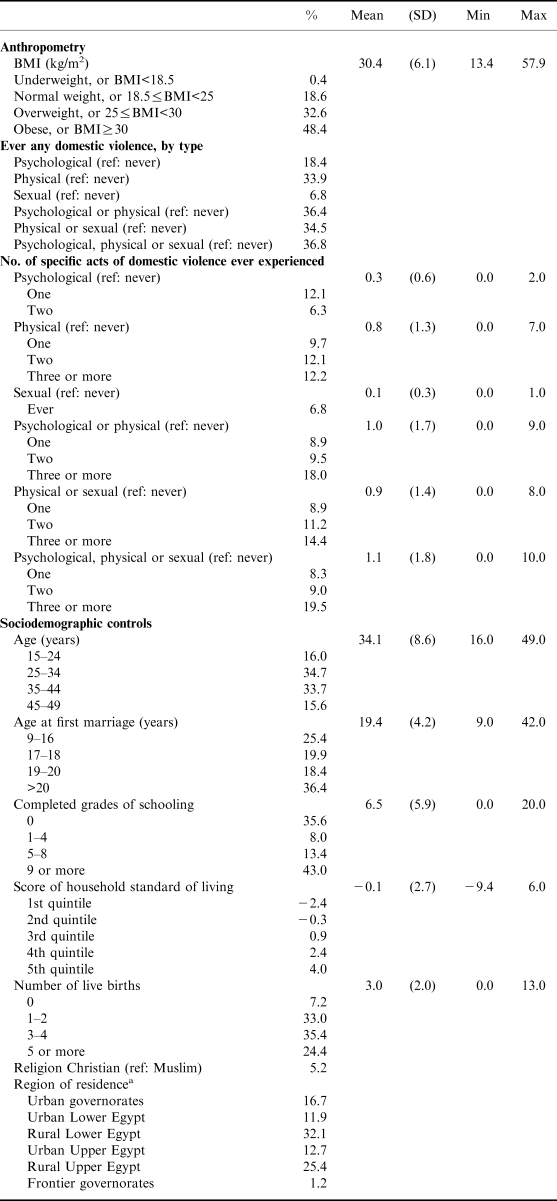
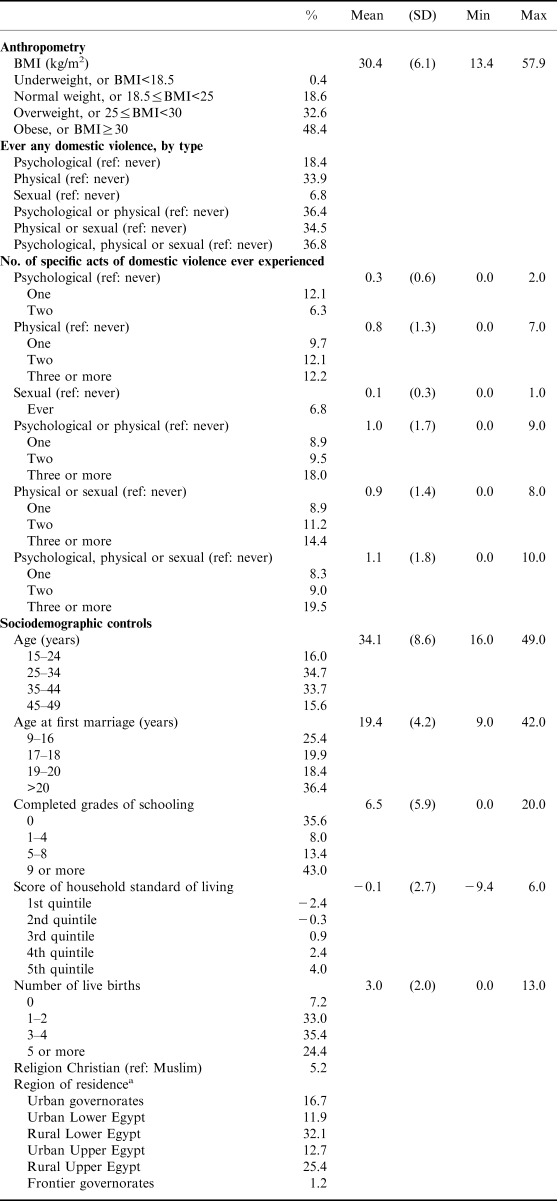
On average, women in the sample were aged 34.1 years and had first married at age 19.4 (Table 1). Women had completed 6.5 grades of schooling, on average, but schooling attainment was bimodally distributed, with 36% having no schooling and 43% having nine or more grades. Women had three live births, on average, and about 5% of women were Christian. Three-quarters were living in rural northern Egypt (32%), rural southern Egypt (25%) or highly urbanized governorates (17%).
Characteristics of the sample, ever-married non-pregnant women aged 15–49 years, Egypt 2005 (n=5015)
a Urban governorates include Cairo, Alexandria, Port Said, Suez; Lower Egypt includes Damietta, Dakahlia, Sharkia, Kalyubia, Kafr El-Sheikh, Gharbia, Menoufia and Behera; Upper Egypt includes Giza, Beni Suef, Fayoum, Menya, Assuit, Souhag, Qena and Aswan; Frontier governorates include Red Sea, New Valley, Matroh, North Sainai and South Sainai.
The mean BMI of women was 30.4 (Table 1). Less than 1% of women were underweight, and more than three-quarters were overweight (33%) or obese (48%). More than one-third (37%) of women reported any prior domestic violence, and large percentages reported any prior psychological (18%), physical (34%) and sexual (7%) violence. More than one-third reported any psychological or physical violence (36%) and any physical or sexual violence (34%). Most often, women reported only one act of psychological violence (12%), two or more acts of physical violence (24%), three or more acts of psychological or physical violence (18%), and three or more acts of physical or sexual violence (14%). More than one-half (19%) of the 37% of women who reported some form of domestic violence reported three or more acts of psychological, physical or sexual violence. Such findings reveal the co-occurrence of multiple forms of domestic violence in this sample.
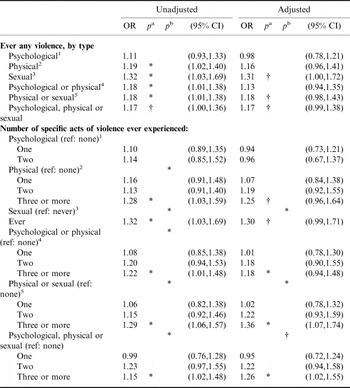
The top panel of Table 2 shows the unadjusted and adjusted odds of being obese according to the types of domestic violence to which women were ever exposed. Women's exposure to any psychological domestic violence was not associated with their odds of being obese. Yet, these odds were higher among women with any prior exposure to physical (uOR=1.19); sexual (uOR=1.32); psychological or physical (uOR=1.18); physical or sexual (uOR=1.18); and psychological, physical or sexual (uOR=1.17) domestic violence. The adjusted odds of being obese were marginally higher among women with any prior exposure to sexual (aOR=1.31); physical or sexual (aOR=1.18); and psychological, physical or sexual (aOR=1.17) domestic violence.
Unadjusted and adjusted odds of obesity, by types and frequency of domestic violence experienced, ever-married women aged 15–49 years, Egypt 2005 (n=5015)

Note: all adjusted models control for the woman's region of residence, age in years, completed grades of schooling, household standard of living score, religion and age at first marriage (categorical versions, as shown in Table 1).
1 Controls also for physical and sexual domestic violence;
2 controls also for psychological and sexual domestic violence;
3 controls also for psychological and physical domestic violence;
4 controls also for sexual domestic violence;
5 controls also for psychological domestic violence.
a p-value for odds ratio.
b p-value for trend test.
The bottom panel of Table 2 shows the unadjusted and adjusted odds of being obese according to the number of specific acts of each type of domestic violence to which women were ever exposed. Prior exposure to one or two acts of psychological domestic violence was not associated with the odds of being obese. Unadjusted dose–response relationships were apparent between the odds of being obese and the number of acts of physical (uOR=1.28 for three or more versus none); sexual (uOR=1.32 for any versus none); psychological or physical (uOR=1.22 for three or more versus none); physical or sexual (uOR=1.29 for three or more versus none); and psychological, physical or sexual (uOR=1.15 for three or more versus none) domestic violence. Adjusted dose–response relationships remained at least marginally significant for prior exposure to sexual, physical or sexual, and psychological, physical or sexual domestic violence. In general, having experienced three or more acts (versus no act) of physical (aOR=1.25), psychological or physical (aOR=1.18), physical or sexual (aOR=1.36), and psychological, physical or sexual (aOR=1.26) domestic violence was associated with higher adjusted odds of being obese.
Discussion
Overweight and obesity are growing problems in poorer countries, and rates of obesity are especially high in women. Until recently, the major determinants of obesity in women have been assumed to relate to their age, reproductive history and socioeconomic changes in the household and society (Kim et al., Reference Kim, Yount, Ramakrishnan and Martorell2007). Yet, theories of ‘biobehaviour’ and the status syndrome posit that a woman's subordinate status vis-à-vis her husband also may predict her risk of obesity. Experiences of severe and/or repeated domestic violence may lead to a sense of lost control and chronic stress, which may alter a woman's dietary practices and physical activity. These changes may elevate a woman's risk of obesity, especially in settings where energy-dense foods are widespread. Although plausible, the influence of domestic violence on obesity is unstudied in poorer, more gender-stratified settings characterized by rapid nutrition transition and endemic obesity, especially in women. The Middle East, where domestic violence and obesity in women are prevalent (Yount, forthcoming), is an especially useful setting for such research. This study, thus, fills a critical gap in knowledge on the gendered causes of women's obesity in one Middle Eastern setting.
In Egypt, women tend to be socially and economically dependent on marriage (Yount, Reference Yount2005a; Yount, in press). Domestic violence, moreover, is not illegal and often is viewed as a legitimate punishment for ‘deviant’ wives (Yount, unpublished). The most dependent wives in Egypt have higher odds of experiencing domestic violence, and these women are more likely to justify such violence (Yount, Reference Yount2005a; Yount, in press; Yount & Li, Reference Yount and Li2009). In this context, almost half of adult women are obese, and so domestic violence may be a plausible predictor of obesity. Three major findings of this analysis are notable.
First, neither any prior nor multiple acts of psychological domestic violence were separately associated with the odds of being obese. This finding contradicts prior research in the US, showing that frequent verbal abuse in childhood, as measured by the Conflict Tactics Scale, predicts higher weight and a higher relative risk of obesity in adulthood (Williamson et al., Reference Williamson, Thompson, Anda, Dietz and Felitti2002). One interpretation of these contradictory findings is that the effects of psychological violence on the risk of obesity may depend on the perpetrator and/or the timing of exposure, with parents being critical attachment figures and childhood being a critical developmental period (Greenfield & Marks, Reference Greenfield and Marks2009). To assess this interpretation, research is needed on whether exposure to psychological violence by different perpetrators at different stages of the life course predicts the risk of obesity in adulthood.
A second major finding was that any sexual domestic violence, both alone and with other forms of domestic violence, was associated with marginally higher adjusted odds of being obese. This finding corroborates those from women veterans in the US showing that a history of military-related sexual assault has been associated with higher odds of a sedentary lifestyle and reported obesity (Frayne et al., Reference Frayne, Skinner, Sullivan and Freund2003). A third major finding was that multiple acts of domestic violence tended to be associated with higher adjusted odds of being obese. Specifically, exposure to three or more acts (versus no acts) of physical, psychological or physical, physical or sexual, and psychological, physical or sexual domestic violence were associated with 1.2–1.4 times higher adjusted odds of being obese. These findings corroborate theories of ‘biobehaviour’ and status syndrome, which attribute poor health in general and obesity in particular to dietary and activity-related responses to chronic stress (Marmot, Reference Marmot2004, Reference Marmot2006; Coccurello et al., Reference Coccurello, D'Amato and Mole2009).
Thus, Egyptian women who experience severe or repeated acts of especially physical or sexual domestic violence may experience adverse psychological after-effects, which lead to excess energy intake or a more sedentary lifestyle, and ultimately to a higher risk of obesity. Exploring the pathways by which this association operates would inform the development of interventions to treat the psychological and behavioural effects of domestic violence, and thereby reduce the risk of obesity in this population.
Notably, the EDHS is a cross-sectional observational survey, which prevents us from inferring that domestic violence causes obesity. Indeed, the causal pathway may be reversed, with violence being a husband's reaction against his obese wife. Despite this possibility, some men in the Middle East tend to rate heavier women as more attractive (Safir et al., Reference Safir, Flaisher-Kellner and Rosenmann2005). Moreover, the collection of retrospective measures of domestic violence helped to establish a clear temporal ordering from prior reported episodes of domestic violence to objective measures of BMI at the time of the survey.
Some potential drawbacks of the EDHS sample merit comment. First, it excluded never-married women. Yet, domestic violence in Egypt occurs largely in formal unions because cohabitation is illegal and dating is often supervised. Second, the subsample of women for the domestic violence module may not represent ever-married women aged 15–49 years. Yet, the observed attributes of sampled and non-sampled women were similar (results available upon request). Third, currently and formerly married women were included in the analysis. This decision was made because domestic violence can have long-lasting psychological effects, and women may experience violence from former partners. This study's analytic interest was, thus, in all past exposures to domestic violence, and so the EDHS strategy of sampling all ever-married women was advantageous. Finally, less than 7% of women in the domestic violence subsample were formerly married, and inferences differed little in models based on married women only (results available upon request). Thus, making inferences to ever-married women 15–49 years in Egypt is reasonable.
Some potential limitations of the data on violence also are notable. First, substantial debate persists about biases in reporting on domestic violence (e.g. Hamby et al., Reference Hamby, Sugarman and Boney-McCoy2006). The module on domestic violence in the DHS is based on a standardized and well-recognized instrument (Straus et al., Reference Straus, Hamby, Boney-Mccoy and Sugarman1996), which in the EDHS has yielded higher estimates of lifetime physical violence by anyone (47%) than has single questions (35%) (El-Zanaty et al., Reference El-Zanaty, Hussein, Shawky, Way and Kishor1996, Reference El-Zanaty and Way2006). Also, the interruption of some EDHS interviews (4%) was not related to women's reports of domestic violence (results available upon request). Still, evidence of response effects to experimental variations of the Conflict Tactics Scale suggests a need for more methodological research (Hamby et al., Reference Hamby, Sugarman and Boney-McCoy2006). Second, most DHS (including those in Egypt) do not ask women about exposure to violence before age 15 years, and such experiences predict domestic violence (e.g. Yount, in press) and obesity (e.g. Williamson et al., Reference Williamson, Thompson, Anda, Dietz and Felitti2002). Excluding this confounder, thus, may overestimate the effects of domestic violence on obesity. Collecting data on these various forms of violence in DHS-type surveys would provide an opportunity to disentangle their direct effects on women's health.
Despite these potential limitations, this analysis is the first to assess the effects of domestic violence on obesity in women in a poorer, more gender-stratified Arab setting experiencing rapid nutrition transition and endemic obesity in women. The findings strongly suggest that over-nutrition in such settings may partly have its roots in the subordination of women.
Acknowledgments
This work was supported by a grant from the Law and Social Sciences Program of the National Science Foundation (SES-0550387). Assistance from Mrs Teresa Parker in the preparation of the manuscript is appreciated.