I first witnessed the professionalization of protection work from the perspective of a field worker, as I implemented, and later on conceived, protection activities in different parts of the world over the course of ten years.Footnote 1 I saw how, gradually, the International Committee of the Red Cross (ICRC) put more emphasis on understanding how different segments of the population faced different threats; I also saw how the institution took a more structural approach to addressing protection issues with the authorities. At the time, the guidance documents on protection that I used as references were mostly produced at country level. While I worked in the field, I had many contacts with other protection actors on the ground, but I knew little about the more conceptual debates around the notion of protection that were initiated at headquarters level in Geneva or elsewhere. Having then myself worked for several years at ICRC headquarters in the Protection Division, I became heavily involved in these debates and ended up participating in numerous inter-institutional workshops and processes linked to protection. There, too, I witnessed the progressive professionalization of the field of protection.
The present article draws on my personal experiences. The first part retraces some of the changes that I observed when I was still working in the field with the ICRC. The second part presents various notions of protection, with an emphasis on how humanitarian actors define their role in protecting civilians. The third part is dedicated to the emergence of professional standards, a step that I see as fundamental on the road to professionalization. It describes the different initiatives that have emerged and how they have combined and complemented each other. The article then turns to other clear indications that the field of protection is going through a cycle of professionalization. Finally, the article ends by enumerating a few of the clear advantages but also some of the risks inherent in the way that the sector is becoming more professional when it comes to protection work.
Looking back at the road that the ICRC took towards professionalization
From dialogue to the elaboration of complex protection strategies integrating multidisciplinary activities
Protecting populations from the effects of conflict and violence has been at the core of the ICRC's field activities for decades.Footnote 2 Documenting abuses and violations of international humanitarian law (IHL) and other relevant sets of rules to prepare representations to the concerned authorities, or armed groups, in the frame of a confidential dialogue has long been a task of the ICRC's field delegate.
In my personal experience during my first years with the ICRC, from the plains of Eastern Slavonia to the mountains of Afghanistan, via the jungle of Colombia, I listened to communities and individuals affected by violence and conflict to understand their fears and the threats that they faced. Their stories became the basis for discussions with local commanders and leaders. Working on protection issues, I had the feeling that being efficient was mostly about being able to find the right argument that would convince my interlocutors to take concrete measures to put a stop to, or at least to limit the occurrence of, abuses and IHL violations. To some extent it was true, especially for a delegate working in remote areas and confronted directly with both the communities affected and the different protagonists in the violence. With experience, however, I came to realize that protection work can take a variety of forms, and that conceptualizing and implementing coherent and successful protection strategies on a nationwide scale demanded much more than documenting violations of IHL and their consequences, and finding the right arguments to address the different stakeholders.
In 2007, the ICRC finalized a lengthy and mostly introspective piece of research on field protection activities in favour of communities and individuals affected by violence outside situations of detention. This research was essentially based on the lessons learned from past ICRC field experience. An internal handbook describing how to define and implement a protection strategy step by stepFootnote 3 was edited and disseminated to all delegations. It soon became part of all standard internal training on protection.
An underlying assumption of the handbook was that a protection strategy should ideally comprise numerous and diverse protection activities, and not be reduced to the bilateral confidential dialogue that has long been the trademark of the ICRC when it comes to protection work. It is then up to each protection co-ordinator in their own context to define a coherent strategy by choosing the type of action that he or she deems the most appropriate considering the environment that he or she works in and the opportunities that it offers.
To do so, a protection co-ordinator must start by identifying existing and potential patterns of abuses affecting different communities and individuals, and define which one he or she will address as a priority. Therefore, in addition to understanding ongoing patterns of abuses as expressed by communities, a protection co-ordinator must also possess thorough knowledge of past trends of violations and abuses in the country where he or she works, as well as major incidents that occurred in previous crises. Finally, in order to select the types of activity to be conducted, several additional factors will be taken into account, in large part to determine their feasibility. Among those factors are the regularity with which access can be granted to communities at risk, the acceptance by all stakeholders of the ICRC's role in protection, the quality of the dialogue with the authorities, and the applicable legal framework, particularly the national legislation, in addition to the relevant international norms.
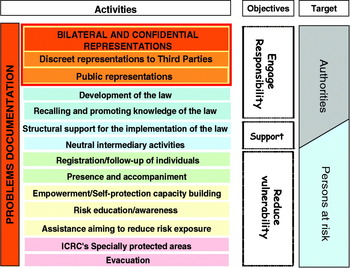
In recent years, the ICRC's protection strategies have tried to combine an authority-centred approach (engaging the responsibility of states and armed actors) with a community approach to protection (reducing their vulnerability).Footnote 4 This is a natural evolution as more time has been dedicated to understanding the vulnerabilities of different segments of the population in a multidisciplinary approach often combining assistance and protection. Figure 1, which was first published in the above-mentioned handbook, is today a central piece in much of the ICRC's internal guidance and training. It summarizes the different categories of protection activities that the institution can potentially deploy in line with these two approaches.
Protection activities implemented by the International Committee of the Red Cross.

Towards a better understanding of the different risks faced by the population
This move to include a community-centred response within the ICRC's protection strategy accompanied the progressive realization that more emphasis was needed on understanding, and then responding to, specific needs within the population. Different population groups may face different threats and their vulnerability is often contextual and not always apparent. They may also benefit from different rights under international law or national legislation.Footnote 5
Since the 1990s, the ICRC has dedicated time and resources to professionalizing its approach to different groups in the general population. It has drawn lessons from its own field experience and from the experiences of others. To give a few examples: evaluations were carried out following large-scale actions in favour of separated children in the Great Lakes and West Africa, which influenced subsequent guidance for unaccompanied children; an international conference preceded by experts’ meetings was organized to discuss the rights and needs of families of missing persons in 2003; pilot programmes with personalized support were put in place for victims of sexual violence in the Democratic Republic of the Congo (DRC), and are now being replicated elsewhere. The overall result was that the ICRC's approaches became increasingly comprehensiveFootnote 6 in terms of responses as the institution became more sensitive to the specific rights and needs of different population groups.Footnote 7
Over the past few years, training programmes have been put in place to ensure that people working on specific protection issues, from work with families of missing persons to work in favour of detainees, benefit from, and contribute to, the latest institutional guidance and reflections.Footnote 8 Alongside this investment in in-house training and workshops on the specific needs of different population groups, the ICRC has recruited specialists at headquarters and in the field. Today, the ICRC has a handful of specialized staff working within the Protection or Assistance Division at headquarters, supporting the delegations setting up activities for the benefit of detainees, internally displaced persons (IDPs), women, children, families of missing people, and migrants. Furthermore, specialized staff can be engaged or deployed at field level upon the request of a delegation. Migrants are the most recent population group for whom the ICRC has adopted an internal reference framework to better define the role that it can play within the Red Cross and Red Crescent Movement in favour of people who are certainly among the most vulnerable to abuses in conflicts and in other situations of violence.
Professionalization at the level of the whole humanitarian community
While several of the main actors involved in protection went through a similar internal process of professionalizing their own response, putting more emphasis on in-house training and lessons learned, something fascinating happened at the level of the humanitarian community as a whole. Indeed, the mid-nineties saw the emergence of what can best be described as a collective spirit of co-operation to professionalize the whole field. A small group of experienced practitioners familiar with protection work started to interact more and more, exchanging experiences and consolidating the conceptual foundations of what was to become a new specialization/profession within the humanitarian field. While it is true that the ICRC and the Office of the United Nations High Commissioner for Refugees (UNHCR) were still key references when it came to protection, many more organizations developed their own expertise – their specific knowhow – with dedicated professional staff.
Towards a greater clarity between different notions of protection
Different notions of protection for different actors
Is protection work specific to a few mandated agencies, or is it a moral imperative of any humanitarian actor? What about the role of other actors such as the military or the police, and their duty to protect? Can one provide protection from a humanitarian perspective without embracing the whole human rights agenda? What about the role of political organizations at the local, regional, or international level?
There have been endless discussions among humanitarian and human rights workers about their role in trying to enhance protection for civilians in armed conflict or in other situations of violence. In fact, in everyday usage the term ‘protection’ can be understood in a variety of ways:
– Protection as an overall objective (a result to be achieved): many actors, whether humanitarian, political, or integrated peacekeeping missions, wish that their intervention would, directly or indirectly, contribute to a better protection of the population.
– Protection as a set of legal obligations: another common understanding of protection relates to the consolidation of a protective legal framework; indeed, protection can be found in the implementation of many legal instruments. The protection offered by refugee laws is probably the most telling example. In that understanding, the notion of status is crucial (refugees, prisoners of war).
– Protection as a concrete activity or a set of activities: finally, and this is the meaning around which most debates revolve, protection can be understood as an activity, or a set of activities, implemented to ensure better protection for the population against identified threats and abuses. In that sense, the protection activities that humanitarian actors may undertake are distinct from legal action (e.g. prosecutions), political action (e.g. sanctions, advocacy), or military or security action (providing physical protection), which other actors may undertake even if all of these actions are aimed at ensuring that the rights of the individual are respected.
While states and political, military, and humanitarian actors can sometimes share a common objective that their intervention has a protective impact, their activities are often fundamentally different by nature. Their mandate, roles, and responsibilities differ, as do their modi operandi.
When humanitarian actors speak of their role in protection they are clearly interested in defining the set of activities that they can implement. Professionalizing the field of protection for humanitarian actors therefore implies defining what specific contribution humanitarian and human rights actors can bring to better protecting the population.Footnote 9
Establishing a common definition of protection for humanitarian and human rights actors
Humanitarian and human right organizations in the 1990s worked jointly on defining what protection work entails for them. Between 1996 and 2001, the ICRC organized a series of workshops, at Ecogia near Geneva, with practitioners from different international organizations. The outcome of each workshop was made public, but the publication that is most often referred to today is the one that summarizes the consensus reached at the end of the series: Strengthening Protection in War: A Search for Professional Standards.Footnote 10
Despite its title, this publication did not contain agreed professional standards. Rather, it contained several key concepts to which different organizations can refer in order to frame their respective approaches (modes of action, responsive approach versus environment-building, type of protection activities). What it also contained is a definition of protection that became the standard one for humanitarian organizations. This definition was subsequently endorsed by the Inter Agency Standing Committee (IASC), who disseminated it widely (see Box 1).
Box 1
In all its publications, the Inter-Agency Standing Committee (IASC) defines protection as: ‘all activities aimed at obtaining full respect for the rights of the individual in accordance with the letter and the spirit of the relevant bodies of law (i.e. human rights law, international humanitarian law, refugee law)’.
This publication already represented a clear step forward in gaining a common understanding of what protection work entails in the field, and how different actors can complement each other. In the end, although falling short of establishing clear standards, it did achieve what it was meant to do: ‘Promote shared principles and practices, and … raise the levels of professionalism and effectiveness in organizations working in the field of protection’.Footnote 11 The proof of its success is that, in the following years, several key publications also took up these concepts. Of particular interest are the ones published by two different networks of humanitarian organizations, the IASC and ALNAP/ODI.Footnote 12 Both publications aimed to further develop a common understanding of what concrete activities are entailed in protection work, detailing some lessons learned and some challenges.
Distinguishing the implementation of core protection activities from mainstreaming protection in assistance and development programming
It is important to underline that the definition of protection that was adopted in the 1990s clearly does not imply that every activity carried out by humanitarian organizations falls under the scope of protection. Many activities are conducted to assist individuals and communities in need without addressing the root causes of violence or aiming to reduce abuses or violations. Those assistance activities are nevertheless not carried out in a vacuum. They can increase or decrease the exposure to risks of a given population. They can support their resilience or, on the contrary, increase covetousness of armed groups. A sound understanding of existing protection issues should therefore also inform such programmes.
When referring to protection, it is therefore necessary to distinguish two tasks with which many large organizations are confronted: putting in place programmes to address abuses and violations directly, and making sure that people managing assistance programmes (in emergency as well as in post-recovery situations) take into account protection issues in their respective planning.
This is the case for the ICRC. In addition to the diverse activities implemented as part of a protection strategy aiming to reduce the recurrence of abuses and violations, the ICRC makes continuous efforts to ensure that the protection concerns identified in a given context are mainstreamed (taken into account) in all the assistance and prevention activities that it will deploy in a specific country. Those activities range from its health programmes to its water and sanitation activities, to educational projects with schoolmasters and teenagers at risk in urban areas affected by conflict or violence.
As we will see below, this distinction between what can be called protection work (or ‘core protection activities’, as described by some donors), on the one hand, and mainstreaming protection in other activities, on the other hand, will later be reflected in the development of professional standards among humanitarian and human rights organizations. Before turning to professionalization, however, let us just illustrate the fact that, when it comes to defining what protection activities can mean on the ground, non-humanitarian actors have also developed their own guidance, taking into account their specific roles and responsibilities.
Defining protection activities from the perspective of peacekeepers
One should note that, in the first decade of the twenty-first century, humanitarian actors were not the only ones to refine their understanding of how they could contribute to a better protection of the population through their activities. The United Nations (UN), and especially the Department of Peacekeeping Operations (DPKO), in close contact with Troops and Police Contributing Countries (TCCs and PCCs), took the initiative to stipulate what was expected from Peacekeeping Operations in terms of protection. This followed the publication in 2009 of a joint study between the United Nations Office for the Coordination of Humanitarian Affairs (OCHA) and DPKO, pointing out serious deficiencies in how UN missions implemented their mandate when it came to protection.Footnote 13
There are many ways to understand what the notion of protection of civilians can cover when deploying military and police forces. There is, of course, a first understanding linked to the need to respect applicable international rules when using force: IHL in conducting military combat operations; international human rights laws when engaging in law enforcement operations. Protecting civilians is at the core of these rules. Therefore training on adequate standard operating procedures is a necessity. There is a second understanding linked to the individual behaviour of each soldier or policeman, namely an obligation not to abuse the power given to him or her. Therefore codes of conduct are another imperative for all troops to be deployed. The third and most widely debated understanding of the notion of protecting civilians is not linked to the harm that the troops could cause (when using force or in relation to individual behaviour) but rather to their ability to prevent third parties from harming the population. In the end, this is often what motivates a peace mission in the first place. It is this crucial aspect of protecting civilians that DPKO reflected on after the 2009 study was published. To complicate matters, it is obvious that peacekeeping forces do not act in a vacuum. National authorities remain the primary duty bearers when it comes to protection, and their role must be reinforced whenever possible and not undercut. Armed groups also have obligations under IHL and they should not be neglected.
A year after the UN study, a concept note defining protection activities for DPKO missions was circulated.Footnote 14 It clearly (and rightly so) goes beyond protection as understood by humanitarians actors, incorporating the specificities and potential added value of UN missions, by categorizing the protection activities that a mission can implement into three tiers:
1. protection through the political process;
2. providing protection from physical violence; and
3. establishing a protective environment.
As Alison Giffen and William J. Durch, who have closely followed the debate on Protection of Civilians (PoC) and peacekeeping over the last years, expressed it:
Peacekeeping is a political enterprise usually engaged in encouraging the brokering or implementation of a peace agreement – a political document – which may require an operation to partner with the host-state government (engaging in reconstruction of the host state's security services) and/or use force to stop spoilers. Such activities may contradict the principles of neutrality, impartiality and independence that guide humanitarian work.
The first tier captures the political and advocacy efforts that mission leadership and personnel should undertake in regard to POC. The second tier outlines different actions that the mission will need to consider to prevent and pre-empt violence against civilians as well as respond to and finally consolidate a situation following an incident. The third tier captures activities such as promoting legal protection, facilitating humanitarian assistance and supporting effective national institutions.Footnote 15
Based on this concept note, DPKO then developed a framework for protection strategies to be used by all missions tasked with protection, as well as training modules on protection of civilians. All those developments were constantly discussed with several UN humanitarian agencies, the ICRC, and a few non-governmental organizations (NGOs) and think tanks. While going beyond what humanitarians would and could implement in terms of protection activities, DPKO made a point not to develop concepts that would be at odds with the understanding and practices of other actors involved in protection.
It is worth noting that regional organizations have also reflected on what role they can play when it comes to implementing protection activities. The African Union, which has mandated peace missions on the continent, has developed its own thinking on how it can best integrate protection into its Peace and Security Architecture. It worked on a guidance note based on a four-tier approach in some respects similar to DPKO's three tiers, contained in its 2010 concept paper on protection.Footnote 16 This is no surprise, as the African Union has benefited from the expert advice of some of the people who were also involved in the larger debate on protection and peacekeeping operation.Footnote 17 The African Union's efforts are nevertheless extremely original and interesting because they put a lot of emphasis on the prevention of violence and abuses thanks to the continental early warning system and the capacity of the Union politically to mobilize members of the Council of the Wise (all well-respected figures on the continent) to mediate when a crisis arises and threatens to bring a country into conflict. The political dimension of protection that the African Union, as a regional institution, can play is therefore a central piece of its understanding of protection.
The search for professional standards in protection for humanitarian actors
Developments over the last two decades
The need to establish common professional standards related to protection work carried out by humanitarian organizations had already been identified in the early 1990s. Commonly agreeing on professional and ethical standards represented an important step, demonstrating a sign of maturity for the field as a whole in requesting to go beyond institutional competition. It also reflected the fact that enough field experience had been gained collectively to draw such standards from the lessons learned. As I have already mentioned, the outcome of the series of workshops that took place in Ecogia between 1996 and 2001 was made public under the title Strengthening Protection in War: A Search for Professional Standards, even though it did not contain agreed professional standards as such, but rather key concepts that have since largely shaped the way in which humanitarian actors conceive their protection activities.
It is worth mentioning that the first edition of the SPHERE standards in 1997 represented the answer of the humanitarian sector to the need to strengthen responsible and efficient provision of assistance in emergencies (both natural catastrophe and conflict).Footnote 18 While containing many elements linking the provision of assistance with sensitivity to the environment in which such assistance is delivered, neither the first edition nor the second revised edition of 2004 contained a chapter on protection. As we will see, it was not until the third edition appeared in 2011 that the standards included a chapter dedicated to protection.
Shortly after the end of the Ecogia workshops, the ICRC looked inward and started to work on its own internal guidelines for protection work in favour of civilians. As mentioned in the introduction, these took several years to be completed and were disseminated internally in early 2007, with a public version being published in autumn 2008.Footnote 19 For a little while, the search for commonly agreed standards for protection work seemed to have been put on hold.
Agreeing on different sets of standards for different use
Thankfully, the search for professional standards was not on hold forever. Before the SPHERE board finally decided to add a chapter on protection, two distinct initiatives to establish standards related to protection appeared almost simultaneously in 2008. They did not compete, but rather complemented each other.
The first one came from a group of Australian NGOs who were implementing assistance programmes in various contexts and felt the need to share experience on how to integrate protection issues into their programming at field level. This initiative clearly targeted NGOs interested in mainstreaming protection in their ongoing field activities, rather than encouraging NGOs to develop new activities centred on protection. Their aim was to produce a ‘systematic guidance for general and sector staff in the minimum actions that should be taken to improve the safety and dignity of individuals and communities participating in humanitarian programmes’.Footnote 20
The ICRC spearheaded the second initiative. This time, the setting up of professional standards clearly targeted organizations willing to conceive and implement stand-alone protection activities, usually with dedicated protection staff. The ambitious nature of this initiative meant that it had to take into account the wide variety of protection actions that humanitarian and human rights actors can implement. From the start, it involved an advisory group of experienced protection practitioners from UN agencies, think tanks, and NGOs. A few underlying assumptions guided the work of those closely involved in the making of these standards. They were best summarized in the introduction of its first edition of 2009:
It is now generally agreed that an effective protection response demands adequate professional competence, and that a concerted effort is required to ensure that protection work by humanitarian and human rights actors meets commonly agreed, minimum professional standards. While respecting the diversity of actors and approaches involved, the aim is to establish a baseline to be respected by all.Footnote 21
Both initiatives proved successful and led to the publication of the first sets of standards for humanitarian agencies interested in protection. Ten years after common concepts and definitions were adopted in the Geneva-based workshops, the time must indeed have been right for humanitarian organizations to take one more step towards professionalization.
It is interesting to note that the two initiatives followed different paths to establish the standards. While that of the Australian NGOs gained its legitimacy based on an extensive field testing over six months of a draft text,Footnote 22 the ICRC initiative gained legitimacy through a series of large consultation processes (conducted with IASC members and with several UN cluster lead agencies, as well as with the network of international NGOs of the International Council of Voluntary Agencies (ICVA)Footnote 23 and the network of US-based NGOs of Interaction US, among others). The consultation process extended to selected National Societies of the Red Cross and Red Crescent, as well as to a few key Médecins sans Frontières (MSF) policy-makers in charge of humanitarian affairs in different sections.Both sets of standards were subsequently presented at the Global Protection Cluster in Geneva, to then be sent to all Protection Clusters established in the field, contributing to their dissemination.Footnote 24
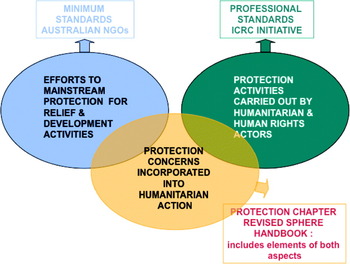
While these sets of standards were being finalized, the board of SPHERE took the decision to include a section on protection in a revised edition of their standards. Several drafts – and drafters – later, the third edition of SPHERE, presented to the public in 2011, does indeed contain a chapter on protection, constructed around a few key principles. In fact, this new chapter combines key elements and notions of both the Australian initiative and the professional standards for protection work edited by the ICRC.
How the three different initiatives to create standards linked to protection are interlinked and complement each other.

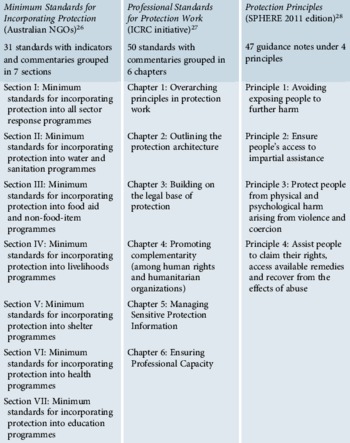
The fact that these three initiatives to create standards in a domain that had none before were conducted almost simultaneously could have created confusion as to which standards apply to whom in what circumstances. Thanks to good communications and mutual reviews, coherence and complementarities between them were achieved.Footnote 25 This single fact is to be taken as a token of the co-operative spirit that exists between protection practitioners at working level, even when their respective organizations might sometimes compete for resources and recognition. Table 1 presents the comparative structure of the three initiatives.
Comparative structure of three initiatives setting standards for Protection

All of these initiatives understood that, to be considered and respected as standards by a very diverse set of organizations interested in protection, their only strength was the fact that they capture what are currently considered to be commonly agreed best practices. There is no instance of certification (of the ISO type). There is no single protection actor that could take the responsibility to judge publicly which organization can be considered as professional.
This also means that all of these sets of standards are bound to evolve with time. De facto, none of the three initiatives had the pretention to be setting standards that would once and for all define the ethic and/or the rules of the game. The SPHERE Standards have already gone through two process of revision since they were first published in 1997. It is reasonable to imagine that in roughly five years a new edition will be on the way, with an even more substantial chapter on protection, addressed to all humanitarian actors.
World Vision UK edited a revised version of the Minimum Standards for Protection Mainstreaming in 2012, incorporating lessons learned in the dissemination and implementation of the set of standards first published by the group of Australian NGOs. This new version also contains an interesting table that summarizes the distinction between protection mainstreaming (‘incorporating protection principles and promoting safety into humanitarian and development programmes’) and stand-alone protection work (‘preventing and responding to violence, or threat of violence, coercion and exploitation, any deliberate deprivation, neglect or discrimination, and supporting people to enjoy their rights in safety, and with dignity’).Footnote 29
As far as the Professional Standards for Protection Work are concerned, two years after the standards were edited in 2009, the ICRC held a workshop with a few of the leading organizations working on protection to reflect on the dissemination and use of the said standards. During this workshop, which took place in September 2011 in Geneva, it was also decided that some chapters would be reworked, adapted, and expanded for a second edition that could be published in 2013.
Among the issues that were identified as justifying starting such a process of revision, three were predominant:
1. A growing feeling that we need more guidance regarding civil–military relations when it comes to protecting civilians, to avoid blurring the lines while developing constructive interaction and considering each other's specific roles and responsibilities;Footnote 30
2. The emergence of new technologies and the capability that they offer for individuals to communicate and report on abuses and developing situations in area of conflict and violence. Such technologies simultaneously present both opportunities for organizations working on protection issues and potential risks that need to be managed (in terms of individual data protection and the risks for individuals, in terms of risks of manipulation, etc.). Many crisis-mappers, who, as a community of practice, are at the forefront of creating and developing tools that can support humanitarian organizations, seem to be ready to engage in a discussion on how to manage the risks while benefiting from the information flow that new technologies can offer;
3. The standards clearly indicated the need to monitor protection activities, but gave little guidance in how to do so.Footnote 31 However, many organizations felt that they had gained valuable field experience in evaluation and monitoring of protection programming over the last years and that a few lessons could already be drawn and included in a new version of the standards.
In summary, the search for professional standards is not yet over, but it has definitively crossed a few milestones over the last five years, helping the whole profession to define itself better.
Professionalization beyond setting standards
The search for professional standards is, nevertheless, only one of the many signs indicating the professionalization of protection work among humanitarian and human rights organizations. It is not the sole symbol of an evolution towards professionalism, although it is a powerful one.
A developing literature
Another indicator is the mere fact that the thinking on ‘protection in times of conflict and organized armed violence’ has gone beyond humanitarian organizations working in the field, to reach universities and think tanks. The latter have started to publish numerous articles and studies dealing one way or another with the protection of civilians.
If many of the publications are reports or articles interested in the protection of civilians debate at the level of the UN (reflecting DPKO interest in protection at mission level, or the debate around the more political notion of Responsibility to Protect at the Security Council/R2P), there are more and more reports and articles on protection work in favour of different population groups, from IDPs to victims of sexual violence or child soldiers. Many articles are still written by past or present practitioners who share experiences and lessons learned, but there are an increasing number of studies and books written by academics, bringing in a more historical and sometimes political perspective on some protection issues.
Indeed, the amount of research and the number of publications dealing one way or another with protection seems to have increased steadily over recent years to the point where it has clearly become too time-consuming for practitioners working in the field even to follow all the key research published on protection.Footnote 32 This is both a blessing in terms of recognition of specific programming and of exchanges of experience, and a risk to see more ‘silos’ being created within the humanitarian community. Indeed, to some extent many practitioners have started only to read articles related to their more specific area of expertise within the protection field (torture and ill-treatment in detention, child protection, gender-based violence, IDP rights and security). In the last section, we will come back to this specific challenge: how to develop specialized knowledge and programmes in favour of different population groups having different needs, while keeping some degree of coherence in the field, thus allowing a holistic approach to protection work.
Perhaps more telling than the increasing number of publications dealing with issues related to protection in times of conflict and/or armed violence is the fact that the field has entered the curricula of several universities offering postgraduate studies in humanitarian affairs, mainly in Europe.Footnote 33
Training and teaching on protection: once a rarity, now a must-do
It is interesting to look more closely at how teaching on protection has evolved over the last couple of decades. In the 1990s, the possibility of being taught on protection work was limited to a handful of workshops and seminars. Furthermore, most of them were strictly internal training programmes developed by a few agencies for their staff (in particular the ICRC and UNHCR). Even as I began my work with the ICRC in 1996, there was little teaching on protection available for new delegates, aside from the induction course that laid the basis for understanding the main notions and concepts to which the institution referred when speaking of its protection mandate, its role, and its practice. During my first three field missions I did not benefit from any additional protection training; I nevertheless participated in a few protection meetings that brought together the delegates working in the same country to discuss protection-related matters, usually around the implementation of contextualized guidelines. These meetings did offer valuable coaching and allowed exchanges of experiences within a given context. I had to wait until my fourth assignment before being offered training on protection (which I had to decline because of operational emergencies), and until my fifth actually to participate in one. I then participated every year in training for protection co-ordinators.
By the end of the 1990s, some external training opportunities started to appear; NGO field workers could enrol in short programmes. Such programmes were often given with the support of the same few agencies, which usually presented the participants with their methodology and some of their lessons learned. The ‘Ecogia’ seminars were probably the most well known among these. Sessions on protection work also progressively entered several on-the-job training courses for field workers who were not protection specialists; worth noting among these are the HELP courseFootnote 34 and courses on international humanitarian law given by the Danish and Finish Red Crosses.Footnote 35
By the end of the first decade of the twenty-first century, many more training opportunities on protection have emerged. The ICRC alone has put in place, in Geneva, a series of training programmes on different themes: detention, tracing missing persons, working with families of missing persons, women and war, protection of the civilian population, data management. Each of them takes a week and is aimed at delegates whose work in the field or at headquarters is directly related to the corresponding theme. Introducing such courses was a recognition that working on different protection issues might entail acquiring different expertise; it was also a recognition that protection work has become more specialized over the course of the last decade.
In fact, the ICRC realized that the more specialized protection work becomes, the more the institution needs to be able to pass on, in a timely manner, knowledge on protection work that corresponds to the issues that delegates are dealing with in their current assignments. Courses given once a year at headquarters are still fundamental to allow exchanges of experiences between the participants and to create a strong corporate identity, but no longer respond entirely to this need to deliver knowledge in a timely manner.
To respond to the growing need of on-the-job training in protection, in 2011 the ICRC finalized a series of 19 e-learning modules for its staff deployed in the field and in charge of setting up and implementing protection activities for the good of the population.Footnote 36 Such e-learning modules are currently being developed for other aspects of protection work (tracing missing persons, visiting detention places).
Efforts to improve and diversify training on protection are not, of course, unique to the ICRC. Many humanitarian NGOs have also started developing their own training on protection. The Norwegian Refugee Centre and the IDMC have gone as far as training the UN PROCAP (UN protection officers on roster for emergencies). The UN has also invested in protection training. I mentioned earlier that DPKO has worked hard over the last couple of years to better define the contribution that peacekeeping missions can make to protect civilians once they are deployed. It is therefore only natural that, in 2010 and 2011, DPKO and the United Nations Institute for Training and Research (UNITAR) invested considerable resources to develop pre-deployment training on protection for troops and personnel leaving on missions. They created different training scenarios based on what they considered to be the existing protection needs that each mission would have to address (security during displacement, security of IDP camps, threats against villagers). As DPKO summarizes it:
The pre-deployment training modules on POC and conflict-related sexual violence are designed to improve the overall coherence and effectiveness of POC activities by:
1) establishing a common understanding of what ‘protection’ means in the context of UN peacekeeping, as distinct from other, non-peacekeeping protection functions and actors;
2) clarifying UN institutional standards and expectations with regards to protection planning and the execution of protection activities;
3) clarifying the different roles and responsibilities of all protection actors – civilian, police and military – within a UN peacekeeping operation, and how the work of each actor relates and contributes to the overarching POC objectives;
4) supporting more effective protection planning by improving awareness of protection threats and civilian vulnerabilities, and by giving peacekeepers explanations of what has worked, and what has not; and
5) Providing an understanding of the challenges and dilemmas facing military and civilian decision-makers in the field, as well as best practices aimed at preventing or responding to sexual violence.Footnote 37
DPKO and UNITAR worked with many partners to develop reference and training material on protection. DPKO worked in particular with UN Women on the theme of sexual violence, and the role that peacekeepers can have to prevent and reduce the occurrence of such violence.Footnote 38
A recent film co-produced by UNITAR and the Australian Government called ‘Mandated to Protect’ was launched at the end of 2011. It presents the recent history of peacekeeping and how protection is taking a pre-eminent role for the missions. It also looks at challenges linked to applying a Protection of Civilians mandate at field level. The documentary ‘will be incorporated into UNITAR's online training program, as well as being made available to all peacekeeping training centres around the world’.Footnote 39
In 2012, if one looks at what is offered in training on protection, one will find that it is no longer only humanitarian organizations and UNITAR offering such on-the-job training. Universities and training institutes have started to develop curricula incorporating protection. For example, on ReliefWeb, by the end of 2011, an Italian Institute for International Politics was advertising an online course on ‘Humanitarian protection’. This specific course looked like a crash course on protection work conducted by humanitarian organizations, condensed into nine sessions, going through notions such as the widely recognized model of the ‘protection egg’ developed during the ICRC's sponsored workshop of the 1990s,Footnote 40 to end up with discussion on prisoners of war and Guantánamo.
Professionalization of protection work is an ongoing process. Protection work, as a field, will continue to grow in complexity and in size. The expectations of affected populations and donor countries will continue to require more accountability and relevance in protection programming.
Advantages of and risks inherent in the growing interest in protection
In the last section of this article, I would like to go through some challenges that the field is likely to confront over the coming years. In fact, some of them are already being addressed by protection actors, while others are lurking.
Professionalization: a trend likely to last
Over the last decade, more and more humanitarian workers have developed an interest, coupled with concrete field experience, in protection work. They have been exposed to more coaching and training on protection than in the past, and are more aware of the challenges of enhancing protection than I was when I started with the ICRC in the mid-nineties. Humanitarian aid workers are, in general, also more aware of the specific vulnerabilities and resilience of different population groups to abuses; and therefore the subsequent need to adapt protection strategies is well understood.
As I have described in these pages, the field has witnessed the emergence of real professional ethics behind many of the standards developed over the last five years. I have no doubt that this trend will continue for at least the foreseeable future. There are numerous platforms for discussing protection among humanitarian actors at both field and global level. This allows for exchanges leading to lessons learned being shared and influencing each other more quickly than in the past. Protection actors will continue to devote more resources to training their new staff and to keeping the ones who have already acquired significant field experience. This trend is also likely to continue at an individual level, with possibilities of enrolling in on-the-job training or in distance learning programmes. At the end of the day, all of these efforts are beneficial to populations affected by conflict and violence, as it is now widely admitted that an effective protection response requires adequate professional competence. Civilians continue to pay a high price when violence erupts. Soldiers are better trained and better equipped. Modern armies often suffer fewer casualties when they are deployed than in the past. Although many armies have clearly tried to limit casualties and destruction within the population, if one looks at recent confrontations around the world it is still civilians who bear the brunt of the violence, and the medium- and long-term consequences. The sense of injustice that this reality represents is today clearly felt by the communities affected. Those communities are increasingly well connected to the world, and able to communicate their needs almost immediately. Their expectation, in terms of protection, from the international communities and from humanitarian actors can only grow. The latter are accountableFootnote 41 to their own boards or directors, to their donors, and most of all to the populations that they support, and improving their capacities to address protection needs is certainly a must.
So where is the catch, where are the remaining challenges on the road to professionalism?
Many challenges accompany any sector that is professionalizing itself, and that is therefore going through changes that oblige even people with extensive work experience to keep abreast of new tools, methodology, or techniques. Here, I choose to present briefly three challenges that are somewhat more peculiar to humanitarian protection actors.
Human resource and time constraints
Specialists working on protection at the headquarters of the main international humanitarian and human rights organizations are still few. Although their number is growing, it is still a small community. This presents some advantages, as it allows for confidence and interpersonal trust to be easily reached. Within the ICRC, the Protection Division has steadily grown, accompanying the professionalization of the institution's response in all domains.Footnote 42 Most of the resources of the Protection Division are dedicated to improving its field programming, while still allowing it to interact with other protection actors at global level. While some interaction through specialized workshops can be less time-consuming, actively participating in collective consultations can demand a large amount of time and energy. For example, reaching consensus between very diverse protection actors in the elaboration of the Professional Standards for Protection Work was an enriching experience, but it took countless hours to integrate everyone's contribution – and this for over two years and numerous drafts.
For organizations that do not have as many specialized protection staff at headquarters, finding the equilibrium between a healthy participation in the collective effort to professionalize the field and the time needed to support field operations can be a catch-22 situation. In fact, it is an inherent difficulty as, in order to be relevant in the global debate, an organization has first and foremost to be effective and innovative at field level. Indeed, it is often through field practice that innovation arises. It is interesting to underline here that innovations can come as a result of well-thought-out and well-documented pilot projects as much as from more spontaneous initiatives taken by field workers confronted by a rapidly evolving situation. Nevertheless, for those field innovations to really influence the practice of the field they must be documented, summarized, shared, and commented on at the global level.
How to maintain a capacity to have a holistic approach while giving sufficient attention to specific needs
As explained in the introduction, since the 1990s the ICRC has become more sensitive to the specific rights and needs of different population groups. It has dedicated time and resources to professionalizing its approach to different groups in the general population. Maintaining a holistic approach towards the consequences of violence for the population as a whole, while integrating the need to better understand, evaluate, and respond to specific vulnerabilities, is, nevertheless, a constant challenge.
There is a risk that, at field level, the ICRC delegate in charge of a local office, who represents the institution in the region that he or she covers, starts to see activities in favour of these different population groups as a task for specialists, owing to the increasing complexity of the programmes implemented.Footnote 43 This risk can be increased if the different tools that the organization develops to address the needs of different population groups begin to differ too dramatically. Maintaining internal coherence between the programmes and approaches in favour of different population groups is therefore critical to the development of increased capacities for all the delegates within the institution. It is important to ensure that common evaluation and reporting tools can be used at field level – that collecting and managing data on abuses against different population groups can be done with common methodology and tools. Dissemination of lessons learned, of new tools and further training must therefore not only be directed at specialists but also at generalists in middle-management positions in the field. Specialists should enrich the practice of all field delegates dealing with protection issues. Field delegates are the ones who are on the front line of any emergency response. They are the ones who have the responsibility of periodically establishing situation analysis as the conflict or violence evolves. They are also the ones who have to have the necessary proximity, humanity, and empathy to understand the short-, middle-, and long-term humanitarian consequences of the violence on the population. They should therefore be able to assess different protection issues, implement an adequate response in line with the organization's guidelines, or feel confident enough to refer the situation to other actors who are able do so. Investing in the development of the capacities of all field staff is therefore paramount in addressing protection issues in areas where no specialists will be deployed.
To increase internal exchanges and ultimately cohesions and coherence between specialists, since 2010 the ICRC has instituted, at headquarters level, a ‘platform’ re-grouping the Assistance Division and the Protection Division, as well as all the institutional focal points for specific population groups such as IDPs, children, or detainees. This platform meets every two months to agree on common concepts and projects, and to exchange information on current field experiences. It has proven extremely useful from the outset.
This challenge might be seen as a purely ICRC preoccupation, given the mandate of the organization and its large operational coverage both in terms of countries and in terms of themes. In fact, the same challenge applies to some extent at the global level. Maintaining a certain degree of coherence between the tools and standards developed by the Global Protection Cluster and the ones develop by the different Protection Sub-Clusters is equally important to avoid the necessary professionalization ending up creating new ‘silos’.
Still an overly strong Western flavour
Protection work is, by essence, certainly not the exclusive domain of Western organizations, because it rests on enhancing respect for the universal rights contained in international treaties. Numerous national NGOs and countless civil society associations throughout the world have been engaged for years in what we consider protection work. At grassroots level, developing meaningful protection work that enhances respect for the basic rights of people in situations of conflict or crisis is indeed a universal preoccupation. This is certainly the case for local and national organizations, whose members can accomplish incredible tasks, taking risks. One can think of all the Israeli and Palestinian NGOs working – often side by side – on complex issues such as access to land or access to justice in the West Bank; or the associations of families of missing persons in Latin America, in Nepal, and in so many other places around the world. Some have gained international recognition (as the mother of the Plaza de Mayo in Argentina) but most work in difficult conditions, often with little international recognition.
Despite this reality, discussing and conceptualizing protection work is still to a certain extent perceived by too many as a feature of international organizations whose headquarters are located in Western countries. Think tanks working on, and influencing, protection work conducted by humanitarians are almost all Anglo-Saxon. Some NGO networks regrouping organizations from different continents, such as ICVA, have relayed protection debates among their members over the last years, encouraging them to give feedback and to participate more actively in ongoing debates at the global level. But these efforts have been isolated. Until recently, key workshops on protection, although they sometimes gathered participants from different continents, tended to take place in London, New York, and Geneva. Traditionally, representatives of donor countries interested in protection were often present, but few representatives of countries experiencing conflict or humanitarian crisis were invited. This has probably contributed to the misperception of protection as a Western concern by some national or even regional authorities. Thankfully, this is now changing, slowly but surely.Footnote 44
There is an urgent need for key international protection actors proactively to bridge the gap between themselves and national and local protection actors. They have to make sure that the professionalization that the field is going through is, and is perceived to be, universal.
Conclusion
This article has underlined several aspects of the ongoing professionalization of protection work. Humanitarian actors have collectively invested in learning exercises and in defining various standards to mainstream protection in assistance activities and to implement stand-alone protection activities. We have seen that they have invested in developing their human resources accordingly. This positive outlook on the evolution of a relatively new field should nevertheless not hide the fact that humanitarian and human rights organizations are not always able to enhance the protection of populations affected by violence. If protection concerns of families of missing people or of demobilized children are effectively better taken into account today, there are plenty of protection needs that continue to go unanswered. If, on the one hand, the response of humanitarian organizations is more professional, on the other hand they face greater complexity in protracted as well as in emergency situations.
The article argues that several steps still need to be taken on the road to professionalization: working more closely, and in partnership, with local and regional organizations; better integration of the understanding of different vulnerabilities and resilience in a holistic approach; better use of new technologies and how they can relay the voice of people affected by violence without endangering them; increasing the number of trained and skilled human resources.
Taking all these steps would enhance the capacity of humanitarian actors to address the challenges that they face in many countries. But they might well fall short of making a real difference on the ground if protection work is not seen as essential, at a time when humanitarian actors are struggling to access many areas affected by violence.
From the perspective of the populations affected by armed violence, protection and assistance should be the two faces of the same coin. Ideally, they should be interlinked in an approach that builds on synergies between programming. Yet there are too many places around the world where the ICRC, and other organizations for that matter, are struggling to implement meaningful protection activities on the ground. It has become a common occurrence that, as they address protection concerns with authorities or armed groups, their legitimacy, their impartiality, and sometimes even their approaches are questioned – regardless of the professionalism that these organizations can show. There is a risk of seeing protection concerns, although considered as a priority, not being addressed with the authorities for fear of jeopardizing assistance activities.
Maintaining the capacity to assist and protect at the same time therefore demands, on top of reinforcing a professional approach, a strong commitment from all humanitarian workers – from the field workers to the senior managers in headquarters.