Political scientists have, for analytical and normative reasons, invested much time and effort in trying to understand the consequences of democracy. A large amount of research concentrates on whether democratic systems perform better in terms of poverty reduction,Footnote 2 economic development,Footnote 3 and environmental quality.Footnote 4 At the international level, a vast literature focuses on the democratic peace hypothesis.Footnote 5 International political economy scholars have examined how democracy affects conflict and dispute settlement in the global trading system,Footnote 6 and how it influences compliance behavior in trade, monetary relations, and other areas.Footnote 7 International relations scholars have also been interested in how democracy influences the propensity of states to engage in international commitments, for example, in the form of joining international organizations and treaties.Footnote 8
The existing literature shows that the implications of democracy for solving important policy problems, both domestically and internationally, vary considerably across levels of analysis, policy problems, and empirical definitions of policy performance. For example, most studies on democratic peace find positive effects for democratic dyads,Footnote 9 while the monadic effects remain disputed. The democracy effects on socioeconomic development appear ambiguous.Footnote 10 In the trade area, democracies tend to escalate disputes more often.Footnote 11 Several studies on environmental performance have shown that democracies perform better in terms of domestic environmental qualityFootnote 12 and international commitment to environmental protection,Footnote 13 but the effects on transboundary environmental problem solving are less clear.Footnote 14
Our contribution fills an important gap in this literature by focusing on the implications of democracy for the provision of global public goods. Most of the existing literature concentrates on the provision of domestic public goods or the international behavior of countries vis-à-vis specific other countries. The empirical focus in this article is on climate change. Within the past twenty-five years, the problem of human-induced climate change has evolved from a rather speculative scientific topic into one of the key issues on the global policy agenda. Nicholas Stern, former World Bank chief economist and author of an influential study on the economic effects of climate change, has called the latter “the biggest market failure the world has ever seen.”Footnote 15 The global scientific community, as organized through the Intergovernmental Panel on Climate Change (IPCC), is largely in agreement that anthropogenic causes, and emissions from the combustion of fossil fuels in particular, are to blame in large part for increasing temperatures in many areas of the world and also for increasing the global average temperature. This community also agrees that the economic and social effects of human-induced climate change are grave and potentially disastrous, notably for societies with insufficient means to adapt, and that reductions of greenhouse gas (GHG) emissions on a large scale are required.Footnote 16
The climate change issue also raises very interesting questions for scholars of comparative and international politics. It is one of the few policy challenges in the international system that corresponds very closely to standard definitions of a global public good and the tragedy of the commons.Footnote 17 Everyone producing GHG emissions, no matter where on earth, contributes to increasing the risks of adverse climatic changes; everyone reducing GHG emissions contributes to the mitigation of such risks. The conventional logic of public goods theory holds that such problems are very difficult to solve,Footnote 18 particularly at the global level. There is no single country or agency that can act as an effective central enforcer, and the costs arising from aggregating national preferences, casting them into collectively binding global decisions, and implementing these policies are high. Moreover, the climate change problem is a long-term, intergenerational problem and involves big scientific challenges in trying to understand the benefits and costs of problem solving.Footnote 19 The obvious difficulties in implementing the 1997 Kyoto Protocol and concluding a follow-up agreement for the post-2012 period demonstrate that the prediction of public goods theory is probably correct.Footnote 20
Nonetheless, when we move from the global system perspective to cross-national comparisons we observe that national contributions to the global public good of climate change mitigation vary considerably, both with respect to political commitments and emission behavior. Table 1 illustrates this point.
Differences in climate change policy across countries

Notes: The commitment variable ranges from 0 to 1, with 1 expressing the strongest political commitment to climate change mitigation. This variable is defined in the empirical design section below. GHG/cap is defined as the average annual change in per capita GHG emissions, excluding land use change, in CO2 equivalents.
Sources: Bättig, Brander, and Imboden Reference Bättig, Brander and Imboden2008; CAIT 2008.
For example, Germany scores high on political commitment and on reducing per capita GHG emissions, as does the United Kingdom. China, India, and Iran appear as laggard countries on both accounts. Australia, Brazil, Japan, and the United States occupy the middle ground. North Korea exhibits relatively low political commitment, but its emissions have declined. Conversely, Norway performs better with respect to political commitment than to GHG reductions.
Even more surprising from the viewpoint of public goods theory, several small countries and even some subnational political units (for example, U.S. cities and states) have adopted ambitious mitigation targets. Small actors can, individually, make only a small contribution to solving the overall problem and should thus have an especially strong incentive to free-ride on the efforts of bigger actors.
Why, apparently, do some countries contribute more to the global public good of climate change mitigation than others? Can we say anything generic about the factors that motivate countries to behave more (or less) cooperatively? The economics literature views environmental outcomes (such as GHG emissions) as determined largely by economic factors, like economic output, income, industrial structure, trade, and so on.Footnote 21 On occasion, economic models include some political control variables, but without much theoretical discussion. Moreover, economic models pay little attention to policy output (political commitments), whereas the political science literature on environmental policy concentrates quite heavily on explaining policy output, rather than policy outcomes.
We address both gaps in this article. First, we concentrate on examining the effects of political institutions on climate change mitigation efforts. It is almost a truism among political scientists that domestic institutions affect international politics. But there is much less agreement, theoretically and empirically, on which particular institutional properties shape policy outputs and outcomes.Footnote 22 We contribute to this research by studying whether and how democracy affects national behavior with respect to the provision of global public goods in the case of climate change mitigation. We focus on the effects of democracy because democracy is arguably the most fundamental feature that distinguishes national political systems in global comparison. Some of the theoretical arguments and empirical findings reported in the existing literature support the claim that democracy is conducive to international public goods provision in the environmental realm.Footnote 23 But others are ambiguous or even negative.Footnote 24 We will develop and test the hypothesis that, ceteris paribus, democracies are more cooperative with respect to climate change mitigation efforts. We theorize that the democracy effect hinges on whether the median voter and/or influential interest groups prefer more public goods provision and conclude that both the demand for, and supply of, climate mitigation measures are likely to be stronger in democracies. Furthermore, we argue that the democracy effect on environmental policy outcome is likely to be weaker than on policy output.
The empirical testing was done on a cross-section of 185 countries in 1990–2004. We used new data on climate change cooperation that allowed us to study the effects of democracy on policy output and policy outcomes side by side. The existing literature has focused either on one or the other dependent variable. Our results confirm that distinguishing between policy output and policy outcome is important. Democracies contribute more to the global public good in terms of policy output. In contrast, the democracy effect on policy outcomes is ambiguous.
Our interpretation of these results is that in moving from political commitments to reductions of GHG emissions, the democracy effect has, up to this point in time, not been able to override countervailing forces that emanate from the free-rider problem, the discounting of future benefits of climate change mitigation, and other factors that cut against efforts to reduce emissions. We also observe that democratic countries are experiencing greater difficulties in coping with emissions from transportation, where emission cuts are most likely to require restrictions on personal freedom (mobility). The main implication of our findings for research on international politics more broadly is that greater efforts should be undertaken to study policy output and outcome side by side. This will help in identifying whether more democratic countries also experience larger “words-deeds” gaps in other policy areas, and whether there are systematic differences of this kind between domestic and international commitments and across different policy areas.
Theory
If each country were equally affected by the free-rider problem associated with the production of global public goods, countries around the globe would, in the absence of other influences, be equally reluctant to contribute to the provision of such goods. Table 1 suggests that this is not the case. Moreover, in climate change policy, smaller countries whose emission reductions can contribute only minimally to solving the overall problem, should have a strong motivation to wait and let the big countries move ahead first. A simple test questions this assumption. In the data set we use for this article (see below), the correlation between country size—in terms of population or gross domestic product (GDP)—and GHG emission growth rates, as well as other indicators for countries' performance in climate change mitigation efforts, is close to zero. That is, on average, smaller countries are neither less nor more cooperative.
A likely explanation for the cross-country variance we observed is that institutions matter. Political institutions differ along many dimensions. We are interested in the effects of democracy. Democracy is arguably the most fundamental characteristic when comparing national political institutions globally.Footnote 25 Our basic argument is that democracy has a positive effect on the demand for and supply of public goods, including global public goods such as climate change mitigation, and that this effect is likely to be stronger with respect to policy output than policy outcome. We arrive at this argument by first outlining the fundamental reasons for the expected positive democracy effect and then addressing two caveats.
Olson, McGuire and Olson, and other authors have argued that nondemocratic polities tend to underprovide public goods.Footnote 26 They are usually governed by small elites who seek to increase their personal wealth at the expense of the population. Hence they have little interest in foregoing private benefits, such as spending tax income on personal consumption or to buy loyalty from cronies, in order to invest in greater amounts of public goods—such as higher levels of environmental quality—that would benefit large parts of the population. That is, public goods are underprovided if opportunity costs associated with public goods provision are concentrated on a small elite, whereas the benefits are widely dispersed. In democracies, provision levels of public goods are influenced much more strongly by the preferences of the median voter or, in a more open formulation, prevailing interests among the electorate. The median voter (or the individual member of the electorate) in democracies incurs smaller opportunity costs from more environmental protection, relative to the median member of the ruling elite in a nondemocracy. Collective action theory tells us that the former cost-benefit distribution is more conducive to public goods provision than the latter.Footnote 27
An extension by Bueno de Mesquita and colleagues of the aforementioned argument focuses on how institutions influence the selection of political leaders and their incentives to provide public goods.Footnote 28 They claim that the extent to which governments provide public goods relative to private ones is determined by the size of the “selectorate” (those who affect the selection of and receive benefits from the leaders) and the size of the winning coalition (the subset of the selectorate that is needed to bring or keep leaders in office). In nondemocracies, the winning coalition is usually small relative to the selectorate. In such systems, leaders thus need to deliver a relatively large amount of private goods to a small number of essential supporters to be able to remain in power. In contrast, in democracies the winning coalition is large relative to the selectorate. Political leaders in democratic systems do not have sufficient resources to reward their supporters with large amounts of private goods. Moreover, loyalty to the incumbent tends to be weaker in democracies than in autocracies (that is, the probability of defection from winning coalitions is higher in democracies). Weaker loyalty of supporters forces democratic political leaders to deliver policies that provide relatively large amounts of public goods if they wish to survive politically. In autocracies, loyalty of elite members to incumbents is usually higher, and this motivates autocratic leaders to deliver more private goods to the small elite that keeps them in power.
This optimism (at the theoretical level) about superior performance of democracies in terms of public goods provision has encountered criticism of various sorts. We address what we regard as the two most important caveats and conclude that only the second of these caveats requires a modification of the basic hypothesis. This caveat leads us to distinguish democracy effects on policy outputs from effects on policy outcomes.
Caveat 1: The Demand Side
The democracy effect argument presented above has both demand- and supply-side components. As to the supply side, it seems reasonable to assume that, at any given level of public demand, democratic leaders are likely to experience greater incentives than autocratic leaders to satisfy this demand. The demand side is more problematic. Extant research has not systematically dealt with the possibility that the median voter does not prefer more environmental quality, or that parochial interest groups dominate the political process.
It is quite intuitive to assume that the median voter in a democracy will usually be more enthusiastic about public goods provision than the median elite member in a nondemocracy. Examples are public schools, public infrastructure (for example, water supply and sanitation, hospitals, electricity, telecommunications), or clean air. We cannot assume automatically, however, that demand for any type of public good is greater in democracies than in autocracies. The existing literature does not offer systematic empirical evidence on this issue.Footnote 29 But we argue that there are several reasons why the median voter in democracies will, on average, be “greener” than the median elite member in nondemocracies.
Critics may object that the median elite member in a nondemocracy tends to be wealthier and better educated than the median voter in a democracy and, assuming that environmental quality is a “normal” good,Footnote 30 thus demands more environmental quality.Footnote 31 At least four arguments cut against this idea. First, democracies are on average richer than autocracies.Footnote 32 It is also well established in the literature that political participation of richer voters in democracies is higher. Consequently, the de facto median voter in democracies may not be poorer than the median elite member in nondemocracies. Second, the median elite member in an autocracy will usually have more opportunities than the average member of the country's population to shield that elite member from negative consequences that may arise from the underprovision of public goods. For example, that elite member can move to a less polluted place within the country (or abroad). Wealthy persons in democracies can, of course, do the same. But this does not undermine demand for public goods provision to the same extent it does in nondemocracies, where the median elite member has more political influence. Third, as noted above, opportunity costs of environmental policies are likely to be higher for the median elite member in a nondemocracy than the median voter in a democracy. The anticipated net benefits of environmental policy will thus be smaller for the median elite member in a nondemocracy. That is, even if the median elite member in an autocracy were greener than the democratic median voter, higher opportunity costs are more likely to lead that member to negative expected net benefits of more environmental protection. Fourth, greater freedom to engage in research, communicate, exchange new evidence on environmental risks, and travel to and obtain information from other countries is likely to make the public in democratic countries more aware of environmental problems and possibilities for their mitigation.Footnote 33 This applies particularly to more complex, less visible, and less local risks (for example, climate change).
Criticism of the democracy-environment hypothesis has also focused on the role of interest groups, arguing that the preferences of the median voter may matter less in the policymaking process than the preferences of influential interest groups. Some critics have claimed that in advanced democracies ever greater interest group pluralism may reduce the provision of public goods.Footnote 34 Politicians are forced to adopt more and more policies that cater to narrowly defined short-term interests of particular groups instead of longer-term interests of the public as a whole. Increasingly strong competition among interest groups may also make it harder to adopt policies that depart substantively from the status quo (gridlock problem). While it is possible that more mature democracies are characterized by more interest group activity, and increasing activity of this nature increases the likelihood of gridlock, we are not aware of any systematic studies that demonstrate such effects for a large sample of countries in environmental policy.
Critics of the democracy-environment hypothesis have also referred to the Olsonian notion that concentrated interests are easier to organize than diffuse interests. To the extent that the costs of slowing down or halting environmental degradation fall primarily on business, whereas the population as a whole benefits, we should expect that business holds less green preferences than the median voter, and that business is able to organize more effectively. Since virtually all highly democratic countries are advanced market economies where the private sector plays the key role in innovation and economic growth, the combination of economic and political freedom may favor business interests over the interests of the median voter and may hence slow progress in environmental policy. While the literature on interest group activity in economic policymaking offers some evidence for greater influence of business relative to other interests,Footnote 35 the environmental policy literature provides many examples where business interests have been overwhelmed by environmental interests.Footnote 36 In some cases, international cooperation—for example, the agreements to protect the stratospheric ozone layer—was even facilitated by “green and greedy” coalitions among business stakeholders and environmental interests.Footnote 37
Rather than creating gridlock, increasing interest group pluralism may thus weaken the pro-business bias of interest group politics and hence promote green interests. If, for instance, greater pluralism in advanced democracies decreases the effectiveness of behind-the-doors lobbying by industry (whose preferences are presumably less green), environmental interest groups may in fact gain greater influence because industry has traditionally been more influential in behind-the-doors lobbying. Beck, Aerni, and others have argued that in mature democracies, interest groups have in recent years been competing harder and harder for the attention of the public, and that public trust has become a key political resource in this process.Footnote 38 Surveys have shown that in many countries the general public has more confidence in the information provided by nongovernmental organizations (NGOs) than the information provided by business.Footnote 39 In many cases, this loss of confidence in business as a stakeholder has put policymakers under intense pressure to shield constituencies from an ever larger range of risks, including environmental risks, often at the expense of business interests. In addition, more pluralistic societies tend to exhibit lower levels of corruption. Corruption is one of the mechanisms through which business interests can obtain political influence, and it directs government resources to the production of private goods. In other words, if democracy promotes interest group pluralism, such pluralism may well lead to more rather than less provision of public goods.
In summary, both demand and supply arguments point, on balance, toward a net democracy effect that is positive. Demand for environmental public goods provision is likely to be at least equally strong, and probably stronger, in democracies than in nondemocracies. At any given level of public demand for public goods provision larger than the status quo (or greater than zero), democratic systems are more likely to supply the desired public goods.
Caveat 2: National Versus Global Public Goods, Policy Output Versus Policy Outcome
A primary characteristic of climate change mitigation is that it is a global public good, that is, the geographic scope of the problem is not congruent with national territories. Since democratic processes operate primarily within the domestic sphere, constituencies and politicians may be less interested in resolving international or global issues relative to domestic problems.Footnote 40 Consequently, we may find that democracy is helpful in dealing with local or national public goods problems, such as local air or water pollution, but not necessarily with complex global problems. However, this argument does not invalidate the democracy-environment hypothesis. Even if the global public goods nature of climate change mitigation weakens the democracy effect, this weakening should be viewed as relative to other public goods problems (notably local or national public goods). There is no reason to assume that any such weakening should be systematically stronger with respect to democracies than nondemocracies.
However, this caveat motivates us to pay more attention to the distinction between policy output and policy outcome. The problem of human-induced climate change has been on the global policy agenda for only about fifteen years, but designing and implementing mitigation policies is complex, costly, and time-consuming. We should thus expect that democracy effects vary across policy output and policy outcome, with democracy having a weaker effect on policy outcomes. This possibility was noted by Neumayer several years ago with respect to other environmental degradation issues but has been largely ignored in subsequent research.Footnote 41
The principal reason to study policy output and outcomes side by side and to expect a weaker democracy effect on outcomes is that the causal chain from environmental risks to public perceptions of such risks, to public demand for risk mitigation, and to policy output is shorter than the one leading from risk via policy output to policy outcome. Because of that, outcomes are, to the extent policies are effective, influenced by policy output, but also by a range of other factors, such as properties of the resource in question, mitigation costs, efficiency of implementing agencies, and so on. Whereas policy outputs are largely under the control of policymakers, policy outcomes may be affected also by factors that are outside of their control. Under conditions of complete information, policymakers will correctly determine the level of environmental protection that provides a net benefit (benefit from risk mitigation minus mitigation costs, including implementation costs) and meets median voter or prevailing interest group demands. They will also anticipate potential implementation problems and design effective monitoring and enforcement mechanisms to that end. But more often than not, such assumptions are violated in the real world. In fact, a common observation in many studies on environmental policy is that policymakers often respond quite well to public demands for more environmental protection, but tend to discount implementation problems, hoping that voters will not be able to identify these problems within a short-enough time-period to be able to punish policymakers.
In sum, the theoretical reasoning in this section produces two hypotheses that will be tested in the remainder of this article.
H1: More democratic countries exhibit stronger political commitment to climate change mitigation.
H2: More democratic countries contribute more to climate change mitigation in terms of emission reduction. However, this positive democracy effect is weaker than the democracy effect on policy output.
Empirical Design
Approach
Focusing on climate change mitigation subjects the democracy-environment hypothesis to a particularly hard test. Because the focus is on national contributions to a global public good associated with substantial scientific uncertainty, a strong free-riding problem, and rather high mitigation costs, any significant, positive effect of democracy will be more convincing than in the case of more local, more visible, and scientifically less-contested environmental degradation issues (for example, local air or water pollution).
The existing literature has produced contradictory results for the democracy effect in climate change mitigation policy. Congleton reports that democracies have higher levels of methane and CFC emissions per capita (his sample included 118 countries in 1989).Footnote 42 Midlarsky finds that more democratic countries have higher per capita carbon dioxide (CO2) emissions (his sample included ninety-eight countries in 1990).Footnote 43 Gleditsch and Sverdrup find that democracy reduces CO2 emissions per capita (their sample included 108 countries in 1990).Footnote 44 Li and Reuveny obtain mixed results for CO2 emissions per capita (their sample included 143 countries from 1961 to 1997): while the effect of a continuous indicator for democracy (Polity IV) is negative and significant, it is positive but not significant for a dichotomous indicator of democracy, and positive and significant for a dichotomous indicator of autocracy.Footnote 45 As to policy output, a recent study by von Stein finds that democracy tends to have a positive effect on formal participation in global climate change policy (the sample included 140 countries from 1992 to 2005).Footnote 46
The empirical results for the democracy-climate policy hypothesis we just discussed are likely to differ due to differences in sampling (number of countries, cross-sectional analysis for individual years or time-periods versus panel data analysis) and different definitions of the dependent variable (emission levels versus trends, policy outcomes versus policy output). We opt for a more comprehensive approach, focusing on 185 countries since 1990, when the climate change issue moved onto the global policy agenda, and examining policy output and outcome side by side. The analysis is cross-sectional because year-to-year changes on our dependent variables and the main independent variable (democracy) are much smaller than cross-sectional variation. The data analysis relies on ordinary least squares (OLS) with robust standard errors (Huber-White estimator).
The dependent variable measures levels of public goods provision in climate change mitigation across countries. It is defined in four forms: in terms of indices for policy output and policy outcome, as well as indicators for emission levels and emission trends. The first index captures policy output; the second index and the two emissions indicators measure policy outcomes. We use three measures for policy outcomes to distinguish emission levels and emission trends because there is disagreement in the literature over which concept is more appropriate. Murdoch and Sandler and some other authors argue that pollution levels may not be appropriate when examining the effect of democracy on policy outcomes, and that one should study trends (or changes); that is, whether democracy contributes to emission reductions.Footnote 47 We agree that the latter approach is better connected to the basic proposition: we do not argue that democracies are “cleaner” at any given point in time; rather, we claim that democracies make a bigger effort to improve their environmental behavior.
Our principal empirical models explain public goods provision as a function of democracy, controlling for climate change risk exposure, income, mitigation costs, trade, and other factors. The robustness of findings is assessed in a variety of ways. We start by excluding the richest countries from the sample because most of the richest countries are highly democratic. Their inclusion might thus bias the results. We also examine the robustness of findings by using alternative indicators for democracy, climate change risk exposure, income, mitigation costs, and trade, and by running the models for the four component indicators of the policy output index separately. In addition, we add a wide range of other control variables. We then reassess the basic results by implementing the models for a climate change cooperation index from another source—that index includes emission levels, emission trends, and a policy component. The final part examines the effect of democracy on GHG emissions by particular economic sectors, notably electricity and heat production, and transportation.
Variables
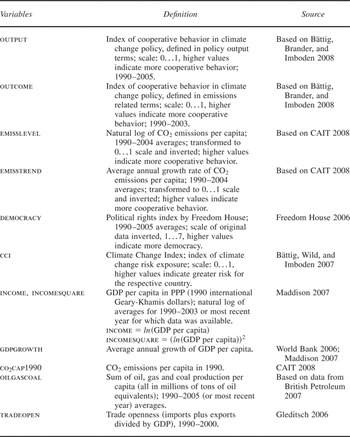
Table 2 offers an overview of variables and data sources. Policy output measures the extent of political, legal, and administrative commitments to the UN-based climate change mitigation process. This index is based on Bättig, Brander, and ImbodenFootnote 48 and includes the following indicators: (1) the UN Framework Convention on Climate Change (UNFCCC) indicator, which is composed of two equally weighted indicators measuring whether the country has ratified the UNFCCC (yes = 1, no = 0) and how fast it has done so (declining scale from 1992 through 1997); (2) the Kyoto indicator, which is composed of two equally weighted indicators measuring whether the country has ratified the Kyoto Protocol (yes = 1, no = 0) and how fast it has done so (declining scale from 1998 through 2005); (3) the reporting indicator, which is composed of two equally weighted indicators measuring whether the country has submitted the latest national climate report (yes = 1, no = 0) and whether it has done so in time; and (4) the funding indicator, which measures how often a country has made its financial contributions to the UNFCCC secretariat in time between 1996 and 2005 (linear scale according to the number of contributions in time). The values of the four components are added with equal weight since there is no compelling argument for why one or the other component should be more important. The values of the policy output index are standardized on a 0 to 1 scale. Higher values indicate more cooperative behavior.
Variables in the principal models

Note:
the dependent variables are shown in the shaded area of the table.
Policy outcomes are measured in three ways. The policy outcome index assesses primarily emission trends. It is composed of two elements: 1990 levels of CO2 emissions per capita in relation to GDP per capita; and the trend of CO2 emissions per capita in relation to GDP per capita between 1990 and 2002. The latter element of the index captures the trend of emissions compared to a quadratic function fitted into the emissions of thirteen EU countries in the 1870 to 2002 period. That is, it uses a fitted environmental Kuznets curve as a benchmark and measures how well a country performs in relation to this benchmark. Relating emission trends and levels to income offers an indication of how well countries are coping with the challenge of growing economically without excessively damaging the natural environment. The values of the index, whose construction is described in greater detail in Bättig and colleagues are standardized on a 0 to 1 scale.Footnote 49 Higher values indicate more cooperative behavior. In addition, we use two indicators whose definition is more simple and straightforward: CO2 emissions per capita (emisslevel), and growth of CO2 emissions per capita (emisstrend). For both indicators we use 1990–2004 averages. To facilitate comparison with the policy output and outcome indices, we invert the scale of emisslevel and emisstrend, so that higher values indicate lower emissions and thus greater contributions to the global public good. We standardize the values to a 0 to 1 scale. We would like to emphasize at this point that the three policy outcome variables measure emission behavior in the broadest possible manner; they do not measure compliance with Kyoto commitments or the effectiveness of such commitments.
democracy is measured with the Freedom House political rights index.Footnote 50 We use this index primarily because it is available for a larger number of countries and more recent years than the Polity IV indexFootnote 51 and other indices for democracy. We invert the original scale, making 1 the least and 7 the most democratic score, and use 1990–2005 averages.
All models include a set of control variables. The Climate Change Index (cci) is based on predictions of future annual and seasonal temperature and precipitation. It captures the degree of future climate change relative to today's natural variability and is calculated on the basis of three global climate model (GCM) simulations of the twenty-first century under the IPCC emission scenarios A2 and B2. While this indicator does not measure climate impacts (for example, in terms of how many percentages climate change could reduce GDP within particular time-frames) it provides a reasonably clear picture of how strong climatic change in individual countries is likely to be.Footnote 52 Higher values on a 0 to 1 scale indicate higher risk exposure of a country. We include this control variable because most theories of international environmental cooperation argue that risk-exposure plays a central role in accounting for why countries respond differently to any given category of international problems.Footnote 53 We expect the index to have a positive effect on cooperative behavior.
income is measured as the natural logarithm of GDP per capita.Footnote 54 We use averages for 1990–2002 (or the most recent year for which data is available). We also include the squared value of this indicator to account for the possibility of an environmental Kuznets curve.Footnote 55 We expect a positive, linear effect of income on policy output. Except for the models including outcome as the dependent variable, the models also include economic growth (gdpgrowth). For models including emission levels and trends as dependent variables we expect nonlinear effects of GDP growth. At lower levels of income, growth is likely to increase emissions. At higher levels of income, it is likely to be associated with nonincreasing or decreasing emissions. All models include a trade openness (tradeopen) variable (exports plus imports divided by GDP). The existing literatureFootnote 56 is divided on whether trade effects are positive, negative, or insignificant. The main reason for uncertainty about the direction and size of trade effects is that trade may have effects on economic structure (composition), economic output (scale), and incomeFootnote 57; it is empirically open which of the three effects dominates or whether they offset each other.
We include a variable that proxies for mitigation costs. There is no agreement in the literature on how to estimate mitigation costs.Footnote 58 We opt for a simple indicator—CO2 emissions per capita in 1990 (co2cap1990)—but assess the impact of alternative measures in our robustness checks. We acknowledge that the effect of the chosen indicator may cut both ways. Countries with higher per capita emissions may be less energy-efficient and may thus find it easier to reduce emissions, at least for some time. Conversely, to the extent that international notions of fairness demand that in the long term such countries have to bring their emissions down to some uniform per capita level (many proposals refer to this as “carbon justice” and often refer to two to five tons of CO2 per capita and year), they may be less willing to cooperate. We use this indicator in all models except those for the policy outcome index—CO2 emissions per capita are used in the construction of that index. Instead, we use fossil fuel production in those models, assuming that producers of fossil fuels (oil, gas, coal) will, for economic reasons, be less interested in contributing to climate change mitigation. This indicator is defined as total fossil fuel production (oil, coal, gas, all in oil equivalents) per capita (oilgascoal).Footnote 59
The policy output index is included as a control variable in the models for emission levels and trends, assuming that politically more committed countries are performing better in political outcome terms as well.
Results
We start by estimating the effect of democracy on four indicators for national contributions to global climate change mitigation: (1) policy output; (2) policy outcome; (3) emission levels (emisslevel); and (4) changes in emission levels (emisstrend). All dependent variables are scaled from 0 to 1, with higher values indicating larger contributions to the global public good.Footnote 60Table 3 shows the estimates.
Effects of democracy

Notes: Robust standard errors in parentheses. * significant at 10%; ** significant at 5%; *** significant at 1%.
Democracy has a positive and significant effect on policy output and on the emission level variable. These effects are substantial: a one-point increase in democracy (around 17 percent on the 1…7 scale) produces a 3.2 percent increase in policy output and a 1 percent increase in policy outcome defined in terms of emission levels. If democracy levels change from those of China (minimum) to those of Canada (maximum), this increases policy output by 19 percent and improves emission levels by 6 percent. These results support hypotheses (1) and (2). Hypothesis (1) (as tested in Model 1, Table 3) claims that more democratic countries exhibit greater political commitment to climate change mitigation. Hypothesis (2) (as tested in Model 3, Table 3) holds that more democratic countries perform better in reducing their emissions, though this effect is likely to be weaker. Indeed, the democracy coefficient in Model 3 is significantly smaller than in Model 1.
The effects of democracy on the policy outcome index and emission trends (Models 2 and 4, Table 3) cut against hypothesis (2).Footnote 61 The effect of democracy on the former is negative and significant, the effect on the latter is positive but insignificant; that is, the results shown in Table 3 support hypothesis (1) but offer only very limited support for hypothesis (2).
The coefficients for the climate change index show that risk exposure does not motivate countries to contribute to the global public good. In the model for emission trends, the effect is even negative and significant. We interpret this finding in the sense that available scientific information on climate change has not (yet?) spurred sufficient public demand for risk mitigation, that the free-rider problem reduces demand for and supply of risk mitigation measures, or both.
As expected, the income effect on policy output is positive and significant.Footnote 62 We also implemented the model with income divided by the Gini index to approximate the income of the median voter. The results (not shown here) are very similar. The environmental Kuznets curve effect is strong in the models for emission levels and follows the expected pattern: emissions increase with income, and at high levels of income start to decrease. This effect is similar for emission trends, but much weaker. Economic growth has a heterogeneous effect. It has no significant effect on policy output, a positive effect in terms of lower emission levels, but an adverse effect on emission trends. The expected Kuznets curve effect for GDP growth does not show up in our data. We cross-checked this result using an interaction term for income and growth. The results (not shown here) are very similar. Per capita CO2 emission levels in 1990 have a significant, negative effect on policy output and the emission level variable, but a significant, positive effect on the emission trend variable. Production of fossil fuels has the expected negative effect on public goods provision. The same effect shows up when we use this variable in the other models in lieu of 1990 CO2 emissions per capita. The negative effect of trade openness on policy output supports the regulatory chill over the trading-up hypothesis.Footnote 63 Countries that are more open to international trade are more reluctant to commit to climate change mitigation.
Our data can also be used to test whether democracies find it easier or harder to bring their self-selected political commitment levels in line with their environmental behavior. To start with, the effect of the policy output variable in the emission level and trend models is positive in most of our models, but statistically significant in only one of them. This suggests that, for all countries in our sample, “words and deeds” are not strongly related. What role does democracy play in this context? To assess this effect, we constructed a new dependent variable. This variable is defined as the policy outcome (the sum of the emisslevel and emisstrend variable, standardized to a 0 to 1 scale) minus the policy output variable. −1 on this scale identifies countries that are investing far more in words than in deeds, +1 identifies countries at the opposite end. When we implement the exact same model as for emisslevel for this new dependent variable, we find that both democracy and income have a significant negative effect (results not shown here). That is, rich and democratic countries are particularly prone to perform better at the political commitment level than in terms of cutting their emissions.
Our results for the policy output index correspond to findings by von Stein,Footnote 64 which to our knowledge is the most sophisticated large-N study focusing on policy output in the climate change area.Footnote 65 The results for emissions-related behavior are helpful in addressing contradictory findings by Gleditsch and Sverdrup, Li and Reuveny, Congleton, and Midlarsky.Footnote 66 As noted above, focusing on emission trends rather than levels may offer a more appropriate test of the democracy-environment hypothesis. We should expect that, ever since climate change policy emerged on the international agenda in the mid- to late 1980s, democracies have been doing a better job in dealing with the problem, irrespective of whether their emission levels were higher or not at the outset of the process (we control for this possibility by including 1990 CO2 emissions per capita). The democracy coefficient in the model for the policy outcome index turns out to be negative and significant, in the model for emission trends it is positive but insignificant. The overall conclusion is that we should be very cautious and perhaps even skeptical in interpreting the positive democracy effect on emission levels as confirmation of the democracy-environment hypothesis.
How robust are these results? For a start, we examined whether excluding the richest 10 percent of the sample (most of these countries are highly democratic) changes the results. It does not. We then explored whether outliers and/or skewed distributions of variables affected the results, but we did not identify significant problems of this kind. For example, we examined the effects of dropping particular countries that appeared as outliers. The results are robust to excluding Iceland, Suriname, and Andorra. These three countries are outliers on the policy output, democracy, and climate risk variables. Iceland scores very high on democracy and policy output, but very low on climate risk. Suriname scores very high on climate risk and very low on policy output. Andorra scores very high on democracy, but very low on policy output. We then cross-examined the results in five more ways: by using six alternative indicators for democracy; by separately estimating the effects of democracy on the four component indicators of the policy output index; by using alternative indicators for climate risk, income, mitigation costs, and trade openness; by adding additional control variables; and by defining an overall climate policy performance index, implementing the explanatory model for this dependent variable and a climate policy performance measure provided by another source (Germanwatch),Footnote 67 and comparing the results. None of these robustness checks changed the conclusions in important ways.
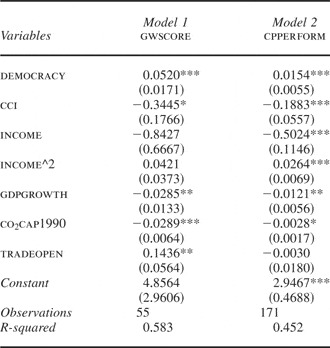
We focused on the last robustness check in some more detail.Footnote 68 We replaced our indicators for the dependent variable with the hitherto most widely used index for national performance in climate change policy, the Climate Change Performance Index (CCPI) by Germanwatch.Footnote 69 This index combines data for emission levels (30 percent weight), emission trends (50 percent weight), and climate policy (20 percent weight). Its 2008 version is available for fifty-six countries (compared to the more than 180 countries in our data set). We standardized the CCPI to the same scale (0…1, 1 indicating strongest performance) used for all definitions of the dependent variable in Table 3 (gwscore). For purposes of comparison, we constructed a similar index based on our own data set, with the same weights of the three components (output = 20 percent, emisstrend = 50 percent, emisslevel = 30 percent, cpperform).
Table 4 shows that the results for the democracy effect are positive and significant for both overall indices of climate policy performance. The caveat is, however, that such overall measures obfuscate important differences between policy output and policy outcome, as shown in Table 3. We also replaced our policy output index with the policy component of the Germanwatch index. The results (not shown here) for the democracy effect are the same as for the models including our policy output index.
Results for overall indices of climate policy performance

Notes: Robust standard errors in parentheses. * significant at 10%; ** significant at 5%; *** significant at 1%.
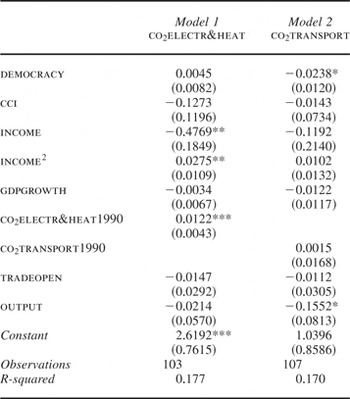
As shown above, democracies find it particularly difficult to match “words and deeds.” The final step in our analysis offers at least a partial explanation for this. Some studies suggest that advanced industrialized countries experience particularly serious difficulties in cutting emissions in the transportation sector, whereas poorer countries experience higher growth rates in GHG emissions from electricity and heat production.Footnote 70 Large point sources (such as thermal power plants) are, in technical and monitoring/enforcement terms, easier to control than transportation. Moreover, democratic governments may find it harder to restrict individual freedom by imposing constraints on personal mobility. To the extent that these assumptions hold true, we should observe a negative effect of democracy on emissions from transportation. Table 5 offers support for this argument.
Democracy effects on CO2 emission trends in electricity and heat production and transport

Notes: Robust standard errors in parentheses. * significant at 10%; ** significant at 5%; *** significant at 1%.
The dependent variable is defined as the average annual growth of CO2 emissions per capita in 1990–2004 from energy and heat production as well as transportation. Again, we inverted the scale and standardized the dependent variables to a 0 to 1 range; higher values indicate smaller or negative emission growth rates. As to CO2 emissions from electricity and heat production, the biggest effects emanated from 1990 emission levels and the environmental Kuznets curve. Countries that had higher emission levels per capita in this sector in 1990 experienced lower growth rates thereafter, and poorer countries experienced higher emission growth rates than richer countries. Interestingly, democratic countries experienced greater difficulties in cutting emissions in the transportation sector. The effect of democracy was negative and significant.Footnote 71 Moreover, better performance in policy output terms had a significant, negative effect on performance in terms of emission trends in the transportation sector. This finding shows that the ambiguous democracy effect on policy outcomes shown in Table 3 may, at least to some extent, stem from the fact that democracies are finding it particularly difficult to restrict individual freedom and curb transport-related emissions. We return to this issue in the conclusions.
Conclusion
In focusing on the implications of democracy for the provision of global public goods, this article addresses an important gap in the international relations and comparative politics literature. The latter deals primarily with the effects of democracy on domestic public goods provision and dyadic international behavior. We have concentrated on climate change, one of the most important and complex global public goods challenges facing humankind. The empirical testing was done on a cross-section of 185 countries in 1990–2004.
The results show that the effect of democracy on political commitment to global public goods provision (policy output) is positive. In contrast, the democracy effects on policy outcomes, measured in terms of emission levels and trends, are ambiguous. The analysis of sectoral emissions suggests that the ambiguous democracy effect in the analysis of total emissions is at least in part due to the negative democracy effect on emissions from transportation. These results demonstrate that, in moving from political commitments to GHG reductions, the democracy effect has up to this point in time not been able to override countervailing forces that emanate from the free-rider problem, the discounting of future benefits of climate change mitigation, and other factors that cut against efforts to reduce emissions.
The research reported in this article has interesting implications for international relations theory as well as climate change policy. The implications for international relations theory are that ambiguous findings in the existing literature with respect to the effects of democracy on domestic public goods provision and dyadic international behavior can be identified also in the area of global public goods provision, particularly for policy outcomes. Studying political commitment and environmental behavior side by side thus produces insights that are missing in studies that concentrate only on one or the other dependent variable. In climate change policy, democracies are clearly more responsive at the political-commitment than at the problem-solving level, not only in absolute terms, but also relative to nondemocracies.
It would be interesting to explore whether more democratic countries experience larger “words-deeds” gaps in other policy areas, and whether there are systematic differences of this kind between domestic and international commitments and across different policy areas. The comparative politics and political economy literature allows for two competing hypotheses.Footnote 72 One assumes that in democracies with a well-informed electorate and strong competition for political offices, policymakers who promise more than they can implement experience political costs, for example an increased risk of losing elections. The other assumes that growing mediatization of politics and other factors that have increased the extent of competition for electoral support motivate policymakers to become more “adventurous” with respect to political commitments. To the extent that voters are myopic and “overdosed” by competing information and political claims, policymakers in advanced democracies can get away lightly with increased “words-deeds” gaps.
The recent international relations literature tends to side with the first assumption. Several authors have argued that democracies have stronger domestic enforcement mechanisms than nondemocracies, and that their decisions to engage in international commitments will thus be more closely aligned with policy outcomes.Footnote 73 Von Stein hypothesizes that “democracies … are more likely to keep their international promises—in large part because they only make promises they know they can keep.”Footnote 74 The approach taken in this article, which uses a unified analytical framework to study policy output, outcome, and gaps between the two, helps in testing this claim without narrowing the focus to legally binding obligations and formal compliance. Hence it is more in line with the recent literature on the effectiveness of international regimes, which conceptualizes effectiveness primarily in terms of problem solving rather than legal compliance.Footnote 75 In using self-selected political commitment levels rather than formal treaty obligations as the benchmark, it also avoids the “constrain or screen” problem inherent in studies focusing on formal treaty commitments and compliance.Footnote 76 In contrast to empirical results on (positive) democracy effects on compliance in the human rights and monetary policy area,Footnote 77 our analysis shows that democracy is associated with a bigger implementation gap in climate change policy. This contrasting evidence appears quite worrying from a normative perspective. The remainder of this section thus concentrates on its policy implications.
In climate change policy, democracies have obviously had a slow start in moving from commitments to emission reductions. This should not come as a great surprise. Climate change is a much more complex challenge than most local or regional environmental degradation issues, such as air and water pollution. It is also characterized by a global free-rider problem.
However, there are signs that more democratic countries are likely to perform better over the long run in policy outcome terms as well. As argued in the theory section of this article, public and interest group demand for climate change mitigation is likely to be stronger in democracies than in nondemocracies. The available empirical evidence in fact suggests that public concern over climate change risks tends to be higher in democracies, independently of income. This is also true of environmental NGO activity.Footnote 78 Moreover, democracies tend to have higher income levels, and the available data shows that the environmental Kuznets curve for GHG emissions has already reached a turning point in most of the rich and democratic countries. Democracies are, independently of income, also more active in environmental monitoring and research and developmentFootnote 79—this increases knowledge about risks and generates new technologies that are more energy efficient. Democracies also tend to perform better in terms of sustainable development more broadly defined (for example, as measured in the form of the World Bank's Index of Adjusted Net Savings and the Center for International Earth Science Information Network's Environmental Performance Index).Footnote 80 It is hard to see why this pattern should not extend to global environmental problems, such as climate change, at least in the long run. The evidence presented in this article is largely congruent with this argument. In combination with the assumption that democratic institutions are more likely to motivate policymakers to supply policies that meet public and interest group demand for climate change mitigation, these findings leave considerable room for optimism.