1. INTRODUCTION
Studies of the interaction of intense laser pulses with cluster targets are of current interest (McPherson et al., Reference McPherson, Thompson, Borisov, Boyer and Rhodes1994; Ditmire et al., Reference Ditmire, Tisch, Springate, Mason, Hay, Smith, Marangos and Hutchinson1997, Reference Ditmire, Zweiback, Yanovsky, Cowan, Hays and Wharton1999). These studies provide information on the basic properties of matter under extreme conditions (Fortov & Morfill, Reference Fortov and Morfill2010; Smirnov, Reference Smirnov2010; Rusek et al., Reference Rusek, Lagadec and Blenski2000; Saalmann et al., Reference Saalmann, Siedschlag and Rost2006; Dorchies et al., 2005; Davis et al., Reference Davis, Petrov and Velikovich2007; Gavrilenko et al., Reference Gavrilenko, Faenov, Magunov, Skobelev, Pikuz, Kim and Milchberg2006; Sherrill et al., Reference Sherrill, Abdallah, Csanak, Dodd, Fukuda, Akahane, Aoyama, Inoue, Ueda, Yamakawa, Faenov, Magnov, Pikuz and Skobelev2006; Dorchies et al., 2008; Taguchi et al., Reference Taguchi, Antonsen, Palastro, Milchberg and Mima2010; Fennel et al., Reference Fennel, Meiwes-Broer, Tiggesbäumker, Reinhard, Dinh and Suraud2010; Bychenkov & Kovalev, Reference Bychenkov and Kovalev2011; Erk et al., Reference Erk, Hoffmann, Kandadai, Helal, Keto and Ditmire2011; Hoffmann et al., Reference Hoffmann, Murphy, Kandadai, Erk, Helal, Keto and Ditmire2011; Mishra et al., Reference Mishra, Holkundkar and Gupta2011). Also, these studies make it possible to develop new approaches to a number of applications, such as initiation of nuclear reactions (Ditmire et al., Reference Ditmire, Zweiback, Yanovsky, Cowan, Hays and Wharton1999; Kishimoto et al., Reference Kishimoto, Masaki and Tajima2002; Grillon et al., Reference Grillon, Balcou, Chambaret, Hulin, Martino, Moustaizis, Notebaert, Pittman, Pussieux, Rousse, Rousseau, Sebban, Sublemontier and Schmidt2002; Buersgens et al., Reference Buersgens, Madison, Symes, Hartke, Osterhoff, Grigsby, Dyer and Ditmire2006; Lu et al., Reference Lu, Liu, Wang, Wang, Zhou, Deng, Xia, Xu, Lu, Jiang, Leng, Liang, Ni, Li and Xu2009; Higginbotham et al., Reference Higginbotham, Semonin, Bruce, Chan, Maindi, Donnelly, Maurer, Bang, Churina, Osterholz, Kim, Bernstein and Ditmire2009; Last et al., Reference Last, Ron and Jortner2011), acceleration of electrons and heavy particles (Ditmire et al., Reference Ditmire, Tisch, Springate, Mason, Hay, Smith, Marangos and Hutchinson1997; Tajima et al., Reference Tajima, Kishimoto and Downer1999; Dobosz et al., Reference Dobosz, Schmidt, Pedrix, Meynadier, Gobert, Normand, Faenov, Magunov, Pikuz, Skobelev and Andreev1998, Reference Dobosz, Schmidt, Pedrix, Meynadier, Gobert, Normand, Ellert, Blenski, Faenov, Pikuz, Skobelev, Magunov and Andreev1999; Sakabe et al., Reference Sakabe, Shimizu, Hashida, Sato, Tsuyukushi, Nishihara, Okihara, Kagawa, Izawa, Imasaki and Iida2004; Fukuda et al., 2004, Reference Fukuda, Faenov, Tampo, Pikuz, Nakamura, Kando, Hayashi, Yogo, Sakaki, Kameshima, Pirozhkov, Ogura, Mori, Esirkepov, Koga, Boldarev, Gasilov, Magunov, Kodama, Bolton, Kato, Tajima, Daido and Bulanov2009; Zhang et al., Reference Zhang, Chen, Wang, Yan, Yuan, Mao, Wang, Liu, Shen, Li, Dong, Lu, Ma, Faenov, Pikuz, Sheng and Zhang2012), and the creation of bright X-ray sources for biomedical and lithographic applications (McPherson et al., Reference McPherson, Thompson, Borisov, Boyer and Rhodes1994; Donnelly et al., Reference Donnelly, Ditmire, Neuman, Perry and Falcone1996; Magunov et al., 2003; Chu et al., Reference Chu, Tsai, Chou, Yang, Lin, Lee, Wang and Chen2005; Fukuda et al., Reference Fukuda, Faenov, Pikuz, Kando, Kotaki, Daito, Ma, Chen, Homma, Kawase, Kameshima, Kawachi, Daido, Kimura, Tajima, Kato and Bulanov2008; Kugland et al., Reference Kugland, Neumayer, Döppner, Chung, Constantin, Girard, Glenzer, Kemp and Niemann2008a, Reference Kugland, Constantin, Neumayer, Chung, Collette, Dewald, Froula, Glenzer, Kemp, Kritcher, Ross and Niemann2008b; Chen et al., Reference Chen, Liu, Wang, Kando, Mao, Zhang, Ma, Li, Bulanov, Tajima, Kato, Sheng, Wei and Zhang2010; Hayashi et al., Reference Hayashi, Pirozhkov, Kando, Fukuda, Faenov, Kawase, Pikuz, Nakamura, Kiriyama, Okada and Bulanov2011; Zhang et al., Reference Zhang, Chen, Yuan, Yan, Wang, Liu, Shen, Faenov, Pikuz, Skobelev, Gasilov, Boldarev, Mao, Li, Dong, Lu, Ma, Wang, Sheng and Zhang.2011; Fazeli et al., Reference Fazeli, Mahdieh and Tallents2011).
The use of the cluster targets imposes constraints on the duration of a laser pulse. The interactions will obviously be efficient if a cluster is not completely destroyed during the laser pulse irradiation, i.e., the density of the clusters does not become lower than the critical value due to Coulomb explosion. For all reasonable sizes of the clusters, this condition means that the duration of the laser pulse should be in the femtosecond or subpicosecond range; i.e., only ultra-short laser pulses can efficiently interact with the clusters.
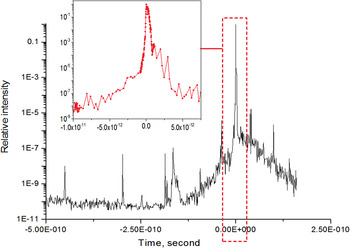
However, even in this case, the clusters should not be too small, because the ultra-short laser pulse is always accompanied with prepulses, which usually have complex temporal structures (see, for example, Fig. 1). In this structure, for example, there are prepulses with duration of the order of the main laser pulse and temporally shifted by some tens of picoseconds to nanoseconds, and also a pedestal of a longer duration (ps to tens of ps) under the main pulse. This later pedestal (see inset of Fig. 1) directly adjoins the basic pulse and has, as a rule, the duration of some picoseconds.
(Color online) The typical form of the ultra short laser pulse (Kiriyama et al., 2010).

The contrast of the laser pulse, i.e., the ratio of the peak power of the main laser pulse to the power of the prepulses, is usually of the order of 104–106 or even worse without special efforts. This means that, if the main pulse is fairly intense (experiments are usually performed at the intensities of I las > 1017–1020 W/cm2), the intensity of the prepulse is not lower than 1013–1014 W/cm2 and is sufficient to destroy the clusters, even before the arrival of the main pulse.
It is obvious, that one of the solutions to such a problem is improving the laser contrast up to the level of about 1010–12 (Zhang et al., Reference Zhang, Chen, Yuan, Yan, Wang, Liu, Shen, Faenov, Pikuz, Skobelev, Gasilov, Boldarev, Mao, Li, Dong, Lu, Ma, Wang, Sheng and Zhang.2011, Reference Zhang, Chen, Wang, Yan, Yuan, Mao, Wang, Liu, Shen, Li, Dong, Lu, Ma, Faenov, Pikuz, Sheng and Zhang2012; Hayashi et al., Reference Hayashi, Pirozhkov, Kando, Fukuda, Faenov, Kawase, Pikuz, Nakamura, Kiriyama, Okada and Bulanov2011; Kiriyama et al., Reference Kiriyama, Mori, Nakai, Shimomura, Sasao, Tanoue, Kanazawa, Wakai, Sasao, Okada, Daito, Suzuki, Kondo, Kondo, Sugiyama, Bolton, Yokoyama, Daido, Kawanishi, Kimura and Tajima2010a; Antonucci et al., Reference Antonucci, Rousseau, Jullien, Mercier, Laude and Cheriaux2009; Doumy et al., Reference Doumy, Quéré, Gobert, Perdrix, Martin, Audebert, Gauthier, J.- Geindre and Wittmann2004). However, as can be seen from the inset of Figure 1, the pedestal to the main laser pulse does not change significantly under such efforts. Another possibility is to use large-sized clusters. In this case, it is possible to preserve its dense (solid-state) core to the moment of arrival of the main laser pulse. But the clusters of too large sizes, as a matter of fact, can destroy all advantages of the cluster targets. Indeed, at very large cluster sizes we will investigate not laser-cluster but laser-droplet interaction, where the skin-layer thickness for laser radiation is less than the cluster size. Therefore it is desirable to take the cluster sizes so that the core of the cluster with the solid density remains at the arrival of the main laser pulse, on one hand, and the sizes of the clusters do not exceed the skin-layer thickness, on the other hand. Thus, for correct choice of the initial cluster size it is necessary to know the degree of cluster destruction by laser prepulses.
In order to estimate how much the laser prepulses destroy a cluster at the moment of the main pulse arrival, it is necessary to know precisely temporal characteristics of the laser pulse, and also to develop an adequate gas-dynamic model of the interaction of the prepulses with the clusters. As to the first problem, although it is a difficult experimental task, there are a number of investigations, in which, at least, some average values of the intensities of the prepulses in various time intervals have been measured (see, for example, Kiriyama et al. (Reference Kiriyama, Michiaki, Nakai, Shimomura, Sasao, Tanaka, Ochi, Tanoue, Okada, Kondo, Kanazawa, Sagisaka, Daito, Wakai, Sasao, Suzuki, Kotakai, Kondo, Sugiyama, Bulanov, Bolton, Daido, Kawanishi, Collier, Hernandez-Gomez, Hooker, Ertel, Kimura and Tajima2010b), Antonucci et al. (Reference Antonucci, Rousseau, Jullien, Mercier, Laude and Cheriaux2009), Doumy et al. (Reference Doumy, Quéré, Gobert, Perdrix, Martin, Audebert, Gauthier, J.- Geindre and Wittmann2004)). The second problem also has not been solved accurately until now. Moreover, without the accurate knowledge of the temporal structure of a laser pulse, which is the input information for corresponding gas-dynamic calculations, theoretical modeling can give only a rough estimation of the clusters evolution under the influence of the laser prepulses and the main pulse.
Therefore, development of the diagnostic methods that allows one to directly obtain information about the cluster destruction by laser prepulses is very important. In this paper, we will show that the key information regarding the existence (or non-existence) of the dense cluster core at the moment of the main laser pulse arrival can be obtained by means of the X-ray spectra emitted from the cluster target. We will propose two diagnostic techniques, one of which is based on the observation of the profiles of the resonance spectral lines (see part 2), and the second one — is on the observation of the hollow ion spectra (see part 3).
2. THE DIAGNOSIS OF CLUSTER DESTRUCTION BY OBSERVATION OF SELF-ABSORPTION EFFECTS
The effects of self-absorption of X-ray spectral lines in plasmas produced by laser interaction with solid targets have been observed for many decades (Irons, Reference Irons1976; Boiko et al., Reference Boĭko, Vinogradov, Ilyukhin, Katulin, Maĭorov, Nosach, Peregudov, Petrov, Pikuz, Skobelev, Faenov, Chirkov and Shilov1981). The experiments with the cluster targets, which have been carried out recently, gave rather ambiguous results concerning the self-absorption effects. Under almost the same parameters as the laser-cluster interaction, these effects are sometimes manifested in the observed spectra and sometimes not. In order to reveal the cause of this phenomenon more clearly, we have carried out special experiments, which make it possible together with the results of previous experimental studies (Gavrilenko et al., Reference Gavrilenko, Faenov, Magunov, Skobelev, Pikuz, Kim and Milchberg2006; Dobosz et al., Reference Dobosz, Schmidt, Pedrix, Meynadier, Gobert, Normand, Faenov, Magunov, Pikuz, Skobelev and Andreev1998, Reference Dobosz, Schmidt, Pedrix, Meynadier, Gobert, Normand, Ellert, Blenski, Faenov, Pikuz, Skobelev, Magunov and Andreev1999; Stentz et al., Reference Stenz, Bagnoud, Blasco, Roche, Salin, Faenov, Magunov, Pikuz and Skobelev2000; Kim et al., Reference Kim, Kumarappan, Milchberg, Faenov, Magunov, Pikuz and Skobelev2006; Faenov et al., Reference Faenov, Magunov, Pikuz, Skobelev, Giulietti, Betti, Galimberti, Gamucci, Giulietti, Gizzi, Labate, Levato, Tomassini, Marques, Bourgeois, Dobosz-Dufrenoy, Ceccoti, Monot, Reau, Popoescu, D'Oliveira, Martin, Fukuda, Boldarev, Gasilov and Gasilov2008), to propose, first, a concept that explains all of the observed data, and, second, to suggest the method allowing us to diagnose the cluster state after its interaction with the laser prepulses.
The essence of the concept is as follows. At the beginning of the interaction with a laser pulse, a cluster target consists of a set of condensed micro-targets (clusters or droplets) with sizes from several nanometers to one micrometer and an atomic density that is almost the same as the density in solid or liquid. After explosion of the clusters and during their expansion, a plasma channel with an average density of about the density of high-pressure gases appears in the cluster target. In other words, the cluster target remains condensed in the femtosecond time scale and turns into gaseous plasma in the picosecond time scale. Therefore, self-absorption effects in the cluster plasma can be observed for spectral lines that are predominantly emitted from the core at the initial stage of the laser pulse, when the cluster has not yet been strongly expanded and cannot be observed in other cases.
The self-absorption effects are most easily identified by a change in the profiles of the spectral lines emitted from the plasma because the self-absorption deforms the spectral line profiles even at an optical thickness of τ ~ 1 (see, e.g., Irons (Reference Irons1976), Boiko et al. (Reference Boĭko, Vinogradov, Ilyukhin, Katulin, Maĭorov, Nosach, Peregudov, Petrov, Pikuz, Skobelev, Faenov, Chirkov and Shilov1981)). We note that the wings of the spectral lines in the laser plasma are usually due to the Doppler effect, which is attributed to its macroscopic expansion, because the average velocity of expansion of most ions is higher than their thermal velocity and additionally fast ions with velocities several orders of magnitude higher than the thermal velocity are also generated under interaction of intense laser radiation with matter.
In the case of laser heating of planar solid targets at normal incidence, this leads to the dependence of the wing shape on the observation direction. In such experiments, there is a particular direction, which is perpendicular to the surface of the target. This direction is simultaneously the direction of the laser plasma expansion and the symmetry axis of the consideration. This leads to the fact that for optically thin plasmas the profiles of the spectral lines observed in the direction parallel to the target surface are symmetric and fairly narrow. On the other hand, profiles observed in the direction perpendicular to the surface are strongly asymmetric with increased short-wavelength wings, where the radiation intensity distribution enables direct measurements of the energy distribution of fast ions.
In the case of laser heating of the clusters (or microdroplets), the situation is different. There is no special direction (since there is spherical symmetry for observation directions) and the observed spectral line profiles, at first sight, should be symmetric because radiation is detected from ions moving both outward and toward the spectrometer. However, in the case of optically thick plasmas asymmetric profiles with suppressed long-wavelength wings are observed. This is due to the spatial separation of the ions that have different velocity components (both in magnitude and, even more significant, in the direction of motion) in the observation direction.
The observed spectra are integrals of the plasma emittance over the view axis of the spectrometer. Since the spatial resolution of the spectrometer is finite, the view axis is a cylinder with a diameter equal to the spatial resolution. Since the spatial resolution of X-ray spectrometers is no better than 5–10 µm and the size of the expanded clusters in the first picoseconds is no more than 2–3 µm, the observed spectrum is given by the integral of the emittance over the full space. Taking into the account the spherical symmetry of the problem, this integral can be represented in the form

where r and θ are the spherical coordinates (the center of the cluster corresponds to r = 0 and θ = 0 corresponds to the direction toward the spectrometer), S r(ω) is the spectrum of the radiation from unit plasma volume at the distance r from the center and has the velocity v(r).
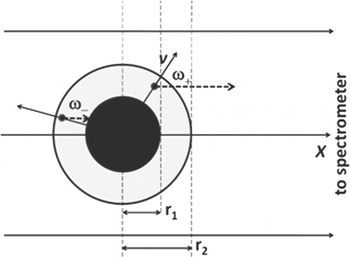
Let the plasma constitute a spherical layer with the inner radius r 1 and the outer radius r 2 (see Fig. 2). Below, we consider two cases where radiation is observed from the entire spherical layer or only from its half that is closer to the spectrometer. For convenience, we introduce the angle θmax that is equal to π and π/2 in the first and second cases, respectively. Without loss of generality, we consider the spectrum of one radiation line and separate S r(ω) into three factors as follows:

where N i(r) is the density of the ions in the ground state, Φ(r) is the excitation function determining the intensity of the line, and L r(ω) is the line profile for the ion at rest.
The scheme of the spatial separation of ions emitting photons shifted towards shorter or longer frequencies from the center of the line during the explosion of the cluster.

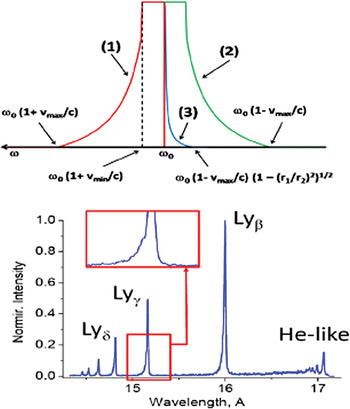
If the natural width of the line is much smaller than the expansion broadening of interest, L r can be taken in the form of the δ function. The line profiles calculated for this case by Eqs. (1)–(2) are shown in Figure 3.
(Color online) (Top) Spectral line profiles observed from the spherical layer of the plasma at nonzero spatial resolutions of the spectrometer; lines 1, 2, and 3 are the spectra from a half of the spherical layer, the entire layer, and the real spectrum, respectively. All 3 lines are the same line in the region ω > ω 0. (Bottom) The emission spectra of the H- and He-like oxygen ions observed in the present experiments.

As can be seen in Figure 3, in this case asymmetry can only appear when the radiation is detected from half of the spherical layer, i.e., when the core of the cluster is opaque (or, at least, strongly absorbing) for X-rays. Strictly speaking, in the case of the opaque core, which incompletely screens the half space far from the spectrometer, integration in Eq. (1) should also be performed over the angular range of π/2 < θ< π – arcsin(r 1/r 2), where for each θ value, the integral with respect to r should be calculated in the limits from r 1/sin(π – θ) to r 2. For this reason, the line profile is not cut-off at the frequency ω0 and a small wing, which is shown in Figure 3 (line 3), appears in the long-wavelength part.
We see that the presence of the opaque core or, in other words, the large optical thickness of the cluster for a given spectral line should lead to the asymmetry of observed spectral line profiles. In this case, the long-wavelength wings of the lines should be suppressed, because an absorber (the dense core of the cluster) is located between ions emitting these photons and the spectrometer. Such absorber is absent for the ions emitting short-wavelength wings. The suppression degree obviously depends on the optical thickness of the cluster core τ and is on the order of exp(–τ).
Thus, asymmetric spectral line profiles will only be observed if a laser prepulse does not destroy a cluster entirely, and the ratio of the red wing to the blue wing can be used to measure the size of the cluster core that is not destroyed by the laser prepulse. It is necessary in this case that the optical thickness of the dense undestroyed cluster core is on the order of one. Note that the cluster will be optically thicker if it consists of several types of light atoms so that the spectral lines of the ions of one type of atoms can efficiently photoionize the ions of another type of atoms (details see in Dobosz et al. (Reference Dobosz, Schmidt, Pedrix, Meynadier, Gobert, Normand, Ellert, Blenski, Faenov, Pikuz, Skobelev, Magunov and Andreev1999), Skobelev et al. (Reference Skobelev, Faenov, Pikuz, Pikuz, Fortov, Fukuda, Hayashi, Pirozhkov, Kawase, Kotaki, Shimomura, Kiriyama, Kato and Kando2011)).
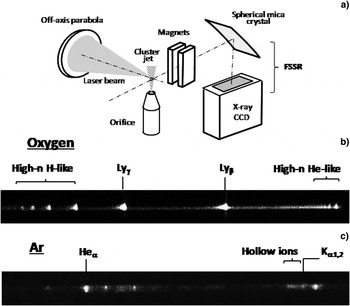
In the present work, the experiments have been carried out with the CO2 clusters using the J-KAREN facility. The J-KAREN facility (Kansai Photon Science Institute, Japan Atomic Energy Agency) (Kiriyama et al., Reference Kiriyama, Mori, Nakai, Shimomura, Sasao, Tanoue, Kanazawa, Wakai, Sasao, Okada, Daito, Suzuki, Kondo, Kondo, Sugiyama, Bolton, Yokoyama, Daido, Kawanishi, Kimura and Tajima2010a, Kiriyama et al., Reference Kiriyama, Michiaki, Nakai, Shimomura, Sasao, Tanaka, Ochi, Tanoue, Okada, Kondo, Kanazawa, Sagisaka, Daito, Wakai, Sasao, Suzuki, Kotakai, Kondo, Sugiyama, Bulanov, Bolton, Daido, Kawanishi, Collier, Hernandez-Gomez, Hooker, Ertel, Kimura and Tajima2010b) a high power Ti:sapphire laser provides the laser pulses with a high contrast of 108–1010, achieved with the use an additional saturable absorber and an additional Pockels cell switch. The pulse duration was 40 fs at pulse energy of about 1 J and a repetition frequency of 1 Hz. The laser intensity of laser radiation in the focal spot with a diameter of 30 µm reached 3 × 10¹⁸ W/cm2. The clusters were created when a gas with an initial pressure of 60 bar was expanded into vacuum through a supersonic nozzle, which consisted of three coaxial conical surfaces. The use of a mixture of 90% He + 10% CO2 created CO2 clusters with an average diameter of 0.36 µm. The laser radiation was focused on the axis of the cluster jet at a distance of 1.5 mm above the output of the nozzle (see Fig. 4a). The laser contrast was changed from 105 up to 1010. X-ray spectra from the target were measured by a FSSR-1D spectrometer with a spherically bent mica crystal (Faenov et al., Reference Faenov, Pikuz, Erko, Bryunetkin, Dyakin, Ivanenkov, Mingaleev, Pikuz, Romanova and Shelkovenko1994; Skobelev et al., Reference Skobelev, Faenov, Bryunetkin, Dyakin, Pikuz, Pikuz, Shelkovenko, Romanova and Mingaleev1995), which was mounted perpendicularly to the laser radiation axis. The spectral lines of H- and He-like ions OVIII and OVII were observed in the first reflection order from the crystal. Figures 3 and 4b show the typical spectra.
(a) The scheme of the experimental setup. Typical emission spectra of the H- and He-like ions of Oxygen (b) and the spectra of Ar ions (c), observed in the present work.

As we see from Figures 3 and 4b the profiles of the observed spectral lines have an asymmetrical shape. It means that the laser prepulses in these experiments did not destroy clusters entirely. Note that symmetrical profiles had been observed in another situation by us earlier (Stentz et al., Reference Stenz, Bagnoud, Blasco, Roche, Salin, Faenov, Magunov, Pikuz and Skobelev2000; Faenov et al., Reference Faenov, Magunov, Pikuz, Skobelev, Giulietti, Betti, Galimberti, Gamucci, Giulietti, Gizzi, Labate, Levato, Tomassini, Marques, Bourgeois, Dobosz-Dufrenoy, Ceccoti, Monot, Reau, Popoescu, D'Oliveira, Martin, Fukuda, Boldarev, Gasilov and Gasilov2008). The optical thickness of the cluster or the size of its core d cold that is not destroyed by the laser prepulse can be determined from the spectra presented. For example, an analysis of line profiles obtained in the present experiment yields τ ~ 1.6 or d cold ~ 0.29 µm. As the initial diameter of cluster was about 0.36 µm we could conclude that the laser prepulse destroyed only small part of the cluster. It means that the larger part of the cluster survived and the main 40 fs laser pulse interacts with the cold core of solid density.
3. DIAGNOSIS OF CLUSTER DESTRUCTION BY A LASER PREPULSE USING THE CHARACTERISTIC AND HOLLOW ION EMISSIONS
It is possible also to diagnose partial cluster destruction by a laser prepulse from observation of the characteristic line radiations of the cluster atoms. For observation of such radiation, the existence of two conditions is necessary — (1) presence of cold matter and (2) presence of the electrons with energy sufficient for K-shell excitation, i.e., at least several keV. As high energy electrons can be generated only after irradiation of the cluster by the main laser pulse, K α lines will be observed only in the case when the cold dense cluster core remains after irradiation by the laser prepulses.
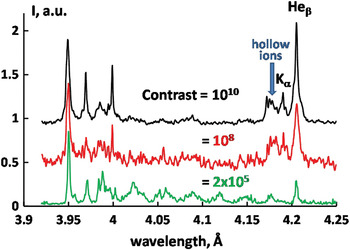
To prove the above statement we have carried out a series of experiments on installation J-KAREN described above. The experiment scheme was practically the same as shown in Figure 4a. Large size argon clusters (an average cluster diameter in the interaction region was about 1.3 µm) were used as a target (Boldarev et al., Reference Boldarev, Gasilov, Faenov, Fukuda and Yamakawa2006). Contrast of the laser pulses was varied from 2 × 10⁵ to 1010. Typical spectra and densitograms for the spectral region of 3.9–4.3 Å are presented in Figures 4c and 5. It should be noted that the scale of wavelengths, presented in Figure 5 corresponds to the fourth order of mica-crystal reflection while the line Heβ is registered in fifth order and its real wavelength is 5/4 times less.
(Color online) Emission spectra of argon clusters observed on J-KAREN installation at various values of the laser pulse contrast.

From Figure 5 it is clearly seen, that at very high laser contrast >108 observable spectra contain intense K α line that is not observed at contrast 2 × 10⁵. It means that in the latter case the laser prepulse was strong enough to ionize all cluster atoms before the arrival of the main pulse. In other cases for of higher laser contrasts, the cold dense part of cluster survived after the laser prepulse. In Figure 5 spectral structures with wavelengths about 4.18 Å are also clearly seen. As shown by Colgan et al. (Reference Colgan, Abdallah, Faenov, Pikuz, Skobelev, Fukuda, Hayashi, Pirozhkov, Kawase, Shimomura, Kiriyama, Kato, Bulanov and Kando2011), Faenov et al. (Reference Faenov, Skobelev, Pikuz, Fortov, Boldarev, Gasilov, Chen, Zhang, Yan, Yaun, Mao and Wang2011) they are the spectral lines of hollow ions. It is important to remember that hollow ions are the ion states with two or more vacancies in internal shells. At radiating decay of such states the spectral lines also called hypersatellites are radiated. At present, there is a considerable body of research devoted to a study of hollow ion spectra in laser-produced plasma (see, for details, review Skobelev et al. (Reference Skobelev, Faenov, Pikuz and Fortov2012)).
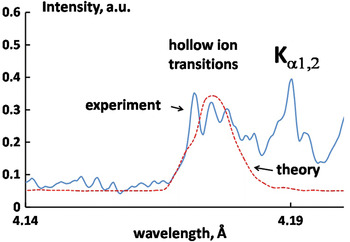
Since hollow ions are doubly excited states hypersatellites should be intense in very high dense plasma. Also, since generation of these states require high excitation energies hollow ions can be effectively excited by hot electrons, generated by the main laser pulse. Therefore an observation of hollow ion spectra will also suggest the existence of a dense core at the moment of arrival of the main pulse. Moreover, a comparison of the experimental and the calculated spectra of hollow ions can be used for estimation of the parameters of the most dense plasma regions generated by the laser prepulse. The calculations were done by atomic and kinetic models described in Colgan et al. (Reference Colgan, Abdallah, Faenov, Pikuz, Skobelev, Fukuda, Hayashi, Pirozhkov, Kawase, Shimomura, Kiriyama, Kato, Bulanov and Kando2011) and Faenov et al. (Reference Faenov, Skobelev, Pikuz, Fortov, Boldarev, Gasilov, Chen, Zhang, Yan, Yaun, Mao and Wang2011). Their results show, for example, that the spectrum of the hollow ions obtained for laser contrast 1010, is described adequately by the modeling for the plasma with T e = 50 eV and N e = 5 × 1022 cm−3 in which there is 1% fraction of hot electrons (see Fig. 6).
(Color online) The comparison of the experimental and the modeling spectra near K α line of Ar ion. The experimental spectrum is obtained for laser contrast 1010, the theoretical spectrum is calculated for T e = 50 eV, N e = 5 × 1022 cm−3 and 1% fraction of hot electrons.

Observations of the hollow ion spectra do not only provide an additional way of diagnosis of a cluster target state after prepulse action, but also in some cases provide the information which other diagnostics cannot provide. Indeed let us consider the case where, the prepulses are unable to destroy the dense cluster core, but can heat the core to a temperature high enough for the ionization of atoms. In this case, although K α characteristic radiations are absent, the hollow ion spectra may be still observed in the emission spectra. This will manifest that the cluster was heated to a warm dense matter state, but was not completely destroyed by the prepulses.
4. CONCLUSION
Analysis of the interaction of ultrashort high intensity laser pulses with cluster targets is of considerable interest both for the study of fundamental properties of matter in extreme conditions and also for the new approaches for solving very important applied problems. In spite of the remarkable progress in improving the contrast of ultrashort pulse lasers, elimination of prepulses in the 1–5 ps time scale before the main ultrashort pulse remains insufficient. Therefore, development of diagnostic methods allowing us to directly obtain information on the cluster state just after interaction of the laser prepulses with the cluster is a state of the art problem nowadays.
The present work shows that it is possible to estimate the existence of the cluster core at high density after the action of laser prepulses by various spectroscopic methods based on the analyses of the X-ray spectra emitted from the cluster target. These methods, first and foremost, allow insight into the major question concerning the preservation of a dense cluster core at the moment of the main laser pulse arrival. In addition, they can be used for quantitative estimation of the size of the undestroyed part of the cluster and also for measuring the preplasma temperature and density.
ACKNOWLEDGEMENTS
The work was partially supported by the Grant-in-Aid for Scientific Research (C) (22604004) and the Funding Program for Next Generation World-Leading Researchers (LR035) from JSPS; RFBR grants 10-02-00345-а and 12-02-91169-GFEN_а; by the Presidium of the Russian Academy of Sciences Programs of Basic Research № 2 and 21 and by the Department of Energy of the United States (contract no. DE-AC52-06NA25396).