Comorbid conditions are associated with increased risk for surgical site infection (SSI)Reference Olsen, Higham-Kessler and Yokoe 1 – Reference Chopra, Marchaim and Lynch 4 and the acquisition of antibiotic-resistant bacteria.Reference McGregor, Perencevich and Furuno 5 – Reference McKinnell, Miller, Eells, Cui and Huang 7 More limited research has been done to assess whether patients with certain comorbid conditions may be at greater risk for central-line–associated bloodstream infections (CLABSIs) than other patients.Reference Pepin, Thom and Sorkin 8 , Reference Lissauer, Leekha, Preas, Thom and Johnson 9 Research using comorbidity for risk adjustment of healthcare-associated infection rates is in its infancy.Reference Moehring and Anderson 10 Risk adjustment based on comorbid conditions would enhance the quality of national reporting of infection control and infectious disease metrics, particularly as it relates to interfacility comparisons and quality-based reimbursement by CMS.
Many risk factor studies in the infectious diseases literature use the Charlson comorbidity index,Reference Charlson, Pompei, Ales and MacKenzie 11 which is based on the International Classification of Diseases (ICD). The Charlson comorbidity index was originally developed to predict 1-year mortality among hospitalized patients.Reference Charlson, Pompei, Ales and MacKenzie 11 This index was not developed for infectious diseases and thus may have variables that are not ideal for either infection control risk factor studies or risk adjustment due to lack of biological plausibility. The Elixhauser index is a newer comorbidity index also based on ICD, but it also was not developed for infectious diseases. The Elixhauser index was originally developed to predict mortality, length of stay, and hospital charges among inpatients.Reference Elixhauser, Steiner, Harris and Coffey 12 This index has been validated in hospital administrative data and has a larger list of comorbid categories than the Charlson comorbidity index.Reference Elixhauser, Steiner, Harris and Coffey 12
The Delphi technique has been used extensively to formally build consensus among experts.Reference Dalkey and Helmer 13 This technique is most effective when there is a lack of or inadequate information about an issue, as in the literature defining comorbid conditions as risk factors for CLABSI and SSI and their potential use for risk adjustment. In contrast to committees and meetings, which can be dominated by a single individual, this technique considers all respondents’ opinions through anonymous reporting and feedback.Reference Dalkey and Helmer 13 The technique is a series of questionnaires or rounds, interspersed by controlled feedback that aims to gain the most reliable consensus of a group of experts.
The objective of our study was to convene a group of experts in the fields of SSI and CLABSI and use the Delphi technique to determine which comorbid conditions were considered related and unrelated to these outcomes based on their knowledge of the literature and content expertise.
METHODS
We selected Delphi methodologyReference Dalkey and Helmer 13 , Reference Powell 14 as a consensus-building technique; it has been well-studied and is the basis for the RAND appropriateness method.Reference Fitch, Bernstein and Aguilar 15 We administered an iterative, 2-round survey broken up by a conference call (ie, survey then conference call then survey) to 9 infectious disease and infection control experts in the United States. Expert qualifications included authorship on studies or guidelines related to CLABSI and SSI (eg, SHEA compendia), leadership of institutional healthcare epidemiology programs, and prominence in national infectious diseases and healthcare epidemiology societies. S.L. and A.D.H. reviewed the literature and chose the experts to approach. We invited 10 experts, and 9 agreed to participate.
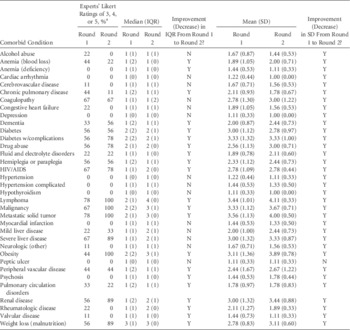
We selected 35 different comorbid condition categories from the CharlsonReference Deyo, Cherkin and Ciol 16 and ElixhauserReference Elixhauser, Steiner, Harris and Coffey 12 comorbidity indices to be considered as potential variables for risk adjustment of both CLABSI and SSI (Table 1). These specific variables were chosen because of their universal availability in hospital billing and administrative databases. Using a web-based survey tool, respondents were presented with all 35 comorbid conditions listed in alphabetical order. Separately for SSI and CLABSI, respondents were asked to independently rate each comorbid condition on a Likert scale from 1 (not at all related) to 5 (strongly related), based on their perceptions of causal relatedness with the outcome. Round 1 surveys were completed within 3 weeks; thereafter, each respondent received a personalized response summary showing their rating and the number of respondents choosing other Likert values (from 1 to 5), for all SSI and CLABSI variables. A conference call moderated by the principal investigator was conducted. The identical survey was repeated in a second round after the conference call to allow respondents to modify their ratings based on the conference-call discussion.
Descriptive Measures of and Changes Between Rounds in Expert Ratings of Perceived Causal Relatedness of Comorbid Conditions with Central-Line–Associated Bloodstream Infection (N=9)

NOTE. IQR, interquartile range; SD, standard deviation; HIV/AIDS, human immunodeficiency virus/acquired immune deficiency syndrome.
a Ratings were defined as follows: 1, not at all related; 2, minimally related; 3, somewhat related; 4, very related; 5, strongly related.
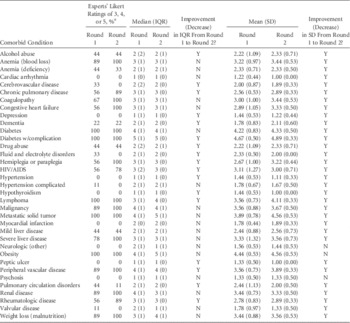
The following measures were calculated for each variable under consideration, separately for CLABSI and SSI: median and interquartile range (IQR), mean and standard deviation (SD) (Table 1). A rating of “3” by a majority of the experts was chosen as the causal relatedness threshold, ie, >50% of experts would need to rate a variable at 3 or higher (3–somewhat related, 4–related, or 5–strongly related). In addition, we assessed expert consensus development by the change in the interquartile range (IQR) and standard deviation (SD) of ratings between rounds 1 and 2. A decrease in IQR and SD indicated a decrease in the variability of the ratings and, therefore, increase in consensus. To assign the final expert consensus on causal relatedness for each comorbid condition, these 3 criteria had to be met at the end of round 2, and they were determined prior to the call: (1) a majority (>50%) of experts rating the condition at 3 or higher; (2) IQR≤1; and (3) SD≤1. Thus, we incorporated both the strength of the rating assigned to each condition and the consensus achieved among the experts.Reference Holey, Feeley, Dixon and Whittaker 17 Similarly, a comorbid condition was considered causally unrelated to the outcome if in round 2 a majority of experts rated the condition at 1, and it met the IQR and SD criteria above. The causal relation was considered indeterminate for the remaining comorbid conditions that were not clearly identified as related or unrelated based on the above criteria. Thus, the indeterminate category included conditions for which consensus was not achieved (IQR or SD>1 after round 2), or conditions rated “2” by most experts. During the conference call, it was apparent that experts had rated conditions at “2” when they were unsure of the relatedness to the outcome, which further validated this classification.
RESULTS
Overall, 9 experts from 8 different medical centers participated in both surveys and the conference call. During the conference call (lasting 2 hours), experts provided their rationale, separately for CLABSI and SSI, for rating each comorbid condition in round 1. More time was spent discussing ratings and rationale for conditions in which there were clear outliers, ie, those for which only 1–2 experts had rated the condition at either extreme (1 or 5) or for which the ratings ranged from 1 to 5. Examples of such variables are severe liver disease, coagulopathy, rheumatologic disease, and congestive heart failure, for both CLABSI and SSI. In contrast, there was less discussion regarding items with an existing consensus and similarity of ratings (regardless of strength of ratings) in round 1 (eg, peptic ulcer disease and other neurologic condition). Descriptive measures of the rating for each comorbid condition and changes in SD and IQR from round 1 to round 2 are presented in Table 1 for CLABSI and Table 2 for SSI.
Descriptive Measures of and Changes Between Rounds in Expert Ratings of Perceived Causal Relatedness of Comorbid Conditions with Surgical Site Infection (N=9)

Note. IQR, interquartile range; SD, standard deviation; HIV/AIDS, human immunodeficiency virus/acquired immune deficiency syndrome.
a Ratings were defined as follows: 1, not at all related; 2, minimally related; 3, somewhat related; 4, very related; 5, strongly related.
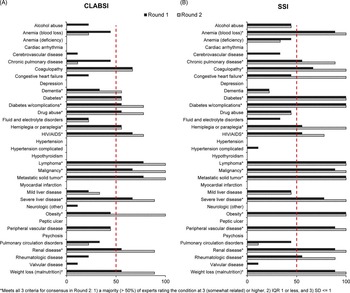
Between round 1 and round 2, the IQR and SD respectively decreased for ratings of 21 of 35 comorbid conditions (60%) and 34 of 35 comorbid conditions (97%) for CLABSI (Table 1); for SSI, and the IQR and SD respectively decreased for 17 of 35 comorbid conditions (49%) and 32 of 35 comorbid conditions (91%) (Table 2). Based on our criteria for expert consensus, at the end of round 2, 13 of 35 comorbid conditions (37%) and 17 of 35 comorbid conditions (49%) were perceived as causally related to CLABSI and SSI, respectively (Figure 1). Moreover, 29% of comorbid conditions were considered not causally related to CLABSI, and 23% were considered not causally related to SSI. The causal relatedness was indeterminate for 34% of comorbid conditions with CLABSI and for 28% of comorbid conditions with SSI.
Perceived causal relatedness; comorbid conditions by percentage of expert ratings between 3 (somewhat related) to 5 (strongly related). (A) CLABSI and (B) SSI.

DISCUSSION
Our study found that the Delphi method effectively led to the identification of ICD-based comorbid conditions perceived as causally related to CLABSI and SSI by expert consensus.
Current methods used by the National Healthcare Surveillance Network (NHSN) and the Centers for Disease Control and Prevention (CDC) for CLABSI risk adjustment consist solely of adjustment by the type of intensive care unit and aggregate duration of central venous catheter use.Reference Dudeck, Horan and Peterson 18 SSI adjustment methods are being updated continually. Prior methodology included adjustment for the American Society of Anesthesiologists (ASA) score, the duration of surgery and whether the procedure was categorized as clean, clean contaminated, or dirty.Reference Haley, Culver, Morgan, White, Emori and Hooton 19 The present methodology is procedure specific.Reference Mu, Edwards, Horan, Berrios-Torres and Fridkin 20 Although it is better than the previous methodologies, some researchers believe that CDC methods of risk adjustment for CLABSI and SSI can be further improved by including adjustment for patient-specific comorbid conditions.Reference Moehring and Anderson 10 , Reference Anderson, Chen, Sexton and Kaye 21 – Reference Bergen and Toney 23
Hospital electronic medical record capabilities are expanding. In addition, hospital databases are becoming more readily accessible to hospital epidemiologists, infection preventionists, and state and government agencies. Almost all institutions in the United States use ICD-10 codes for billing as required by CMS. Therefore, we believe that ICD-based comorbid conditions can be easily obtained electronically and hold great promise for HAI risk adjustment.
While it is tempting to analyze all comorbid conditions for which data are available as possible risk factors, caution must be exercised when conducting and interpreting tests of statistical association. Statistically significant results obtained from large datasets might not be biologically meaningful or necessarily indicate causality.Reference Rothman, Greenland and Lash 24 – Reference Harrell, Lee and Mark 26 Others suggest the identification of biologically plausible causal variables to be critical.Reference Greenland and Morgenstern 27 Thus, the Delphi method serves a critical role of identifying causal variables that should help guide model selection in risk factor studies and predictive modeling for risk adjustment. For this reason, our study is novel in using expert consensus to identify potentially causal variables that can guide appropriate use of results from statistical analyses of comorbid condition-outcome (SSI or CLABSI) associations and can guide future risk factor and risk adjustment studies. Using the Delphi method, not only were we able to incorporate the strength of the ratings for each variable selected by a majority, we also improved consensus as indicated by decrease in both the IQR and standard deviation between rounds 1 and 2.
This study was limited by a relatively small panel of experts; however, this size has been considered appropriate for a homogenous group.Reference Fitch, Bernstein and Aguilar 15 , Reference O’Leary, Lynch, Clancy, Winter and Myers 28 We only explored conditions that are components of the Charlson and Elixhauser scores. However, collectively, these scores include many important and relevant comorbid diseases. The Chronic Disease Score,Reference McGregor, Kim and Perencevich 29 , Reference Stevens, Concannon, van Wijngaarden and McGregor 30 which has shown promise in the field of antibiotic resistance, was not studied because of the lack of standardization in mapping medications in most electronic medical records. This lack of mapping makes the use of medication-based risk adjustment much more complicated; it is not currently feasible to incorporate it into national reporting systems such as the CDC NHSN system. Another limitation of our methodology is that the Delphi method uses group discussion that prevents anonymity of the expert panel. A limitation of our method is that we assessed surgical site infection as a whole and not site-specific surgical procedures, which may have distinct important risk factors.
In summary, we have identified comorbid conditions based on ICD classifications that can be used for future HAI risk-factor studies and future risk-adjustment studies. Large studies involving multiple hospitals exploring ICD-based risk-factor analysis and risk-factor adjustment are needed. We hope that the CDC strongly considers including ICD-based comorbid condition risk adjustment in the near future.
ACKNOWLEDGMENTS
Financial support: This study was supported by the Agency for Healthcare Research Quality (grant no. R01HS022291).
Potential conflicts of interest: All authors report no conflicts of interest relevant to this article.