

On 24 March 2013, the government of Cyprus reached an agreement with the International Monetary Fund (IMF) and European creditors to avert a complete and irreversible collapse of its currency and economy at the absolute eleventh hour. Relative to other Eurozone economies that had reached similar agreements with the IMF and international creditors, the terms meted out to the Cypriot government as conditions for the loans it received were much harsher, leading many citizens of that country to complain of unfair treatment, and analysts to conclude that “the Cypriots held out too long.”Footnote 1 But why would a government facing dire economic consequences resist seeking help? This article seeks to answer this important question in comparative and international political economy by focusing on the determinants of IMF program participation. Specifically, as in the recent Cypriot case, two general questions are pertinent. Why do some states participate in IMF programs while others do not? And why do some states enter into IMF programs when experiencing less severe economic distress, while others seemingly require harsher signals before seeking IMF assistance?
A statutory function of the IMF is to serve as the lender of last resort for countries with balance of payments problems.Footnote 2 Yet while most countries entering into IMF programs do suffer balance-of-payments problems, not all countries with balance-of-payments problems enter into IMF programs. Nor is it the case that all participating countries suffer equally critical balance-of-payments problems. Some countries are willing to participate even when their balance of payments, foreign debts and foreign reserves are sound (Vreeland Reference Vreeland2003). Just as interestingly, participating countries appear to heed different warning signs: some participate in IMF programs when key economic indicators dip, while others require these same indicators to plummet before seeking help.
The recent global economic crises provide plentiful anecdotes to illustrate the puzzle in which we are interested, of which Cyprus is merely the most recent. Going back to 1997, for instance, one notes that the countries most affected by the Asian Financial Crisis had very different approaches to the possibility of IMF assistance even though the roots of their problems were similar. Malaysia initially considered IMF program participation, yet ultimately chose not to participate, resorting instead to its own heterodox adjustment measures. In contrast, Thailand, Indonesia and South Korea all entered into IMF programs. But while Thailand and Indonesia went to the IMF for help before their crises grew too severe, South Korea resisted participation until it was literally on the brink of national bankruptcy. The more recent global financial crisis has further diversified the IMF’s portfolio of clients, as many developed countries have been forced to seek IMF loans, yet the empirical record indicates a similar pattern of different degrees of willingness to do so. Perhaps the most dramatic example of the reluctance to seek help comes from Iceland, which, seemingly overnight, went from being a financial success story to the brink of national bankruptcy. Yet even as the Icelandic krona depreciated precipitously, the Icelandic government publicly refused to contemplate the possibility of seeking the IMF’s help until it was forced to reconsider when it had no other alternatives and considerably diminished bargaining leverage.
This article explains these varied paths to IMF program participation by focusing on the political decision making of a participating government. Consistent with extant scholarship, we expect governments to wish to avoid paying the ‘sovereignty costs’ associated with signing an IMF agreement. But we also identify a second political consideration, which we label ‘competency costs’, which are incurred when a government is seen as unable or unwilling to make the difficult decisions––including possibly seeking outside help—required to rescue a rapidly worsening economy. Our hypotheses highlight the changing trade-off between these two types of domestic political costs as economic conditions fluctuate and the differing responses to this trade-off by different regime types. Specifically, we contend that when an economic crisis is mild, sovereignty costs outweigh competency costs. Thus a government that is sensitive to the political costs will be less willing to participate in an IMF program. In comparison, as economic conditions worsen, competency costs grow larger than sovereignty costs, and a government that is sensitive to the political costs will be more likely to participate in an IMF program. In other words, the response of a government to the same economic conditions is contingent on its sensitivity to the trade-off between these two domestic political costs. We posit that democratically elected governments should be more sensitive, ceteris paribus, to this trade-off than non-democratic governments. Accordingly, non-democratic governments should react more consistently to economic stimuli, while democratic governments should delay the pain associated with IMF austerity programs as long as they can until they begin to run the risk of being viewed as incompetent, at which point, like Cyprus, they will enter a program (though now at a greater disadvantage). A statistical evaluation using an updated version of the IMF program dataset originally developed by Vreeland (Reference Vreeland2003) finds robust support for our hypotheses. Specifically, we find that, when an economic crisis is mild, non-democracies are more likely than democracies to participate in an IMF program; yet when economic crisis worsens, democracies are more likely to participate in an IMF program than non-democracies. We attribute this difference to the electoral accountability mechanism central to democratic governance. In an auxiliary analysis, we test this causal mechanism directly. Democracies, we show, are less likely to enter IMF programs in election years except when they face economic crisis. Simply put, democratic leaders prefer to avoid the pain associated with IMF conditionality when they can, but recognize that crises can hurt their political survival too, especially if they are perceived as not seeking available help.
This article is the first to identify the perverse incentives created by democratic accountability for leaders to seek external assistance from international creditors, of which the IMF is the largest and most significant, even at the risk of further damage to the national economy. As such, our findings contradict the conventional wisdom that IMF programs serve as useful scapegoats for democratic governments that lack the ‘political will’ required to push through difficult economic reforms. That logic would suggest that democratic governments should be willing to enter IMF programs at less severe signs of economic crisis. Rather, our theoretical argument explains (and the empirical results suggest) that democratic governments’ sensitivity to sovereignty costs is considerable and leads them to avoid IMF programs until the competency costs associated with economic failure dominate politicians’ considerations.
We organize the article as follows. The next section discusses the relevant extant scholarship on IMF program participation, focusing principally on prior studies of political factors.Footnote 3 We then introduce our theoretical argument, which is based on a formal model, and present the hypotheses to be tested. We then discuss the statistical model and data used to test the hypotheses and present our results. A penultimate section provides evidence for our electoral accountability causal mechanism. The conclusion summarizes our findings, considers their policy and normative implications, and suggests future research directions.
THE DETERMINANTS OF IMF PROGRAM PARTICIPATION: A BRIEF LITERATURE REVIEW
Current research on the IMF by political economists has focused on evaluating the consequences of IMF programs on economic growth (Vreeland Reference Vreeland2003; Dreher Reference Dreher2006), public spending (Nooruddin and Simmons Reference Nooruddin and Simmons2006), foreign investment (Jensen Reference Jensen2004; Edwards Reference Edwards2006) and economic reform (Pop-Eleches Reference Pop-Eleches2008; Stone Reference Stone2002), with a new wave of work focused on the design of conditionality programs (Caraway, Rickard and Anner Reference Caraway, Rickard and Anner2012; Dreher and Jensen Reference Dreher and Jensen2007; Dreher, Sturm and Vreeland Reference Dreher, Sturm and Vreeland2009). In contrast with this increasingly sophisticated research agenda on the effects of IMF programs, theoretical models of the political considerations that lead countries to reach agreements with the IMF in the first place are comparatively undertheorized. The key problems, we believe, are (1) inadequate attention to a borrowing country’s decision making and (2) existing studies’ attempts to consider the political and economic determinants of an IMF program in a simply additive fashion.
IMF programs require an agreement between the IMF and a borrowing country. While scholars are increasingly interested in understanding the IMF’s decision making, usually within the principal-agent framework, we focus our attention on studies that concentrate on explaining the government’s decisions.Footnote 4 Earlier works on IMF program participation have identified the main indicators of economic distress associated with a ‘need’ for IMF help, and more recent studies emphasize the domestic political considerations associated with heeding these economic distress signals.
The most robust predictor of IMF program participation has been whether a country experiences negative economic growth. Negative growth is a good indicator of overall structural weaknesses in a country’s economy, and is likely correlated with several other indicators of economic distress. Even when controlling for more specific economic factors, empirical studies of IMF program participation find a significant effect for negative and poor economic growth (Barro and Lee Reference Barro and Lee2005; Bird Reference Bird1996; Edwards Reference Edwards2006; Jensen Reference Jensen2004; Knight Reference Knight and Santaella1997; Nooruddin and Simmons Reference Nooruddin and Simmons2006; Pop-Eleches Reference Pop-Eleches2008; Stone Reference Stone2008; Sturm, Berger and de Haan Reference Sturm, Berger and de Haan2005; Thacker Reference Thacker1999; Vreeland Reference Vreeland2007).
While growth rates are a useful summary indicator of a country’s economic health, scholars also identify specific economic conditions that should make it more likely that a country will approach the IMF for help. Three in particular are worth noting: the country’s balance of payments deficits, level of foreign currency reserves and level of foreign debt. While there are theoretical reasons for the importance of each in whether a country seeks IMF loans, empirical research finds the greatest support for the importance of foreign reserves: states with low reserves are particularly likely to ask for assistance (Barro and Lee Reference Barro and Lee2005; Nooruddin and Simmons Reference Nooruddin and Simmons2006; Sturm, Berger and de Haan Reference Sturm, Berger and de Haan2005; Moser and Sturm Reference Moser and Sturm2011; Thacker Reference Thacker1999; Vreeland Reference Vreeland2007).
Leading IMF scholars note that the explanatory power of statistical models with only these economic indicators is quite limited (Bird Reference Bird2003; Vreeland Reference Vreeland2007). To augment the explanatory power of IMF program participation models, political economists have argued that the decision to approach the IMF for assistance is political, and therefore that domestic political factors must be taken into account.
The leading contributor to this perspective is Vreeland (Reference Vreeland2003), who argues that there may be other reasons to participate in an IMF program than mere financial needs. He contends that borrowing governments may want to borrow from the IMF not because they are in dire need of financial resources, but because reform-minded governments may need to tip the balance against domestic opposition to IMF conditionality. He argues that partnering with the IMF can strengthen governments’ reform initiatives, as having the IMF on their side can increase the costs of rejection for domestic opposition. Rejecting the IMF is costly to domestic opposition in at least three ways. First, it directly limits the country’s future access to IMF resources. Second, it sends negative signals to creditors, making them less likely to roll over existing loans. Finally, it sends negative signals to future investors (Vreeland Reference Vreeland2003, 53). Thus when a country faces stronger domestic opposition, it may want to bring in the IMF. Vreeland’s empirical findings suggest that this reasoning is plausible. Specifically, countries with greater numbers of domestic veto players, which should make reform harder to initiate, are more likely to sign IMF programs.
Yet there are political costs of bringing in the IMF. Vreeland (Reference Vreeland2003) acknowledges that borrowing governments are also sensitive to the so-called sovereignty costs of bringing international actors, such as the IMF, to cope with economic problems. These are costly for a government, as domestic opposition can accuse the borrowing government of selling the country out to foreign interests, especially since the austerity conditions associated with these programs are likely to be quite unpopular, as is the dominance of the United States and other Western countries in the IMF’s decision making. Empirical studies often find that prior customers are more likely to borrow from the IMF than are countries without prior IMF experience (Bird, Hussain and Joyce Reference Bird, Hussain and Joyce2004; Conway Reference Conway2007; Jensen Reference Jensen2004; Moser and Sturm Reference Moser and Sturm2011). The so-called revolving door has been interpreted as evidence of sovereignty costs, since repeat customers of the IMF should suffer lower sovereignty costs and thus be less sensitive to them than “IMF program virgins.” Moser and Sturm (Reference Moser and Sturm2011) also report that one of the most consistent political variables in determining IMF program participation is election timing. They show that countries are more likely to participate in an IMF program soon after an election, hoping that they will have enough time to recover from sovereignty or austerity costs before the next election.
Explanations focusing on domestic political considerations therefore pull in different directions. On the one hand, the IMF might serve as a useful scapegoat for leaders who need to initiate painful austerity measures, but on the other hand, governments risk incurring sovereignty costs associated with giving up control over economic policy making. We believe that one fruitful way to reconcile these two competing political factors is to consider the interactions between economic and political circumstances.
THEORY: GOVERNMENTS AS COMPETENT STEWARDS OF THE ECONOMY
Our argument expands on existing domestic political arguments.Footnote 5 In particular, we highlight the trade-off between the sovereignty costs of IMF program participation and what we term “competency costs,” which accrue when the government is blamed for not seeking the IMF’s help when the economic crisis becomes increasingly dire. By identifying this latter cost feared by governments, and analyzing its trade-off against sovereignty costs, we provide a more nuanced political account of IMF program participation that can explain why some governments seek help from the world’s ‘lender of last resort’ given economic stresses, while others choose to go it alone when faced with similar conditions.
When a government seeks (and ultimately secures) a loan from the IMF, it can use the loan for economic recovery. But the loan comes with political ‘sovereignty costs’ that stem from a perceived dilution of the country’s sovereignty resulting from its entry into an IMF program. As Vreeland (Reference Vreeland2003) contends, the government can tip the balance against the domestic opposition by bringing in the IMF and blaming it as the source of painful economic reforms, thus diverting popular frustration. While certainly plausible, involving the IMF in order to tip the balance against domestic opposition can also backfire, as the opposition can blame the government for yielding its sovereignty to a technocratic international organization that is not politically accountable to the nation’s citizens. The IMF typically requires various policy reform measures called conditionalities to fix fundamentals of the economy; the opposition can frame pursuing these reforms as the government delegating its policy-making autonomy to IMF technocrats. Such criticisms are louder the greater the discrepancy between the government and the IMF in the diagnosis and prescriptions for economic and institutional reforms. That is, the more the IMF program departs from what the government would or could have attempted on its own, the more the government can be blamed for the hardships accompanying the IMF’s conditionality-laden programs.
We agree that governments incur sovereignty costs when they approach the IMF for help, but these are not the only kind of political costs when the government weighs IMF program participation. In fact, there are other domestic political costs when a government chooses not to seek IMF help in times of economic crisis. When a government does not seek IMF assistance in the midst of an economic downturn, thereby risking a deepening economic crisis, the government suffers from another kind of domestic political cost: competency costs. Governments are expected to deliver solutions to a crisis, or, minimally, to be seen as taking decisive action in order to solve the problems that afflict the economy. When the government lets the economic crisis worsen without taking any substantial initiatives, it will be solely blamed for the worsening economy (Lewis-Beck and Paldam Reference Lewis-Beck and Paldam2000).
The government therefore needs to weigh the relative costs of participating (‘sovereignty’) vs. not participating (‘competency’) in an IMF program. We assume that the sovereignty costs do not change much depending on the economic conditions. That is, the dilution of sovereignty by (at least partially) delegating policy-making authority to the IMF does not change much as economic conditions worsen. This is because the discrepancy between the necessary policy reform measures that the IMF recommends and those the government would have implemented without IMF intervention does not increase as economic conditions worsen. This does not mean that policy reform measures themselves do not vary by economic conditions. They do. But the discrepancy between the IMF’s and the government’s policy prescriptions is not likely to increase, as both would push for stricter reform measures as economic conditions worsen.
Yet the pay-off of not having an IMF program for the government, either by not requesting one or by having a request rejected, is a function of the country’s economic distress. As economic conditions worsen and the government is perceived as doing nothing, the cost of non-participation increases. Thus we contend that the competency costs increase as economic conditions worsen, and decrease as economic conditions improve.
In sum, there is a critical trade-off between the two domestic political costs, depending on economic circumstances. When an economic crisis is mild, sovereignty costs outweigh competency costs. When an economic crisis is severe, competency costs increase drastically and can surpass sovereignty costs (see Appendix 1 for a formal model establishing these points).
The second part of our theory deals with how governments respond to the changing trade-off between the two political costs. That is, not all leaders and governments are equally sensitive to the potential domestic political costs. Existing political science scholarship, including that applied in the IMF literature, identifies political institutions, such as democracy, as a primary determinant of whether (and how much) politicians worry about incurring the wrath of citizens. We adopt that reasoning and argue that the two kinds of domestic political costs we have identified as relevant to the decision about whether to engage IMF participation are refracted through political institutions to affect executives’ decisions to approach the IMF in times of economic crisis. To the extent that citizens factor economic performance and national sovereignty into their evaluation of incumbents, governments that rely on citizen support to retain power, such as democracies, will place greater weight on the trade-off between the sovereignty costs and the competency costs. In a mild crisis, or during earlier stages of a crisis when its potential severity is still uncertain, the perceived sovereignty costs should be larger than the competency costs, so governments that are sensitive to domestic political costs will be more reluctant to participate in an IMF program than governments that are less sensitive to domestic political costs. On the contrary, when the crisis is severe, or as it deepens, the competency costs associated with a failure to stem the downward spiral grow larger than any potential sovereignty costs associated with seeking the IMF’s assistance. In this situation, governments that are sensitive to domestic political costs will be more willing to participate in an IMF program than those that are less sensitive to domestic political costs. Thus while a worsening economic crisis generally motivates a government to participate in an IMF program, the likelihood of program participation should also vary by type of political institutions. The key insight here is that the influence of political institutions on IMF program participation is not just additive to economic conditions but interactive: the effect of political institutions on IMF program participation is conditional on the severity of the crisis, a possibility that the existing literature has thus far ignored. The preceding theoretical framework generates the following testable following hypotheses:
Hypothesis 1: When the economic crisis is mild, as the government’s sensitivity to political costs increases, the less likely it will be to participate in an IMF program. However, when the economic crisis is more serious, the greater the government’s sensitivity to political cost, the more likely it will be to participate in an IMF program.
Hypothesis 2: As an economic crisis worsens, the greater the probability that the IMF and a country will agree to an IMF program.
The first hypothesis is particularly interesting, novel and counterintuitive. A government’s sensitivity to either sovereignty costs or competency costs has a conditional effect on the probability of an IMF program. When the crisis is deemed manageable through purely domestic measures, then the government fears less damage to its reputation for being competent at economic management. With fewer potential competency costs feared, sovereignty costs loom larger in the government’s calculations, so more politically sensitive governments are less likely to participate in an IMF program than less politically sensitive governments. Either they may choose simply not to initiate a negotiation with the IMF, or they might demand a larger loan with fewer strings attached than the IMF is willing to accept. Our prediction thus agrees with the conventional expectation that politically vulnerable governments resist IMF programs due to sovereignty costs, but only when the economic crisis is mild.
Crucially, our argument reveals that sensitivity to IMF help is conditional on the nature of the economic crisis. In fact, as the crisis deepens, the above calculus under milder economic crisis changes. A worsening economy increases the competency costs to be paid by the incumbent government. These costs, stemming from a reputation of having presided over a major economic meltdown and being perceived of incapable of marshaling an economic rescue package, come to outweigh any sovereignty costs associated with approaching the IMF. Therefore, as the economic situation worsens, more politically sensitive governments become more (not less) likely to participate in an IMF program than their less sensitive counterparts. Given the political imperative of appearing to be doing what it needs to do in order to stem further economic decline, a politically sensitive government will be more flexible in its negotiations with the IMF and will therefore be more capable of reaching an agreement on an IMF program. In comparison, a less politically sensitive government is freer from such a political backlash and is therefore in a position to push for a better bargain with the IMF or walk away from the negotiation table. Given larger flexibility on a loan package for a politically sensitive government, the IMF and the government are more likely to enter into an IMF agreement.
In sum, our argument suggests that more politically sensitive governments are more responsive to a severe economic crisis than less politically sensitive governments, even as they are less likely to enter IMF programs when the crisis is less severe. Our theory therefore builds productively on existing frameworks to provide a plausible answer to the puzzle that motivates our research: the conventional wisdom that politically sensitive governments are less likely to participate in IMF programs holds only when economic conditions are mild. When they worsen, we argue that politically sensitive governments are more likely to participate in IMF programs than less politically sensitive governments.
EMPIRICAL ANALYSIS: WHY AND WHEN DO COUNTRIES ENTER IMF PROGRAMS?
The theoretical argument developed in the previous section encompasses the conventional wisdom of IMF program participation, but adds one important hypothesis. Previous scholarship suggests that the only domestic considerations relevant to governments are whether or not they get punished for the austerity measures associated with IMF programs, and, given such punishment, whether the government has sufficient political will to push through the much-needed (but painful) economic reforms. But this way of thinking ignores the conditions under which the government begins the conversation with the IMF in the first place. States are most likely to approach the IMF when they are facing an ongoing or potential economic crisis and when the government feels pressure to act. Citizens demand that their government protect them from economic turmoil, and the last thing a government can afford to do is nothing at all. Left with few alternatives besides an IMF program, the government must therefore weigh the competing costs of the domestic unpopularity it might suffer on account of the economic reforms that will be required in exchange for a loan (the sovereignty costs) with the backlash it would suffer if it did nothing and the economic crisis worsened (the competency costs).
We capture a government’s sensitivity to domestic political costs with the country’s degree of democracy, which builds on the core comparative politics notion that more democratic governments are more sensitive to domestic political costs. This is because the political survival of democratic leaders is more heavily dependent on citizens in democracies than in non-democracies (Bueno de Mesquita et al. Reference Bueno De Mesquita, Smith, Siverson and Morrow2003). Democratic governments are most sensitive to such domestic concerns on account of their formal accountability mechanisms. This has led previous scholars to suggest that democracies should always be more reluctant to pay the sovereignty costs associated with IMF programs and therefore always to be less likely to enter IMF programs. On the other hand, democratic governments are likely to have more veto players, and following Vreeland’s tipping the balance argument, more veto players should trigger democratic governments to willingly participate in IMF programs to use the aegis of the international financial institution against domestic naysayers. Thus these two reasonable arguments provide competing predictions with regard to the effect of democratic political institutions on the probability of an IMF program. Our theoretical argument resolves these competing predictions by providing conditions under which democracies should be more or less likely to enter IMF programs.
Our model makes clear that existing rationales, while sound, miss another important dimension of this decision process: that a democratically elected government will also feel greater pressure to act decisively to head off economic crisis, especially when the crisis is considered acute. Thus the hypothesized relationship between democracy and the probability of IMF program participation is non-linear and conditional on the state of the economy.
To test the hypotheses we proposed in the previous section, we estimate a series of logistic models predicting whether or not an IMF program is signed between a government and the IMF in a given year, conditional on whether it was already in such a program in the previous year. Our data cover all countries for which information on IMF programs is available. Data for IMF program participation until 2004 come from Vreeland (Reference Vreeland2003), and we have updated these data through 2006. We limit our sample to non-concessional lending, since concessional loans provide long-term development financing rather than short-term balance-of-payments financing to countries experiencing financial crises.Footnote 6 The resulting dataset spans 1970 to 2006.
Given our theoretical model, we collect data on three types of independent variables: economic risk indicators, IMF considerations and domestic political factors. To capture the objective risk of an economic crisis that might necessitate an IMF program, we gather data on four separate indicators of economic performance that are commonly identified in the existing literature (Bird, Hussain and Joyce Reference Bird, Hussain and Joyce2004; Nooruddin and Simmons Reference Nooruddin and Simmons2006; Moser and Sturm Reference Moser and Sturm2011; Vreeland Reference Vreeland2003). First, we measure the country’s current account balance (as a share of GDP) since it is the most common theoretically indicated measure of economic trouble, though the empirical evidence for this measure is mixed in the existing literature. More certain, by contrast, is that countries facing foreign exchange shortages are likely to turn to the IMF for loans that ease their liquidity. We therefore collect data on the size of the country’s foreign exchange reserves in terms of the number of months of imports they can cover. Third, the country’s debt service burden (as a share of its exports) is an important indicator of its need for liquidity. As the debt burden grows, states must borrow even more to meet their obligations, and the risk of them defaulting on their loans increases. Finally, as a summary indicator for the health of the overall economy, we create a variable for whether the country had negative GDP per capita growth in a particular year. We treat these four variables as distinct indicators of the same underlying concept of economic distress, and so include them separately in the regression models below. Our key results do hold if we include the full set simultaneously, though doing so increases the variability of the estimates due to induced multicollinearity.
Next we turn to the IMF’s considerations. We expect the IMF to be more sensitive to large economies whose troubles are more likely to ripple across the global economy. We therefore control for the size of the country’s gross domestic product (GDP). Further, following recent scholarship, we include a measure of a country’s affinity to the United States (Barro and Lee Reference Barro and Lee2005; Dreher and Jensen Reference Dreher and Jensen2007; Thacker Reference Thacker1999). We use the country’s UN voting record-based s-score to measure this affinity, and the expectation is that countries closer to the United States should be more likely to get IMF programs, as the United States uses its considerable clout at the IMF on behalf of its friends (Signorino and Ritter Reference Signorino and Ritter1999). Finally, we measure the IMF’s budget considerations by calculating the number of IMF programs it has in place simultaneously in a given year. The expectation is that, given its budget constraints, the IMF should be less eager to conclude new programs when it already has a large number in place.
Finally, we account for domestic political factors.Footnote 7 A country’s sensitivity to sovereignty costs is modeled by the length of time that has elapsed since its last entry into an IMF program. The intuition is that sovereignty costs associated with a new program should be lowest when countries have just paid these costs for an earlier program (Bird, Hussain and Joyce Reference Bird, Hussain and Joyce2004).Footnote 8 The government’s sensitivity to domestic political pressures is captured by a dichotomous indicator for democracy, in which we code countries as democratic if they score 7 or higher on the combined Polity regime type scale (Jaggers and Gurr Reference Jaggers and Gurr1995).Footnote 9
Data for the economic variables come from the World Bank’s World Development Indicators and the IMF’s Government Finance Statistics. Data on IMF program participation and type are from Vreeland (Reference Vreeland2003) and our own coding. Data on affinity to the United States are generated using EUGene (Bennett and Stam Reference Bennett and Stam2000), and data on regime type are from Polity (Marshall, Jaggers and Gurr Reference Marshall, Jaggers and Gurr2010). Summary statistics for all variables used in the empirical analysis are provided in Appendix 2.
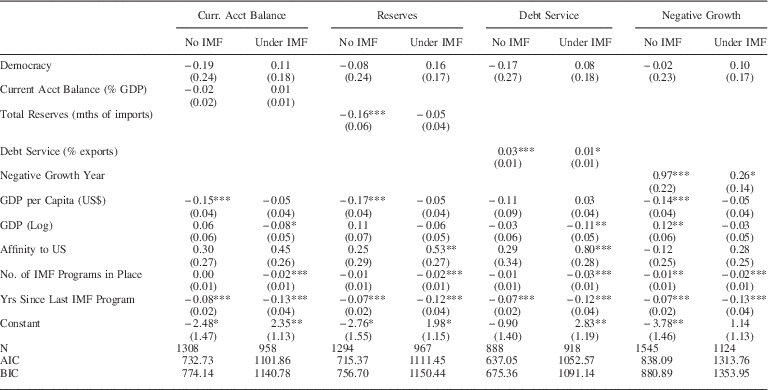
We begin by estimating a baseline model of IMF program participation. To account for the dynamic properties of the data-generating process, we divide the sample according to whether or not the country was under an IMF program in the previous year (Amemiya Reference Amemiya1985). The resulting model is a dynamic logit.Footnote 10 The results are presented in Table 1. Results in the ‘No IMF’ column are from a model of the probability of signing an IMF program if a country was not under an IMF program in the previous year. Those in the ‘Under IMF’ column are for the sample of country-years in which the country was under an IMF program in the previous year.
Baseline Models of IMF Participation

Note: logit coefficients with standard errors in parentheses corrected for clustering by country. *p<0.10, **p<0.05, ***p<0.01
The results in Table 1 confirm our basic intuitions of what factors lead countries into IMF programs. First consider the results for each crisis indicator when countries were not in an IMF program in the previous year. Of the four economic indicators of economic distress that might lead countries to seek help from the IMF, only current account balance is not statistically significant. However, consistent with previous research, we find that a strong foreign reserve position is the best prophylactic against IMF programs, that increasing debt burdens are positively linked to IMF program participation and that a negative growth year is a strong predictor of entering an IMF program. The finding confirms our claim that economic growth is a good summary indicator of economic situation. The results also provide strong statistical support for the claims that richer countries are less likely to seek IMF help, and that the passage of time since the last IMF program makes it more likely that countries will return to the IMF for help.
Turning to the model of immediate recidivism (since these are countries that are signing a new IMF program despite being in one in the previous year), the relationships between the independent variables and the probability of signing an IMF program change in instructive ways. The economic stress indicators are no longer statistically significant at conventional levels, though debt burdens are so at a less stringent 0.10 level. Instead, the main drivers of recidivism appear to be organizational imperatives. First, the number of other IMF programs in place globally is negatively and statistically significantly related to IMF program renewal. This finding suggests that the IMF is less likely to promote recidivism when its budget is being stressed by having a large number of ongoing programs. Second, affinity to the United States positively predicts being able to sign a new program despite having been in one the previous year. This supports claims that the United States uses its influence over the IMF to reward its allies (Barro and Lee Reference Barro and Lee2005; Dreher and Jensen Reference Dreher and Jensen2007; Thacker Reference Thacker1999). Taken together, these last two findings suggest that the IMF’s imperatives might cut in conflicting directions: it faces genuine budget constraints, but must nonetheless accommodate the preferences of its most important donor.
Finally, we note that democracy is never a significant predictor of IMF program participation. This is in contrast to previous scholarship to some degree, but is predicted by our framework, which suggests that democracies and non-democracies react differently to similar economic stimuli when deciding whether to seek the IMF’s help.
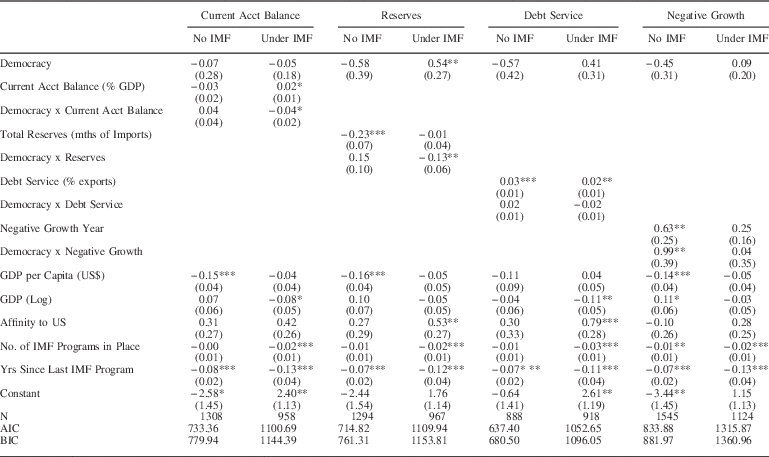
To test the main hypotheses, we explore the interactive effects of economic conditions and regime types. These results are presented in Table 2. Each of the four economic risk indicators is interacted with the dichotomous indicator of democracy. What do these results tell us? Since none of the results from the baseline variables substantially changes with the addition of the interaction terms, we focus our discussion on the evaluation of Hypothesis 1.
Conditional Models of IMF Participation
Note: logit coefficients with standard errors in parentheses corrected for clustering by country. *p<0.10, **p<0.05, ***p<0.01
To facilitate interpretation of the substantive effects from the interaction terms, we calculate the predicted probabilities of IMF participation using the coefficient estimates from Table 2.Footnote 11 These are presented in Table 3.
Marginal Effects: How Democracies Respond to Crisis

Note: cell entries are marginal effects of economic indicators depending on whether a country is a democracy or not and whether it was under an IMF program in the previous year. Marginal effects are calculated using the margins command in Stata and are based on the estimates from Table 2. Standard errors for the marginal effects are reported in parentheses. *p<0.10, **p<0.05, ***p<0.01
We begin our discussion of the interactive results with the ‘No IMF’ columns in Tables 2 and 3. As before, current account balance does not predict IMF program participation, but reserve positions, debt burdens and negative growth do. Democracies do not respond any differently than their non-democratic counterparts to the first two of these stress indicators. Stronger reserve positions make all regime types less likely to approach the IMF; higher debt burdens make them more likely. But the story is different when it comes to economic growth. Negative economic growth rates make both non-democracies and democracies more likely to approach the IMF, but their effect is more than doubled in democracies. This provides strong support for our argument that democracies seek the IMF’s help when economic conditions worsen because of fear of domestic political repercussions.
The ‘Under IMF’ columns subtly bolster this intuition. Recall that these columns estimate the probability of signing a new IMF program when a country was already under one in the previous year. Such continuation of economic ‘pain’ should be less welcome in democratic regimes. And one sees this in how democracies respond to improving economic conditions. As the current account balance improves and reserves grow, democracies become less likely to sign a new IMF program. However, worsening debt burdens and continued negative growth make maintaining the status quo more likely. Overall, the results thus provide strong support for our principal hypothesis. Democracies are more sensitive to extremely severe economic crises that affect the entire economy. Further, the political calculus that we highlight matters most when a government considers a new IMF program rather than a continuation of an existing program.
Controlling for the other economic conditions in our models focused on negative economic growth does not alter these conclusions. Figure 1 shows the predicted probability of IMF program participation at different foreign reserve and debt service levels.Footnote 12 The X coordinate represents the foreign reserves in months of imports, varying from 0 to 12, and the Y coordinate represents the debt service in months of exports, varying from 0 to 100. Thus the larger the X is and the smaller the Y is, the milder the economic crisis. Values along the Z axis represent the predicted probability of entering an IMF program given the country’s level of foreign reserves and debt service burden from 0 to 100 percent. The solid plane is drawn with positive-growth previous year and the hollow plane is drawn with negative-growth previous year. The left-hand graph is for non-democracies and the right-hand graph is for democracies.
Predicted probability of IMF program entry (3-dimensional)
As predicted, when economic growth is positive, democracies are less likely to sign an IMF program than their non-democratic counterparts, even given the same level of foreign reserves and debt service burdens. But as conditions worsen (specifically when the country experiences negative growth in a given year), democracies are considerably more likely to sign an IMF program than their non-democratic counterparts, even when other economic distress indicators are held constant. The negative growth effect, in other words, is a lot more salient in democracies than in non-democracies.
Overall, the predicted probabilities drawn in Figure 1 confirm conventional theories when the economic conditions are not dire. When the economic crisis is mild, non-democratic countries are more likely to participate in IMF programs. For instance, with positive economic growth in the previous year, when debt service level is about 30 percent of the yearly export and the foreign reserve level is low (affording only two months of imports), the predicted probability of IMF program participation is around 18 percent for non-democracies and 10 percent for democracies, holding other variables at their means. Most importantly, in any combination of debt service and foreign reserves, the probability of IMF program participation is higher for non-democracies than democracies when the previous year’s growth was positive.
The pattern drastically changes with negative economic growth in the previous year. While the probability of IMF program participation increases for both non-democracies and democracies, the increase in the probability is much greater for democracies than for non-democracies. With any combination of debt service and foreign reserves, the probability of participation is always higher for democracies than for non-democracies. When the economic problems grow very serious, for example, with 40 percent of debt service and one-month of exports in foreign reserves, the probability of IMF program participation is higher than 40 percent for democracies, which in turn is more than 10 percent percent higher than the corresponding probability for non-democracies.
EXPLAINING THE DIFFERENCE: AN ELECTORAL CONNECTION
Democracies are more likely to enter IMF programs when economic conditions worsen. But why? We have argued that this is because democratically elected leaders must worry about perceptions of their competence at handling economic crisis. While leaders prefer to avoid the costs of conditionality whenever possible, a leader who is seen as avoiding difficult choices as the economy worsens is vulnerable to criticism from the opposition and punishment by voters. Especially visible signals of the worsening economy, such as a negative growth rate, amplify these concerns, while more complex indicators such as current account balances, reserve positions and debt burdens, while vitally important for a country’s economic health, are less obvious to voters. Leaders therefore do not respond differently to such indicators across regime types, but they do to negative growth.
In this brief section, we provide additional evidence in support of the implicit causal mechanism. Our argument hinges on the electoral vulnerability of democratic leaders. An observable implication of this logic is that leaders should be particularly eager to seek the IMF’s help as elections draw near. No leader wants to enter an election season with the economy in crisis, but if so, he or she must signal their comitment to solving the crisis by seeking all available means of help. Note that this argument cuts in the opposite direction to arguments that privilege ‘sovereignty costs’, since those would suggest that leaders should avoid the IMF at all costs at election time. Our argument instead predicts that leaders weigh sovereignty costs against competency costs. If economic conditions are tolerable, then democratic leaders should avoid the IMF’s conditionality-laden help as elections approach, but when the economy is in freefall, the logic inverts and democratic leaders should change their tune.
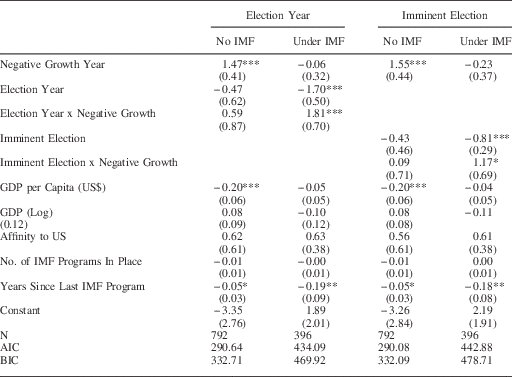
To test this logic, we limit our sample to countries scoring 7 or higher on the Polity scale that ranges from −10 to 10, which is the conventional threshold for a full-fledged democratic system. We use the World Bank’s Governance Indicators dataset to code two election variables. The first, Election Year, is coded 1 if the country is in an election year, and 0 otherwise. The second, Imminent Election, is coded 1 if the country is within two years of an election, and 0 otherwise. We replace the Democracy variable in the earlier models with these election variables, and interact them with the economic crisis indicators. Table 4 presents the results of this analysis.
Elections and IMF Participation
Note: logit coefficients with standard errors in parentheses corrected for clustering by country. *p<0.10, **p<0.05, ***p<0.01
Consider the first two columns first, which are the results from the ‘Election Year’ model. The first column considers the case of when the country was not under an IMF program in the previous year. The negative growth indicator is positively signed and statistically significant. Economic crisis in democracies leads leaders to seek the IMF’s help. Neither the election year variable nor the interaction is significant, which demonstrates that the negative growth imperative operates independently of election considerations when the country has not just been in an IMF program. However, when a country has been in an IMF program in the prior year, the logic changes. Now the election year indicator is negatively signed and statistically significant, indicating that leaders are loathe to incur conditionality costs when they have to contest elections. But if they are unfortunate enough to face an election when their economy is in crisis, they change tack and are more likely to sign an IMF program. The interaction term between election year and the negative growth variable is positive and statistically significant. These patterns are replicated in the last two columns, where we use an ‘Imminent Election’ indicator instead. As expected, the effect sizes are smaller than when we use the ‘Election Year’ variable, as the incumbent’s electoral vulnerability is lower the further away they are from an election.
This auxiliary analysis bolsters our confidence in the overall argument advanced in this article. We have shown that democracies behave differently from non-democracies in their response to economic crisis, and attributed this difference to different domestic political considerations. Limiting the sample to democracies, we have shown that election proximity drives leader behavior vis-à-vis the IMF. Together, the results provide strong support for our hypotheses and for the causal mechanism posited. We consider the implications of these results below.
CONCLUSION
IMF programs are designed to solve economic problems. As such, economic distress indicators are the best predictor of whether and when countries will seek the IMF’s help. But this help is politically costly, both because domestic opposition groups can gain advantage by portraying an IMF program as ceding sovereignty (for which the incumbent government should be blamed), and because the conditionality that accompanies the IMF’s help can inflict pain on domestic constituencies (for which the incumbent will also be blamed). No wonder, then, that governments that rely on popular support to retain power will try to resist taking the “bitter pill” as long as possible. This is precisely what the Icelandic government, proud of its history of financial independence and strength, tried to do for much of 2008, even after the country’s economic crisis appeared to be spiraling out of control.
Yet the same political calculations that made the Icelandic government reluctant to seek the IMF’s help eventually made doing so imperative. As the storm buffeting Iceland’s economy gained force, the government had to decide whether going it alone and preserving sovereignty was worth the risk of complete economic collapse under its watch. That choice, unpalatable to any democratic government, was clear; in late October 2008, facing national bankruptcy, the Icelandic government finally turned to the IMF.
The lessons of the Icelandic experience from 2008, or, indeed, the Cypriot experience from 2013, highlight the importance of paying attention to the political calculations underlying a decision to enter an IMF program. While political economists have recognized that ‘sovereignty costs’ deter governments from entering IMF programs, a countervailing political incentive has been missed––governments also fear paying the ‘competency costs’ if they are perceived as doing too little to avoid economic collapse. These contradictory impulses––to maintain autonomy but ensure economic security––are weighed differently by different political regimes and with interesting moral hazard implications.
Democratic governments prefer not to pay the high costs of IMF programs because these are politically unpalatable. Therefore, when they can avoid having to do so, they do. But as economic conditions worsen, democratic leaders fear being labeled incompetent for doing nothing to avert a full-blown extended crisis and are therefore spurred to action. Thus when conditions are particularly dire, democracies are more likely to sign IMF programs than their non-democratic counterparts. Further, these dynamics are accentuated as elections draw near; democratic leaders facing crisis are much more likely to approach the IMF if an election is imminent. Empirical evidence from a global sample of countries covering 1970–2006 supports this hypothesis.
The argument and finding reported in this article are important for our understanding of IMF program participation, and therefore of the IMF’s effects. Until now, the dominant explanation of how a country’s domestic politics affected IMF program participation was either that it made a country less likely to sign an IMF agreement or more likely to use the IMF as an aegis behind which to push through politically difficult economic reforms. We do not disagree with these explanations, and in fact agree that such considerations do affect states’ decision making—but only when economic conditions allow them to do so. When economic conditions become more dire, however, the domestic political calculus shifts in favor of action. Democratically elected leaders are especially vulnerable to this pressure to want to appear decisive, and are therefore more likely to enter IMF programs when the domestic economy is in serious trouble. The implication of this analysis is therefore that democratic leaders might often wait longer than their non-democratic counterparts to seek help from the IMF, and that this instinct might have the unintended consequence of making the situation worse in the long run. In international finance, as in many other walks of life, prevention might be better than cure, and inducing politicians to recognize this is an important task ahead for the IMF.
APPENDIX 1: A FORMAL MODEL OF IMF PROGRAM PARTICIPATION
The IMF program participation game is a complete information game with two players: the IMF and the government. Upon observing a realization of economic performance (r), the government decides whether or not to request an IMF program from the IMF. In reality, the negotiation for an IMF program is initiated either on the recommendation of IMF staff, often after an Article IV technical consultation, or by the request of a potential borrower. The process involves many rounds of negotiations between the IMF and the borrowing government. We simplify this process by assuming that the government makes an offer if it wants an IMF program, and that the IMF can either approve or reject the request from the government.Footnote 13
Participation game
The payoff of having no IMF program (that is, when there is no offer made by the IMF in the first place) for the IMF is normalized to zero. For the government, the pay-off of not having an IMF program, either by not requesting one or by having a request rejected, is a function of its economic performance. The payoff decreases as the economic crisis grows more dire, as the government is responsible for the worsening economic crisis and domestic opposition can label the government as incompetent, which represents a “competency cost.” We allow that different governments might weigh (discount) the competency cost differently. For instance, to the extent that citizens factor economic performance into their evaluation of incumbents, governments that rely on citizen support to retain power, such as democracies, will place greater weight on maintaining a reputation for being competent at managing the national economy (that is, they will be more sensitive to paying competency costs) than others, such as autocracies. The sensitivity to the competency costs is captured with the γ term.
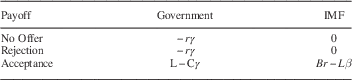
The game is illustrated in Figure 2. It begins when a government decides it needs to request assistance from the IMF. When the government makes a request L (size of the loan), the IMF gets to decide whether it wants to approve the request. If the IMF accepts the request, an IMF program is signed. When an agreement is reached, the government enjoys the economic benefits of the loan, L, but suffers a domestic political cost from having to agree to international assistance that results in the implementation of reform (conditionality) measures mandated by the structural adjustment program. Following the literature, we call these “sovereignty costs” since they stem from a perceived dilution of the country’s sovereignty resulting from its entry into an IMF program. Such programs, often called ‘austerity’ programs, are particularly unpopular since they typically result in short-term pain for constituents. The political cost (that is, loss of domestic support) is an increasing function of the scope of the reform measures (C) and the degree of government sensitivity to domestic political consequences of economic reforms, γ.
When γ is high, a government is sensitive to the consequences of its policy choice––whether it is a decision not to request an IMF program in times of economic crisis or a decision to sign an IMF program that involves politically unpopular reform measures. Conversely, when γ is low, a government is less sensitive to either of these costs.
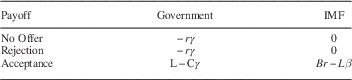
When an IMF program is signed, the IMF enjoys the benefit (B) from the program (for example, increased bureaucratic incentives, service to principals such as the United States, etc.) proportional to the size of the realization of the economic crisis. We assume here that when a country is in a deeper crisis, the potential benefit is higher for the IMF since the credit for rescuing the country from crisis will be greater, as will the IMF’s influence over the extent of economic reform via conditionality. We also assume that a signed program carries potential costs for the IMF. Here the cost is limited to financial risk in lending. Thus the cost to the IMF is proportional to the size of the loan multiplied by the probability of default (β). The payoff structure defined by this simple game is summarized in Table 5
Payoffs for Each Player
Solution
As the game assumes complete information, we can use the subgame perfect Nash equilibrium as the solution concept, and solve the game with simple backward induction. The IMF approves the request if and only if the payoff of doing so is larger than the payoff of rejecting the country’s request. Mathematically, this is
 $$Br{-}L\beta \geq 0.$$
Solving the equation with respect to the size of the loan, we get
 $$L\leq B{r \over \beta }.$$
Thus, given the political constraints, the IMF prefers to approve a loan request when the requested loan is smaller than the threshold,  $$L^{{*}} =B{r \over \beta }$$
. Conversely, when the loan requested by the government is larger than the threshold, the IMF rejects the request.
Moving to the decision by the government, when does the government offer L? First, note that the government always prefers to request the largest L that is going to be approved by the IMF. This is because the larger the size of the loan, the more benefits the government enjoys. Thus when a government requests a loan, it always offers L *. The government gets the same payoff of −rγ whether it makes a request larger than L * (which will be rejected by the IMF) or does not make a request in the first place. Therefore, the choice for the government is between requesting L *, which the IMF will approve, and receiving −rγ (the payoff from making no request or making one that will be rejected by the IMF).
The government makes an offer  $$L^{*} =B{r \over \beta }$$
if and only if the payoff of having an IMF program is larger than not having an IMF program. Mathematically this is:
 $$L{-}C\gamma \geq {-}r\gamma. $$
Solving the equation with respect to the size of the benefit for the IMF, we get
 $$B\geq {\beta \over r}(C{-}r)\gamma. $$
Lemma: When  $$B\geq {\beta \over r}(C{-}r)\gamma $$
, the government makes an offer of
 $$L^{*} =B{r \over \beta }$$
, which is approved by the IMF. When B<B *, the government prefers not to request an IMF program, resulting in no IMF program.
The probability of having an IMF program thus varies as β, r, C and γ vary. Most importantly,
Proposition: When C increases, B * increases. When r increases, B * decreases. When γ increases, B * increases if r is smaller (C > r). When γ increases, B * decreases if r is larger (C<r).
From this analysis, we can generate the following hypotheses:
Hypothesis 1: When the economic crisis is mild, as the government’s sensitivity to either political cost increases, the less likely it will be to participate in an IMF program. However, when the economic crisis is more serious, as the government’s sensitivity to either political cost increases, the more likely it will be to participate in an IMF program.
Hypothesis 2: As an economic crisis grows more serious, the more the IMF and a country are likely to arrange an IMF program.