Although antimicrobials substantially improve rates of patient morbidity and mortality, numerous negative downstream consequences can occur, including the emergence and spread of multidrug-resistant organisms (MDROs), Clostridium difficile infections, drug–drug interactions, and adverse drug events.Reference Karanika, Paudel, Grigoras, Kalbasi and Mylonakis 1 , Reference Tamma, Avdic, Li, Dzintars and Cosgrove 2 MDROs are particularly relevant to the population of maintenance hemodialysis patients because rates of colonization and infection in this population are among the highest among all patient populations.Reference Zacharioudakis, Zervou, Ziakas, Rice and Mylonakis 3 – Reference Song, Park, Kang and Lee 5 Furthermore, MDROs cause ~2 million infections and 23,000 deaths per year, with an annual excess cost to the medical system of $20 billion.Reference Marston, Dixon, Knisely, Palmore and Fauci 6 The ongoing spread of MDROs and emergence of novel antimicrobial resistance profiles further emphasizes their significant public health threat.
It has been estimated that 20%–50% of prescribed antimicrobials are not appropriate or not necessary. 7 The implementation of antimicrobial stewardship programs are an effective strategy toward decreasing unnecessary antimicrobial exposure and improving antimicrobial prescribing patterns. In the hospital and long-term care settings, antimicrobial stewardship programs have been shown to reduce antimicrobial prescribing by ≥20% and to reduce infections caused by MDROs and Clostridium difficile, adverse drug events and costs.Reference Karanika, Paudel, Grigoras, Kalbasi and Mylonakis 1 , Reference Baur, Gladstone and Burkert 8 In response to these data, the Centers for Medicare and Medicaid Services and the Joint Commission require antimicrobial stewardship programs in hospitals and nursing care centers, and similar requirements are under development for ambulatory care settings. 9
In dialysis facilities, ~30%–35% of antimicrobial doses administered are unnecessary.Reference Snyder, Patel, Kallen, Strom, Tucker and D’Agata 10 , Reference Hui, Nalder and Buising 11 Although antimicrobial stewardship programs have been established for hospital and long-term care settings, 7 programs targeting the unique aspects of outpatient dialysis facilities, where patients receive care at regular intervals, have not been developed. In this study, a multifaceted antimicrobial stewardship program was developed and implemented in 6 outpatient dialysis facilities, and its efficacy in decreasing antimicrobial use was evaluated.
Methods
Study design
Over a 28-month period, a quasi-experimental study was conducted in 6 outpatient dialysis facilities in the New Jersey area. The size of the facilities ranged from 35 to 95 patients. The antimicrobial stewardship program was implemented from July 1, 2015, to October 31, 2016, of which the first 4 months were considered the wash-out period, during which time the intervention was introduced. Rates of antimicrobial use per 100 patient months were compared to the 12-month preintervention period from July 1, 2014, to June 30, 2015. Data on antimicrobial use, patient demographics, comorbidities and clinical data were collected from the central electronic medical record database. The primary outcome was the monthly incidence rate of intravenous antimicrobial doses administered per 100 patient months. Secondary outcomes included rates of use for specific antimicrobials or antimicrobial groups. Negative outcomes, potentially associated with the implementation of an antimicrobial stewardship program, included rates of BSI and hospitalization because a decreased use of antimicrobials as a result of the program could potentially lead to increased rates of hospitalization or infection. Confounders included rate of tunneled catheters (because patients with catheters receive more antimicrobials than those without),Reference Snyder, Patel, Kallen, Strom, Tucker and D’Agata 12 the rate of methicillin-resistant Staphylococcus aureus BSI (because these would warrant vancomycin therapy), and the composite of facility-level quality measures: albumin, hemoglobin, phosphorus and calcium values, no catheter exposure >90 days, hospitalizations, readmissions and mortality rates. Higher values were more favorable. The Institutional Review Board of the Rhode Island Hospital and the organization approved this study. Informed consent was waived.
Antimicrobial stewardship program
The antimicrobial stewardship program had 4 main components. First, leadership support was obtained through discussions during one-on-one meetings and the unit-based program leader (ie, the nurse manager) in each unit was identified. Second, educational programs were conducted and led by the nurse educator, including didactic and informal sessions at each unit, which emphasized the overall importance of improving antimicrobial prescribing patterns. All unit staff members, including physicians, physician assistants, nurse practitioners, dialysis technicians, dieticians, and social workers, were invited to these unit-based sessions. A separate educational session was provided to the medical directors. These sessions focused on 3 areas previously identified as the most common reasons for inappropriate prescribing: (1) criteria for starting antimicrobials for a presumed BSIs, (2) criteria for diagnosing skin and soft-tissue infections, and (3) de-escalation or narrowing of antimicrobials (eg, from vancomycin to cefazolin in a patient with a methicillin-susceptible Staphylococcus aureus [MSSA] infection or from third- or fourth-generation cephalosporins to cefazolin in a patient with a cefazolin-susceptible bacterial infection).Reference Snyder, Patel, Kallen, Strom, Tucker and D’Agata 10 Educational posters and pocket cards containing the criteria for appropriate antimicrobial prescribing were also provided. Third, conference calls were conducted with all 6 clinical managers program leaders and the research personnel, including the infectious disease physician. During these monthly calls, review of all antimicrobial courses prescribed in the previous month were reviewed, focusing on indication for prescribing and type of antimicrobial prescribed. Recommendations were discussed for optimizing prescribing using national consensus guidelines by major infectious disease and nephrology societies.Reference Snyder, Patel, Kallen, Strom, Tucker and D’Agata 10 , 13 – Reference Dellinger, Gross and Barrett 26 During each call, the importance of reviewing microbiology reports and antimicrobial susceptibility data, to de-escalate antimicrobials, was emphasized. Feedback regarding prescribing practices was also provided during these calls. Lastly, to facilitate the engagement of all healthcare workers and to promote a cultural transformation in antimicrobial prescribing, the positive deviance process was implemented. Positive deviance is a social and behavioral change process founded on the observations that there are individuals in organizations whose uncommon (deviant) practices generate better (positive) results than those of their peers.Reference Pascale 27 The process differs from most traditional improvement methods, which depend on the creation of new process or importation of best practices developed elsewhere. Positive deviance is predicated on the beliefs that expertise for change resides in all organizations, change is best guided by those with knowledge of an organization’s culture and norms, and widespread diffusion of new practices depends on widespread involvement of frontline staff in the improvement process. This behavioral strategy was part of a Centers for Disease Control and Prevention hemodialysis BSI prevention collaborative, which resulted in a substantial decrease in rates of BSI.Reference Downham, Jones and Peterson 28 The basic steps of the positive deviance process were (1) defining the problem and establishing goals; (2) determining whether there are staff, the positive deviants, who are achieving better outcomes than others; (3) discovering the behaviors and strategies that enable the positive deviants to achieve the better outcomes; and (4) providing the opportunity for staff to practice the positive deviance behaviors and strategies. Implementation of these steps included discovery and action dialogues sessions. These small group conversations were held in all 6 facilities and were designed to help staff uncover and learn about positive deviant practice behaviors and strategies that would help ensure appropriate antimicrobial prescribing.Reference Lindberg, Downham, Buscell, Jones, Peterson and Krebs 29 Clinical scenarios were also developed by staff to demonstrate positive deviance behaviors and to provide opportunity for the staff to practice these behaviors by engaging in role play.
The overall process was facilitated by research personnel with expertise in infectious disease and antimicrobial use in dialysis settings (E.M.C.D.), positive deviance (C.C.L., C.M.L., and G.D.), nursing education (C.L.), and infection prevention (G.D.). Adaptation of the process to the participating dialysis facilities and important implementation details were guided by a steering committee comprised of the regional director of operations and clinical managers from each site.
Statistical analyses
Rates of antimicrobial use per 100 patient months were calculated for the preintervention and intervention periods, resulting in 24 data points. The 4-month wash-out period was not included in the analyses. A segmented regression analysis of this interrupted time-series study was performed using an overdispersed Poisson mixed-effects model of monthly data, where random effects accounted for clinic correlation (ie, the Glimmix procedure) using SAS Enterprise Guide version 7.1 software (SAS Institute, Cary, NC). An interrupted time-series design is the strongest quasi-experimental approach to evaluate longitudinal effects of an intervention.Reference Schweizer, Braun and Milstone 30 , Reference Wagner, Soumerai, Zhang and Ross-Degnan 31 The segmented regression models were further adjusted for seasonality. Standardized effect sizes were estimated: the change in level (immediate change), defined as the difference between the estimated outcome at the first time point of the intervention and that predicted by the preintervention trend, and the change in trend (slope change), defined as the difference between the preintervention slope and the intervention slope. The intervention trend was also estimated.
For all other variables and rates, including those for antimicrobials or antimicrobial groups with a high frequency of monthly zero use, average rates during the preintervention and intervention periods were compared using the Wilcoxon signed rank test. All tests of significance were 2-tailed, and a P value≤.05 was considered statistically significant.
Results
Patient population and antimicrobial utilization
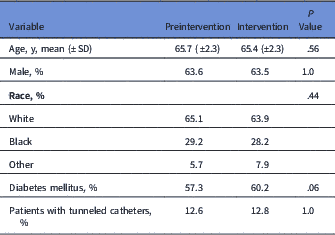
During the preintervention and intervention periods, 591 and 626 patients received outpatient hemodialysis at the enrolled facilities, respectively. Patient demographics and clinical characteristics were not statistically different between the 2 time periods (Table 1). Antimicrobial utilization by type, during the 28-month period, was as follows, given in doses per 100 patient months: vancomycin (12.32), cefazolin (3.30), gentamicin (2.17), cefepime (0.68), ceftazidime (0.19), ampicillin (0.15), daptomycin (0.11), and ceftriaxone (0.06).
Patient Characteristics in the Preintervention and Intervention Periods

Effect of the antimicrobial stewardship program
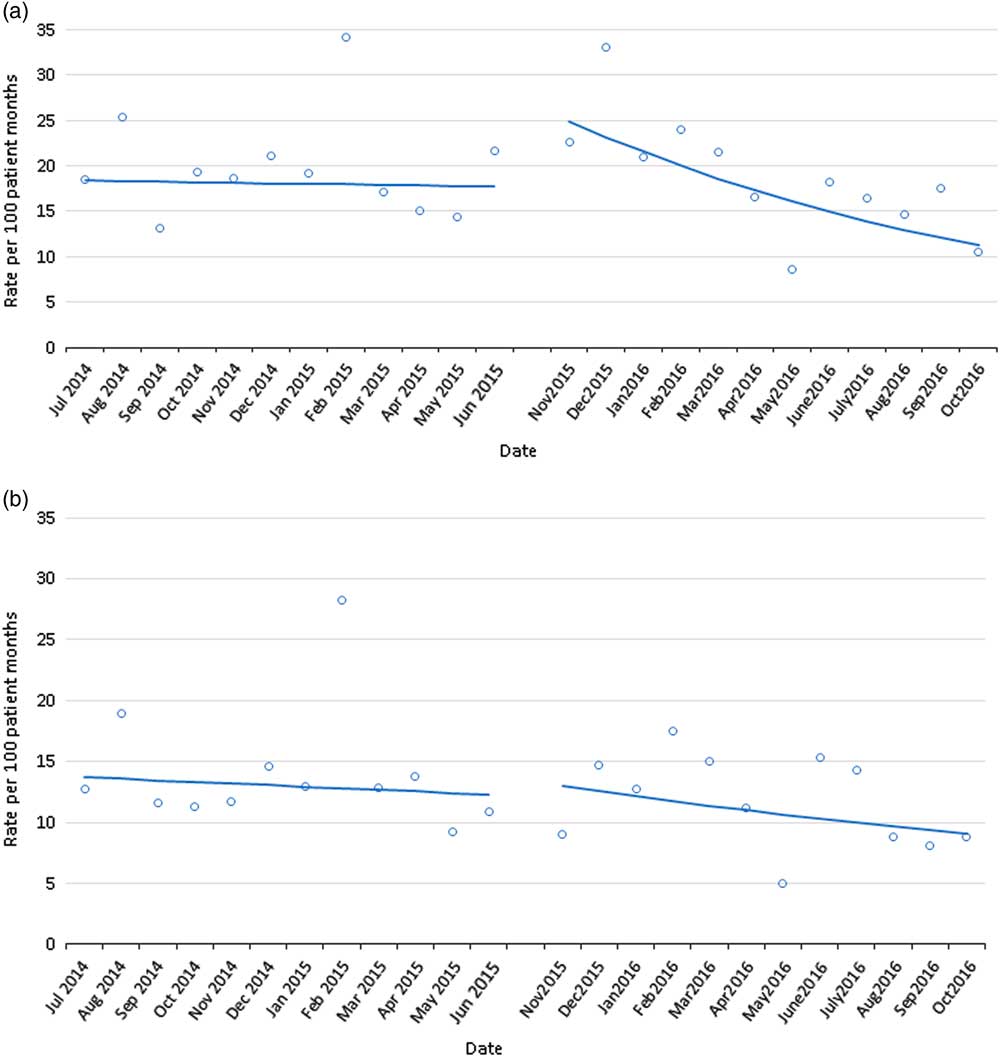
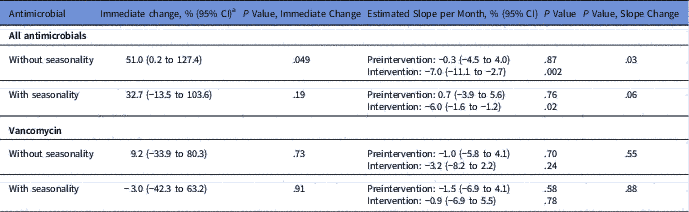
For all antimicrobials, there was no statistically significant change in level immediately after the intervention. The model estimated a change in slope after intervention (P=.06), resulting in a statistically significant decreasing trend of 6% monthly reduction in antimicrobial doses per 100 patient months (P=.02) (Table 2, Fig. 1a). The observed mean monthly rate of antimicrobial doses per 100 patient months at the beginning of the intervention was 22.6 doses, and this rate decreased to 10.5 at the end of the intervention. There were no significant changes in level or trend for vancomycin doses (Table 2, Fig. 1b). There were no statistically significant differences in the mean monthly rates for broad-spectrum cephalosporins (ie, cefepime, ceftazidime, or ceftriaxone), gentamicin, or cefazolin (Table 3).
a. Rates of total antimicrobial use during the preintervention and intervention periods. b. Rates of vancomycin use during the preintervention and intervention periods.

Summary of the Interrupted Time-Series Analysis on the Percentage Changes During the Preintervention and Intervention Periods

Note. CI, confidence interval.
a Immediate change: the change in level defined as the difference between the estimated outcome at the first time point of the intervention and that predicted by the preintervention trend.
Comparison of Mean Rates of Antimicrobial Doses per 100 Patient Months During the Preintervention and Intervention Periods

Note. SD, standard deviation.
a Broad-spectrum cephalosporins: cefepime, ceftazidime, ceftriaxone.
Clinical outcomes
We detected no significant changes in the mean rate of hospital admissions, all bloodstream infections (BSIs) and methicillin-resistant Staphylococcus aureus BSIs between the 2 periods (mean rate±SD during the preintervention period vs the intervention period): rate of hospital admissions per year (1.9±0.3 vs 1.8±0.4; P=.44), rate of all BSIs per 100 patient months (0.5±0.4 vs 0.5±0.3; P=.43), rate of methicillin-resistant Staphylococcus aureus BSIs per 100 patient months (0.04±0.06 vs 0.14±0.09; P=.06). The mean composite of facility-level quality measures also did not differ between the preintervention and intervention periods (mean score, 344±14 vs 357±11; P=.06).
Inappropriate antimicrobial use
During the monthly conference calls, criteria for antimicrobial administration were reviewed for each antimicrobial dose. Data for individual doses were compiled into antimicrobial courses, defined as antimicrobials administered for the treatment of an infection episode. In total, 220 antimicrobial courses were administered during the intervention period. During the calls, sufficient data to make informed recommendations were available for 145 (66%) courses. Antimicrobial adjustments were recommended for 30 (20.6%) of these courses. Reasons for adjustment in prescribing included (1) change from vancomycin to cefazolin for MSSA BSIs (40%), (2) antimicrobials discontinued as criteria for presumed BSIs, access-site infection or skin/soft-tissue infection were not met (34%), (3) change from third- or fourth-generation cephalosporins to cefazolin for the treatment of an infection caused by a cefazolin-susceptible gram-negative pathogen (12%), (4) discontinuation of dual antimicrobial therapy as single agent was sufficient (8%), and (5) other (6%).
Discussion
A multifaceted antimicrobial stewardship program specifically targeting the unique aspects of outpatient hemodialysis facilities was developed and implemented in 6 outpatient hemodialysis facilities over a 12-month period. The implementation of this educational and behavioral program was associated with significant reductions in antimicrobial use. During the intervention period, prescribing of all antimicrobial doses per 100 patient months decreased by 6% per month, with an initial mean of 22.6 antimicrobial doses per 100 patient months down to a mean of 10.5 antimicrobial doses per 100 patient months at the end of the intervention. We detected no significant increase in the incidence of negative clinical outcomes associated with reducing antimicrobial exposure. Mean rates of hospitalizations and BSIs were comparable between the preintervention and intervention periods. Analyses of specific antimicrobial types, including vancomycin, cefazolin, gentamicin, and broad-spectrum cephalosporins, did not demonstrate significant decreases, which may reflect small sample sizes.
A component of this antimicrobial stewardship program included monthly reviews of the indications for all prescribed antimicrobials with the clinical managers of the enrolled facilities. Over the 12-month intervention period, these recommendations led to changes in 20.6% of antimicrobial courses. The most frequent recommendation was to prescribe cefazolin instead of vancomycin for an MSSA infection. Prescribing cefazolin instead of vancomycin in this setting is important for 2 reasons. First, it will prevent unnecessary exposure to vancomycin, and second, clinical outcomes of MSSA BSIs are better when treated with cefazolin compared to vancomycin.Reference Schweizer, Furuno and Harris 32 – Reference Chan, Warren and Thadhani 34 For example, Chan et alReference Chan, Warren and Thadhani 34 showed that among maintenance hemodialysis patients with MSSA bacteremia, treatment with cefazolin was associated with a 38% lower risk of hospitalization and death compared to treatment with vancomycin. Another frequent recommendation provided by the antimicrobial stewardship team was to de-escalate from broad-spectrum cephalosporins, including cefepime and ceftazidime, to cefazolin when microbiology data reported a cefazolin-susceptible pathogen. Avoiding broad-spectrum cephalosporins diminishes the likelihood of the emergence and spread of multidrug-resistant gram-negative bacteria. These pathogens include extended-spectrum β-lactamase–producing Enterobacteriaceae, which are frequent among the dialysis population.Reference Saely, Kaye, Fairfax, Chopra and Pogue 35 Other important recommendations provided by the antimicrobial stewardship program included discontinuing antimicrobials when criteria, based on national guidelines, for presumed infections were not met and when dual antimicrobial therapy was not indicated.
The Centers for Medicare and Medicaid Services and the Joint Commission now require antimicrobial stewardship programs in hospitals and nursing care centers. Numerous resources are available to guide the implementation of these programs. Although these resources do not specifically target the maintenance hemodialysis population, many can be adapted to the out-patient dialysis units.Reference Cunha and D’Agata 36 The core elements of antimicrobial stewardship programs, which were also included in this study, are the following: (1) leadership commitment to support required personnel and financial resources, (2) identification of the leader of the antimicrobial stewardship program, who should have drug expertise and will lead the effort, including monitoring adherence to the program and its outcomes, (3) implementation of policies that support optimal prescribing of antimicrobials, (4) method for tracking the program’s effectiveness, (5) provision of feedback pertaining to rates of antimicrobial use and other outcomes to all relevant staff, and (6) educational efforts focusing on the negative impacts of antimicrobial use and optimization of antimicrobial prescribing. 7
This study has several limitations. First, although 6 facilities were enrolled, these results may not be generalizable to other dialysis facilities. Second, while nurse managers, identified as the unit-based program leaders, were provided with educational resources that focused on optimizing antimicrobial prescribing, recommendations were also provided by an infectious disease physician. Because an infectious disease physician may not be available to all future antimicrobial stewardship programs in dialysis facilities, further training in drug expertise should be provided to these leaders. Numerous resources are publicly available from the Agency of Healthcare Research and Quality, Centers for Disease Control and Prevention, the Society of Healthcare Epidemiology and the Infectious Disease Society of America. 7 , Reference Dellit, Owens and McGowan 37 These resources include workshops, guidelines, and implementation and audit tools. Third, although calls were established to review the indications for antimicrobial prescribing in the previous month, using a more timely approach, such as checklist prior to administering antimicrobials, may have increased the efficacy of the program. Lastly, we did not find significant differences in negative outcomes including rates of hospitalization and all types of BSI. We did detect a trend toward an increase in MRSA BSI during the intervention period, although there was no significant decrease in vancomyin use. Future programs need to monitor for potential negative outcomes.
The efficacy of antimicrobial stewardship programs in improving antimicrobial prescribing patters and reducing unnecessary exposure have been widely documented in the hospital setting. This study provides data to support the efficacy of these programs in dialysis facilities. Improving antimicrobial prescribing practices in outpatient dialysis facilities is critical for ensuring optimal infection management, reducing adverse drug events, and curtailing the ongoing emergence and spread of MDROs.Reference Cunha and D’Agata 36 , Reference D’Agata 38 Dialysis facilities should consider implementing antimicrobial stewardship programs toward the ultimate goal of improving the quality of life of maintenance hemodialysis patients.
Acknowledgments
Financial support
This work was supported by the Agency of Healthcare Research and Quality (AHRQ grant no R18 HS021666 to E.M.C.D.) and the National Institute of Allergy and Infectious Diseases (NIAID grant no. K24 AI119158 to E.M.C.D.). The funding agencies did not have any role in the study design, collection, analysis and interpretation of the data, writing the report or decision to submit the report for publication.
Conflicts of interest
All authors report no conflicts of interest relevant to this article.