INTRODUCTION
Besnoitia besnoiti is the causative agent of bovine besnoitiosis, a parasitic disease of cattle widely distributed in subSaharian areas, which has recently received increased attention in Mediterranian countries (Cortes et al. Reference Cortes, Ferreira, Silva, Vidal, Serra and Caeiro2003, Reference Cortes, Leitão, Vidal, Vila-Vicosa, Ferreira, Caeiro and Hjerpe2005; Juste et al. Reference Juste, Cuervo, Marco and Oregui1990 and see P. J Bourdeau et al. (Abstract. IX European Multicolloquium of Parasitology, pp. 459–460, 2004)). Bovine besnoitiosis may have 2 clinical phases. During the initial phase, namely during the first 4 to 12 days of infection, a high parasitaemia occurs, and parasitaemia may be associated with fever and fever-associated signs. Subsequently, in the chronic stage, the parasite shows a high tropism to the skin, leading to dramatic thickening, hardening and folding or wrinkling of the skin, especially around the neck, shoulders and rump, always accompanied by hyperkeratosis, hyperpigmentation and alopecia (Pols, Reference Pols1960). Furthermore, abortion may occur during the acute phase (Juste et al. Reference Juste, Cuervo, Marco and Oregui1990) and irreversible aspermy is a common sequel developing during the chronic phase. The above-mentioned, together with the refractoriness to all anti-parasitic compounds tested so far, render bovine besnoitisis an important re-emerging disease in the South of Portugal (Cortes et al. Reference Cortes, Ferreira, Silva, Vidal, Serra and Caeiro2003). Despite considerable efforts to identify and develop effective agents to treat bovine besnoitiosis (Shkap et al. Reference Shkap, Pipano and Ungar-Waron1987), none has yet demonstrated any effect for treatment or prevention of disease.
In the United States, the thiazolide nitazoxanide [2-acetolyloxy-N-(5-nitro-2-thiazolyl)benzamide] (NTZ; Alinia™) is currently used in humans for the treatment of persistent diarrhoea caused by Cryptosporidium parvum and Giardia intestinalis in adults, adolescents, and children from 1 year of age. In addition, NTZ exhibits a broad spectrum of activities against a wide variety of enteric bacteria, protozoa, and intestinal and tissue-dwelling helminth parasites, infecting animals and humans (Fox and Saravolatz, Reference Fox and Saravolatz2005; Hemphill et al. Reference Hemphill, Mueller and Esposito2006a; Pankuch and Appelbaum, Reference Pankuch and Appelbaum2006). Against Helicobacter pylori, Giardia intestinalis and Cryptosporidium parvum, the drug has been postulated to act via reduction of its nitro-group by nitroreductases, including pyruvate ferredoxin oxidoreductase (PFOR) (Coombs and Muller, Reference Coombs and Muller2002; Sisson et al. Reference Sisson, Goodwin, Raudonikiene, Hughes, Mukhopadhyay, Berg and Hoffman2002). In terms of veterinary use, the drug is marketed for the treatment of equine myeloencephalitis caused by Sarcocystis neurona (Navigator™). However, its application can be related to severe gastrointestinal problems (Navigator™ prescription information, IDDEX Pharmaceuticals Inc., Greensboro, NC, USA). It has been speculated that this is due to the action of PFOR (pyruvate ferredoxin oxidoreductase or other nitro-reductases, which could reduce the nitro-group and kill anaerobic intestinal bacteria through the production of free radicals (reviewed by Hemphill et al. Reference Hemphill, Mueller and Esposito2006a). Thus, NTZ-derivatives have been synthesized in which the thiazole-associated nitro-group has been replaced by a bromo-group, and the salicylic acid moiety has been modified (Esposito et al. Reference Esposito, Stettler, Moores, Pidathala, Muller, Stachulski, Berry, Rossignol and Hemphill2005, Reference Esposito, Mueller and Hemphill2007; Muller et al. Reference Muller, Ruhle, Muller, Rossignol and Hemphill2006).
Recently, in vitro studies demonstrated the efficacies of NTZ and several bromo-derivatives lacking the thiazole-associated nitro-group against Neospora caninum tachyzoites (Esposito et al. Reference Esposito, Stettler, Moores, Pidathala, Muller, Stachulski, Berry, Rossignol and Hemphill2005). Neospora caninum is an apicomplexan parasite causing abortion and stillbirth in cattle (Dubey, Reference Dubey1999; Hemphill et al. Reference Hemphill, Vonlaufen and Naguleswaran2006b). Since Neospora, Cryptosporidium and Sarcocystis all belong to the phylum Apicomplexa, we investigated the in vitro efficacy of NTZ and a limited number of NTZ-derivatives against B. besnoiti tachyzoites. For this we employed the Vero cell culture model (Cortes et al. Reference Cortes, Reis, Waap, Vidal, Soares, Marques, Pereira, Fazendeiro, Ferreira, Caeiro, Shkap, Hemphill and Leitao2006). B. besnoiti tachyzoite proliferation and adhesion/invasion was assessed by real-time PCR, and TEM was performed to document the drug-induced damage imposed upon the parasites. Our results suggest that thiazolides act against B. besnoiti tachyzoites, and compounds lacking the nitro-groups are equally effective, suggesting that these could be potentially applied in food animals such as cattle.
MATERIALS AND METHODS
Vero cell culture and parasite purification
Besnoitia besnoiti tachyzoites (Bb1Evora03 isolate) were maintained in Vero cell cultures (culture medium: DMEM containing 2% fetal calf serum, 50 IU/ml penicillin, and 50 μg/ml streptomycin). Parasites were harvested using a cell scraper when the cell monolayer started to be destroyed. Harvested material was repeatedly passaged through a 25-gauge needle and parasites were purified using cellulose CF11 columns.
Infection of Vero cells and in vitro drug treatment assays
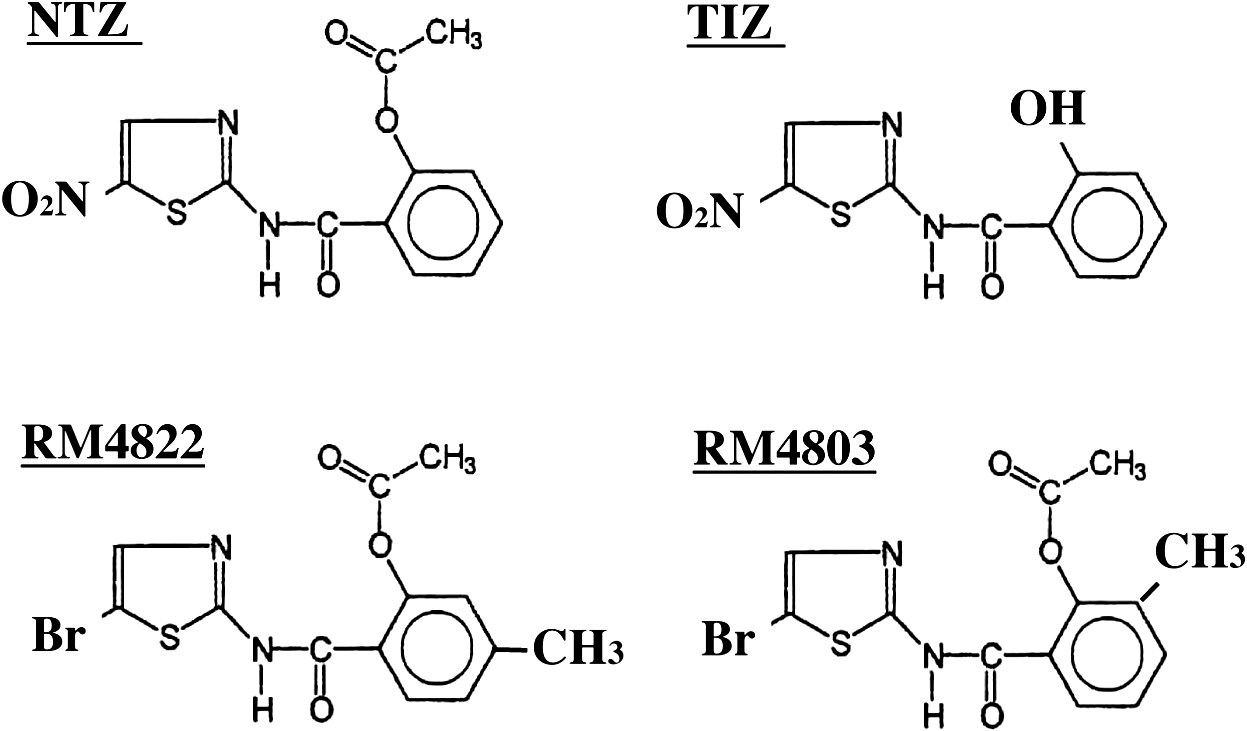
Nitazoxanide (NTZ), tizoxanide (TIZ), and the NTZ-derivates Rm4822 and Rm4803 (see Fig. 1), were obtained from Romark Laboratories (Tampa, FL, USA), and were synthesized at the Department of Chemistry, University of Liverpool. Stock solutions were prepared at a concentration of 10 mg/ml in dimethyl sulfoxide (DMSO) and were kept at −20°C. Fresh dilutions to the appropriate concentration were prepared in culture media. DMEM with the same DMSO concentration was used as control. Vero Cell confluent monolayers in 24-well tissue culture plates (Sarstedt, Newton, MA) were inoculated with B. besnoiti tachyzoites (5×10⁴) and incubated for 2 h at 37°C, 5% CO2. Unbound parasites were removed by washing with DMEM, and infected monolayers were maintained in culture medium containing the drugs, as indicated for the individual experiments. In order to assess selective toxicity, uninfected Vero cell monolayers were treated identically. Where indicated, NTZ was added to the Vero cells 24 h before infection. Samples for monitoring parasite proliferation were taken at different times post-initiation of drug treatment. Each assay in a given experiment was carried out in triplicate.
Structures of the thiazolides investigated in this study.

Processing of DNA samples and light cycler-based quantitative PCR
DNA purification was performed using the DNAeasy kit (QIAGEN, Basel, Switzerland) as previously described for N. caninum infected cell cultures (Esposito et al. Reference Esposito, Mueller and Hemphill2007). For quantitative PCR, primers directed to ITS1 region of B. besnoiti were used Results shown correspond to mean values (plus/minus standard deviations) of triplicate determinations.
PDTC-based adhesion/invasion assay
This assay was performed as previously described for N. caninum and Toxoplasma gondii (Naguleswaran et al. Reference Naguleswaran, Muller and Hemphill2003). Shortly, Vero cell monolayers were incubated with B. besnoiti tachyzoites either in the presence or absence of NTZ, TIZ, Rm4803 or Rm4820. Infected monolayers were incubated for 2 h at 37°C in DMEM containing 100 μm pyrrolidine dithiocarbamate (PDTC), 0·2 μm CuSO4 and rabbit anti-B. besnoiti antiserum (1:200), which killed and permeablilized extracellular tachyzoites. In parallel, wells were incubated in DMEM without any additives. The wells were then washed with DMEM and treated with 1 mg/ml DNase in DMEM for 1 h at 37°C. Finally, the wells were washed with DMEM containing 1 mm EDTA and the cellular material was taken up in 180 μl of lysis buffer (DNAeasy kit; QIAGEN). The number of intracellular tachyzoites and the overall number of parasites in a given experiment were determined by real-time PCR as described above.
Transmission electron microscopy
Vero cell monolayers were grown in 6-well tissue culture plates, infected with B. besnoiti tachyzoites for 2–4 days, and treated with NTZ and Rm4822 (10 μg/ml) as described above. At different time-points, as indicated below, monolayers were washed with 100 mm sodium cacodylate buffer, pH 7·2, and fixed in 100 mm sodium cacodylate buffer containing 2·5% glutaraldehyde. Cells were scraped off with a rubber policeman, post-fixed in 1% OsO4 (4 h, 4°C), pre-stained in 1% uranyl acetate (1 h, 4°C), dehydrated in ethanol, and embedded in Epon 820 resin. The resin was polymerized at 65°C for 48 h. Ultrathin sections were cut and loaded onto 300-mesh copper grids (Plano GmbH). Staining with uranyl acetate and lead citrate was performed as described by Hemphill and Croft (Reference Hemphill, Croft and Rogan1997). Finally, grids were viewed on a Phillips 400 TEM operating at 80 kV.
Statistical analysis
For time-course and PDTC-based adhesion/invasion experiments, the significance of the differences between end-point values of the control and experimental assays was determined by Student's t-test, using the Microsoft Excel program. P values <0·05 were considered statistically significant.
RESULTS
The nitro-thiazolide compounds NTZ and TIZ inhibit the intracellular proliferation of B. besnoiti tachyzoites
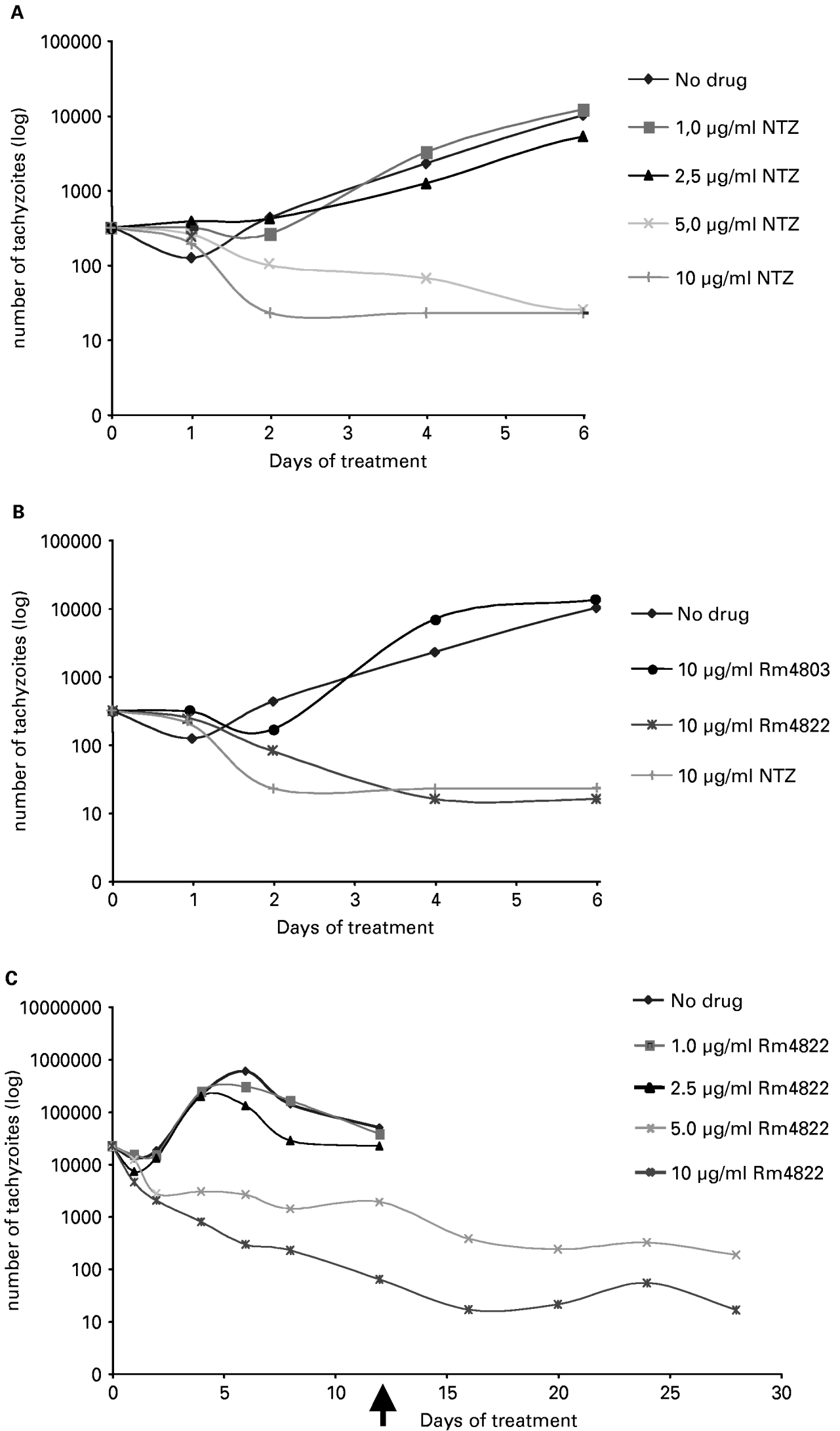
In order to assess whether NTZ inhibits the proliferation of B. besnoiti tachyzoites, parasites were allowed to infect Vero cell monolayers for 1 h prior to addition of NTZ at concentrations from 1 to 10 μg/ml (Fig. 2A), and samples were collected at different time-points until day 6. Real-time PCR showed that NTZ readily inhibited proliferation of Besnoitia tachyzoites in a dose-dependent manner, with 5 and 10 μg/ml being most efficient (Fig. 1A). Similar results were obtained when NTZ was replaced by its deacetylated metabolite TIZ (data not shown). In parallel, light microscopical inspection of infected and non-infected Vero cell monolayers did not reveal any drug-induced alterations by these drugs, confirming the selective parasite-specific toxicity of NTZ and TIZ as previously reported by Esposito et al. (Reference Esposito, Stettler, Moores, Pidathala, Muller, Stachulski, Berry, Rossignol and Hemphill2005) (data not shown). Thus, further experiments were performed at a drug concentration of 10 μg/ml.
Effects of thiazolides on the proliferation of Besnoitia besnoiti tachyzoites in Vero cells in vitro as assessed by quantitative real time PCR. (A) Dose-dependent inhibition of tachyzoite proliferation by the nitrothiazole NTZ. Similar results were obtained for TIZ. (B) Inhibition of proliferation of B. besnoiti tachyzoites in the presence of NTZ and the bromo-derivative Rm4822, while Rm4803 did not affect proliferation. (C) Dose dependency of the inhibitory effect mediated by Rm4822. At 12 days of Rm4822 treatment, the drug was removed, and no further growth of parasites was noted until day 28, indicating the parasitocidal effect of Rm4822.

The bromo-compounds Rm4822 and Rm4803 exhibit differential effects
As shown in Fig. 1B, Rm4822, a thiazolide compound with a bromo-group substituting for the nitro-group on the thiazole-ring, plus as methylation at position 4 on the salicylic acid ring (Esposito et al. Reference Esposito, Stettler, Moores, Pidathala, Muller, Stachulski, Berry, Rossignol and Hemphill2005), exhibited a proliferation inhibitory potential similar to NTZ. In contrast Rm4803, a bromo-derivative carrying the methylation on position 3, did not have any effect at all, and Besnoitia tachyzoite proliferation was comparable to controls where only the solvent was added (Fig. 2B). Thus, thiazolides act against Besnoitia using a mechanism which is independent of the nitro-group, and in which a defined position of the salicylic acid moiety plays a crucial role. Rm4822 inhibited B. besnoiti proliferation in a dose-dependent manner, with an efficiency similar to NTZ (Fig. 2C). The drug was most active at 5 and 10 μg/ml. In some experiments, Rm4822 treatment was discontinued at day 12 and the cultures were maintained until day 28. In any case, no increase in parasite numbers was noted, indicating that in vitro treatment with both 5 and 10 μg/ml of Rm4822 was parasitocidal rather than only parasitostatic (Fig. 2C).
Effects of thiazolides on adhesion and invasion of Vero host cells by B. besnoiti tachyzoites
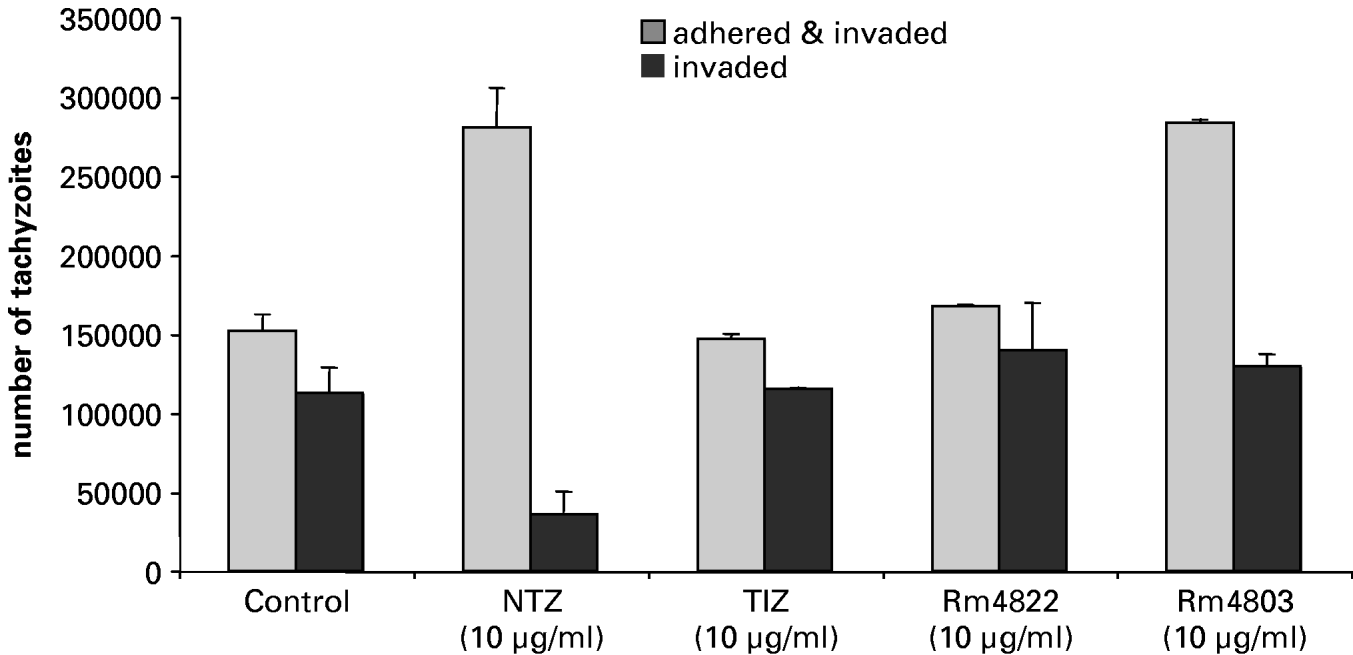
In order to study whether the impact of these drugs can be attributed to any interference in the adhesion/invasion process of B. besnoiti tachyzoites, freshly isolated parasites were incubated with NTZ, TIZ, Rm4822 and Rm4803 for 2 h prior to letting them interact with Vero cell monolayers. The overall number of parasites (adhered and invaded) interacting with Vero cells was quantified by real-time PCR. In a parallel experiment, the number of intracellular (invaded) tachyzoites was determined by PDTC/antiserum treatment, DNAse digestion and real-time PCR, as previously described for N. caninum and T. gondii by Naguleswaran et al. (Reference Naguleswaran, Muller and Hemphill2003), (see Materials and Methods section). The invasion efficiency (percentage of invaded tachyzoites in relation to the overall parasite number) of control parasites (incubated in DMSO alone) was around 80% (Fig. 3). In NTZ-treated samples, the overall number of tachyzoites interacting with Vero cells was greatly increased by almost 2-fold, but the invasion efficiency reduced to roughly 10%, resulting in greatly decreased numbers of intracellular parasites. This shows that tachyzoites adhered more efficiently, but exhibited impaired invasion abilities (Fig. 3). In contrast, both overall parasite number and invasion rates for TIZ and Rm4822-treated tachyzoites were similar to the controls, indicating that neither TIZ- nor Rm4822-treatment affected the initial host-parasite interaction. The overall number of tachyzoites interacting with Vero cells was increased by 2-fold in Rm4803-treated preparations, but nevertheless the number of invaded parasites was equal to the untreated control (Fig. 3).
Analysis of the effects of the nitrothiazoles NTZ and TIZ and the bromoderivatives Rm4822 and Rm4803 on host cell adhesion and invasion. Grey bars indicate values for the overall parasite numbers (adhered and invaded), and the dark bars indicate the numbers of invaded parasites only. Note that in the absence of drugs, around 80% of those parasites interacting with their host cells had actually invaded their host cells. In NTZ-treated cultures, a higher number of parasites adhered to, but only a small fraction of those actually had invaded their host cells. Values for TIZ and Rm4822 remained similar as for the controls. Rm4803 treatment resulted in higher numbers of parasites adhering to their host cells, but Rm4803 did not result in increased invasion.

Electron microscopy reveals ultrastructural effects of NTZ and Rm4822 in B. Besnoiti-infected HFF and Vero cell monolayers
The effects of NTZ in tachyzoite-infected Vero cell monolayers were studied in comparison to untreated cultures by TEM at different time-points p.i. In control cultures (Fig. 4), B. besnoiti tachyzoites were found within their host cells and localized within the parasitophorous vacuole, which was clearly separated from the host cell cytoplasm by the parasitophorous vacuole membrane (PVM, see large arrows in Fig. 4B, C). Tachyzoites exhibited the typical features of apicomplexan parasites such as conoid at the apical tip, micronemes and rhoptries (Fig. 4B, C), but only few dense granules could be seen. Rhoptry contents had an amorphous and rather electron-dense appearance (Fig. 4B, C). Tachyzoites were densely packed within the vacuole, and the vacuole membrane was often in tight contact with the parasite plasma membrane (large arrows in Fig. 4). The space between the tachyzoites was filled with granular material (small arrowheads in Fig. 4B, C).
TEM of Vero cells infected with Besnoitia besnoiti tachyzoites. (A) Low magnification view of a parasitophorous vacuole containing numerous tachyzoites. (B, C) Higher magnification views of parasitophorous vacuoles. Rop=rhoptries, dg=dense granules, mic=micronemes, con=conoid, nuc=nucleus. Large arrows point towards the parasitophorous vacuole membrane, small arrows indicate the granular matrix filling the lumen of the vacuole. Note that parasites are extremely densely packed.

In NTZ-treated parasites, clear alterations in parasite ultrastructure were visible already after 12 h of treatment. During the first 12 and 24 h following the initiation of drug treatment, the most prominent hallmark was the occurrence of numerous vacuoles within the parasite cytoplasm (Fig. 5A, B). These vacuoles were often filled with membranous and filamentous material of unknown origin. While the nucleus as such remained largely intact, other membranous structures within the parasites were dramatically affected (Fig. 5A). Overall, the PVM had started to disintegrate in some cells (large arrows in Fig. 5A), while in others (Fig. 5B) the PVM was partially still discernible. In addition, at 12 h of NTZ treatment, the granular material constituting the matrix of the parasitophorous vacuole was still visible in many instances. In some cases, (Fig. 5A), vacuoles were surrounded by numerous host cell mitochondria. At later time-points such as 24 h post-initiation of treatment, the damage became more dramatic, with even increased vacuolization of tachyzoites, distorted nuclei, and complete loss of the PVM (Fig. 5C). The granular material within the matrix of the parasitophorous vacuole disappeared, and in some cases was replaced with membranous and electron-dense clumps of unknown origin (small arrow in Fig. 5C). Note that the parasite plasma membranes appeared still intact during this observation period. RM4822-treated cultures fixed at 12 h p.i., intracellular tachyzoites were also found to be extensively vacuolized. A clearly delineated parasitophorous vacuole and corresponding membrane was largely missing already at this time-point. (Fig. 6A, B). Only in very few cases, the granular parasitophorous vacuole matrix, or matrix remnants, were still partially visible (Fig. 6C, small arrows). Non-vacuolized parts of the tachyzoites started to become rather electron dense, and in longitudinal sections as in Fig 6C, membranous structures were distorted, while the nucleus and associated ER appeared unaffected. Rhoptries and micronemes and parasite mitochondrion could not be distinguished any more. At 24 h post-initiation of treatment (Fig. 6D, E), the situation remained the same. In some treated parasites, the nucleus contained electron-dense deposits, indicating that extensive chromatin condensation could have taken place (see Fig. 6E). Note that the parasite plasma membranes, and in many instances the conoid, were still clearly discernible and appeared still intact during the observation period.
TEM of Besnoitia besnoiti in Vero cells treated with 10 μg/ml of NTZ for 12 h (A), 24 h (B) and 48 h (C). Note the high degree of vacuolization of the parasite cytoplasm already at 12 h. Large arrows point towards the parasitophorous vacuole membrane which, in some instances, is already distorted at early time-points (A), small arrows indicate the granular matrix filling the lumen of the vacuole, which is partially distorted already after 12 h (A), but definitely non-existent at 48 h. Instead, the vacuole contains membranous debris of unknown origin. Nuc=nucleus, mito=host cell mitochondria in close vicinity of the parasites.

TEM of Besnoitia besnoiti in Vero cells treated with 10 μg/ml of Rm4822 for 12 h (A–C) and 48 h (D, E). (B) Lower magnification view of (A). Note that parasites exhibit a high degree of vacuolization and aberrant membrane organization indicative for considerable metabolic stress. The parasitophorous vacuole membrane (large arrows) is considerably distorted already at 12 h (A–C), and this effect remains also at later time-points (D, E). In a few cases, matrix residues (small arrows) are still visible (small arrows). In (E), note the presence of highly condensed and electron-dense material within the nucleus (white arrow). However, the conoid as such (con) is still clearly discernable.

DISCUSSION
In this study we demonstrate that the nitro-thiazole analogue NTZ, its metabolite TIZ, and a bromo-derivative, Rm4822, exhibit similar in vitro efficacies against B. besnoiti tachyzoites. This indicates, that the observed anti-parasitic activity is not dependent on the thiazole-ring-associated nitro-group. In addition, our findings have also shown that Rm4803, which structurally differs from Rm4822 with regard to the positioning of the methylation on the benzene ring of the salicylic acid moiety, exhibits a strongly impaired antiparasitic activity. This conforms to earlier in vitro findings obtained with N. caninum (Esposito et al. Reference Esposito, Stettler, Moores, Pidathala, Muller, Stachulski, Berry, Rossignol and Hemphill2005, Reference Esposito, Mueller and Hemphill2007), and C. parvum (Hemphill and Mathis, unpublished observations), which have also indicated that bromo-compounds exhibit similar anti-parasitic efficacy and that the activity of Rm4803 is reduced compared to other bromo-thiazolides unpublished observations). Our experiments also demonstrate the importance of the benzene ring for drug efficacy, since exchanging the thiazole-nitro-group for a bromide does not notably impair the anti-parasitic activity of the molecule. This indicates that the nitro-group is not crucially instrumental in terms of parasiticidal activity, but that a crucial role is possibly mediated through the unmodified ortho-position on the benzene ring. On the other hand, a methyl substitution ortho-versus para on an aromatic ring is well know to critically influence reactivity of other substituents including the beta-ketoamide functionality.
While TIZ and Rm4822 appeared to exert their effect by inhibiting intracellular proliferation of tachyzoites, NTZ also inhibited the host cell invasion process. This differs from N. caninum, where NTZ-treatment of tachyzoites did not affect host cell entry (Esposito et al. Reference Esposito, Stettler, Moores, Pidathala, Muller, Stachulski, Berry, Rossignol and Hemphill2005). Thus, our study indicates that not only intracellular B. besnoiti, but also extracellular tachyzoites, are susceptible to NTZ, but not to its metabolite TIZ, which represents the deacetylated compound. In addition, we also found that NTZ, and Rm4803-treated parasites exhibited increased adhesion to host cells. It is very likely that adhesion to host cells is, similar to other apicomplexans, dependent on the initial interaction between the host cell and tachyzoite plasma membrane and the sequential release of proteins from secretory organelles including micronemes, rhoptries and dense granules (Sibley, Reference Mordue, Desai, Dustin and Sibley2004; Hemphill et al. Reference Hemphill, Vonlaufen and Naguleswaran2006b), organelles that are also readily found in B. besnoiti tachyzoites. However, in Besnoitia, the major surface constituents have not been identified so far, and the secretory organelles have not been characterized on the molecular level. Currently, we do not know whether NTZ affects secretory events or has an impact on the functional activity of secretory proteins, and this needs to be investigated in the future. In any case, it is likely that the activity against the extracellular stages in not relevant to the killing mechanism of the drug, and that the decisive anti-parasitic action is taking place intracellularly, a suggested earlier for N. caninum (Esposito et al. Reference Esposito, Stettler, Moores, Pidathala, Muller, Stachulski, Berry, Rossignol and Hemphill2005).
TEM showed that treatment of intracellular tachyzoites with NTZ, TIZ and Rm4822 caused massive vacuolization and membranous vesiculation within the parasite cytoplasm after 12–48 h. These are signs of severely impaired metabolic activity and can be attributed to the action of the drugs. Other effects included distortion of the PVM, and degradation of the granular matrix of the parasitophorous vacuole. The effects appeared similar for all three drugs, and massive vacuolization of the cytoplasm of N. caninum and T. gondii tachyzoites was reported earlier also upon treatment of N. caninum- and T. gondii-infected cells with ponazuril (Darius et al. Reference Darius, Mehlhorn and Heydorn2004; Mitchel et al. Reference Mitchell, Zajac, Davis, Kennedy and Lindsay2005). Darius et al. (Reference Darius, Mehlhorn and Heydorn2004) also indicated that ponazuril was targeting the N. caninum apicoplast. However, we found no clear evidence for thiazolide-induced damage specifically occurring at the apicoplast in B. besnoiti. In addition, similar findings, and especially interference in the maintenance of the structural integrity of the parasitophorous vacuole membrane, had been reported for N. caninum tachyzoites treated with NTZ (Esposito et al. Reference Esposito, Stettler, Moores, Pidathala, Muller, Stachulski, Berry, Rossignol and Hemphill2005).
Detailed ultrastructural analysis indicated that distortion of the PVM and degradation of the granular matrix occurred earlier in Rm4822-treated cultures, namely shortly (12 h) after initiation of drug treatment, while similar effects in NTZ-treated cultures were seen only later. It has been shown that the parasitophorous vacuole represents an essential compartment for survival, development, and proliferation, not only of B. besnoiti, but also for other cyst forming coccidian parasites (Mordue et al. Reference Mordue, Desai, Dustin and Sibley1999). In T. gondii the membrane delineating the parasitophorous vacuole acts as a molecular sieve, allowing free diffusion of small molecules such as sugars, amino acids, nucleobases and cofactors from the host cytoplasm, to the vacuolar space (Schwab et al. Reference Schwab, Beckers and Joiner1994). In addition, it is conceivable that in B. besnoiti-infected cells, like for other apicomplexans, the PVM and its constituents, as well as parasite-derived secretory products passing through the membrane into the host cell cytoplasm, are involved in manipulating host cell functions. Thus, the PVM participates in selective diffusion of molecules, and represent an important constituent involved in regulating import and export of molecules (Schwab et al. Reference Schwab, Beckers and Joiner1994), and as its structural integrity is distorted, parasites are deprived of their natural habitat, stop proliferation, and undergo distinct structural alterations and finally cell death. However, more detailed investigations are required in order to define the exact mechanism of the anti-parasitic activity of NTZ and RM4822 against B. besnoiti tachyzoites. Most importantly, the respective drug targets need to be identified and characterized.
The fact that bromo-derivatives such as Rm4822 exhibit anti-parasitic activity against B. besnoiti is important. B. besnoiti is a parasite of cattle (Cortes et al. Reference Cortes, Reis, Waap, Vidal, Soares, Marques, Pereira, Fazendeiro, Ferreira, Caeiro, Shkap, Hemphill and Leitao2006). As NTZ is also active against both semi-aerobic and anaerobic bacteria, this will inevitably cause significant problems in the digestive system in ruminants and also any other mammals. The gut contains beneficial populations of microflora, principally comprised of anaerobic bacteria. Oral application of a broad spectrum compound such as NTZ will kill the bacterial flora, which may lead to secondary complications including severe gastrointestinal disturbances. This has been documented in horses, where administration of NTZ can disrupt the normal microbial flora of the gastrointestinal tract, which caused enterocolitis, and has even lead to death of individual horses (Navigator™ prescribing information, IDDEX Pharmaceuticals Inc., Greensboro, NC, USA). It has been speculated that this is due to the action of PFOR or other nitro-reductases, which reduce the nitro-group and kill the bacteria through the production of free radicals (reviewed by Hemphill et al. (Reference Hemphill, Mueller and Esposito2006a)). However, solid experimental evidence for this hypothesis is missing. Studies in H. pylori suggested that, in contrast to metronidazole, NTZ was largely non-mutagenic (Sisson et al. Reference Sisson, Goodwin, Raudonikiene, Hughes, Mukhopadhyay, Berg and Hoffman2002). However, the prescribing information on NTZ (Alinia™) states that the drug was genotoxic in one tester strain (TA 100) in the Ames bacterial mutation assay. As potential mutagenicity would never be compatible with application of the drug in food and breeding animals bromo-compounds such as Rm4822 could represent a safe alternative. Rm4822 will probably have no effect against the intestinal microbial flora (Pankuch and Appelbaum, Reference Pankuch and Appelbaum2006), and computed toxicity suggested that Rm4822 is very unlikely to exhibit any mutagenicity (data not shown). Thus, bromo-derivatives represent a safer alternative to the parent compound NTZ, but with a similar efficacy against B. besnoiti and/or other apicomplexan parasites. Further studies are required to investigate whether Rm4822 will be useful for in vivo treatment of B. besnoiti infections, which may be of practical use in animal production.
The authors acknowledge financial support provided by the Swiss National Science Foundation (grant no. 3100A0-112532/1) and COST 854.