In recent years, a growing body of literature on personality and child development has made it increasingly clear that personality pathology is not exclusive to adulthood and some personality disorders diagnosed in adulthood are likely to have developmental pathways that begin in childhood (Bemporad, Smith, Hansen, & Cicchetti, Reference Bemporad, Smith, Hanson and Cicchetti1982, Cicchetti & Crick, Reference Cicchetti and Crick2009; Cicchetti & Olsen, Reference Cicchetti, Olsen, Lewis and Miller1990; DeClercq, De Fruyt, Van Leeuen, & Mervielde, Reference De Clercq, De Fruyt, Van Leeuwen and Mervielde2006; Geiger & Crick, Reference Geiger, Crick, Ingram and Price2001; Johnson, Bromley, Bornstein, & Sneed, Reference Johnson, Bromley, Bornstein, Sneed, Wolfe and Mash2006; Shiner, Reference Shiner2009). Although the pathogenesis of personality disorder has been studied extensively with respect to the role of adverse childhood experiences (Widiger, DeClercq, & DeFruyt, Reference Widiger, De Clercq and De Fruyt2009; Zanarini, Reference Zanarini2000), no single risk factor has received as much focus as child maltreatment. Research has demonstrated that personality disorders are more prevalent among individuals with a history of abuse in childhood (Cicchetti & Valentino, Reference Cicchetti, Valentino, Cicchetti and Cohen2006; Johnson, Cohen, Brown, Smailes, & Bernstien, Reference Johnson, Cohen, Brown, Smailes and Bernstien1999; Johnson, Smailes, Cohen, Brown, & Bernstein, Reference Johnson, Smailes, Cohen, Brown and Bernstien2000; Joyce et al., Reference Joyce, McKenzie, Luty, Mulder, Carter and Sullivan2003). Further, recent longitudinal studies have shown that childhood abuse and neglect are predictive of an increased risk for personality pathology in adulthood (Johnson, Bromley, & McGeoch, Reference Johnson, Bromley, McGeoch, Oldham, Skodol and Bender2005; Johnson et al., Reference Johnson, Bromley, Bornstein, Sneed, Wolfe and Mash2006; Widom, Czaja, & Paris, Reference Widom, Czaja and Paris2009). One longitudinal study showed that having a documented child abuse experience made an individual over four times more likely to be diagnosed with a personality disorder in adulthood, even after controlling for parental education, age, and parental psychiatric history (Johnson et al., Reference Johnson, Cohen, Brown, Smailes and Bernstien1999).
Borderline personality disorder (BPD) in particular has received strong attention as a possible outcome of child maltreatment. BPD is a serious form of psychopathology characterized by a complex constellation of social, cognitive, emotional, and behavioral dysregulation, most notably features of affective instability and dysregulation, impulsivity, dysfunctional interpersonal relationships, and identity problems (American Psychiatric Association, 2000). In addition to its concerning and extensive symptomatology, the disorder also is notably prevalent in severely impaired populations requiring intensive or inpatient psychiatric care. BPD is the most common Axis II disorder seen in inpatient psychiatric settings. Although the disorder is estimated at rates of 1%–6% in the general adult population, it is thought to be present in 10%–15% of clinical populations (Lenzenweger, Reference Lenzenweger2008; Skodol et al., Reference Skodol, Gunderson, Pfohl, Eidiger, Livesley and Siever2002; Swartz, Blazer, George, & Winfield, Reference Swartz, Blazer, George and Winfield1984; Tomko, Trull, Wood, & Sher, Reference Tomko, Trull, Wood and Sher2013; Trull, Stepp, & Durett, Reference Trull, Stepp and Durett2003; Widiger & Weisman, Reference Widiger and Weissman1991). BPD sufferers often require extensive mental health care. BPD criteria are met in 19% of psychiatric hospitalizations, and the rate of suicide in individuals with the disorder is close to 50 times the rate of the population (American Psychiatric Association, 2000; Widiger & Frances, Reference Widiger, Frances, Tasman, Hales and Frances1989).
Research indicates that maltreatment is a serious risk factor for the development of BPD. Up to 71% of BPD patients report severe abuse in childhood (Cicchetti & Valentino, Reference Cicchetti, Valentino, Cicchetti and Cohen2006; Lieb, Zanarini, Schmahl, Linehan, & Bohus, Reference Lieb, Zanarini, Schmahl, Linehan and Bohus2004; Widom et al., Reference Widom, Czaja and Paris2009), and history of childhood abuse has been shown to predict borderline symptoms independent of family environment and parental psychopathology (Bradley, Jeneai, & Westen, Reference Bradley, Jenei and Westen2005). A review of relevant literature by Ball and Links (Reference Ball and Links2009) found support for childhood trauma as a causative factor in the development of BPD. This is a crucial consideration when examined in concert with current longitudinal research supporting personality as an outcome that develops over time in response to a dynamic and transactional process between environmental and genetic influences (Beauchaine, Klien, Crowell, DeBridge, & Gatzke-Kopp, Reference Beauchaine, Klien, Crowell, Debridge and Gatzke-Kopp2009; Belsky et al., Reference Belsky, Caspi, Arseneault, Bleidorn, Fonagy and Goodman2012; Geiger & Crick, Reference Geiger, Crick, Ingram and Price2001; Lenzenweger & Willett, Reference Lenzenweger and Willett2009; Shiner, Reference Shiner2009).
If personality is a dynamic system developing over time, then prodromal symptoms of personality pathology should become apparent in developmentally relevant ways. Content analysis of DSM criteria by Geiger and Crick (Reference Geiger, Crick, Ingram and Price2001) found five childhood indicators of BPD: hostile or paranoid worldview; impulsivity; intense, unstable, or inappropriate emotion; excessively close relationships; and lack of sense of self. Many noted sequelae of child maltreatment form a pattern of dysfunction in childhood that is strikingly similar to both these criteria and BPD in adulthood. Child victims of maltreatment have shown disruptions in peer, familial, and romantic relations, impulsivity and attentional difficulties, dysregulation of affect, and negative or disrupted representations of self (Cicchetti & Valentino, Reference Cicchetti, Valentino, Cicchetti and Cohen2006; Rogosch & Cicchetti, Reference Rogosch and Cichetti2005; Rogosch, Cicchetti, & Aber, Reference Rogosch, Cichetti and Aber1995; Shields & Cicchetti, Reference Shields and Cicchetti1997; Toth, Cicchetti, MacFie, Maughan, & Vanmeenen, Reference Toth, Cicchetti, MacFie, Maughan and Vanmeenen2000). In addition, maltreated children are at higher risk for youth suicidal ideation or behavior (Bridge, Goldstein, & Brent, Reference Bridge, Goldstein and Brent2006). This is especially notable because up to 30% of adults with BPD report the onset of self-injurious behavior prior to the age of 12 (Zanarini et al., Reference Zanarini, Frankenburg, Ridolfi, Jager-Hyman, Hennen and Gunderson2006).
The similarities between characteristics of BPD in adulthood and the featural pattern of deficits associated with maltreatment suggest a possible pathway by which BPD develops. However, major limitations present in the current literature circumscribe conclusions that may be drawn by researchers in this arena.
First, current studies relating maltreatment to BPD have traditionally relied on retrospective reports of maltreatment by adults identified as meeting criteria for BPD. Such studies are limited by retrospective identification of maltreatment experiences, because any significant relationships found may be influenced by participant response bias or recall bias (Johnson et al., Reference Johnson, Bromley, McGeoch, Oldham, Skodol and Bender2005; Widom, Raphael, & DuMont, Reference Widom, Raphael and DuMont2004). As Radke-Yarrow, Campbell, and Burton (Reference Radke-Yarrow, Campbell and Burton1970) note in their discussion of factors that influence recall, an individual's current state, including psychopathological symptoms, has been shown to influence recall ability (for a review of literature on state-dependent recall, see Blaney, Reference Blaney1986). Moreover, as noted by Shiner (Reference Shiner2009), this issue of recall bias is exceptionally salient in the realm of personality pathology owing to the distortion of perception inherent within the class of disorders. Distorted interpersonal perceptions are fundamental to the nature of BPD symptoms in particular.
Second, although it is clear that maltreatment is a serious risk factor for later personality pathology and BPD specifically, previous studies have generally focused on adult personality outcomes in their investigations (Paris, Reference Paris2005). This is unfortunate, because information on personality development and outcomes through childhood and adolescence may help to illuminate the specific functional mechanisms by which maltreatment impacts later personality. In addition, examination of childhood personality processes may also elucidate prodromal signs of personality pathology, better allowing researchers to develop and implement early interventions. To our knowledge, no studies to date have examined self-report of developmentally salient BPD symptoms in maltreated children.
Third, when considering maltreatment as a risk factor in the development of personality pathology, researchers too often ignore the myriad differences in individual maltreatment experiences. Researchers have increasingly moved away from a “presence versus absence” dichotomy of maltreatment experience when considering abuse or neglect in analyses. However, many maltreatment parameters are frequently ignored, such as the chronicity and timing of maltreatment. When included in analyses, information on the developmental timing, onset, and recency of maltreatment can produce a more nuanced understanding of the impact of maltreatment on individual neurobiological, psychological, emotional, and behavioral outcomes (Cicchetti, Rogosch, Gunnar, & Toth, Reference Cicchetti, Rogosch, Gunnar and Toth2010; Manly, Cicchetti, & Barnett, Reference Manly, Cicchetti and Barnett1994; Marshall & English, Reference Marshall and English1999). Studies by Manly, Kim, Rogosch, and Cicchetti (Reference Manly, Kim, Rogosch and Cicchetti2001) and Thornberry, Ireland, and Smith (Reference Thornberry, Ireland and Smith2001) found that the developmental period in which maltreatment first occurred differentially impacted outcomes on a host of maladaptive factors, including internalizing and externalizing symptomatology, delinquency, teen pregnancy, and alcohol and drug use. A recent examination by Jaffee and Maikovich-Fong (Reference Jaffee and Maikovich-Fong2011) replicated facets of these findings; maltreatment occurring in multiple developmental periods compared to a single developmental period was similarly found to be related to increased internalizing and externalizing problems. However, these differences became nonsignificant once family and environmental characteristics such as caregiver depression, arrest history, educational qualifications, and neighborhood danger were controlled for in analysis. In addition, an investigation by Jonson-Reid, Kohl, and Drake (Reference Jonson-Reid, Kohl and Drake2012) found that chronicity was a strong predictor of negative child and adult outcomes such as substance use, violent delinquency, suicide attempts, and mental health treatment. To date, work focused on the relation between maltreatment and the development of BPD has not considered chronicity and developmental timing of maltreatment.
The goal of the present investigation is to examine the impact of maltreatment subtype, timing, and chronicity in the development of four major categories of developmentally salient borderline features: affective instability, identity problems, negative relationships, and self-harm.
Hypotheses
-
Hypothesis 1: Maltreated children, compared to nonmaltreated children, will display higher overall levels of borderline features.
-
Hypothesis 2: Maltreated children will have significantly higher scores on four the major borderline feature scales: affective instability, identity problems, negative relationships, and self-harm.
-
Hypothesis 3: Maltreatment subtype, including physical abuse (PA), sexual abuse (SA), emotional maltreatment (EM), and physical neglect (PN), will impact the degree of borderline features present.
-
Hypothesis 4: The maltreated group will be more likely to have high scores on all four borderline feature subscales.
-
Hypothesis 5: Maltreatment chronicity, onset, and recency will predict overall borderline feature scores.
-
Hypothesis 6: Maltreatment chronicity, onset, and recency will predict rates of individuals with elevated scores on all four subscales.
Method
Participants
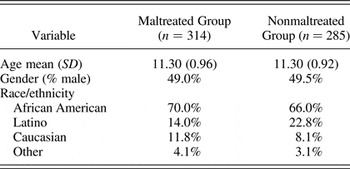
The current study was focused on 10- to 12-year-olds. Participants included 599 children (M age = 11.30, SD = 0.94) who attended a summer camp research program designed for low-income school-aged children. The sample comprised children who had been maltreated (n = 314) and comparison children who had not been maltreated (n = 285). Children were residing with their biological mothers and had not attended any previous camp research program. Over 90% of the families of both the maltreated and the nonmaltreated children had histories of receiving public assistance. Demographic characteristics are presented in Table 1. No significant differences were found between the maltreated group and the comparison group in terms of age, gender, or race/ethnicity.
Demographic characteristics

Note: Differences between groups are nonsignificant.
Parents of all children provided informed consent for participation in addition to providing consent for examination of Department of Human Services (DHS) records regarding the family history. The maltreated group was recruited based on information contained in DHS records for children identified by the county as having experienced at least one form of child abuse and/or neglect. The sample was representative of DHS service recipient families within the county. To recruit families, a liaison from DHS contacted families with a child who had been maltreated to inform them of their eligibility for the study. The study was explained to caregivers, and if parents were interested, then they signed a release to have their names provided to team members for recruitment. Participation was voluntary, and families could decline to participate without any negative consequences from DHS. If a family elected to participate, after providing consent, a comprehensive search of DHS records was completed to independently code for maltreatment information. Maltreatment was identified and categorized using operational criteria specified in the Maltreatment Classification System (MCS; Barnett, Manly, & Cicchetti, Reference Barnett, Manly, Cicchetti, Cicchetti and Toth1993). The coding process used in the analysis of DHS records is described in detail in Barnett et al. (Reference Barnett, Manly, Cicchetti, Cicchetti and Toth1993). Mothers also were interviewed by research staff using the Maternal Maltreatment Classification Interview (Cicchetti, Toth, & Manly, Reference Cicchetti, Toth and Manly2003) to determine if additional maltreatment experiences may have occurred that were not known to DHS.
Maltreated children in this sample were predominantly from low socioeconomic status families, as is consistent with the national demographic characteristics of maltreating families (Fourth National Incidence Study of Child Abuse and Neglect; Sedlak et al., Reference Sedlak, Mettenburg, Basena, Petta, McPherson and Greene2010). Consequently, demographically comparable nonmaltreated children were recruited from families receiving Temporary Assistance for Needy Families. A DHS liaison contacted qualifying nonmaltreating families to explain the study and inform them of their eligibility. If interested, parents signed a release for their names to be given to the project for recruitment. DHS record searches also were completed for nonmaltreating families to verify the absence of any record of child maltreatment. Once recruited, trained research assistants interviewed mothers of children in the nonmaltreatment group using the Maternal Maltreatment Classification Interview to confirm a lack of DHS involvement pertaining to prior maltreatment experiences. Only children without any documented or maternally reported history of abuse or neglect were retained in the nonmaltreated group. Record searches also were conducted in the year following camp attendance to ensure that all available information had been obtained.
Classification of the maltreated group based on the experiences of various maltreatment subtypes was accomplished via the MCS (Barnett et al., Reference Barnett, Manly, Cicchetti, Cicchetti and Toth1993). The MCS is a reliable and valid tool for classifying subtype(s) of maltreatment (Bolger, Patterson, & Kupersmidt, Reference Bolger, Patterson and Kupersmidt1998; English et al., Reference English, Upadhyaya, Litrownik, Marshall, Runyan and Graham2005; Manly et al., Reference Manly, Cicchetti and Barnett1994) that utilizes DHS records detailing investigations and findings involving maltreatment in identified families over time. The MCS codes all available information on an individual based on DHS data and makes independent determinations of maltreatment experiences rather than relying on official designations or case dispositions. Operational criteria are used to designate all subtypes of maltreatment that children have experienced (i.e., neglect, emotional maltreatment, physical abuse, or sexual abuse) and the severity of each subtype experienced.
The MCS also uses documented DHS records to determine when in the course of development maltreatment occurred. Maltreatment events were coded as occurring during one of five developmental periods, including infancy (0–18 months), toddlerhood (19–35 months), preschool (36–59 months), early school age (ages 5–7), and later school age (ages 8–12). The number of developmental periods where maltreatment was known to have occurred was then totaled to produce an index of chronicity of maltreatment. The developmental period of onset and the recency of maltreatment also were determined. This information was used to identify three groups among maltreated children: early onset, not recent (n = 107); early onset, recent (n = 89); and later onset, recent (n = 118). The early onset, not recent group was defined as individuals who had maltreatment onset in the infancy, toddler, or preschool period and most recent maltreatment experience in the infancy, toddler, or preschool period. The early onset, recent group was defined at individuals who had maltreatment onset in the infancy, toddler, or preschool period and most recent maltreatment experience in the early school age or later school age period. Later onset, recent was defined at individuals who had maltreatment onset in the early school age or later school age period and most recent maltreatment experience in the early school age or later school age period.
Coding of the DHS records was conducted by trained research assistants, doctoral students, and clinical psychologists. Coders were required to meet acceptable reliability with criterion standards before coding actual records for the study. Reliability was established for the presence versus absence of each maltreatment subtype (κs = 0.90–1.00).
In terms of the subtypes of maltreatment, neglect involves failure to provide for the child's basic physical needs for adequate food, clothing, shelter, and medical treatment. Emotional maltreatment involves extreme thwarting of children's basic emotional needs for psychological safety and security, acceptance and self-esteem, and age-appropriate autonomy. Physical abuse involves the nonaccidental infliction of physical injury on the child (e.g., bruises, welts, burns, choking, or broken bones). Finally, sexual abuse involves attempted or actual sexual contact between the child and a family member or person caring for the child for purposes of that person's sexual satisfaction or financial benefit.
All children in the maltreatment group had a history of abuse and/or neglect as documented by DHS records. Of the maltreated group, 79.9% had experienced physical neglect, 53% had experienced emotional maltreatment, 28.9% had experienced a form of physical abuse, and 8.6% experienced a form of sexual abuse. The majority of children experienced multiple subtypes of maltreatment, with 56.2% of the maltreated children having experienced two or more subtypes of maltreatment. In this sample, all 15 possible combinations of maltreatment subtypes were represented. This comorbidity of maltreatment subtypes is typical in previous literature examining developmental sequelae of maltreatment (Manly, Reference Manly2005).
Participants were classified as one of the four primary subtypes of maltreatment based on a hierarchical classification system (e.g., Barnett et al., Reference Barnett, Manly, Cicchetti, Cicchetti and Toth1993; Rogosch & Cicchetti, Reference Rogosch and Cichetti2005) that takes into consideration the degree to which the subtype of maltreatment violates cultural standards and the relative frequency of the maltreatment form. Based on this classification system, any child who experienced sexual abuse was categorized as sexually abused (n = 27). Any child who had been physically abused but not sexually abused was classified as physically abused (n = 78). A child who experienced neglect but had not experienced physical or sexual abuse was classified as physically neglected (n = 194), and children who had experienced emotional maltreatment absent of all other forms of maltreatment were classified as emotionally maltreated (n = 15).
Procedure
Children attended a weeklong day camp from 9:00 a.m. to 4:00 p.m. and participated in both traditional camp activities and research assessments (for detailed descriptions of camp procedures, see Cicchetti & Manly, Reference Cicchetti, Manly, Brody and Sigel1990). Children were transported by bus to the camp each day, with travel time averaging 45 min. At the camp, children were assigned to groups of eight (four maltreatment and four comparison) same-age and same-sex peers. Each group was led by three trained camp counselors who were unaware of the maltreatment status of children and the hypotheses of the study. In addition to recreational activities, after providing assent, children participated in various research assessments. Trained research assistants conducted these individual research sessions in which questionnaires and other research measures were administered. This paper focuses on maltreatment parameters as related to responses on the Borderline Personality Features Scale for Children (BPFS-C; Crick, Murray-Close, & Woods, Reference Crick, Murray-Close and Woods2005).
The BPFS-C
Borderline traits were measured using the BPFS-C (Crick et al., Reference Crick, Murray-Close and Woods2005), a self-report questionnaire used to measure borderline personality features in youth. The scale is based on the Personality Assessment Inventory (PAI; Morey, Reference Morey1991), a measure used to assess borderline personality pathology among adults. The BPFS-C has demonstrated reliability and validity, and was developed in consultation with the author of the PAI. The four subscales of the BPFS-C are the same as the subscales of the PAI: affective instability, identity problems, negative relationships, and self-harm. However, Crick et al. (Reference Crick, Murray-Close and Woods2005) have adapted the items so they reflect age-appropriate indicators (e.g., middle childhood and beyond) of borderline personality pathology. For example, affective instability is measured with questions such as “My feelings are very strong. For instance, when I get mad, I get really really mad. When I get happy, I get really really happy” and “I go back and forth between different feelings, like being mad or sad or happy.” Children report on identity problems through questions such as “I feel that something important is missing about me, but I don't know what it is” and “I change my mind almost every day about what I should do when I grow up.” Examples of negative relationship subscale questions include “I want to let some people know how much they've hurt me” and “I've picked friends who have treated me badly”; self-harm questions include “When I get upset, I do things that aren't good for me” and “I get into trouble because I do things without thinking.” Children rate each statement on a Likert scale based on how true the statement is of themselves, from 1 (not at all true) to 5 (always true).
Each of the four subscales of the BPFS-C has 6 items, for a total of 24 items. The Likert scores for these items are summed (some items are reverse-scored) to generate a composite borderline personality features score, with higher scores indicative of higher levels of borderline traits. Crick et al. (Reference Crick, Murray-Close and Woods2005) reports that the measure has established construct validity. In the current investigation, internal consistency for the measure was α = 0.83.
Results
Borderline features in maltreated and nonmaltreated groups
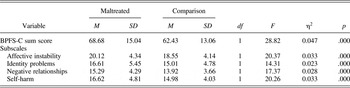
Overall borderline feature scores on the BPFS-C were compared in maltreated and nonmaltreated groups. An analysis of variance (ANOVA) revealed that maltreated children reported significantly higher levels of borderline features than did nonmaltreated children, F (1, 590) = 28.83, p < .001, η2 = 0.047. Additional ANOVAs were performed to determine whether significant differences were present between maltreated and comparison groups on each of the four subscales. On each subscale, maltreated children had significantly higher scores than did nonmaltreated children. Findings for each subscale are reported in Table 2.
Borderline features in maltreated and nonmaltreated groups

Note: BPFS-C, Borderline Personality Features Scale for Children.
BPFS-C sum score by maltreatment subtype
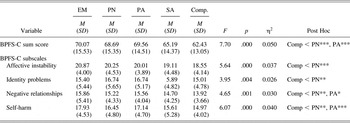
Total borderline features scores were compared by individual maltreatment subtype (EM, PN, PA, SA, and comparison). The findings are summarized in Table 3. Results showed a main effect of individual subtype on overall borderline features, F (4, 587) = 7.70, p < .001, η2 = 0.050. Pairwise comparisons indicated that physically neglected children had significantly higher borderline features scores than did the nonmaltreated comparison group (mean difference = 6.25, SE = 1.32, p < .001). Physically abused children also had significantly higher borderline feature scores than did the comparison group (mean difference = 7.12, SE = 1.81, p = .001). Emotionally maltreated and sexually abused children did not differ from nonmaltreated children with respect to overall borderline features. Maltreatment subtypes did not significantly differ among one another in overall borderline features.
Borderline features by maltreatment subtype

Note: EM, Emotional maltreatment; PN, physical neglect; PA, physical abuse; SA, sexual abuse; Comp., comparison; BPFS-C, Borderline Personality Features Scale for Children.
*p < .05. **p < .01. ***p < .001.
BPFS-C subscales by maltreatment subtype
Scores on each of the four BPFS-C subscales were also compared by individual maltreatment subtype (EM, PN, PA, SA, and comparison). Results showed a main effect of individual subtype on all four scales: affective instability, F (4, 587) = 4.64, p < .001, η2 = 0.037, identity problems, F (4, 587) = 3.95, p < .01, η2 = 0.026, negative relationships, F (4, 587) = 4.65, p < .01, η2 = 0.030, and self-harm F (4, 587) = 6.07, p < .01, η2 = 0.047. Pairwise comparisons indicated that physically neglected children had significantly higher scores than did nonmaltreated children on all four subscales: affective instability (mean difference = 1.70, SE = 0.40, p < .001), identity problems (mean difference = 1.73, SE = 0.48, p = .003), negative relationships (mean difference = 1.30, SE = 0.37, p = .005), and self-harm (mean difference = 1.47, SE = 0.41, p = .001). Relative to nonmaltreated children, physically abused children also endorsed more related to negative relationships (mean difference = 1.63, SE = 0.52, p = .01) and self-harm (mean difference = 2.16, SE = 0.57, p < .001). Emotionally maltreated children and sexually abused children did not significantly differ from nonmaltreated children on any of the four subscales. Maltreatment subtypes did not significantly differ among one another with regard to the subscales.
Borderline features by number of maltreatment subtypes
In order to determine the impact of exposure to multiple types of maltreatment experiences on development of borderline features, overall borderline features were compared in children who had experienced one or two subtypes of maltreatment and those who had experienced three or four subtypes. Differences were found between groups in overall borderline features, F (2, 589) = 14.49, p < .001, η2 = 0.047. Tukey post hoc analyses showed significant differences in mean scores between the comparison group (M = 62.43, SD = 13.06) and both one to two subtypes (M = 68.82, SD = 15.14; p > .001) and three to four subtypes (M = 67.88, SD = 14.63; p < .05). No significant differences were found between one and two subtypes, and three and four subtypes.
Borderline features by number of developmental periods maltreated
Linear regression analysis was used to test if the number of developmental periods in which maltreatment occurred, that is, chronicity, significantly predicted participants' borderline personality feature scores. The results of the regression indicated the number of developmental periods with maltreatment explained 4.4% of the variance, R 2 = .044, F (1, 590) = 28.23, p < .001. It was found that greater chronicity significantly predicted higher borderline features (B = 2.892, SE = 0.544, p < .001).
Borderline features by maltreatment onset and recency
An ANOVA was used to examine overall borderline feature scores as a function of patterns of onset and recency of maltreatment. Differences were found in overall borderline features by onset and recency group, F (3, 588) = 11.21, p < .001, η2 = 0.057. Tukey post hoc analyses revealed significant differences in mean scores between the nonmaltreated group (M = 62.43, SD = 13.06) and the early onset, not recent group (M = 67.49, SD = 15.95; p < .01), the early onset, recent group (M = 71.42, SD = 15.91; p < .001), and the later onset, recent group (M = 67.67, SD = 13.31; p < .01). No significant differences were found in mean borderline feature scores between the different onset and recency categories.
Borderline features by gender
Borderline feature scores were compared by sex to investigate the role of gender. Males and females did not differ in overall BPFS-C scores by gender, F (1, 590) = 0.315, ns. The rates of high scores on the BPFS-C sum also did not differ by gender, with 17.3% of males and 19.5% of females scoring one standard deviation or more over the mean, χ2 (1, N = 592) = 0.53, ns.
High-risk group
Because diagnosis of BPD requires noted impairment of five of the nine BPD criteria listed in the DSM-IV, it is important to examine children who have high scores on most or all of the BPFS-C borderline feature subscales, because these children may be at especially high risk for development of BPD later in life. We defined this high-risk group as individuals with elevated scores on all BPFS-C subscales, with three subscales more than 1 SD above the mean. In the full sample, 39 children met criteria for this high-risk group, including 4.3% of nonmaltreated children (comprising 30.8% of the high-risk group) and 8.6% of maltreated children (69.2% of the high-risk group). This rate significantly differed, χ2 (1, N = 599) = 4.73, p < .05. The high-risk group was examined by maltreatment subtype as well. Relative to 4.3% of nonmaltreated children, 13.3% of the EM group, 7.7% of the PN group, 11.5% of the PA group, and 3.7% of the SA group met inclusion criteria for the high-risk group. Relative to the comparison group, rates of inclusion in the high-risk group significantly differed in the PA group, χ2 (1, N = 363) = 6.03, p < .05, but did not significantly differ in the EM, PN, and SA groups: EM χ2 (1, N = 300) = 2.66, ns; PN χ2 (1, N = 479) = 2.69, ns; and SA χ2 (1, N = 312) = 0.16, ns. Rate of inclusion in the high-risk group was also examined by number of maltreatment subtypes (one to two vs. three to four). Of the one to two subtypes group, 8.9% met criteria for the high-risk group, whereas in the three to four subtypes group, 8.0% met criteria for inclusion. This rate significantly differed between the comparison group and the one to two subtypes group, χ2 (1, N = 565) = 5.14, p < .05, but did not significantly differ between the comparison group and the three to four subtypes group.
Inclusion in high-risk group by number of developmental periods maltreated
Logistic regression analysis was used to test if the number of developmental periods in which maltreatment occurred significantly predicted whether a participant would meet criteria for the high-risk group. The overall model was not significant (χ2 = 3.195, df = 1, p = .074). The number of developmental periods maltreated also was not significant (B = 0.250, SE = 0.134, p = .062, odds ratio [OR] = 1.284).
Inclusion in high-risk group by maltreatment onset and recency
Logistic regression analysis was used to test if patterns of onset and recency of maltreatment significantly predicted whether a participant would meet criteria for the high-risk group. The overall model was significant (χ2 = 10.116, df = 3, p < .05) and accounted for between 1.7% (Cox and Snell R 2 = .017) and 4.4% (Nagelekerke R 2 = .044) of the variance. Inclusion in the early onset, not recent group significantly predicted whether a participant would meet criteria for the high-risk group (B = 0.958, SE = 0.434, p < .05, OR = 2.607). Inclusion in the early onset, recent group was also a significant predictor (B = 1.166, SE = 0.437, p < .01, OR = 3.208). Inclusion in the later onset, recent group did not significantly predict whether a participant would meet criteria for the high-risk group.
Discussion
The present study supplements current knowledge on the pathogenesis of BPD though assessment of differences in developmentally salient borderline features in maltreated children, a group at known risk for the development of BPD in adulthood. Our analyses revealed increased rates of borderline features in the maltreated sample relative to an age and socioeconomic status matched comparison group, providing evidence that maltreatment confers considerable risk for development of age-salient borderline personality features in middle childhood. Maltreated children also reported significantly higher levels of all of the borderline features (e.g., affective instability, identity problems, negative relationships, and self-harm) measured in this examination. Thus, no single borderline trait is producing the differences seen between maltreated and comparison groups. It would seem that all featural facets of BPD may be impacted by maltreatment. Further, maltreated children were over twice as likely to have high scores on all four BPD subscales and thus be considered at high risk for later development of the disorder. These findings are consistent with the extensive literature associating child maltreatment with BPD in adulthood (Battle et al., Reference Battle, Shea, Johnson, Yen, Zlotnick and Zanarini2004; Herman, Perry, & Van der Kolk, Reference Herman, Perry and Van der Kolk1989; Johnson et al., Reference Johnson, Smailes, Cohen, Brown and Bernstien2000).
The distinctive forms of maltreatment were differentially related to borderline feature presentation in childhood. Our data showed that physical abuse and physical neglect were associated with increased overall borderline feature scores. However, this relation was not significant for sexual abuse, a finding contrary to previous literature linking sexual abuse and BPD (Johnson et al., Reference Johnson, Cohen, Brown, Smailes and Bernstien1999; Weaver & Clum, Reference Weaver and Clum1993). One possible explanation for this incongruity lies in sample size. Despite a relatively large maltreatment group, our sexual abuse group (n = 27) may not have had enough power to exhibit the effects seen in previous literature. This study's young cohort may also explain the discrepancy. Another study by Widom et al. (Reference Widom, Czaja and Paris2009), which examined BPD in substantiated cases of sexual abuse prior to age 11, also found that sexual abuse was not a significant risk factor for BPD diagnoses in adulthood. It may be the case that some children participating in such studies will subsequently be sexually abused in adolescence, producing results more consistent with the adult retrospective literature. More research is needed to clarify the relation between BPD symptoms and possible influences of developmental timing of sexual abuse.
However, the strong associations between sexual abuse and BPD reported by other researchers, primarily via retrospective investigations, may be due to impacts on outcome variables not seen until adolescence or adulthood such as romantic relationships. If this is the case, either the effects of sexual abuse relative to BPD may be latent during the middle-childhood period or the middle childhood variables influenced by sexual abuse and associated with BPD were not appropriately measured in this study. Although the former explanation may be true, it is somewhat unlikely if our findings are interpreted through a developmental pathways framework that supports continuity in development. The latter explanation would then be one of heterotypic continuity, the idea that an underlying factor may express itself in different forms at different developmental stages. One developmentally salient variable in middle childhood that may be an earlier manifestation of the influence of sexual abuse is relational aggression (Crick et al., Reference Crick, Murray-Close and Woods2005). An investigation by Cullerton-Sen et al. (Reference Cullerton-Sen, Cassidy, Murray-Close, Cicchetti, Crick and Rogosch2008) showed sexual abuse as a predictor of relational aggression for girls. Relational aggression is an established correlate of BPD (Werner & Crick, Reference Werner and Crick1999). Therefore, future research should be conducted to determine if relational aggression in childhood among girls experiencing sexual abuse is associated with later emergence of BPD in adulthood.
The present study also considers the importance of maltreatment chronicity in the development of borderline symptoms through examination of developmental onset and recency of maltreatment. Specifically, findings showed that the number of developmental periods in which maltreatment occurred significantly predicted borderline feature scores. For every additional developmental period in which maltreatment occurred, there was an increase of 1.284 in an individual's likelihood of meeting criteria for the group with three subscale scores 1 SD or more above the mean. Although no prior studies have examined the relation between chronicity of maltreatment and patterns of borderline features, this finding is consistent with prior research showing that chronicity of maltreatment is associated with increases in both externalizing and internalizing problems (Jonson-Reid et al., Reference Jonson-Reid, Kohl and Drake2012; Manly et al., Reference Manly, Kim, Rogosch and Cicchetti2001). Chronic maltreatment has been shown to impact factors key to the successful maintenance of interpersonal relationships such as prosocial behavior (Jaffee & Maikovich-Fong, Reference Jaffee and Maikovich-Fong2011). The decreased prosocial behavior seen in chronically maltreated children may be a precipitant of relational challenges and higher scores on the negative relationships subscale, leading to higher overall borderline feature scores in this analysis.
Differences in overall borderline feature scores were also found between the nonmaltreated group and all maltreated onset and recency groups. However, although each onset and recency group evinced significantly higher overall borderline scores than did the nonmaltreated group, no significant differences were found between earlier and later maltreatment onset and recency groups. This is consistent with the findings of Jaffee and Maikovich-Fong (Reference Jaffee and Maikovich-Fong2011) that the effects of chronicity on internalizing and externalizing problems are not dependent on the developmental period when maltreatment began. Manly et al. (Reference Manly, Kim, Rogosch and Cicchetti2001) also found a similar pattern of significant differences between nonmaltreated and maltreated peers yet limited differences between onset and recency subgroups within the maltreated group. The lack of differences between onset and recency groups may be a result of not accounting for severity and density of maltreatment experiences between maltreatment onset and most recent maltreatment event.
Chronicity of maltreatment was found to influence whether a child displayed significantly higher borderline subscores than the mean. Our analysis showed that for each additional developmental period in which maltreatment occurred, an individual is 1.28 times more likely to meet criteria for a high-risk group in which scores on three out of four subscales are one standard deviation or more above the mean.
Onset and recency also appeared to exert influence over the development of borderline personality features. Those in the early onset, not recent group were 2.61 times more likely to meet criteria for the high-risk group, while those in the early onset, recent group were 3.21 times more likely to meet criteria for the high-risk group. However, inclusion in the later onset, recent group was not a predictor for inclusion in the high-risk group. One possible explanation for this finding is that an early childhood free of maltreatment thus allowed individuals to successfully complete stage-salient developmental tasks that later influence the development of borderline personality features and/or serve as protective factors. A number of studies on BPD have linked the disorder to one of the primary developmental milestones of early childhood: forming a secure attachment to a caregiver (Agrawal, Gunderson, Holmes, & Lyons-Ruth, Reference Agrawal, Gunderson, Holmes and Lyons-Ruth2004; Bowlby, Reference Bowlby1988; Bradley & Westen, Reference Bradley and Westen2005; Carlson, Egeland, & Sroufe, Reference Carlson, Egeland and Sroufe2009; Fonagy, Reference Fonagy2000; Hill et al., Reference Hill, Stepp, Wan, Hope, Morse and Steele2011). Maltreatment has long been established in the literature as a risk factor for the formation of an insecure attachment (Cicchetti & Barnett, Reference Cicchetti and Barnett1991; Egeland & Sroufe, Reference Egeland and Sroufe1981), and attachment theory posits that this attachment serves as the foundation for an internal working model of relationships and self-representation that guides our behavior in future relationships (Bowlby, Reference Bowlby1969). Moreover, maltreatment and BPD also are both associated with the disorganized attachment classification (Carlson, Cicchetti, Barnett, & Braunwald, Reference Carlson, Cicchetti, Barnett and Braunwald1989; Levy, Reference Levy2005; Nakash-Eisikovits, Dutra, & Westen, Reference Nakash-Eisikovits, Dutra and Westen2002). In the case of disorganized attachment, repeated contradictory cues and inconsistent caregiving patterns lead to a breakdown in distress regulation strategies in infancy and a conceptualization of the attachment relationship and the self that is fragmented and incoherent (Hesse & Main, Reference Hesse and Main2000; Main & Solomon, Reference Main and Solomon1990). Levy (Reference Levy2005) notes that some researchers have argued that disorganized attachment is at the root of BPD itself (Holmes, Reference Holmes2003, Reference Holmes2004; Liotti, Reference Liotti, Bailey and Gilbert2000). However, recent work by Carlson et al. (Reference Carlson, Egeland and Sroufe2009) examining the relationship between infant attachment and BPD found that the link between disorganized attachment and adult borderline symptoms may be mediated by the disturbance of self-representational processes in middle childhood and early adolescence. Research implicates maltreatment in the disruption of self-system processes and the establishment of a sense of self (see Cicchetti & Valentino, Reference Cicchetti, Valentino, Cicchetti and Cohen2006, for a review).
This analysis produced no differences in overall BPD precursor scores by gender. The absence of differences between males and females on these traits is not unprecedented; a 2005 study of BPD precursors in children aged 6–12 by Rogosch and Cicchetti also produced no differences in trait rates by gender. However, the finding is noteworthy considering the gender disparity in rates; BPD in adulthood is estimated in 3% of females and 2.4% of males (Tomko et al., Reference Tomko, Trull, Wood and Sher2013). These slightly contrasting rates may be due to factors associated with measurement of BPD features in children. Perhaps the adaptation of BPD features to reflect age-salient issues has produced criteria that are more gender neutral. However, the finding may reflect multifinality in outcomes associated with this developmental pathway. Based on similarities in prevalence, symptoms (e.g., impulsivity) and outcomes (e.g., increased risk for suicide), Paris (Reference Paris1997) has suggested that BPD and antisocial personality disorder (ASPD) may share a common etiology. Beauchaine et al. (Reference Beauchaine, Klien, Crowell, Debridge and Gatzke-Kopp2009) extended this theory, positing that sex functions as a moderator in the expression of BPD and ASPD as produced through genetic predispositions to impulsivity and environmental influences. Findings from this study may reflect individuals who have begun on this maladaptive pathway as a function of maltreatment but have not yet had the behavioral expression moderated by sex. If this is the case, then our findings would suggest that gender does not discriminate BPD from ASPD until some time in adolescence. However, should the two disorders share an underlying etiology, the precipitants of multifinality in BPD and ASPD remain unclear. Future research is needed to test possible mechanisms of influence, including biological or hormonal changes associated with puberty, gender differences in peer relationships, and sociocultural differences in gender roles.
Certain limitations present in this study should be noted. Although we examined the number of subtypes of maltreatment, these analyses do not take into consideration the severity of each maltreatment experience. Examination of chronicity in conjunction with information on the severity of maltreatment may provide a clearer perspective on the impact of maltreatment onset and recency variables in particular. In addition, this investigation did not include other developmental systems such as attentional networks and emotion regulation systems that are likely influential in production of BPD features (Crowell, Beauchaine, & Linehan, Reference Crowell, Beauchaine and Linehan2009; Posner et al., Reference Posner, Rothbart, Vizueta, Levy, Evans and Thomas2002; Putnam & Silk, Reference Putnam and Silk2005; Rogosch & Cicchetti, Reference Rogosch and Cichetti2005). Although beyond the scope of this investigation, individual borderline features and environmental considerations such as maltreatment should be measured in concert with other systems to fully understand the developmental phenomena being examined. This multiple levels of analysis approach will provide a more comprehensive understanding of maladaptive personality processes (Cicchetti & Blender, Reference Cicchetti and Blender2006; Cicchetti & Dawson, Reference Cicchetti and Dawson2002). Further study of these networks within the sample and the high BPD features group in particular will enable us to better elucidate the processes underlying these behavioral outcomes. Finally, researchers have called for investigations on continuity in underlying personality organization (Lenzenweger & Cicchetti, Reference Lenzenweger and Cicchetti2005). As such, longitudinal research on the topic is essential to determine whether individuals high in borderline precursor features at this time point will go on to develop clinical BPD in adulthood.
When examined in conjunction with studies linking childhood trauma and BPD diagnosis in adulthood, results encourage consideration and further review of a multilevel developmental pathway model in which maltreatment may play a role. Should individuals from our identified high-risk group go on to develop the full disorder in adulthood, the BPFS-C may prove an extremely valuable clinical tool for identification of individuals at high risk for BPD and thus candidates for preventative interventions. Because BPD is notoriously challenging to effectively treat once canalized (Linehan, Reference Linehan1993; Zanarini, Frankenburg, Reich, & Fitzmaurice, Reference Zanarini, Frankenburg, Reich and Fitzmaurice2012) early intervention becomes of paramount importance. Prospective longitudinal studies may better clarify the relation among BPD features, chronicity, sexual abuse, and gender seen in this investigation. An empirical examination of Beauchaine et al.'s (Reference Beauchaine, Klien, Crowell, Debridge and Gatzke-Kopp2009) theory of BPD/ASPD development beginning in early to middle childhood would be especially informative.