Republican Congressman Duke Cunningham resigns after pleading guilty to bribery. House Majority Leader Tom DeLay is indicted and forced to relinquish his leadership position, and later resigns from Congress. House Democrat William Jefferson is stripped of his position on the Ways and Means Committee after an FBI raid of his congressional office and amid reports that he hid $90,000 in alleged bribes in a freezer at his home. Stories of wrongdoing in government surface almost daily as members of Congress come under a microscope for close ties to lobbyists. As the 2006 congressional elections approach, Democrats have made corruption a central theme in their campaigns, arguing that a series of scandals adds up to a full-blown culture of corruption. In response, Republicans have rejected this characterization and attempted to point the finger back at Democrats, suggesting that people who live in glass houses shouldn't throw stones.
For the Democrats' charge of a “culture of corruption” to stick, two conditions must hold. First, voters must accept that corruption is commonplace—even a way of life—for those in and around the federal government. Second, citizens have to place the blame for this squarely, or at least largely, on the Republican Party. We consider these two themes below. Do citizens perceive corruption in the many transactions and decisions that take place every day in politics? And if so, can Democrats use these judgments to their advantage?
Corruption from the Voter's Perspective
What, exactly, do people mean when they talk about corruption? At one level it seems fairly obvious—we all know corruption when we see it. The dominant conception of corruption, as Mark Warren and Michael Johnston note in this symposium, is of a violation of some public trust by a governmental official, such as Rep. Cunningham's acceptance of bribes, which can be managed and controlled by more rules and more transparency. But as Warren argues (and we agree), a small-d democratic conception of corruption is much broader; it goes beyond mere violations of established rules. Political scientists, however, have tended to focus on corruption as illegal activity on the part of public officials (Fackler and Lin 1995; Meier and Holbrook 1992; Nye 1989). This definition, though relatively easy to recognize, we believe fails to account for much of what the public thinks is corrupt. This is not to suggest that the public fails to equate patently illegal behavior on the part of officials with corruption; of course it does. Respect for the principle of the “rule of law” runs deep in American political culture. Indeed, comparative political scientists often single out the United States as unique because of its “legalistic-rationalistic” mindset (Almond and Verba 1965; Huntington 1981). Not surprisingly, bribe-taking, the hiring of “ghost employees” for public works projects, and other patently illegal activities are widely viewed as corrupt.
Even so, research on American public opinion further suggests that a sizeable portion of the electorate views many ostensibly legal behaviors as corrupt as well, if favoritism or brazen self-interest is implied (Johnston 1986 and this symposium; Hibbing 2002; Redlawsk and McCann 2005). An official in a government agency who uses his or her connections to help an unemployed friend find a job could be seen as corrupt, even when such actions do not violate any laws. The same could be said for a host of other activities—a candidate who engages in prodigious (but legal) fundraising for a campaign, a member of Congress who flies home frequently to consult with wealthy business owners in the district, or an office seeker who promises voters special policy benefits if elected.
Political reformers frequently acknowledge this much more expansive understanding of corruption when drafting legislation to “clean up” politics. As the Bipartisan Campaign Finance Reform Act of 2002 was being debated, for example, lawmaker after lawmaker emphasized the importance of avoiding not only corruption, which was no doubt understood in narrow legalistic terms, but also the “appearance of corruption,” an open-ended phrase that might touch on many everyday activities in politics. Such activities may well spark in the average citizen a sense of what Warren (2004 and this symposium) calls “duplicitous exclusion” that violates norms of “openness, publicity, and inclusion.”
We illustrate the above points regarding public opinion through two surveys: a large exit poll in six very different locations on the day of the 2000 election (Kenosha, WI, Lafayette and West Lafayette, IN, Iowa City, New York, Miami, and New Orleans, with a total N over 6,000); and a statewide poll of likely participants in the 2004 Democratic Primary in New Hampshire (N = 447).1
See Redlawsk and McCann (2005) for details concerning the design of the six-city exit poll in 2000. The Survey Center at the University of New Hampshire administered the pre-primary poll via telephone in December of 2003. Respondents were chosen through random digit dialing; only those indicating that they would participate in the January 27, 2004, primary were interviewed.
How corrupt would it be if …
- Someone on the government payroll did no work for the pay?
- A police officer accepted money not to write a traffic ticket?
- A citizen claimed government benefits to which he or she was not entitled?
- An official gave a contract to a campaign contributor without considering other contractors?
- An elected official with many wealthy backers supported a tax cut that largely benefited the rich?
- An elected official raised campaign funds while inside his or her government office?
- Voters supported a candidate for office in return for a promise to fix potholes on their street?
- An official recommended an out-of-work friend for a government job?
- A political candidate running for public office took a $500 donation from a wealthy business owner?
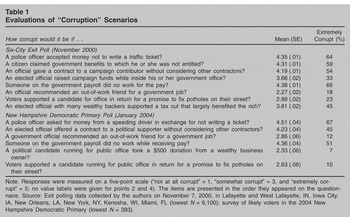
We chose scenarios that varied widely across two dimensions, an “illegal” versus “legal” continuum, and “official” actors versus ostensibly “private” citizens. Under the traditional definition of the term corruption—the misuse of public office for private gain—we would expect bribery to be most strongly condemned, followed perhaps by no-bid government contracting. Both activities are patently illegal and involve officials carrying the imprimatur of the state. Someone on the government payroll doing no work for the pay is also illegal, but our wording does not imply that the shirker occupies a prominent or powerful position. It is certainly illegal when citizens claim government benefits they do not deserve, but these are not “official” actors either. In these latter two cases, then, citizens adhering to traditional understandings of corruption should be less harsh in their judgments. The remaining items on recommending an unemployed friend for a job, voting for candidates who promise to repair local roads, donating to a political campaign, and backing a tax cut that largely benefits the rich are relatively common occurrences in the United States, actions that are all legal on their face and do not imply the abuse of constitutionally established roles. As shown in Table 1, when citizens consider these behaviors, they do not always conform to the conventional understanding of corruption.
Evaluations of “Corruption” Scenarios

The findings here suggest that “average” citizens acting in a private capacity might be considered corrupt—as corrupt as government officials—if they seek special treatment or put their own individual concerns above a well-recognized “public good.” It is clear that lawbreaking (bribery, shirking responsibilities in a government job, no-bid contracting) is more uniformly condemned than other presumably legal actions (assisting an unemployed friend, accepting campaign contributions). Yet citizens who are clearly breaking the law but acting in a private capacity (claiming benefits to which one is not entitled) are viewed on average as being about as “corrupt” as the police officer who accepts a bribe or the government employee who does no work for the pay. There is apparently little distinction in the public's definition of corruption between those who occupy “public” and “private” roles.
Similar findings emerge when an indisputably lawful action is considered: voters supporting a candidate in return for a promise to fix potholes on their street. The exit poll respondents on average believed that this behavior is more corrupt than an official assisting an unemployed friend. Among the likely New Hampshire Democratic Primary participants, citizens voting specifically to get their potholes repaired were seen as more corrupt than the political candidate who accepts a $500 donation from a wealthy business owner. On what basis are such judgments rendered? Warren (2004) and Hibbing (2002) offer a rationale: these voters are aiming to exploit electoral processes in order to gain particularistic benefits. Nearly one out of five participants in the six-city survey and one out of 10 of the likely primary voters saw such behavior as extremely corrupt—a minority viewpoint, to be sure, but a strikingly large percentage given conventional understandings of the term “corruption” (Nye 1967; Peters and Welch 1978; Johnston 2001). On the face of it, citizens appear to be quite “democratically minded” when ruling on the ethics of civic life. “Regular” Americans seem to be held to the same standards of behavior as government officials.
Americans are therefore well primed to accept the Democrats' central charge this year that a culture of corruption envelopes Washington, D.C. If legal as well as illegal behaviors and actions undertaken by private citizens as well as public servants can register as “corrupt,” charges of rampant wrongdoing are liable to be taken quite seriously.
Socioeconomic Underpinnings of Corruption Dispositions
This inference must be tempered, however, by an important caveat. The citizens who think in more expansive terms about political corruption tend to occupy the lower rungs of the socioeconomic status scale (Redlawsk and McCann 2005; Johnston 1986; Gardiner 1970). Those with more education, income, and other social resources tend to think in traditional legal terms about corruption. Bribery, embezzlement, and other serious crimes imply corruption, but favoritism and “special interest” politics are not condemned, as long as no laws were violated. As Johnston (1986) suggests, people with more resources are likely to be better informed about policymaking, and therefore more familiar with (and less offended by) self-interested or narrow-minded behavior in political circles. Moreover, what looks like illegitimate favoritism from a low-SES perspective—the paving of particular roads, personal access to congressional representatives—may be seen by high-status individuals as “merely the fruits of merit and expertise” (387).
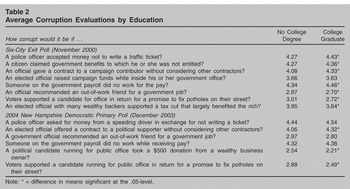
The relationship between status and judgments concerning corruption is apparent in our surveys. Table 2 shows a breakdown in mean corruption evaluations by education, coded in dichotomous terms (college graduate versus those without a college degree). Among general election voters and likely primary participants, we find a consistent pattern. Respondents who had not gone to college were more apt to label the pursuit of self-interest in politics (e.g., voting to get the streets in one's neighborhood paved, a business owner donating to a campaign) as corrupt. On the other hand, when government officials broke the law to further some interest (bribery, no-bid contracts given to supporters), respondents in the high-education group were quicker to declare corruption.2
Dividing the samples based on family income results in similar patterns. The more affluent respondents are, the more inclined they were to understand corruption in legalistic terms.
Average Corruption Evaluations by Education

What does this imply about the “culture of corruption” charge in 2006? One of the most regrettable findings from the vast literature on American public opinion is that citizens with fewer socioeconomic resources tend to pay less attention to political campaigning, and express less interest in general in politics. Those who may be most sympathetic to the charge that corruption has become a way of life in government—because their interpretations of “corruption” include many everyday political activities—may be more difficult for Democrats to reach and mobilize under the banner of reform.
Partisan Considerations
Rallying citizens around the issue of corruption is further complicated by the presence of other salient considerations in voters' minds, notably partisan identifications. What might appear to be an outrageous example of corruption to citizens in one partisan camp could look like only a simple misunderstanding from the opposing party's perspective.
We observed this first-hand, but unexpectedly, in surveys conducted in 2004. Under the auspices of the Time-Sharing Experiments in the Social Sciences Program (TESS), we sought to probe the public-private distinction in judgments concerning corruption.3
The TESS web site at www.experimentcentral.org contains details regarding recruitment of respondents and survey administration. We gratefully acknowledge support from the TESS program, from Diana Mutz and Arthur Lupia (Principal Investigators), and from the National Science Foundation, which provided funding for the data collection. The Indiana University Center for Survey Research administered the surveys, which were conducted nationally.
How corrupt would it be if …
- A speeding driver offered money to a police officer in exchange for not writing a ticket?
- Someone appointed by a Senator to do a government job did no work for the pay?
- A campaign contributor requested that an elected official grant a contract to him or her without considering other contractors?
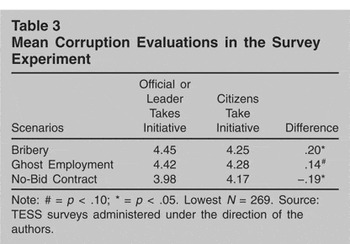
Much to our surprise, differences in judgments from one group to the next varied markedly across the three scenarios, as seen in Table 3. The topics of bribery and ghost employment elicited results in keeping with a traditional “public-private” distinction: a police officer seeking a bribe was deemed significantly more corrupt than a private citizen offering money (though the survey respondents on the whole still saw the driver offering a bribe as quite corrupt); and the hypothetical senator who put a ghost employee on the government payroll was rated as more corrupt than the employee who took it upon himself or herself to do no work. Americans believe that violations of the law are highly corrupt, whether undertaken by “regular” citizens or officials, but they condemn those acting in a public role especially strongly.
Mean Corruption Evaluations in the Survey Experiment

Curiously, however, the survey participants on average believed that the private contractor seeking a no-bid grant would be more corrupt than the official who actually offers such a grant. Why is this? We suspect that this strange anomaly surfaced because of the information environment at the time the TESS study went into the field (late October, 2004). Shortly before the experiment was conducted, stories circulated of illegal no-bid contracts for Iraq reconstruction that had been provided to Halliburton, the company previously headed by Vice President Dick Cheney (Mann 2004; Solomon 2004). It did not take long for the Democratic vice-presidential candidate, John Edwards, to respond, calling the no-bid contracts “special favors” and “wrong” (Kerry-Edwards 2004). No similar claims were aired about ghost employees or bribery. Thus the electoral contest in 2004 provided a kind of natural experiment on top of our survey experiment, which allowed us to delve further into how partisan preferences can affect citizens' perceptions of corruption.
Initially, if anything, the growing focus on no-bid contracts and Halliburton that fall appears to have made respondents less condemning of these contracts, if we simply compare the three survey datasets (Mean = 3.98 in the TESS study, 4.23 in the 2004 New Hampshire Primary study, 4.19 in the 2000 exit polls). The New Hampshire study provides a clue about where we should look for an explanation. That survey of likely Democratic primary voters found the greatest condemnation of no-bid contracting in any of our studies. If partisanship were driving at least part of this effect, we might well expect Republicans during the election of 2004 to be supportive of a Republican administration seeking re-election, even to the point of shaping their perceptions of corruption.
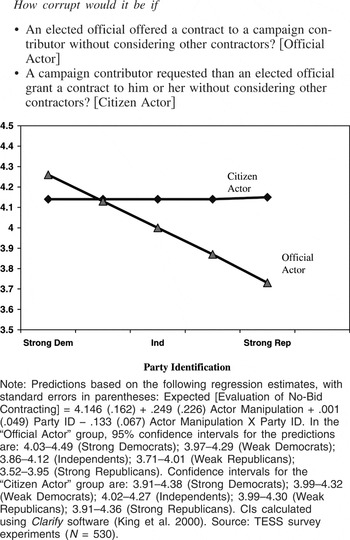
To examine this, we specified an ordinary least squares regression model for judgments concerning no-bid contracting. We included our actor manipulation and partisanship, along with an interaction term between the two. We found no main effects for the actor manipulation or for partisanship. But the interaction of the two was significant. When a government official was said to be extending a no-bid contract, Republicans were significantly less likely to see the action as corrupt compared to Democrats. However, when a private citizen was the actor, partisanship played no role whatsoever. This suggests that our survey respondents were attuned to the political environment in which they found themselves. Mass dispositions regarding integrity and corruption in American politics are actually somewhat flexible, and may partly reflect partisan rationalizations. Actions that Democrats condemn as corrupt may be viewed as nearly aboveboard by Republicans if incumbent Republican officeholders are linked at the time to such behaviors.4
We should note that party identification did not significantly interact with the experimental treatment for the bribery and ghost employment items in the TESS surveys. These non-findings lend further weight to our conjecture that the Cheney-Halliburton controversy put a partisan cast on evaluations of no-bid contracting (McCann and Redlawsk 2006).
The potential for partisanship to condition judgments of fair and foul behavior in politics must be great indeed, given that none of the survey items specifically mentioned Halliburton, the vice president, or any other administration official. The fitted values from this regression appear in Figure 1. On average, strong Republicans were more than half a point lower on the five-point corruption scale than strong Democrats when “official” actors were evaluated. No comparable patterns emerged when a “private citizen” took the initiative.

Predicted Response to No-Bid Contract Scenario, by Actor and Partisanship
Corruption and the 2006 Elections
Do voters care about corruption? Americans have become increasingly cynical about politics and politicians over the past three decades (Hibbing 2002) Early in this campaign cycle, corruption appeared to be on its way to becoming a central concern. President George Bush's deputy chief of staff, Karl Rove, was under threat of indictment (since removed), Scooter Libby, Vice President Cheney's chief of staff was indicted and as of this writing awaits trial. Two congressmen had resigned—DeLay under indictment, and Cunningham after pleading guilty to bribery. And Jack Abramoff, the lobbyist's lobbyist, was said to be cooperating with federal prosecutors in a wide-ranging investigation reaching into House and Senate offices, as well as other races such as Ralph Reed's run for lt. governor of Georgia. The list goes on. Certainly the raw materials necessary for corruption to play a major role in the 2006 elections seemed to be in place. Yet the evidence for a general rising of voters against a culture of corruption is mixed at best. By late June, the Washington Post could headline a story: “Call for Lobbying Changes Is A Fading Cry, Lawmakers Say” (Birnbaum and VandeHei 2006), while at virtually the same time a Gallup Poll reported that fully 85% of the public said “corruption” was an extremely or somewhat important factor in the congressional vote, second only to the war in Iraq (National Journal Hotline 2006).
Various studies suggest that charges of corruption can be consequential on the day of the election. Individual candidates running for election or re-election under a cloud of scandal are significantly more vulnerable (see, e.g., Banducci and Karp 1994; Dimock and Jacobson 1995; Jacobson and Dimock 1994; Fackler and Lin 1995; Peters and Welch 1980; Welch and Hibbing 1997; Alford et al. 1994). But whether one party can wage a successful national campaign against a “culture of corruption” remains to be seen.5
As Gary C. Jacobson (2004) writes, national issues can have powerful effects on midterm congressional races. The Democrats learned this lesson the hard way in 1994. Yet even then, popular disgust over Washington scandals was just one of many factors shaping voting decisions (see pp. 176–84).
Symposium Authors' Bios
Michael Johnston is the Charles A. Dana Professor of Political Science, and division director for the social sciences, at Colgate University in Hamilton, New York. He has studied issues of corruption, democratization, and development comparatively for many years. His most recent book, Syndromes of Corruption: Wealth, Power, and Democracy, was published by Cambridge University Press at the end of 2005.
James A. McCann is associate professor of political science and graduate placement director at Purdue University, West Lafayette, Indiana. He conducts research on campaigns and elections, public opinion, and political parties, both in the United States and cross-nationally. His work has appeared in many leading scholarly journals. He can be reached at mccannj@purdue.edu.
David P. Redlawsk is associate professor of political science at the University of Iowa. His research focuses on voting, campaigns, elections, and the role of emotions in politics. Recent publications include two new books, How Voters Decide: Information Processing in an Election Campaign, with Richard Lau, and an edited volume, Feeling Politics: Emotion in Political Information Processing. He can be reached at davidredlawsk@uiowa.edu.
Mark E. Warren teaches political theory at the University of British Columbia, where he holds the Chair for the Study of Democracy and directs the Centre for the Study of Democratic Institutions. His current research interests include new forms of citizen participation and democratic representation, the relationship between civil society and democracy, and the corruption of democratic relationships.