INTRODUCTION
When performing the horizontal line bisection test, young healthy individuals deviate their attempted bisections to the left of center, a phenomenon known as “pseudoneglect” (e.g., Bowers & Heilman, Reference Bowers and Heilman1980; Jewell & McCourt, Reference Jewell and McCourt2000). This bias is thought to be related to right hemisphere dominance in the allocation of spatial or global attention. With aging, there is a decrease of this left-sided bias (Schmitz & Peigneux, Reference Schmitz and Peigneux2011). This age-related change in the allocation of horizontally allocated spatial attention is thought to be the result of age-associated changes in functional hemispheric asymmetries. Specifically, the right hemi-aging model (Albert & Moss, Reference Albert and Moss1988) posits that the right hemisphere is more susceptible to age-related decline than the left hemisphere. Thus, the alterations in right hemispheric functions may help to explain age-related changes in the allocation of horizontal spatial attention.
In addition to the horizontal pseudoneglect, healthy people can also display a vertical attentional bias (vertical pseudoneglect). For example, when attempting to bisect vertically oriented lines (intersection of the coronal and sagittal planes), young right-handed individuals tend to deviate their bisections upward (Jeerakathil & Kirk, Reference Jeerakathil and Kirk1994). Although the reason for this bias is not fully known, there is some evidence that the right hemisphere might also play a critical role in mediating this bias.
For example, Suavansri, Falchook, Williamson, and Heilman (Reference Suavansri, Falchook, Williamson and Heilman2012) have shown that, in healthy adults, vertical line bisections are biased upward, and are higher in the left than right hemispace. Since it is the right hemisphere that primarily allocates attention to left hemispace, these findings would suggest that the upward visuospatial attentional bias in adults might result from right hemispheric dominance for allocating spatial attention. Thus, if the right hemisphere is more susceptible to age-related decline than the left hemisphere (Albert & Moss, Reference Albert and Moss1988), just as there is a reduction in the leftward bias in horizontal line bisection with aging, there might be an age-related reduction of this upper bias in vertical line bisection.
There is, however, an alternative hypothesis that makes an opposite prediction as to how aging might affect the upward vertical attention bias. Differential age-related degradation of the dorsal versus ventral attentional streams may result in greater upward bias with age. Crivello, Tzourio-Mazoyer, Tzourio, and Mazoyer (Reference Crivello, Tzourio-Mazoyer, Tzourio and Mazoyer2014) performed longitudinal assessments of gray matter atrophy in a large population of older and younger adults using voxel based morphometry. They revealed that the dorsal visual stream, including the superior and inferior parietal lobes, exhibited substantially larger reductions in gray matter volume than did the temporal lobe’s ventral visual stream. Lesion studies have revealed that with a dorsal (parietal) lesion, patients have neglect of lower egocentric space (Rapcsak, Cimino, &, Heilman, Reference Rapcsak, Cimino and Heilman1988) and in contrast, a ventral temporal-occipital lesion induces neglect of higher egocentric space (Shelton, Bowers, & Heilman, Reference Shelton, Bowers and Heilman1990; Adair, Williamson, Jacobs, Na, & Heilman, Reference Adair, Williamson, Jacobs, Na and Heilman1995).
These observations suggest that the dorsal stream allocates egocentric attention downward, and the ventral stream allocates egocentric attention upward. Since the dorsal stream has been shown to have a greater decline/reduction with aging than the ventral stream, this aging-related asymmetrical decline should be associated with an increase in an upward attentional bias. To our knowledge, currently it is not known if the right hemisphere age-related decline induces downward deviation or the dorsal stream age-related decline induces upward deviation in the allocation of attention. Thus, the aim of this research was to investigate possible differences in vertical attentional bias between younger and older adults.
METHODS
Participants
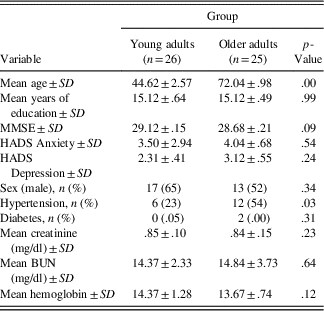
Twenty-six young (17 males; mean age 44.62±2.57 years, mean education 15.12±.64) and 25 elderly (13 males; mean age 72.04±.98 years, mean education 15.12±.49) non-demented, right-handed adults participated in this study. Participants were divided into two groups of age according to World Health Organization criteria, thus the young group consisted of participants of 21 to 64 years of age, while age of older participants ranged from 65 to 82 years. All subjects were native Polish speakers, and were recruited to alarger project according to criteria mentioned in our previous manuscript (see Mańkowska et al., Reference Mańkowska, Heilman, Williamson, Biedunkiewicz, Dębska-Ślizień and Harciarek2017). All participants were tested in the same room at approximately the same time of a day (11:00 AM±1 ht). Exclusion criteria were neurological or psychiatric disorders, a history of substance abuse, as well as major organ failure (e.g., renal, pulmonary, cardiac, hepatic). All participants underwent ophthalmic examination before testing; other than refractive errors that were corrected with glasses, none of the participants had defective vision.
The approximate sample size for this study was predetermined by power analysis conducted using G*Power software (presuming a medium effect size and an α of .05). The analysis showed that there should be 23 participants in each group to detect between-group differences.
Apparatus and Procedures
All experimental procedures took place at the Institute of Psychology, University of Gdańsk (Poland). The local research ethics committee approved the experimental protocol of the study. Before testing, each participant signed an informed consent form. All participants declared general well-being on the day of testing. Following experimental procedures, all participants were compensated with 100 PLN (Polish equivalent of 27 USD).
Mental status
Mini-Mental State Examination (MMSE) was used to evaluate the participants’ cognitive status. To minimize the likelihood of substantial contributions of a neurodegenerative process to the experimental results, only individuals with a MMSE score of 26 or higher were included in this study. Depression and anxiety of each subject were examined with the use of the Polish adaptation of Hospital Anxiety and Depression Scale (HADS; see Mańkowska et al., Reference Mańkowska, Heilman, Williamson, Biedunkiewicz, Dębska-Ślizień and Harciarek2017).
Vertical line bisection task
All participants sat at a table and were instructed to bisect vertical lines (24 cm×2 mm) presented individually on a sheet of paper. These sheets of paper (A4 format; 30 cm×21 cm) were sequentially presented such that the lines were vertical (intersection of the midsagittal and coronal planes), presented at eye level, and placed on a white frame board. After each participant attempted to bisect a line, the sheet of paper with this line was removed, numbered, and a new sheet of paper with a new line was placed on the frame until all 24 bisections were performed.
Participants were facing the lines, and the distance between the participants and each line was 50±4 cm. All participants used their right hand to mark what they perceived as the middle of the line. During the task, participants were not given any feedback as to their performance. Deviations from the midpoint of each attempted bisection were measured to the nearest millimeter. Upward deviations (above the line’s midpoint) were designated as positive and downward deviations were designated as negative. The results were summed for each participant, and an algebraic mean was calculated.
RESULTS
Demographic and Clinical Factors
Independent t tests analysis did not reveal any group differences in sex, education, as well as general cognitive status as indicated by MMSE between the Younger and Older groups. In addition, both groups did not differ in terms of depression and anxiety symptoms as measured by the Polish adaptation of the Hospital Anxiety and Depression Scale (see Table 1).
Demographic and biochemical data

BUN=blood urea nitrogen; MMSE=Mini-Mental State Examination; HADS=Hospital Anxiety and Depression Scale.
Vertical Line Bisection Task
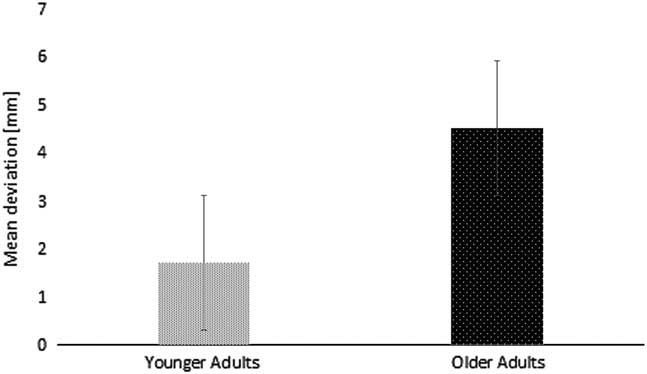
One-sample t-tests that compared the participants’ performance with the correct bisection point (=00) revealed that both younger (M=1.71; SD=3.30); t(25)=2.64; p=.01) and older (M=4.52; SD=4.09); t(24)=5.52; p=.00) adults showed systematic upward bias.
In the overall group of 51 participants, line bisection performance was normally distributed (Shapiro Wilks W=0.98; p=.52). Thus, to learn if there was a group difference in the allocation of spatial attention determined by the performance of a vertical line bisection test, an independent t-test was conducted. Overall, the analysis revealed that elderly participants deviated their bisections significantly more upward than did the young individuals, t(49)=-2.71; p=.009 (see Figure 1).
Elderly participants deviated their bisections significantly more upward than did the young individuals.

DISCUSSION
The current study was designed to investigate and compare the direction and magnitude of vertical attentional bias in younger and older participants. There are two alternative hypotheses that were investigated. Since aging might be associated with a greater decline in right than left hemispheric functions (e.g., Albert & Moss, Reference Albert and Moss1988; Dolcos, Rice, & Cabeza, Reference Dolcos, Rice and Cabeza2002; Schmitz & Peigneux, Reference Schmitz and Peigneux2011) and the right hemisphere appears to mediate upward attention (Suavansri et al., Reference Suavansri, Falchook, Williamson and Heilman2012), one hypothesis is that with aging there would be a decrease in the upward vertical bias.
The alternative hypothesis is that with aging, there is also a decline in the dorsal visual stream that mediates the downward allocation of vertical attention and, therefore, with aging there would be in increase in older participants’ upward vertical bias. The results of this study revealed that both younger and older healthy participants have an upward deviation on their attempted vertical bisections; however, the upward bias seen in older participants was significantly greater than that observed in the younger adults. These results appear to support the dorsal stream aging hypothesis.
As mentioned, according to Crivello and co-workers (2014), healthy older people have more rapid atrophy of their superior and inferior parietal lobes than of their ventral temporal lobes. In addition, in a study that used positron emission tomography imaging, Martin, Friston, Colebatch, and Frackowiak (Reference Martin, Friston, Colebatch and Frackowiak1991) found that there is a decrease of blood flow to the parietal lobes with aging. Furthermore, Braddick, Atkinson, and Wattam-Bell (Reference Braddick, Atkinson and Wattam-Bell2003) noted that neurons with larger cell bodies and axon diameters are more susceptible to age-related degeneration; thus, the dorsal stream might be more vulnerable to aging due to its cellular composition. Hence, with greater age-related reduction of the activity of the dorsal stream, there might be an alteration in the balance between ventral and dorsal networks inducing a stronger upward bias.
It has been shown that the first and last visual scans can influence performance on the line bisection test (Rinaldi, Di Luca, Henik, & Girelli, Reference Rinaldi, Di Luca, Henik and Girelli2014). When reading and writing, most speakers of European languages usually start at the upper left portion of the page. Older people have practiced reading and writing for a longer time than have younger people. Thus, older people might have a different initial direction of gaze than do younger people. However, we did not track eye movements, and it is possible that with advancing age the scanning strategy in the vertical plane changes.
In summary, the results of this study show that, whereas people, in general, have an upward attentional bias while performing the vertical line bisection task, this upward bias appears to increase with aging. Although our findings suggest that age-related changes in the dorsal visual stream account for this age-related increase in the upward bias, future research is necessary to link our behavioral findings to neurophysiological correlates. In addition, older adults appear to have an increased risk of falling, and future studies are needed to learn if this increase of upward bias with aging may influence participants’ everyday activities such as walking.
ACKNOWLEDGMENTS
This study was supported by the National Science Centre, Poland (grant number 2015/17/B/HS6/03951), PI: Michał Harciarek. None of the funders had any role in study design, data collection, data analysis, interpretation, or the decision to submit an article for publication. Conflicting interests: The authors declare no conflicting interests.