Introduction
Amaryllidaceae alkaloids represent a kind of phenylalanine and tyrosine derivatives restricted to the only Amaryllidaceae plant family (Zhong, Reference Zhong2005). Galantamine (GAL, Fig. 1), a benzazepine alkaloid, was first isolated from the bulbs and flowers of Galanthus caucasicus and Galanthus woronowii by Bulgarian scientists in the mid-20th century (Heinrich and Teoh, Reference Heinrich and Teoh2004). This has been also obtained from the other related genera such as Narcissus, Leucojum, Lycoris (Bastida et al., Reference Bastida, Viladomat, Llabrés, Quiroga, Codina, Feliz and Rubiralta1990; Moraes-Cerdeira et al., Reference Moraes-Cerdeira, Burandt, Bastos, Nanayakkara, Mikell, Thurn and McChesney1997; Cherkasov and Tolkachev, Reference Cherkasov, Tolkachev and Hanks2002). GAL is a long acting, selective, reversible and competitive inhibitor of the acetylcholinesterase (AChE) enzyme (Thomsen et al., Reference Thomsen, Bickel, Fischer and Kewitz1998), which is marketed as a hydrobromide salt under the name of Razadyne® (formerly Reminyl®) and Nivalin® for the treatment of Alzheimer's disease (AD), poliomyelitis and other neurological diseases (Heinrich and Teoh, Reference Heinrich and Teoh2004). Recently the more widespread licensing of GAL throughout the world has caused a need for alternative sources. Synthetic methods have been developed and used to produce GAL for the pharmaceutical industry (Tiffen, Reference Tiffen1997), but high costs and increasing demand make extraction from plant sources an attractive option. A potential source for large-scale extraction of the alkaloid is members of Amaryllidaceae family especially Narcissus and Galanthus species (Lubbe et al., Reference Lubbe, Gude, Verpoorte and Choi2013). As a part of our ongoing studies on the natural source of GAL and due to the importance of this compound in clinical medicine (Jiang et al., Reference Jiang, Yang, Li, Wang and Wang2015; Naharci et al., Reference Naharci, Ozturk, Yasar, Cintosun, Kocak, Bozoglu, Tasci and Doruk2015), we report here for the first time quantification of this alkaloid in some wild populations of G. nivalis and N. tazetta. Additionally, our findings provide valuable information for the selection of GAL-rich genotypes.
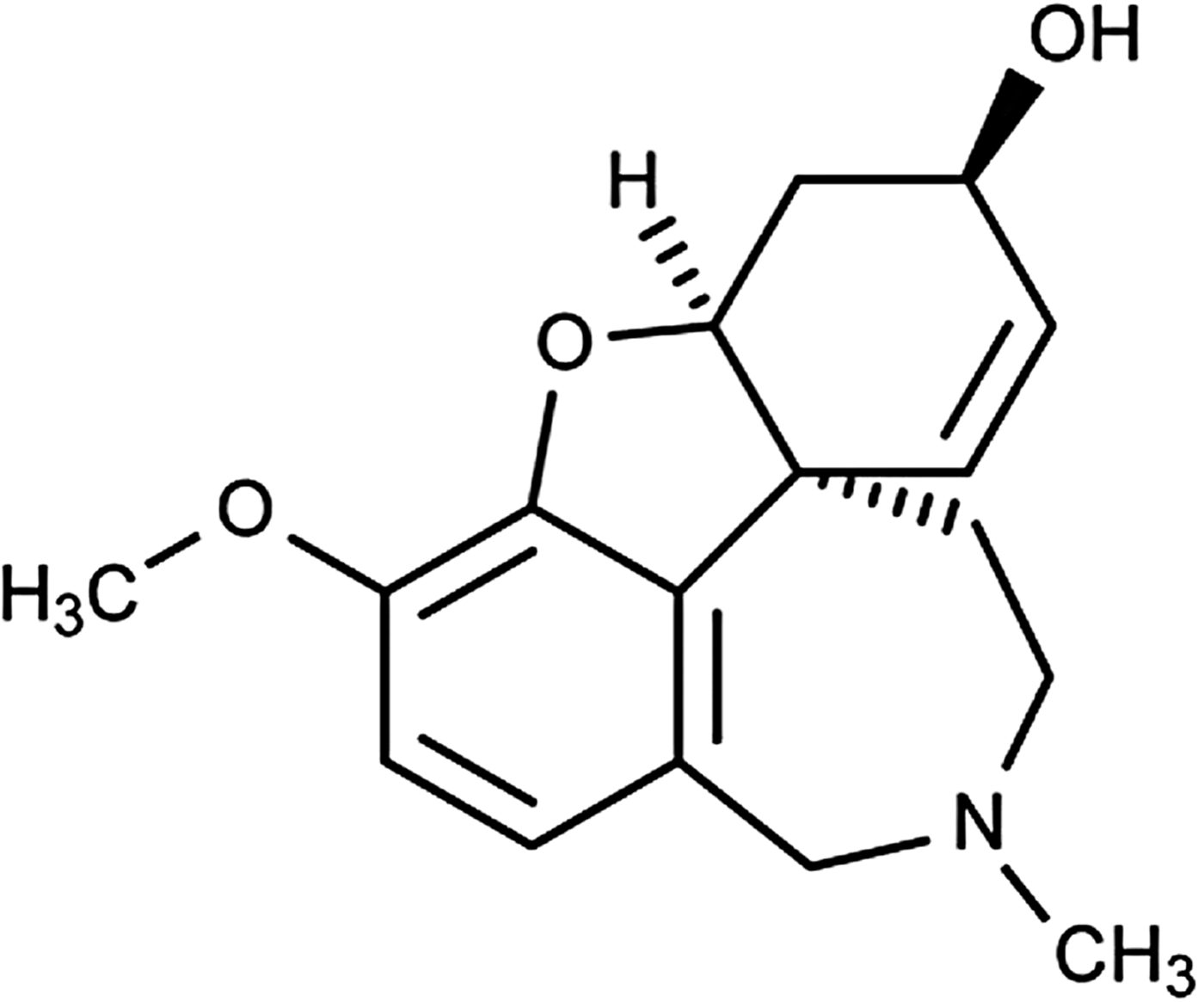
Chemical structure of GAL.

Experimental
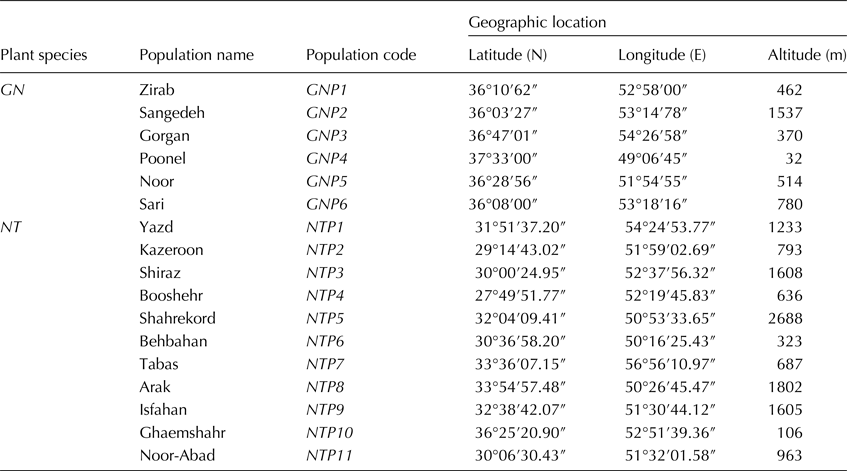
A total of six G. nivalis populations (GNP1–GNP6) and 11 N. tazetta populations (NTP1–NTP11) were collected across different geographical regions from the north to the southwest of Iran. The bulbs of wild G. nivalis and N. tazetta populations were collected at fruiting set stage in March and April 2014 from their natural habitats, respectively (Table 1). Air-dried bulbs (300 mg) of all collected GNPs and NTPs were powdered in a mortar and extracted three times with methanol (3 × 5 ml) by sonication at room temperature as described previously (Georgieva et al., Reference Georgieva, Berkov, Kondakova, Bastida, Viladomat, Atanassov and Codina2007). After filtration, the plant residues were rinsed with methanol (2 × 5 ml) and the combined methanol extract was evaporated under vacuum. The dry extract was re-dissolved in 3% H2SO4 (4 ml) and defatted with diethyl ether (3 × 5 ml). After basification to pH 9–10 with 25% ammonia, the GAL was extracted with chloroform (3 × 5 ml). The organic solvent was dried under reduced pressure in a rotary evaporator at 40°C (Heidolph Instruments GmbH, Schwabach, Germany). The extracts were dissolved in high-performance liquid chromatography (HPLC) grade methanol (1 ml), filtered through a Millipore filter (0.45 mm) and stored in a refrigerator until analysis. HPLC and liquid chromatography-mass spectrometry (LC-MS) analyses were performed as described in the Supplementary Material (online only).
Geographic location of the studied Galanthus nivalis (GN) and Narcissus tazetta (NT) populations from Iran

Discussion
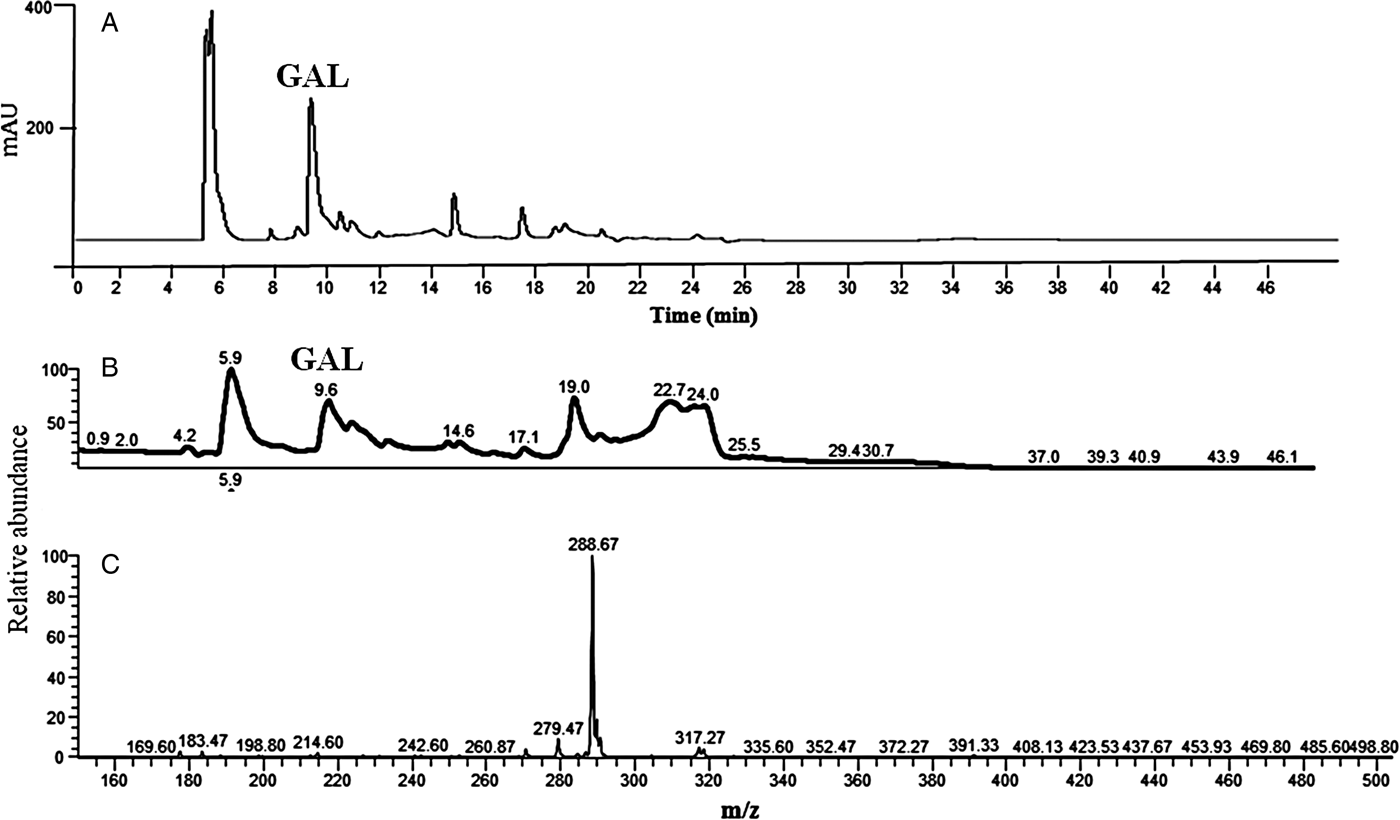
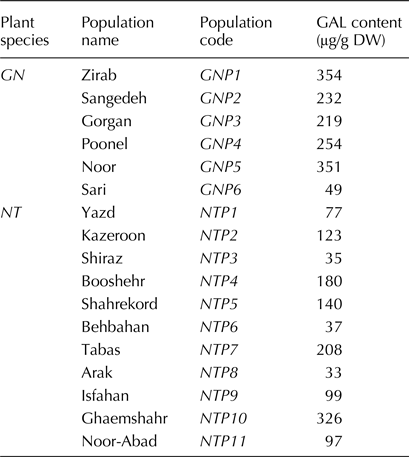
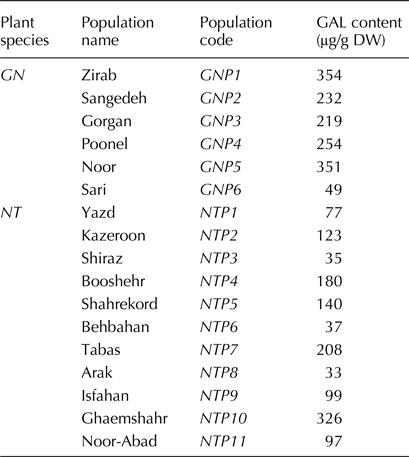
One of the most used HPLC method for the quantitative determination of GAL and some other Amaryllidaceae alkaloids was developed by Sellés et al. (Reference Sellés, Viladomat, Bastida and Codina1999). Recently, different HPLC systems for analysis of GAL in various species of Amaryllidaceae family have also been reported (Petruczynik et al., Reference Petruczynik, Misiurek, Tuzimski, Uszynski, Szymczak, Chernetskyy and Waksmundzka-Hajons2016; Svinyarov et al., Reference Svinyarov, Keremedchieva and Bogdanov2016). Although, the technique has been previously used for estimation of GAL in some members of Amaryllidaceae family such as Narcissus confusus (Sellés et al., Reference Sellés, Viladomat, Bastida and Codina1999), Leucojum aestivum (Schumann et al., Reference Schumann, Berkov, Claus, Gerth, Bastida and Codina2012), Galanthus trojanus, Galanthus cilicicus, Galanthus elwesii (Kaya et al., Reference Kaya, Fillik, Hisil and Unver2004, Reference Kaya, Polat, Emir, Sarikaya, Onur and Somer2014), Zephyranthes rosea and Clivia miniata (Petruczynik et al., Reference Petruczynik, Misiurek, Tuzimski, Uszynski, Szymczak, Chernetskyy and Waksmundzka-Hajons2016), but no reports are available regarding quantitative estimation of GAL in wild growing populations of G. nivalis and N. tazetta from Iran. The identification and quantitative determination of GAL in all collected GNPs and NTPs was established by comparison of the retention time, MS spectra and peak area with the standard. According to Sellés et al. (Reference Sellés, Viladomat, Bastida and Codina1999), a mobile phase consisting of acetonitrile gave symmetrical and sharp peak of GAL at a RT (retention time) of 20.1 min. Figure 2 show LC-MC total ion chromatogram of the extract. All calibration curves were linear over the concentration ranges with correlation coefficients (r) higher than 0.9990. The GAL content ranged from 0.05 to 0.36 mg/g dry weight (DW) in the bulbs of GNPs, and from 0.03 to 0.33 mg/g DW in the bulbs of NTPs (Table 2). Maximum content of GAL (0.36 and 0.33 mg/g DW) was measured in the Zirab population of G. nivalis and Ghaemshahr population of N. tazetta, respectively. Studies have reported that different geographical regions and cultural practices affected the chemical compositions of the plants (Hadian et al., Reference Hadian, Mirjalili, Kanani, Salehnia and Ganjipoor2011; Aghaei et al., Reference Aghaei, Mirjalili and Nazeri2013; Khadivi-Khub et al., Reference Khadivi-Khub, Aghaei and Mirjalili2014). Georgieva et al. (Reference Georgieva, Berkov, Kondakova, Bastida, Viladomat, Atanassov and Codina2007) studied GAL distribution in various wild populations of L. aestivum by GC-MS (gas chromatography-mass spectrometry) and found that the GAL content ranged from 28 to 2104 µg/g DW in the bulbs, and from traces to 454 µg/g DW in the shoot-clumps. Due to the importance of GAL as natural compound with potent of the AChE inhibition (Jiang et al., Reference Jiang, Yang, Li, Wang and Wang2015; Naharci et al., Reference Naharci, Ozturk, Yasar, Cintosun, Kocak, Bozoglu, Tasci and Doruk2015), there is a need for further investigations on the variations of the compounds within and among wild populations of both plant species. The variations in GAL content in the studied GNPs and NTPs suggest that the genetic factor plays an important role in the biosynthesis of this compound. The chemical variation can be also attributed to environmental factors. Hanover (Reference Hanover1992) provides evidence that terpene biosynthesis are strongly controlled by genetic factors, he also reported instances of environmental variation in terpene expression under extreme habitat conditions. In this respect, an intensive selection in wild plants is necessary to obtain GAL-rich cultivars for the extraction of this pharmaceutically interesting compound. In conclusion, our results show that G. nivalis populations especially Zirab population (GNP1) and Noor population (GNP5) are valuable source of GAL. It can provide an ample opportunity to take this plant for extensive research for mass cultivation on plants and enhanced anti-AD compound production through different breeding and biotechnological strategies such as cell suspension cultures and large-scale cultivation in bioreactor system.
HPLC-UV chromatogram of the methanolic extract of Narcissus tazetta recorded at 280 nm (A), total ion chromatogram (TIC) related to LC-MS analysis of the same extract (B), and mass spectrum of GAL in which 288.6 m/z (C) could be assigned to its proton adduct ion. (Both chromatographic and mass spectrometric condition of analyses are explained in the experimental section.)

Content of galantamine (GAL) in the bulb of studied Galanthus nivalis (GN) and Narcissus tazetta (NT) populations from Iran
Supplementary material
The supplementary material for this article can be found at https://doi.org/10.1017/S1479262117000107.
Acknowledgements
The authors thank the Shahid Beheshti University Research Council and the Iran National Science Foundation (INSF, Grant No. 94021603) for financial support of this project. They also thank Mr M. Ghasemi and Mr M. Abbas-Mohammadi for their kind collaboration in plant material collection and HPLC analyses, respectively. This work was a part of M. Rahimi Khonakdari's M.Sc. thesis.