





Introduction
Endometrial cancer (EC) is the most common gynaecological malignancy, accounting for approximately 8–10% of all cancers affecting women. Worldwide, it is the fourth most frequently diagnosed cancer and the fourth leading cause of cancer-related death among women.Reference Sung, Ferlay and Siegel1 Over the past decade, its incidence has increased substantially, particularly in high-income countries. Global estimates indicate that the number of new cases rose from 43,470 (7,950 deaths) in 2010 to 121,578 cases (29,638 deaths) in 2018, reaching approximately 417,367 new diagnoses and 97,370 deaths in 2020.Reference Sung, Ferlay and Siegel1 This trend is largely attributable to population ageing and the increasing prevalence of obesity.
The standard management of EC consists of total hysterectomy with bilateral salpingo-oophorectomy, with or without sentinel lymph node mapping, systematic lymphadenectomy, and peritoneal cytology. Adjuvant treatment, including radiotherapy (RT) with or without chemotherapy, is prescribed according to recognized prognostic factors used to define risk categories. These include age, disease stage, tumour size, histological subtype and grade, depth of myometrial and cervical invasion, lymphovascular space invasion, stromal involvement, and lymph node status.Reference Bosse, Peters and Creutzberg2
With the aim of evaluating the application of current international guidelines for the management of EC in Italy, as well as treatment outcomes and toxicity patterns, Autorino et al. (2024) established the LArge Database In Endometrial cancerS (LADIES).Reference Autorino, Rinaldi and Macchia3 However, the first analysis included patients treated between 2010 and 2020 and did not incorporate molecular data, as these were not routinely available during that period.
In 2020, the joint ESGO–ESTRO–ESP consensusReference Concin, Matias-Guiu and Vergote4 introduced molecular profiling into the standard risk stratification system. Following publication of these recommendations, several Italian centres progressively incorporated molecular classification into routine clinical decision-making for patients with EC.
Recent advances in the molecular characterization of EC have led to the adoption of a four-class molecular classification system comprising POLE-ultramutated (POLEmut), mismatch repair-deficient (MMRd), p53-abnormal (p53abn), and no specific molecular profile (NSMP) tumours. This classification has important prognostic and predictive implicationsReference Talhouk, McConechy and Leung5–Reference León-Castillo, de Boer and Powell9 and is increasingly used to guide adjuvant treatment decisions. POLEmut tumours are associated with an excellent prognosis, MMRd tumours have an intermediate prognosis and potential sensitivity to immunotherapy, p53abn tumours are characterized by aggressive clinical behaviour and poorer outcomes, whereas NSMP tumours represent a heterogeneous group with variable prognostic risk. Additional biomarkers, including oestrogen and progesterone receptors (ER/PR), L1CAM, and the DNA mismatch repair proteins MLH1, MSH2, MSH6, and PMS2, provide complementary prognostic and predictive information and further refine tumour characterization. The integration of these molecular factors into routine clinical practice has substantially improved risk stratification and is now considered an essential component of contemporary EC management.
In particular, omission of RT appears to be safe in patients with POLEmut tumours, for whom no locoregional recurrences have been reported. In the MMRd subgroup, locoregional control rates appear comparable following external beam radiotherapy (EBRT), interventional radiotherapy (IRT), or observation alone, suggesting a limited benefit from RT. Conversely, patients with p53abn tumours derive a significant locoregional control benefit from EBRT compared with IRT alone. In NSMP tumours, IRT appears to be as effective as EBRT and superior to observation alone in reducing local recurrence.Reference Horeweg, Nout and Jurgenliemk-Schulz10 Furthermore, the PORTEC-3 trial confirmed the prognostic and predictive value of the molecular subgroups in identifying patients most likely to benefit from adjuvant chemoradiotherapy, leading to their incorporation into current classification systems11 and treatment guidelines.Reference Concin, Matias-Guiu and Vergote4
Against this background, the Gynaecology Study Group of the Italian Association of Radiotherapy and Clinical Oncology (AIRO GYN) conducted a national survey to evaluate the implementation of molecular profiling in the selection of adjuvant treatment for EC across Italian RT centres. The present report describes the survey methodology and presents its findings.
Materials and Methods
In June 2024, a panel of Italian radiation oncologists and data managers belonging to the AIRO GYN Study Group developed a questionnaire investigating the management of patients with EC treated between 2020 and 2022. The questionnaire was initially assessed by an independent group of AIRO GYN physicians to evaluate its readability, clarity, and usability and was subsequently refined according to their recommendations.
The final questionnaire comprised 15 questions organized into five sections, including both closed- and open-ended items. Depending on the specific domain explored, responses referred either to the number of participating centres or to the number of patients.
Sections Introduction, Materials and Methods, Results collected information on the characteristics of participating RT centres, including geographical distribution, institutional affiliation, multidisciplinary tumour board (MDT) organization, and the number of patients with EC managed during the study period.
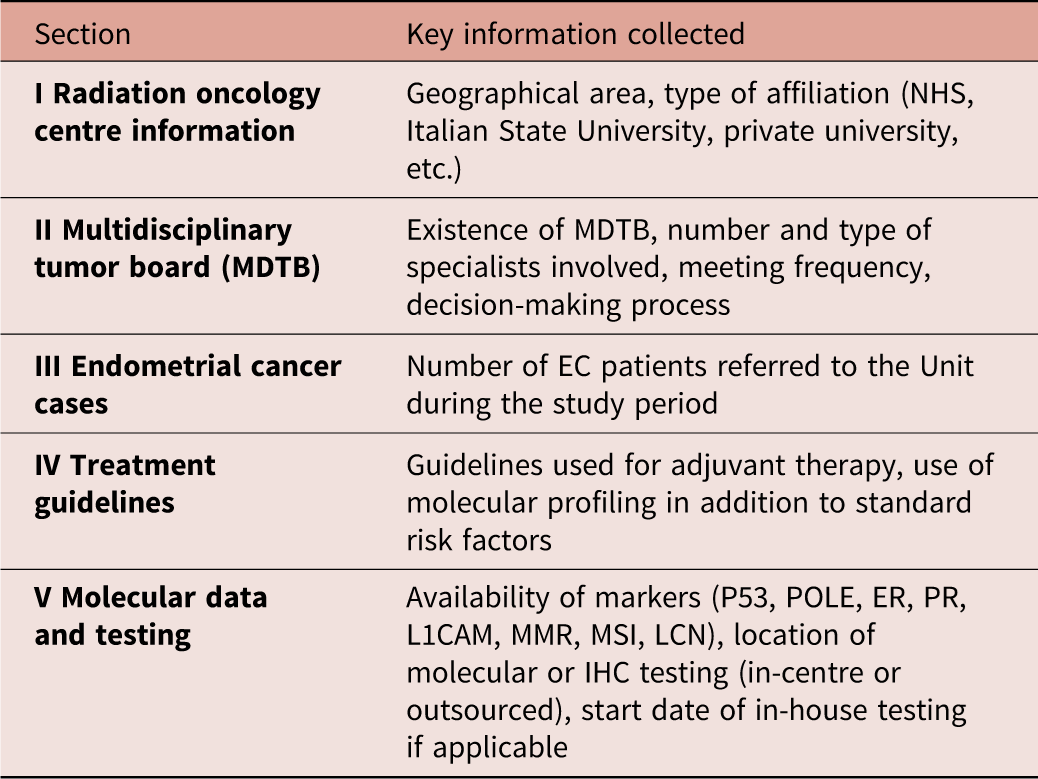
Sections Discussion and Conclusions investigated the clinical guidelines adopted for adjuvant treatment and the implementation of molecular profiling, including the biomarkers assessed and the methodologies used for molecular and immunohistochemical analyses (Table 1).
Questionnaire sections

Table 1. Long description
A table with five rows and two columns. The first column lists sections and the second column lists key information collected. Row 1: Section 1, Radiation oncology centre information; Geographical area, type of affiliation (N H S, Italian State University, private university, etc.). Row 2: Section 2, Multidisciplinary tumor board (M D T B); Existence of M D T B, number and type of specialists involved, meeting frequency, decision-making process. Row 3: Section 3, Endometrial cancer cases; Number of E C patients referred to the Unit during the study period. Row 4: Section 4, Treatment guidelines; Guidelines used for adjuvant therapy, use of molecular profiling in addition to standard risk factors. Row 5: Section 5, Molecular data and testing; Availability of markers (P 53, P O L E, E R, P R, L 1 C A M, M M R, M S I, L C N), location of molecular or I H C testing (in-centre or outsourced), start date of in-house testing if applicable.
Abbreviations: NHS = National Health Service; IHC = immunohistochemistry.
The survey was distributed to the 15 centres that had previously participated in the LADIES project.Reference Autorino, Rinaldi and Macchia3 All centres belonged to both the AIRO GYN Study Group and the AIRO Brachytherapy, IRT, and IORT Study Group. Survey responses were entered into an Excel database for subsequent statistical analysis.
Statistical analysis
Data processing was performed in June 2024 at Fondazione Policlinico Universitario A. Gemelli IRCCS, Università Cattolica del Sacro Cuore, Rome.
Categorical variables are presented as frequencies and percentages. Percentages were calculated with reference to the number of respondents for each individual question. Descriptive statistics were used to summarize the characteristics of participating centres and the distribution of responses across the different survey domains. Statistical analyses were performed using SPSS software (version 20.0; SPSS Inc., Chicago, IL, USA).
Results
All 15 invited Italian RT centres completed the questionnaire, corresponding to a response rate of 100%.
Section I – Geographical distribution and institutional affiliation
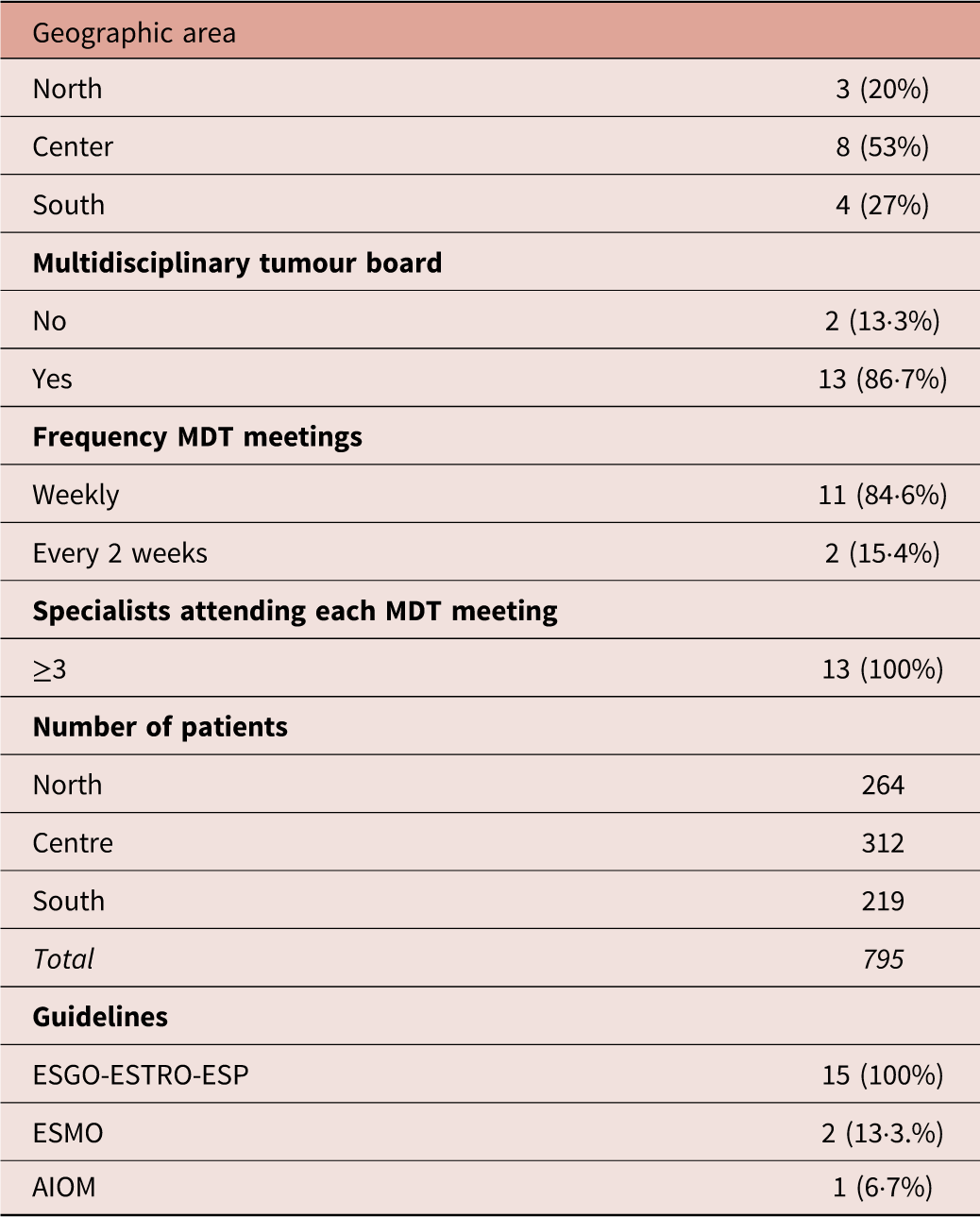
Among the participating centres, three (20%) were located in Northern Italy, eight (53%) in Central Italy, and four (27%) in Southern Italy (Table 2). The northern region included centres in Lombardy, Veneto, and Emilia-Romagna; the central region comprised Lazio, Umbria, Tuscany, and Abruzzo; and the southern region included Sicily, Puglia, and Molise.
Replies to questionnaire sections I–IV in numbers and percentages

Table 2. Long description
The table presents data from questionnaire responses across different geographic areas and multidisciplinary tumor boards. It has 11 rows and 2 columns. The columns are labeled ʼGeographic areaʼ and values. The rows are labeled as follows: North with a value of 3 (20 percent), Center with a value of 8 (53 percent), South with a value of 4 (27 percent), Multidisciplinary tumour board with subcategories No and Yes having values 2 (13.3 percent) and 13 (86.7 percent) respectively, Frequency MDT meetings with subcategories Weekly and Every 2 weeks having values 11 (84.6 percent) and 2 (15.4 percent) respectively, Specialists attending each MDT meeting with a value of 13 (100 percent), Number of patients with subcategories North, Centre, and South having values 264, 312, and 219 respectively, and a total of 795, Guidelines with subcategories ESGO-ESTRO-ESP, ESMO, and AIOM having values 15 (100 percent), 2 (13.3 percent), and 1 (6.7 percent) respectively.
Most respondents (9/15; 60%) were affiliated with National Health Service (NHS) hospitals, while five centres (33·3%) were university hospitals and one (6·7%) was a private institution.
Section II – Multidisciplinary tumour boards
A dedicated MDT was available in 13 of the 15 participating centres (86·7%). Each MDT included at least three specialists. Radiation oncologists, gynaecological oncologists, and medical oncologists were represented in all MDTs, whereas pathologists and radiologists participated in 92·3% and 61·5% of centres, respectively. Geneticists and nuclear medicine physicians were involved in 30·7% and 23·0% of MDTs, respectively. MDT meetings were held weekly in 11 centres (84·6%) and fortnightly in two centres (15·4%) (Table 2).
Section III – Endometrial cancer cases
During the 2020–2022 study period, five centres (33·3%) managed more than 100 patients with EC, four centres (26·7%) treated between 50 and 99 patients, and six centres (40·0%) managed fewer than 50 patients. The geographical distribution of patient volume is summarized in Table 2.
Section IV – Guidelines for adjuvant treatment
All participating centres reported using the ESGO–ESTRO–ESP guidelines to guide adjuvant treatment decisions and to integrate molecular profiling with established clinicopathological risk factors. In addition, two centres also referred to the ESMO guidelines and one centre to the AIOM guidelines (Table 2).
Section V – Molecular profiling
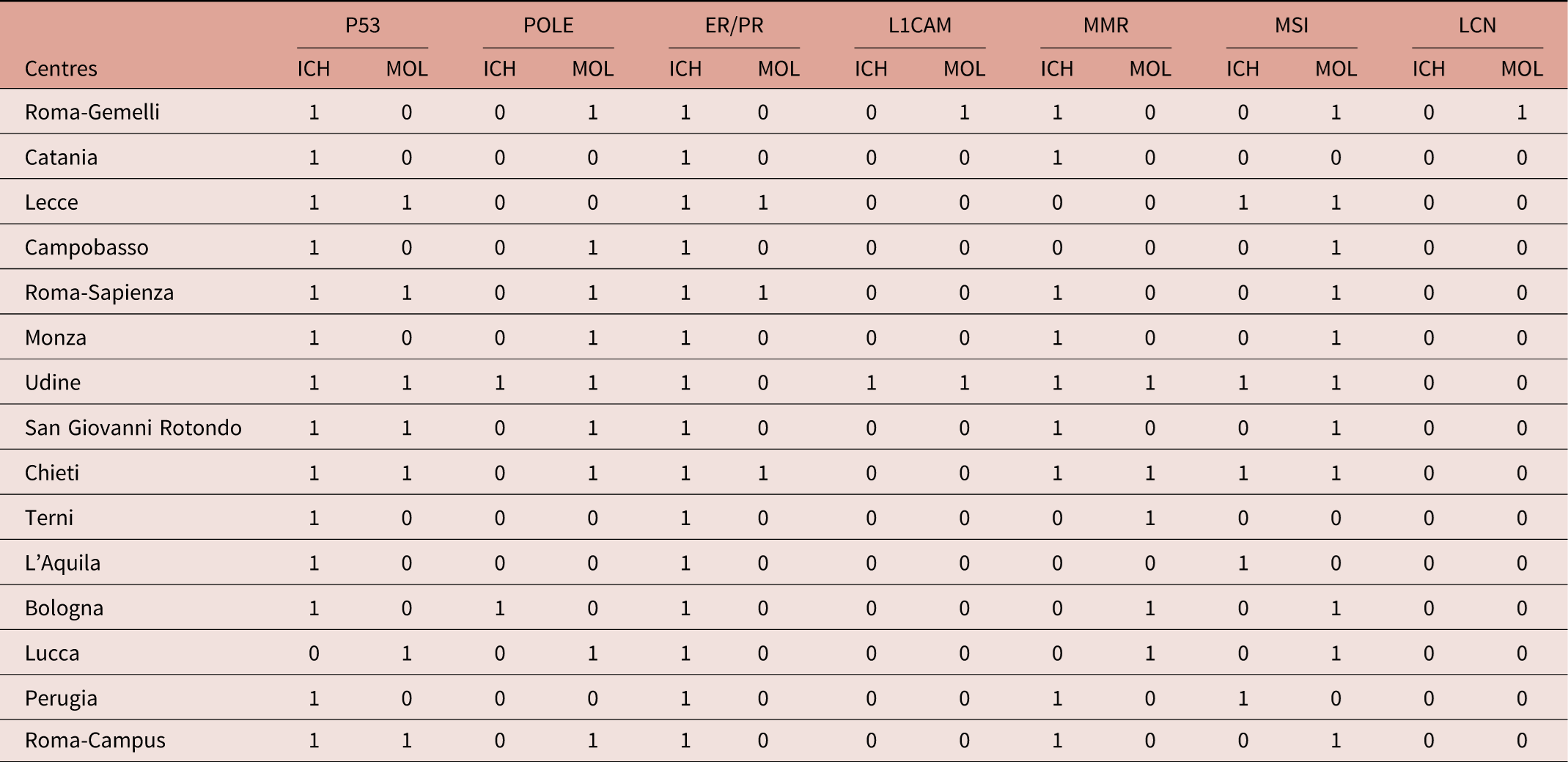
Immunohistochemical assessment of molecular biomarkers was introduced in most participating centres in 2020, whereas molecular testing became progressively available from 2021 onwards (Table 3). Molecular analyses were performed locally in 14 centres, while one centre referred specimens to another institution within the same region.
Immunohistochemistry (IHC) and molecular analysis (MOL) carried out (1) or not (0) from centres responding to the survey

Table 3. Long description
The table compares the availability of immunohistochemistry (IHC) and molecular analysis (MOL) across various centers. It has 14 rows and 14 columns. The columns are labeled with different biomarkers: P53, POLE, ER/PR, L1CAM, MMR, MSI, and LCN. Each biomarker column is divided into ICH and MOL sub-columns. The rows are labeled with the names of different centers: Roma-Gemelli, Catania, Lecce, Campobasso, Roma-Sapienza, Monza, Udine, San Giovanni Rotondo, Chieti, Terni, LʼAquila, Bologna, Lucca, Perugia, and Roma-Campus. Each cell contains a value of 1 or 0, indicating whether the analysis was carried out (1) or not (0).
p53 analysis
In all centres, p53 was analysed with 14/15 laboratories (93·3%) performing the analysis by immunohistochemistry (IHC). Six (40%) of centres used both IHC and molecular analysis, while 1 centre (6%) used only molecular analysis.
POLE analysis
Eight centres (60%) used molecular analysis to detect POLE mutation. One centre (6%) used only IHC while another 1 (6%) used both IHC and molecular analysis. Five centres (33·3%) did not perform POLE analysis.
ER/PR analysis
In all centres, ER/PR (100%) were analysed by means of IHC. Three centres (20%) also used molecular analysis in all EC samples.
L1CAM analysis
Only 2 centres (13·3%) detected L1CAM, 1 (6%) using molecular analysis and the other (6%) both molecular analysis and IHC.
MMR analysis
Twelve centers (80%) performed MMR analysis; 9 (60%) used IHC, 3 used molecular analysis, and 2 (13%) used both methods
MSI analysis
Thirteen centres (86%) performed microsatellite instability (MSI) testing; 11 centers (73%), used molecular analysis, 5 (33·3%) used IHC, and 3 (20%) employed both molecular analysis and IHC.
LCN analysis
Only 1 centre detected Copy Number Low (LCN) by means of molecular analysis.
Discussion
This survey provides a snapshot of current clinical practice in radiation oncology for the management of EC across Italy. It builds upon the findings of the LADIES studyReference Autorino, Rinaldi and Macchia3 and the introduction of molecularly integrated risk stratification guidelines, with particular emphasis on multidisciplinary collaboration, adherence to international recommendations, and the implementation of molecular profiling in routine clinical practice.
The survey findings highlight several strengths of the Italian healthcare system, including widespread adherence to international guidelines, regular multidisciplinary team (MDT) discussions, and broad availability of the principal molecular biomarkers. In particular, a dedicated MDT was established in the majority of participating centres, with meetings held on a weekly or fortnightly basis to discuss EC cases. Radiation oncologists, gynaecological oncologists, and medical oncologists were consistently represented, while pathologists, radiologists, nuclear medicine physicians, and geneticists participated according to local organization and clinical requirements. The involvement of these additional specialists, whenever appropriate, may further strengthen multidisciplinary decision-making and facilitate the implementation of precision medicine.
All participating centres reported adherence to the ESGO–ESTRO–ESP guidelines, demonstrating a high level of alignment with internationally recognized recommendations for risk stratification and adjuvant treatment selection.
A major finding of the present survey was the widespread availability of the principal molecular biomarkers. In particular, p53 and ER/PR were routinely assessed by IHC in all participating centres. Assessment of DNA mismatch repair (MMR) status was available in 80% of centres and is recognized as an important component of prognostic evaluation and treatment selection in EC. The MMR genes (MLH1, MSH2, MSH6, and PMS2) are responsible for DNA repair, and their inactivation results in MSI, a molecular phenotype associated with distinct biological behaviour and increasing therapeutic relevance.Reference Thaker, Sood, Lentz, Lobo, Gershenson and Katz12–Reference Kunkel and Erie15
By contrast, the availability of more advanced molecular testing remained heterogeneous. Variable access to analyses of MSI, POLE mutations, L1CAM, and LCN-2 reflected differences in local laboratory infrastructure and diagnostic resources. POLE mutations identify an ultramutated subgroup of EC characterized by an enhanced anti-tumour immune response and an excellent prognosis, whereas L1CAM expression has been associated with aggressive tumour behaviour and resistance to treatment.
In this context, it is important to acknowledge the emerging subgroup of multiple-classifier ECs, characterized by the coexistence of more than one molecular alteration (for example, POLEmut, MMRd, and/or p53abn). These tumours may exhibit distinct biological behaviour and prognostic features, although their optimal clinical management remains an area of ongoing investigation. A recent multicentre studyReference Szatkowski, Nowak-Jastrząb and Kluz16 highlighted the complexity of risk stratification in this subgroup and the need for further refinement of current classification systems. However, the identification of multiple-classifier EC requires comprehensive molecular profiling, including routine POLE mutation testing, which was not consistently available across participating centres. Consequently, this aspect was not specifically evaluated in the present survey and should be considered one of its limitations, reflecting the current variability in the implementation of molecular diagnostics.
Another limitation of the present study is the interval between data collection and publication. The survey was conducted in June 2024 to provide a national overview of molecular profiling practices in Italian RT centres. However, the management of EC is evolving rapidly, and clinical practice may change considerably over a relatively short period, particularly in light of ongoing clinical trials and anticipated updates to the ESGO–ESTRO–ESP guidelines. Therefore, the findings should be interpreted as representative of clinical practice during a defined period rather than reflecting current real-time practice.
The principal limitation identified by this survey was the heterogeneous implementation of advanced molecular profiling across participating centres. This variability reflected differences in molecular testing capacity and indicated that the integration of comprehensive molecular profiling into routine clinical practice was still at an early stage in Italy.
Another important finding was the variability in testing methodologies. Many centres relied on either IHC or molecular analysis alone rather than adopting an integrated diagnostic approach. Such heterogeneity may reduce the consistency of molecular classification and potentially affect the precision of treatment planning. Although immunohistochemical assessment was introduced in most centres in 2020, molecular testing became more widely available only from 2021 onwards. Furthermore, while some institutions implemented comprehensive molecular profiling from the outset, others introduced testing progressively, often because of technical or organizational constraints. It is, therefore, reasonable to expect a further expansion of molecular diagnostic capabilities in the coming years.
The survey also demonstrated that several centres relied on external laboratories for molecular testing. Although this reflects organizational and logistical challenges, it also highlights the potential value of collaborative hub-and-spoke networks, in which specialized centres provide molecular testing for surrounding institutions. Such an approach could improve equitable access to comprehensive molecular diagnostics, reduce regional disparities, and facilitate the delivery of increasingly personalized treatment strategies.
Conclusions
This survey conducted within the AIRO GYN Study Group provides an overview of the current management of EC in Italy, with particular emphasis on adherence to international guidelines and the implementation of molecular profiling in routine clinical practice.
The findings demonstrate a high level of compliance with guideline-based management and confirm the widespread adoption of a multidisciplinary approach across participating centres. Nevertheless, considerable variability remains in the availability and integration of advanced molecular diagnostics, with several biomarkers not yet uniformly accessible throughout the country.
This study describes real-world clinical practice during a period of progressive implementation of molecular diagnostics in Italy and contributes to identifying centres that may serve as regional referral hubs in accordance with contemporary standards and clinical guidelines.
Future research should prospectively evaluate the impact of molecular classification on treatment decision-making and clinical outcomes in patients with EC. In addition, further studies are warranted to assess how the continued integration of molecular profiling into routine practice will influence clinical pathways and support the development of structured regional referral networks.
Acknowledgements
The authors thank the Scientific Committee and Board of the AIRO for the critical revision and final approval of the manuscript (Nr.26/2025).
Author contributions
Autorino R conceived of the presented idea.
Autorino R, Rinaldi RM developed the theory and collected data and performed the analysis.
Autorino R, Rinaldi RM wrote the paper.
Aristei C contributed to the final version of the manuscript.
Macchia G, Gravina GL, Santo B, Morganti G, Perrucci E, Raguso A, Matteucci P, Draghini L, Augurio A, Mignogna M, De Felice F, Meregalli S, Tamburo M, Titone F contributed to the implementation of the research.
Aristei C, Gambacorta MA. supervised the findings of this work.
All authors discussed the results and contributed to the final manuscript.
Financial support
The authors declare that no funds, grants, or other support were received during the preparation of this manuscript.
Competing interests
The authors have no relevant financial or non-financial interests to disclose.
Ethical standards
Given the nature of the study, which consisted of a survey and did not involve any intervention on patients nor the collection of identifiable personal data, approval from the local Ethics Committee or Health Authority (ASL) was not required.
Author’s number explanation
This manuscript reports the results of a national survey conducted by the Gynecology Study Group of the Italian Association of Radiation and Clinical Oncology (AIRO). Given the multicentre nature of the study and the need to ensure appropriate representation of all participating institutions, more than 10 authors were involved. For these reasons, the number of authors is higher than the allowed number of authors of Journal of Radiotherapy in Practice.

 Open access

