Introduction
In most European societies, life expectancy has increased significantly in the past decades and is predicted to rise in the future. A longer lifespan not only increases healthy years of life, it also comes with a longer phase of needing long-term care. Today, family members contribute most in caring for older people in Europe. In Southern and Eastern European countries, they provide up to 80 per cent of the care work, in Germany 64 per cent and in Denmark still 40 per cent (Organisation for Economic Co-operation and Development (OECD) 2005: 108).
Previous research shows that partners and adult children are the most common familial care-givers (OECD 2011: 90). Parents particularly receive care from children where there is no partner available or where physical limitations accumulate (Haberkern and Szydlik Reference Haberkern and Szydlik2010). In most countries, daughters have the lion's share of this care work; they provide care to elderly parents more often and more intensively than sons (e.g. Arber and Ginn Reference Arber and Ginn1995; Bracke, Christiaens and Wauterickx Reference Bracke, Christiaens and Wauterickx2008; Chesley and Poppie Reference Chesley and Poppie2009).
In fact, gender inequality in intergenerational care needs to be viewed with a cautious eye. On the one hand, intergenerational care is associated with worsening health, fewer working hours and smaller incomes (OECD 2011). Gender inequality in care, therefore, can translate into gender inequality in other spheres and increase the poverty risk of women. On the other hand, gender inequality in care can be expensive for societies when care and work responsibilities are allocated according to gender rather than according to skills, talents and abilities, e.g. when highly educated daughters provide care to their parents whereas lower-educated sons stay in the labour market. Finally, it must be questioned whether ageing societies can do without a substantial contribution of male carers in the future. Even though a number of studies have analysed daughters’ and a few sons’ care behaviour (e.g. Arber and Ginn Reference Arber and Ginn1995; Crespo Reference Crespo2006; Lee, Dwyer and Coward Reference Lee, Dwyer and Coward1993), a comprehensive cross-national account of gender differences in intergenerational care in Europe is still missing. It is still open to debate what factors influence the gendered division in intergenerational care.
In principle, gender inequality in care may have three general causes. First, daughters and sons may have different resources and needs that affect their care-giving, e.g. education, employment status, etc. Second, daughters and sons may respond to the same needs and resources in different ways, e.g. daughters may be more responsive to their parents’ needs. Finally, welfare state regulations and cultural norms may not be gender neutral and could affect the engagement of daughters and sons in intergenerational care differently.
The present paper focuses on these three aspects in a comparative perspective. The main questions are as follows: Which factors – individual, familial and/or institutional – influence gender divisions in intergenerational care? Are parents more likely to receive care from daughters because female offspring have different resources compared to sons or because daughters respond differently to the same resources? Finally, do social care policies and cultural norms influence gender inequality?
Using data from the Survey of Health, Ageing and Retirement in Europe (SHARE), we analysed daughters’ and sons’ care involvement in 14 European countries (Austria, Belgium, Czech Republic, Denmark, France, Germany, Greece, Ireland, Italy, the Netherlands, Poland, Spain, Sweden and Switzerland) from the parents’ perspective. In the following section, we review theoretical contributions on gender differences in intergenerational care as well as previous research findings. After a description of data and methods, we present the empirical findings. The paper closes with a discussion of the results and political implications.
Theoretical reasoning and previous research
Research on gender inequality in intergenerational care gives three different accounts of such inequality. The first argument can be labelled the different resources argument. Following this line of reasoning, parents are more likely to be able to fall back on their daughters than on their sons because daughters are in a better position to provide care. Regular support requires substantial discretionary time. Since men are in the labour force much more often and work longer hours on average than women, gender differences in intergenerational care are often explained by the different employment patterns among adult children (e.g. Crespo Reference Crespo2006; Gerstel and Sarkisian Reference Gerstel and Sarkisian2004; Haberkern et al. Reference Haberkern, Schmid, Neuberger and Grignon2012). Hence, gender inequality would be a matter of resources. Parents could expect to receive as much care from their sons as from their daughters if both had the same needs and opportunities. This argument, however, is strongly contested.
The second argument locates the cause of gender inequality in care not only in different resources but also in different responses to the same resources (different response argument). Women are said to be more responsive to the needs of their parents and to provide more regular and time-intensive care than sons (e.g. Heuschneider, Liebischer and Tropf Reference Heuschneider, Liebischer, Tropf, Engelhardt and Schmidt2011). Furthermore, daughters have been found to have more difficulties in combining paid work and care work (Kalmijn and Saraceno Reference Kalmijn and Saraceno2008). In contrast to sons, daughters are more likely to cut down working hours or interrupt their working careers to provide intensive support (Campbell and Martin-Matthews Reference Campbell and Martin-Matthews2003; Gerstel and Sarkisian Reference Gerstel and Sarkisian2004). Gender inequality can also partly be traced to the preferences of both the recipient and provider of care. Mothers are closer to their daughters and vice versa. They prefer to receive care from their daughters rather than their sons, whereas daughters show a greater willingness to provide care to their mothers, and sons to their fathers (Pillemer and Suitor Reference Pillemer and Suitor2006; Suitor and Pillemer Reference Suitor and Pillemer2006: 149). The same-sex preference in caring translates into gender inequality as women tend to outlive men. Furthermore, family structures are resources in care arrangements, both for the care recipient and for potential care providers. Such structures are associated with gender inequality. According to previous studies, both brothers and sisters tend to spend less time caring for their parents and are less likely to be the main care-givers when they have sisters. In mixed-gender sibling groups, men provide less care, which again indicates that care work lies in the responsibility of daughters rather than sons (Tolkacheva, Broese van Groenou and van Tilburg Reference Tolkacheva, Broese van Groenou and van Tilburg2010). Following this line of research, daughters and sons respond differently to the same resource while they also respond to different resources.
The third argument is put forward in theoretical research on welfare states and family cultures (e.g. Bettio and Plantenga Reference Bettio and Plantenga2004; Saraceno Reference Saraceno2010). Welfare states can both reduce or increase gender inequality in intergenerational care. On the one hand, welfare states reduce gender inequality by providing or subsidising professional care services as an alternative to familial care. According to Jensen (Reference Jensen2008), social care services, such as domestic help or personal care, not only relieve relatives from the burden of care-giving but also free women from their traditional caring role in families. Research consistently shows that public service provision entails lower levels of intergenerational care in particular of daughters (Haberkern and Szydlik Reference Haberkern and Szydlik2010; Igel et al. Reference Igel, Brandt, Haberkern and Szydlik2009). We expect daughters in particular to provide care more frequently in countries with low service provision (cf. Bonsang Reference Bonsang2009) such as Poland and Southern European countries. Conversely, gender inequality should be lower in Scandinavian countries, the Netherlands and Switzerland where public service provision is comparatively generous.
On the other hand, welfare states may also strengthen families in their care-giving functions by offering cash-for-care benefits or care leave programmes (cf. Da Roit Reference Da Roit2007; Da Roit and Le Bihan Reference Da Roit and Le Bihan2010; Timonen, Convery and Cahill Reference Timonen, Convery and Cahill2006; Ungerson Reference Ungerson2004). Most countries in this study have introduced cash-for-care in recent decades. Cash-for-care paid to the care recipient can be spent on formal or informal care (e.g. Austria, Belgium, Italy, France, Germany, the Netherlands, Poland and Spain; Saraceno and Keck Reference Saraceno and Keck2010). Cash-for-care can also address the costs of caring when it is directly paid to the informal carer. Either way, cash-for-care schemes provide incentives for informal care that otherwise would be unpaid (Rummery Reference Rummery2009), in particular when affordable professional alternatives are scarce, as in Italy or Spain. As men still earn more compared to women throughout Europe (Mandel and Semyonov Reference Mandel and Semyonov2005), the incentive of cash-for-care is likely to be smaller for sons than for daughters. Moreover, care work is mainly considered a woman's task so that cash-for-care regulations are likely to address mostly women, thereby reproducing existing gender inequalities (Leitner Reference Leitner2003; Saraceno Reference Saraceno2010). We therefore expect cash-for-care to reproduce or even increase gender inequality in intergenerational care (Leitner Reference Leitner2003; Saraceno Reference Saraceno2010; Saraceno and Keck Reference Saraceno and Keck2010).
Welfare states combine different programmes to meet the care demand among older populations. The different mix of professional care services and cash-for-care schemes reflect different cultural norms and values underlying care systems (Bettio and Plantenga Reference Bettio and Plantenga2004; Haberkern and Szydlik Reference Haberkern and Szydlik2010; Saraceno and Keck Reference Saraceno and Keck2010). In Scandinavian countries and the Netherlands, most people believe that everyone should have the freedom to choose his or her preferred care arrangement and the State generally should provide support to older people. Therefore, these countries not only provide cash-for-care but also generous public care services and thereby give older people more of a choice between family and professional care more or less independent of their specific family or financial situation (Huber et al. Reference Huber, Rodrigues, Hoffmann, Gasoir and Marin2009; Pavolini and Ranci Reference Pavolini and Ranci2008). Hence, legal and normative obligations for children are comparatively low. In contrast, family obligation norms are high in most Central and Southern European countries where many people believe that children should support their parents in the case of care dependency (Eurobarometer 2007). As care obligations apply to daughters in particular, we expect daughters to be more involved in their parents’ care and gender inequality to be more pronounced in countries with family care obligation norms.
In all European countries, elderly care is mainly viewed as a woman's task, yet the gender-specific allocation of family and household work varies considerably across Europe (Plantenga et al. Reference Plantenga, Remery, Figueiredo and Smith2009). Particularly in Eastern and Southern European countries, family work is strongly ascribed to the female working sphere. This ascription of care tasks to women may lead to a gender-specific division of care tasks at the expense of daughters and thus contribute to sustaining the gendered organisation of intergenerational care.
Three arguments have been presented to explain gender inequality in intergenerational care. First, daughters and sons have different opportunity and needs structures. Second, daughters and sons respond differently to their parents’ and their own resources as well as to family structures. Third, welfare state programmes and cultural norms are not gender-neutral.
A systematic approach for connecting these arguments with empirical analyses is provided by the intergenerational solidarity model (Szydlik Reference Szydlik2008, Reference Szydlik2012). According to this model, solidarity between family generations is influenced by opportunity and need structures of the parent and the child at the individual level, by family structures at the family level and by cultural-contextual structures at the country level. Opportunity structures reflect opportunities or resources for solidarity. They enable, promote, hinder or prevent social interaction. For example, closer geographic proximity enables adult children to provide care for a parent. Need structures indicate the need for solidarity. Frail parents may be in need of help and care. The relation between parent and child is embedded in family structures. They include, for example, family size and composition, earlier family events, as well as family roles and norms. With regard to care, the existence of (female) siblings may lower the likelihood of providing care to one's parents. Cultural-contextual structures represent societal conditions within which intergenerational relations develop. These include social and economic conditions, and the organisation of the tax system and the welfare state, labour and housing markets, as well as specific norms relating to certain institutions and groups. For example, living in a ‘strong’ welfare state may reduce children's care responsibilities toward their elderly parents.
We have grouped the above-mentioned predictors according to this model. We have also included variables that have been shown to make a difference in intergenerational care but have not yet been used in gender-sensitive research on intergenerational care.
Regarding parental opportunity and need structures, parents’ care dependency (Feld, Dunkle and Schroepfer Reference Feld, Dunkle and Schroepfer2005), partnership status, and access to formal and informal assistance have been found to be associated with daughters’ and sons’ care involvement (Suitor and Pillemer Reference Suitor and Pillemer2006).
As for the child's opportunities, previous research indicates that geographical proximity to parents is a major condition for frequent care-giving (e.g. Haberkern and Szydlik Reference Haberkern and Szydlik2010). Regular support also requires substantial discretionary time so that parents are less likely to be able to fall back on daughters and sons in full-time employment. The effect of partnership and marriage on care-giving is uncertain. Whereas some studies found that married children participate less in care of their parents, others found that they are more likely to provide intergenerational care (Laditka and Laditka Reference Laditka and Laditka2001; Lee, Dwyer and Coward Reference Lee, Dwyer and Coward1993; Ogg and Renaut Reference Ogg and Renaut2006).
Regarding family structures, the commitment of daughters and sons in care-giving seems to be influenced by the sibling constellation (Tolkacheva, Broese van Groenou and van Tilburg Reference Tolkacheva, Broese van Groenou and van Tilburg2010), with care work being shifted to daughters. Furthermore, the gender of the parent and the child is associated with intergenerational care (Lee, Dwyer and Coward Reference Lee, Dwyer and Coward1993).
Family structures and individual life situations are furthermore embedded in cultural-contextual structures. The chances of parents being able to rely on either daughters or sons is likely to be influenced by the provision of professional care services and cash-for-care services, on the one hand, and family obligation norms and the gendered division of labour, on the other.
Data, variables and methods
Data
The data for this study are from the first two waves of SHARE. The first wave was conducted in 2004–05 in 11 European countries (Austria, Belgium, Denmark, France, Germany, Greece, Italy, the Netherlands, Sweden, Switzerland and Spain). The second wave (2006–07) added the Czech Republic, Ireland and Poland. SHARE collects information on the socio-economic status, health and family relations of non-institutionalised individuals aged 50 and over and their partners (irrespective of age) living in the same household. Interviewees were asked to provide detailed information on their children in and outside their household. This information allows analysis of parent–child dyads while taking into account the opportunities and needs of the potential providers and recipients of care. We analysed parent–child dyads with dependent parents aged 50 and over (respondent) and adult children (18+) based on the first interview with each respondent.Footnote 1 Parents were regarded as dependent when they had at least one limitation in the activities of daily living (ADL; eating, getting dressed, washing, toilet use, walking and getting up) or the instrumental activities of daily living (IADL; housework, transportation and paperwork; Katz Reference Katz1983). Since SHARE only asks one member of every couple about support received (the ‘family respondent’), the care recipient was defined as the ADL- or IADL-dependent person. Where both partners were dependent, they were considered as care recipients. The sample consisted of 19,147 parent–child dyads.
Variables
Conceptualising care solely as ADL support has turned out to underestimate sons’ support as sons tend to provide IADL rather than ADL support (Brandt, Haberkern and Szydlik Reference Brandt, Haberkern and Szydlik2009; Miller and Cafasso Reference Miller and Cafasso1992). Therefore, we conceptualised care as regular support with personal care, household or paperwork. In the interview, respondents were asked whether they received help with (a) personal care, (b) practical household work or (c) paperwork from anyone outside their household. The time frame was the last 12 months. Respondents could list up to three persons including their children. Subsequently, the survey asked how often the respondent received such help. In addition, respondents were asked whether they received personal care from someone within their household and, if so, the relationship of the person. Again, respondents could name their children. However, it was not asked how often the respondent received care from members of the household. Considering the wording of the question and interviewer instructions, but also findings from previous research (Mestheneos and Triantafillou Reference Mestheneos and Triantafillou2005; Michaud, Heitmueller and Nazarov Reference Michaud, Heitmueller and Nazarov2010), we can assume that care from co-habitating children is provided at least almost weekly. Based on the information on support from children inside and outside the household, we built a dependent variable that equals 1 in two cases: (a) if the child does not co-habit and the parent reports having received personal care, practical household work or paperwork from the child ‘almost every week’ or ‘almost daily’; and (b) if the child lives in the parent's household and the parent reports having received personal care from the child. Consequently, the dependent variable equals 0 if children provide support less than ‘almost every week’ or not at all.
Explanatory variables were operationalised as follows. Parental opportunity and need structures were determined by the parent's functional limitations defined as the number of ADL and IADL limitations (IADL: household work, shopping or getting around for other purposes; ADL: see above), the parent's age (metric) and partnership status (dummy variable partner in household). Moreover, two dummy variables measured whether the parent had received professional care (‘formal care’) or domestic help (‘formal help’) in the year before the interview. As for the child's opportunities and needs, living distance to the parents (‘in the household/building’, ‘<1 kilometre (km)’, ‘1–5 km’, ‘5–25 km’, ‘25–100 km’, ‘>100 km’), employment status (‘not employed’, ‘working full-time’, ‘working part-time’, ‘self-employed’) and the child's partnership status as a dummy variable were included in the analyses. The model also comprises family structures, specifically the sibling constellation of the child (‘no siblings’, ‘only sisters’, ‘only brothers’, ‘both sisters and brothers’) and whether the child is a biological child or a stepchild. Furthermore, family structures include the gender of the parent (1=mother) and the child (1=daughter).
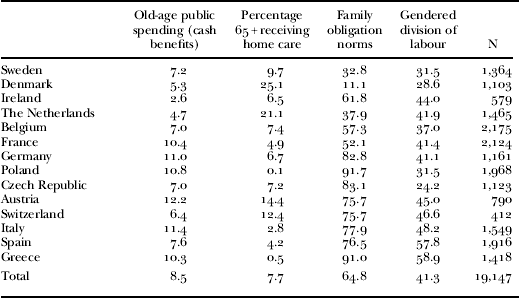
Cultural-contextual factors include professional care services, cash-for-care payments, family obligation norms and gender role norms (see Table 1). The proportion of over 65-year-olds using formal long-term care services at home (home-care services) indicates the level of professional care services (taken from Huber et al. Reference Huber, Rodrigues, Hoffmann, Gasoir and Marin2009; see p. 72 for comments on data comparability). We drew on the first edition from 2009 so that the figures for home care come closest to the first wave of SHARE. Denmark (25%) and the Netherlands (21%) stand out with the highest share of home-care recipients, whereas Greece and Poland have the lowest share (below 1%).
Cultural-contextual variables

Note : Basis: parent–child dyads with parents in need of care (N=19,147).
Sources : Survey of Health, Ageing and Retirement in Europe 2004, 2006, release 2.5.0; Huber et al. (Reference Huber, Rodrigues, Hoffmann, Gasoir and Marin2009); OECD (2010); own calculations.
As an indicator of cash-for-care benefits, we chose direct cash benefits paid to seniors as a percentage of the Gross National Product (OECD 2010). Cash-for-care schemes are administered in very different ways in the countries under study, and precise and harmonised indicators for spending on cash-for-care are not available so far. We therefore used the proxy ‘Public expenditure on old-age cash benefits in 2005, in % Gross Domestic Product’, which also includes pensions and lump sum payments to persons who have reached pension age or fulfil the necessary contribution requirements for pensions. The share is highest in Austria, France, Germany, Greece, Italy and Poland (10–12%) and lowest in Ireland, the Netherlands and Denmark (2–5%).
Family obligation norms in a country were measured as the percentage of respondents who believe that the family and not the State should be mostly or exclusively in charge of caring for older people (taken from SHARE). The measurement indicates to what extent the family, e.g. spouses and children, are expected to provide care in a country. The lowest agreement with family obligations in care can be observed in the Scandinavian countries, Denmark (11%) and Sweden (33%); the highest agreement can be found in Greece and Poland where more than 90 per cent of the respondents perceive elderly care as a responsibility of the family.
Finally, gender role norms were measured by the proportion of couples with a gendered distribution of labour (concerning housework, earning money, raising the children) taken from SHARE. We speak of a gendered division of labour when all three items correspond to traditional gender roles, e.g. women are responsible for housework and the upbringing of children, whereas men are responsible for family income. The Central Eastern European countries, Czech Republic and Poland, as well as the Scandinavian countries, Denmark and Sweden, have the lowest shares of couples with a gendered division of labour (between 24 and 32%). The highest proportions are observed in the Southern European countries, Greece and Spain (almost 60%).
Method
In order to analyse which individual, familial and cultural-contextual factors determine intergenerational care, multilevel models with two levels – the dyad level and the country level – were applied. This procedure allows the undistorted estimation of influences of higher on lower levels.Footnote 2 Multilevel models further allow slopes to vary across higher-level groups (random slopes) (Hox Reference Hox2002). Thus, it is possible to test whether the effect of the child's gender varies across countries.
Two models were estimated to test which of the three causes account for gender inequality in intergenerational care: (a) different resources, (b) different behaviour or (c) welfare states and culture. In a first step (Model I), we estimated a two-level logistic multilevel model including a random intercept and a random slope for the child's gender, thereby testing whether parents are more likely to fall back on daughters or sons (gender effect) and whether we can expect different gender effects in the countries under study. If gender inequality can be traced to different resources of daughters and sons, then we should observe no gender effect after controlling for individual and familial opportunity and need structures. In a second step (Model II), interaction terms with the child's gender were included in order to test whether – from the parent's perspective – daughters and sons respond differently to the same circumstances, e.g. the care need of the parent, full-time employment of the child or the parent having a partner, and whether welfare state programmes and cultural norms influence gender inequality in intergenerational care. Because the sample size at the country level is just N=14, only one explanatory variable at a time was introduced at this level.
Results
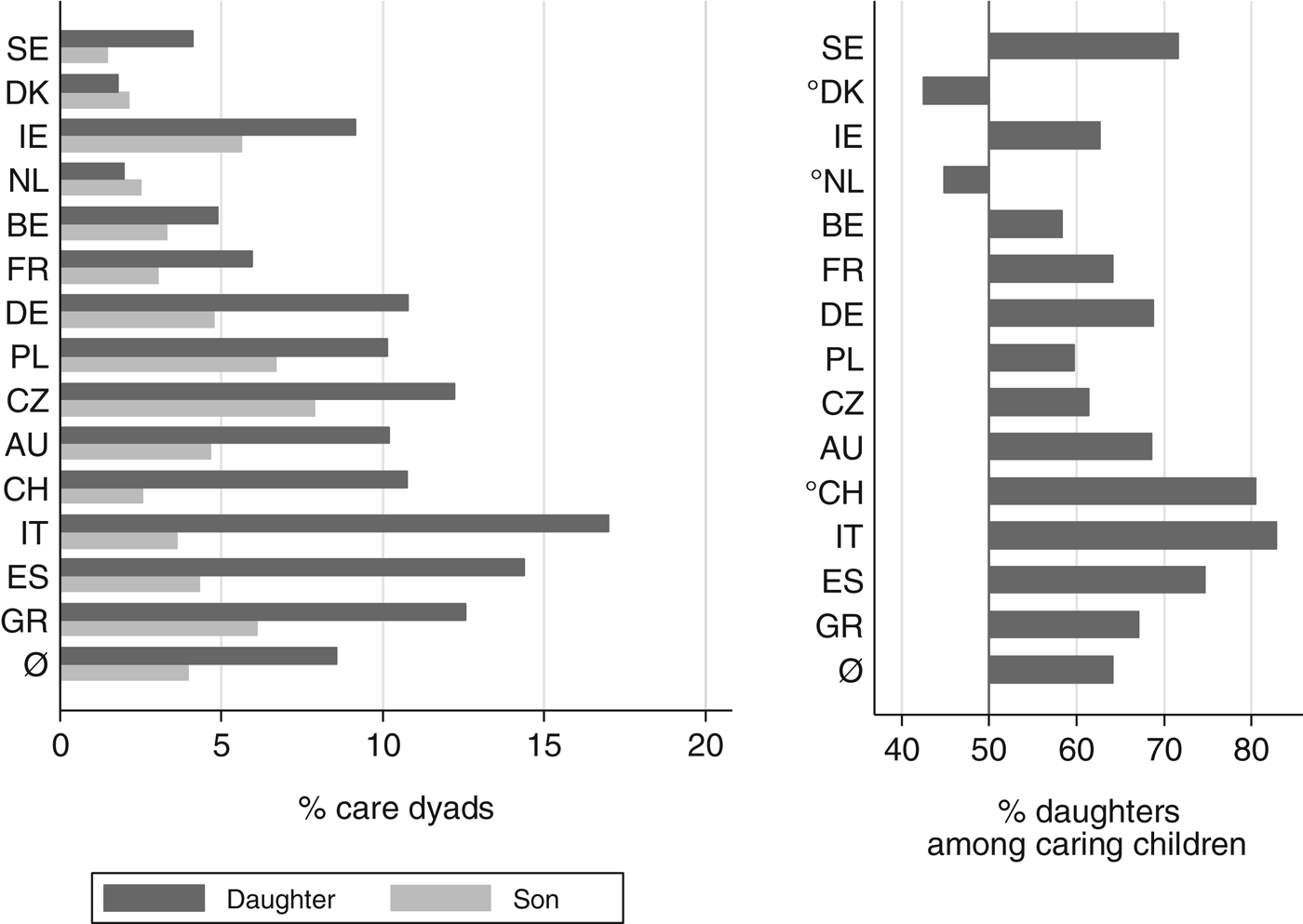
Care involvement of daughters and sons varies considerably between European countries (Figure 1, left side). In less than 3 per cent of all dyadic relationships between dependent parents and their children in Denmark and the Netherlands, the parents receive care from the child. In Greece, Italy, Spain and the Czech Republic, the respective share is about 10 per cent. Care provided by daughters varies more across countries than care provided by sons. In Southern and Eastern European countries as well as in Austria, Germany and Switzerland, the proportion is higher than 10 per cent. With the exception of the Czech Republic, Greece, Poland and Ireland, the proportion of sons regularly supporting a parent is below 5 per cent.
Intergenerational care and gender. Notes : Left sample: parent–child dyads with parents in need of care (N=19,147). Right sample: parent–child dyads with parent receiving care from child (N=1,255). ° N<30. SE: Sweden. DK: Denmark. IE: Ireland. NL: The Netherlands. BE: Belgium. FR: France. DE: Germany. PL: Poland. CZ: Czech Republic. AU: Austria. CH: Switzerland. IT: Italy. ES: Spain. GR: Greece. Ø: total. Sources : Survey of Health, Ageing and Retirement in Europe 2004, 2006, release 2.5.0; own calculations.
The right side of Figure 1 represents the proportion of daughter–parent dyads among all intergenerational care dyads. Hence, a share above 50 per cent indicates that more daughters than sons are involved in intergenerational care. Across all countries under study, more than two-thirds of the children providing care are daughters. Only in Denmark and the Netherlands – where the sample included less than 30 care dyads – are sons over-represented among caring children; in all other countries, daughters are over-represented. The share of daughters among all carers is highest in Austria, Germany, Italy, Spain, Sweden and Switzerland, where less than three out of ten children involved in intergenerational care are sons.
To assess gender inequality, both the absolute and the relative measure have to be considered. Although the proportion of daughters among care dyads is much larger than the proportion of sons, the absolute difference between daughters’ (4%) and sons’ (1%) care involvement is small (three percentage points) in Sweden. Thus, given the low level of intergenerational support, gender inequality is a rather minor issue in intergenerational care in Sweden. In Spain, however, parents receive care from daughters (14%) much more often than from sons (4%) even though the proportion of women among all caring dyads is similar to the situation in Sweden.
Overall, the difference in daughters’ and sons’ involvement is linked to the absolute participation of children: the more intergenerational care relationships can be observed, the greater is gender inequality (r=0.60, p<0.05). In Denmark, Sweden, Belgium, the Netherlands and France – countries with a generous provision of social services – relative gender inequality is comparably low and intergenerational care is not widely spread (below 5%). By contrast, in Southern Europe where care recipients, at least in some cases, receive cash-for-care payments, gender inequality is high and children are strongly involved in intergenerational care. The unequal participation of daughters and sons in these countries is therefore particularly significant as the number of families and people affected is much higher.
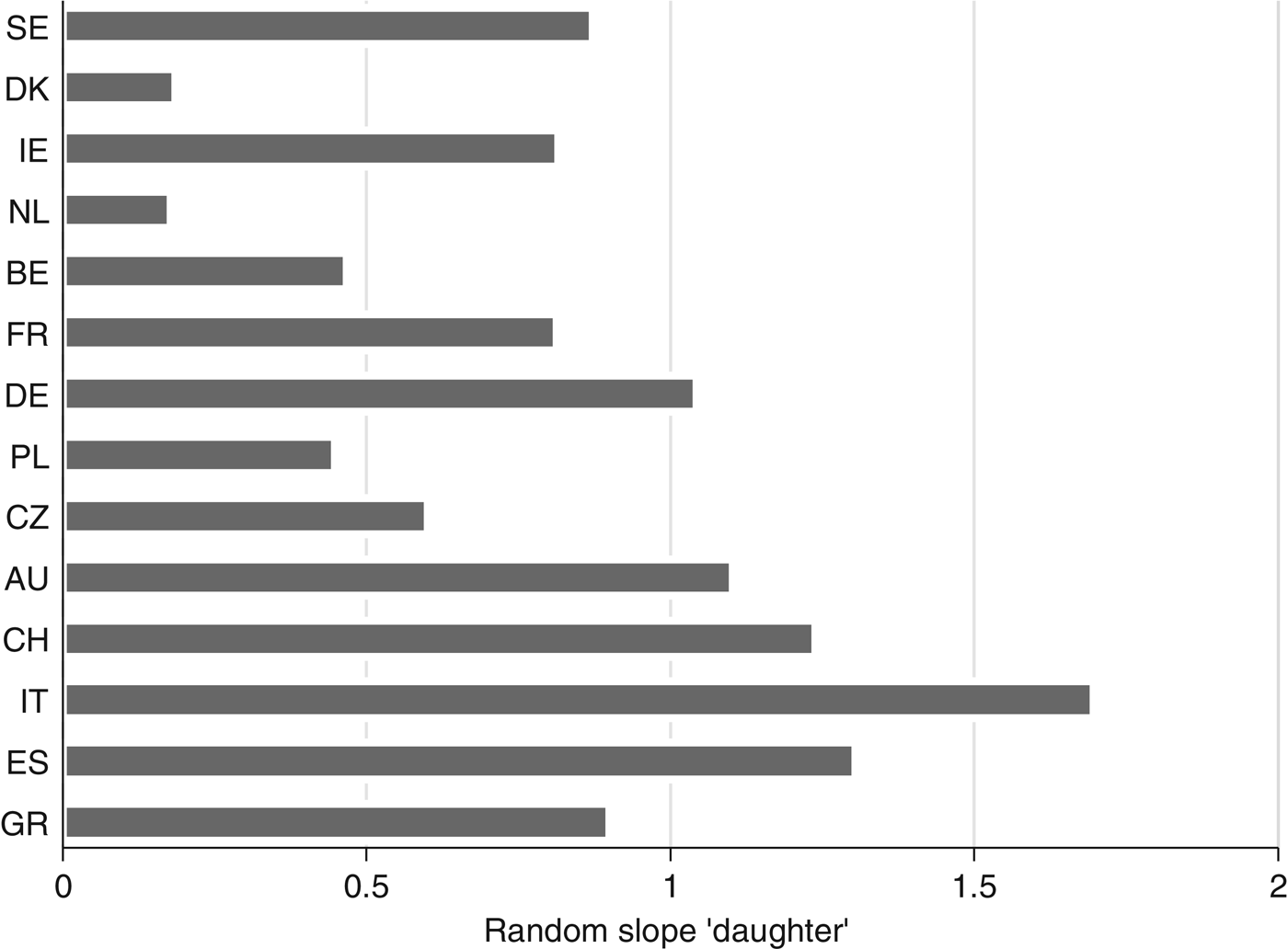
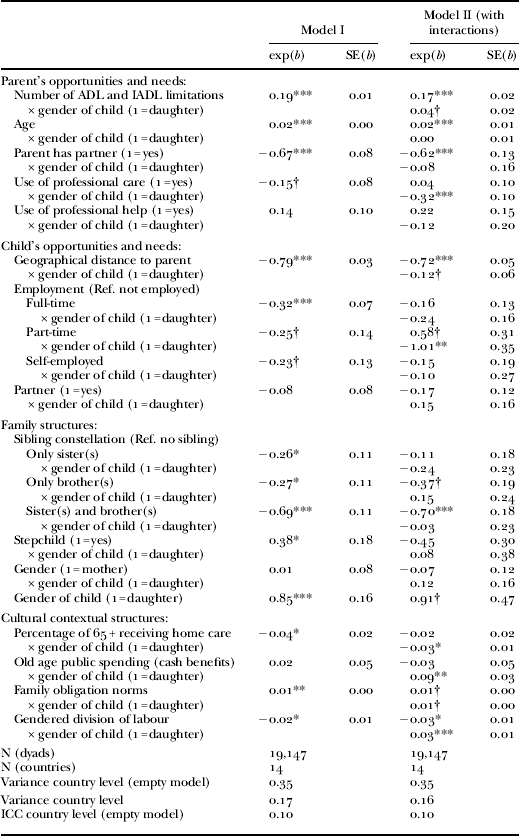
Table 2 presents the logistic multilevel regression models. Model I traces gender differences to different resources and needs. We assume all independent variables to have the same effect in parent–daughter and parent–son relationships. Model II further includes interactions with the child's gender in order to test whether, from the parent's perspective, daughters and sons respond differently to the parental care needs and other need and opportunity structures. Finally, Model II also includes interactions with the child's gender and with welfare state programmes or cultural norms to test whether the social context increases or reduces gender inequality in care. Furthermore, we visualised the country-specific effect of the child's gender in Model I (Figure 2) and interactions between the child's gender and cultural contextual structures in Model II (Figure 3).
Country differences in gender effects. Notes : Sample: parent–child dyads with parents in need of care (N=19,147). Random slope estimates from logistic multilevel models controlled for the parent's and the child's opportunities and needs as well as for family structures. See Figure 1 for country codes. Sources : Survey of Health, Ageing and Retirement in Europe 2004, 2006, release 2.5.0; own calculations.
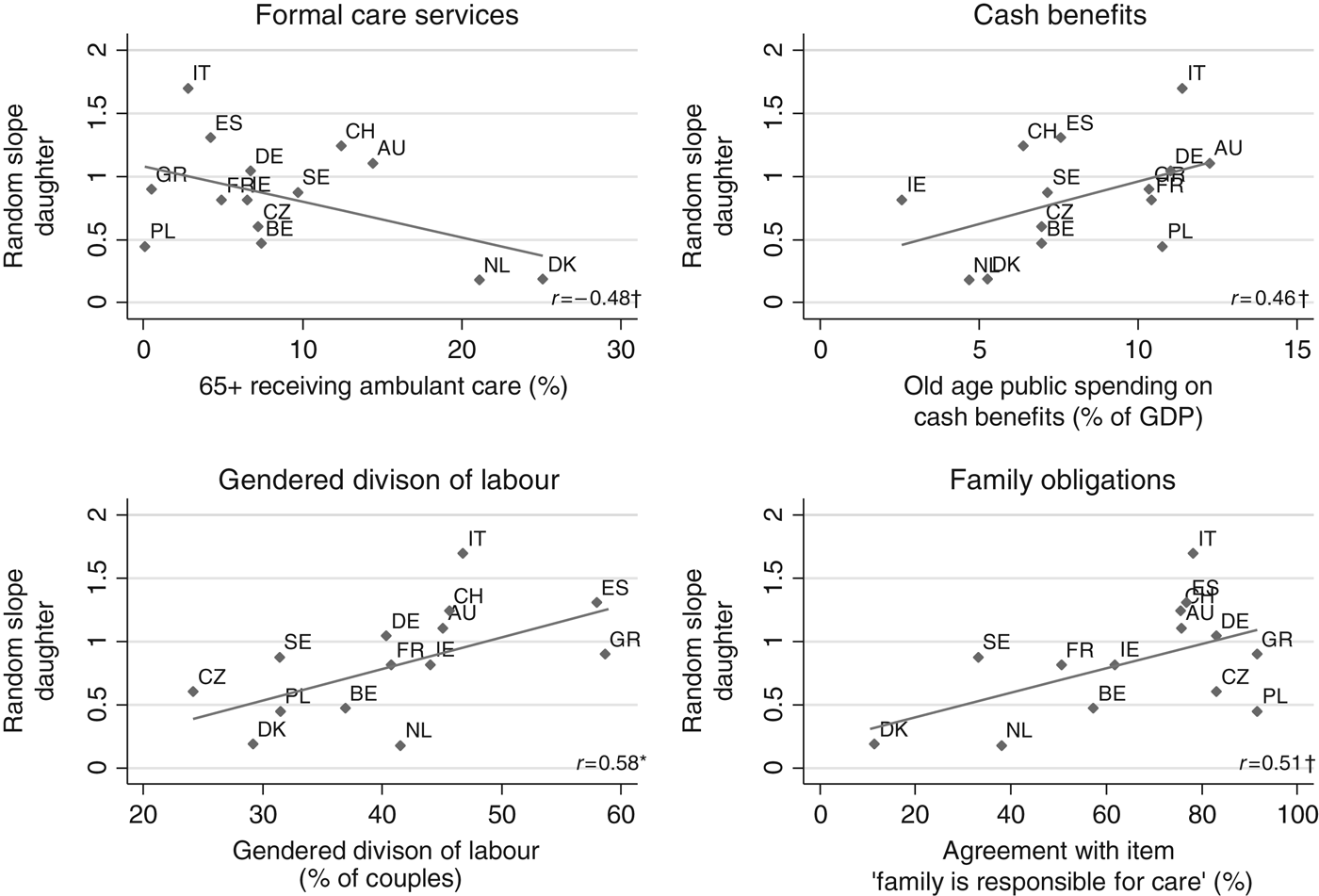
Gender effects and cultural-contextual factors. Notes : Sample: parent–child dyads with parents in need of care (N=19,147). Random slope estimates from logistic multilevel models controlled for the parent's and the child's opportunities and needs as well as for family structures. See Figure 1 for country codes. GDP: Gross Domestic Product. Sources : Survey of Health, Ageing and Retirement in Europe 2004, 2006, release 2.5.0; OECD (2010); own calculations. Significance levels: † p<0.1, * p<0.05.
Care from children: logistic multilevel models
Notes: Basis: parent–child dyads with parents in need of care (N=19,147). SE: standard error. ADL: activities of daily living. IADL: instrumental activities of daily living. Ref.: reference category. ICC: intraclass correlation.
Sources: Survey of Health, Ageing and Retirement in Europe 2004, 2006, release 2.5.0; OECD (2010); own calculations.
Significance levels: † p<0.1, * p<0.05, ** p<0.01, *** p<0.001.
The analyses reveal that parents are more likely to receive care from daughters than from sons, as indicated by the positive effect of gender of child in Model I. Hence, gender inequality in care cannot be traced to different resources of daughters and sons only. Intergenerational care from children is also associated with opportunities and needs of the parent, the child's own employment and family situation, family structures as well as with welfare state programmes and cultural norms (Model I). However, the associations are not always identical for daughters and sons (Model II).
Regarding the parent's opportunities and needs, parents who have more functional limitations and are older are more likely to receive care from a child. The interaction term with the child's gender suggests that needy parents are more likely to fall back on their daughters (Model II). Thus, the assumption that daughters adapt their behaviour more frequently to parental needs seems to hold. As long as parents live in partnerships, they are less likely to receive care from both daughters and sons.
Recipients of professional care are less likely to receive care from daughters whereas receiving professional care has no effect on care from sons. This indicates that when professional care is not available and parents turn to their children, only daughters not sons step into the breach. Professional assistance, such as helping with household chores, has no effect on intergenerational care from daughters and sons. The assumption that mothers are more likely to receive care from their daughters than fathers is not confirmed.
With respect to the child's opportunities and needs, geographical proximity is an important condition for functional solidarity among generations: the greater the residential distance between parents and children, the lower the chance of intergenerational care. This result holds for daughters and sons, with parents being more likely to receive care from daughters living nearby than from sons, albeit this relation is only weakly significant. Regarding employment status, parents are more likely to receive care from their part-time employed sons and less likely from their part-time employed daughters than from sons and daughters who are home-makers or retired. In contrast to our expectations, parents are as likely to receive care from full-time and self-employed sons compared to unemployed sons. Although parents are more likely to fall back on home-makers than on daughters working full-time (not shown), we observed no significant difference between full-time working daughters and sons. The parent's likelihood of being cared for is not influenced by the child's partnership status.
With regard to family structures, parents are most likely to receive care from an only child. In sibling groups, however, not every child is equally engaged in intergenerational care. If parents only have daughters, they are as likely to receive care from the daughters as parents of an only child are from that child. Parents who also have sons are less likely to receive care from the child. In sibling groups with sons, the children seem to be more likely to leave the care work to their siblings, professional carers or in-home carers. Parents cannot expect stepchildren – and stepsons in particular – to provide care with the same likelihood as biological children.
Fathers are as likely as mothers to receive care from a child when opportunity and need as well as family structures are considered. As for the child's gender, the results show that parents have a greater chance of receiving care from daughters. The random slope estimates in Model I reveal that the gender effect varies considerably across Europe (Figure 2). The gender effect is highest in Italy, Spain and Switzerland and lowest in Denmark and the Netherlands. The effects reflect the gender arrangements in these countries; for instance, they mirror the fact that gender equality was late to be put on the political agenda in the Southern European countries and Switzerland. The third argument traces the differences in gender inequality directly to cultural-contextual structures.
Indeed, an explanation of whether parents receive care from a child is not only framed by the personal and family environment but it is also embedded in institutional structures and cultural norms. Figure 3 shows the (significant) associations between the country-specific gender effects, on the one hand, and welfare state policies and cultural norms, on the other. Gender inequality is highest in countries with low provision of professional home-care services, high public spending on cash benefits, a high percentage of couples with a traditional household division of labour and a high percentage of older persons regarding the family as being responsible for elderly care.
The association between gender inequality and cultural-contextual structure is also confirmed by Model II. Whether parents receive care from a daughter is more dependent on institutional and cultural conditions than care from sons. In parent–daughter dyads, 12.7 per cent of the variance of the dependent variable is attributed to the country level, the respective share for parent–son dyads is 7.8 per cent (analyses not shown). This is reflected in the effects of the macro indicators, which are much more strongly associated with daughters’ care involvement than with sons’ (see Model II). A generous provision of formal home-care services is related to a lower likelihood of receiving care from daughters, indicating that such services relieve daughters of regular, time-intensive support to a parent. However, the same is not true for sons. The probability of receiving care from sons is not lower in countries with high service provision. This result supports the finding that formal care services substitute only for care by daughters but not for care by sons, who show lower levels of engagement in the first place. The contrary also holds true: parents can expect their daughters but not their sons to step into the breach when affordable or sufficient professional care services are not available.
Cash payments, by contrast, are positively linked to intergenerational care from daughters – the higher the amount the welfare state spends on such payments, the higher the likelihood of care-giving. Cash payments thus seem to have the desired effect of fostering intergenerational care, but, as expected, they motivate daughters not sons. Family obligation norms increase the parent's chance of receiving intergenerational care, in particular from daughters. A gendered division of labour seems to increase gender inequality in intergenerational care as well. In countries with a more gendered division of labour, parents can more likely expect care from their daughters than from their sons. As cultural and institutional factors impact on daughters and sons in different ways, they affect gender inequality in intergenerational care. According to likelihood-ratio tests, cash-for-care and care services have a similar explanatory power. The gender division of labour indicator is the most powerful and family obligation norms the least powerful predictor.
Conclusion
This study focuses on gender differences in intergenerational care in a cross-national perspective. It complements and expands the picture of considerable gender differences in intergenerational care that has been portrayed in a number of national studies. Gender differences vary substantially across Europe and are associated with cultural and institutional factors. Our results confirm the low level of intergenerational care in Northern European countries and the high level in the south of Europe (see e.g. Brandt, Haberkern and Szydlik Reference Brandt, Haberkern and Szydlik2009; Ogg and Renaut Reference Ogg and Renaut2006). However, when we analyse daughters’ and sons’ care separately, it turns out that this pattern applies only to daughters’ care-giving. Sons’ care-giving tends to be low in all countries. Gender differences between daughters’ and sons’ involvement in care is highest in the Mediterranean and Switzerland and lowest in the Scandinavian countries and the Netherlands.
The study aims to identify the main causes of gender inequality in intergenerational care. Three possible explanations have been tested: (a) women and men have different resources; (b) women and men respond differently to the same resources; (c) welfare state programmes and cultural norms address women and men differently. First of all, parents are more likely to receive care from their daughters than from their sons when the children have the same resources and live in the same circumstances. Therefore, gender differences in care cannot be explained by a gender-specific allocation of resources only, e.g. different employment patterns of women and men.
From the parent's perspective, daughters and sons seem to respond differently to parental need and opportunity structures – which is in line with the second cause of gender inequality. With increasing functional limitations, parents are more likely to be able to fall back on their daughters but not on their sons. In addition, parents without access to affordable professional care services can more likely rely on their daughters than on their sons. As for the child's need and opportunity structures, daughters respond differently to employment status than sons. Parents are more likely to receive care from unemployed than from part-time employed daughters, presumably because daughters with fragmented working careers and with care experience are more likely to engage in caring for their parents (and can more easily be asked to do so by the parent). On the other hand, daughters seem to be more willing to interrupt their working careers in order to attend to their parents in times of need. Parents, however, are more likely to receive care from part-time employed sons than from sons who are home-makers or in retirement. The hypotheses that gender differences in intergenerational care are mainly rooted in gender-specific employment patterns thus cannot be confirmed. We rather find different responses to employment status, e.g. because daughters are more willing to provide intensive care than sons and are less attached to the labour market.
Another factor thought to possibly cause the preponderance of women in intergenerational care might be parents preferring care by a child of the same sex. Our analyses, however, fail to confirm this hypothesis. Rather we found parents more likely to receive care from daughters regardless of the parent's gender.
Overall, we cannot confirm the first argument that gender inequality in intergenerational care can be traced to different need and opportunity structures of daughters and sons only. Parents are more likely to receive care from their daughters even if we take employment status and other resources into account. Gender inequality rather can be explained by referring to the second argument according to which parents are more likely to receive care from their daughters because daughters are more responsive to the parent's needs than sons. Furthermore, daughters and sons respond differently to the same resources while also being responsive to different resources, e.g. parents can more likely fall back on daughters living close by than on sons.
We also can confirm the third explanation for gender inequality in intergenerational care. Welfare state programmes and cultural norms matter – but only for daughters. Whether parents can fall back on their daughters is influenced by welfare state regulations and cultural norms. The generous provision of care services relieves daughters of having to provide care to their parents and therefore reduces gender inequality in intergenerational care. In countries with low provision of care services, parents rely on their daughters rather than on their sons. Daughters seem to give priority to the needs of their parents rather than their own. When parents have access to affordable quality care, they do not have to ask their daughters for care. In this case, the latter are unburdened from the traditional female caring responsibility.
Cash-for-care encourages care by daughters but not by sons. Thus, the assumption that cash benefits are more likely to address women seems to hold. Since men earn more than women in all European countries and care work is considered to be a woman's task, cash benefits predominantly activate women and thereby seem to preserve the gendered organisation of care. As long as equal pay between women and men fails to be achieved, cash-for-care may not have the desired effect of increasing sons’ engagement in intergenerational care.
Family obligation norms function similarly. They are associated with daughters’ care-giving more than with sons’. In countries where most people agree that the family and not the State should bear responsibility for elderly care, parents more often receive care from daughters. The norm to provide support to family members thus rather seems to obligate women more than men.
In addition, gender role norms are important as well. Parents more often receive care from daughters in countries with a rigid gendered division of labour while sons are engaged to a lower degree. Overall, the empirical results show that not only individual and familial factors contribute to gender differences in intergenerational care, but cultural-contextual factors do so as well.
Informal care represents the backbone of most care systems. In light of the high costs of professional care and tight public budgets as well as the widespread preference for family care arrangements, it is unlikely that European welfare states will be able to master the future need for care without support by family members. As labour force participation rates of women have increased in the past decades and nothing points to a halt of this trend, older parents in the near future will either be less likely to be able to fall back on their daughters in times of need or daughters will have to detach themselves from the labour market and face the risk of unemployment, loss of income and future poverty.
To the present day, welfare states with a generous provision of professional care services, such as in the Scandinavian countries and the Netherlands, have relieved women of caring burdens and have thereby reduced gender inequality in intergenerational care – which has also reduced gender inequality in terms of income and gainful employment since informal carers work fewer hours and earn less (OECD 2011). However, the Scandinavian model has failed to motivate sons to make a greater commitment to providing care to their parents. Achieving gender equality in intergenerational care is still a one-way ticket from informal care by women towards State care. Against the background of demographic ageing and tight budgets, the welfare state cannot fully take on care responsibilities and do without the family and the informal support of both daughters and sons.
Cash-for-care programmes must be designed in ways that allow for a reconciliation of informal care and gainful employment for adult daughters and sons alike. This may also include activation policies targeting men. Cash-for-care could be partitioned similar to parental leave programmes so that a certain timespan is reserved for sons, if there are any.
In addition, achieving a work–care balance has to be facilitated by offering caring children and relatives the possibility of drawing on professional assistance. On the one hand, welfare state policies are more likely to support equal choice in intergenerational care if gender equality is deeply rooted in the public arena and private enterprises. On the other hand, welfare states need to expand (semi-) professional care services in order to support family care without placing too much of a burden on caring relatives. Furthermore, these services need to provide alternatives to family care where necessary. An important argument in support of this is that professional care services also reduce gender-specific inequalities. Accomplishing an appropriate welfare mix is one of the great challenges that societies will have to face in the decades to come.
Acknowledgements
This paper uses data from SHARE wave 1 and 2 release 2.5.0, as of 24 May 2011 or SHARELIFE release 1, as of 24 November 2010. The SHARE data collection has been primarily funded by the European Commission through the 5th Framework Programme (project QLK6-CT-2001-00360 in the thematic programme Quality of Life), through the 6th Framework Programme (projects SHARE-I3, RII-CT-2006-062193, COMPARE, CIT5-CT-2005-028857 and SHARELIFE, CIT4-CT-2006-028812) and through the 7th Framework Programme (SHARE-PREP, number 211909, SHARE-LEAP, number 227822 and SHARE M4, number 261982). Additional funding from the US National Institute on Aging (U01 AG09740-13S2, P01 AG005842, P01 AG08291, P30 AG12815, R21 AG025169, Y1-AG-4553-01, IAG BSR06-11 and OGHA 04-064) and the German Ministry of Education and Research, as well as from various national sources, is gratefully acknowledged (see www.share-project.org for a full list of funding institutions).