INTRODUCTION
Schistosomiasis has been described as a “three factor disease” involving schistosomes, snails and humans (Kloos, Reference Kloos1985). However, a fourth factor, involving reservoir hosts, could maintain the infection in nature and serve as sources of infection for humans, thus may have potentially significant implications for transmission, parasite hybridization and control efforts. In East Africa, Schistosoma mansoni and S. haematobium, the two predominant species responsible for human schistosomiasis, have been found in many domestic mammals (Nelson, Reference Nelson1960; Nelson et al. Reference Nelson, Teesdale, Highton, Wolstenholme and O'Connor1962; Ouma and Fenwick, Reference Ouma, Fenwick, Macpherson and Craig1991). However, for these infected mammals to be considered true reservoir hosts, they must also pass viable and infective eggs and maintain the life cycle of the parasite (Duplantier and Sene, Reference Duplantier, Sene, Morand, Krasnov and Poulin2006).
Whereas S. haematobium has only been found in a few non-human primates and in a small number of rodents (Ouma and Fenwick, Reference Ouma, Fenwick, Macpherson and Craig1991), S. mansoni has been found in numerous host species, including rodents, in which the parasites mature and produce large numbers of viable eggs (McMahon and Baalawy, Reference McMahon and Baalawy1967; Kawashima et al. Reference Kawashima, Katamine, Sakamoto and Shimada1978; Rodrigues-Silva et al. Reference Rodrigues-Silva, Machado e Silva, Faerstein, Lenzi and Rey1992). Rodents are capable of sustaining natural populations of S. mansoni with little transmission input by humans (Théron et al. Reference Théron, Pointier, Morand, Imbert-Establet and Borel1992), and have been implicated as important reservoir hosts in South America, the Caribbean and West Africa (D'Andrea et al. Reference D'Andrea, Maroja, Gentile, Cerqueira, Maldonado and Rey2000; Duplantier and Sene, Reference Duplantier and Sene2000; Gentile et al. Reference Gentile, Costa-Neto, Goncalves, Bonecker, Fernandes, Garcia, Barreto, Soares, D'Andrea, Peralta and Rey2006). However, the role of small mammals in East Africa, especially in the Lake Victoria Basin where rates of incidence are extremely high, requires additional investigation (Nelson, Reference Nelson and Dunsmore1983).
In the present study, a survey of schistosomes was conducted in small mammals collected from sites in Kisumu city in the Lake Victoria Basin, western Kenya. The aims of this study were to determine if schistosome species infect local small mammals, to identify species able to host schistosomes, and to determine parasite prevalence and intensity. In addition, we explored whether these hosts can become coinfected with multiple schistosome species. Finally, we consider and discuss the implications of our findings with respect to schistosomiasis control.
MATERIALS AND METHODS
Small mammal collection and examination
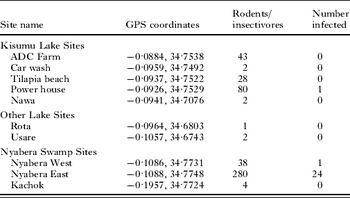
Small mammals were collected in western Kenya from habitats near the shore of Lake Victoria, and from Nyabera Marsh within the Kisumu city boundaries (Table 1), using Sherman's rodent traps (Tallahassee, FL, USA). Traps were baited with a mixture of peanut butter and cupcakes (locally known as queen cakes). Traps were checked at dusk and dawn, and captured animals were returned live to the laboratory in Kisian, Kenya, 12 km west of Kisumu. Collections were done about once monthly between January 2007 and December 2008, with each collection session lasting about 5 days. For all captured individuals, sex, weight and several size measurements were taken to aid in taxonomic identification.
Collection localities, rodent/insectivore numbers, and prevalence of schistosomes

Small mammals were anaesthetized with ether, and injected with 0·5 ml of a mixture of 26% pentobarbital containing 100 units of heparin. The abdominal cavity of each animal was opened and worms were recovered from the hepatic portal system by perfusion (Lewis, Reference Lewis, Coligan, Kruisbeek, Margulies, Shevach and Strober1998). A liver press was made from each animal and examined using a compound microscope to determine if schistosome eggs were present. After dissection, carcasses were preserved in 95% ethanol and submitted to the National Museum of Kenya (NMK), Mammal Section, for identification. Rodents and insectivores were identified and placed in the NMK permanent collection (NMK Accession numbers: 16527–16800, 167802–167823, 168269–168356, 169349–169422).
Processing of worms
The worms recovered from the dissected animals were placed in 100% ethanol, and stored at 4°C for 2–10 weeks. The worms were then photographed, before the posterior 10–15% of each worm was removed, retained in 100% ethanol, and saved for DNA analysis. Genomic DNA from whole or parts of adult worms, was extracted using a modified HotShot method (Truett et al. Reference Truett, Heeger, Mynatt, Truett, Walker and Warman2000; Steinauer et al. Reference Steinauer, Agola, Mwangi, Mkoji and Loker2008 b), and was stored at 4°C until polymerase chain reaction (PCR) amplification.
Partial sequences of the cox1 mDNA were amplified using TaKaRa Ex Taq (Takara Bio Inc., Otsu, Japan) following the manufacturer's instructions and using the following primers: ‘cox1F4’, ATT TGG WAC TGC TTT TTT TGA GCC, and ‘cox1 Schist 3’ TAA TGC ATA CGG AAA AAA ACA (Lockyer et al. Reference Lockyer, Olson, Ostergaard, Rollinson, Johnston, Attwood, Southgate, Horak, Snyder, Le, Agatsuma, McManus, Carmichael, Naem and Littlewood2003). PCR reactions were analysed by agarose gel electrophoresis: 1·0% agarose gels were stained with 0·5% GelRed™ Nucleic acid gel stain (Biotium, Hayward, CA, USA), and visualized on a UV transilluminator. Amplicons were purified by ethanol precipitation and products were sequenced with BigDye version 3.1 kit (Applied Biosystems, Foster City, CA, USA) in an ABI 3130x sequence analyzer (Applied Biosystems). The resulting DNA sequences were verified by aligning reads from both 5′- and 3′ directions, using Sequencher software version 4.9 (Gene Codes, Ann Arbor, Michigan), and manually corrected for ambiguous base calls.
Data analysis
In addition to 47 newly collected sequences, 3 GenBank sequences from 3 species were included as reference samples (S. mansoni AJ519524, S. bovis AJ519521 and S. rodhaini AY157202). A reference sample for S. kisumuensis could not be included, since the species was described from the same material considered in the present study (Hanelt et al. Reference Hanelt, Brant, Steinauer, Maina, Kinuthia, Agola, Mwangi, Mungai, Mutuku, Mkoji and Loker2009). New sequences are available in the ‘Schistosomes of Kenyan Rodents and Insectivores’ project on the BOLD database (www.barcodinglife.org) and on GenBank (Accession numbers: GU294793–GU294839). Alignment was performed by eye and was trivial, as there were no insertions or deletions present in the fragments sequenced. The Kimura 2-parameter (K2P) model of base substitution (Kimura, Reference Kimura1980) was used as a measure of pairwise sequence distances. To visualize these distances, a neighbour-joining (NJ) tree was produced in MEGA4 (Tamura et al. Reference Tamura, Dudley, Nei and Kumar2007). A bootstrap test was done using 500 replicates. The goal of this analysis was to cluster individuals into similar groups for identification purposes, and the resulting tree should not be interpreted as a phylogenetic hypothesis. Worm species identifications were made according to clustering with the reference sequences.
RESULTS
Small mammals
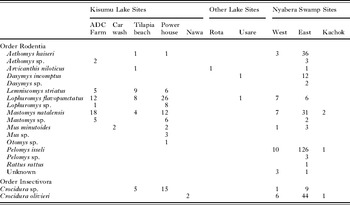
Rodents of 10 genera and insectivores of 1 genus were collected from 3 different collection sites (Table 1) located within the city of Kisumu. The rodents comprised 9 identified species and 8 unidentified groups (Table 2). Overall, the most abundant species in the study area were Pelomys isseli (Issel's groove-toothed swamp rat), Mastomys natalensis (Natal multimammate mouse), Lophuromys flavopunctatus (Yellow-spotted brush-furred rat), and Crocidura olivieri (African giant shrew). Mastomys natalensis was common across all collection sites, whereas P. isseli was only collected from Nyabera Marsh, and L. flavopunctatus was predominantly collected from the lake sites.
Numbers of rodents and insectivore species collected at ten sites in the Lake Victoria Basin

Schistosome genetic data
A cox1 amplicon for schistosomes was obtained from all 47 individuals collected. Sequence alignments comprised 607 bp. No insertions, deletions or stop codons were observed in any sequence. The lack of stop codons, the consistent length of all sequences and the lack of variance between the 2 sequencing primers suggests that the obtained sequences were coding cox1 and not NUMTs (nuclear mitochondrial DNA) (Buhay, Reference Buhay2009).
Parasites
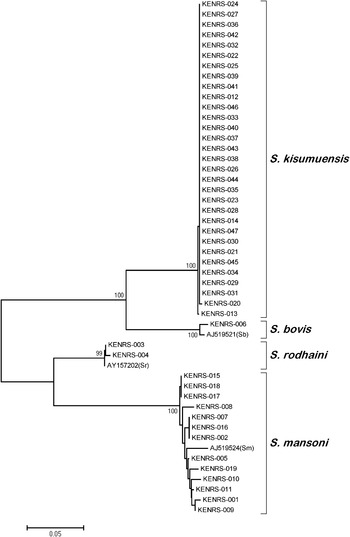
The results of the overall NJ analysis of distances among the 47 individuals are summarized in Fig. 1. Sequences clustered into 4 groups, representing 4 schistosome species, S. mansoni Sambon, 1907, S. rodhaini Brumpt, 1931, S. bovis (Sonsino, 1876) Blanchard, 1895 and S. kisumuensisHanelt et al. Reference Hanelt, Brant, Steinauer, Maina, Kinuthia, Agola, Mwangi, Mungai, Mutuku, Mkoji and Loker2009.
Neighbour-joining tree based on cox1 barcode nucleotide distances (K2P) for schistosomes recovered from rodents. Bootstrap values ⩾95% given, together with a K2P distance scale bar.

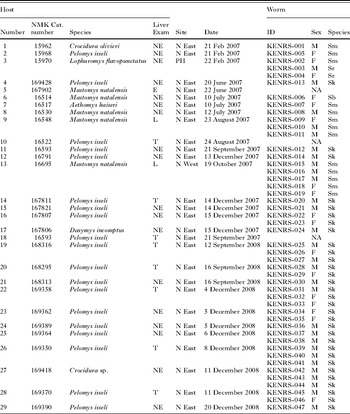
Of the 397 rodents and 83 insectivores examined, 24 rodents (6·8%) and 2 shrews (2·4%) harboured schistosomes (Table 3). The large majority of infected rodents (96·6%) and all of the infected shrews were collected from Nyabera Marsh; 67% of all animals were collected at Nyabera Marsh. Only a single infected rodent was found outside of Nyabera, at the Power house site (Table 3, host #3). Worms were not recovered from 3 hosts containing eggs in their liver. This indicates either error in the worm collection protocol or worm mortality.
Hosts infected with schistosome adults and/or eggs
(N East: Nyabera East; N West: Nyabera West, PH: Power house; Sm: Schistosoma mansoni; Sr: S. rodhaini; Sb: S. bovis, Sk: S. kisumuensis; E: immature eggs; L: lateral-spined egg; T: terminal-spined egg; NE: no eggs seen; NA: no adults recovered.)

Of the 26 hosts from which adult worms were recovered, S. kisumuensis was the most common schistosome encountered (65·9%), followed by S. mansoni (27·7%), S. rodhaini (4·3%), and S. bovis (2·1%). Intensities ranged from 1 to 5 (mean=1·81). The 2 infected shrews harboured 1 worm species each, S. mansoni (host #1) and S. kisumuensis (host #27). One rodent host contained a mixed schistosome species infection of S. mansoni and S. rodhaini (host #3). Male to female sex ratios were 1·16 for S. mansoni, and 2·44 for S. kisumuensis.
Genetic differences between S. kisumuensis individuals (all collected at Nyabera, but some collected more than a year apart) were extremely low, containing only 3 polymorphic sites (cox1 genetic distance <0·01%). On the other hand, genetic differences within the S. mansoni population collected at Nyabera were much higher, containing 28 polymorphic sites (cox1 genetic distance=1·07%).
DISCUSSION
The role of rodents as reservoir hosts for S. mansoni has been well established in South America, and the Caribbean Islands. For example, a comprehensive study of S. mansoni on the island of Guadeloupe suggested complicated transmission dynamics between the intermediate host, humans and the Black rat Rattus rattus (for a review, see Théron and Pointier, Reference Théron and Pointier1995). Sylvatic cycles in which rats serve as the primary (or perhaps only) definitive host exist in this region (Théron, Reference Théron1984; Sire et al. Reference Sire, Durand, Pointier and Théron1999; Prugnolle et al. Reference Prugnolle, De Meeus, Durand, Sire and Théron2002). In Brazil, longitudinal studies of S. mansoni in the Scaly-footed water rat, Nectomys squamipes, suggested that the rodent host can increase parasite transmission and spread infection to new areas (D'Andrea et al. Reference D'Andrea, Maroja, Gentile, Cerqueira, Maldonado and Rey2000; Gentile et al. Reference Gentile, Costa-Neto, Goncalves, Bonecker, Fernandes, Garcia, Barreto, Soares, D'Andrea, Peralta and Rey2006). However, the role of rodents in the transmission of schistosomes in East Africa has received little attention.
In Africa, S. mansoni is frequently recovered from naturally infected small mammals (for reviews see Nelson, Reference Nelson1960; Nelson et al. Reference Nelson, Teesdale, Highton, Wolstenholme and O'Connor1962; Pitchford, Reference Pitchford1977; Kawashima et al. Reference Kawashima, Katamine, Sakamoto and Shimada1978). However, compared with the relatively high prevalences found among rodents in the New World, ranging from 30% to 100% (Théron et al. Reference Théron, Pointier, Morand, Imbert-Establet and Borel1992; Rey, Reference Rey1993; D'Andrea et al. Reference D'Andrea, Maroja, Gentile, Cerqueira, Maldonado and Rey2000), prevalences reported from Africa are usually much lower, less than 5% (for example, see Schwetz, Reference Schwetz1954, Reference Schwetz1956; Nelson, Reference Nelson1960; Pitchford and Visser, Reference Pitchford and Visser1962; McMahon and Baalawy, Reference McMahon and Baalawy1967; Karoum and Amin, Reference Karoum and Amin1985). Only a single report, from eastern Kenya (Kawashima et al. Reference Kawashima, Katamine, Sakamoto and Shimada1978), describes higher prevalences, up to 44% in Pelomys sp.
In Kisumu, Kenya, we recorded a relatively low overall schistosome prevalence (6·0%). However, 27% of the schistosome-infected rodents and shrews harboured S. mansoni, and nearly a third of these were infections consisting of both male and female worms. Surprisingly, we found 2 schistosome species in shrews, S. kisumuensis and S. mansoni; the host record of C. olivieri for S. kisumuensis is new. Shrews have previously been reported to be infected with S. mansoni, in the Democratic Republic of the Congo (Stijns, Reference Stijns1952) and Egypt (Kuntz, Reference Kuntz1958). Although the current study and Kuntz (Reference Kuntz1958) found only immature worms, Stijns (Reference Stijns1952) observed fully developed eggs in the host's intestine. Thus, shrews cannot be ruled out as possible reservoir hosts.
Of the 4 rodent species infected with S. mansoni, the most likely to contribute to natural transmission is M. natalensis, because it was the most common host for S. mansoni, it contained the majority of the S. mansoni worms recovered, and 2 of these hosts contained mature male and female worms, and mature S. mansoni eggs in the liver. Mastomys natalensis is semi-domestic, found in close association with humans (Isaacson, Reference Isaacson1975), is tolerant of habitat modification, it readily follows roads and is often transported around Africa accidentally by vehicles (Granjon et al. Reference Granjon, Lavrenchenko, Corti, Coetzee and Abdel Rahman2008). Mastomys natalensis has been noted to be a very clean animal, pushing refuse out of the nests; droppings have rarely been found in its burrows (Isaacson, Reference Isaacson1975). In most parts of its range, it is considered a major pest (Sluydtsa et al. Reference Sluydtsa, Davisa, Mercelisa and Leirsa2009). It is widespread throughout sub-Saharan Africa, except for areas in the south-western portion of the continent. Previous work suggests that M. natalensis can host S. mansoni throughout its range, including Kenya (Nelson et al. Reference Nelson, Teesdale, Highton, Wolstenholme and O'Connor1962), northern South Africa (Pitchford, Reference Pitchford1959; Pitchford and Visser, Reference Pitchford and Visser1962) and the Democratic Republic of the Congo (Schwetz, Reference Schwetz1954, Reference Schwetz1956). Furthermore, experimental infections of field-derived M. natalensis exposed to S. mansoni in the field (Pitchford and Visser, Reference Pitchford and Visser1962) and laboratory (for example, see Lämmler and Petranyi, Reference Lämmler and Petranyi1971), produced mature worms that passed large numbers of eggs, a finding which has led some to use this mouse as a model schistosome host. In nature, M. natalensis could be infected by direct contact with water, as they are known to be good swimmers (Isaacson, Reference Isaacson1975), or by the ingestion of infected snails, which has been shown possible with Mastomys coucha (Luttermoser, Reference Luttermoser1963).
With an infection prevalence of 7·5% and high population densities, M. natalensis could contribute significantly to schistosome eggs in the environment. Studies of rodent population densities conducted in mosaic-structured agricultural environments have measured 50–150 M. natalensis per ha (Makundi et al. Reference Makundi, Massawe and Mulungu2007; Sluydtsa et al. Reference Sluydtsa, Davisa, Mercelisa and Leirsa2009). Assuming that Nyabera Marsh and the connected, downstream Dunga Marsh (2500 ha) contain an average of 100 mice/ha, with an infection rate similar to that found in our study, there may be as many as 18 750 M. natalensis mice infected with S. mansoni in and around the marshes surrounding Kisumu. Again, compared to the large number of people infected with S. mansoni in Kisumu, rodents probably play but a minor role in transmission. However, it is nearly impossible to envision that the many, and largely uncharacterized numbers of eggs shed by rodents each day do not lead to the infection of snails and subsequent transfer to humans. Although small, murine-snail transmission could potentially be of considerable significance in areas with active schistosomiasis control programmes, since the transmission from rodents to snails would not be interrupted. This could serve to maintain transmission and a source of new infections or reinfections to humans after successful treatment.
Another schistosome we encountered was S. rodhaini, which is endemic within the Lake Victoria Basin (Saoud, Reference Saoud1966; Handzel et al. Reference Handzel, Karanja, Addiss, Hightower, Rosen, Colley, Andove, Slutsker and Secor2003; Morgan et al. Reference Morgan, DeJong, Lwambo, Mungai, Mkoji and Loker2003) and was first discovered in western Kenya in the early 1960s (Nelson et al. Reference Nelson, Teesdale, Highton, Wolstenholme and O'Connor1962). Its re-discovery in the area in snails during earlier surveys (Mungai et al. Reference Mungai, Agola, Morgan, DeJong, Karanja, Muchemi, Loker and Mkoji2003; Steinauer et al. Reference Steinauer, Hanelt, Mwangi, Maina, Agola, Kinuthia, Mutuku, Mungai, Wilson, Mkoji and Loker2008 c), and its occurrence in a rodent examined during the present survey suggest that the parasite remains present in western Kenya. Prevalence of S. rodhaini in the mammals surveyed was much lower than that of S. mansoni, which is surprising because S. rodhaini is considered a rodent parasite. However, the prevalence of S. rodhaini in snails was also low and temporally very sporadic (Steinauer et al. Reference Steinauer, Hanelt, Mwangi, Maina, Agola, Kinuthia, Mutuku, Mungai, Wilson, Mkoji and Loker2008 c). The possibility that other mammals transmit S. rodhaini in the Kisumu area or that S. rodhaini is transient in the Kisumu area cannot be ruled out, and deserves further investigation.
The presence of S. rodhaini and S. mansoni together in at least one L. flavopunctatus individual further confirms that the two parasite species can co-occur in the same host, and indicates a potential host in which hybridization can occur. Hybrids have been found in snails in the Lake Victoria Basin, including at the same site where this individual rodent host was collected (Morgan et al. Reference Morgan, DeJong, Lwambo, Mungai, Mkoji and Loker2003; Steinauer et al. Reference Steinauer, Mwangi, Maina, Kinuthia, Mutuku, Agola, Mungai, Mkoji and Loker2008 a). Although S. rodhaini rarely infects humans (D'Haenens and Santele, Reference D'Haenens and Santele1955) and is not considered to be of public health significance, its interactions with S. mansoni in rodents might be significant with respect to the epidemiology of human schistosomiasis. Hybridization of pathogenic organisms could potentially result in the creation of new lineages or adaptive gene introgression (movement of advantageous alleles between species). Through this process, S. mansoni could obtain novel alleles from S. rodhaini that may alter characteristics such as virulence patterns, and ability to invade new host species or habitats (Arnold, Reference Arnold2004; Steinauer et al. Reference Steinauer, Hanelt, Mwangi, Maina, Agola, Kinuthia, Mutuku, Mungai, Wilson, Mkoji and Loker2008 c). Introgression of neutrally evolving genes from S. rodhaini to S. mansoni has been reported in western Kenya, and thus indicates the potential for adaptive introgression (Allison and Seeley, Reference Allison and Seeley2004; Steinauer et al. Reference Steinauer, Hanelt, Mwangi, Maina, Agola, Kinuthia, Mutuku, Mungai, Wilson, Mkoji and Loker2008 c). S. rodhaini and its hybrids with S. mansoni might also be of public health significance owing to the HIV pandemic affecting especially the Lake Victoria Basin (Allison and Seeley, Reference Allison and Seeley2004), since they (and possibly S. kisumuensis and S. bovis) could potentially break species barriers to become an opportunistic infection in immuno-compromised individuals. These findings highlight the need for additional studies of potential hybrids from rodent populations in endemic areas where S. mansoni and S. rodhaini are sympatric.
Based on the relatively low prevalence rates of S. mansoni in rodents in sub-Saharan Africa (including the current study), compared to the much higher rates in the New World, the importance of rodents in the transmission and maintenance of S. mansoni has been gauged from negligible (Nelson, Reference Nelson1960; Pitchford and Visser, Reference Pitchford and Visser1962) to important (Ouma and Fenwick, Reference Ouma, Fenwick, Macpherson and Craig1991; Duplantier and Sene, Reference Duplantier and Sene2000). Although the participation of rodents compared with humans in Africa appears to be considerably lower, several facts suggest that these reservoir hosts should be taken into consideration in future schistosomiasis control programmes. First, as noted above, several rodent species, including M. natalensis, are good hosts for S. mansoni. Second, studies have noted that S. mansoni has few deleterious effects on rodent hosts (D'Andrea et al. Reference D'Andrea, Maroja, Gentile, Cerqueira, Maldonado and Rey2000), and in some cases, rodents (Arvicanthis niloticus, Nile rat) collected in the field and exposed and maintained in the laboratory, continued passing large numbers of eggs for up to 2·5 years (Kuntz and Malakatis, Reference Kuntz and Malakatis1955), a time-period which could easily outlast some human treatment programmes. Third, although the infection rate with S. mansoni is low, the number of rodents per ha and the cohabitation of rodents such as M. natalensis with humans makes parasite transmission to humans a greater possibility. Finally, since this and other studies have found that rodents are capable of simultaneously hosting S. rodhaini and S. mansoni, they appear to be providing ‘theatres’ allowing interspecific interactions, which, as mentioned above, can lead to hybridization or genetic introgression (Arnold, Reference Arnold2004; Arnold et al. Reference Arnold, Sapir and Martin2008).
Nyabera Marsh, at just over 5 ha, is a habitat with a remarkably complex pattern of schistosome species and transmission. Our rodent survey revealed the presence of 3 schistosome species: S. mansoni, S. bovis and S. kisumuensis. In addition, snail surveys at the same site, have identified the presence of S. rodhaini (Steinauer et al. Reference Steinauer, Hanelt, Mwangi, Maina, Agola, Kinuthia, Mutuku, Mungai, Wilson, Mkoji and Loker2008 c), S. haematobium (Hanelt, personal observations), and avian schistosomes (Brant, personal observation). The presence in Nyabera of both Biomphalaria and Bulinus snails and the intense use of this peri-urban habitat by humans, domestic and wild animals contribute to the remarkable ability to support 5 Schistosoma life cycles. Similar habitats adjacent to African towns are by no means an uncommon occurrence and, if afforded the same degree of sampling intensity as undertaken in Nyabera, may yield similarly diverse transmission patterns.
Modern quantitative studies emphasizing the role of small mammals in serving as a source for snail infections are needed now that large-scale schistosomiasis control programmes are underway (Fenwick et al. Reference Fenwick, Webster, Bosque-Oliva, Blair, Fleming, Zhang, Garba, Stothard, Gabrielli, Clements, Kabatereine, Toure, Dembele, Nyandindi, Mwansa and Koukounari2009). Reservoir hosts may prove able to maintain cycles of infection until after successful chemotherapeutic intervention, thus providing a means for parasites like S. mansoni to re-infect humans. Alternatively, their role may prove to be neutral if they are unproductive relative to egg production or if they have separate cycles of S. mansoni transmission independent of those in humans. These alternatives need to be examined in a variety of African transmission settings. Thus, we believe that more focused studies on the role of reservoir hosts in Africa are needed, especially in areas with active schistosomiasis control programmes.
ACKNOWLEDGEMENTS
Primary funding was provided by NIH grant AI044913. We thank Diana M. S. Karanja and her team for their support during the field survey, George Rosenberg and the Molecular Biology Facility at UNM, and NIH grant 1P20RR18754, IDeA Program of the National Center for Research Resources for providing access to microscope and sequencing facilities. This research was supported by the Kenya Medical Research Institute (KEMRI), and is published with the approval of the Director, KEMRI.