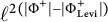
1 Introduction
Let
 $K\subset H$
be an extension of Hopf algebras over a field
 $\mathbb {k}$
and consider the strong monoidal restriction functor
 $$ \begin{align*}\operatorname{Res}_K^H\colon H\text{-}\mathbf{Mod}\to K\text{-}\mathbf{Mod}.\end{align*} $$
This functor has a left and a right adjoint, given by induction and coinduction
 $$ \begin{align*}\operatorname{Ind}_K^H\colon K\text{-}\mathbf{Mod}\to H\text{-}\mathbf{Mod}, \qquad \operatorname{CoInd}_K^H\colon K\text{-}\mathbf{Mod}\to H\text{-}\mathbf{Mod}.\end{align*} $$
The extension
 $K\subset H$
is a Frobenius extension if there is a natural isomorphism
 $\operatorname {Ind}_K^H\cong \operatorname {CoInd}_K^H$
. In this case,
 $\operatorname {Ind}_K^H$
is a Frobenius functor [Reference Caenepeel, Militaru and Zhu5, Reference Shimizu47], that is, a simultaneous left and right adjoint to
 $\operatorname {Res}_K^H$
. By [Reference Kelly28], the functor
 $\operatorname {Ind}_K^H$
then has both a lax and an oplax monoidal structure
 $$ \begin{align*} \operatorname{lax}_{V,U}\colon \operatorname{Ind}_{K}^H(V)\otimes \operatorname{Ind}_{K}^H(U)\to \operatorname{Ind}_{K}^H(V\otimes U),\\ \operatorname{oplax}_{V,U}\colon \operatorname{Ind}_{K}^H(V\otimes U)\to \operatorname{Ind}_{K}^H(V)\otimes \operatorname{Ind}_{K}^H(U). \end{align*} $$
It is a natural question to ask what compatibilities these structures satisfy. It turns out that
 $\operatorname {Ind}_K^H$
is almost never a strong monoidal functor, where the lax and oplax structures are inverse to each other, but often a Frobenius monoidal functor, where they satisfy a compatibility similar to the axioms of a Frobenius algebra.
Theorem A (See Theorem 4.2 and Corollary 4.4)
Assume that H is either finite-dimensional or pointed.Footnote
1
If
 $K\subset H$
is a Frobenius extension, then
 $\operatorname {Ind}_K^H$
is a Frobenius monoidal functor.
The study of Frobenius extensions of rings is by now a classical topic that goes back to [Reference Kasch26, Reference Nakayama and Tsuzuku41]. It was continued in the context of Hopf algebras by [Reference Farnsteiner15, Reference Fischman, Montgomery and Schneider18, Reference Schneider45]. The above result (Theorem A) builds on the work of [Reference Fischman, Montgomery and Schneider18, Reference Schneider45] using our results in [Reference Flake, Laugwitz and Posur21]. It contributes to the study of conditions on right adjoints of strong monoidal functors to give Frobenius monoidal functors [Reference Balan2, Reference Flake, Laugwitz and Posur21, Reference Yadav51].
There are several special cases when the conclusions of Theorem A hold.
Corollary B (See Corollaries 4.6 and 4.7)
Assume that H is finitely generated and faithfully flat over K and that either one of the following conditions holds:
-
(i) K is a normal Hopf subalgebra of H;
-
(ii)
 $K\subset Z(H)$
;
-
(iii) H is commutative.

Or, assume that H is finite-dimensional, and one of the conditions (i)–(vii) holds, where:
-
(iv)
$\alpha _H(k)=\alpha _K(k)$
, for all
$k\in K$
, where
$\alpha _H$
and
$\alpha _K$
are the distinguished grouplike elements of
$H^*$
and
$K^*$
, respectively; -
(v) both H and K are unimodular;
-
(vi) H is semisimple.



Then
 $\operatorname {Ind}_K^H$
is a Frobenius monoidal functor.
Building on our work in [Reference Flake, Laugwitz and Posur20, Reference Flake, Laugwitz and Posur21] and the theory of integrals of Hopf algebras, the second main result of this article gives conditions when
 $\operatorname {Ind}_K^H$
lifts to a braided Frobenius monoidal functor on the Drinfeld centers [Reference Joyal and Street25, Reference Majid35] of the categories of modules over the Hopf algebras K and H. Here, the Drinfeld center
 $\mathcal {Z}(H\text {-}\mathbf {Mod})$
is, equivalently, realized as the category of Yetter–Drinfeld modules
 ${\vphantom {\mathbf {YD}}}^{H}_{H}{\mathbf {YD}}$
[Reference Yetter52].
Theorem C (See Theorem 4.21)
Let
 $K\subset H$
be a Frobenius extension of finite-dimensional Hopf algebras. If the dual Hopf algebras
 $K^*$
and
 $H^*$
are unimodular, then the functor
 $$ \begin{align*} \mathcal{Z}(\operatorname{Ind}_K^H)\colon {\vphantom{\mathbf{YD}}}^{K}_{K}{\mathbf{YD}}\to {\vphantom{\mathbf{YD}}}^{H}_{H}{\mathbf{YD}},\quad (V,\delta)\mapsto (\operatorname{Ind}_K^H(V),\delta^{\operatorname{Ind}_K^H(V)}),\\ \delta^{\operatorname{Ind}_K^H(V)}(h\otimes v)=h_{(1)}v^{(-1)}S(h_{(3)})\otimes h_{(2)}\otimes v^{(0)},\qquad v\in V, h\in H, \end{align*} $$
from [Reference Flake, Laugwitz and Posur20, Corollary 7.2] is a braided Frobenius monoidal functor.
An important special case of Theorem C concerns (co)semisimple Hopf algebras.
Corollary D (See Corollary 4.24)
Assume that
 $K\subset H$
is an extension of finite-dimensional Hopf algebras such that either
-
(i) H is semisimple and co-semisimple, or
-
(ii) H is semisimple and
$\operatorname {char} \mathbb {k} =0$
,

Then
 $\mathcal {Z}(\operatorname {Ind}_K^H)$
is a braided Frobenius monoidal functor.
We apply our results to various classes of examples of Frobenius extensions of Hopf algebras, including:
-
• Some examples of restricted Lie algebras (see Example 4.23).
-
• Induction along the extension
$H\subset \operatorname {Drin}(H)$
for the Drinfeld double
$\operatorname {Drin}(H)$
of a unimodular Hopf algebra H gives a Frobenius monoidal functor (see Section 5.1). -
• The inclusion of the large central subalgebra
$\mathcal {O}_{\mathsf {H}}\subset U_\epsilon (\mathfrak {g})$
into the De Concini–Kac–Procesi form of the quantized enveloping algebra at a root of unity
$\epsilon $
of odd order
$\ell $
gives a Frobenius monoidal induction functor. This functor only extends to Yetter–Drinfeld categories as a braided lax or oplax monoidal functor but not as a braided Frobenius monoidal functor (see Section 5.2). -
• If
$\ell>3,$
we show that any Hopf subalgebra
$K\subset u_\epsilon (\mathfrak {g})$
of the small quantum group that yields a Frobenius extension is an extension of
$u_\epsilon (\mathfrak {h})$
, for a Lie subalgebra
$\mathfrak {h}\subset \mathfrak {g}$
, by an enlargement of the Cartan part (see Section 5.3). -
• Finally, we consider the Kac–Paljutkin algebra
$H_8$
, an eight-dimensional semisimple Hopf algebra, which contains the group algebra of the Klein four-group
$\mathsf {C}_2\times \mathsf {C}_2$
. We investigate the extension to Drinfeld centers of the induction functor along this Frobenius extension in detail and identify the simple objects in its image. Moreover, we use this functor to construct rigid Frobenius algebras in
$\mathcal {Z}(H_8\text {-}\mathbf {Mod})$
(see Sections 5.4 and 5.5).



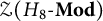
It is an interesting question which of the results of the present article can be generalized to (finite abelian) tensor categories. After completion of the present article, [Reference Jaklitsch and Yadav24] appeared which contains several results in this direction. In particular, Questions 5.20 and 5.21 were answered in the affirmative in [Reference Jaklitsch and Yadav24, Theorem 3.24].
The article is structured as follows: We start by including necessary preliminaries in Section 2 and present results on Frobenius extensions of Hopf algebras, mostly obtained from [Reference Fischman, Montgomery and Schneider18, Reference Schneider45], in Section 3. The main results of the article are found in Section 4 while Section 5 is devoted to classes of examples. At the end, in Section 5.6, we include some open questions.
2 Preliminaries
We briefly recall the concepts required in this article and fix notation. Throughout,
 $\mathbb {k}$
denotes a field and further assumptions on
 $\mathbb {k}$
will be stated when needed. We refer the reader to [Reference Majid36, Reference Montgomery39, Reference Radford44] for textbook accounts of the theory of Hopf algebras and [Reference Etingof, Gelaki, Nikshych and Ostrik13] for the theory of monoidal and braided monoidal categories.
2.1 Hopf algebras and their module categories
Let H be a Hopf algebra over
 $\mathbb {k}$
, by which we mean a bialgebra with product
 $m_H$
, unit
 $1_H\in H$
, coproduct
 $\Delta _H: H\to H\otimes H$
, and counit
 $\varepsilon _H\colon H\to \mathbb {k}$
, that has an invertible antipode
 $S_H\colon H\to H$
. We use adapted Sweedler’s notation, with suppressed summation,
 $$ \begin{align*}\Delta_H(h)=h_{(1)}\otimes h_{(2)}\in H\otimes H,\end{align*} $$
to denote the coproduct evaluated at
 $h\in H$
. We use the standard convention to denote
 $$ \begin{align*}(\Delta_H\otimes {\operatorname{id}})\Delta_H(h)=h_{(1)}\otimes h_{(2)}\otimes h_{(3)}=({\operatorname{id}}\otimes\Delta_H)\Delta_H(h),\end{align*} $$
which is justified by coassociativity of
 $\Delta _H$
. A morphism of Hopf algebras
 $\varphi \colon K \to H$
is required to be a morphism of both algebras and coalgebras that commutes with the antipodes, that is,
 $\varphi S_K=S_H\varphi $
. We denote the
 $\mathbb {k}$
-dual of a finite-dimensional Hopf algebra H by
 $H^*$
.
We will consider the monoidal category
 $H\text {-}\mathbf {Mod}$
of left H-modules. The monoidal subcategory of finite-dimensional H-modules is denoted by
 $H\text {-}\mathbf {mod}$
. On the tensor product
 $V\otimes W=V\otimes _\mathbb {k} W$
of two H-modules V and W, H acts via
 $h\cdot (v\otimes w)=h_{(1)}\cdot v\otimes h_{(2)}\cdot w$
and the tensor unit
 is given by
 $\mathbb {k}$
with H-action via
 $h\cdot 1=\varepsilon (h)$
, for
 $h\in H$
.
2.2 Induction and restriction functors
Given a morphism of Hopf algebras
 $\varphi \colon K\to H$
, consider the restriction functor
 $$ \begin{align*}G=\operatorname{Res}_\varphi\colon H\text{-}\mathbf{Mod}\to K\text{-}\mathbf{Mod}, \quad W\mapsto \left.W\right|{}_K. \end{align*} $$
Restriction has a left and a right adjoint functor given by
 $$ \begin{align} L=\operatorname{Ind}_\varphi(V):=H\otimes_K V, \qquad R=\operatorname{CoInd}_\varphi(V)=\operatorname{Hom}_{K}(H,V), \end{align} $$
for a K-module V. The left H-module structure on
 $\operatorname {CoInd}_\varphi (V)$
is
 $$ \begin{align} h\cdot f(g)=f(gh), \qquad f\in \operatorname{Hom}_{K}(H,V), ~~ h,g\in H. \end{align} $$
In this article, we will focus on the case of an inclusion
 $\iota \colon K\hookrightarrow H$
of Hopf algebras and denote the induction and restriction functors by
 $$ \begin{align*}\operatorname{Ind}_K^H=\operatorname{Ind}_\iota\quad\dashv\quad \operatorname{Res}_K^H=\operatorname{Res}_\iota \quad\dashv\quad \operatorname{CoInd}_K^H=\operatorname{CoInd}_\iota.\end{align*} $$
2.3 Lax, oplax, and Frobenius monoidal functors
We will briefly recall the definitions of lax, oplax, strong, and Frobenius monoidal functor between monoidal categories
 $\mathcal {C}$
and
 $\mathcal {D}$
. Let
 $\mathcal {C}, \mathcal {D}$
denote monoidal categories which, by Mac Lane’s coherence theorem [Reference MacLane34], we can regard as strict monoidal for simplicity. A lax monoidal functor is a functor
 $R: \mathcal {D} \rightarrow \mathcal {C}$
together with morphisms
 $$ \begin{align} \operatorname{lax}_{X,Y}\colon RX \otimes RY \longrightarrow R(X \otimes Y), \end{align} $$
natural in
 $X,Y \in \mathcal {D}$
and a morphism
 such that the associativity constraint
 $$ \begin{align} \operatorname{lax}_{X \otimes Y, Z} (\operatorname{lax}_{X, Y} \otimes {\operatorname{id}})= \operatorname{lax}_{X, Y \otimes Z}({\operatorname{id}} \otimes \operatorname{lax}_{Y,Z}) \end{align} $$
holds for
 $X,Y,Z \in \mathcal {D}$
as well as the unitality constraints

Dually, one defines an oplax monoidal functor as a functor
 $L: \mathcal {D} \rightarrow \mathcal {C}$
with morphisms
 $$ \begin{align} \operatorname{oplax}_{X,Y}\colon L(X \otimes Y) \longrightarrow LX \otimes LY, \end{align} $$
natural in
 $X,Y$
and a morphism
 satisfying the conditions obtained from Equations Equations (2.4) and (2.5) by duality.
A strong monoidal functor can now be defined as a lax monoidal functor where
 $\operatorname {lax}_{X,Y}$
and
 $\operatorname {lax}_0$
are isomorphisms.
The following result is due to [Reference Kelly28] (see also [Reference Flake, Laugwitz and Posur20, Proposition 2.2] for details).
Lemma 2.1 If G is strong monoidal, L left adjoint to G, and R right adjoint to G. Then L is oplax monoidal and R is lax monoidal.
This lemma can be applied to the Hopf algebra case.
Example 2.2 For a morphism of Hopf algebras
 $\varphi \colon K\to H$
, we note that
 $G=\operatorname {Res}_\varphi $
is a strong monoidal functor and will identify
 $\left. (W\otimes X)\right |{}_K$
and
 $\left .W\right |{}_K\otimes \left. X\right |{}_K$
for H-modules
 $W,X$
to simplify notation. Then
 $R=\operatorname {CoInd}_\varphi $
and
 $L=\operatorname {Ind}_\varphi $
have the following lax and oplax monoidal structures, for K-modules V and U:
 $$ \begin{align} \operatorname{lax}^R_{V,U}\colon R(V)\otimes R(U)\longrightarrow R(V\otimes U),\nonumber \\ f\otimes g\mapsto \big(h\mapsto f(h_{(1)})\otimes g(h_{(2)})\big), \end{align} $$
 $$ \begin{align} \operatorname{oplax}^{L}_{V,U}\colon L(V\otimes U)\to L(V)\otimes L(U),\nonumber \\ h\otimes_K (v\otimes u)\mapsto (h_{(1)}\otimes_K v)\otimes (h_{(2)}\otimes_K u). \end{align} $$
Finally, a Frobenius monoidal functor (see, e.g., [Reference Day and Pastro10])
 $F\colon \mathcal {D}\to \mathcal {C}$
is a functor equipped with a lax monoidal structure
 $(\operatorname {lax},\operatorname {lax}_0)$
, and an oplax monoidal structure
 $(\operatorname {oplax}, \operatorname {oplax}_0)$
satisfying the following two compatibility conditions, for any objects
 $X,Y,Z$
of
 $\mathcal {D}$
:
 $$ \begin{align} (\operatorname{lax}_{X,Y}\otimes {\operatorname{id}}_{F(Z)})({\operatorname{id}}_{F(X)}\otimes \operatorname{oplax}_{Y,Z}) & = \operatorname{oplax}_{X\otimes Y,Z}\operatorname{lax}_{X,Y\otimes Z} \end{align} $$
 $$ \begin{align} ({\operatorname{id}}_{F(X)}\otimes \operatorname{lax}_{Y,Z})(\operatorname{oplax}_{X,Y}\otimes {\operatorname{id}}_{F(Z)}) & = \operatorname{oplax}_{X,Y\otimes Z}\operatorname{lax}_{X\otimes Y,Z}. \end{align} $$
Recall that
 $\mathcal {C}$
is braided monoidal if it comes with natural isomorphisms
 $$ \begin{align*}\Psi^{\mathcal{C}}_{X,Y}\colon X\otimes Y\to Y\otimes X,\end{align*} $$
called the braiding which satisfy the hexagon axioms (see, e.g., [Reference Etingof, Gelaki, Nikshych and Ostrik13, Section 8.1]). For
 $\mathcal {C},\mathcal {D}$
braided monoidal categories, say that a lax (or, oplax) monoidal functor
 $F\colon \mathcal {D}\to \mathcal {C}$
is lax braided (resp. oplax braided) if the conditions
 $$ \begin{align} \operatorname{lax}_{Y,X}\Psi^{\mathcal{C}}_{F(X),F(Y)}&=F(\Psi^{\mathcal{D}}_{X,Y})\operatorname{lax}_{X,Y}, \end{align} $$
 $$ \begin{align} \Psi^{\mathcal{C}}_{F(X),F(Y)}\operatorname{oplax}_{X,Y}&=\operatorname{oplax}_{Y,X}F(\Psi^{\mathcal{D}}_{X,Y}) \end{align} $$
hold for all objects
 $X,Y\in \mathcal {D}$
. A Frobenius monoidal functor between braided monoidal categories is called braided if it is both lax braided and oplax braided.
2.4 Algebraic structures in monoidal categories
Let
 $\mathcal {C}$
be a monoidal category. We can define an algebra in
 $\mathcal {C}$
as an object A in
 $\mathcal {C}$
together with morphisms
 $m_A\colon A\otimes A\to A$
,
 in
 $\mathcal {C}$
which satisfy the associativity and unitality axioms internally to
 $\mathcal {C}$
. Algebras in
 $\mathcal {C}$
form a category denoted by
 $\mathbf {Alg}(\mathcal {C})$
. Dually, we define coalgebras in
 $\mathcal {C}$
which form a category
 $\mathbf {CoAlg}(\mathcal {C})$
. One checks that a lax/oplax monoidal functor
 $F\colon \mathcal {D}\to \mathcal {C}$
induces a functor
 $\mathbf {Alg}(\mathcal {D})\to \mathbf {Alg}(\mathcal {C})$
/a functor
 $\mathbf {CoAlg}(\mathcal {D})\to \mathbf {CoAlg}(\mathcal {C})$
. The (co)multiplication and (co)units on the images of these functors are defined by
 $$ \begin{align} m_{F(A)}=F(m_A)\operatorname{lax}_{A,A}, \qquad u_{F(A)}=F(u_A)\operatorname{lax}_{0}, \end{align} $$
 $$ \begin{align} \Delta_{F(C)}=\operatorname{oplax}_{C,C}F(\Delta_C), \qquad \varepsilon_{F(C)}=\operatorname{oplax}_{0} F(\varepsilon_C), \end{align} $$
where
 $(A,m_A,u_A)$
is an algebra and
 $(C,\Delta _A,\varepsilon _A)$
is a coalgebra in
 $\mathcal {D}$
.
Recall that a Frobenius algebra in a monoidal category
 $\mathcal {C}$
is an object A in
 $\mathcal {C}$
which is an algebra
 $(A,m_A,u_A)$
and a coalgebra
 $(A,\Delta _A,\varepsilon _A)$
such that the compatibility conditions
 $$ \begin{align} (m_A\otimes {\operatorname{id}}_A)({\operatorname{id}}_A\otimes \Delta_A)=\Delta_A m_A=({\operatorname{id}}_A\otimes m_A)(\Delta_A\otimes {\operatorname{id}}_A) \end{align} $$
hold. A morphism of Frobenius algebras is required to commute with both the algebra and coalgebra structures. We denote the category of Frobenius algebras in
 $\mathcal {C}$
by
 $\mathbf {Frob}(\mathcal {C})$
. One checks that a Frobenius monoidal functor
 $F\colon \mathcal {D}\to \mathcal {C}$
induces a functor
 $\mathbf {Frob}(\mathcal {D})\to \mathbf {Frob}(\mathcal {C})$
that combines the induced functors on algebras and coalgebras defined in Equations (2.13) and (2.14).
Recall that an algebra A in a braided monoidal category
 $\mathcal {C}$
with braiding
 $\Psi $
is commutative if
 $m_A\Psi _{A,A}=m_A$
and a coalgebra C is cocommutative if
 $\Psi _{C,C}\Delta _C=\Delta _C$
. A commutative Frobenius algebra is a Frobenius algebra which is commutative as an algebra and note that this implies cocommutativity as a coalgebra.
One checks that a braided lax (resp. braided oplax) monoidal functor preserves commutative algebras (resp. cocommutative coalgebras). Hence, a braided Frobenius monoidal functor preserves commutative Frobenius algebras.
2.5 The Drinfeld center, Yetter–Drinfeld modules, and the Drinfeld double
For a monoidal category
 $\mathcal {C}$
, the Drinfeld center
 $\mathcal {Z}(\mathcal {C})$
is a braided monoidal category (see [Reference Joyal and Street25, Definition 3] and [Reference Majid35, Example 3.4]). In this article, we will describe the Drinfeld center
 $\mathcal {Z}(H\text {-}\mathbf {Mod})$
by the equivalent category
 ${\vphantom {\mathbf {YD}}}^{H}_{H}{\mathbf {YD}}$
of Yetter–Drinfeld modules (or YD modules for short) over a Hopf algebra H (see [Reference Majid36, Example 9.1.8], [Reference Yetter52]). This category
 ${\vphantom {\mathbf {YD}}}^{H}_{H}{\mathbf {YD}}$
consists of objects V which are both left H-modules and left H-comodules with the coaction
 $$ \begin{align*}\delta\colon V\to H\otimes V, \qquad v\mapsto v^{(-1)}\otimes v^{(0)},\end{align*} $$
satisfying the Yetter–Drinfeld condition
 $$ \begin{align} \delta(h v)=h_{(1)}v^{(-1)}S(h_{(3)})\otimes h_{(2)}v^{(0)}, \end{align} $$
for
 $h\in H, v\in V$
. The tensor product
 $V\otimes W$
of two YD modules is simply the tensor product of the underlying H-modules and H-comodules via
 $\Delta _H$
and
 $m_H$
, respectively. The braiding
 $\Psi _{V,W}\colon V\otimes W\to W\otimes V$
of two YD modules is given by
 $$ \begin{align} \Psi_{V,W} \colon V\otimes W\to W\otimes V, \qquad v\otimes w \mapsto (v^{(-1)}\cdot w)\otimes v^{(0)}, \end{align} $$
for any
 $v\in V,w\in W$
. It shall be noted that, when H is finite-dimensional, the category of Yetter–Drinfeld modules is equivalent to modules over a Hopf algebra, called the Drinfeld double of H (see, e.g., [Reference Etingof, Gelaki, Nikshych and Ostrik13, Section 7.14]). In this article, we will work with the YD module description of the center which is more convenient, especially when working with infinite-dimensional Hopf algebras.
3 Frobenius extensions of Hopf algebras
We now discuss results on Frobenius extensions of Hopf algebras following [Reference Fischman, Montgomery and Schneider18, Reference Schneider45]. We start by describing isomorphisms of induction and coinduction functors in Section 3.1. The associated augmented algebra is introduced as a key tool to study Frobenius extensions in Section 3.2. The concepts of extensions of right integral type and normal bases, and criteria when such extensions are Frobenius extensions, are recalled in Sections 3.3–3.5.
3.1 Isomorphisms of induction and coinduction functors
Let
 $K\subset H$
be an inclusion of Hopf algebras (from now on called an extension of Hopf algebras).
Remark 3.1 We say that
 $K\subset H$
is a finite extension if H is finitely generated as a left K-module. We note that, as we only consider Hopf algebras with invertible antipode, H is finitely generated/projective/faithfully flat/free as a left K-module if and only if H has the respective property as a right K-module. Thus, we will say that H is finite/projective/faithfully flat/free over K in these cases without ambiguity.
We first recall when induction and coinduction along
 $K\subset H$
are isomorphic based on maps called Frobenius morphisms (see [Reference Kassel27, Reference Menini and Năstăsescu38, Reference Nakayama and Tsuzuku41]).
Proposition 3.2 The following statements are equivalent:
-
(i) The functors
$\operatorname {Ind}_K^H$
and
$\operatorname {CoInd}_K^H$
are isomorphic. -
(ii)
-
(a) H is finite projective over K, and
-
(b) there is a morphism of K-K-bimodules
$\operatorname {tr} \colon H \to K$
which induces a bijection
$\theta _H \colon H\to \operatorname {Hom}_K(H,K), h\mapsto \operatorname {tr}((-)h)$
.
-



We adopt the following terminology from [Reference Fischman, Montgomery and Schneider18, Reference Schneider45].
Definition 3.3 (Frobenius extensions and Frobenius morphisms)
A map
 $\operatorname {tr}$
satisfying the conditions in Proposition 3.2(ii)(b) is called a Frobenius morphism. If such a Frobenius morphism exists for H finite projective over K, then we call
 $K\subset H$
a Frobenius extension of Hopf algebras.
If H is finite projective over K, Frobenius morphisms are in bijection with natural isomorphisms
 $\theta \colon \operatorname {Ind}_K^H\stackrel {\sim }{\longrightarrow } \operatorname {CoInd}_K^H$
. Indeed, a Frobenius morphism
 $\operatorname {tr}\colon H\to K$
gives a natural isomorphism
 $\theta \colon \operatorname {Ind}_K^H\to \operatorname {CoInd}_K^H$
with component maps
 $$ \begin{align} \theta_V(h\otimes v)=\big(g\mapsto \operatorname{tr}(gh)v \big). \end{align} $$
Example 3.4 Let
 $\mathsf {G}$
be a group and
 $\mathsf {K}\subset \mathsf {G}$
a subgroup of finite index. One shows as in [Reference Flake, Laugwitz and Posur21, Example 5.22] that
 $\operatorname {tr}(g)=g$
, if
 $g\in \mathsf {K}$
, and
 $\operatorname {tr}(g)=0$
otherwise extends to a Frobenius morphism
 $\operatorname {tr}\colon \mathbb {k} \mathsf {G}\to \mathbb {k} \mathsf {K}$
.
Not all extensions of Hopf algebras admit a Frobenius morphism, for instance, the inclusion of the group algebra
 $\mathbb {k} \mathsf {C}_\ell $
of a cyclic group of order
 $\ell>2$
into the Taft algebra
 $T_\ell (q)$
, associated with an
 $\ell $
-th root of unity, does not, as shown in [Reference Flake, Laugwitz and Posur21, Example 5.7].
For Frobenius extensions of Hopf algebras, it is useful to fix the following dual sets of generators for H (see [Reference Flake, Laugwitz and Posur21, Lemma 5.8] and cf. [Reference Fischman, Montgomery and Schneider18, 1.3. Proposition]).
Corollary 3.5 If
 $K\subset H$
is a Frobenius extension with Frobenius morphism
 $\operatorname {tr}$
, then there exist
 $n\geq 1$
and generators
 $h_1,\ldots ,h_n$
of H as a left K-module and
 $\delta _1,\ldots , \delta _n$
of H as a right K-module such that, for all
 $h\in H$
,
 $$ \begin{align} \sum_{i=1}^n \delta_i\otimes_K h_i h &= \sum_{i=1}^n h\delta_i\otimes_K h_i, \end{align} $$
 $$ \begin{align} h =\sum_{i=1}^n \operatorname{tr}(h\delta_i)h_i&= \sum_{i=1}^n \delta_i\operatorname{tr}(h_i h). \end{align} $$
Moreover, the inverse of
 $\theta _V$
from Equation (3.1) is given by
 $$ \begin{align} \theta_V^{-1}\colon \operatorname{CoInd}_K^H(V)\to \operatorname{Ind}_K^H(V), \quad f\mapsto \sum_{i=1}^n\delta_i\otimes_K f(h_i). \end{align} $$
For a Frobenius extension
 $K\subset H$
, we can give
 $F:=\operatorname {Ind}_K^H$
the structure of a left and right adjoint to
 $G:=\operatorname {Res}_K^H$
. The units and counits of these adjunctions are
 $$ \begin{align} \operatorname{unit}^{G\dashv F}_W&\colon W\to FG(W), &w&\mapsto \sum_{i=1}^r \delta_i\otimes_K h_iw, \end{align} $$
 $$ \begin{align} \operatorname{counit}^{G\dashv F}_V&\colon GF(V)\to V, & h\otimes_K v& \mapsto \operatorname{tr}(h)v, \end{align} $$
 $$ \begin{align} \operatorname{unit}^{F\dashv G}_V&\colon V\to GF(V), &v&\mapsto 1\otimes_K v, \end{align} $$
 $$ \begin{align} \operatorname{counit}^{F\dashv G}_W&\colon FG(W)\to W, &h\otimes_K w&\mapsto hw, \end{align} $$
for any K-module V and any H-module W. Moreover, the functor F is lax and oplax monoidal with the lax and oplax monoidal structures
 $$ \begin{align} \operatorname{lax}_{V,U}\colon F(V)\otimes F(U)&\to F(V\otimes U),\nonumber \\ \quad (h\otimes_K v)\otimes (g\otimes_K u)&\mapsto \sum_i \delta_i\otimes_K (\operatorname{tr}((h_i)_{(1)}h)v\otimes \operatorname{tr}((h_i)_{(2)}g)u), \end{align} $$
 $$ \begin{align} \operatorname{oplax}_{V,U}\colon F(V\otimes U)&\to F(V)\otimes F(U),\nonumber \\ \quad h\otimes_K (v\otimes u)&\mapsto (h_{(1)}\otimes_K v)\otimes (h_{(2)}\otimes_K u), \end{align} $$


The following natural isomorphisms, called projection formula morphisms, will be important later. The general categorical aspects of the theory behind these morphisms are described in general in [Reference Flake, Laugwitz and Posur20] (see also [Reference Bruguières, Lack and Virelizier4, Reference Fausk, Hu and May17, Reference Flake, Laugwitz and Posur21]).
Definition 3.6 Given a Frobenius extension
 $K\subset H$
, we define the left projection formula morphisms to be the following natural transformations:
 $$ \begin{align} \mathrm{lproj}_{{W},{V}}^{F, G\dashv F}\colon W\otimes F(V)&\to F(G(W)\otimes V),\nonumber \\ w\otimes (h\otimes_K v)&\mapsto \sum_{i=1}^r \delta_i\otimes_K ((h_i)_{(1)}w\otimes \operatorname{tr}((h_i)_{(2)}h)v), \end{align} $$
 $$ \begin{align} \mathrm{lproj}_{{W},{V}}^{F, F\dashv G}\colon F(G(W)\otimes V)&\to W\otimes F(V),\nonumber \\h\otimes_K (w\otimes v)&\mapsto h_{(1)}w\otimes (h_{(2)}\otimes_K v), \end{align} $$
and the right projection formula morphisms to be
 $$ \begin{align} \mathrm{rproj}_{{V},{W}}^{F, G\dashv F}\colon F(V)\otimes W&\to F(V\otimes G(W)),\nonumber \\ (h\otimes_K v)\otimes w&\mapsto \sum_{i=1}^r \delta_i\otimes_K (\operatorname{tr}((h_i)_{(1)}h)v\otimes (h_i)_{(2)}w), \end{align} $$
 $$ \begin{align} \mathrm{rproj}_{{V},{W}}^{F, F\dashv G}\colon F(V\otimes G(W))&\to F(V)\otimes W,\nonumber \\ h\otimes_K (v \otimes w) &\mapsto (h_{(1)}\otimes_K v)\otimes h_{(2)}w. \end{align} $$
We note that the pair
 $\mathrm {lproj}^{F, G\dashv F}$
and
 $\mathrm {rproj}^{F, G\dashv F}$
comes from the adjunction
 $G\dashv F$
, where F is right adjoint to G while the other pair comes from the adjunction
 $F\dashv G$
, where F is the left adjoint. This is indicated in the superscripts.
Lemma 3.7 The projection formula morphisms are isomorphisms for any Frobenius extension of Hopf algebras.
Proof This follows from the results of [Reference Flake, Laugwitz and Posur20, Section 7]. The invertibility of the projection formula morphisms can also be checked directly using the inverse antipode. For instance, one checks that
 $$ \begin{align} (\mathrm{lproj}^{F,F\dashv G}_{{W},{V}})^{-1}\colon W\otimes F(V)&\to F(G(W)\otimes V),\nonumber \\ w\otimes (h\otimes_K v)&\mapsto h_{(2)}\otimes_K( S^{-1}(h_{(1)})w\otimes v), \end{align} $$
 $$ \begin{align} (\mathrm{rproj}^{F,F\dashv G}_{{V},{W}})^{-1}\colon F(V)\otimes W&\to F(V\otimes G(W)),\nonumber \\ (h\otimes_K v)\otimes w &\mapsto h_{(1)}\otimes_K( v\otimes S(h_{(2)})w). \end{align} $$
Formulas for the inverses for the other two morphisms can be obtained using Corollary 3.5 but we will not require them.
3.2 The augmented algebra associated with an extension of Hopf algebras
Let
 $K\subset H$
be an extension of Hopf algebras. In this section, we introduce the associated augmented algebra
 $\overline {H}^*$
following [Reference Fischman, Montgomery and Schneider18, Reference Schneider45]. To do this, we first recall the definition of integrals of augmented algebras.
Definition 3.8 (Integrals, unimodularity)
Let A be a
 $\mathbb {k}$
-algebra with an algebra map
 $\varepsilon \colon A\to \mathbb {k}$
, called the augmentation.
-
(i) A right integral is an element
$\Lambda \in A$
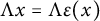
such that
$\Lambda x=\Lambda \varepsilon (x)$
for all
$x\in A$
, that is, an element spanning a submodule of A as a right module over itself, on which A acts by its counit. -
(ii) Similarly, a left integral is an element
$\Lambda \in A$
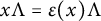
such that
$x\Lambda =\varepsilon (x)\Lambda $
for all
$x\in A$
. -
(iii) An augmented algebra is called unimodular if the spaces of left and right integrals coincide.




It follows from the definition that the space of right integrals forms a left A-submodule of A. In particular, if the space of right integrals is one-dimensional, this gives rise to an algebra map
 $\alpha _A\colon A\to \mathbb {k}$
determined by the left multiplication
 $$ \begin{align} a \Lambda = \alpha_A(a)\Lambda, \qquad \forall a\in A, \end{align} $$
for any nonzero right integral
 $\Lambda $
of A. Note that
 $\alpha _A$
is independent of the choice of
 $\Lambda $
. The following lemma shows that it detects unimodularity.
Lemma 3.9 Assume that the spaces of left and right integrals of A are one-dimensional. Then the augmented algebra A is unimodular if and only if
 $\alpha _A=\varepsilon $
.
Proof If A is unimodular, then any right integral is also a left integral and hence
 $\alpha _A=\varepsilon $
. Conversely, if
 $\alpha _A=\varepsilon $
and
 $\Lambda $
is a right integral, then
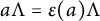 $a\Lambda =\varepsilon (a)\Lambda $
and hence
 $\Lambda $
is also a left integral. By one-dimensionality of the spaces of integrals, it follows that any left integral equals
 $s\Lambda $
for a nonzero right integral
 $\Lambda $
and
 $s\in \mathbb {k}$
, and hence is a right integral.
Remark 3.10 The above concepts generalize the corresponding tools for Hopf algebras. If H is a finite-dimensional Hopf algebra, then H is an augmented algebra with a one-dimensional space of right integrals [Reference Larson and Sweedler31]. Thus,
 $\alpha _H\in H^*$
is a morphism of algebras, that is,
 $\Delta _{H^*}(\alpha _H)=\alpha _H\otimes \alpha _H$
(see, e.g., [Reference Montgomery39, Section 2.2]).
 $\alpha _H$
is called the distinguished grouplike element of
 $H^*$
. It follows that H is unimodular if and only if
 $\alpha _H=\varepsilon _H$
.
Definition 3.11 (
$\overline {H}$
,
$\overline {H}^*$
)


Let
 $K\subset H$
be an extension of Hopf algebras and set
 $K^+:=\ker \varepsilon _K$
.
-
(i) Define
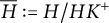
$\overline {H}:=H/HK^+$
, where
$HK^+$
is the left H-module generated by
$K^+$
. Then
$\overline {H}$
is a left H-module coalgebra with a K-linear co-augmentation
$\nu \colon \mathbb {k}\to \overline {H}$
,
$1\mapsto \overline {1}=1_H+HK^+$
. -
(ii) The H-module quotient map
$H\to \overline {H}$
,
$h\mapsto \overline {h}=h+HK^+$
is a morphism of co-augmented coalgebras, that is, a morphism of coalgebras such that
$1_H\mapsto \overline {1}$
. -
(iii) The
$\mathbb {k}$
-dual
$\overline {H}^*=\operatorname {Hom}_\mathbb {k}(H/HK^+,\mathbb {k})$
is an augmented algebra with the convolution product and unit given by
$$ \begin{align*}(\mu*\nu)(\overline{h}) = \mu(\overline{h_{(1)}})\nu(\overline{h_{(2)}}) , \end{align*} $$
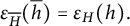
$\varepsilon _{\overline {H}}(\overline {h})=\varepsilon _H(h).$
The augmentation
$\varepsilon \colon \overline {H}^*\to \mathbb {k}$
is given by evaluation of a linear function
$\mu \colon \overline {H}\to \mathbb {k}$
at
$\overline {1}$
, that is, by
$\varepsilon (\mu )=\mu (\overline {1})$
.











Lemma 3.12 Let
 $K\subset H$
be an extension of Hopf algebras.
-
(i) For all
$h\in H, k\in K$
,
$\overline {hk}=\varepsilon (k)\overline {h}$
. -
(ii) If H is finite over K, then
$\overline {H}$
is finite-dimensional.



Proof To prove Part (i), note that
 $K^+\subset K$
is a complement to the space
 $\mathbb {k} 1_K$
as a
 $\mathbb {k}$
-vector space. Thus, any
 $k\in K$
decomposes as
 $k=k'+\varepsilon (k)1$
with
 $k'\in K^+$
and hence
 $$ \begin{align*}\overline{hk}=\overline{hk'}+\varepsilon(k)\overline{h}=\varepsilon(k)\overline{h}.\end{align*} $$
To prove Part (ii), assume H is generated by a finite set of elements
 $\{h_i\}_i$
over K. Then for every
 $h\in H$
, there are elements
 $\{k_i\}_i$
in K such that
 $h=\sum _i h_i k_i$
, and
 $$ \begin{align*}\overline{h} = \sum_i \overline{h_i k_i} = \sum_i \varepsilon(k_i) \overline{h_i},\end{align*} $$
by Part (i). Hence,
 $H/HK^+$
is finite-dimensional.
3.3 Frobenius extensions of right integral type
In this section, we recall extensions of Hopf algebras of right integral type and their main properties (see [Reference Fischman, Montgomery and Schneider18, 1.10. Definition]).
Definition 3.13 (Right integral type)
We say that an extension
 $K\subset H$
of Hopf algebras is of right integral type if there exists:
-
(a) a nonzero right integral
$\lambda $
for
$\overline {H}^*$
; -
(b) an element
$\Lambda \in H$
such that, for all
$h\in H$
,
$$ \begin{align*}\lambda(\overline{\Lambda h})=\varepsilon(h);\end{align*} $$
-
(c) a relative modular function, that is, a morphism of algebras
$\chi \colon K\to \mathbb {k}$
such that, for all
$k\in K$
,
$h\in H$
, (3.20)
$$ \begin{align}\lambda(\overline{kh})=\chi(k)\lambda(\overline{h}).\end{align} $$


Remark 3.14 Note that the conditions (a) and (b) in Definition 3.13 are existence conditions for certain integral elements related to the Hopf algebra extension
 $K\subset H$
. In particular, if H is finite-dimensional, there exists a nonzero right integral
 $\Lambda $
for H, satisfying
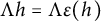 $\Lambda h=\Lambda \varepsilon (h)$
, and a right integral
 $\lambda $
for
 $\overline {H}^*$
such that condition (b) holds. Further, if the space of right integrals for
 $\overline {H}^*$
is one-dimensional (e.g., when
 $\overline {H}^*$
is finite-dimensional and
 $HK^+$
is a two-sided ideal and hence
 $\overline {H}^*$
is a finite-dimensional Hopf algebra), then the relative modular function
 $\chi $
always exists. In general, the existence of
 $\lambda ,\Lambda ,$
and
 $\chi $
is not guaranteed.
Remark 3.15 Note also that if
 $\chi $
as in (c) exists, then it is unique for a given
 $\lambda $
, and in fact, determined by (3.20) for any choice of
 $\overline {h}$
such that
 $\lambda (\overline {h})\neq 0$
. Moreover, if the space of right integrals of
 $\overline {H}^*$
is one-dimensional, then
 $\chi $
is unique. The map
 $\chi $
is not to be confused with the map
 $\alpha _K$
from Equation (3.19).
We recall some results from [Reference Fischman, Montgomery and Schneider18].
Definition 3.16 [Reference Fischman, Montgomery and Schneider18, 1.1. Definition]
Let
 $K\subset H$
be an extension of Hopf algebras, let
 $\beta $
be an algebra automorphism of K. Let
 $K^\beta $
be the right K-module whose action is twisted by
 $\beta $
. We say that
 $K\subset H$
is a
 $\beta $
-Frobenius extension if H is finite projective over K and
 $H\cong \operatorname {Hom}_K(H,K^\beta )$
as an H-K-bimodule.
The following argument is taken from [Reference Fischman, Montgomery and Schneider18, 1.8. Corollary].
Lemma 3.17 Assume
 $K\subset H$
is a
 $\beta $
-Frobenius extension and there is a linear map
 $\chi \colon K\to \mathbb {k}$
such that
 $\beta (k)=\chi (k_{(1)}) k_{(2)}$
for all
 $k\in K$
. Then the following are equivalent:
-
(a)
$K\subset H$
is a Frobenius extension; -
(b)
$\chi =\varepsilon $
; -
(c)
$\beta ={\operatorname {id}}$
.


Proof The immediate implications are (b)
 $\Rightarrow $
(c)
 $\Rightarrow $
(a), so it remains to prove (a)
 $\Rightarrow $
(b).
Assume
 $K\subset H$
is a
 $\beta $
-Frobenius extension and a Frobenius extension. Then we have an isomorphism
 $\phi \colon H\to H^{\beta }$
of H-K-bimodules, where the right K-action on
 $H^{\beta }$
is twisted by
 $\beta $
. Set
 $u:=\phi (1)$
. We compute
 $$ \begin{align*}u\phi^{-1}(1) = \phi^{-1}(\phi(1)) = 1, \end{align*} $$
in particular,
 $\varepsilon (u)\neq 0$
. We also compute for all
 $k\in K,$
 $$ \begin{align*}k u = \phi(k) = u \beta(k) , \end{align*} $$
which implies
 $\varepsilon \beta =\varepsilon $
on K. Finally, for all
 $k\in K$
,
 $$ \begin{align*}\varepsilon\beta(k) = \chi(k_{(1)}) \varepsilon(k_{(2)}) = \chi(k). \end{align*} $$
We have shown
 $\chi =\varepsilon \beta =\varepsilon $
.
We recall the following key result obtained from [Reference Schneider45, 3.3. Theorem].
Theorem 3.18 (Schneider)
Assume that
 $K\subset H$
is an extension of Hopf algebras of right integral type such that H is finite faithfully flat over K. Then:
-
(a) H is finite projective over K.
-
(b)
$K\subset H$
is a Frobenius extension if and only if
$\chi =\varepsilon _K$
. -
(c) If the equivalent conditions of (b) hold, a choice of Frobenius morphism in the sense of Definition 3.3 is given by setting
(3.21)for any nonzero right integral
$$ \begin{align} \operatorname{tr}\colon H\to K, \quad \operatorname{tr}(h):= \lambda(\overline{h_{(1)}}) h_{(2)}\in K, \end{align} $$
$\lambda $
of
$\overline {H}^*$
.


Proof We apply the statement in [Reference Fischman, Montgomery and Schneider18, 1.14. Theorem] (as a right-hand version of [Reference Schneider45, 3.3. Theorem]) in the special case of
 $H=W=A$
and
 $K=U$
. Then
 $A^{\mathrm {co} H}=\mathbb {k} 1_H$
and the extension
 $\mathbb {k}\subset H$
is Galois. Moreover, it follows from [Reference Fischman, Montgomery and Schneider18, 2.4. Lemma] that
 $H^{\mathrm {co} \overline {H}}=K$
. Thus, [Reference Fischman, Montgomery and Schneider18, 1.14. Theorem] implies that
 $K\subset H$
is a
 $\beta $
-Frobenius extension such that
 $\beta (k)=\chi (k_{(1)})k_{(2)}$
, with
 $\chi $
the relative modular function. In particular, H is finite projective over K, proving (a), and (b) follows from Lemma 3.17.
Finally, the formula for
 $\operatorname {tr}$
in (c) is the formula for the Frobenius morphism denoted by f in [Reference Fischman, Montgomery and Schneider18, 1.14. Theorem] specified to the above setup. Note that
 $\operatorname {tr}$
indeed has image contained in K by the argument in [Reference Schneider45, 3.1. Theorem].
Remark 3.19 In the context of abelian tensor categories, which are, in particular, rigid, [Reference Shimizu48, Section 4.2] provides a generalization of the relative modular function of [Reference Fischman, Montgomery and Schneider18] – the relative modular object
 $\chi _G$
associated with a strong monoidal functor
 $G\colon \mathcal {C}\to \mathcal {D}$
which preserves projective objects. This object
 $\chi _G$
controls whether G is a Frobenius functor. In the case when
 $G=\operatorname {Res}_K^H$
for an extension of finite-dimensional Hopf algebras,
 $\chi _G$
is the one-dimensional K-module given by acting via the relative modular function
 $\chi $
from Equation (3.20).
A condition on H that implies that any extension
 $K\subset H$
is of right integral type is cocommutativity of the coradical
 $H_0$
of H (see, e.g., [Reference Montgomery39]).
Corollary 3.20 [Reference Schneider45, 4.3. Corollary]
Let H be a Hopf algebra such that
 $H_0$
is cocommutative. Then any finite extension
 $K\subset H$
of Hopf algebras is of right integral type such that H is faithfully flat over K.
Proof If the coradical of H is cocommutative and H is finite over K, then H is faithfully flat over K by [Reference Takeuchi50]. That
 $K\subset H$
is of right integral type was proved in [Reference Fischman, Montgomery and Schneider18, 4.9. Corollary].
A Hopf algebra is pointed if every simple subcoalgebra is one-dimensional.
Corollary 3.21 Let H be a pointed Hopf algebra. Then any finite extension
 $K\subset H$
is of right integral type and H is free over K.
Proof For any pointed Hopf algebra,
 $H_0$
is a group algebra and hence cocommutative. Freeness of H over K is a theorem from [Reference Radford43].
3.4 Normal bases and extensions of right integral type
In the following, we recall classes of extensions of Hopf algebras which are of right integral type. The next definition follows [Reference Fischman, Montgomery and Schneider18, 4.1. Definition].
Definition 3.22 (Right normal basis)
We say that H has a right normal basis over K if there exists an isomorphism
 $H\cong \overline {H}\otimes K$
of right K-modules and left
 $\overline {H}$
-comodules. Here, H has the induced left
 $\overline {H}$
-comodule structure.
In particular, the existence of a right normal basis for H over K implies that H is free as a right K-module. In particular, H is faithfully flat over K. Moreover, [Reference Fischman, Montgomery and Schneider18, 4.8. Theorem] proves the following result.
Proposition 3.23 Let
 $K\subset H$
be a finite extension of Hopf algebras. If H has a right normal basis over K, then
 $K\subset H$
is of right integral type and H is free over K.
Combining this result with [Reference Schneider45, 2.4. Theorem] yields the following result.
Corollary 3.24 Assume H is finite-dimensional and
 $K\subset H$
is a Hopf subalgebra. Then
 $K\subset H$
is an extension of right integral type such that H is free over K.
Proof Note that [Reference Schneider45, 2.4. Theorem] shows that H has a right normal basis over K and is, in particular, free over K.
Remark 3.25 In the cases when H has a right normal basis over K or
 $H_0$
is cocommutative, or when H is finite-dimensional or pointed, we have seen that
 $K\subset H$
is of right integral type (see Proposition 3.23 and Corollaries 3.20, 3.21, and 3.24). Moreover, it was shown in [Reference Fischman, Montgomery and Schneider18, 4.9. Corollary] that the space of right integrals of
 $\overline {H}^*$
is one-dimensional and that
 $\chi $
is the algebra map by which K acts (from the left) on the space of right integrals of
 $\overline {H}^*$
via Equation (3.20). In this situation,
 $\chi $
is unique for the extension
 $K\subset H$
by Remark 3.15.
3.5 Criteria for Frobenius extensions of Hopf algebras
We include some sufficient criteria to obtain Frobenius extensions of Hopf algebras. The following proposition describes the case where the Hopf algebras are finite-dimensional.
Proposition 3.26 [Reference Fischman, Montgomery and Schneider18, 1.7. Theorem and 1.8. Corollary]
Let
 $K\subset H$
be an extension of finite-dimensional Hopf algebras.
-
(i) There exists a right integral
$\lambda _H$
of
$H^*$
and a left integral
$\Lambda _K$
of K such that the map
$\lambda _{\overline {H}}(\overline {h}):=\lambda _H(h \Lambda _K)$
, for
$h\in H$
, defines a right integral on
$\overline {H}^*$
. -
(ii)
$K\subset H$
is a Frobenius extension if and only if
$\alpha _H(k)=\alpha _K(k)$
for all
$k\in K$
.







Here,
 $\alpha _H$
is the modular function of the Hopf algebra H (see Remark 3.10).
Corollary 3.27 Let H be a unimodular Hopf algebra. Then
 $K\subset H$
is a Frobenius extension if and only if K is unimodular.
Proof This follows directly from Proposition 3.26(ii) and the fact that a Hopf algebra H is unimodular if and only if
 $\alpha _H=\varepsilon _H$
.
Remark 3.28 If
 $K\subset H$
is an inclusion of finite-dimensional Hopf algebras, the relative modular function is given by
 $$ \begin{align}\chi=(\alpha_H)|_K * \alpha_K^{-1},\end{align} $$
for the convolution inverse
 $\alpha _K^{-1}=\alpha _K S_K$
of the distinguished grouplike of
 $K^*$
[Reference Fischman, Montgomery and Schneider18, 1.6. Definition], where
 $S_K$
is the antipode of K.
Example 3.29 If
 $K=\mathbb {k}$
and H is a finite-dimensional Hopf algebra, then Proposition 3.26 shows that for a nonzero right integral
 $\lambda _H$
of
 $H^*$
,
 $\operatorname {tr}:=\lambda _H\colon H\to \mathbb {k}$
defines a Frobenius morphism and
 $\mathbb {k} \subset H$
is a Frobenius extension.
To provide another sufficient criterion for Frobenius extensions, recall the concept of a normal Hopf subalgebra [Reference Montgomery39, 3.4.1 Definition], that is, a Hopf subalgebra
 $K\subset H$
such that K is an H-H-subbimodule with respect to the adjoint action. In this case,
 $HK^+=K^+H$
and hence
 $HK^+$
is a Hopf ideal and
 $\overline {H}$
a Hopf algebra. For example, if K is contained in the center
 $Z(H)$
of H, then K is a normal Hopf subalgebra.
Corollary 3.30 Assume K is a normal Hopf subalgebra of H such that H is finite and faithfully flat over K. Then
 $K\subset H$
is a Frobenius extension of right integral type.
Proof By [Reference Fischman, Montgomery and Schneider18, 1.11. Example], since K is a normal Hopf subalgebra such that
 $\overline {H}$
is finite-dimensional by Lemma 3.12(ii), it follows that
 $K\subset H$
is an extension of right integral type. As H is faithfully flat over K, by Theorem 3.18, we know that H is finite projective over K and that, to show that
 $K\subset H$
is a Frobenius extension, it remains to check that
 $\chi =\varepsilon _K$
. Since
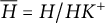 $\overline {H}=H/HK^+$
is a finite-dimensional Hopf algebra,
 $\overline {H}^*$
has a unique nonzero right integral
 $\lambda $
up to scalars. Moreover, using that
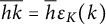 $\overline {hk}=\overline {h}\varepsilon _K(k)$
, for
 $k\in K$
, we compute
 $$ \begin{align*} \lambda(\overline{k} \overline{h}) =\lambda(\overline{h_{(1)}S(h_{(2)}) k h_{(3)}}) &=\lambda(\overline{h_{(1)}})\varepsilon_K(S(h_{(2)})k h_{(3)})\\ &=\lambda(\overline{h})\varepsilon_K(k) =\chi(k) \lambda(\overline{h}). \end{align*} $$
This shows that
 $\chi =\varepsilon _K$
, and
 $K\subset H$
is a Frobenius extension by Theorem 3.18.
The statement of Corollary 3.30 simplifies when H is finite-dimensional. In this case, any normal Hopf subalgebra
 $K\subset H$
gives a Frobenius extension since H is free over K.
4 Frobenius monoidal induction functors
This section contains the main results of the article on the Frobenius monoidal structure of induction along a Frobenius extension of Hopf algebras (Theorem 4.2) and when this Frobenius monoidal functor extends to categories of YD modules (Theorem 4.21).
4.1 Conditions for induction functors to be Frobenius monoidal
We will now prove that the induction functor
 $\operatorname {Ind}_K^H$
, for a Frobenius extension
 $K\subset H$
of Hopf algebras of right integral type, is a Frobenius monoidal functor together with the lax and oplax monoidal structures from Equations (3.9) and (3.10).
We equip H with the regular right H-coaction. Then, K has a right H-coaction given by extending the regular K-coaction via the inclusion
 $K\subset H$
. We recall the following results from [Reference Flake, Laugwitz and Posur21, Proposition 5.13 and Corollary 5.14].
Proposition 4.1 Let
 $K\subset H$
be a Frobenius extension of Hopf algebras.
-
(1) The following conditions are equivalent:
-
(i) The natural transformations
$\mathrm {rproj}^{F, F\dashv G}$
and
$\mathrm {rproj}^{F, G\dashv F}$
from Definition 3.6 are mutual inverses. -
(ii) The Frobenius morphism
$\operatorname {tr}\colon H\to K$
is a morphism of right H-comodules.
-
-
(2) If the equivalent conditions in (1) hold, then
$\operatorname {Ind}_K^H\colon K\text {-}\mathbf {Mod}\to H\text {-}\mathbf {Mod}$
is a Frobenius monoidal functor. -
(3) A Frobenius morphism
$\operatorname {tr}$
satisfying condition (1)(ii) is unique up to multiplication by a nonzero scalar.




Theorem 4.2 Let
 $K\subset H$
be a Frobenius extension of Hopf algebras of right integral type (see Definition 3.13). Then
 $$ \begin{align*}\operatorname{Ind}_K^H\colon K\text{-}\mathbf{Mod}\to H\text{-}\mathbf{Mod}\end{align*} $$
is a Frobenius monoidal functor.
This functor restricts to finite-dimensional modules,
 $\operatorname {Ind}_K^H\colon K\text {-}\mathbf {mod}\to H\text {-}\mathbf {mod}$
.
Proof Assume that
 $K\subset H$
is a Frobenius extension. Then H is finite projective over K. Now, [Reference Schneider45, 1.8. Corollary] shows that H is faithfully flat over K. Thus, Theorem 3.18 implies that
 $K\subset H$
admits a Frobenius morphism of the form
 $$ \begin{align*}\operatorname{tr}(h)=\lambda(\overline{h_{(1)}}) h_{(2)}.\end{align*} $$
Such a Frobenius morphism is clearly a morphism of right H-comodules by coassociatity of the coproduct of
 $\Delta (h)=h_{(1)}\otimes h_{(2)}$
of H. Thus, the claim follows from Proposition 4.1. As H is, in particular, finite over K, it is clear that induction restricts to the subcategories of finite-dimensional modules.
Remark 4.3 By Theorem 3.18, Theorem 4.2 says that for any finite faithfully flat extension
 $K\subset H$
of right integral type such that
 $\chi =\varepsilon _K$
,
 $\operatorname {Ind}_K^H$
is a Frobenius monoidal functor.
The following corollaries of Theorem 4.2 present specific assumptions that ensure that
 $\operatorname {Ind}_K^H$
is a Frobenius monoidal functor based on the results of Sections 3.3 and 3.4.
Corollary 4.4 Let
 $K\subset H$
be a finite Frobenius extension of Hopf algebras. Then
 $\operatorname {Ind}_K^H$
is Frobenius monoidal in each of the following cases:
-
(i) H is finite-dimensional.
-
(ii) H is pointed.
-
(iii) H has a right normal basis over K.
-
(iv) The coradical of H is cocommutative.
Proof In all of these cases (i)–(iv),
 $K\subset H$
is a faithfully flat extension of right integral type by [Reference Fischman, Montgomery and Schneider18, Reference Schneider45] (see Proposition 3.23 and Corollaries 3.20, 3.21, and 3.24). By assumption,
 $H\subset K$
is a Frobenius extension. Thus, the result follows from Theorem 4.2.
Example 4.5 If H is finite-dimensional, it follows from Example 3.29 and Corollary 4.4 that
 $H^*$
is a Frobenius algebra internal to
 $H\text {-}\mathbf {Mod}$
. Moreover, the isomorphism
 $\operatorname {Ind}_\mathbb {k}^H\cong \operatorname {CoInd}_\mathbb {k}^H$
gives that
 $H\cong H^*$
as left H-modules, which also follows from H being a Frobenius algebra via the right integral of
 $H^*$
[Reference Larson and Sweedler31].
Corollary 4.6 Let
 $K\subset H$
be a finite faithfully flat extension of Hopf algebras. The induction functor
 $\operatorname {Ind}_K^H$
is Frobenius monoidal provided that one of the following holds:
-
(i) K is a normal Hopf subalgebra of H;
-
(ii) K is contained in the center
$Z(H)$
of H; -
(iii) H is commutative.

Proof As
 $K\subset H$
is a finite faithfully flat extension, Corollary 3.30 implies that
 $K\subset H$
is a Frobenius extension of right integral type in case condition (i) holds. The cases when (ii) or (iii) hold are special cases as each of these conditions implies (i). Now, the claim follows from Theorem 4.2.
Corollary 4.7 Let
 $K\subset H$
be an extension of finite-dimensional Hopf algebras. Then the induction functor
 $\operatorname {Ind}_K^H$
is Frobenius monoidal provided that one of (i)–(iii) from Corollary 4.6 or one of the following conditions is satisfied:
-
(iv)
$\alpha _H(k)=\alpha _K(k)$
for all
$k\in K$
; -
(v) both H and K are unimodular;
-
(vi) H is semisimple.


Proof Since H is finite-dimensional, the extension
 $K\subset H$
is finite, free, and of right integral type (see Corollary 3.24). Thus, Corollary 4.6 applies. Moreover, assuming condition (iv) holds, it follows from Proposition 3.26 that
 $K\subset H$
is a Frobenius extension. Condition (v) is a special case of condition (iv). Assuming condition (vi),
 $K\subset H$
is a Frobenius extension because H being semisimple implies that K is semisimple, see [Reference Montgomery39, Section 3.2] and thus both H and K are unimodular. Now, the claim follows from Theorem 4.2.
4.2 Frobenius monoidal functors of Yetter–Drinfeld modules
In this section, we will introduce a class of Frobenius extensions of Hopf algebras
 $K\subset H$
, called central Frobenius extensions, for which the functor
 $\operatorname {Ind}_K^H$
extends to a braided Frobenius monoidal functor on categories of YD modules denoted by
 $\mathcal {Z}(\operatorname {Ind}_K^H)$
.
Definition 4.8 (Central Frobenius extension)
We say that a Frobenius extension
 $K\subset H$
of Hopf algebras is central Frobenius extension if there exists a central Frobenius morphism
 $\operatorname {tr}\colon H\to K$
, that is, a Frobenius morphism that is a morphism of H-H-bicomodules.
The condition that
 $\operatorname {tr}\colon H\to K$
is a morphism of H-H-bicomodules amounts to
 $$ \begin{align} h_{(1)}\otimes \operatorname{tr}(h_{(2)})\otimes h_{(3)}=\operatorname{tr}(h)_{(1)}\otimes \operatorname{tr}(h)_{(2)}\otimes \operatorname{tr}(h)_{(3)}\quad \in \quad H\otimes K\otimes H, \end{align} $$
for all
 $h\in H$
, where we identify
 $K\otimes K\otimes K$
as a subspace of
 $H\otimes K\otimes H$
. Note that if a Frobenius morphism
 $\operatorname {tr}$
with this property exists, then it is unique up to a nonzero scalar by Proposition 4.1(3).
The concept of a central Frobenius extension is justified by the following result.
Theorem 4.9 [Reference Flake, Laugwitz and Posur21, Proposition 5.19 and Corollary 5.20]
A Frobenius extension
 $K\subset H$
is a central Frobenius extension if and only if the natural transformations
 $\mathrm {lproj}^{F, F\dashv G}$
and
 $\mathrm {lproj}^{F, G\dashv F}$
as well as
 $\mathrm {rproj}^{F, F\dashv G}$
and
 $\mathrm {rproj}^{F, G\dashv F}$
from Definition 3.6 are mutual inverses. In this case,
 $$ \begin{align} \mathcal{Z}(\operatorname{Ind}_K^H)\colon {\vphantom{\mathbf{YD}}}^{K}_{K}{\mathbf{YD}}\to {\vphantom{\mathbf{YD}}}^{H}_{H}{\mathbf{YD}},\quad (V,\delta)\mapsto (\operatorname{Ind}_K^H(V),\delta^{\operatorname{Ind}_K^H(V)}),\qquad \text{where}\nonumber \\ \delta^{\operatorname{Ind}_K^H(V)}(h\otimes v)=h_{(1)}v^{(-1)}S(h_{(3)})\otimes h_{(2)}\otimes v^{(0)}, \end{align} $$
for
 $v\in V, h\in H$
, is a braided Frobenius monoidal functor. Its lax and oplax monoidal structure are given in Equations (3.9) and (3.10), that is,for YD modules
 $(V,\delta ^V)$
,
 $(W,\delta ^W)$
over K,
 $$ \begin{align} \operatorname{lax}_{(V,\delta^V),(W,\delta^W)}=\operatorname{lax}_{V,W}, \qquad \operatorname{oplax}_{(V,\delta^V),(W,\delta^W)}=\operatorname{oplax}_{V,W}. \end{align} $$
Remark 4.10 Note that the lax and oplax monoidal structures do not depend on the coactions of the YD modules
 $(V,\delta ^V),(W,\delta ^W)$
. In other words, the morphisms
 $\operatorname {lax}_{V,W}$
and
 $\operatorname {oplax}_{V,W}$
of H-modules are morphisms in
 ${\vphantom {\mathbf {YD}}}^{H}_{H}{\mathbf {YD}}$
without adjustment. The formula for the coaction in Equation (4.2) is obtained from the formulas for the projection formula isomorphisms and their inverses in Equations (3.16) and (3.17). Again, the lax and oplax monoidal structures depend on a choice of isomorphism
 $\operatorname {Ind}_K^H\cong \operatorname {CoInd}_K^H$
via a choice of the Frobenius morphism
 $\operatorname {tr}$
(cf. [Reference Flake, Laugwitz and Posur21, Remark 5.15]).
Remark 4.11 Assume that
 $K\subset H$
is a Frobenius extension of Hopf algebras. Equivalently, we have a natural isomorphism
 $\operatorname {Ind}_K^H\cong \operatorname {CoInd}_K^H$
by Proposition 3.2. By [Reference Flake, Laugwitz and Posur20, Corollary 7.2] and [Reference Flake, Laugwitz and Posur20, Corollary 7.11], we obtain two different ways to extend
 $\operatorname {Ind}_K^H$
to a functor on Drinfeld centers, that is, categories of YD modules. One of the functors, obtained from the adjunction
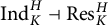 $\operatorname {Ind}_K^H\dashv \operatorname {Res}_K^H$
, is oplax monoidal and the other functor, obtained from the adjunction
 $\operatorname {Res}_K^H\dashv \operatorname {CoInd}_K^H$
via the isomorphism
 $\operatorname {Ind}_K^H\cong \operatorname {CoInd}_K^H$
, is lax monoidal. The two functors only differ in how they extend the coaction of a YD module from K to H. The stronger condition that
 $K\subset H$
is a central Frobenius extension ensures precisely that these two ways to extend the coaction are equal. Hence,
 $\operatorname {Ind}_K^H$
has both a braided lax and oplax monoidal structure and we showed in [Reference Flake, Laugwitz and Posur21] that these satisfy the compatibilities of a Frobenius monoidal functor (see Equations (2.9) and (2.10)).
Example 4.12 Continuing Example 3.4, we see that the Frobenius morphism
 $\operatorname {tr}\colon H=\mathbb {k}\mathsf {G}\to K=\mathbb {k}\mathsf {K}$
is evidently a morphism of left and right H-comodules. Hence,
 $K\subset H$
is a central Frobenius extension and the induced functor on Drinfeld centers is hence braided Frobenius monoidal, recovering the result from [Reference Flake, Harman and Laugwitz19, Proposition B.1].
More generally, we can prove that Frobenius extensions of cocommutative Hopf algebras or quasitriangular Hopf algebras, where the inclusion preserves the R-matrix, are central Frobenius extensions. Recall that
 $1\otimes 1$
is an R-matrix for a cocommutative Hopf algebra.
Corollary 4.13 Assume that
 $K\subset H$
is a Frobenius extension of finite-dimensional Hopf algebras such that H is quasitriangular with an R-matrix
 $R\in K\otimes K$
. Then
 $K\subset H$
is a central Frobenius extension.
Proof By assumption,
 $K\subset H$
is a Frobenius extension. By Corollary 3.24,
 $K\subset H$
is of right integral type and hence, by Theorem 3.18, there exists a Frobenius morphism
 $\operatorname {tr}\colon H\to K$
that is a morphism of right H-comodules. The assumption that
 $R\in K\otimes K$
means that K is also quasitriangular with the same R-matrix and that
 $G=\operatorname {Res}_K^H$
is a braided strong monoidal functor. Now, by [Reference Flake, Laugwitz and Posur21, Corollary 4.17], the left projection formula morphisms from Definition 3.6 are also mutually inverse. This implies, by Theorem 4.9, that
 $\operatorname {tr}$
is a morphism of left H-comodules and hence of H-H-bicomodules. Thus,
 $K\subset H$
is a central Frobenius extension.
We conclude this section with a detailed example of a Frobenius extension of infinite-dimensional Hopf algebras where
 $\operatorname {tr}$
is only a morphism of right H-comodules but not of left H-comodules so that
 $\operatorname {Ind}_K^H$
is Frobenius monoidal but Theorem 4.9 does not apply. A finite-dimensional example was given in [Reference Flake, Laugwitz and Posur21, Example 5.25].
Example 4.14 Let
 $\epsilon $
be a primitive
 $\ell $
-th root of unity, with
 $\ell>1$
, and consider the Hopf algebra
 $$ \begin{align*}B=\mathbb {k} \langle g,x\rangle/(gx-\epsilon xg),\end{align*} $$
which can be seen as an infinite-dimensional analog of the Taft algebra (which, additionally, quotients out the relations
 $x^\ell =0$
and
 $g^\ell =1$
). The coproduct, counit, and antipode are defined by the following formulas on generators:
 $$ \begin{align*} \Delta(g)=g\otimes g, \quad \Delta(x)=x\otimes 1+g\otimes x, \quad \varepsilon(g)=1, \quad \varepsilon(x)=0, \\ S(g)=g^{-1}, \quad S(x)=-g^{-1}x. \end{align*} $$
Inductively, the coproduct is given by
 $$ \begin{align} \Delta(g^ix^j)=\sum_{a=0}^j \binom{j}{a}_\epsilon \epsilon^{i(a-j)}g^{i+j-a}x^a\otimes g^ix^{j-a}, \end{align} $$
where the
 $\epsilon $
-binomial coefficients are
 $$ \begin{align*}\binom{j}{a}_\epsilon=\frac{[j]_\epsilon!}{[a]_\epsilon![j-a]_\epsilon!},\end{align*} $$
for
 $[n]_\epsilon =1+\epsilon +\cdots +\epsilon ^{n-1}$
and
 $[n]_\epsilon !=[n]_\epsilon [n-1]_\epsilon \dots [1]_\epsilon $
. One checks that the subalgebra K generated by
 $g^{\pm \ell }$
and
 $x^\ell $
is central. Thus,
 $K \subset B$
is a Frobenius extension by Corollary 3.30.
A basis for
 $\overline {B}$
is given by
 $\left \lbrace \overline {g^ix^j}\mid 0\leq i,j\leq \ell -1\right \rbrace $
and one checks that a right integral is
 $$ \begin{align*}\lambda\colon \overline{B}\to \mathbb {k}, \quad \overline{g^ix^j}\mapsto \delta_{i,0}\delta_{j,\ell-1},\end{align*} $$
where
 $\delta _{i,j}$
denotes the Kronecker delta. Equation (3.21) yields the Frobenius morphism
 $$ \begin{align*}\operatorname{tr}\colon B\to K, \quad g^ix^j\mapsto \delta_{i,0}\delta_{j,\ell-1},\end{align*} $$
for all
 $0\leq i,j\leq \ell -1$
. We compute, using the formula for the coproduct (4.4), that
 $$ \begin{align*} (g^ix^j)_{(1)}\otimes \operatorname{tr}((g^ix^j)_{(2)}) =g^{\ell-1}\otimes 1 \neq 1\otimes 1=\operatorname{tr}(g^ix^j)_{(1)}\otimes \operatorname{tr}(g^ix^j)_{(2)}. \end{align*} $$
Hence,
 $\operatorname {tr}$
is not a morphism of left H-comodules. As
 $\operatorname {tr}$
is a morphism of right H-comodules, and hence unique up to a scalar by Proposition 4.1(3), there cannot be a Frobenius morphism that is a morphism of H-H-bicomodules. Hence,
 $K\subset B$
is not a central Frobenius extension.
4.3 Unimodularity and semisimplicity conditions for central Frobenius extensions
We now prove the second main theorem of the article that a Frobenius extension
 $K\subset H$
of finite-dimensional Hopf algebras is a central Frobenius extension if
 $K^*$
and
 $H^*$
are unimodular (Theorem 4.21). As a special case, when H is semisimple and co-semisimple, any Hopf subalgebra
 $K\subset H$
gives a central Frobenius extension (Corollary 4.24).
We first characterize central Frobenius extensions of Hopf algebras of right integral type.
Proposition 4.15 Let
 $K\subset H$
be a finite extension of Hopf algebras of right integral type such that H is faithfully flat over K. Then the following are equivalent:
-
(a)
$K\subset H$
is a central Frobenius extension, -
(b)
$\chi =\varepsilon _K$
, for the relative modular function
$\chi $
, and (4.5)for all
$$ \begin{align} \lambda(\overline{h_{(1)}}) h_{(2)}=h_{(1)} \lambda(\overline{h_{(2)}}), \end{align} $$
$h\in H$
, where
$\lambda $
is a nonzero right integral of
$\overline {H}^*$
.


Proof Assume
 $K\subset H$
is a central Frobenius extension. Then by Theorem 3.18,
 $\chi =\varepsilon _K$
and a Frobenius morphism is given by
 $$ \begin{align*}\operatorname{tr}(h)=\lambda(\overline{h_{(1)}}) h_{(2)} .\end{align*} $$
It is clearly a morphism of right H-comodules and, hence, unique (up to a nonzero scalar) with this property. As
 $K\subset H$
is a central Frobenius extension, this Frobenius morphism
 $\operatorname {tr}$
is also a morphism of left H-comodules, and we have
 $$ \begin{align*} h_{(1)}\otimes \lambda(\overline{h_{(2)}}) h_{(3)} =h_{(1)}\otimes \operatorname{tr}(h_{(2)}) &=\operatorname{tr}(h)_{(1)}\otimes \operatorname{tr}(h)_{(2)}\\ &=\operatorname{tr}(h_{(1)})\otimes h_{(2)} =\lambda(\overline{h_{(1)}}) h_{(2)}\otimes h_{(3)}, \end{align*} $$
where the third equality uses that
 $\operatorname {tr}$
is a morphism of right H-comodules. Applying
 ${\operatorname {id}}_H\otimes \varepsilon _H$
to this equality, we obtain Equation (4.5) from the counit axioms.
Conversely, assume
 $\chi =\varepsilon _K$
and Equation (4.5). Then
 $K\subset H$
is a Frobenius extension by Theorem 3.18 with Frobenius morphism
 $\operatorname {tr}$
as above and Equation (4.5) implies that
 $$ \begin{align*}h_{(1)}\otimes \operatorname{tr}(h_{(2)})=\operatorname{tr}(h_{(1)})\otimes h_{(2)}.\end{align*} $$
Hence,
 $K\subset H$
is a central Frobenius extension.
Corollary 4.16 Assume
 $K\subset H$
is a finite Frobenius extension of Hopf algebras and H is cocommutative. Then
 $K\subset H$
is a central Frobenius extension.
Proof As the coradical
 $H_0$
is cocommutative,
 $K\subset H$
is of right integral type and H is faithfully flat over K by Corollary 3.20. The result now follows from Proposition 4.15.
Example 4.17 If
 $H=\mathbb {k} \mathsf {G}$
is a group acting on a Lie algebra
 $\mathfrak {g}$
by Lie algebra automorphisms and
 $\mathsf {K}$
is a finite-index subgroup, we can form the semidirect product
 $\mathbb {k} \mathsf {K} \ltimes U(\mathfrak {g}$
) (cf. [Reference Montgomery39 Section 5.6]). If
 $\operatorname {char} \mathbb {k}=0$
, any pointed cocommutative Hopf algebra is of this form. Now,
 $$ \begin{align*}\mathbb {k} \mathsf{K}\ltimes U(\mathfrak{g})=K\subset H=\mathbb {k} \mathsf{G}\ltimes U(\mathfrak{g})\end{align*} $$
is a finite extension of right integral type by Corollary 3.20 since H is cocommutative. Here,
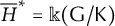 $\overline {H}^*=\mathbb {k} (\mathsf {G}/\mathsf {K})$
is the algebra of functions on the quotient
 $\mathsf {G}$
-set
 $\mathsf {G}/\mathsf {K}$
. A right integral is given by the indicator function
 $\delta _{\mathsf {K}}$
of the coset
 $\mathsf {K}$
. For
 $k\in \mathsf {K},g\in \mathsf {G}$
, and
 $u\in \mathfrak {g}$
,
 $$ \begin{align*}\delta_{\mathsf{K}}(\overline{kh})=\delta_{\mathsf{K}}(\overline{h})=\varepsilon_K(k)\delta_{\mathsf{K}}(\overline{h}), \quad \delta_{\mathsf{K}}(\overline{ku})=0=\varepsilon_K(u)\delta_{\mathsf{K}}(\overline{u}).\end{align*} $$
This shows that
 $\chi =\varepsilon _K$
and hence
 $K\subset H$
is a Frobenius extension. As H is cocommutative,
 $K\subset H$
is a central Frobenius extension by Corollary 4.16.
Next, we derive the following necessary condition for central Frobenius extensions.
Proposition 4.18 If
 $K\subset H$
is a central Frobenius extension of right integral type, then
 $\overline {H^*}$
is unimodular.
Proof In general, the dual
 $A^*$
of a finite-dimensional coaugmented coalgebra A is unimodular if and only if
 $\lambda (a_{(1)})\otimes a_{(2)}=a_{(1)}\otimes \lambda (a_{(2)})$
for a nonzero integral
 $\lambda $
of
 $A^*$
. Applying the map
 $h\mapsto \overline {h}$
to Equation (4.5) thus implies unimodularity of
 $\overline {H}^*$
.
As the following example shows, the converse of Proposition 4.18 is false in the sense that there are Frobenius extensions
 $K\subset H$
such that
 $\overline {H}^*$
is unimodular that are not central.
Example 4.19 Let
 $u_\epsilon (\mathfrak {sl}_2)$
be the small quantum group of
 $\mathfrak {sl}_2$
associated with a root of unity
 $\epsilon $
of order
 $\ell \geq 2$
. Consider the Frobenius extension
 $\mathbb {k} \mathsf {C}_\ell \subset u_\epsilon (\mathfrak {sl}_2)$
from [Reference Flake, Laugwitz and Posur21, Examples 5.16 and 5.25]. The quotient map
 $u_\epsilon (\mathfrak {sl}_2)\to \overline {u_\epsilon (\mathfrak {sl}_2)}$
identifies
 $f^je^ik^m$
and
 $f^je^i$
and,
 $$ \begin{align*}\overline{H}\cong \mathbb {k}\left\lbrace f^je^i\mid 0\leq i,j\leq \ell-1\right\rbrace,\end{align*} $$
as a
 $\mathbb {k}$
-vector space. Using the coproduct formulas from [Reference Kassel27, Proposition VII.1.3], we compute the coproduct
 $\underline {\Delta }$
of
 $\overline {H}$
to be
 $$ \begin{align*}\underline{\Delta}(f^je^i)=\sum_{r=0}^i\sum_{s=0}^j\epsilon^{r(i-r)+s(j-s)-2(i-r)(j-s)}\binom{i}{r}_\epsilon\binom{j}{s}_\epsilon f^se^{i-r}\otimes f^{j-s}e^r.\end{align*} $$
This coalgebra is not a bialgebra as
 $\mathbb {k} \mathsf {C}_\ell $
is not a normal Hopf subalgebra. With the right integral
 $\lambda (f^je^i)=\delta _{i,\ell -1}\delta _{j,\ell -1}$
for
 $\overline {u_\epsilon (\mathfrak {sl}_2)}^*$
, we compute that
 $$ \begin{align*}(\lambda\otimes {\operatorname{id}})\underline{\Delta}(f^je^i)=\delta_{i,\ell-1}\delta_{j,\ell-1}\epsilon^{0}\binom{\ell-1}{0}_\epsilon\binom{\ell-1}{\ell-1}_\epsilon f^0e^0=({\operatorname{id}}\otimes \lambda)\underline{\Delta}(f^je^i).\end{align*} $$
Thus,
 $\overline {u_\epsilon (\mathfrak {sl}_2)}^*$
is unimodular. However, it was shown in [Reference Flake, Laugwitz and Posur21, Example 5.16] that the associated Frobenius morphism
 $\operatorname {tr}$
is not a morphism of
 $u_\epsilon (\mathfrak {sl}_2)$
-bicomodules. Thus,
 $\mathbb {k} \mathsf {C}_\ell \subset u_\epsilon (\mathfrak {sl}_2)$
is not a central Frobenius extension.
Example 4.20 Continuing Example 4.14, we note that
 $\underline {\Delta }(\overline {g^ix^j})$
is computed using the same formula (4.4), for
 $0\leq i,j\leq \ell -1$
, replacing
 $g^ax^b$
by
 $\overline {g^ax^b}$
for all
 $0\leq a,b\leq \ell -1$
. Thus, we check that
 $\overline {B}^*$
is not unimodular since
 $$ \begin{align*}(\lambda\otimes {\operatorname{id}})\Delta(\overline{g^ix^j})=\overline{1}\otimes \overline{1} \neq \overline{g^{\ell-1}}\otimes \overline{1}=({\operatorname{id}}\otimes \lambda)\Delta(\overline{g^ix^j}).\end{align*} $$
This provides another way to see that
 $K\subset B$
is not a central Frobenius extension.
Theorem 4.21 Let
 $K\subset H$
be a Frobenius extension of finite-dimensional Hopf algebras. If
 $K^*$
and
 $H^*$
are unimodular, then
 $K\subset H$
is a central Frobenius extension.
In particular,
 $\mathcal {Z}(\operatorname {Ind}_K^H)\colon {\vphantom {\mathbf {YD}}}^{K}_{K}{\mathbf {YD}}\to {\vphantom {\mathbf {YD}}}^{H}_{H}{\mathbf {YD}}$
is a braided Frobenius monoidal functor.
Proof By Proposition 3.26, a right integral for
 $\overline {H}^*$
is given by the formula
 $$ \begin{align*}\lambda_{\overline{H}}(\overline{h})=\lambda_H(h\Lambda_K),\end{align*} $$
where
 $\lambda _H$
is a right integral for
 $H^*$
and
 $\Lambda _K$
is a left integral for K. Since
 $K^*$
is unimodular, the distinguished grouplike element
 $g_K=1$
and we find that
 $$ \begin{align} (\Lambda_K)_{(2)}\otimes S^{-1}((\Lambda_K)_{(1)})=(\Lambda_K)_{(1)}\otimes S((\Lambda_K)_{(2)}), \end{align} $$
for all
 $k\in K$
by [Reference Radford44, Theorem 10.5.4]. Denoting
 $\lambda =\lambda _H$
, we compute
 $$ \begin{align*} \lambda_{\overline{H}}(\overline{h_{(1)}}) h_{(2)}&=\lambda(h_{(1)}\Lambda_K) h_{(2)}\\ &=\lambda((h(\Lambda_K)_{(1)})_{(1)}) (h(\Lambda_K)_{(1)})_{(2)}S((\Lambda_K)_{(2)})\\ &=\lambda((h(\Lambda_K)_{(2)})_{(1)}) (h(\Lambda_K)_{(2)})_{(2)}S^{-1}((\Lambda_K)_{(1)})\\ &=(h(\Lambda_K)_{(2)})_{(1)}S^{-1}((\Lambda_K)_{(1)}) \lambda((h(\Lambda_K)_{(2)})_{(2)})\\ &=h_{(1)}(\Lambda_K)_{(2)}S^{-1}((\Lambda_K)_{(1)}) \lambda(h_{(2)}(\Lambda_K)_{(3)})\\ &=h_{(1)} \lambda(h_{(2)}\Lambda_K)=h_{(1)} \lambda_{\overline{H}}(\overline{h_{(2)}}), \end{align*} $$
for any
 $h\in H$
. Here, the second equality uses that for any
 $h,g\in H$
,
 $$ \begin{align*}h_{(1)}g\otimes h_{(2)}=(hg_{(1)})_{(1)}\otimes (hg_{(1)})_{(2)}S(g_{(2)}),\end{align*} $$
followed by applying Equation (4.6) in the third equality. The fourth equality uses that
 $\lambda (h_{(1)}) h_{(2)}=h_{(1)} \lambda (h_{(2)}),$
for all
 $h\in H$
, by unimodularity of
 $H^*$
, followed by the bialgebra axiom in the fifth, and
 $h_{(2)}S^{-1}(h_{(1)})=\varepsilon _H(h)1_H$
and the counit axiom in the sixth equality. Thus, by Proposition 4.15,
 $K\subset H$
is a central Frobenius extension. The last conclusion follows from Theorem 4.9.
Corollary 4.22 If
 $K\subset H$
is a Frobenius extension of finite-dimensional Hopf algebras and H is co-semisimple, then
 $K\subset H$
is a central Frobenius extension.
Proof If H is co-semisimple, then
 $H^*$
is semisimple and hence unimodular by [Reference Larson and Sweedler31, Propositions 3 and 4]. Moreover,
 $K^*$
is a quotient of the semisimple Hopf algebra
 $H^*$
and hence also semisimple (cf. [Reference Radford44, Exercise 10.3.1]). Thus,
 $K^*$
is also unimodular and the result follows from Theorem 4.21.
The following example shows that even if
 $H^*$
and K are unimodular (K even semisimple),
 $K\subset H$
might not be a (central) Frobenius extension of Hopf algebras.
Example 4.23 Let
 $\mathfrak {g}$
be a restricted Lie algebra over a field
 $\mathbb {k}$
of characteristic p with p-map
 $\mathfrak {g}\to \mathfrak {g}, x\mapsto x^{[p]}$
. Denote its (finite-dimensional) restricted universal enveloping algebra by
 $u(\mathfrak {g})$
(see, e.g., [Reference Montgomery39, Section 2.3]). Now, by cocommutativity,
 $u(\mathfrak {g})^*$
is unimodular.
Consider a restricted Lie subalgebra
 $\mathfrak {k}\subset \mathfrak {g}$
which is abelian and such that
 $\mathfrak {k}^{[p]}=\mathfrak {k}$
. Then
 $u(\mathfrak {k})\subset u(\mathfrak {g})$
is a commutative Hopf subalgebra. By [Reference Hochschild22],
 $u(\mathfrak {k})$
is semisimple and hence unimodular. However,
 $u(\mathfrak {k})\subset u(\mathfrak {g})$
might not be a Frobenius extension of Hopf algebras (unless, say,
 $\mathfrak {k}\subset \mathfrak {g}$
is normal, that is, closed under the adjoint action). A counterexample is given by the two-dimensional restricted Lie algebra
 $$ \begin{align*}\mathfrak{g}=\mathbb {k} x\oplus \mathbb {k} t, \quad [t,x]=x, \quad t^{[p]}=t, \quad x^{[p]}=0 ,\quad\mathfrak{k}=\mathbb {k} t\subset\mathfrak{g}.\end{align*} $$
A left (but not right) integral for
 $u(\mathfrak {g})$
is
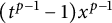 $(t^{p-1}-1)x^{p-1}$
and a left integral for
 $u(\mathfrak {k})$
is
 $t^{p-1}-1$
. Thus,
 $$ \begin{align*}\alpha_{u(\mathfrak{k})}(t)=0\neq 1=\alpha_{u(\mathfrak{g})}(t),\end{align*} $$
see [Reference Farnsteiner16], and we do not have a Frobenius extension by the converse implication in Proposition 3.26(ii). However, considering instead the Hopf subalgebra
 $u(\mathfrak {h})$
, with
 $\mathfrak {h}=\mathbb {k} x$
,
 $$ \begin{align*}\alpha_{u(\mathfrak{h})}(x)=0=\alpha_{u(\mathfrak{g})}(x),\end{align*} $$
which yields a Frobenius extension of Hopf algebras, and by Theorem 4.21, a central Frobenius extension. Note that
 $u(\mathfrak {h})$
is not semisimple.
Corollary 4.24 Let H be a finite-dimensional Hopf algebra and
 $K\subset H$
a Hopf subalgebra.
-
(i) If H is semisimple and co-semisimple, then
$K\subset H$
is a central Frobenius extension. -
(ii) If
$\mathbb {k}$
is a field of characteristic zero and H is semisimple, then
$K\subset H$
is a central Frobenius extension.


In either case,
 $\mathcal {Z}(\operatorname {Ind}_K^H)\colon {\vphantom {\mathbf {YD}}}^{K}_{K}{\mathbf {YD}}\to {\vphantom {\mathbf {YD}}}^{H}_{H}{\mathbf {YD}}$
is a braided Frobenius monoidal functor.
Proof If
 $\operatorname {char} \mathbb {k} =0$
, by [Reference Larson and Radford30, Theorem 3.3], H is semisimple if and only if it is co-semisimple. Thus, Part (ii) follows from Part (i).
To prove Part (i), assume that H is semisimple and co-semisimple. Then H and
 $H^*$
are unimodular by [Reference Larson and Sweedler31, Propositions 3 and 4]. Now assume that K is a Hopf subalgebra of H. Since H is free over K by [Reference Nichols and Bettina Zoeller42], any left integral
 $\Lambda _H$
of H is equal to
 $\Lambda _K\Lambda $
, for a left integral
 $\Lambda _K$
of K and an element
 $\Lambda \in H$
. Thus, if H is semisimple, then K is also semisimple (cf. [Reference Montgomery39, Section 3.2]) and hence unimodular.
Thus, both H and K are unimodular and we have
 $\alpha _H=\varepsilon _H$
and
 $\alpha _K=\varepsilon _K$
. This implies that
 $K\subset H$
is a Frobenius extension by Proposition 3.26. As H is co-semisimple by assumption, the result follows from Corollary 4.22.
5 Classes of examples
We now present classes of extensions of Hopf algebras involving Drinfeld doubles, quantum groups at roots of unity, and the Kac–Paljutkin algebra. Throughout this section, we will always use Frobenius morphisms of the form in (3.21) and the lax and oplax monoidal structures of Equations (3.9) and (3.10).
5.1 Drinfeld doubles of unimodular Hopf algebras
Next, we apply our results to the Drinfeld double
 $\operatorname {Drin}(H)$
of a unimodular Hopf algebra H. We use the presentation of
 $\operatorname {Drin}(H)$
of [Reference Radford44, Section 13.1].
Corollary 5.1 Let H be a finite-dimensional unimodular Hopf algebra. Then the extension
 $H\subseteq \operatorname {Drin}(H)$
is a central Frobenius extension.
Proof Factorizable Hopf algebras are unimodular [Reference Radford44, Proposition 12.4.2]. Hence, the Drinfeld double of a finite-dimensional Hopf algebra H is unimodular as it is factorizable [Reference Radford44, Theorem 3.2.1]. Hence,
 $\alpha _{\operatorname {Drin}(H)}=\varepsilon $
. As H is also unimodular by assumption, we have that
 $\alpha _H=\varepsilon $
. Thus,
 $\chi =(\alpha _{\operatorname {Drin}(H)})|_H *\alpha _H = \varepsilon $
so that
 $H\subset \operatorname {Drin}(H)$
is a Frobenius extension.
As shown in [Reference Fischman, Montgomery and Schneider18, 1.9. Example], a right integral
 $\lambda $
for
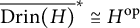 $\overline {\operatorname {Drin}(H)}^*\cong H^{\mathrm {op}}$
corresponds to a left integral
 $\Lambda _H$
of H and we may write
 $$ \begin{align*}\lambda_{\overline{\operatorname{Drin}(H)}}(f\otimes h)=\varepsilon(h)f(\Lambda_H).\end{align*} $$
We now compute, for
 $f\in H^*$
and
 $h\in H$
,
 $$ \begin{align*} (\lambda_{\overline{\operatorname{Drin}(H)}}\otimes {\operatorname{id}}_{\operatorname{Drin}(H)})\Delta_{\operatorname{Drin}(H)}(f\otimes h)&= \lambda_{\overline{\operatorname{Drin}(H)}}(f_{(2)}\otimes h_{(1)})\otimes (f_{(1)}\otimes h_{(2)})\\ &=f_{(2)}(\Lambda_H) f_{(1)}\otimes h\\ &=f_{(1)}(\Lambda_H) f_{(2)}\otimes h\\ &=({\operatorname{id}}_{\operatorname{Drin}(H)}\otimes \lambda_{\overline{\operatorname{Drin}(H)}})\Delta_{\operatorname{Drin}(H)}(f\otimes h), \end{align*} $$
where the second to last equality uses that
 $H\cong H^{**}$
is unimodular. Thus,
 $H\subset \operatorname {Drin}(H)$
is a central Frobenius extension by Proposition 4.15.
In particular, the induction functor
 $$ \begin{align*}\operatorname{Ind}_H^{\operatorname{Drin}(H)}\colon H\text{-}\mathbf{Mod}\to \operatorname{Drin}(H)\text{-}\mathbf{Mod}\simeq {\vphantom{\mathbf{YD}}}^{H}_{H}{\mathbf{YD}},\end{align*} $$
which is left and right adjoint to the forgetful functor
 $F\colon {\vphantom {\mathbf {YD}}}^{H}_{H}{\mathbf {YD}}\to H\text {-}\mathbf {Mod}$
, is a Frobenius monoidal functor which extends to Drinfeld centers as a braided Frobenius monoidal functor.
Remark 5.2 Note that
 $\operatorname {Drin}(H)^*$
will only be unimodular if both H and
 $H^*$
are unimodular [Reference Radford44, Proposition 13.4.1]. Hence, Corollary 5.1 shows that the converse of Theorem 4.21 does not hold. For example, the Hopf algebra
 $u(\mathfrak {g})$
from Example 4.23 is not unimodular but its dual is. Thus,
 $u(\mathfrak {g})^*\subset \operatorname {Drin}(u(\mathfrak {g})^*)\cong \operatorname {Drin}(u(\mathfrak {g}))^{\mathrm {op}}$
is a central Frobenius extension even though
 $\operatorname {Drin}(u(\mathfrak {g}))^{\mathrm {op}}$
is not unimodular.
5.2 Quantum groups at roots of unity
In this section, we apply the results of Section 4.1 to obtain Frobenius monoidal functors to categories of representations of quantum groups at roots of unity.
We let
 $U_\epsilon (\mathfrak {g})$
denote the De Concini–Kac–Procesi form of the quantized enveloping algebra, or, quantum group, associated with a fixed Cartan datum of a semisimple Lie algebra
 $\mathfrak {g}$
and specialized to a root of unity
 $\epsilon \in \mathbb{C}$
of odd order
 $\ell $
Footnote
2
(see [Reference Chari and Pressley6, Section 9.1] or [Reference De Concini and Kac11]). We let
 $E_i, F_i, K_i$
denote the usual generators of these quantum groups.
We will also consider the small quantum group
 $u_\epsilon (\mathfrak {g})$
, defined as the quotient of
 $U_\epsilon (\mathfrak {g})$
by the ideal generated by
 $E_\alpha ^\ell , F_\alpha ^\ell , K_i^\ell $
, for positive roots
 $\alpha $
of
 $\mathfrak {g}$
. The finite-dimensional Hopf algebra
 $u_\epsilon (\mathfrak {g})$
is factorizable [Reference Lyubashenko33, Corollary A.3.3] and hence unimodular (see, e.g., [Reference Radford44, Proposition 12.4.2]). We refer to [Reference De Renzi, Geer and Patureau-Mirand12, Section 2.1] for explicit formulas of the braiding, ribbon structure, and integrals for
 $u_\epsilon (\mathfrak {g})$
and its dual.
It is well-known that
 $U_\epsilon (\mathfrak {g})$
contains a large central Hopf subalgebra
 $Z_0$
, which can be identified with the coordinate Hopf algebra
 $\mathcal {O}_{\mathsf {H}}$
of an affine algebraic group
 $\mathsf {H}$
, giving an extension of Hopf algebras
 $\iota \colon \mathcal {O}_{\mathsf {H}}\hookrightarrow U_\epsilon (\mathfrak {g})$
. Being generated by grouplike and skew-primitive elements,
 $U_\epsilon (\mathfrak {g})$
is a pointed Hopf algebra and
 $U_\epsilon (\mathfrak {g})$
is free and finite over
 $\mathcal {O}_{\mathsf {H}}$
. Thus, by Corollary 3.21, the extension
 $\mathcal {O}_{\mathsf {H}}\subset U_\epsilon (\mathfrak {g})$
is of right integral type and since
 $\mathcal {O}_{\mathsf {H}}\subset Z(H)$
,
 $\mathcal {O}_{\mathsf {H}}$
is a normal Hopf subalgebra. Thus, we obtain the following result from Corollary 3.30.
Corollary 5.3 The induction functor
 $$ \begin{align*}\operatorname{Ind}_{\iota}\colon \mathcal{O}_{\mathsf{H}}\text{-}\mathbf{Mod}\to U_\epsilon(\mathfrak{g})\text{-}\mathbf{Mod}\end{align*} $$
is a Frobenius monoidal functor.
Because
 $\mathcal {O}_{\mathsf {H}}$
is a central subalgebra, we have that the ideal
 $U_\epsilon (\mathfrak {g})\mathcal {O}_{\mathsf {H}}^+$
is two-sided. This makes
 $\overline {U_\epsilon (\mathfrak {g})}$
a Hopf algebra which can be identified with
 $u_\epsilon (\mathfrak {g})$
. Thus, as a right integral, we can use the integral
 $\lambda $
of
 $u_\epsilon (\mathfrak {g})^*$
from [Reference De Renzi, Geer and Patureau-Mirand12, Section 2.1] for which, by Corollary 4.6(ii),
 $$ \begin{align*}\operatorname{tr}(h)=\lambda(\pi(h_{(1)}))\otimes h_{(2)}\end{align*} $$
is a Frobenius morphism, where
 $\pi \colon U_\epsilon (\mathfrak {g})\to u_\epsilon (\mathfrak {g})$
is the quotient morphism.
Remark 5.4 The functor
 $\operatorname {Ind}_{\mathcal {O}_{\mathsf {H}}}^{U_\epsilon (\mathfrak {g})}$
was shown to induce an oplax monoidal functor
 $\mathcal {Z}(\operatorname {Ind}_\iota )$
on the Drinfeld centers in [Reference Flake, Laugwitz and Posur20, Corollary 8.8(ii)]. We note that
 $\mathcal {O}_{\mathsf {H}}\subset U_\epsilon (\mathfrak {g})$
is not a central Frobenius extension of Hopf algebras. Indeed,
 $\operatorname {tr}$
is not a morphism of H-H-bicomodules by Proposition 4.15, since
 $$ \begin{align*}\operatorname{tr}(h)=\lambda(\pi(h_{(1)}))\otimes h_{(2)}\neq h_{(1)}\otimes \lambda(\pi(h_{(2)})).\end{align*} $$
To verify this, consider the unique monomial
 $$ \begin{align*}X=F_1^{\ell-1}\ldots F_r^{\ell-1}K_{2\rho} E_1^{\ell-1}\ldots E_r^{\ell-1},\end{align*} $$
on which the integral is nonzero, the coproduct takes the form
 $$ \begin{align*} \Delta(X) \quad\in\quad &X\otimes K_{2\rho} K_{1}^{\ell-1}\ldots K_r^{\ell-1}+K_{2\rho}K_{1}^{1-\ell}\ldots K_r^{1-\ell}\otimes X \\ &+\ker(\lambda\pi)\otimes U_\epsilon(\mathfrak{g})+U_\epsilon(\mathfrak{g})\otimes \ker(\lambda\pi). \end{align*} $$
Thus, applying
 $\lambda (\pi (h_{(1)}))\otimes h_{(2)}$
and
 $h_{(1)}\otimes \lambda (\pi (h_{(2)}))$
yields
 $$ \begin{align*}K_{2\rho} K_{1}^{\ell-1}\ldots K_r^{\ell-1}\quad \text{and}\quad K_{2\rho}K_{1}^{1-\ell}\ldots K_r^{1-\ell}, \quad\text{respectively}.\end{align*} $$
Multiplying with
 $K_{2\rho }^{-1}$
yields distinct elements in the group algebra generated by the
 $K_i$
, unless
 $\ell =2$
, which contradicts our assumption that
 $\ell $
is odd. Thus, we do not obtain a Frobenius monoidal functor
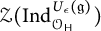 $\mathcal {Z}(\operatorname {Ind}_{\mathcal {O}_{\mathsf {H}}}^{U_\epsilon (\mathfrak {g})})$
from Theorem 4.9.
Example 5.5 By the above, we see that
 $\operatorname {Ind}_{\mathcal {O}_{\mathsf {H}}}^{U_\epsilon (\mathfrak {g})}(\mathbb {k})\cong \overline {U_\epsilon (\mathfrak {g})}\cong u_\epsilon (\mathfrak {g})$
is a Frobenius algebra in
 $U_\epsilon (\mathfrak {g})\text {-}\mathbf {mod}$
. The
 $U_\epsilon (\mathfrak {g})$
-action is the regular one, restricted along
 $\pi $
. The coproduct is that of the small quantum group
 $u_\epsilon (\mathfrak {g})$
and the product can be obtained by dualizing the coproduct along the trace map
 $\operatorname {tr}$
from Remark 5.4.
5.3 Hopf subalgebras of small quantum groups
Recall that the small quantum group, for a root of unity of odd order
 $\ell>2$
, has a triangular decomposition
 $$ \begin{align*}u_\epsilon(\mathfrak{g})=u_\epsilon(\mathfrak{n}_-)\otimes \mathbb{C}\mathsf{K}\otimes u_\epsilon(\mathfrak{n}_+),\end{align*} $$
as a
 $\mathbb{C}$
-vector space, where
 $\mathsf {K}$
is the group generated by the
 $K_i$
, which is isomorphic to
 $\mathbb{Z}_\ell ^r$
, and
 $u_\epsilon (\mathfrak {n}_-)$
and
 $u_\epsilon (\mathfrak {n}_+)$
are the subalgebras generated by the
 $F_i$
and the
 $E_i$
, respectively.
We will now consider triples
 $(\Sigma , I_+, I_-)$
defining a Hopf subalgebra of
 $u_\epsilon (\mathfrak {g})$
. Here,
 $\Sigma \subset \mathsf {K}$
is a subgroup and
 $I_\pm $
are subsets of
 $\{1,\ldots , r\}$
which are identified with subsets of the simple roots of
 $\mathfrak {g}$
. We require that
 $K_i\in \Sigma $
if
 $i\in I_+\cup I_-$
. It is easy to verify that the subalgebra generated by the
 $E_i$
, for
 $i\in I_+$
,
 $F_j$
, for
 $j\in I_-$
, and
 $g\in \Sigma $
generate a Hopf subalgebra of
 $u_\epsilon (\mathfrak {g})$
which we denote by
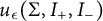 $u_\epsilon (\Sigma , I_+, I_-)$
. By [Reference Müller40, Theorem 6.3], see also [Reference Andruskiewitsch and García1, Corollary 1.13], all possible Hopf subalgebras of
 $u_\epsilon (\mathfrak {g})$
are obtained this way.
Example 5.6 Let
 $\mathfrak {h}\subset \mathfrak {g}$
be an inclusion of semisimple Lie algebras, defined by a sub-Cartan datum. Then one obtains a triple
 $(\Sigma ,I_+,I_-)$
as above with
 $I_+=I_-$
defined such that the simple roots of
 $\mathfrak g$
indexed by
 $I_+=I_-$
are the simple roots of
 $\mathfrak {h}$
and
 $\Sigma $
is the subgroup of
 $\mathsf {K}$
defining the Cartan part of
 $u_\epsilon (\mathfrak {h})$
. This displays
 $u_\epsilon (\mathfrak {h})$
as a Hopf subalgebra of
 $u_\epsilon (\mathfrak {g})$
.
We will now determine those Hopf subalgebras of
 $u_\epsilon (\mathfrak {g})$
that lead to Frobenius extensions.
Proposition 5.7 If I is a subset of the simple roots of
 $\mathfrak {g}$
and
 $\Sigma \subset \mathsf {K}$
is a subgroup containing
 $(K_i)_{i\in I}$
, then
 $u_\epsilon (\Sigma ,I,I)$
is unimodular. Conversely, if
 $\ell>3$
and
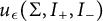 $u_\epsilon (\Sigma , I_+, I_-)$
is unimodular, then
 $I_+=I_-$
.
Corollary 5.8 Assume that
 $I_+,I_-$
are subsets of the simple roots of
 $\mathfrak {g}$
and
 $\ell>3$
. Then, the extension
 $u_\epsilon (\Sigma ,I_+,I_-)\subset u_\epsilon (\mathfrak {g})$
is a Frobenius extension if and only if
 $I_+=I_-$
.
Proof of Proposition 5.7
Consider any triple
 $(\Sigma ,I_+,I_-)$
as above. Denote
 $u'=u_\epsilon (\Sigma , I_+, I_-)$
and
 $u=u_\epsilon (\mathfrak {g})$
. For
 $I=I_+\cap I_-$
, we have a sequence of extensions of Hopf algebras
 $$ \begin{align*}u_\epsilon(\Sigma, I,I)\subset u_\epsilon(\Sigma, I_+,I)\subset u'\subset u.\end{align*} $$
We first claim that
 $u_\epsilon (\Sigma , I,I)$
is unimodular. Indeed, restricting
 $\Sigma $
to the subgroup generated by those
 $K_i$
with
 $i\in I$
we obtain a quantum group
 $u_\epsilon (\mathfrak {h})$
, where
 $\mathfrak {h}$
is obtained by restricting the Cartan datum to the subset I. As
 $\mathfrak {h}$
is again a semisimple Lie algebra, the Hopf algebra
 $u_\epsilon (\mathfrak {h})$
is unimodular. Further, arguing as in the proof of Corollary 4.24, a nonzero left integral
 $\Lambda $
for
 $u_\epsilon (\Sigma , I,I)$
is obtained as a product
 $\Lambda _2=\Lambda _1\Lambda '$
, where
 $\Lambda _1$
is a left integral for
 $u_\epsilon (\mathfrak {h})$
and
 $\Lambda '\in \mathbb{C} \Sigma $
(as otherwise
 $\Lambda _2=0$
). We now check that for
 $K_j$
, with
 $j\notin I$
,
 $$ \begin{align*}\Lambda_2K_j=\Lambda_1\Lambda'K_j=\Lambda_1K_j\Lambda'=K_j\Lambda_1\Lambda'=K_j\Lambda_2=\Lambda_2.\end{align*} $$
The second equality uses that
 $\Lambda '\in \mathbb{C} \Sigma $
, which is commutative. The third equality uses the form of
 $\Lambda _1$
, see [Reference Lyubashenko33], in which for any
 $E_i$
, the corresponding
 $F_i$
appears with the same power in
 $\Lambda _1$
, and that
 $E_iK_j=\epsilon ^{-i\cdot j}K_jE_i$
and
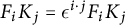 $F_iK_j=\epsilon ^{i\cdot j}F_iK_j$
. The last equality uses the assumption that
 $\Lambda _2$
is a left integral for
 $u_\epsilon (\Sigma , I,I)$
. This shows that
 $u_\epsilon (\Sigma , I,I)$
is unimodular.
Next, we claim that
 $u_\epsilon (\Sigma , I_+,I)$
is not unimodular unless
 $I_+=I$
. Assume
 $\Lambda _3=\Lambda _2\Lambda "$
is a nonzero left integral for
 $u_\epsilon (\Sigma , I_+,I)$
, with
 $\Lambda _2$
as in the previous paragraph. Given
 $j\in I_+\setminus I$
, we use the triangular decomposition of u to see that
 $\Lambda "\in \mathbb{C}\Sigma \prod _{k\in I_+\setminus I}E_k^{\ell -1}$
. Thus,
 $\Lambda _3E_j=0=\varepsilon (E_j)\Lambda _3$
for any
 $j\in I_+\setminus I$
. It also follows that
 $$ \begin{align*}\Lambda_3K_j=\epsilon^{\sum_{k\in I_+\setminus I}(1-\ell)j\cdot k}\Lambda_2K_j\Lambda"=\epsilon^{\sum_{k\in I_+\setminus I}j\cdot k}\Lambda_3,\end{align*} $$
using that
 $\Lambda _2K_j=\Lambda _2$
as
 $\Lambda _2$
is a left and right integral for
 $u_\epsilon (\Sigma , I,I)$
. Now, if
 $\epsilon ^{\sum _{k\in I_+\setminus I}j\cdot k}=1$
, for all
 $j\in I_+\setminus I$
, then the restriction of the Cartan matrix to the subset
 $I_+\setminus I$
has only zero row sums when viewed as a matrix with entries in
 $\mathbb{Z}_{\ell }$
. However, Lemma 5.9(i) below shows that this is impossible. Hence,
 $\Lambda _3$
is not a right integral and
 $u_\epsilon (\Sigma , I_+,I)$
is not unimodular.
Finally, again assuming
 $\ell>3$
, we claim that
 $u'=u_\epsilon (\Sigma , I_+,I_-)$
is unimodular if and only if
 $I_-=I_+=I$
. Let
 $\Lambda _4=\Lambda _3\Lambda "'$
be a nonzero left integral for
 $u'$
with
 $\Lambda _3$
a left integral for
 $u_\epsilon (\Sigma , I_+,I)$
as in the previous paragraph. Take
 $F_m$
with
 $m\in I_-\setminus I$
. A similar calculation as in the previous paragraph shows that
 $$ \begin{align*}\Lambda_4K_m=\epsilon^{-\sum_{n\in I_-\setminus I}m\cdot n}\Lambda_3K_m \Lambda"'=\epsilon^{\sum_{k\in I_+\setminus I}m\cdot k-\sum_{n\in I_-\setminus I}m\cdot n}\Lambda_4.\end{align*} $$
Similarly, we have, for
 $j\in I_+\setminus I$
, that
 $$ \begin{align*}\Lambda_4K_j=\epsilon^{\sum_{k\in I_+\setminus I}j\cdot k-\sum_{n\in I_-\setminus I}j\cdot n}\Lambda_4.\end{align*} $$
Note that
 $(I_+\setminus I)\cap (I_-\setminus I)$
is empty. Hence,
 $\Lambda _4$
is a right integral if and only if the square matrix
 $d=(d_{a,b})$
, with entries in
 $\mathbb{Z}_\ell $
and rows and columns indexed by
 $a,b\in (I_+\setminus I)\cup (I_-\setminus I)$
, defined by
 $$ \begin{align*}d_{a,b}=\begin{cases} a\cdot b, &\text{if } b \text{ in } (I_+\setminus I),\\ -a\cdot b, &\text{if } b \text{ in } (I_-\setminus I), \end{cases} \end{align*} $$
has only zero row sums. This is not possible as shown in Lemma 5.9(ii) below, since, by assumption,
 $\ell>3$
is odd.
Proof of Corollary 5.8
We know that u is unimodular as it is factorizable. Thus, by Corollary 3.27,
 $u'\subset u=u_\epsilon (\mathfrak {g})$
is a Frobenius extension if and only if
 $u'$
is unimodular. Thus, the claim follows as by Proposition 5.7,
 $u'=u_\epsilon (\Sigma ,I_+,I_-)$
is unimodular if and only if
 $I_+=I_-=I$
.
Lemma 5.9 Let C be a Cartan matrix of finite type and
 $\ell> 3$
an odd integer.
-
(i) Not all row sums of C are equal to zero modulo
$\ell $
. -
(ii) Now assume
$\ell>3$
and consider the modified Cartan matrix
$C_J$
in which the columns corresponding to a subset J of the simple roots are multiplied by
$-1$
. Then, not all row sums of
$C_J$
are equal to zero modulo
$\ell $
.


Proof First, observe that if the statements hold for all indecomposable Cartan matrices then they hold for decomposable Cartan matrices.
To prove Part (i), note that the statement is easily verified for Dynkin diagrams of rank
 $1$
or
 $2$
. Next, every Dynkin diagram for rank
 $r\geq 3$
has at least two endpoints with just a single other vertex connected to it. Using a suitable ordering of simple roots, this vertex corresponds to a row
 $(2,-1,0,\dots ,0)$
in the Cartan matrix, whose row sum is nonzero modulo any
 $\ell \neq 1$
.
To prove Part (ii), multiply each column of the roots from a subset J of the simple roots I by
 $-1$
. For rank
 $1$
, the statement is clear since
 $\ell \neq 2$
. For rank
 $2$
, we check all three cases separately. The Cartan matrices are given by
 $$ \begin{align*} \begin{pmatrix} 2\eta_1 & -\eta_2\\ -\eta_1 & 2\eta_2 \end{pmatrix}, \qquad \begin{pmatrix} 2\eta_1 & -\eta_2\\ -2\eta_1 & 2\eta_2 \end{pmatrix},\qquad \begin{pmatrix} 2\eta_1 & -\eta_2\\ -3\eta_1 & 2\eta_2 \end{pmatrix}, \qquad \eta_1,\eta_2\in \{\pm 1\}. \end{align*} $$
For the second two matrices, it is not possible to choose
 $\eta _1,\eta _2$
such that both row sums are zero modulo any
 $\ell \neq 0$
. For the first matrix, this is only possible when
 $\eta _1=-\eta _2$
and
 $\ell =3$
. However, we assume that
 $\ell>3$
so at least one row sum is nonzero modulo
 $\ell $
in all cases.
For rank
 $r\geq 2$
, we can again find an endpoint whose row in the Cartan matrix is
 $(2,-1,0,\dots ,0)$
. The corresponding row sum is now given by
 $2\eta _1-\eta _2$
, for some
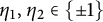 $\eta _1,\eta _2\in \{\pm 1\}$
. This row sum can only be zero if
 $\eta _1=-\eta _2$
and
 $\ell =3$
. As
 $\ell>3$
by assumption, this case is ruled out as well.
Example 5.10 Let
 $\mathfrak {g}$
be a semisimple Lie algebra.
-
(i) For a Lie subalgebra
$\mathfrak {h}\subset \mathfrak {g}$
obtained from a subset of the simple roots,
$u_\epsilon (\mathfrak {h}) \subset u_\epsilon (\mathfrak {g})$
is a Frobenius extension. -
(ii) The inclusion of a group algebra
$\mathbb{C} \Sigma \subset u_\epsilon (\mathfrak {g})$
is Frobenius, corresponding to the case when
$I_+=I_-$
are empty.




Example 5.11 Let
 $\epsilon $
be a primitive third root of unity and consider the Hopf subalgebra
 $u'$
of
 $u_\epsilon (\mathfrak {sl}_3)$
generated by
 $K_1,K_2, E_1, F_2$
only. Let
 $\Lambda _K$
be a nonzero left and right integral for the Cartan group algebra. Then
 $$ \begin{align*}\Lambda=\Lambda_KE_1^2F_2^2\end{align*} $$
is a left and right integral for
 $u'$
. Thus,
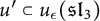 $u'\subset u_\epsilon (\mathfrak {sl}_3)$
is a Frobenius extension. This case is excluded in Proposition 5.7 by assuming that
 $\ell>3$
.
Corollary 5.12 Set
 $u=u_\epsilon (\mathfrak {g})$
and
 $u'=u_\epsilon (\Sigma , I,I)$
where I is a subset of the simple roots of
 $\mathfrak {g}$
and
 $\Sigma \subset \mathsf {K}$
is a subgroup containing
 $K_i$
, for all
 $i\in I$
. Then, the functor
 $\operatorname {Ind}_{u'}^u$
is Frobenius monoidal.
Proof Since both Hopf algebras are unimodular by Proposition 5.7, we have that the condition from Proposition 3.26 holds and the inclusion of Hopf algebras is a Frobenius extension and
 $\chi =\varepsilon _{u'}$
by Theorem 3.18. Hence, the statement follows from Theorem 4.2.
Remark 5.13 An inclusion
 $u_\epsilon (\mathfrak {h})\subset u_\epsilon (\mathfrak {g})$
does not preserve universal R-matrices of these quasitriangular Hopf algebras. Hence, Corollary 4.13 does not apply here. Indeed, we do not expect that
 $\operatorname {Ind}_{u'}^n$
extends to a Frobenius monoidal functor on Drinfeld centers.
Example 5.14 Consider a semisimple Lie algebra
 $\mathfrak {g}$
of rank r. For I the set of simple roots and
 $i\in I$
, consider the Hopf subalgebra
 $u_i:=u_\epsilon (\mathsf {K},I\setminus \{i\},I\setminus \{i\})$
of
 $u=u_\epsilon (\mathfrak {g})$
containing all simple roots besides the i-th. Using the PBW basis for u, we see that
 is a Frobenius algebra of dimension
 $\dim (u)/\dim (u_i)$
.Footnote
3
5.4 The Kac–Paljutkin algebra
In this section, we study an eight-dimensional Hopf algebra
 $H_8$
which gives a central Frobenius extension
 $K=\mathbb {k} \mathsf {K}\subset H_8$
, where
 $\mathsf {K}=\mathsf {C}_2\times \mathsf {C}_2$
is the Klein four-group and
 $\operatorname {char} \mathbb {k}=0$
.
Definition 5.15 (The Kac–Paljutkin algebra)
The Kac–Paljutkin algebra
 $H_8$
of [Reference Masuoka37] is defined as
 $$ \begin{align*}H_8=\mathbb {k} \langle x,y,z ~|~ x^2=y^2=1,~z^2=\frac{1}{2}(1+x+y-xy),~xy=yx,~zx=yz,~zy=xz \rangle,\end{align*} $$
and becomes a Hopf algebra with coproduct determined by
 $$ \begin{align*}\Delta(x)=x\otimes x, \quad \Delta(y)=y\otimes y,\quad \Delta(z)=\frac{1}{2}(1\otimes 1+1\otimes x+y\otimes 1-y\otimes x)(z\otimes z).\end{align*} $$
Note that
 $\varepsilon (x)=\varepsilon (y)=1$
,
 $\varepsilon (z)=0$
determine the counit.
A basis for
 $H_8$
is given by
 $\{ 1, x, y, z,xy, xz, yz, xyz\}$
. The Hopf algebra
 $H_8$
is a semisimple Hopf algebra that is neither commutative nor cocommutative. The group algebra of the Klein four group
 $K=\mathbb {k}\mathsf {K} =\mathbb {k} \langle x,y\rangle $
is a Hopf subalgebra. As H is semisimple, the extension
 $K\subset H$
is a Frobenius extension by Corollary 4.7.
Note that
 $\ker \varepsilon _K$
has basis
 $1-x,1-y,1-xy$
and thus
 $\overline {H_8}$
has basis
 $1,z$
(where we use elements from
 $H_8$
to denote their cosets in
 $\overline {H_8}$
), and both elements are grouplike. We verify that the augmented algebra
 $$ \begin{align*}\overline{H_8}^*\cong\mathbb {k}[a]/(a^2-1)\cong \mathbb {k} \mathsf{C}_2,\end{align*} $$
a group algebra. Here,
 $1=\delta _1+\delta _z$
and
 $a=\delta _1-\delta _z$
in the dual basis
 $\{\delta _1,\delta _z\}$
to
 $\{1,z\}$
. An integral is given by
 $1+a$
which, when viewed as a function on
 $\overline {H_8}$
, corresponds to
 $2\delta _1$
. Thus, by Equation (3.21), we have the Frobenius morphism determined by
 $$ \begin{align}\operatorname{tr}\colon H_8\to K, \quad 1\mapsto 2, \quad z\mapsto 0.\end{align} $$
Our results imply, as
 $H_8$
is semisimple, that
 $K\subset H_8$
is a central Frobenius extension (see Corollary 4.24). Thus, we obtain a Frobenius monoidal functor
 $$ \begin{align*}\mathcal{Z}(\operatorname{Ind}_K^{H_8})\colon {\vphantom{\mathbf{YD}}}^{K}_{K}{\mathbf{YD}}\to {\vphantom{\mathbf{YD}}}^{H_8}_{H_8}{\mathbf{YD}}. \end{align*} $$
By Equations (3.9) and (3.10), the lax and oplax monoidal structures are given by

Moreover, this Frobenius monoidal functor is separable, that is, for any
 $V,U$
in
 ${\vphantom {\mathbf {YD}}}^{K}_{K}{\mathbf {YD}}$
,
 $$ \begin{align*}\operatorname{lax}_{V,U}\operatorname{oplax}_{V,U}={\operatorname{id}}_{F(V\otimes U)}.\end{align*} $$
Lemma 5.16 The functor
 $$ \begin{align*}\mathcal{Z}(\operatorname{Ind}_{K}^{H_8})\colon {\vphantom{\mathbf{YD}}}^{K}_{K}{\mathbf{YD}}\to {\vphantom{\mathbf{YD}}}^{H_8}_{H_8}{\mathbf{YD}}\end{align*} $$
is a separable braided Frobenius monoidal functor.
Proof Corollary 4.24 implies that
 $\mathcal {Z}(\operatorname {Ind}_{K}^{H_8})$
is a braided Frobenius monoidal functor. We can check that the separability condition on the generator
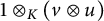 $1\otimes _K (v\otimes u)$
of
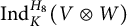 $\operatorname {Ind}_K^{H_8}(V\otimes W)$
as a left
 $H_8$
-module where it is clear.
Assume now that
 $\mathbb {k}$
is algebraically closed and recall that
 $\operatorname {char} \mathbb {k}=0$
. The simple YD modules over the Kac–Paljutkin algebra
 $H_8$
were explicitly described in [Reference Hu and Zhang23, Reference Shi46]. With the notation of [Reference Shi46], there are five non-isomorphic simple
 $H_8$
-modules
 $$ \begin{align*}V_1(b), \quad b\in \left\lbrace \pm1, \pm i\right\rbrace, \quad V_2,\end{align*} $$
where on the one-dimensional simples
 $V_1(b)$
, z acts by b and
 $x,y$
act by
 $b^2$
. For the two-dimensional simple
 $V_2=\mathbb {k}\left \lbrace v_1,v_2\right \rbrace $
, we have
 $$ \begin{align*}zv_1=v_1,\quad zv_2=-v_2, \quad xv_1=-v_2, \quad yv_1=v_2.\end{align*} $$
The simple K-modules are one-dimensional and denoted by
 $\mathbb {k}_{\epsilon _x,\epsilon _y}$
, where x, y act by
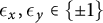 $\epsilon _x,\epsilon _y\in \left \lbrace \pm 1\right \rbrace $
, respectively. We compute for
 $\operatorname {Ind}=\operatorname {Ind}_K^{H_8}$
that
 $$ \begin{align*} \operatorname{Ind}(\mathbb {k}_{1,1})&\cong V_1(1)\oplus V_1(-1), \\ \operatorname{Ind}(\mathbb {k}_{1,-1})&\cong \operatorname{Ind}(\mathbb {k}_{-1,1})\cong V_2,\\ \operatorname{Ind}(\mathbb {k}_{-1,-1})&\cong V_1(i)\oplus V_1(-i). \end{align*} $$
Thus, every simple
 $H_8$
-module is a summand of an object in the image of
 $\operatorname {Ind}$
.
We observe that a YD module
 $(V,\delta _V)$
over
 $H_8$
appears in the closure of the image of
 $\mathcal {Z}(\operatorname {Ind}_K^{H_8})$
under direct summands if and only if its coaction
 $\delta _V$
factors through
 $K\otimes V$
, for
 $K=\mathbb {k} \mathsf {K}$
. In the list of simple YD modules over
 $H_8$
from [Reference Shi46, Theorem 3.13], we can identify the images of the simple YD modules over K under
 $\mathcal {Z}(\operatorname {Ind})=\mathcal {Z}(\operatorname {Ind}_K^{H_8})$
as follows:
 $$ \begin{align*} \mathcal{Z}(\operatorname{Ind})(\mathbb {k}_{1,1}^1)&\cong M\left\langle 1,1\right\rangle\oplus M\left\langle -1,1\right\rangle, & \mathcal{Z}(\operatorname{Ind})(\mathbb {k}_{1,1}^x)&\cong M\left\langle (x,y)\right\rangle,\\ \mathcal{Z}(\operatorname{Ind})(\mathbb {k}_{1,1}^{xy})&\cong M\left\langle 1,xy\right\rangle\oplus M\left\langle -1,xy\right\rangle, & \mathcal{Z}(\operatorname{Ind})(\mathbb {k}_{1,1}^y)&\cong M\left\langle (x,y)\right\rangle,\\ \mathcal{Z}(\operatorname{Ind})(\mathbb {k}_{-1,-1}^x)&\cong M\left\langle i,x\right\rangle\oplus M\left\langle -i,x\right\rangle, & \mathcal{Z}(\operatorname{Ind})(\mathbb {k}_{-1,-1}^1)&\cong M\left\langle (1,xy)\right\rangle,\\ \mathcal{Z}(\operatorname{Ind})(\mathbb {k}_{-1,-1}^{y})&\cong M\left\langle i,y\right\rangle\oplus M\left\langle -i,y\right\rangle, & \mathcal{Z}(\operatorname{Ind})(\mathbb {k}_{-1,-1}^{xy})&\cong M\left\langle (1,xy)\right\rangle,\\ \mathcal{Z}(\operatorname{Ind})(\mathbb {k}_{1,-1}^{1})&\cong M\left\langle (1,y))\right\rangle, & \mathcal{Z}(\operatorname{Ind})(\mathbb {k}_{1,-1}^{x})&\cong M\left\langle (x,1)\right\rangle,\\ \mathcal{Z}(\operatorname{Ind})(\mathbb {k}_{1,-1}^{y})&\cong M\left\langle (y,xy))\right\rangle, & \mathcal{Z}(\operatorname{Ind})(\mathbb {k}_{1,-1}^{xy})&\cong M\left\langle (xy,x)\right\rangle,\\ \mathcal{Z}(\operatorname{Ind})(\mathbb {k}_{-1,1}^{y})&\cong M\left\langle (1,y))\right\rangle, & \mathcal{Z}(\operatorname{Ind})(\mathbb {k}_{-1,1}^{1})&\cong M\left\langle (x,1)\right\rangle,\\ \mathcal{Z}(\operatorname{Ind})(\mathbb {k}_{-1,1}^{xy})&\cong M\left\langle (y,xy))\right\rangle, & \mathcal{Z}(\operatorname{Ind})(\mathbb {k}_{-1,1}^{x})&\cong M\left\langle (xy,x)\right\rangle. \end{align*} $$
This list shows that all eight one-dimensional simples
 $$ \begin{align*}M\left\langle a,b\right\rangle, \text{ with } \left\langle a,b\right\rangle=\left\langle \pm 1,1\right\rangle,\left\langle \pm 1,xy\right\rangle,\left\langle \pm i,x\right\rangle,\left\langle \pm i,y\right\rangle,\end{align*} $$
and a family of six two-dimensional simples
 $$ \begin{align*}M(\left\langle c,d\right\rangle), \text{ with } \left\langle c,d\right\rangle=\left\langle x,y\right\rangle,\left\langle 1,xy\right\rangle,\left\langle x,1\right\rangle,\left\langle 1,y\right\rangle,\left\langle xy,x\right\rangle,\left\langle y,xy\right\rangle,\end{align*} $$
appear as summands. There are eight further simple YD modules over
 $H_8$
with coactions that do not factor over the group algebra K and that do not appear in the image of
 $\mathcal {Z}(\operatorname {Ind})$
.
As an application, we can now construct commutative Frobenius algebras in
 ${\vphantom {\mathbf {YD}}}^{H_8}_{H_8}{\mathbf {YD}}$
.
Example 5.17 Let  be the trivial Frobenius algebra. Then
 is the two-dimensional Frobenius algebra
 $\overline {H_8}^*=\mathbb {k}[a]/(a^2-1)$
in
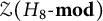 $\mathcal {Z}(H_8\text {-}\mathbf {mod})$
, where
 $1$
, a correspond to
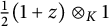 $\tfrac {1}{2}(1+z)\otimes _K 1$
,
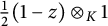 $\tfrac {1}{2}(1-z)\otimes _K 1$
, respectively. The coproduct is given by

using that
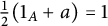 $\frac {1}{2}(1_A+a)=1$
, and
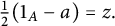 $ \frac {1}{2}(1_A-a)=z.$
Moreover,

The counit for the Frobenius algebra is thus given by
 $\epsilon _A(1_A)=1$
and
 $\epsilon _A(a)=0.$
The
 $H_8$
-Yetter–Drinfeld module structure on A consists of the trivial
 $H_8$
-coaction and the
 $H_8$
-action
 $$ \begin{align*}z\cdot a=-a, \quad x\cdot a=y\cdot a=a.\end{align*} $$
5.5 Rigid Frobenius algebras in the Drinfeld center of the Kac–Paljutkin algebra
As an application of our results, we conclude by constructing Frobenius algebras in
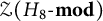 $\mathcal {Z}(H_8\text {-}\mathbf {mod})$
whose categories of local modules are modular fusion categories. We now assume that
 $\operatorname {char}\mathbb {k}=0$
and
 $\mathbb {k}$
is algebraically closed.
An étale algebra in an abelian tensor category
 $\mathcal {C}$
is a commutative separable algebra [Reference Davydov, Müger, Nikshych and Ostrik8, Definition 3.1]. We say that A is connected if
 . Any connected étale algebra in a fusion category is a Frobenius algebra (see, e.g., [Reference Laugwitz and Walton32, Proposition 3.11]). Connected étale algebras in
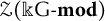 $\mathcal {Z}(\mathbb {k} \mathsf {G}\text {-}\mathbf {mod})$
, for a finite group
 $\mathsf {G}$
, were classified in [Reference Davydov7]. These are described by a normal subgroup
 $\mathsf {N}\triangleleft \mathsf {H}$
, for a subgroup
 $\mathsf {H}\subset \mathsf {G}$
and cocycle data (see [Reference Laugwitz and Walton32, Section 6.2] for details).
We now apply this classification to
 $\mathsf {K}=\mathsf {C}_2\times \mathsf {C}_2$
. In case
 $\mathsf {N}=\{1\},$
we only get the trivial algebra
 in
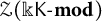 $\mathcal {Z}(\mathbb {k} \mathsf {K}\text {-}\mathbf {mod})$
and its image in
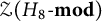 $\mathcal {Z}(H_8\text {-}\mathbf {mod})$
was considered in Example 5.17. If
 $\mathsf {N}=\mathsf {H}$
, the categories of local modules are trivial (see [Reference Davydov and Simmons9] or [Reference Laugwitz and Walton32, Corollary 6.18(3) and (4)]). We will not compute the images of these so-called Lagrangian subalgebras under
 $\mathcal {Z}(\operatorname {Ind}_{\mathbb {k} \mathsf {K}}^{H_8})$
here. Hence, we will consider the cases
 $$ \begin{align*}\mathsf{H}=\mathsf{K}=\mathsf{C}_2\times \mathsf{C}_2\quad \text{ and }\quad\mathsf{N}=\left\langle n\right\rangle\cong \mathsf{C}_2, \quad \text{ where } n=x, y, \text{ or } xy.\end{align*} $$
The triples
 $\{(n,\epsilon _x,\epsilon _y):n\in \{x,y,xy\},\epsilon _x,\epsilon _y\in \{\pm 1\}\}$
parameterize a discrete family of 12 non-isomorphic two-dimensional étale algebras
 $A_{n,\epsilon _x,\epsilon _y}$
in
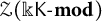 $\mathcal {Z}(\mathbb {k} \mathsf {K}\text {-}\mathbf {mod})$
. We use the basis
 $\left \lbrace e_1,e_n\right \rbrace $
, with
 $\deg e_1=1$
and
 $\deg e_n=n$
. The action is given by
 $x\cdot e_m=\epsilon _x e_m$
,
 $y\cdot e_m=\epsilon _x e_m$
, for some
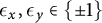 $\epsilon _x,\epsilon _y\in \left \lbrace \pm 1\right \rbrace $
, where
 $m=1,n$
. These algebras are Frobenius algebras with coproduct and counit
 $$ \begin{align*}\Delta(e_m)=e_1\otimes e_{m}+e_n\otimes e_{nm},\end{align*} $$
for
 $m=1,n$
, by [Reference Laugwitz and Walton32, Proposition 6.12].
Our results imply that these algebras induce four-dimensional commutative algebras in
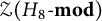 $\mathcal {Z}(H_8\text {-}\mathbf {mod})$
. We denote these algebras by
 $$ \begin{align*}B_{n,\epsilon_x,\epsilon_y}=\mathcal{Z}(\operatorname{Ind}_{\mathbb {k} \mathsf{K}}^{H_8})(A_{n,\epsilon_x,\epsilon_y}).\end{align*} $$
A basis for each of these algebras is given by
 $$ \begin{align*}\{ b_{1m}:=1\otimes e_m,\quad b_{zm}:=z\otimes e_m~|~ m=1,n \}.\end{align*} $$
Lemma 5.18 The algebra
 $B_{n,\epsilon _x,\epsilon _y}$
is a commutative Frobenius algebra in
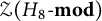 $\mathcal {Z}(H_8\text {-}\mathbf {mod})$
. Explicitly, for
 $m,m'\in \left \lbrace 1,n\right \rbrace $
:
-
(i) The
$H_8$
-action is given by the induced action, that is,
$$ \begin{align*} z\cdot b_{1m}=b_{zm}, \quad z\cdot b_{zm}=\frac{1+\epsilon_x+\epsilon_y-\epsilon_x\epsilon_x}{2}b_{1m}=b_{1m},\\ x\cdot b_{11}=b_{11}, \quad x\cdot b_{z1}=b_{z1},\quad y\cdot b_{11}=b_{11}, \quad y\cdot b_{z1}=b_{z1},\\ x\cdot b_{1n}=\epsilon_{x}b_{1n}, \quad x\cdot b_{zn}=\epsilon_{y}b_{zn},\quad y\cdot b_{1n}=\epsilon_{y}b_{1n}, \quad y\cdot b_{zn}=\epsilon_{x}b_{zn}. \end{align*} $$
-
(ii) The
$H_8$
-coaction is determined by
$$ \begin{align*} \delta(b_{1m})=m\otimes b_{1m}, \quad \delta(b_{zm})= m(1+\epsilon_xx+\epsilon_xy -\epsilon_x\epsilon_xxy)\otimes b_{zm}. \end{align*} $$
-
(iii) The multiplication is determined by
Thus,
$$ \begin{align*} b_{1m}b_{1m'}=b_{1,mm'}, \quad b_{zm}b_{1m'}=b_{1m}b_{zm'}=0,\quad b_{zm}b_{zm'}=b_{z,mm'}. \end{align*} $$
$1=b_{11}+b_{z1}$
is a central idempotent decomposition of the unit and as a
$\mathbb {k}$
-algebra,
$B_{n,\epsilon _x,\epsilon _y}$
is isomorphic to
$\mathbb {k}[a]/(a^2-1)\times \mathbb {k}[b]/(b^2-1)$
.



Recall the definition of a rigid Frobenius algebra in a ribbon category
 $\mathcal {D}$
[Reference Laugwitz and Walton32, Definition 3.8].Footnote
4
A rigid Frobenius algebra A is, equivalently, a connected, commutative, special Frobenius algebra, that is,

for  . The categories of internal modules
 $\mathbf {Mod}_{\mathcal {D}}\text {-}A$
over such an algebra A provide a source of tensor categories and their centers are given by the categories
 $\mathbf {Mod}^{\mathrm {loc}}_{\mathcal {D}}\text {-}A$
of so-called local modules [Reference Kirillov and Ostrik29, Reference Laugwitz and Walton32, Reference Schneider45].
The Drinfeld center
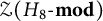 $\mathcal {Z}(H_8\text {-}\mathbf {mod})$
of the category of finite-dimensional
 $H_8$
-modules is a ribbon category. Indeed,
 $H_8$
is a spherical Hopf algebra as it is involutory, that is,
 $S^2={\operatorname {id}}_H$
for the antipode S [Reference Barrett and Westbury3, Example 3.2]. Thus, the ribbon structure on the center of
 $H_8\text {-}\mathbf {mod}$
is obtained from the spherical structure of
 $H_8\text {-}\mathbf {mod}$
via [Reference Shimizu49]. As
 $\operatorname {char} \mathbb {k} =0$
, the category
 $H_8\text {-}\mathbf {mod}$
is fusion and so is its Drinfeld center [Reference Etingof, Nikshych and Ostrik14, Theorem 2.15].
Corollary 5.19 The algebras
 $B=B_{n,\epsilon _x,\epsilon _y}$
are rigid Frobenius algebras in
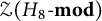 $\mathcal {Z}(H_8\text {-}\mathbf {mod})$
. In particular, the categories
 $\mathbf {Mod}_{H_8\text {-}\mathbf {mod}}\text {-}B$
are fusion categories and their Drinfeld centers
 $$ \begin{align*}\mathcal{Z}(\mathbf{Mod}_{H_8\text{-}\mathbf{mod}}\text{-}B)\simeq\mathbf{Mod}^{\mathrm{loc}}_{\mathcal{Z}(H_8\text{-}\mathbf{mod})}\text{-}B\end{align*} $$
are modular fusion categories.
Proof As  , our explicit calculations after Lemma 5.16 show that
 $B=\mathcal {Z}(\operatorname {Ind}_K^{H_8})(A_{n,\epsilon _x,\epsilon _y})$
only contains a single copy of the tensor unit
 and is, hence, connected. It remains to show that B is special. By definition, this amounts to the composition
 $m_B\Delta _B$
of coproduct and product being a nonzero multiple of the identity. We know by [Reference Laugwitz and Walton32, Theorem 6.14] that for the algebras
 $A=A_{n,\epsilon _x,\epsilon _y}$
,
 $$ \begin{align*}m_A\Delta_A=|\mathsf{N}|{\operatorname{id}}_{A}=2{\operatorname{id}}_A.\end{align*} $$
As, by Lemma 5.16,
 $\operatorname {lax}_{A,A}\operatorname {oplax}_{A,A}={\operatorname {id}}$
, it follows that
 $$ \begin{align*}m_B\Delta_B&=\operatorname{Ind}(m_A)\operatorname{lax}_{A,A}\operatorname{oplax}_{A,A}\operatorname{Ind}(\Delta_A)=2{\operatorname{id}}_{\operatorname{Ind}(A)}=2{\operatorname{id}}_B,\\ \varepsilon_Bu_B&=\operatorname{oplax}_0 (b_{11}+b_{z1})=\varepsilon_{H_8}(1)+\varepsilon_{H_8}(z)=1, \end{align*} $$
showing that B is a special Frobenius algebra.
The non-degenerate braided tensor categories
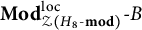 $\mathbf {Mod}^{\mathrm {loc}}_{\mathcal {Z}(H_8\text {-}\mathbf {mod})}\text {-}B$
inherit the ribbon structure of
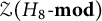 $\mathcal {Z}(H_8\text {-}\mathbf {mod})$
by [Reference Kirillov and Ostrik29] and are, hence, modular tensor categories.
5.6 Further questions
Here, we collect some open questions and directions not investigated in this article and [Reference Flake, Laugwitz and Posur21].Footnote 5
Question 5.20 Assume that
 $\operatorname {char} \mathbb {k}=0$
. If
 $G\colon \mathcal {C}\to \mathcal {D}$
is a strong monoidal functor of fusion categories, is
 $\mathcal {Z}(R)$
always a Frobenius monoidal functor?
For fusion categories of the form
 $\mathcal {C}=H\text {-}\mathbf {mod}$
, for a finite-dimensional semisimple Hopf algebra H over
 $\mathbb {k}$
, with
 $\operatorname {char} \mathbb {k}=0$
, it follows from Corollary 4.24 and Theorem 4.9 that Question 5.20 is answered in the affirmative for tensor functors induced by extensions of Hopf algebras. The question can be asked, specifically, for categories of modules over semisimple quasi-Hopf algebras.
Question 5.21 If
 $K\subset H$
is an inclusion of semisimple finite-dimensional quasi-Hopf algebras over a field or characteristic zero, is
 $\mathcal {Z}(\operatorname {Ind}_K^H)$
a Frobenius monoidal functor?
Another interesting question may be the explicit computation of the lax and oplax monoidal structures for the functor in Corollaries 5.3 and 5.12 and the resulting Frobenius algebras in
 $U_\epsilon (\mathfrak {g})\text {-}\mathbf {Mod}$
and
 $u_\epsilon (\mathfrak {g})\text {-}\mathbf {Mod}$
, respectively.
Finally, concerning the commutative Frobenius algebras
 $B=B_{m,\epsilon _x,\epsilon _y}$
from Section 5.4, it would be interesting to identify their tensor categories of modules and their modular categories of local modules from Corollary 5.19 among known modular fusion categories, for example, as Drinfeld centers of finite-dimensional modules over (quasi-)Hopf algebras.
Acknowledgements
We thank Harshit Yadav and Kenichi Shimizu for helpful comments on topics related to this work. We also thank the anonymous referee for helping us to improve this manuscripts (see especially Example 5.14).