


INTRODUCTION
Corruption is a difficult challenge for the manifestation of political institutions, and many advanced and developing countries around the world are confronting it (Agerberg Reference Agerberg2019; Chabova Reference Chabova2016; Maeda and Ziegfeld Reference Maeda and Ziegfeld2015). Income inequality has also been increasing and causing scholars and policy makers to evaluate the acceptance of income distribution that results from the market economy (Larsen Reference Larsen2016; McCoy and Major Reference McCoy and Major2007; Reynolds and Xian Reference Reynolds and Xian2014; Roex, Huijts, and Sieben Reference Roex, Huijts and Sieben2019). According to traditional wisdom, citizens’ perceptions of corruption have significant detrimental effects on political trust and participation and undermine the legitimacy of political institutions (Anderson and Tverdova Reference Anderson and Tverdova2003; Chang and Chu Reference Chang and Chu2006; Clausen, Kraay, and Nyiri Reference Clausen, Kraay and Nyiri2011; Treisman Reference Treisman2007). As a result, political trust based on the principles of accountability and fairness and the impartiality of political institutions has become eroded, thus inhibiting the healthy functioning of the democratic system and market economy (Ariely and Uslaner Reference Ariely and Uslaner2016; Zmerli and Castillo Reference Zmerli and Castillo2015).
The perception of fairness sustained by political trust is a critical factor in citizens’ acceptance of income differences due to a market economy and their support for redistributive policies (Hadler Reference Hadler2005; Yamamura Reference Yamamura2014). Although previous literature has widely documented the negative effects of corruption on political institutions, how these effects influence citizens’ perceptions about the fairness of income distribution remains largely unknown. In particular, East Asian countries have different social and cultural backgrounds compared to Western societies, which could lead to differences in people's attitudes toward political and economic outcomes (Chang and Huang Reference Chang and Huang2016; Chi and Kwon Reference Chi and Kwon2016; Wang Reference Wang2016). For example, the value systems of many East Asian countries are highly influenced by Confucianism and Buddhism, which both emphasize social hierarchy and social cohesion. This may potentially make citizens’ attitudes toward corruption and perceptions about fairness different from those observed in Western societies. Accompanied by increasing income inequality, tackling government corruption and enhancing political trust to assure political institutions function appropriately are important for East Asia's economic and political developments.
In spite of the accomplishments made by previous studies, corruption is mostly hidden and invisible to the public, and it is difficult to measure. This raises questions about the reliability of studies that use perceived indicators of corruption, and comparative studies that perceived and experience-based indicators of corruption are growing (Gutmann, Padovano, and Voigt Reference Gutmann, Padovano and Voigt2020; Treisman Reference Treisman2007). However, as argued by Treisman (Reference Treisman2007) and Clausen, Kraay, and Nyiri (Reference Clausen, Kraay and Nyiri2011), even though perceived corruption may not reflect the actual level of corruption, perceptions about corruption usually have significant effects on the citizens’ trust in political institutions. In addition, Pellegata and Memoli (Reference Pellegata and Memoli2016; Reference Pellegata and Memoli2018) show that perception-based indexes are reliable indicators of corruption, and citizens’ perceptions are not necessarily diverged from the reality. In this study, I argue that the negative association between citizens’ perceptions of corruption and perceived fairness can be partly explained by reduced political trust. In other words, three psychological state variables of political attitudes—perceptions of corruption, political trust, and perceptions of fairness—are well connected.
The purpose of this study is to identify the role of political trust in shaping the underlying channel of the relationship between citizens’ perceptions of corruption and perceived fairness of income distribution for East Asian countries. Using the fourth wave of data from East Asian Barometer as well as causal mediation analysis, this study systematically investigates the direct effect of perceived corruption and its indirect effect, as mediated through reduced levels of political trust, on perceived fairness of income distribution. Moreover, I examine the possibility of reciprocal causal effects that perceived fairness influences political trust and consequently corruption. Finally, I conduct sensitivity analysis to examine the robustness of the causal mediation effect. By using mediation analysis in examining the connections among perceived corruption, political trust, and perceived fairness, this study contributes to the understanding in the effects of corruption on perceived fairness by offering the potential causal inferences of mechanisms linking these three important psychological state variables of political attitudes.
LITERATURE REVIEW
CORRUPTION AND POLITICAL TRUST
Even though there is no comprehensive definition of corruption, the term generally refers to the misuse of public office for private financial gain (Akçay Reference Akçay2006; Warren Reference Warren2004). Thus, corruption usually involves the abuse of power and authority by elected officials and/or bureaucrats for private gains. Corruptive activities incur a misallocation of public resources in the decision-making process at the expense of the collective society, thus degrading government performance and reducing public support for political institutions. From the perspective of fairness, corruption has been considered as a problem of injustice, because it breaks the principles of procedural and distributive justice (Smith Reference Smith2010).
According to Rawls’ (Reference Rawls1971) theory of justice as fairness, fair procedures must display regularity and impartiality in their applications, and they are essential for ensuring that the basic structure of society is regulated in a fair, efficient, and productive way. By contrast, in market economies, distributive justice is mainly described by the principles of meritocracy and egalitarianism. Meritocracy emphasizes that rewards received are based on one's efforts and contributions, while egalitarian justice focuses on the way public resources are allocated on the basis of need and equality among members of a society. Because of its distortions in public decision making, corruption deteriorates social inequality in political procedures and the mechanisms of the distribution of wealth and status in society (Gupta, Davoodi, and Alonso-Terme Reference Gupta, Davoodi and Alonso-Terme2002; Alesina and Angeletos Reference Alesina and Angeletos2005; Smith Reference Smith2010). When corruption is widespread, people are likely to perceive that the overall distribution of income and wealth in society is not fairly based on meritocratic and egalitarian principles (Alesina and Angeletos Reference Alesina and Angeletos2005).
When society's collective demand is distorted by corrupt bureaucrats from their privileged positions, it undermines the principles of political accountability and fairness as well as the impartiality of political institutions. As a result, corruption erodes political trust, reduces citizens’ confidence in the political system, and depresses political participation. Corruption also typically increases the costs of public administration, causes an efficiency loss of public good production, and reduces the productivity of firms that interact with the government (Della Porta Reference Della Porta, Pharr and Putnam2000). Accordingly, because of it distorts the process of public decision making, corruption raises economic risk, discourages investments, hampers economic growth, and spurs economic inequality (Gupta, Davoodi, and Alonso-Terme Reference Gupta, Davoodi and Alonso-Terme2002). Many studies have shown that corruption has strong negative effects on citizens’ trust in political institutions as well as economic outcomes (Anderson and Tverdova Reference Anderson and Tverdova2003; Chang and Chu Reference Chang and Chu2006; Clausen, Kraay, and Nyiri Reference Clausen, Kraay and Nyiri2011; Della Porta Reference Della Porta, Pharr and Putnam2000; Pellegata and Memoli Reference Pellegata and Memoli2016).
While these studies consider corruption as a cause for eroding political trust, an alternative perspective includes the reverse causality in linking political trust and corruption. Most notably, by incorporating the concept of social capital, the theoretical framework of Della Porta (Reference Della Porta, Pharr and Putnam2000) describes corruption as both a cause and consequence of political trust and social trust. Chang and Chu (Reference Chang and Chu2006) and Morris and Klesner (Reference Morris and Klesner2010) also show that corruption has detrimental effects on political trust, but also that trust affects how citizens perceive the actions of government officials. This perspective argues that a lack of trust in the government discourages cooperative behaviors, favors instrumental and individualistic approaches to solve problems, fosters corruption, and transforms citizens into clients who seek private protection so as to gain access to decision making (Della Porta Reference Della Porta, Pharr and Putnam2000; Uslaner Reference Uslaner2002; Wroe, Allen, and Birch Reference Wroe, Allen and Birch2013). According to these arguments, there is a reciprocal causality between corruption and political trust.
POLITICAL TRUST AND PERCEIVED FAIRNESS
Citizens’ trust in political institutions plays a critical role in fostering public support for government policies that usually serve to coordinate and complement market outcomes in order to achieve the goals of economic efficiency or equity. When a political system is trustworthy, citizens are more willing to comply with government policies, because they tend to trust in fair treatment, especially for those for whom the policy outcomes are disadvantageous (Ariely and Uslaner Reference Ariely and Uslaner2016; Jimenez and Iyer Reference Jimenez and Iyer2016; Larsen Reference Larsen2016; Marien and Werner Reference Marien and Werner2019). Political trust is generally defined as the confidence people have in institutions and government, which mostly depends on their evaluation of the political systems in their countries. Thus, political trust is largely shaped by citizens’ perceptions about the political and economic performances of their government. Government performance that achieves or surpasses public expectations can enhance citizens’ trust in political institutions. By contrast, an incompetent government generates political dissatisfaction and skepticism, and can dampen citizens’ trust in political institutions.
A critical determinant of political trust is the government's integrity in providing open, clean, and fair public management, which relate to procedural justice concerning fairness and transparency during the decision making processes. Preventing corruption can foster high standards of behavior, reinforce the credibility and legitimacy of policy decision making, safeguard the public interest, and consequently raise confidence in the policy making process (OECD 2017). By contrast, when corruption erodes confidence in political institutions, citizens will perceive public decision-making as unfair, with less legitimacy, and they will be less willing to comply with policy outcomes.
The degree of political trust has been found to play a crucial role in various aspects of political and economic outcomes. For example, Yamamura (Reference Yamamura2014) shows that people have more positive attitudes toward income redistribution and perceive their tax burden as low when they have a higher degree of trust in government, while Torgler (Reference Torgler2003) and Berens and Schiller (Reference Berens and von Schiller2017) indicate that trust in institutions can substantially increase the support for more progressive taxation, improve tax morale, and prevent tax evasion. These findings suggest that the perceived fairness of political and economic outcomes critically depends upon whether political institutions can impartially exercise public power and make justifiable decisions (Bauhr and Charron Reference Bauhr and Charron2020).
Even though existing literature has shown a strong link between political trust and perceived fairness, it is not sufficiently understood whether fairness perception that is generated by preserving the procedural justice of the political system influences citizens’ trust in institutions or the effect is just the reverse. To fill this gap, Holtz (Reference Holtz2013) considers trust in government as entity-based justice perceptions, such that trust forms prior to the initiation of social exchange, and therefore trust influences fairness perceptions. It is argued that events cannot be classified as being inherently fair or unfair; instead, they are interpreted as fair or unfair based upon the trustworthiness of the entity. Based on Holtz's framework, Jimenez and Iyer (Reference Jimenez and Iyer2016) show that trust in government has a significant influence on both perceived fairness of the tax system and compliance decisions.
Some other studies alternatively argue that political institutions that support norms of fairness enhance the formation of trust, and that perceived fairness in terms of distributive, procedural, and formal justice influences people's incentives for trust and trustworthiness (Rothstein and Uslaner Reference Rothstein and Uslaner2005; You Reference You2012; Chi and Kwon Reference Chi and Kwon2016). By contrast, a lack of political trust may foster corruption (Della Porta Reference Della Porta, Pharr and Putnam2000; Uslaner Reference Uslaner2002), and this consequently leads to a causal direction in the links of corruption, political trust, and fairness such that perceived fairness affects political trust and thus influences corruption.
As income inequality remains a primary concern, the perceived fairness of income distribution becomes important from the perspective of policy making in achieving economic security and prosperity, because the perception of unfairness can potentially damage citizens’ compliance and cooperation with government regulations and policies. As argued by the modernization theory (Inglehart and Welzel Reference Inglehart and Welzel2005), the degree of the acceptance of income inequality will increase along with the process of modernization. Therefore, the acceptance of income disparity depends on whether the market economy and political system can generate prosperity and justice. This theoretical prediction suggests that the collapse of communism in eastern Europe will lead to a higher acceptance of income inequality, which will gradually converge with that of western European countries (Gijsberts Reference Gijsberts2002). This is also mostly consistent with the concept of procedural justice that emphasizes the equality of opportunity and the principle of meritocracy in determining political and economic outcomes (e.g., Larsen Reference Larsen2016; Ledgerwood et al. Reference Ledgerwood, Mandisodza, Jost and Pohl2011; Reynolds and Xian Reference Reynolds and Xian2014; Roex, Huijts, and Sieben Reference Roex, Huijts and Sieben2019).
THEORETICAL FRAMEWORK AND HYPOTHESES
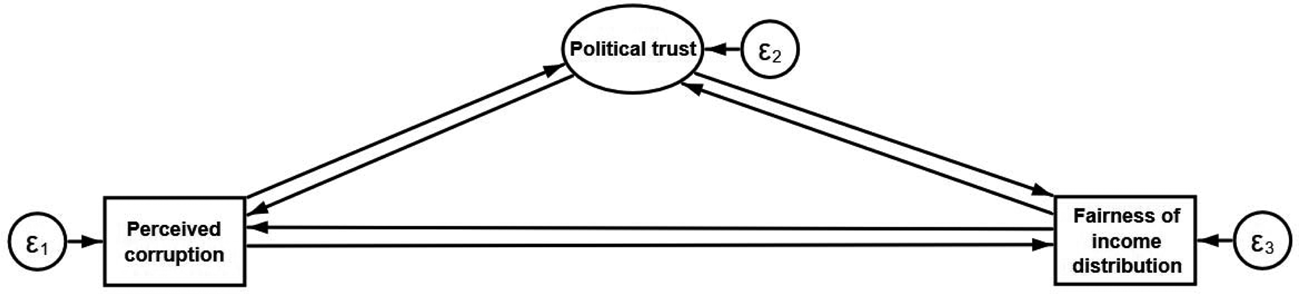
This study examines the causal inferences of citizens’ perceptions of corruption in explaining perceived fairness of income distribution by incorporating citizens’ trust in political institutions and tests the reciprocal causal effects. The theoretical frameworks are based on the arguments of mutual causality linking perceived corruption, political trust, and perceived fairness (Della Porta Reference Della Porta, Pharr and Putnam2000; Uslaner Reference Uslaner2002; Rothstein and Uslaner Reference Rothstein and Uslaner2005; Holtz Reference Holtz2013). As Figure 1 shows, the first causal direction runs as follows: perceived corruption affects perceived fairness of income distribution (direct effect), and perceived corruption erodes political trust and consequently influences perceived fairness of income distribution (indirect effect). The second causal direction describes the reciprocal effects as follows: perceived fairness of income distribution affects perceived corruption (direct effect), and perceived fairness of income distribution influences political trust and consequently affects perceived corruption (indirect effect). Hence, I test and analyze the following hypotheses and research question.
H1: Perceived corruption has a detrimental effect on citizens’ trust in political institutions.
Path diagram

H2: Citizens who have lower levels of political trust are more likely to perceive income distribution as unfair in their countries.
H3: Perceived corruption erodes citizens’ trust in political institutions and consequently has a negative impact on perceived fairness of income distribution.
RQ1: Is the indirect effect of perceived corruption mediated by political trust on perceived unfairness of income distribution significant and robust?
I now present the following reverse hypotheses and question.
H4: A lower level of citizens’ trust in political institutions is associated with higher perceptions of corruption.
H5: Citizens who perceive income distribution as unfair tend to have lower levels of political trust.
H6: Perceived unfairness of income distribution erodes citizens’ trust in political institutions and consequently leads to a higher level of perceived corruption.
RQ2 Is the indirect effect of perceived unfairness of income distribution mediated by political trust on perceived corruption significant and robust?
DATA AND EMPIRICAL METHOD
This study employs cross-country data drawn from the fourth wave survey of Asian Barometer to undertake the empirical investigations, conducted between 2014 and 2016. After excluding the samples with incomplete information about government corruption, this study uses the data of Cambodia, Indonesia, Japan, South Korea, Mongolia, Singapore, Philippines, Taiwan, Thailand, Malaysia, and Myanmar for a total of 14,182 observations.
Social and cultural contexts have been the focus for understanding politics in Asia since the 1990s when the debate over “Asian values” arose along with the dispute over whether Asian culture is fundamentally incompatible with democratic development. From the cultural approach, people's political attitudes and perceptions about economic outcomes are affected by their social norms and traditional values (Lee and Stolte Reference Lee and Stolte1994; Mishler and Rose Reference Mishler and Rose2001). Distinct from the Judeo-Christian traditions of Western societies, the value systems stemming from the social and cultural contexts of many East Asian countries could lead to differences in people's attitudes toward political and economic outcomes (Chang Reference Chang2018; Chang and Huang Reference Chang and Huang2016; Chi and Kwon Reference Chi and Kwon2016; Mishler and Rose Reference Mishler and Rose2001; Wang Reference Wang2016; Welzel Reference Welzel2011; Wong, Wan, and Hsiao Reference Wong, Wan and Hsiao2011).
In many East Asian countries, Confucianism and Buddhism have highly influenced the social norms and traditional values by emphasizing social hierarchy, social harmony, and collective interests (Barr Reference Barr2000; Huntington Reference Huntington1997). It is possible that Confucian values could make people more deferential to authority and consequently reduce the effect of corruption. By contrast, it is also possible that the Buddhist belief in harmony and self-restraint makes people more likely to attribute unfairness in income distribution to fate and to just accept it. These factors could potentially make citizens’ attitudes toward corruption and perceptions about fairness different from those observed in Western societies. In sum, the social norms and traditional values embedded in Asian cultures that emphasize collectivism, responsibilities for the group, and acceptance of hierarchies could lead to more submissive attitudes toward political and economic outcomes (Fukuyama Reference Fukuyama1998).
This research examines the relationship between perceived corruption and political trust and its effects on citizens’ perceived fairness of income distribution. Therefore, I construct two dependent variables as measures of perceived fairness of income distribution. The first measure (Unfair1) is constructed from responses to the question asking: “How fair do you think income distribution is in [country]?” The response is coded as 1 if the respondent answers very unfair or unfair and coded as 0 otherwise. The second measure (Unfair2), is constructed from responses to the question asking: “Considering all the effort that you and your family members have made in the past, do you think the income that your family currently receives is fair or not fair?” The response is coded as 1 if the respondent answers very unfair or unfair and coded as 0 otherwise.
The key explanatory variables are corruption and political trust. As a key explanatory variable, political trust (Ptrust) is constructed by using factor analysis from responses to the question asking: “I am going to name a number of institutions (President or Prime Minister; The courts; The national government; The political parties; Parliament; Civil service; The military; The police; Local government), and for each one, please tell me how much trust you have in them? A higher value of this variable indicates a higher level of political trust.
Moreover, the variable of measuring citizens’ perceptions of corruption (Corruption) is constructed with the response to the question: “How widespread do you think corruption and bribe-taking are in the national government in [capital city]?” The responses to this question are scaled from 0 (Hardly anyone is involved) to 3 (Almost everyone is corrupt). For the purpose of comparison, I also construct the variable of measuring citizens’ experiences with corruption (Corruptexp) with the response to the question: “Have you or anyone you know personally witnessed an act of corruption or bribe-taking by a politician or government official in the past year?” The variable is coded as 1 if the respondent personally witnessed this, was told so by a family member who personally witnessed this, or was told so by a friend who personally witnessed this, and coded as 0 otherwise.
As Treisman (Reference Treisman2007, Reference Treisman and Heywood2014), Mishler and Rose (Reference Mishler and Rose2008), Morris and Klesner (Reference Morris and Klesner2010), and Chabova (Reference Chabova2016) argue, it is possible that subjective measures of corruption perception are from capturing not observations as to the frequency of corruption, but rather inferences made by survey respondents on the basis of conventional understanding about the causes of corruption. Corruption perception can be influenced by media reporting on corruption cases or by discontent with political or economic situations. By contrast, experience-based measures of corruption are noisy; survey respondents may not answer as honestly about their own experiences, and they tend to capture petty corruption, which highly correlates to the interactions that citizens have with low-level government public officials. These studies suggest that people perceive a lower level of corruption in countries with more developed economies, long-established liberal democracies, a free press, more women in government, and a high degree of openness to international trade, while the frequency of experienced corruption can be reduced by economic development. However, given the purpose of this study, I do believe that it is appropriate by using perceived measures of corruption for our analysis on the connections among three psychological state variables of political attitudes—citizens’ perceptions of corruption, political trust and perceived fairness. In addition, I also conduct our analysis with experience-based measures of corruption for the purpose of comparison.
As control variables, our empirical estimations also use some individual socioeconomic characteristics and country-level variables that are important for shaping the relationship between corruption and political trust and the perceived fairness of income distribution (Agerberg Reference Agerberg2019; Ariely and Uslaner Reference Ariely and Uslaner2016; Pellegata and Memoli Reference Pellegata and Memoli2016). The individual socioeconomic characteristics include gender (Gender), age (Age), marital status (Married), years of schooling (Edu), employment status (Employed), income level (Income1, Income2, Income3, and Income4), political interest (Interest), the frequency of obtaining political information (Info), the frequency of internet use (Internet), partisanship (Partisan), political efficacy (Efficacy), and social class (Class).Footnote 1 For capturing cross-country differences in the contextual effects stemming from cultural, social, and political factors that have been argued to be significant in explaining citizens’ attitudes toward government and political institutions at the country level, I also include a government quality index (WGI), GINI coefficient (GINI), GDP per capita (GDP), and unemployment rate (U) as control variables.
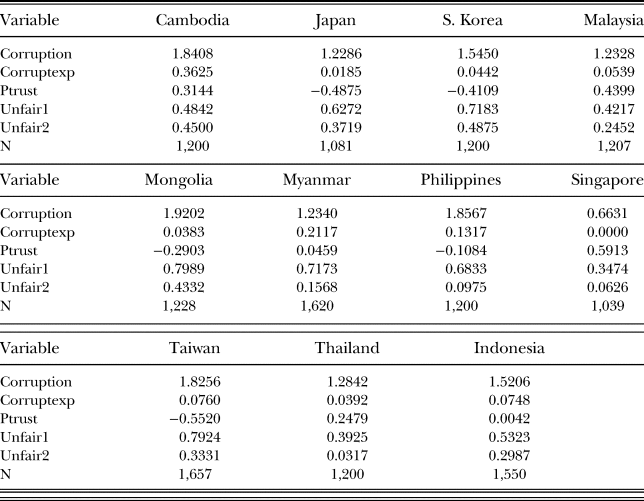
As a contextual factor, I set up a variable for measuring the quality of national institutions and government performance (WGI), which is an index of government quality formed by adding up the 2016 World Bank's Governance Indicators (WGI) established by Kaufmann, Kraay, and Mastruzzi (Reference Kaufmann, Kraay and Mastruzzi2009). The concept of WGI contains six different indicators, reflecting six dimensions of governance: voice and accountability, political stability and absence of violence, government effectiveness, regulatory quality, rule of law, and control of corruption.Footnote 2 The value of an indicator for each dimension ranges approximately from -2.5 (weak) to 2.5 (strong).Footnote 3 Here, WGI generally captures the traditions and institutions by which authority in a country is exercised and includes the process by which governments are selected, monitored and replaced; the capacity of the government to effectively formulate and implement sound policies; and the respect of citizens and the state for the institutions that govern economic and social interactions among them (Kaufmann, Kraay, and Mastruzzi Reference Kaufmann, Kraay and Mastruzzi2009). I also employ other country-level variables, such as Gini coefficient (GINI), GDP per capita (GDP), and unemployment rate (U) based on the World Bank as a source, to capture the contextual effects. Table 1 presents the mean values of the key variables used in this study. Appendices 1 and 2 list the definitions and descriptive statistics of variables used herein and are available upon request.
Mean values of key variables for East Asian countries

To test the hypotheses described above, I begin with multilevel models to take into account the socioeconomic differences across East Asian countries since individuals are nested within national contexts (Snijders and Bosker Reference Snijders and Bosker2011). This allows us to obtain some basic understanding about the connections between corruption, political trust, and perceived fairness concerning income distribution. For estimating the direct effect and indirect effect of perceived corruption, I continue with the causal mediation analysis proposed by Imai, Keele, and Tingley (Reference Imai, Keele and Tingley2010), which has become increasing popular in various disciplines such as epidemiology, political science, and psychology (Keele, Tingley, and Yamamoto Reference Keele, Tingley and Yamamoto2015; Imai and Yamamoto Reference Imai and Yamamoto2013). The literature usually considers this framework to identify the causal inference that defines a mechanism for processing a causal variable of interest (independent variable—perceived corruption) and its influences on an outcome (dependent variable—perceived fairness) through an intermediate variable (mediator—political trust). One of the main purposes of causal mediation analysis is to decompose the total effect of the explanatory variable on the dependent variable into direct and indirect effects. From our theoretical and empirical frameworks, Figure 1 illustrates the path diagram. By using causal mediation analysis, it allows us to systematically examine whether three psychological state variables—perceptions of corruption, political trust, and perceptions of fairness are well connected and whether the causal inferences are supportive for our theoretical framework.
RESULTS
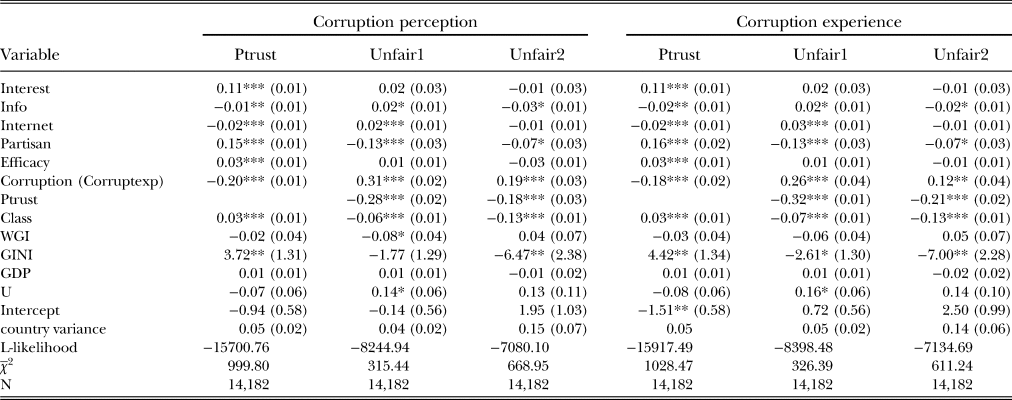
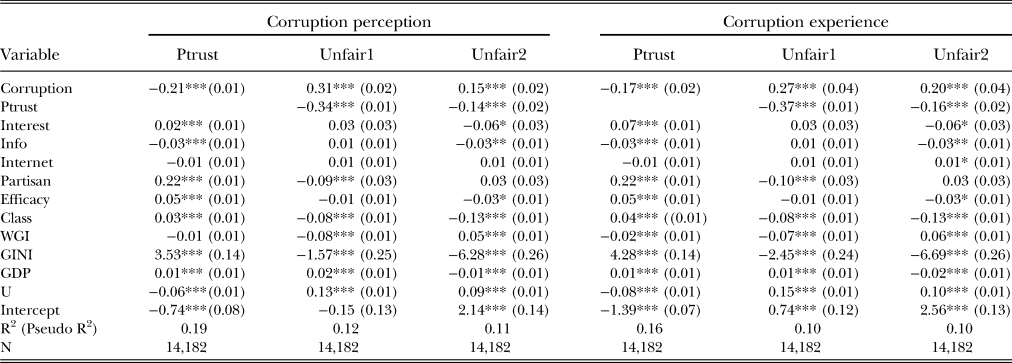
As a preliminary test of our hypotheses, Table 2 reports the estimations of multilevel models. The results show that corruption perception (Corruption) and corruption experience (Corruptexp) are both negatively associated with political trust and positively related to the probabilities of perceiving income distribution as unfair (Unfair1, Unfair2), while political trust has significantly negative relationships with the probabilities of perceiving income distribution as unfair.Footnote 4 In other words, corruption can erode citizens’ trust in political institutions and increase the probabilities of perceiving income distribution as unfair for citizens. By contrast, citizens with higher levels of political trust tend to less likely perceive income distribution as unfair in their countries. These results mostly support H1 and H2 as described in previous sections. However, both corruption perception and corruption experience have stronger direct effects on Unfair1 than on Unfair2. This suggests that East Asian citizens have a somewhat different belief system regarding the sources of inequality and redistribution, because the effects of corruption on perceived fairness are weaker under the consideration of personal efforts.
Corruption, political trust, and perceived fairness of income distribution—multilevel analysis

Note: Only the estimates of the core variables are shown in this table and the complete results with the inclusion of all control variables can be seen in the online appendix. Numbers in parentheses are standard errors. ***, **, and * denote significance at the 0.1%, 1%, and 5% levels, respectively. The LR test vs. (liner) probit model: Prob >=  $ \overline \chi ^2 $ = 0.0000.
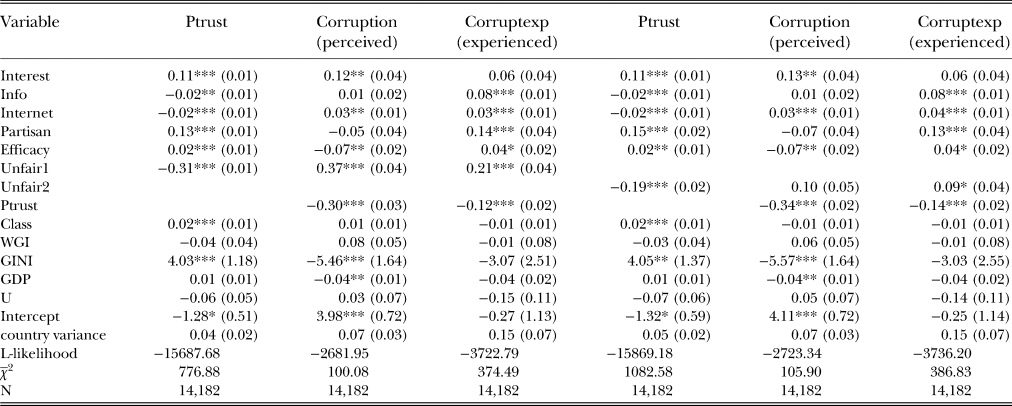
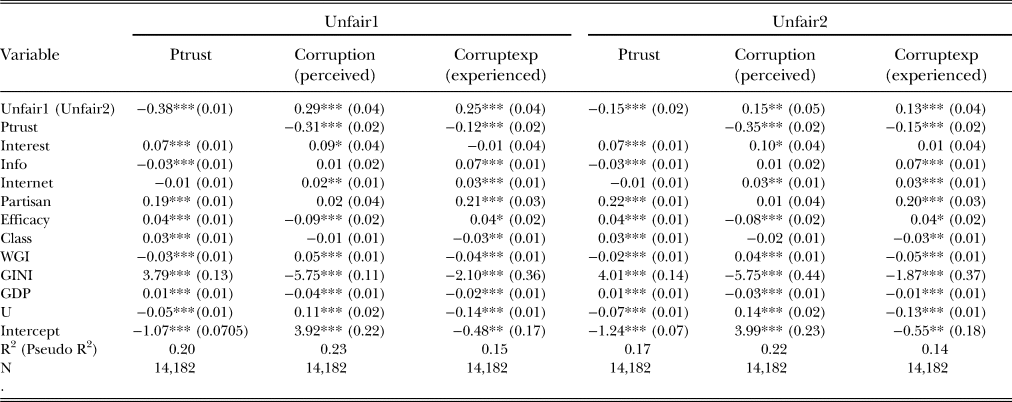
Table 3 shows the results of multilevel analysis from examining the reciprocal effect by reversing the causal direction. The measures of perceived fairness of income distribution (Unfair1, Unfair2) are both negatively associated with political trust, while political trust has significantly negative relationships with corruption perception and corruption experience. This suggests that citizens who perceive income distribution as unfair tend to have lower levels of political trust, and citizens with lower levels of political trust are more likely to perceive the government as corrupt and have experiences of government corruption. These results mostly support H4 and H5 and confirm the reciprocal effects of perceived fairness of income distribution on corruption. However, Unfair1 has stronger direct effects on corruption than Unfair2, suggesting that perceived fairness of income distribution under the consideration of personal efforts has only insignificant or weak effects on corruption.
Perceived fairness of income distribution, political trust, and corruption - multilevel analysis (reciprocal effect)

Note: Only the estimates of the core variables are shown in this table and the complete results with the inclusion of all control variables can be seen in the online appendix. Numbers in parentheses are standard errors. ***, **, and * denote significance at the 0.1%, 1%, and 5% levels, respectively. The LR test vs. (liner) probit model: Prob >=  $\overline \chi ^2$ = 0.0000.
Using the approach of causal mediation analysis proposed by Imai, Keele, and Tingley (Reference Imai, Keele and Tingley2010), this study next estimates the direct effect of perceived corruption and the indirect effect via political trust on perceived fairness of income distribution. As Table 4 reports, corruption perception (Corruption) is negatively associated with political trust (Ptrust) and positively related to the perceived unfairness of income distribution (Unfair1 and Unfair2), while political trust also negatively correlates to the levels of perceived unfairness of income distribution. These findings support H1 and H2, suggesting that perceived corruption has a detrimental effect on citizens’ trust in political institutions, and that citizens with higher levels of political trust are less likely to perceive income distribution as unfair in their countries. More importantly, perceived corruption erodes citizens’ trust in political institutions, and through this indirect effect, it consequently has a negative impact on perceived fairness of income distribution. These results also support H3.
Perceived fairness of income distribution, political trust, and corruption—causal mediation analysis

Note: Only the estimates of the core variables are shown in this table and the complete results with the inclusion of all control variables can be seen in the online appendix. Numbers in parentheses are standard errors. ***, **, and * denote significance at the 0.1%, 1%, and 5% levels, respectively.
Table 5 reports the results of causal mediation analysis by examining the reciprocal effect of perceived fairness of income distribution on perceived corruption. The measures of perceived fairness of income distribution (Unfair1 and Unfair2) are negatively associated with political trust (Ptrust) and positively related to the corruption perception (Corruption) and corruption experience (Corruptexp), while political trust also negatively correlates to the levels of corruption perception and corruption experience. Supporting H4 and H5, these findings indicate that citizens who perceive income distribution as unfair have lower levels of political trust, and that citizens with lower levels of trust in political institutions tend to have higher levels of perceived corruption. Supporting H6, these results also suggest that perceived unfairness of income distribution erodes citizens’ trust in political institutions and consequently leads to a higher level of perceived corruption.
Corruption, political trust, and perceived fairness of income distribution (reciprocal effect) - causal mediation analysis

Note: Only the estimates of the core variables are shown in this table and the complete results with the inclusion of all control variables can be seen in the online appendix. Numbers in parentheses are standard errors. ***, **, and * denote significance at the 0.1%, 1%, and 5% levels, respectively.
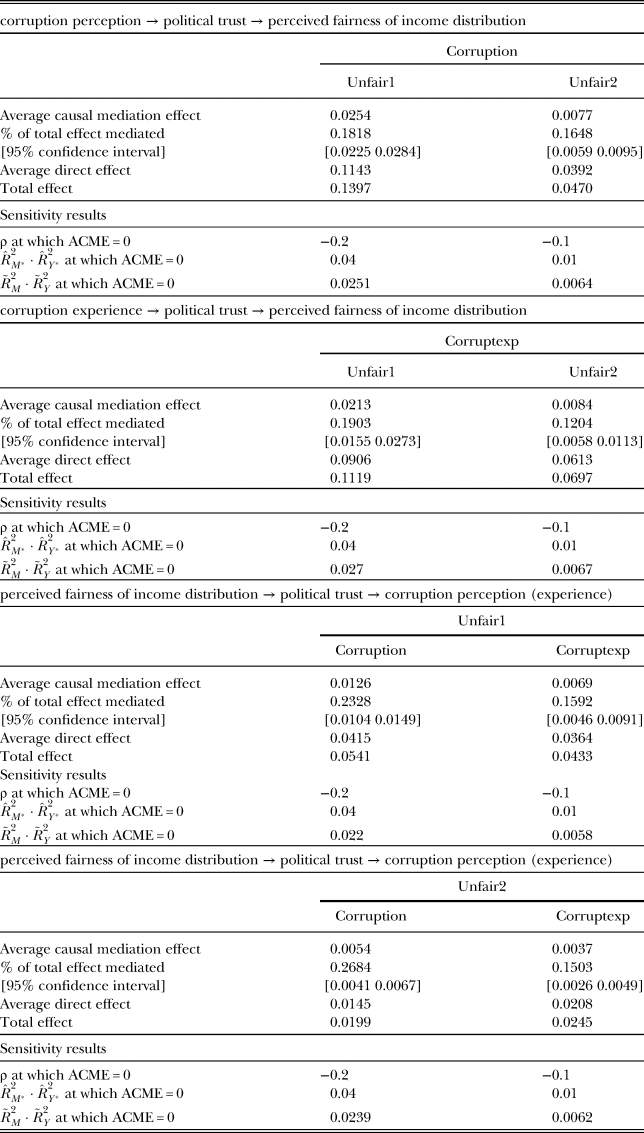
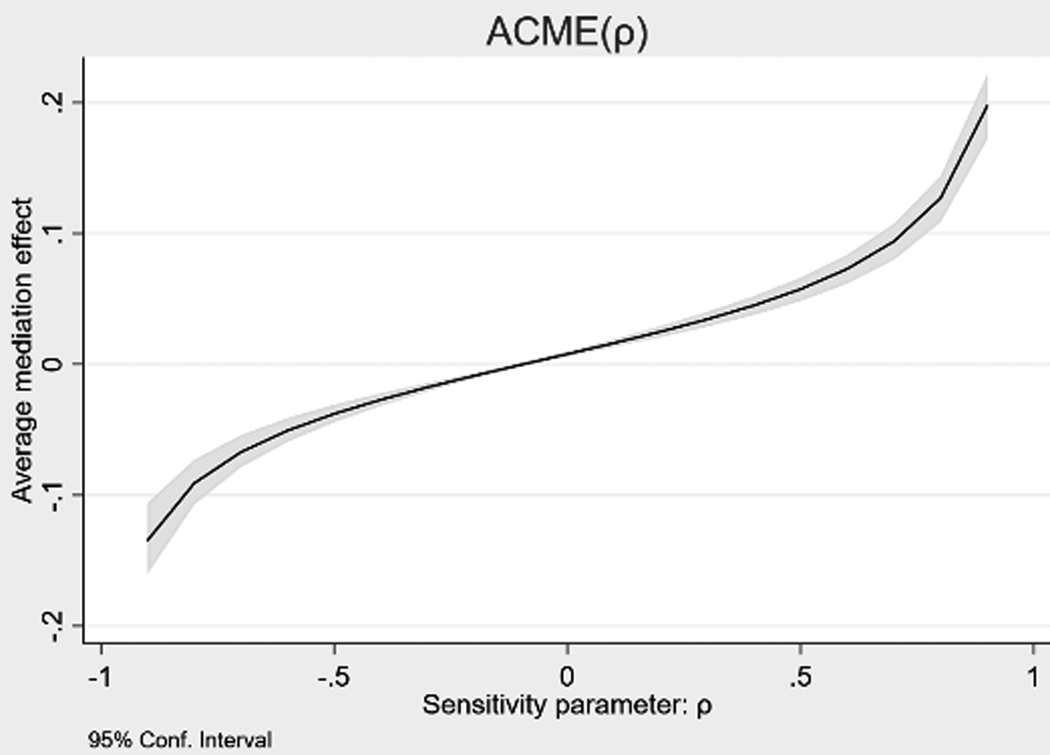
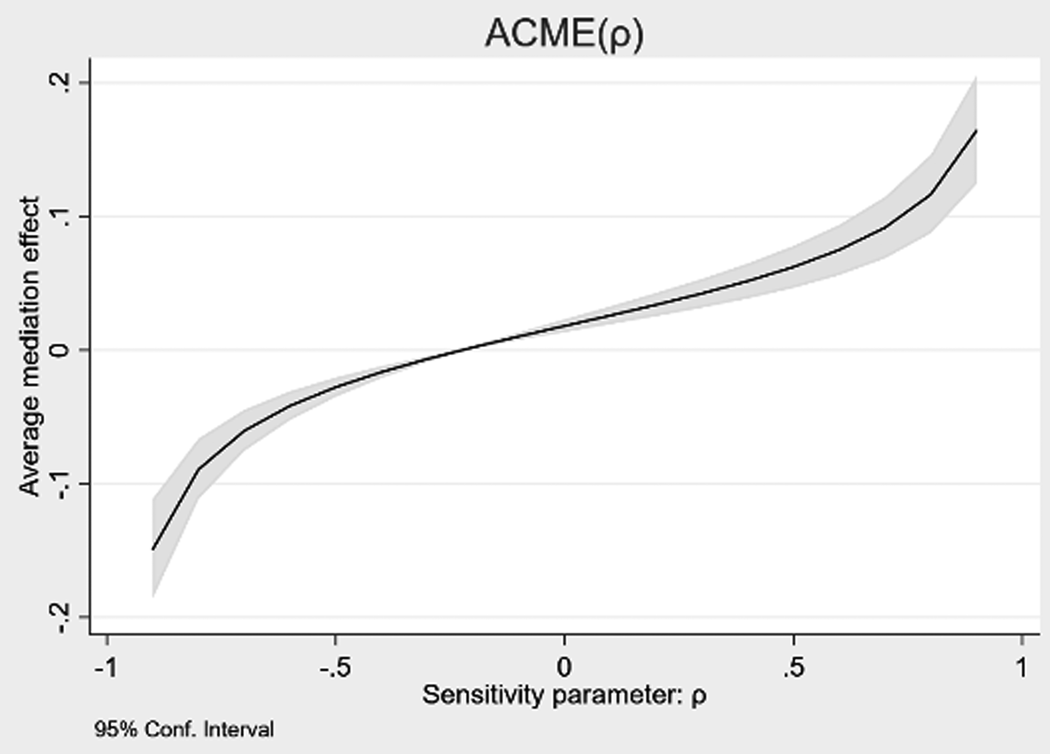
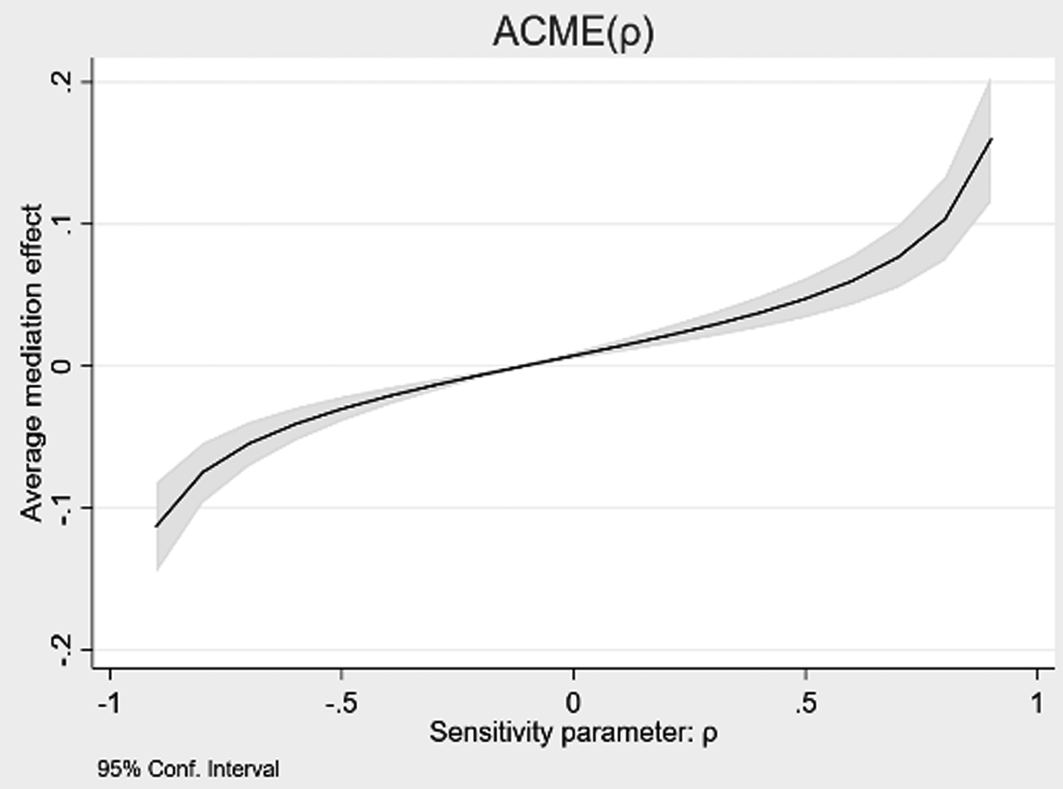
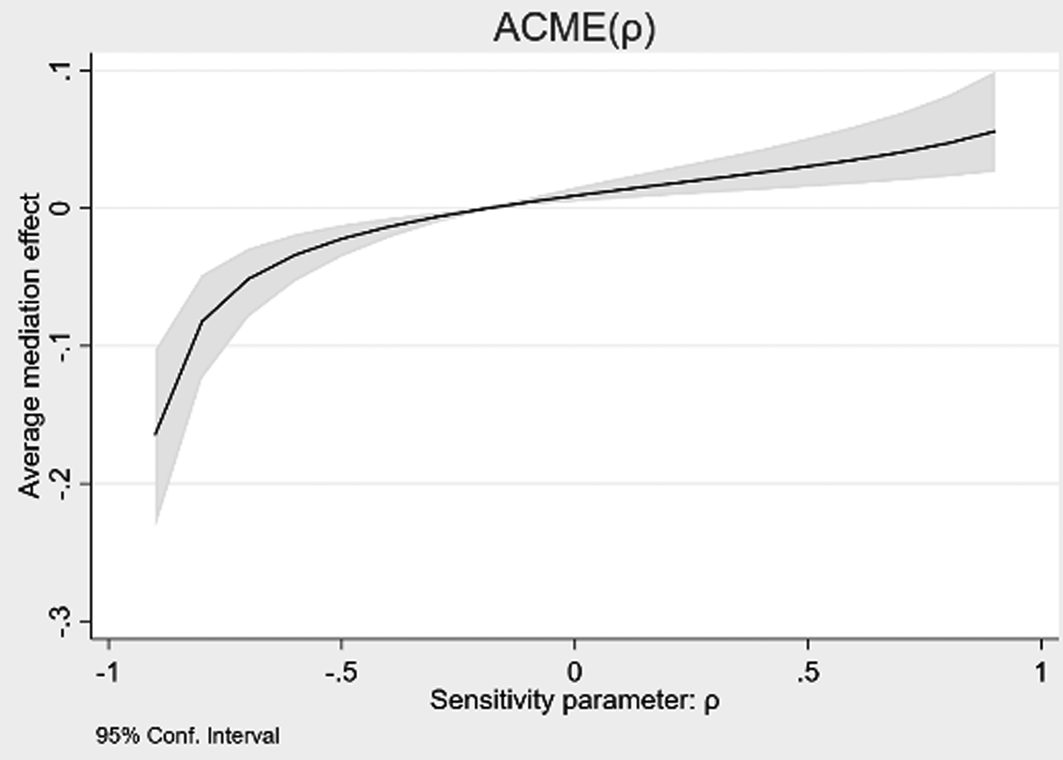
To check the robustness of the causal mediation effects (RQ1 and RQ2), I conduct the sensitivity analysis suggested by Imai, Keele, and Tingley (Reference Imai, Keele and Tingley2010). Table 6 reports the results of sensitivity analysis, which is based on the correlation between the error for the mediation model and the error for the outcome model. This correlation across the two error terms is denoted as ρ and serves as the sensitivity parameter. Even though there is no standard criterion to evaluate how sensitive is the result for violating the sequential ignorability (SI) assumption, the results of our sensitivity analysis indicate that the value of ρ at which the average causal mediation effect (ACME) equals zero ranges between −0.2 and −0.1.
Average causal mediation effects and sensitivity results

As Table 6 reports, for the causal direction of corruption perception (corruption) → political trust → perceived fairness of income distribution, ACME is 0.0254 and accounts for 18.18 percent of the total effect of corruption perception on perceived fairness of income distribution without considering personal efforts (Unfair1). Compared with the average direct effect and the total effect at 0.1143 and 0.1397, respectively, ACME tends to be substantial. This suggests that a rise in the measure of perceived corruption leads to a total increase of 13.97 percent in the probability of perceiving the income distribution as unfair, and 18.18 percent of this total increase is mediated by a drop in political trust. However, ACME is relatively smaller on perceived fairness of income distribution with the consideration of personal efforts (Unfair2) at 0.0077.
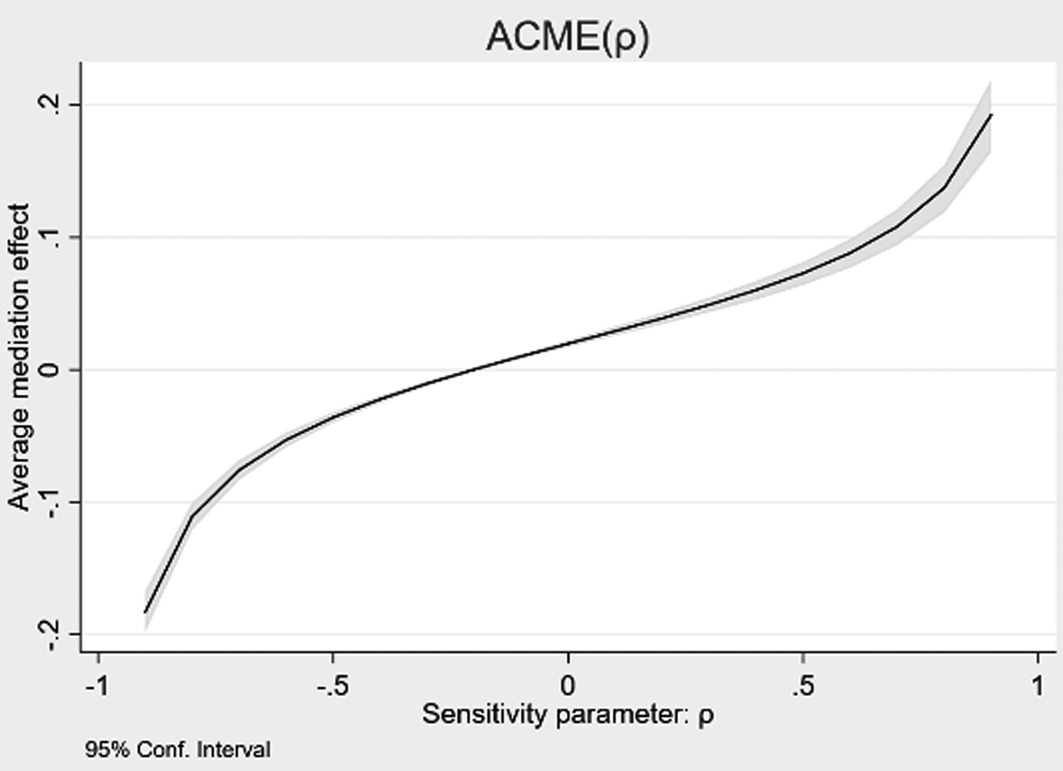
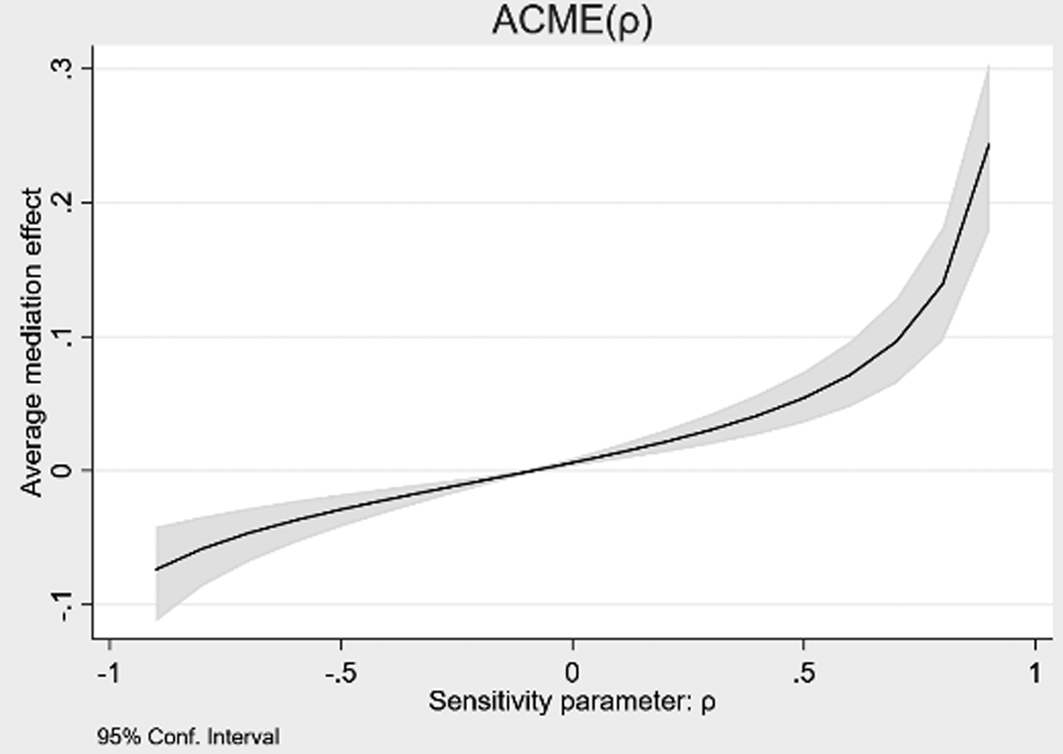
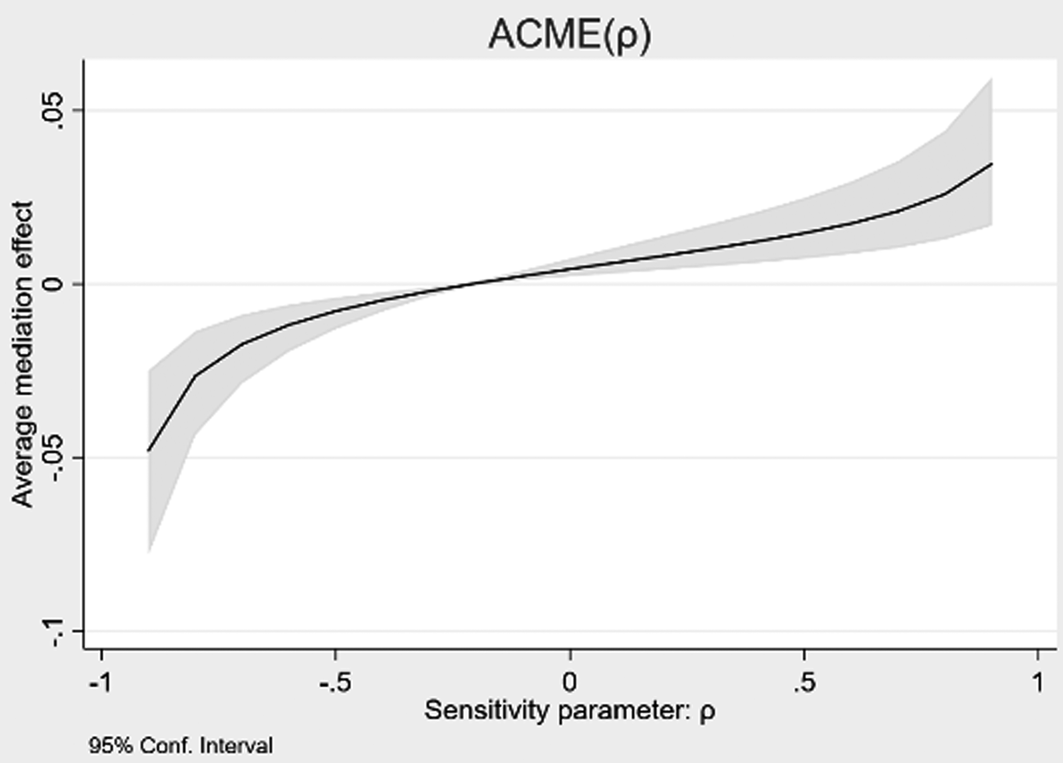
The values of sensitivity parameter ρ are −0.2 and −0.1 for Unfair1 and Unfair2, respectively. Figures 2 and 3 illustrate the results from sensitivity analysis for ACME of corruption perception on Unfair1 and Unfair2, respectively. For example, in Figure 2 showing ACME on Unfair1, the x-axis represents the value of the sensitivity parameter ρ, and the y-axis represents the range of potential indirect effects. For the sensitivity parameter ρ ranging from −1 to 1, the solid curvilinear lines within the gray 95 percent confidence interval indicate the results from sensitivity analysis, presenting that the conclusion about ACME under the SI assumption would remain unless ρ is less than −0.2. In addition, the value of ρ for ACME on Unfair2 is relatively smaller at −0.1. This suggests that the conclusion is plausible given even substantial departures from the ignorability of the mediator. Compared with other studies such as Hicks and Tingley (Reference Hicks and Tingley2011), Keele, Tingley, and Yamamoto (Reference Keele, Tingley and Yamamoto2015), and Tingley et al. (Reference Tingley, Yamamoto, Hirose, Keele and Imai2014), the results of our sensitivity analysis indicate that the causal mediation effects are modestly robust.
Sensitivity analysis of average causal mediation effect (ACME) for perceived fairness of income distribution (Unfair1): average causal mediation effect as a function of the degree of violation of the SI assumption. (Corruption perception)

Sensitivity analysis of average causal mediation effect (ACME) for perceived fairness of income distribution (Unfair2): average causal mediation effect as a function of the degree of violation of the SI assumption. (Corruption perception)

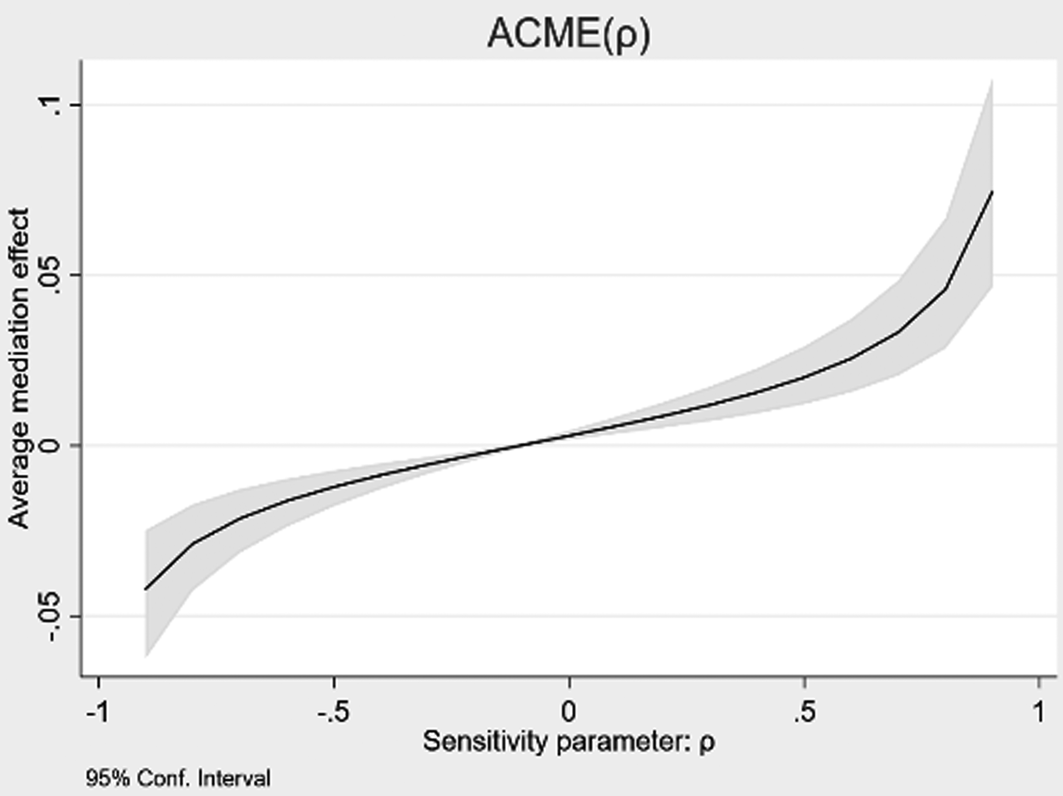
For the causal direction of corruption experience (corruptexp) → political trust → perceived fairness of income distribution, ACME is 0.0213 and accounts for 19.03 percent of the 0.1119 total effect of corruption experience on perceived fairness of income distribution without considering personal efforts (Unfair1). This indicates that corruption experience leads to a total increase of 11.19 percent in the probability of perceiving income distribution as unfair, while 19.03 percent of this total increase is mediated by the decrease in political trust. ACME is also relatively smaller on perceived fairness of income distribution with the consideration of personal efforts (Unfair2) at 0.0084, while the values of ρ are -0.2 and -0.1 for Unfair1 and Unfair2, respectively. Figures 4 and 5 also illustrate the results from sensitivity analysis for ACME of corruption experience on Unfair1 and Unfair2. These results suggest that corruption perception and corruption experience both have indirect effects mediated by political trust on perceived fairness of income distribution. Accordingly, our empirical findings for RQ1 suggest that the indirect effect of perceived corruption mediated by political trust on the likelihood of citizens to perceive the income distribution in their countries as unfair is significant and robust.
Sensitivity analysis of average causal mediation effect (ACME) for perceived fairness of income distribution (Unfair1): average causal mediation effect as a function of the degree of violation of the SI assumption (Corruption experience)

Sensitivity analysis of average causal mediation effect (ACME) for perceived fairness of income distribution (Unfair2): average causal mediation effect as a function of the degree of violation of the SI assumption (Corruption experience)

To examine the robustness of reciprocal effects regarding RQ2, I also conduct sensitivity analysis for the reciprocal ACMEs by reversing the causal direction as perceived fairness of income distribution (Unfair1 and Unfair2) → political trust → perceived corruption (Corruption). Table 6 also reports that ACME of Unfair1 on corruption perception (Corruption) is estimated at 0.0126 and accounts for 23.28 percent of the total effect of Unfair1 on corruption perception. However, ACME of Unfair1 on corruption experience (Corruptexp) is relatively smaller at 0.0069. Moreover, as shown in Table 6 and illustrated in Figures 6 and 7, the values of ρ for ACME of Unfair1 on corruption perception and corruption experience are -0.2 and -0.1, respectively. This shows that perceived unfairness of income distribution also can erode citizens’ trust in political institutions and consequently leads to a higher levels of corruption perception and corruption experience. By contrast, as shown in Table 6 and illustrated in Figures 8 and 9, ACME of Unfair2 on corruption perception and corruption experience are estimated at 0.0054, and 0.0039, while the values of ρ are −0.2 and -0.1, respectively. Overall, the results of sensitivity analysis suggest that ACMEs of perceived fairness )of income distribution on perceived corruption mediated by political trust are also modestly robust.
Sensitivity analysis of average causal mediation effect (ACME) for corruption perception (Corruption): average causal mediation effect as a function of the degree of violation of the SI assumption (Unfair1)

Sensitivity analysis of average causal mediation effect (ACME) for corruption experience (Corruptexp): average causal mediation effect as a function of the degree of violation of the SI assumption (Unfair1)

Sensitivity analysis of average causal mediation effect (ACME) for corruption perception (Corruption): average causal mediation effect as a function of the degree of violation of the SI assumption (Unfair2

Sensitivity analysis of average causal mediation effect (ACME) for corruption experience (Corruptexp): average causal mediation effect as a function of the degree of violation of the SI assumption (Unfair2)

Comparing ACMEs from both causal directions (see Table 6), the mutual causalities in the relationships between corruption, political trust, and perceived fairness of income distribution are significant. Moreover, there are no substantial differences in ACMEs of corruption perception and corruption experience on perceived fairness of income distribution. However, ACMEs of perceived fairness of income distribution mediated by political trust on corruption perception are slightly stronger than on corruption experience. In other words, the measures of perceived and experience corruption both can explain the indirect effect of corruption mediated by political trust on perceived fairness of income distribution, but the effect of perceived fairness of income distribution mediated by political trust on corruption is better explained by using perceived corruption than experienced corruption. In addition, the estimated ACMEs are larger when using Unfair1 as the measure of perceived fairness of income distribution than those by using Unfair2 with the consideration of personal efforts. This also indicates that East Asian citizens have a somewhat different belief system regarding the sources of inequality and redistribution.
Among the control variables at the individual level, political interest, partisanship, and political efficacy are positively associated with political trust, but citizens who feel close to a political party are less likely to perceive the income distribution as unfair. As for the country-level control variables, without considering personal efforts, citizens in countries with higher levels of government quality (WGI) and income inequality (GINI) are less likely to perceive the income distribution as unfair (Unfair1), and citizens in countries with higher levels of unemployment rate (U) are more likely to perceive the income distribution as unfair. Moreover, taking into account the efforts that the respondents’ family members have made in the past (Unfair2), citizens in countries with higher levels of government quality (WGI) are more likely to perceive the income distribution as unfair. By contrast, citizens in countries with higher levels of GDP per capita (GDP) are less likely to perceive the income distribution as unfair.
Regarding the results of reciprocal effects as reported in Table 5, citizens in countries with higher levels of government quality (WGI) tend to have higher levels of corruption perception and lower levels of corruption experience, while income inequality (GINI) has significantly negative relationships with corruption perception and corruption experience. It is possible that citizens in countries with higher levels of income inequality are more likely to accept the outcomes of income distribution resulting from a market economy and have more trust in political institutions, and thus are less likely to perceive government as corrupt or have experiences of government corruption.
DISCUSSION AND CONCLUSION
Corruption can have many detrimental effects on well-functioning democratic institutions and can potentially erode citizens’ trust in government and political foundations. Corruption reduces people's confidence in a government's efforts to assure the fairness of income distribution resulting from the market system and to justify sufficient social welfare programs. While the actual level of corruption usually cannot be directly observed by the public, this study shows that people's perceptions of corruption—the belief that government, special interests, and powerful individuals collude at the public expense—itself has corrosive effects on political trust and perceptions of fairness. The findings from this study suggest that growing perceptions of corruption are themselves corrosive of political life. More importantly, the results from causal mediation analysis confirm that three psychological state variables of political attitudes—perceptions of corruption, political trust, and perceptions of fairness, are well connected. The negative association between citizens’ perceptions of corruption and perceived fairness can be partly explained by reduced political trust.
Emerging evidence has shown that corruption remains a concern in many East Asian countries and could erode political trust and undermine well-functioning democratic systems in these countries. In particular, given the contextual differences in social and cultural backgrounds from Western societies, the effects of perceived corruption on perceived fairness have not been adequately examined for East Asian countries. Thus, this study analyzes causal inferences of perceived corruption in explaining perceived fairness of income distribution by incorporating citizens’ trust in political institutions for this region.
The results from this study are summarized as follows. First, consistent with the previous literature, perceived corruption has a detrimental effect on citizens’ trust in political institutions in East Asian countries. Moreover, citizens who have lower levels of political trust are more likely to perceive income distribution as unfair in their countries.
Second, if perceived corruption can erode citizens’ trust in political institutions, it consequently has a negative impact on perceived fairness of income distribution. In other words, the effect of perceived corruption mediated by political trust on perceived unfairness of income distribution is significant. This indirect effect ranges approximately from 12 to 19 percent of the total effect of perceived corruption on perceived unfairness.
Third, regarding the reciprocal effect, perceived fairness of income distribution also has a strong effect on political trust and consequently has significant influences on corruption perceptions. The indirect effect mediated by political trust ranges from 15 to 27 percent of the total effect of perceived fairness of income distribution on perceived corruption. Our results thus provide empirical support for causal inferences that explain the effect of perceived corruption on perceived fairness of income distribution mediated by political trust as well as the reciprocal effect in reversing the causal direction.
The findings from this study extend our understanding about the role of political trust in shaping the relationship between perceived corruption and perceived fairness of income distribution in East Asian countries. Because confronting the problem of rising income inequality has become an important challenge for many East Asian countries, the perceived fairness of income distribution will be critical for citizens’ support of policy implementations that reduce income inequality. This will also have significant impacts on the success of a market economy and citizens’ satisfaction with a democratic system. This study contributes to the literature on corruption, and the results have important implications for government policies that reduce income inequality.
CONFLICTS OF INTEREST
Wen-Chun Chang declares none.
SUPPLEMENTARY MATERIAL
The supplementary material for this article can be found at https://doi.org/10.1017/jea.2020.44.