Seven years after the Korean War's end, tens of thousands of middle school, high school, and university students took to the streets in cities throughout South Korea to force the resignation of the country's first president, Syngman Rhee. What became known as “4.19” ushered in a year of extensive political discussion and activism among youths, intellectuals, and politicians, each of whom sought to seize upon the democratic and nationalist potential of the momentous event.Footnote 1
Students of the Foreign Language College of Korea (present-day Hankuk University of Foreign Studies), addressing the foreign population in an English-language declaration published in the monthly magazine Segye [World], exuberantly proclaimed in the wake of Rhee's resignation that April 19th represented the country's “2nd liberation,” equal in magnitude to the Magna Carta, the French Revolution, and the March First Movement. In a more figurative mode, Sin Ilch'ŏl of Korea University likened April 19th to the abrupt—and sober—awakening of a hapless wino who, like modern Korea, had been slapped silly during its “dark history,” which stretched back to the late Chosŏn era and extended through the colonial era, national division, and the Korean War. Though the philosophy lecturer signaled in his essay considerably more caution than the ebullient college students, he hoped that after the breakthrough of April 19th, Koreans would succeed in achieving a bourgeois democratic revolution, as well as a socioeconomic one (Segye 1960).
However, aspirations for enduring, substantive change, both within South Korea and between the two Koreas, dissipated when General Park Chung Hee staged a military coup in 1961 that overthrew the new head of state, Prime Minister John Myun Chang. After ruling as the leader of a military junta, Park resigned his military post and was elected president in 1963, an office he would hold until his assassination sixteen years later. As if to offset the bold exuberance of its debut, South Korea's first democratic spring quietly faded into memory, regarded by many contemporaries as an “incomplete revolution” (miwansŏng hyŏngmyŏng).
Such early disappointment notwithstanding, April 19th established youth-driven protest movements as a crucial factor in South Korean politics during the long years of authoritarian rule (1948–87). The recurring importance of youth protest is evident in numerous turning points in subsequent decades—among them, Chŏn T'aeil's self-immolation in 1970, the violent Kwangju Struggle of 1980, and the hard-won democratic transition of June 1987 (Choi Reference Choi1991; Dong Reference Dong, Kim and Kihl1988). As a historical memory and formative political event, April 19th speaks directly to the broader trajectory of South Korean politics amid the wrenching transformations of the “miracle on the Han.” It should come as no surprise that numerous conferences and ceremonies were held in 2010 to commemorate the fiftieth anniversary of the event.
As much as April 19th presaged the contentious protests of the 1970s and 1980s, it also harkened back to the March First Movement of 1919, as well as colonial liberation in 1945. In fact, it was in and through the seminal event of April 19th that South Korean protestors, intellectuals, and even ideologues transposed narratives of anti-Japanese resistance and eventual emancipation to the culture of post-1945 politics. In short, beginning in 1960, Manichean conflicts between colonized and colonizer were replicated in agonistic struggles between progressive elements and the authoritarian state. April 19th, in this regard, established an evolving pattern in South Korea that survives to this day.Footnote 2
The eruption of the 1960 protests was unexpected and abrupt. In the words of one contemporary observer, the initial street march in Taegu on February 28 came as a “categorical shock” (pulmun ŭi syokk'ŭ) (Saebyŏk 1960). For one thing, antigovernment activism of any sort was extremely risky in the authoritarian political milieu of South Korea at the height of the Cold War (Douglas Reference Douglas1963). Moreover, the event occurred early in the global wave of youth-driven movements that came to define the decade. Thus, from the standpoint of 1960, student protest had not yet become such a common occurrence, either in East Asia or in other parts of the world. At this specific juncture, April 1960 prefigured the better-known youth eruptions of the Global Sixties—not least the Anpo protests that erupted just weeks later in Japan.Footnote 3 Within this context, the emergence of student protest as a political force was not a foregone conclusion, despite the privileged place of March First in collective memory. Rather, narratives of anticolonial youth resistance had to be seized upon and reinvented to fit the exigencies of the postcolonial era. April 19th was the definitive moment in this process.
Earlier studies have shed light on the structural and political causes behind April 19th (D. Kim Reference Kim1997; Q. Kim Reference Kim1996). My investigation centers on the ways in which nationalist projects instituted by the state to instill loyalty and obedience in the nation's youths actually planted the seeds for patriotic, anti-state collective action. Scholars have pointed out this connection between liberal-democratic ideology in the new education system and April 19th. This study, however, is the first to investigate liberal-democratic and nationalist elements in schoolbooks in conjunction with school culture as causal factors in the escalation and magnitude of April 19th.
North of the 38th parallel, the architects of the North Korean revolution divided the duties of nation among newly privileged, and freshly redefined, social categories of workers, peasants, women, and youths (Armstrong Reference Armstrong2002). In the South, efforts to rework the identities of workers, peasants, and women to fit the exigencies and ideological contours of the anticommunist state were far less thoroughgoing and inclusive. In contrast, however, statist ideological projects reached out to students at every level of the education system, while placing particular emphasis on middle school and high school students. More so than any other social identity, the South Korean “student” was assigned the moral duty of serving as the vanguard of postcolonial nation-building and postwar national recovery. The present article documents the production of students as a nationwide social organization that was well-versed in the moral imperatives of nationalist discourse and conversant in the myriad practices of patriotic “studenthood.” I conceive of post-Korean War “studenthood” as a school-based system of symbols and meanings through which students generated individual and group actions within the privileged categorical identity of “student.”
To take full account of the intimate relationship between discourse and practice, I will investigate post-Korean War nationalist schoolbooks in conjunction with nation-centered student activities, especially those organized by the National Defense Student Corps (Hakto hoguktan, hereafter NDSC). For the former, my analysis will focus on the “morals education” (toǔi kyoyuk) curriculum that was instituted in the latter half of the 1950s in middle schools and high schools around the country. Despite early efforts to dissociate the new education system from its colonial-era predecessor, Ministry of Education officials incorporated elements of Japanese “ethics” (shūshin) classes in developing this new classroom subject designed to address the “dissolution of citizens' spirit” that had resulted from the ideologically divisive Korean War (Taehan 1988). As part of Japan's “spiritual mobilization” during the Asia Pacific War, ethics texts demanded loyalty to the emperor and sacrifice for the nation from Japanese and Korean schoolchildren alike (Yamashita Reference Yamashita and Weiming1996). South Korean morals primers of the 1950s, in very similar fashion, stress the ultimate primacy of nation in nearly every sphere of youth life. Yet, at the same time, they also contain chapters on democracy and anticommunism, as well as recurring narratives of collective resistance from the recent colonial past. In up-to-date fashion, these morals texts situated youths at the forefront of national history—and squarely in the complex postcolonial, Cold War juncture of the mid-twentieth century.
The NDSC, an appendage of the Ministry of Education, also borrowed elements from youth mobilization projects of the late colonial era. Most conspicuously, NDSC officials maintained the militaristic orientation of Japanese imperialist programs as they set out to mobilize South Korean schoolchildren in training exercises and statist rallies. However, in addition to militarizing youths, the NDSC oversaw the organization of student governments, volunteer programs, and other school-based activities that provided students with venues for the enactment of nationalist narratives and upstanding nation-centered practices. I devote equal attention to the practical dimension of studenthood because the enactment of nation-centered morals provides a window into the effectivity of nationalist discourse, and its sub-field of scholastic discourse. A great many students may have misunderstood, glossed over, rejected, or yawned through lessons about the Korean nation and student morality. Nonetheless, in fragmented, ephemeral, and variable ways, student actions coincided with nation-centered ideals to produce, and reproduce, nationalist beliefs in everyday life, student activities, and even street marches. As I will demonstrate, students seized upon the protean potential of nation-centered performances to reinterpret and recombine discursive and practical aspects of their school lives and stage the unanticipated student protests of 1960.
March First Commemorations after Liberation
Nationalists make ample use of myths, symbols, and traditions in ways that foster a sense of collective belonging among disparate groups. In a given nationalized context, the initial selection of nationalist matériel often lacks determinacy, and can even possess a surprising element of arbitrariness (Hobsbawm and Ranger Reference Hobsbawm and Ranger1992). The present section examines the designation of the March First Movement as a key event in the South Korean nationalist repertoire during the early postliberation years. After Liberation in 1945, Korean leaders on either side of the 38th parallel had access to numerous narratives of independence activism and anticolonial resistance, due to the wide range of pursuits undertaken by colonial nationalists in Korea, China, Japan, the Soviet Union, and the United States. To cultivate a nation-centered identity among Northerners, ideologues in North Korea emphasized the anti-Japanese resistance of guerrilla bands in Manchuria in the 1930s and 1940s. This choice mirrored the pre-1945 nationalist credentials of the northern leadership, in particular, the emerging figure of Kim Il Sung (Armstrong Reference Armstrong1995). South Korean nationalists, for their part, emphasized colonial-era youth protest.
Taking part in the “Wilsonian moment” that followed the end of World War I, the leaders of the March First Movement espoused the principle of national self-determination in declaring Korea's right to independence to the international community (Manela Reference Manela2007). Although these demonstrations did not produce the desired result of ending colonial rule, the movement appealed to the moderate-to-conservative political sensibilities of many early South Korean leaders and intellectuals. Survey of Korean History, written by the prominent historian Yi Pyŏngdo, reflects this affinity (Reference Pyŏngdo1948, 487–90). Yi's account of the colonial era revolves exclusively around the March First Movement, which interrupted the “grave trials” that followed colonization in 1910 and generated new forms of independence activism and anticolonial resistance in the 1920s and 1930s. For Yi, March First and its immediate legacy quite literally were colonial history. Equating the thirty-five years of colonial history with March First in this manner was the norm among mainstream South Korean nationalists.Footnote 4 The observance of commemorations in the early postliberation years reified this dominant view of the recent colonial past.
During the three years of its existence, the United States Army Military Government in Korea (USAMGIK) supported rightists and right-leaning moderates among Korea's leading political figures. In this incipient Cold War context, communist and left-of-center leaders faced considerable suspicion and hostility in the southern half of the Korean peninsula. Within six months of Liberation, General John R. Hodge, the head of USAMGIK, collaborated with Syngman Rhee and other domestic rightist leaders to install the Representative Democratic Council (RDC), a coalition of twenty-eight conservative figures, as the sole representative body of southern Koreans (Cumings Reference Cumings1981, 231–37). Amid the ongoing contentiousness that characterized the politics of the time, the RDC lacked the requisite authority and clout to enact significant policies or institutional changes on its own. Thanks to its direct connection to USAMGIK, however, the RDC was able to take the lead on less weighty matters. Under the three years of U.S. occupation, the short-lived RDC and subsequent USAMGIK-supported Korean advisory bodies oversaw the organizing of South Korea's first national commemorations.
March First and Liberation Day were the two most important events for organized collective remembrance in South Korea between 1945 and 1948. Each year, on March 1 and August 15, memorial ceremonies were held on a grand scale in front of USAMGIK Headquarters, Seoul Stadium, and other sites in the capital with top nationalist leaders and foreign officials in attendance.Footnote 5 Elementary nationalist rituals of hoisting the national flag and singing the national anthem were features common to March 1 and August 15 ceremonies. In addition, in both March 1 and August 15 ceremonies, speakers recalled Korean resistance to Japanese rule from the recent past, while urging their compatriots to take steadfast and unified action to respond to the divisive politics of the present. For example, the coalition nationalist An Chaehong, in his speech on March 1, 1947, beseeched his fellow commemorators to adhere to “the March First Spirit by transcending factions and partiality in order to take cooperative action in the great cause of national revolution and the completion of national liberation” (Kuksa 1968–2007, 4:353). However, in comparison to Liberation Day observations, March First commemorations gave greater accent to memories of colonial-era resistance. This was evident as much in the rhetoric of the ceremonies as the rituals. March First remembrances featured recitations of the 1919 Declaration of Independence, as well as a brief history of the Korean independence movement, each given by distinguished veterans of the original event. Attendees also observed a moment of silence in honor of deceased independence fighters. After the delivery of speeches by Korean and USAMGIK leaders, a prominent nationalist figure led the assembled crowds, which numbered in the tens of thousands, in three shouts of manse (long live Korea). Ceremonies concluded with a procession that streamed through the streets of central Seoul to mirror the original event (Kuksa 1968–2007, 2:155–58). Through these mnemonic practices, nationalist ideologues imported fragments of anticolonial protest to serve as some of the earliest collective rituals in postliberation South Korea.
Owing to the prominent role played by youths in 1919, March First, as a national commemoration, was linked to students in a way that Liberation Day was not. As early as 1946, the year of the first ceremony, the USAMGIK Education Bureau (forerunner to the Ministry of Education) instructed educators to hold individual school remembrances in conjunction with the main memorial event in Seoul Stadium. In 1949, the new Republic of Korea (ROK) government introduced a national holiday system that consisted of Liberation Day, March First, and three additional days. Among the five newly instituted holidays, March First emerged as the one most closely associated with students. Reflecting this, on March 1, 1949, the ROK's first March First Day, students were mobilized to join rightist youth organizations, local officials, and adult citizens in remembrances observed in cities and towns around the country, such as Mokp'o, Sunch'ŏn, and Kongju. Ceremonies were typically held in schoolyards in which assembled youths and adults participated in street marches, cheers of manse, and other March First rituals (Kuksa 1968–2007, 16:557–58). That same year, emphasis on the linkage between students and colonial-era resistance was evident, too, on November 3, in the official ceremony for the Kwangju Students Movement of 1929.Footnote 6 Nineteen forty-nine also marked the year in which the Ministry of Education established the NDSC. In subsequent years, the nationwide organization would incorporate March First and the Kwangju Movement into its calendar of activities to solidify further this association between students and resistance.
Students as the Moral Vanguard
From its inception on April 22, 1949, the NDSC served as the chief student organization at the local and national levels until its dissolution on May 10, 1960, in the wake of April 19th. Formally, its membership consisted of all students enrolled in the nation's middle schools, high schools, and universities; in practice, however, those who regularly took active part in NDSC activities were primarily the student representatives of individual schools. The organization was the brainchild of An Hosang, South Korea's first Minister of Education. The German-trained ideologue co-drafted the One People Doctrine (Ilminjuŭi), the ultranationalist theory that served nominally as the guiding principle for nation-building under Syngman Rhee. The NDSC clearly bore the marks of An's totalistic, state-centered vision for the new Korea. An also incorporated into the NDSC many of the militarized aspects of statist youth organizations that he had observed as a doctoral student in Germany in the 1920s, and as a philosophy professor in Korea during the Asia Pacific War (Yŏn Reference Chŏngŭn2003). The education minister and his controversial NDSC apparatus quickly drew criticism from various quarters. Early reactions were so unfavorable as to place the viability of the organization into doubt (Son Reference Insu1994, 178–86). But the outbreak of the Korean War in 1950 breathed new life into the NDSC.
For starters, the anticommunist rhetoric that NDSC ideologues employed to justify their projects took on newfound salience in the midst of combat with North Korean and Chinese forces. And the mobilization of youths in military drills and pro-state rallies gained a higher degree of tolerability under the exceptional circumstances of war, especially in light of the participation of teenage conscripts in the conflict. On top of this, Paek Nakchun, the second Minister of Education, began expanding the scope of the NDSC in 1951, even as the nation remained embroiled in war (Yŏn Reference Chŏngŭn2004, 216–23). Under the two subsequent education ministers, Kim Pŏmnin and Yi Sŏngŭn, the NDSC continued to move beyond the militarized focus to encompass extracurricular activities, student government, and youth involvement in postwar rebuilding. The NDSC also underwent organizational restructuring in 1951 to give greater autonomy to provincial NDSC bureaus and, in particular, to local NDSC chapters—that is, individual schools and universities. In this new arrangement, the central NDSC in Seoul oversaw the organization's growing number of ceremonies, competitions, and training programs, but local and provincial administrators had a greater voice than before in the actual conduct of NDSC activities. That the nation's primary student organization retained its militaristic orientation—and remained subject to manipulation by the regime in Seoul—was, to be sure, an undesirable state of affairs. Nonetheless, NDSC administrators, by the mid-1950s, had implanted the organization as a fixture of student life throughout the country.
As part of the organization's expansion, NDSC officials installed an extensive set of events and activities that placed students on figurative stages where they performed in ways that mirrored the dominant version of Korean history disseminated in morals schoolbooks. The pro-state account of the national past contains several important features. First, human agency—in the form of patriotic action—drives the narrative. Textbook histories highlight the endeavors of youthful protagonists at critical moments in the nation's past—be they the hwarang of antiquity or the student protestors of 1919.Footnote 7 Second, the Korean historical experience is narrated over vast stretches of time as a cycle of crisis, resistance, and recovery that turns on key national events, such as Silla's defeat of Tang armies in the seventh century and Chosŏn's repulsion of Japanese invaders in the sixteenth century. Education ideologues applied this narrative strategy to the present by attributing the economic and social crises that plagued postwar South Korea to colonization and, more immediately, communist invasion. This brings us to the third salient element of the textbook narrative: the utilization of anticommunist and anti-Japanese themes as spurs to patriotic action in the postcolonial, postwar present. Passages that relate the collective setbacks of the preceding half century invariably conclude with exhortations urging youths to exercise steadfast vigilance (in lieu of resistance) against the continuing threat of Japanese and communist invasion and to serve as upstanding young citizens for the various tasks of nation-building (Mungyobu Reference Mungyobu1960, 127–34; P. Yi Reference Pyŏngdo1956, 191–99).
The NDSC systematized student participation in commemorations of the March First Movement and the Kwangju Students Movement, as the two events became regular dates on the NDSC calendar in the early 1950s. After Korean War combat had reached a stalemate in the summer of 1951, memorial ceremonies for March First and the Kwangju Movement resumed in Seoul and cities around the country. Two years later, the Ministry of Education announced that the anniversary of the Kwangju Movement would thenceforth be observed as Students Day. The yearly Students Day event opened with the memorial ceremony for the 1929 incident, which was followed by the awarding of exemplary middle and high school students. The NDSC also scheduled alongside Students Day a variety of auxiliary events, including a debate competition, a drama festival, and a long-distance race. Ancillaries to March First were also scheduled beginning in 1955 (Chungang 1959, 132–43). Additionally, the NDSC mobilized students for numerous military-style training exercises and anticommunist marches and rallies, as well as commemorations of Liberation Day and June 25th, the day marking the outbreak of the Korean War. This around-the-calendar schedule of events enabled students to experience key moments in recent history through engagement in a repertoire of practices that included singing patriotic anthems, observing commemorative rituals, and marching in formation.
At the same time, NDSC activities reinforced the dominant historical narrative by emphasizing proper student conduct. Schoolbooks of the 1950s frequently return to the idea that youths, as dutiful national citizens (kungmin), should contribute to the good of the nation by behaving properly in numerous spheres of social life. Student probity was to begin with the most unexceptional of daily actions: among other things, refraining from smoking and drinking, maintaining a cheerful disposition, and dressing appropriately for the occasion (Mungyobu Reference Mungyobu1959b, 67–69). But the dos and don'ts of upstanding behavior also encompassed a wide range of additional topics, such as frugality and economic rationality, science and superstitions, and family and gender relations. Work was another area of focus. In schoolbooks and other educational materials, the Ministry of Education emphasized to students that young citizens should do their best and serve as “stalwarts of the nation” (nara ŭi ilkkun).
Numerous NDSC activities reflected this concern with upright youth action for the tasks of postwar rebuilding. Science fairs, poster exhibitions, and speech competitions held throughout the 1950s highlighted the importance of promoting economic production, contributing to scientific development, and achieving the aim of “one vocation for every person” (irin ilgi). In addition, Upstanding Student Commendations (Sŏnhaeng hakto p'yoch'ang), awarded annually on Students Day, recognized the exemplary conduct of middle and high school students in an array of categories, including Love for Nation (Aeguksim), the Spirit of Sacrifice (Hŭisaeng chŏngsin), Filial Spirit (Hyodosim), and even Apprehending Communist Spies (Kanch'ŏp ch'ep'o) (Chungang 1959, 157–60). At the local level, school chapters of the NDSC organized Rural Enlightenment Teams (Nongch'on kyemongdae), which consisted of high school students who traveled to villages during winter or summer vacation and instructed, or “enlightened,” residents in a number of areas, such as literacy, national history, hygienic practices, and basic science. These volunteer projects positioned students as patriotic national citizens, who, in teaching subjects that they themselves had only recently learned, fostered the nation's recovery by helping lay the foundations for rural development. Reflecting this perception is a passage from a 1957 report written by a volunteer team from the Kyŏngbok School, located in Seoul:
In response to the difficulties of the present, let us harness all of our energies and mobilize for the sake of enlightening farmers, the orphans of twentieth-century civilization! After doing away with their ignorance, how shall we ensure development of the nation [minjok]? Impassioned Kyŏngbok students! The countryside calls for your fervent ardor! Impassioned Kyŏngbok students! Arm in arm, let us charge forward in our “rural enlightenment” endeavors, and in land plots and levees throughout the nation, proclaim ourselves vanguard of the new history. (Hagwŏn 1957, 142)
School-based Identities and Student Unity
Even as scholastic discourse interpellated students as the nation's moral vanguard, it also preserved space for the coexistence of this collective self-understanding with particularistic school identities, as is evident in the Kyŏngbok quotation. In fact, individual schools, as the primary loci for everyday student action and identification, served as indispensable conduits for the periodic channeling of youths into the “imagined community” of the national student body. The utility of schools as organizational sites resided in the robustness of school-based identities, which were carefully cultivated among students from the very start of their educational tenures.
At this juncture in South Korean history, when compulsory education consisted of only the six years of the primary level, advancing to middle school (not to mention high school) was still regarded as a noteworthy achievement. Given the import of the occasion, entering middle school was marked by the matriculation ceremony (iphaksik), which codified the act of joining the school community in dignified and formal fashion. But speakers also made sure to extend a warm welcome to entrants. In the Taeryun School's matriculation ceremony of 1951, the elderly headmaster Sŏ Pyŏngjo could barely contain his delight at the entry of the new class:
With the matriculation ceremony for the two hundred incoming students of our Taeryun School now underway, I have one pronouncement: I am immensely pleased to share in the happiness of this occasion with the other ladies and gentlemen assembled here.… I am so very pleased and deeply blessed to see, beginning today, several hundred sons of the nation—with intelligent eyes, like shining stars, brimming with hope—warmly nestled in Taeryun's bosom. (Taeryun 2001, 270)
As speakers enthusiastically proclaimed the arrival of the newest members, the ceremonial gathering of teachers, administrators, and like-attired students in the school auditorium provided a corresponding sense of community. Donned by the incoming class for the first time, school uniform, cap, and badge were among the numerous markings that gave symbolic reality to the school community. Incoming students often met the faculty's enthusiasm with commensurate excitement. Kim T'aeguk's recollections of matriculating in the Nagyang School provide a glimpse into the emotions of the occasion: “As I met my new peers and new teachers, it occurred to me that I would be studying with them, and my heart swelled with an indescribable happiness, much like the feeling of schoolchildren on a fun picnic” (Ch'angmun 1958, 117).
Students and teachers drew on the idiom of family to frame the school as a secure, warm, and loving environment. The familial language of inclusion appears frequently in school publications of the 1950s. For example, in the Tanguk School's student magazine, departing senior Kim Chonghŭm related his sadness over leaving his “alma mater's warm bosom.” And years after graduating, Kyŏngbok School alum Chŏn Segi referred to the institution as “our nest ‘Kyŏngbok’” in a contribution published in that school's student magazine (Tanguk 1960, 61; Hagwŏn 1957, 18).Footnote 8 Mirroring this, the primary scholastic relationships of peer-peer, junior-senior, and student-teacher resembled the emotive bonds of home life. For their part, pupil-teacher relations, despite carrying a paternalistic element, were also permeated by affectivity.
Endowed with a welter of emotions, bonds, and attachments, individual schools possessed the unique capability of producing the cohesiveness among students necessary for active participation in regionally and nationally organized student activities. Sports are an especially relevant example. Physical education ranked high on the priority list of South Korean ideologues, who sought to harness the productive potential of a healthful and energetic youth population. Reflecting this, the postwar NDSC stressed that “disciplining the mind and body” through student athletics was an “essential condition for national development” (Chungang 1959, 185–86). This instrumental view is strikingly congruous to that of colonial-era ideologues who, in the final stages of the Asia Pacific War, placed great emphasis on the “unity of mental and physical training” and the role of physical education in preparing students to serve as “true Imperial subjects” (Sin Reference Chubaek, Cheuk and Kŭnsik2006, 247).
Nonetheless, the majority of South Korea's early education leaders were sensitive to the need to effect a break from the militarized physical education policies of the late colonial era. The privileging of intermural competition was a key difference between student sports of the late colonial era and of the 1950s. As the Asia Pacific War wore on, colonial ideologues increasingly subordinated individual and group success to the exigency of maintaining imperial unity. Thus, the “meaning” (ŭiŭi) that inhered in sports participation, rather than the final score of competitions, received the greater emphasis (Sin Reference Chubaek, Cheuk and Kŭnsik2006, 247). After Liberation, South Korean educators cultivated intermural competitiveness in order to reverse such efforts to deemphasize individual achievement and school-based identities. Schoolchildren were introduced to competition at the primary educational level. In local match-ups and regional meets, youngsters engaged in sports contests, as well as sing offs, treasure hunts, and other nonathletic games. At the secondary level, local, regional, and national contests dotted school calendars to provide students with a plethora of venues in which to vie for victory—and bragging rights. Soccer, basketball, and baseball were among the most popular spectator sports, but match-ups in tennis, handball, and other sports also filled out school calendars. The thrill of sports competition and spectatorship even spilled over to nonathletic competitions, including the enthusiastically attended—and hard fought—battles of the bands held in Seoul Stadium.
At the same time, athletic participation was to be a source of fun, and sports fellowship an essential part of democratic life. Emphasizing this recreational component, South Korean education bureaucrats designated sports as the primary extracurricular pursuit for the nation's students and encouraged youths of all skill levels to participate in the burgeoning culture of sports competition (H. Yi Reference Hangnae2003, 504). Imbued with recurring messages of student goodwill and camaraderie, intermural encounters may be seen equally as sites for the showcasing of friendly antagonisms, as well as the building of cross-school bonds that merged with discourse on studenthood. Reflecting the latter connection, the ten-year history of the NDSC identified the cultivation of a “lofty sporting spirit” and the promotion of “friendship between schools” as key objectives for its Nationwide Students Athletics Tournament and, by extension, the betterment of the nation's welfare and development (Chungang 1959, 186).
Guardians of the Nation and Democracy
Up to this point, I have explored the ways in which students trained to perform as productive and upstanding citizens in various pursuits of their everyday lives. The majority of moral imperatives for students, as I have shown, were conducive to the practice of youthful docility and responsibility in a well-ordered society. However, the issue of morality for dutiful young citizens grew more complex when it came to matters of national politics. After Liberation, and especially after the Korean War, textbook histories located South Korea among the “free world” nations of the world, which were set in polar opposition to nondemocratic social orders of past and, in particular, of present. Designed to legitimate the South Korean nation-state, this ideologized framing strategy coexisted in postwar schoolbooks with a modicum of democratic content. To balance this statist objective and the latter element, postwar textbooks introduce fundamental democratic concepts, while conveying that the free will of autonomous, reasoning citizens—rather than the rote observance of dos and don'ts—should be the source of upright conduct, defined as acts that at once benefit the individual, the group, and the nation (Mungyobu Reference Mungyobu1962, 5–6). However unrealistic, this equation was designed to cultivate docility and productivity among citizens who would freely abide by the policies and laws of state in all matters.
In postwar schoolbooks, lessons on democracy most commonly consist of platitudes that draw on basic ideals and concepts, such as freedom, rights, and equality. More advanced lessons delve into abstract theoretical discussions that define the key terms of democracy and plug them into the statist formula described above. Chapters on democratic institutions and processes, for their part, provide a more concrete understanding of the liberal-democratic system by devoting systematic coverage to topics that include popular sovereignty, the separation of powers, and the electoral process (Yu Reference Chino1955). However, a comprehensive examination of postwar schoolbooks reveals that passages critical of nondemocratic ideologies and contexts are in many ways more descriptive of democratic life than such conceptual treatments of democracy. In privileging South Korea's political system over North Korea's, as well as the “free world” over the communist bloc, postwar textbooks present an abridged world-historical narrative that highlights the Manichean struggles between democratic forces and the nondemocratic systems of feudalism, totalitarianism, and communism. The accompanying accounts and caricatures of nondemocratic life, which underscore the objectionability of the latter three systems of rule, also serve as film-negative descriptions of what democratic life ought to be.
Considered in this light, an account in High School Morality III detailing the numerous injustices, inequalities, and prohibitions under feudalism simultaneously highlights the inviolability of meritocracy, gender and status equality, and political and religious freedoms in democratic societies (Mungyobu Reference Mungyobu1959c, 79). The same text also levels a critique at totalitarianism that targets excessive state power, the state's intrusion in people's lives, and the “eradication of individual freedoms and rights” (Mungyobu Reference Mungyobu1959c, 91). Such criticisms are directed to the fascist polities in Germany and Italy in the 1930s and 1940s, yet they also bear relevance to the more blatant attempts of the ROK state to manipulate and control its citizens in the 1950s. The primary straw man of the statist democratic narrative, however, is communism. For instance, Middle School Morality II identifies unjust distribution, exploitative division of labor, and the curtailment of individual freedoms as realities of life under communism that force commoners to “live no differently than slaves” (Mungyobu Reference Mungyobu1959a, 145–46). High School Morals II, for its part, imaginatively sketches a regime of police terror implemented by the Communist Party—depicted as a monolithic, global entity—to impose its will and snuff out dissent among non-Party members (Mungyobu Reference Mungyobu1962, 147–48). Though not nearly as ruthless or entrenched, the intelligence tactics and the system of privilege abused by Syngman Rhee and his Liberal Party (LP) in the 1950s do bear some resemblance to this view of life under communism. With this in mind, it is not unreasonable to suggest that, by presenting evocative caricatures of the nondemocratic, the dominant democratic narrative may very well have furnished students with fuel for political critique of their own government.
In comparison to the embellished negative depictions of nondemocratic systems, textbooks present democracies in positive and idealized fashion. For example, High School Morals I emphasizes that democratic life is premised upon the fundamental dignity of people, “the loftiest and noblest of beings” (Mungyobu Reference Mungyobu1959b, 50). Postwar textbooks enlist this recurring notion of democratic humanism to point up the agency and creative potential of individuals, evident in the arts, religion, scholarship, and so forth. For its part, High School Morals II juxtaposes the value placed on individuality and intellect in democracies against the determinism and the disdain for human liberties of communist countries. Schoolbooks also expand upon basic humanistic ideals to underscore the ability of humans to distinguish right from wrong, especially in the area of personal conduct. At one level, this emphasis on moral discernment undergirds the concept of self-awareness (chagak), which posits that, on the basis of individual judgment and volition, humans should engage in upright actions, especially those that benefit the nation. At another level, however, the stress on moral evaluations opens up to the ideal of self-governance (chach'i), which urges students, in the tasks of daily life, to enlist their own critical faculties to generate upstanding actions proactively, rather than await instructions or rely on the help of others. High School Morals I emphasizes that the “spirit of autonomy” should, in properly democratic fashion, imbue schools, student organizations, and local governments so as to facilitate the nation's “social development and cultural progress” (Reference MungyobuMungyobu 1959b, 21).
Ideology and national politics constituted another area in which students were expected to put their moral discernment into practice. Referring back to youth protest of the colonial era, a passage in Middle School Morality II explains that
Generally speaking, the minds of youths are pure, and their sense of justice is steadfast. In short, they have a keen understanding for what is right and wrong; and when a cause is just, they would even seek to dedicate their very lives. For example, they are unable to bear the sight of the oppression of the weak or the harming of their compatriots. Moreover, because they have cultivated their spirit of resistance [panhangsim], students are more likely to act out against the oppressor and the injurer. The Kwangju Students Movement of the Japanese colonial era clearly attests to this sort of case. (Mungyobu Reference Mungyobu1959a, 136)
In a rather surprising move, given the conservative tenor of these schoolbooks, the middle school primer then points out that students are justified in demonstrating when the ideological cause is just—that is, beneficial to the nation—and when protest actions transcend considerations of “personal gain and glory.” The discussion concludes with a table that reminds the reader of youth protests from Korea's recent past:
Significant Student Movements in our Nation's History
1. 4253Footnote 9 [1919] March 1: Independence Movement
2. 4259 [1926] June 10: The June Tenth Manse Movement
3. 4262 [1929] November 3: The Kwangju Students Uprising
4. 4278 [1945]: The Anti-Trusteeship Movement after Liberation
5. 4278 [1945] November 24: The Sinŭiju Students Uprising
6. 4279 [1946] March 14: The Hamhŭng Students Uprising
7. 4283 [1950]: During the War, the Student Volunteer Corps Rally
Rather than explicitly sanction, this schoolbook discreetly endorses patriotic collective action among students. High School Morals III, for its part, explains that citizens' freedoms “obtain an important meaning when exercised to assert claims for escaping situations wherein the ruler or the state violates rights to the point of impeding personal growth” (Mungyobu Reference Mungyobu1959c, 65). In this passage, the endorsement of democratic protestations against internal authority is decidedly more ambiguous. Viewed from a broader perspective, however, it is apparent that alongside their pro-state thrust, postwar schoolbooks promote humanistic ideals and individual rights, while recommending the exercise of keen judgment and bold action in order to identify and redress national problems. And, even as the possible causes for democratic discontent freely traverse a broad swath of historical periods and contexts, the preferred protagonists of patriotic action that emerge in these passages are the nation's conscientious youths.
April 19th
Thus far, I have examined the constitution of the nationwide social organization of students in three distinct ways. At one level, the NDSC apparatus tied students around the country to a centralized institutional structure that emanated from Seoul to intermediate regional bureaus and local school chapters. In addition, each individual school community bound its students together as the members of an organic organizational site. Finally, the national student body was an “imagined community” that was informed by the collective self-understanding that students should act as the nation's vanguard, whether in mundane pursuits or in times of crisis. In this final section, I will demonstrate the linkages between these three dimensions of postwar school life and the student demonstrations of 1960.
The starting point of the events of April 1960 was the February 28 march in the southeastern city of Taegu. That day, approximately 1,100 high school students staged demonstrations in opposition to measures taken by LP-sympathetic education officials who sought to block student attendance at a Democratic Party (DP) campaign rally for the March 15 elections. News of the shocking Taegu incident ignited a series of at least fifteen high school marches in cities around the country, including Seoul, Taejŏn, and Pusan. Demonstrators in these offshoot marches circumspectly criticized LP campaign abuses, while expressing their support for the DP's John Myun Chang, who sought a second term as vice president. On election day, riots erupted in the southeastern port city of Masan in response to egregious electoral violations perpetrated by local, LP-backed election officials. As the situation intensified, policemen resorted to open gunfire, killing seven and injuring approximately fifty. The Masan riots consisted primarily of adults, but middle school and high school students made up about one-fourth of protestor ranks (E. Lee Reference Lee2004, 63). Syngman Rhee, who ran unopposed, and Yi Kibung, his unpopular vice-presidential running mate, won the March 15 elections amid vociferous criticisms over the violence in Masan and widespread electoral irregularities. In subsequent weeks, intermittent high school demonstrations erupted in Chinhae, Yŏngdŭngp'o, Pusan, and Seoul; however, whether or not these protests would result in new elections remained uncertain. Then, on April 11, a fisherman recovered the body of Kim Chuyŏl, a high school student who had been killed in the March 15 riots and disposed of in Masan Bay. Thousands of high school students in Masan staged peaceful demonstrations that lasted until April 13. With public furor nearing a fever pitch, tens of thousands of university students took to the streets in Seoul, Pusan, Taegu, and other cities beginning on April 19. The entry of undergraduates into the fray proved to be the decisive lever that toppled the Rhee regime. With few options remaining, the president resigned from office on April 27.
To illustrate the creative ways in which students engineered the 1960 demonstrations, I will distinguish between the organizational and the ideational resources that they appropriated from school life.Footnote 10 Organizational resources refer to institutional structures, human relationships, and social networks that activists depend on to organize a collective action. Ideational resources, on the other hand, consist of what Elisabeth Clemens calls “scripts for action,” which people learn through lived experience, formal institutions, the mass media, and other sources. This latter type consists of cognitive understandings and practical knowledge about how a particular group should act in a given situation—for the purposes of this article, students in the face of political injustice.
I will consider organizational resources first, focusing primarily on the Taegu march of February 28, the Masan marches of April 11–13, and the Seoul marches of April 19 because archival data for these key events is comparatively abundant. In each of these events, student leaders utilized existing school-based structures and relations to marshal their peers into taking collective action. To begin, in many of the high school demonstrations, student officers exploited the chain of command of their student governments, installed by the NDSC in every school, to prepare for marches and disseminate plans in rapid and organized fashion. At the undergraduate level, student leaders relied on relationships based in study groups, academic departments, and, when applicable, the individual colleges of their institution in mobilizing demonstrators on the university basis. Second, thanks in large part to leadership retreats organized by the NDSC, the student leaders of high schools located in the same city tended to be acquaintances or friends. In the Taegu, Masan, and Seoul demonstrations, cross-institutional communications between student leaders, as well as ordinary students, were crucial in spreading the word and coordinating actions. Third, based on fragmentary evidence, it is known that in a number of instances, students contacted their friends and acquaintances in different parts of the country by mail or in person to share information and urge reluctant student leaders to seize the protest initiative at their school. Relationships forged previously in local and regional student activities enabled many of these communications.
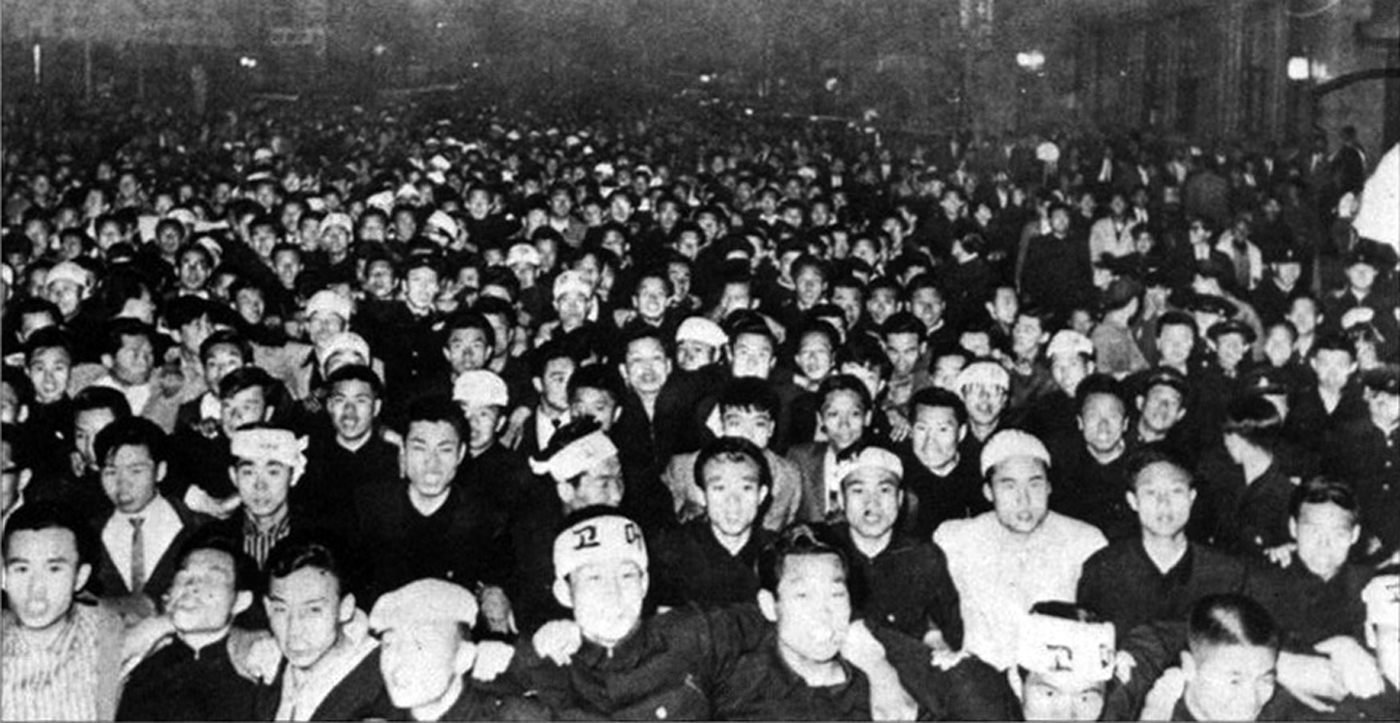
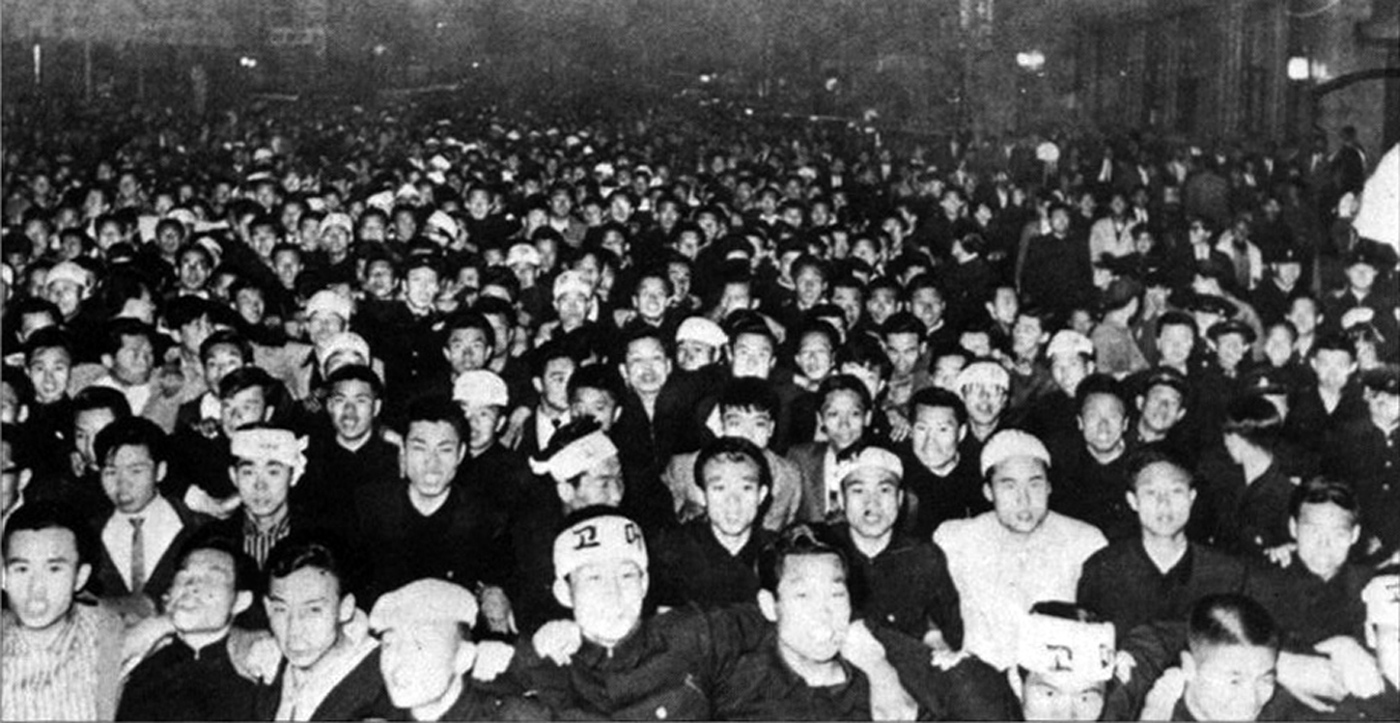
In the absence of actual interactions, student solidarity played an important part in the unfolding of the 1960 demonstrations. Reports of the shocking Taegu marches of February 28 spurred high school students in other cities, such as Taejŏn and Seoul, to stage marches of their own in the first half of March. Following the March 15 riots, stories of police violence against youths in Masan became a central grievance in subsequent student marches, particularly in the crucial demonstrations precipitated by the discovery of Kim Chuyŏl. Intermural competitiveness surfaced frequently as an important enabling factor by motivating reluctant students to join their peers on the streets, as indicated in oral and written testimonies from the Taegu and Masan demonstrations. Moreover, in conjunction with the Kim Chuyŏl story, growing criticisms among high school protestors about continued undergraduate inaction prompted university student leaders to plan a joint demonstration on or after April 21 (Hanguk 2001, 38, 169). Further attesting to the salience of cross-school rivalries and student solidarity, student leaders at Korea University organized a surprise march on April 18 to upstage other universities located in the capital. News of this preemptive action and student injuries immediately precipitated the eruption of the massive university protests on April 19, several days ahead of the planned date. (see figure 1).
Korea University students protesting in front of the National Assembly Building on April 18, 1960. Many of the student demonstrators wore “Kodae” (Korea University) headbands during their march. Courtesy of the Korea Democracy Foundation.
In terms of ideational resources, student demonstrators turned to the classic “script for action” of the upright youth protest, which they had learned in lessons on national history, as well as through participation in NDSC rallies and commemorations. Reflecting on students' co-optation of this statist model of action, one observer remarked in the wake of the Taegu marches that
More so than those of other generations, students of the present generation participate frequently in “temo” [demonstrations]. They regard “temo” as a banal affair. The thought arises that this sort of ingrained experience is the principal cause for their easy appropriation of the “temo” form. (Saebyŏk 1960, 99)
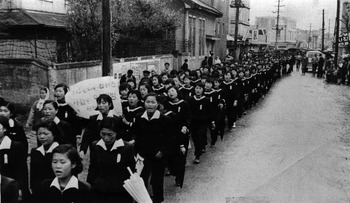
Students utilized their conversancy in “statist demonstrations” (kwanje siwi), or “temo,” in several ways. For starters, between eluding police obstacles and rushing in rugby-style scrums, they replicated the organized marching formations of official rallies in order to point up their solemnity and pacifism. Numerous protestors emphasized in their testimonies and interviews that they had marched in “disciplined and orderly fashion” (chilsŏ chŏngyŏnhage) to indicate the upstanding nature of their protest (4.19 Charyo 1960). Second, protesting students frequently drew on the music of official rallies to express their unified indignation in such songs as the national anthem “Patriotic Hymn” (Aegukka), the war ballad “Comrade in Arms” (Chŏnuga), and the “NDSC Song” (Hakto hoguktanga) (Tonga ilbo 1960; 3.15 ŭigŏ 1995). Finally, students shouted slogans and carried placards in all of the street demonstrations of March and April 1960. Although their strident demands for new elections and the redress of police violence contrasted starkly with the anticommunist chants and banners of statist rallies, they derived from the same template of collective student action (see figure 2).
Students of Sŏngji Girls' High School marching in Masan after the discovery of Kim Chuyŏl's body on April 11, 1960. Courtesy of Tonga ilbo.

Among journalists, opposition politicians, and ordinary citizens, recognition of this nationalist script underlay the resonance of the demonstrations and, to a large degree, shielded student marchers from serious consequences. To facilitate understanding in these terms, protestors carefully framed their claims in the idiom of moral youth protest in order to euphemize the antigovernment thrust of their actions. De-ideologized slogans appealed to student rights, the sanctity of education, legal principles, and basic democratic ideals in voicing grievances over LP conduct surrounding the elections. The following is a sampling of slogans chanted by protesting students in Seoul and Pusan in late March and early April 1960:
(1) Students! Rise up!
(2) The government should bear responsibility for the Masan Incident!
(3) The police should bear responsibility for the student shooting incident!
(4) We want a fair election!
(5) We reject the murderous elections!
(6) Peaceful demonstrations are our right!
(7) Give campuses freedom!
(8) Long live the Republic of Korea! (Hanguk ilbo 1960; Tonga ilbo 1960)
In the final stages of April 1960, open criticisms of the LP and demands for Rhee's ouster grew more frequent. But even as protestors increasingly politicized their claims, they consistently presented themselves as conscientious students unfettered by ideological influence or political motivations. To be sure, LP officials did attempt to attribute student demonstrations to leftist instigation, but such clumsy allegations simply did not hold water. In fact, not so much as a student suspension or a temporary school closure resulted from such tactics.
Student bloodshed buttressed the salience of the scholastic frame—a phenomenon that first became evident in the wake of the March 15 riots. Because the national media focused primarily on the incident's youthful victims, it came to be widely known as a student-led uprising, despite its predominant composition of adult men (Masan 1960; Tonga ilbo 1960). The subsequent discovery of Kim Chuyŏl's body on April 11 solidified this perception. Hours after the riots, local police disposed of the boy in Masan Bay due to the brutal cause of his death: an errant tear gas canister that had penetrated his left eye socket. The appalling story stoked public furor over LP-sanctioned violence, and the image of Kim's brutalized corpse emerged as a key symbol of the escalating student protest. The armed suppression of the April 18–26 demonstrations only served to bolster the nationalist legitimacy of the protestors. Loaded with symbolic value, the 183 deaths that resulted were pivotal in eliminating the final shreds of public support for Syngman Rhee.
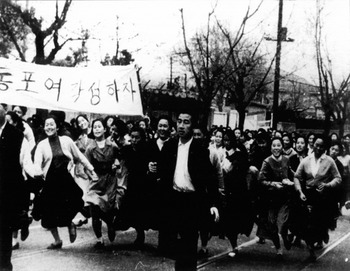
It is important to note that as much as the scholastic frame generated student protests, it also limited their scope. Most significantly, the nationalist lens obfuscated the class-based dimension of April 19th. While students headlined the demonstrations, the workers, day laborers, and unemployed citizens who joined them on the streets at numerous key junctures appeared most commonly in newspaper stories in the vague, neutral categories of “citizens” (simin) and “throngs” (kunjung). Similarly, the small group of leftist university students involved in the planning of the massive April 19 demonstration felt compelled to censor their own socialist and social-democratic views in order to avoid alienating their more moderate peers and to dissociate themselves from politically immoderate associations (Hanguk 2001, 168). Viewed in terms of protest strategy, journalists, opposition politicians, and the protestors themselves cautiously defined the unraveling demonstrations in the nationalist, student-centered idiom in order to circumscribe their political meaning within the limits of South Korea's anticommunist ideology (see figure 3).
Yonsei University students taking to the streets on April 19, 1960. Courtesy of the Korea Democracy Foundation.

Conclusion
Harkening back to Kim Chuyŏl, Pak Chongch'ŏl, Yi Hanyŏl, and other youthful victims of government suppression in the 1980s would also serve to rally the public in support of student movements. This is a clear reflection of the firm legitimacy that youth victimization and moral student action have held in public discourse in South Korea. Owing to their privileged position in society, student demonstrators have succeeded in exerting a major influence in national politics at various times and places in modern East Asia. In this broader regional context, April 19th in South Korea bears a striking resemblance to the Tiananmen Square protests of 1989. Notably, in the “political theater” of the latter event, student protestors appropriated statist scripts of action, while mobilizing memories of key events in China's modern past, in particular, the May Fourth Movement of 1919 (Esherick and Wasserstrom Reference Esherick and Wasserstrom1990). Unlike in China, the tactics, alliances, and causes of youth-driven movements in South Korea would develop sophistication, density, and diversity in concert with the country's great transformation after 1960, as Namhee Lee has shown in her important book (Reference Lee2007). Yet, despite the many changes, moral youth action against the authoritarian state would remain the predominant idiom for the legitimate expression of political, economic, and social discontent until the democratic transition of 1987.
On a final note, the April 1960 protests provide an interesting contrast with the May 1968 protests in France. In the latter case, the remarkable diversity of participants, who achieved “unforeseen alliances and synchronicities” across social segments, was a critical dimension of its contemporary magnitude in France. It was only after its disappointing denouement that interpreters began to simplify the event as a “youth rebellion,” further depoliticizing May 1968 of its radical and transformative qualities (Ross Reference Ross2002). In contrast, revisionist scholars in South Korea have, in the 1980s and 1990s, sought to repoliticize the 1960 protests by recovering the social diversity of protestors—in particular, its subaltern components (D. Kim Reference Kim1997). The long-term interplay between South Korea's official anticommunist discourse and progressive counter-movements, in large part, accounts for these divergences from the French experience.
Acknowledgments
I am very grateful to Nancy Abelmann, Charles Armstrong, Eun-Jin Lee, Andre Schmid, two anonymous reviewers, and the Editor for their invaluable feedback on earlier versions of this article.