Introduction
Conservation of many species is challenged by the lack of specific information about critical life-stages including dispersal and establishment (Schemske et al. Reference Schemske, Husbands, Ruckelshaus, Goodwillie, Parker and Bishop1994); these challenges become even more acute in the face of fragmented habitats and changing climate (Heller & Zavaleta Reference Heller and Zavaleta2009; Ellis Reference Ellis2011), and especially for groups of organisms with few demographic studies (Ellis & Yahr Reference Ellis, Yahr, Hodkinson, Jones, Waldren and Parnell2010). Lichens are generally held up as examples of long-lived, slow-growing organisms, though ephemeral lichen species do exist (Poelt & Vězda Reference Poelt and Vězda1990), in which life spans can be as short as a few months. Such species appear to have life cycles dictated in part by disturbance required for the creation of their habitats, for example on soils in forestry settings (Kantvilas Reference Kantvilas2005), or on small pebbles, detritus or other unstable habitats, where fast pre-emption of resources (i.e. space) is critical for reproduction (Grime Reference Grime1977).
Cladonia is a genus of more than 450 species, perhaps best known for long ecological persistence in the extensive mats of Cladonia subgenus Cladina (reindeer lichens), relatively late-successional species dominating huge areas of the taiga over periods spanning many decades (Ahti Reference Ahti1961). In contrast, many Cladonia subgenus Cladonia are largely early-colonizing species, limited in both physical and temporal habitat availability. The circumboreal species C. botrytes falls into this latter group, being confined to decaying wood and bark during a relatively narrow window between appearance of the substratum and its progression through medium to advanced states of decay. It is a diminutive Cladonia species, often dwarfed by the other co-occurring species (e.g. larger statured lichens, mosses or vascular plants) and with local population persistence determined in part by habitat patch dynamics as stumps decay and are overtopped by bryophytes (Caruso et al. Reference Caruso, Thor and Snall2010). Cladonia botrytes is listed as a conservation target in several central European countries (Austria, Germany, Poland and Switzerland; Coppins & Coppins Reference Coppins and Coppins1998) and Britain and Ireland, although it is common in northern parts of its range (e.g. Norway, northern North America; Lynge Reference Lynge1921; Thompson Reference Thompson1967; Dahl & Krog Reference Dahl and Krog1973).
In the UK, Cladonia botrytes is known from only 16 10-km grid squares, all in Scotland, 13 of which are from confirmed herbarium collections or from observations since the 1990s (Coppins & Coppins Reference Coppins and Coppins1998; National Biodiversity Network 2012). Most occurrences are in the major watersheds of the Cairngorm Mountains, almost exclusively on cut stumps of conifers, mainly Pinus sylvestris (Coppins & Coppins Reference Coppins and Coppins1998; Street Reference Street1998). In Britain, occurrences are comprised of small, continuous mats of primary squamules producing one to several podetia occupying a discrete area on the cut surface. Outside Britain, it can be a common species on stumps (Caruso et al. Reference Caruso, Rudolphi and Thor2008), where it is found growing in more extensive swards and occupying other types of conifer lignum in the boreal-continental region of Eurasia and North America (Litterski Reference Litterski1992), extending to montane regions of the temperate zone (Litterski & Ahti Reference Litterski and Ahti2004).
We present the first demographic study of Cladonia botrytes in Britain. We traced the occurrence of individual mats of podetia-bearing squamules (hereafter called mats) on stumps following the discovery of Britain's largest-known recent population in 1998 at Kindrogan, a Scottish Field Study Centre. Monitoring of populations of C. botrytes was carried out by students attending annual Lichen Identification courses, providing a unique opportunity to collect data on population dynamics of this species. We document the rapid change in population size, a trend of steady decline and eventual local extirpation. Additionally, we suggest that the life history of this lichen in the UK is largely annual, with a relatively small proportion of mats persisting more than a single year. We use these findings to frame the likely conservation implications for this species in Britain. We also base our discussion on a comparison of regional survey data from two time points across several populations.
Methods
Detailed demographic study
A site in central Scotland, at Kindrogan Field Centre, Perthshire (56°45′N, 3°33′W), was monitored since the discovery of C. botrytes in 1998 until its local extirpation in 2011. The site is characterized by mixed non-native conifer plantation, clear-felled probably in the late 1970s (c. 1978), when the stumps were created. The site was replanted with conifer, but in two places the plantings failed, creating two open, sheltered clearings where C. botrytes was subsequently discovered on stumps. Each year, surveys of cut stumps in two clearings were made with the assistance of members of the annual ‘Introduction to Lichens Field Course’ run by BJC and AMC. Clearings were separated by c. 100 m of plantation, and were treated as separate populations.
In Britain, C. botrytes ‘individuals’ are comprised of a small mat of basal squamules, often surmounted by one to several podetia; these so-called ‘mats’ tend to occupy an area of only c. 1 cm2, rather than the large swards which occur in other parts of its range. Occurrences as small, isolated mats make the demographic approach of tracking individual thalli feasible. Methodology for monitoring populations of C. botrytes was devised by AMC: each year in April, every stump was examined and the location of each individual mat of C. botrytes squamules with podetia was mapped by noting compass bearing and distance from the centre of each stump. Mats of primary squamules without podetia were not counted or tracked, and multiple discrete mats could occur on a single stump. Hereafter, the individual tracked reproductive mats will be referred to as ‘mats’ for simplicity. The number of podetia was also counted in each mat as an estimate of reproductive output, but individual apothecia were not counted (more than one apothecium may occur on a podetium). Identification of C. botrytes in the field was checked in each instance by BJC, and a photographic record made.
To estimate the error in recording mat position, a known point was measured using an equivalent method by a sample of recorders, and an observed discrepancy in bearing and distance was used to combine readings that were likely to be the result of erroneous records. Sketch maps were drawn of cut stumps, including C. botrytes mats, stump centres, and other conspicuous ‘landmarks’ (e.g. stump topography, other species, bark, decay) to ensure that position data from observers were correct and unambiguous. All field data were checked by AMC, and all reliable data from hand-written records were collated by BJC and RY. Data from each clearing were treated as separate populations.
Population trends
A population is defined as all the individual reproductive mats occurring within a spatially-delimited area. In the demographic study, each population occupies a group of spatially clustered stumps within a small clearing. Trends in population size over time were quantified using three measures: 1) the number of stumps with extant C. botrytes for each clearing; 2) the total number of mats per clearing, tracked on a per-stump basis; 3) the total number of podetia within a clearing.
Where a stump was not re-found in a given year (missing data), we assumed that mats persisted in the same state as the previous year, for example assumed present in 2001 if present in 2000, though lacking data for 2001. Since individual mats could be tracked across years, persistence of mats was examined by plotting the number of years a mat was found at the same location (i.e. distance and bearing). If mats were found in the same position as a previously identified mat, it was considered the same ‘individual’, even if there were gaps in the observations (i.e. observed in 1999, not observed in 2000 or 2001, observed in 2002).
Spatial factors
We examined the contribution of separate stumps to the overall population size within a clearing by ranking an individual stump according to the proportion of mats which it supported during the life-span of the entire population. Spatial aggregation of colonized stumps was calculated using Geary's C statistic with a weighting factor equivalent to the proportion of mats occurring on a stump during the lifespan of the population. The expected value under a spatially random pattern is 1, with values less than 1 and approaching zero indicating positive aggregation, and values greater than 1 indicating segregation (Geary Reference Geary1954). Significant clumping of colonized stumps is likely a product of frequent short dispersal events, whereas random or segregated distributions suggest a higher level of background dispersal.
Site surveys
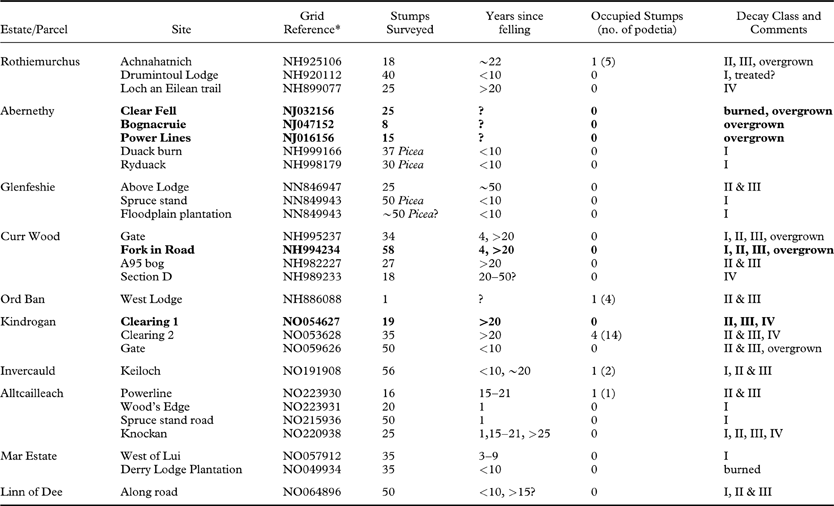
For the wider regional surveys, field visits were carried out in September–November 2006 by searching sites previously identified (Street Reference Street1998) and newly targeted ones (Table 1). As in the demographic study, a population is defined as all the individual reproductive mats occupying a spatially-discrete site. All sites searched occupy discrete blocks of forestry or spatially-discrete areas of pine woodland. Contacts with land managers helped to identify new potential sites with conifer (mostly Pinus sylvestris) stumps of suitable age. Stumps were mostly between 4 and 25 years since felling, cut at about 30–70 cm from the ground. Typically, in any site, all the visible conifer stumps were searched with the assistance of a hand lens, and pine stumps were particularly targeted. For stumps where C. botrytes was present, the stump was measured and a species list of the cut surface assembled. Stumps without C. botrytes were typically not measured, as this would have proved too time-consuming. Other conifer lignum substrata were also searched wherever they were encountered within study sites. The decay state of stumps was assessed using a scoring system based on Pyle & Brown (Reference Pyle and Brown1998) and Makinen et al. (Reference Makinen, Hynynen, Siitonen and Sievaneni2006): early stages of decay, Class I stumps have bark firmly attached with the exposed wood still hard and appearing freshly cut or only slightly bleached. Weakly decayed stumps fall into Class II, having loose bark present, outer layers of wood beginning to soften, but with the core still fairly hard, and wood able to be penetrated by a knife less than 1 cm. Medium decay or Class III is indicated by the absence of bark, a thin spongy layer in the sapwood (often indicated by blocky products of brown-rot fungi), the core of the wood still hard, but crevices indicative of sapwood sloughing beginning to form, and penetrable between 1–5 cm with a knife. Class IV stumps are often no longer circular in outline owing to breakage and decomposition.
Sites and stumps surveyed and occurrence of C. botrytes by stump condition in 2006. Those representing re-surveys of known occurrences are marked in bold.
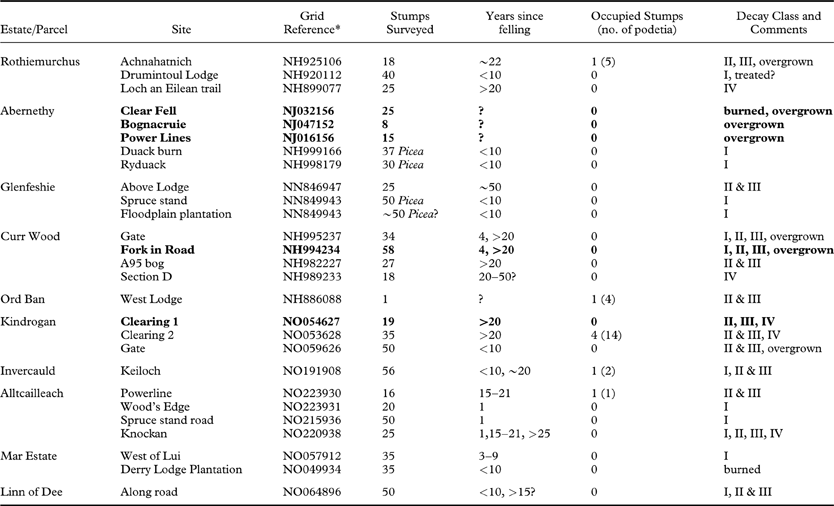
* British National Grid references (map datum from Ordnance Survey of Great Britain) are given for each stump with C. botrytes, if found, or for the approximate centre of the site surveyed.
Results
Detailed demographic study
Population trends
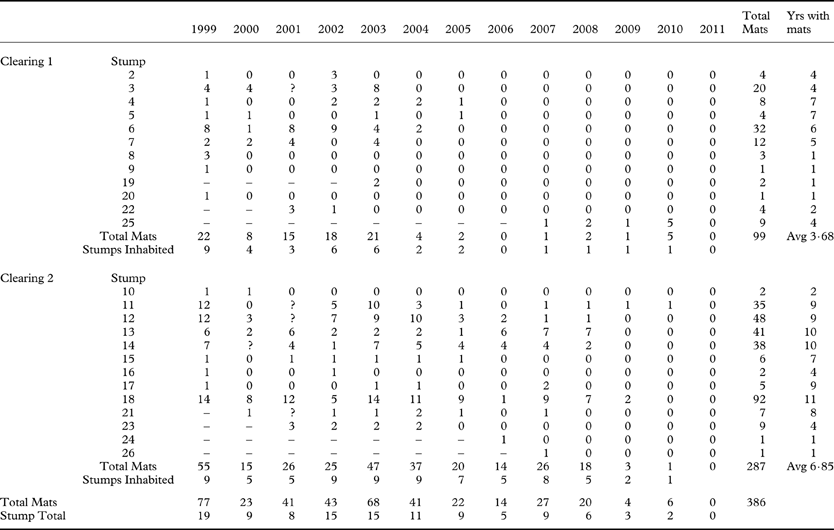
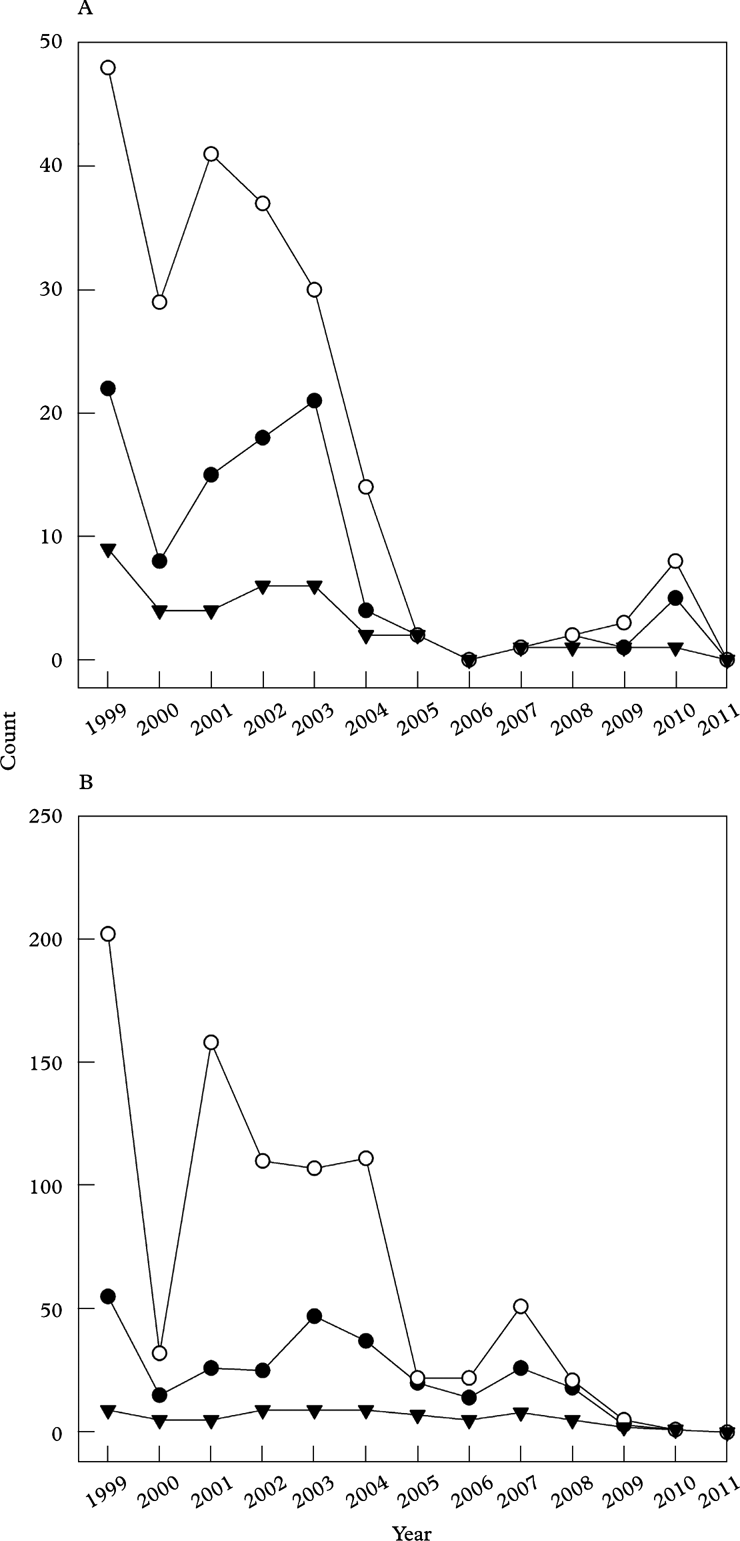
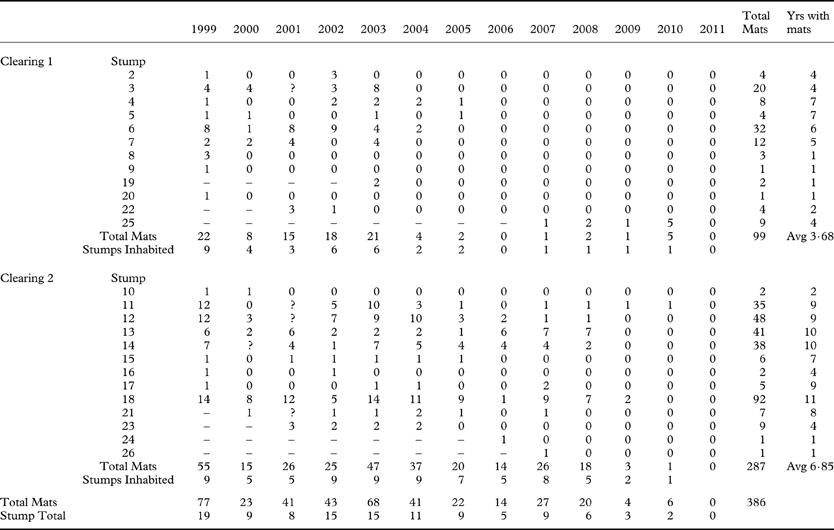
The populations at Kindrogan Field Centre were first discovered in 1998 and individuals were tracked for 13 years, until no further occurrences of C. botrytes could be found (from 2011 onwards). In the first year (1998), a single mat was recorded from a single stump; the following year, more focused exploration revealed 77 individual mats from 19 stumps distributed in two separate clearings. Of about 50–60 available stumps across the two clearings, only 25 were ever found to host C. botrytes. In both clearings, the general trend over the course of the study was of decline in the number of stumps colonized and in the mats and podetia recorded, but with wide fluctuations. Individual stumps were characterized by different demographic patterns (Table 2), although these were broadly similar across clearings (Fig. 1). The maximum number of mats per stump in a given year was 14, observed on Stump 18 in two separate, non-consecutive years. On average, stumps in Clearing 2 supported more mats (for stumps with mats in a given year, Clearing 1 had on average 2·8±2·2 mats per stump versus 3·9±3·7 for Clearing 2) and for nearly twice as many years as those in Clearing 1 (Table 2).
Kindrogan: mat summaries by clearing, stump and year.
Population trends of C. botrytes at Kindrogan Hill, Perthshire; A, Clearing 1; B, Clearing 2 (note the difference in vertical axis scaling. ▼, number of stumps colonized; •, number of reproductive mats over all stumps; ○ total number of podetia per year.

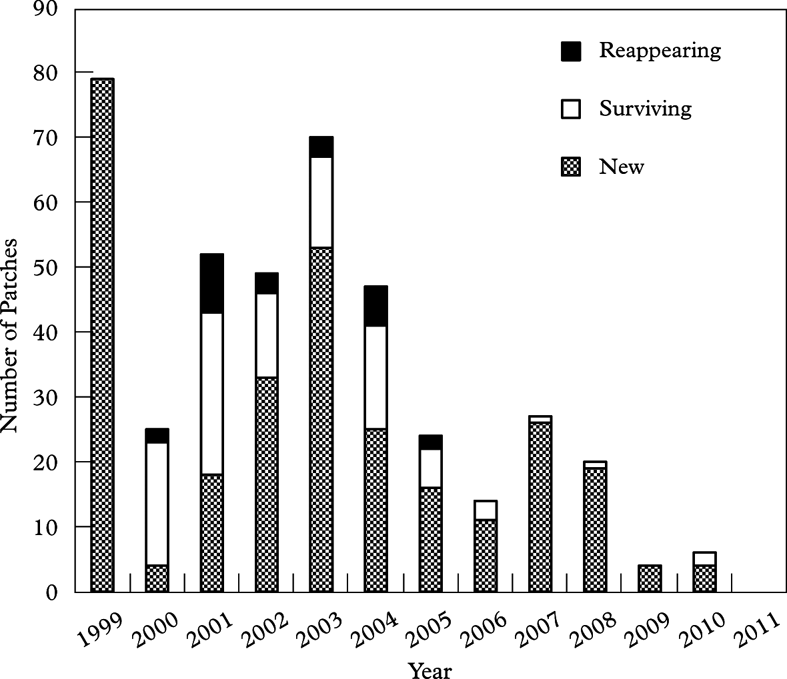
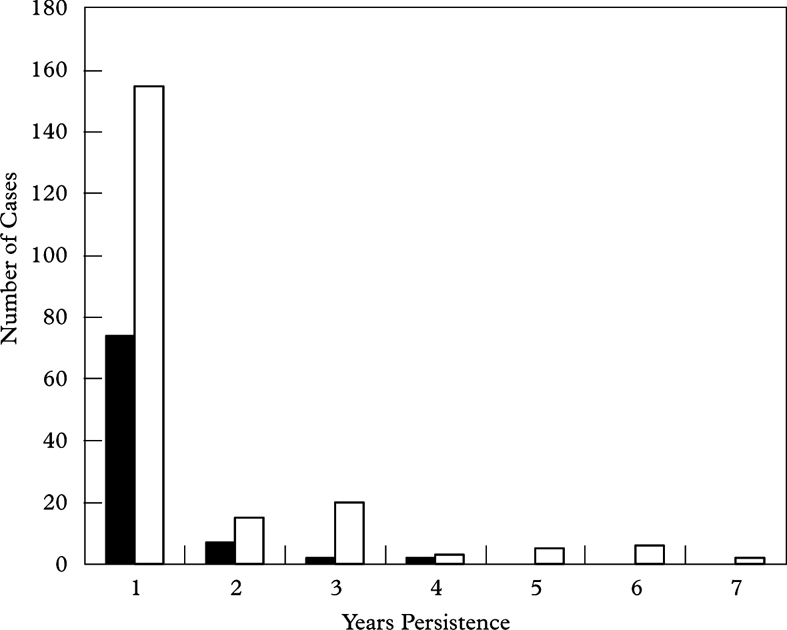
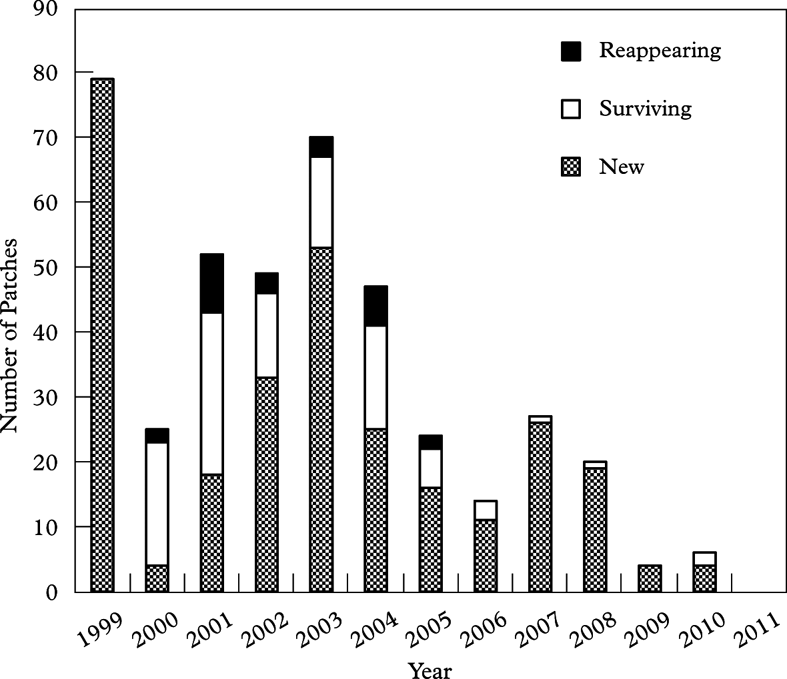
Our data indicate transient population dynamics of C. botrytes, in which a majority of mats in most years are new occurrences, with fewer examples surviving from previous years, or reappearing at the same location after a period of absence (Fig. 2). First, we deal with survival of new mats: of a total of 291 unique mats with podetia (‘reproductive mats’) 78·7% persisted for a single year, with only 13·7% of mats persisting for 3 or more consecutive years (Fig. 3).
Status of reproductive mats by year for all mats across clearings. Re-appearring mats are those which occupy the same position following one or more years of absence.
Years of continuous individual mat persistence by clearing; ▪ clearing 1; □ clearing 2.
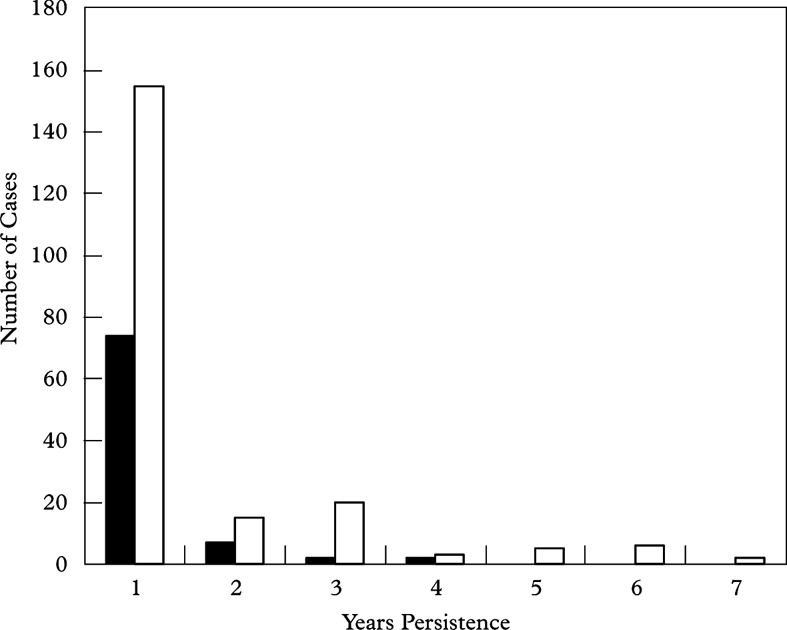
Secondly, we consider reappearing mats: for stumps which had been consistently recorded, there were sometimes gaps between observations of the same mat (n = 26), that is a mat observed at a given position in one year, was absent for one or more following years, and then subsequently reappeared in the same position. This may reflect transient dynamics of the mat, and/or the ephemeral nature of podetia used to locate the mat (i.e. squamules may have persisted, but podetia did not). If the duration of second (and in only two cases subsequent) appearances are added to those of the first, the maximal persistence of an individual reproductive mat is 7 years (2 cases, with gaps of 2 and 4 years, respectively). Six cases apparently persisted for 6 years (3 with 2-year gaps, 2 with 1-year gaps and 1 with two gaps of 1 and 2 years, respectively) (Fig. 3). Observations across years directly support the ephemeral nature of podetia. Repeat observations for mats demonstrated that individual podetia can persist over the course of two years, though podetia at an identical position to the previous year often appeared senescent in the second year.
Spatial factors
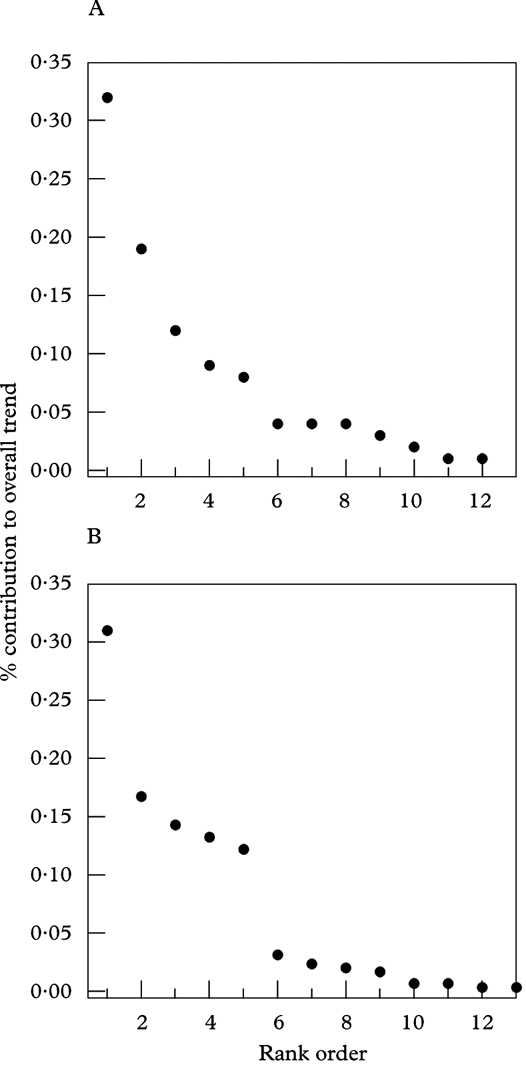
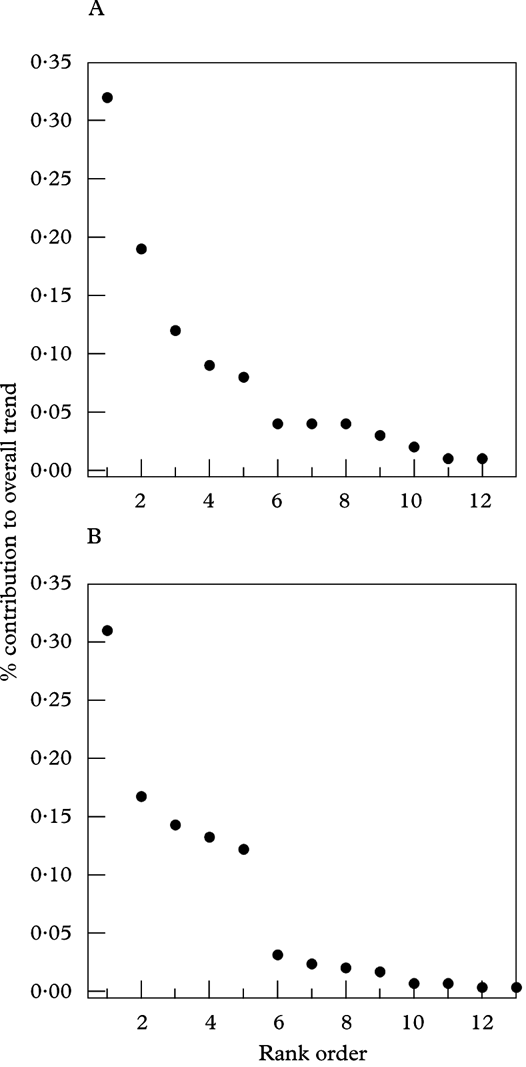
Relatively few stumps in each clearing contributed to the overall population trend, with only three stumps in each clearing accounting for more than 60% of all mats observed in that clearing across all years (Fig. 4). Based on their contribution to the populations within each clearing, occupied stumps were not spatially aggregated in either clearing (Clearing 1, Geary's C=0·784, P>0·1; Clearing 2, Geary's C=1·154, P>0·1), with the test statistic indicating a near random spatial structure in both clearings.
Contribution of individual stumps to total population size. Ranks are given for percentage of total population across all years found on a given stump for; A, clearing 1; B, clearing 2.
Regional site surveys
Across 27 sites, 685 pine stumps and 165 spruce stumps were searched in 2006. Only 8 stumps out of more than 800 searched supported C. botrytes, with half in a single site, Kindrogan Clearing 2 (now extirpated). In the sites where the most C. botrytes mats had been recorded in 1998 (e.g. Abernethy's Power Lines, Clear Fell and Bognacruie), loss of C. botrytes was attributed to overgrowth by shrubs, mostly Calluna vulgaris and Vaccinium myrtillus. In 2006, C. botrytes was found only on cut surfaces of pine, and only once on one end of a cylindrical cut piece of slash rather than a stump rooted in the ground. This slash log was upturned and mimicked a stump.
Stumps which supported C. botrytes in 2006 had a generally south-east facing aspect (Table 1) and belonged to decay Class II or III. The size of stumps was 57 cm in diameter on average (range 15–85), and 36 cm in height (15–80; Table 1). Stumps of less than ten years since felling did not support this species.
Discussion
We report transient population dynamics of the conservation priority species, Cladonia botrytes, at three spatial scales. First, at a regional scale and across the British range of the species, none of the prior populations known from 1998 was extant after eight years (2006), but five new populations were discovered, four of which were comprised of a single stump, each with a single reproductive mat (the fifth was Kindrogan Clearing 2). Secondly, we report the discovery and disappearance of two populations over the course of a 13 year demographic study at Kindrogan. Lastly, we report the transient nature of individual reproductive mats of the lichen on stumps at Kindrogan, with the vast majority (>78%) of monitored mats appearing and disappearing within one year. Local site factors appear to play an important role in population dynamics, since at the Kindrogan site Clearing 2 had more individuals with higher reproductive output and stumps which were occupied for nearly twice as long, as compared with the population in Clearing 1 (Fig. 1).
We also highlight several caveats to the interpretation of the data. The observations in our study were limited to mats of squamules with podetia. In Britain, C. botrytes ‘individuals’ are comprised of a small mat of basal squamules, often surmounted by one to several podetia (average 2·3 ± 2·4, n=265 unique mats); these so-called ‘mats’ tend to occupy an area of only c. 1 cm2. It is possible that the mycelium or primary thallus does persist for a relatively long period in a minority of cases. However, from our data, podetia are mostly annual in persistence, and this may account for the gaps in observations for mats, if the primary thallus or mycelium persists but podetia are not always present. Furthermore, there is some ambiguity in the persistence times of reproductive mats because in a small number of cases, stumps were not relocated for a given year. In 2001, four stumps were not relocated (n=30 mats), and in 2000, one stump was not relocated (n=7 mats), with the assumption that mats persisted through these periods with missing data. This assumption provided a conservative estimate for persistence, which assumes mat longevity and underscores the observed transient nature of the reproductive mats. Additional factors may have had a bearing on the observed presence of podetia; for example, clearings were subject to occasional disturbance by the activities of school groups based at Kindrogan, and evidence that stump edges were sometimes scraped away by badgers foraging for invertebrates was also observed.
Given some circumspection around the persistence of mycelia or non-reproductive mats, two elements, dispersal and habitat quality, help to explain transient dynamics in C. botrytes.
Dispersal
All stumps within the two clearings at Kindrogan were of an equivalent age and occurred within a similar stand-setting, and there was no evidence of spatial aggregation of colonized stumps in the populations monitored. Overall population patterns within each clearing show that few of the stumps accounted for a large numerical proportion of the population. This non-aggregated pattern of heavily-colonized stumps suggests that beyond the edge of an individual stump (the habitat patch), background dispersal must be important for local population dynamics or, alternatively, that all stumps within clearings are within local dispersal ranges. Taken together with regional survey data, it seems likely that background long-distance dispersal is probably responsible for a low-frequency rain of spores at population and regional scales, in line with theoretical predictions of high dispersal for species of ephemeral habitats (Travis & Dytham Reference Travis and Dytham1999). Our results contrast therefore with studies on C. botrytes in Sweden, where the colonization of stumps increased with the rising number of nearby occupied stumps (Caruso et al. Reference Caruso, Thor and Snall2010). In that study, colonization also decreased with increasing decay of stumps, showing the sensitivity of the species to habitat patch dynamics as well as demographic factors (Caruso et al. Reference Caruso, Thor and Snall2010).
Habitat Quality
Observations of C. botrytes were made on stumps only in decay classes II and III, corresponding to weak to medium decay stages, following classifications commonly in use for describing decomposition of logs (e.g. Pyle & Brown Reference Pyle and Brown1998; Makinen et al. Reference Makinen, Hynynen, Siitonen and Sievaneni2006). Likewise, the populations at Kindrogan Field Centre occupied stumps from about 20–30 years since felling, slightly older than the peak abundances found in a Swedish study, where C. botrytes was most abundant on stumps 12–13 years since felling (where stumps normally decay about 20 years after felling; Caruso et al. Reference Caruso, Rudolphi and Thor2008). We surmise that C. botrytes was likely to have been present on the Kindrogan stumps for several years prior to its discovery there in 1998.
Wood decomposition is known to correlate with microenvironmental factors such as moisture content, though autogenic factors (especially competition) may be equally important in determining the occurrence of the diminutive C. botrytes. For this species, a narrow temporal window may exist between felling of pines and overgrowth of the understorey and other larger-statured and more competitive lichens and bryophytes (e.g. Caruso & Rudolphi Reference Caruso and Rudolphi2009). A typical succession of lichen species on stumps may progress from normally epiphytic species to the species-rich swards on intermediate-aged substrata, and finally to those which are more commonly found on soil in later stages of decay (Krueger & Daniels Reference Krueger and Daniels1998). These vegetation processes extend beyond the stump surface and include dynamics within the surrounding vegetation; for example, Kindrogan Clearing 1 is smaller in area than Clearing 2, with stumps more subject to shading and needle deposition from surrounding conifers. This difference may account for shorter overall persistence times of the population in Clearing 1, and for the loss of C. botrytes on the affected stumps near the clearing edges. Likewise, the sites from 1998 with the most C. botrytes, and from which the species was absent in 2006 surveys, had been overgrown by shrubs, mostly Calluna vulgaris and Vaccinium myrtillus. This is partly explained by changes to deer management across Scotland, with increased culling of red deer during 1994–2000 following the Deer (Scotland) Act (1996), and persistently high cull levels through to 2009 (Anon. 2001, 2006). Consequently, habitats have experienced lower grazing pressure during the 1990s and 2000s than over the last century. In Scotland, grazing is associated with a decrease in both vegetation height and biomass with increasing deer density (Baines et al. Reference Baines, Sage and Baines1994; Hegland et al. Reference Hegland, Rydgren and Seldal2006). The effects of deer on Calluna vulgaris and Vaccinium myrtillus, that is decreasing cover and height (Baines et al. Reference Baines, Sage and Baines1994), suggest deer maintain an open understorey, conditions associated with the occurrence of C. botrytes and partly explaining its decline at sites with overgrown stumps. The addition of taller stumps to the landscape is currently being implemented in some pinewoods as a way to promote habitat diversity, and this may have the added benefit of providing longer-lived habitat patches for this species and others (Coppins & Coppins Reference Coppins and Coppins2006; Rothero Reference Rothero2008).
The threat status of Cladonia botrytes in Britain can be explained by factors which integrate its life-history with the man-made habitat in which it occurs. The species' landscape-scale rarity may be explained by infrequent long-distance dispersal, that is dispersal limitation (Sillett et al. Reference Sillett, McCune, Peck, Rambo and Ruchty2000), and/or the limited availability of a suitable local habitat. Untangling dispersal limitation from habitat limitation requires careful study, but experimental evidence has demonstrated dispersal limitations in epiphytic lichen species of old forests (Dettki et al. Reference Dettki, Klintberg and Esseen2000; Hilmo & Sastad Reference Hilmo and Sastad2001) and it has been shown experimentally for wood-inhabiting decay fungi (Edman et al. Reference Edman, Kruys and Jonsson2004). Habitat limitation is known for patch-tracking species, with the loss of a patch (e.g. overgrowth or decay of a stump) resulting in local extinction (Fedrowitz et al. Reference Fedrowitz, Kuusinen and Snall2012). Similar to the landscape-scale trend of over-topping, stumps for the Kindrogan populations were increasingly shaded by the extension of adjacent conifer canopy, including litter rain from larch, and were altered by decay and the overgrowth of bryophytes and other Cladonia spp.
Conclusions
In Britain, the absence of old-growth stand structure and dynamics in the core part of C. botrytes range means that sympathetic habitat management is likely to offer the most tangible means of ensuring viable populations. For C. botrytes, this includes a continuous supply of suitable habitat across the landscape within the known range of the species, including maintaining sufficient deadwood habitat in the form of stumps and slash (off-cut ‘waste’ wood from forestry operations) in early to middle stages of decay, with sufficient grazing pressure to prevent overgrowth by ground-layer vegetation. Provision of small, open clearings within forestry plantations, where stumps are sheltered but well-lit and deer are available to graze developing shrub layers to prevent stumps becoming over-shaded, is recommended. Such targeted habitats will benefit other forms of wildlife which favour sheltered but well-lit glades within forest habitats (e.g. Fuller et al. Reference Fuller, Smith, Grice, Currie and Quine2007). A management goal within C. botrytes' British range is to increase the biodiversity of pinewoods by promoting deadwood habitats and their specialist species (e.g. Humphrey et al. Reference Humphrey, Stevenson, Whitfield and Swailas2002a, Reference Humphrey, Davey, Peace, Ferris and Hardingb; Rothero Reference Rothero2008). Recommendations for introducing new stumps above the height of the understorey will likely accommodate C. botrytes by providing cut-pine surfaces that will remain a suitable habitat long enough to be both suitably decayed but not overgrown by faster-growing vascular plants. The conservation of this diminutive and dynamic species must be thought of at the landscape scale, as local extinctions appear frequent, and a regional integrated approach to provide suitable habitat in a periodic way must be considered.
In contrast to the common perception of lichens as being long-lived organisms, we conclude that C. botrytes and probably other lichen species are transient and rare and encompass a unique set of conservation challenges. Analogues for this dynamic system are ‘hyperdispersed and ephemeral’ epiphytic orchids (Tremblay et al. Reference Tremblay, Melendez-Ackerman and Kapan2006) or saproxylic insects with ‘boom and bust’ population dynamics (e.g. Lemperiere & Marage Reference Lemperiere and Marage2010).
The project was funded by the Royal Botanic Garden Edinburgh, and grants from the Royal Society for the Protection of Birds and Cairngorms National Park. Scottish Natural Heritage funded preliminary work for Cladonia botrytes as a Scottish Priority lichen. Chris Ellis provided valuable discussions and comments on the manuscript. Surveys were greatly assisted by the help of the following: Abernethy, Andy Amphlett; Glen Feshie, Thomas Macdonnell; Rothiemurchus, Stuart Blackhall; Curr Wood, Ern Emmett and Henry Becker; Kindrogan, and Martyn Jamieson. In addition, Colin Leslie assisted by providing maps, and both he and Jim Gillies provided helpful discussions about forest management at Glen More and Inshriach. John Spittle from Forest Enterprise provided useful site history for the clearings at Kindrogan. We acknowledge the willing and enthusiastic involvement of the students who participated in the monitoring project at Kindrogan over 13 years, and especially Fraser McBirnie of Forest Research, who subsequently discovered C. botrytes at a new site in Curr Wood, and later refound it at Braemar. Jane Sears assisted with financial details. We are grateful for the funding, advice and assistance from these institutions and individuals.