I. Introduction
Since the early 19th century, the reception of the Parthenon frieze has enshrined its place among the canons of beauty in the modern Western world.Footnote 1 This evaluation of the frieze was written into its purchase from Lord Elgin by the British House of Commons in 1816. The House’s decision to buy the Elgin Marbles was informed by the recommendation of a group of artists, patrons and connoisseurs who judged the sculptures to be ‘the finest models and the most exquisite monuments of antiquity’.Footnote 2 Installed in the British Museum, the Marbles soon became renowned for their beauty, thanks not least to the admiring attention of writers and artists, from William Hazlitt and John Keats to Antonio Canova and Auguste Rodin.Footnote 3
Another was Sir Lawrence Alma-Tadema, who in 1868 completed his painting Phidias Showing the Frieze of the Parthenon to His Friends (fig. 1).Footnote 4 At the centre with his back to the frieze is Phidias, whom Plutarch says had a leading role in the Athenian building programme of the fifth century ‘due to his friendship with Pericles’. Specifically, the painting alludes to Plutarch’s comment that Phidias organized private viewings of his artworks for Pericles and his mistresses (Per. 13.9). Alma-Tadema envisages such a viewing. On scaffolding near the temple’s ceiling, Phidias presents the relief to Pericles, who stands on the right admiring the frieze beside a nattily clad woman, perhaps Aspasia. Plutarch makes no mention of the Parthenon frieze when discussing Pericles’ building projects. However well-informed, this scene is a flight of fantasy in which Alma-Tadema transposes onto antiquity the conditions for viewing the frieze close-up that he enjoyed in the British Museum.Footnote 5 More than that, the painting collapses ancient and modern aesthetic attitudes; just as we admire the frieze today, it suggests, so it was when it was made in the 430s BCE.Footnote 6
Phidias Showing the Frieze of the Parthenon to His Friends, Sir Lawrence Alma-Tadema, 1868, oil on panel, 72.5cm x 109cm, Birmingham Museums Trust.

Figure 1. Long description
The painting Phidias Showing the Frieze of the Parthenon to His Friends by Sir Lawrence Alma-Tadema, created in 1868, depicts a group of people gathered around Phidias, an ancient Greek sculptor, as he presents the frieze of the Parthenon. The scene is set in an ornate, classical interior with detailed architectural elements and frescoes on the walls. The figures are dressed in ancient Greek attire, and the composition captures a moment of intellectual and artistic discussion. The painting is executed in oil on panel and measures 72.5 centimetres by 109 centimetres.
One question the painting raises, then, is about the relationship between ancient and modern conceptions of beauty in art. Are they as equivalent as Alma-Tadema would have us believe? In this paper, I want to turn the question of beauty from the modern reception of the Parthenon frieze to its ancient manufacture and meaning. How important was beauty for those who commissioned and made the frieze? In what ways, if at all, did the subject matter and formal execution of the frieze relate to Classical Athenian notions of beauty?Footnote 7
Many have sought to link the frieze to the civic and political values expressed in Classical Athenian texts.Footnote 8 The relevance of Athenian aesthetic values for the frieze’s interpretation has been strangely neglected, however, despite their prominence, especially beauty, in Athenian texts. So, for example, in Thucydides’ rendition of his funeral oration of 431 BCE, soon after the Parthenon frieze was completed, Pericles honoured the city’s war dead by extolling an Athenian cultural ideology suffused with aesthetic concerns.Footnote 9 Athenians dispel their troubles, he says, with ‘delight’ (τέρψις) in ‘games and festivals held throughout the year and elegant [ϵὐπρϵπέσιν] private estates’ (2.38). The Athenian aesthetic sensibility is praiseworthy in its moderation: ‘we are lovers of beauty (φιλοκαλοῦμέν) without extravagance’ (2.40). Athenians’ responses to life’s greatest challenges are also glorified according to aesthetic principles. Τhey adapt to difficult circumstances ‘with consummate grace (χαρίτων)’, and fight in a manner that ‘adorns’ (κοσμέω) the polis (2.41–42). In this famous speech, Athens is presented as ‘an education to Greece’ in part because of the aesthetic habits and values woven into everyday life in the polis, whether in public festivities, private houses or action on the battlefield (2.41).
Thucydides’ reference to ‘delight in games and festivals’ highlights an aspect of life in Classical Athens where ideas about beauty came to the fore: divine worship.Footnote 10 As Jon Mikalson has shown, Classical Athenian literature and inscriptions repeatedly emphasize beauty in relation to a wide array of religious activities.Footnote 11 For instance, the aspiration that a procession or sacrifice be ‘beautiful’ (καλή), ‘as beautiful as possible’ (ὡς καλλίστη) or ‘worth seeing’ (ἀξιοθέατος).Footnote 12 Other common elements of festivals, such as musical and athletic contests, were also customarily assessed by aesthetic criteria.Footnote 13 The Athenians publicly honoured individuals who helped make the Panathenaea and City Dionysia ‘as beautiful as possible’ (ὡς κάλλιστα).Footnote 14 Such beauty in divine veneration was a matter of Athenian pride. In Plato’s Alcibiades, Socrates reports an uncompromising Athenian boast: ‘We perform the most sacrifices of the Greeks and the most beautiful ones (καλλίστας) … we have given the gods the most expensive and the most reverend processions’ (148e). Isocrates likewise claims that Athens ‘has the most spectacles and the most beautiful ones (θϵάματα πλϵῖστα καὶ κάλλιστα)’ (4.44–45).Footnote 15
The extensive textual evidence for beauty’s importance in Classical Athenian culture and religion offers an untapped opportunity for looking at the Parthenon frieze in light of contemporary Athenian religious and aesthetic attitudes. By drawing on the textual record in visual analysis of the frieze, I intend to show how its subject matter and formal execution relate to Athenian ideas about beauty and to what end. Far from being prized for its own sake, beauty’s significance for the frieze was entangled with political and theological interests.
Before we begin, a word on the Greek terminology for beauty. The Greek language contains a rich collection of terms and phrases for expressing beauty, understood as a pleasing aesthetic property of things (sights, sounds, activities and so on) that can inspire various responses: delight, admiration, wonder, awe, fear, even sadness. In any case, beauty attracts and demands attention. Because of its power to please and command attention, beauty confers value on that which possesses it, a kind of value immediately recognized in perception and experience. To investigate a culture’s views on beauty, then, is to investigate a culturally contingent system of value. Although these core features of beauty make it identifiable as a concept across time and place, and therefore viable as a topic of historical enquiry, they also permit endless variation. The things considered beautiful in a society and their significance in different areas of life, whether in art, religion, politics, ethics, attitudes to the body, gender or death, are culturally specific and labile.
The terminology for beauty in a given language is itself illuminating as to these cultural particularities. This is certainly true of ancient Greek, which has numerous conceptually interconnected terms to convey beauty, each with their own applications and nuances: for example, kalos (‘beautiful’, ‘fine’), kallos (‘beauty’), charis (‘beauty’), aglaia (‘splendour’, ‘glamorous beauty’), axiotheatos (‘worth seeing’), agalma (‘object of delight’), kosmos (‘ornament’, ‘adornment’) and megaloprepeia (‘splendour’, ‘magnificence’).Footnote 16 These words frequently appear in connection with religious activities. Of these, kalos and charis deserve special mention. Fundamental to charis in its different guises is the notion of ‘pleasure’. In some contexts, it can mean ‘beauty’ in the sense of a pleasing aesthetic property of things. In others, it can signify a ‘favour’ (a pleasing act from one person to another) or ‘gratitude’ (the pleasure felt by a beneficiary). As well as a term for beauty, then, charis denotes a social ideal of reciprocity based on the exchange of pleasing gifts and favours. This ideal underpinned Greek religion.Footnote 17 It was in hope of inspiring divine pleasure and favour (charis) that worshippers gave gods all kinds of offerings, from processions and sacrifices to temples and physical dedications of all sorts.
Kalos is an adjective often applied to those offerings in Greek texts.Footnote 18 Because kalos ranges from ‘beautiful’ in the sense of aesthetically attractive to ‘good’ or ‘appropriate’, we might wonder what makes, say, a procession kalos. Does this simply mean it was ‘good’, performed the right way as custom dictates? To be sure, kalos includes this sense of decorum when applied to religious rituals. But as scholars have shown, when we probe why such rituals were considered kalos, and the measures taken to make them so, kalos typically has an aesthetic bearing too: a pleasure to the eyes and ears of beholders, human and divine.Footnote 19
II. A subject worth seeing
With funds extorted from the Delian League, the Parthenon was built in Athena’s sanctuary on the Athenian acropolis (Plut. Per. 12, 14). When completed in 432 BCE, it was the largest and most richly decorated temple on the Greek mainland: a powerful expression of Athenian piety, power and economic prosperity some 50 years after the acropolis was sacked by the Persians.Footnote 20 It is hard not to see allusions to Athenian conflict with the Persians in the Parthenon’s relief metopes, decorated with battles between gods and Giants, Greeks and Trojans, Lapiths and Centaurs, Greeks and Amazons. The sculptures in the east pediment depicted the birth of Athena, those in the west her contest with Poseidon for patronage of Athens; two myths appropriate for a temple for Athena in her sacred heartland on the acropolis.
The subject of the frieze was also fitting in its local context: a grand religious procession of the kind held at Athenian festivals, not least on the acropolis. Contrary to what is often claimed, images of ritual were not uncommon on Greek temples. Processions adorned the column drums and sima parapet of the Archaic temple of Artemis at Ephesus, for example.Footnote 21 In other ways, the Parthenon frieze, like the temple to which it was attached, was exceptional. Carved on blocks of Pentelic marble one metre high, it encompassed all four sides of the temple’s exterior cella walls and measured some 160 metres in length, the largest single example of bas-relief from mainland Greece.
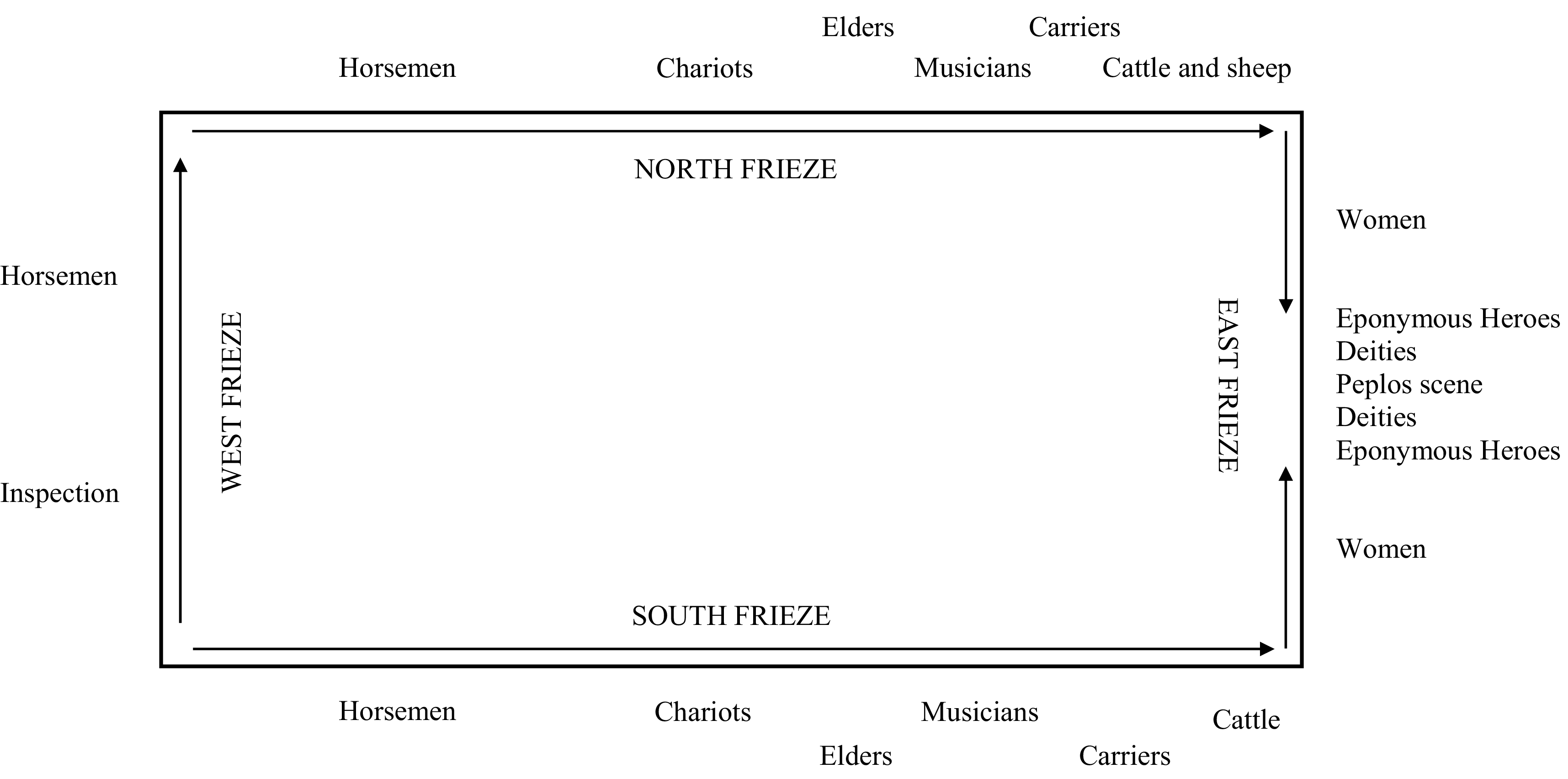
The narrative sequence of the frieze begins on the west side with a prelude to the procession as cavalrymen have their steeds inspected before joining the parade (fig. 2). On the north and south sides the procession is in full flow. Ranks of cavalry, horse-drawn chariots and various contingents of worshippers and sacrificial animals move towards the east side of the temple. There the parade continues, headed by large groups of maidens who process from left and right towards the centre of the east frieze, where Athens’ eponymous heroes and the Olympian gods are assembled to witness the procession and a ritual involving a robe conducted in their midst.
Plan of the Parthenon frieze.

Figure 2. Long description
The diagram illustrates the layout of the Parthenon frieze, divided into four sections: North Frieze, East Frieze, South Frieze and west frieze. The north frieze includes horsemen, chariots, elders, carriers, musicians, and cattle and sheep. The East Frieze features Women, Eponymous Heroes, Deities, a Peplos scene, Deities and eponymous heroes. The South Frieze contains Horsemen, Chariots, Musicians, Elders, Carriers and cattle. The west frieze displays horsemen and an inspection scene. Arrows indicate the direction of the narrative sequence around the frieze.
Every four years the Athenians offered a robe (peplos) to Athena Polias at the goddess’ Great Panathenaea festival, on the 28th of Hekatombaion in mid-summer.Footnote 22 This ritual’s inclusion on the east side is often regarded as the clincher that the subject of the whole frieze is the grand procession held during the Great Panathenaea, which began in the Kerameikos, snaked through the Agora and ended on the acropolis with a large sacrifice to Athena and the presentation of the peplos.Footnote 23 This seems to me a more prescriptive judgement of the frieze’s subject matter than is warranted by what the frieze itself shows. For while it includes things known to have been part of the Panathenaic procession, it omits many others that we know were part of it, and includes elements with no attestable relation to the Panathenaea. It seems safer to conclude, therefore, that the frieze ‘subsumes the Panathenaia but is not limited to it’; rather, it presents a ‘composite image … designed to evoke the general spirit of the city’s religious life’.Footnote 24
To evoke the general spirit of Athenian religion, an image of a festive procession was especially apposite. First, because of the communality of a large procession, a ritual that embodies like no other the community as a corporate group, united in movement and divine reverence. Second, because of the peculiar culture of festivity in Classical Athens, or, as Pericles puts it, the ‘delight in games and festivals throughout the year’ at the heart of Athenian democratic identity (Thuc. 2.38).Footnote 25 Involvement in ritual was the essential means by which Athenian citizens participated in their city’s political life.Footnote 26 According to Plutarch, ‘Pericles gave the reins to the people, and made his policy one of pleasing them, ever devising some sort of a pageant in the town for the masses, or a feast, or a procession’ (Per. 11.4). The Old Oligarch affirms that Athens had more festivals than any other state (3.8). Democratic Athens loved to put on a show and make a spectacle of itself in the act of honouring its gods. This is precisely what we see on the Parthenon frieze.
Although the frieze does not, in my view, record a particular event or represent a particular Athenian festival, it certainly envisages a procession of great public significance, to judge from both its inclusion in the temple’s decorative ensemble and its scale. The procession encircles the entire temple and features some 378 humans and 245 animals. This is a grand spectacle of the kind witnessed at the most important Athenian festivals, such as the Panathenaea, the City Dionysia and the Eleusinian Mysteries.Footnote 27 While concerns with beauty permeated many aspects of Athenian religion, sacred decrees indicate that certain festivals were accorded special aesthetic attention: unsurprisingly, those deemed most important in the religious calendar. In Classical Athens, specific measures were in place so that sacrifices at the Panathenaea, the Dionysia and the mysteries at Eleusis would be, as the inscriptions say, ‘as beautiful as possible’.Footnote 28 According to Classical Athenian sensibilities, then, the very subject of the Parthenon frieze, a grand sacrificial procession at a festival, was charged with the expectation of beauty. It portrays a ritual defined in popular Athenian discourse by the aspiration to be ‘worth seeing’ and ‘as beautiful as possible’.
So, what made a procession worthy of that aesthetic judgement in Athenian eyes? Does the procession depicted on the Parthenon frieze live up to those aesthetic ideals?
III. Equestrian aesthetics
The group given by far the greatest showtime on the frieze is the cavalry, who appear on its west, north and south sides and occupy nearly half of its total length. Though cavalcades were familiar sights at Athenian festivals, their prominence on the frieze is such that specific political and military explanations have been sought.Footnote 29 The most compelling is that they allude to recent military reforms which expanded the Athenian cavalry to a force of 1,000.Footnote 30 Hoplites still formed the bulk of the Athenian army but on the frieze the cavalry star because they were the new crème de la crème.Footnote 31 That citizens are soldiers was an idea deeply entrenched in Athenian democratic ideology, as the city’s tradition of funeral orations shows.Footnote 32 Another political factor behind the cavalry’s prominence on the frieze is suggested by Xenophon’s comment that ‘in our states the cavalry are recruited from those who have ample means and take a considerable part in the government’ (Eq. 2.1). From this perspective, the frieze’s emphasis on the cavalry is an assertion of Athenian civic duty, military might and socio-political elitism. However valid, this interpretation neglects any consideration of how the cavalry actually appears on the frieze. Time, then, to take a closer look.
The most obvious feature of the horses is their consistency in size, pose and proportion. Almost all hold their heads high, their necks arched, their manes standing on end, their front legs rearing in mid-air (fig. 3 SM (= supplementary material) and fig. 4). Most have large flaring nostrils, big round eyes and bulging veins on their legs and undercarriage. Many have their mouths slightly open in a neigh and, where visible, their tails raised. These common attributes give visual coherence to the cavalcade, while subtle variations in the angle of the horses’ heads, the height of their forelegs and the position of their hindlegs ensure that for all the horses’ consistency, the cavalcade does not appear monotonous.Footnote 33
Blocks XLII and XLIII of the north frieze of the Parthenon, ca. 438–432 BCE, marble, 1m H. London, British Museum 1816,0610.41 and 1816,0610.42.

Figure 4. Long description
The image shows a detailed marble relief sculpture from the north frieze of the Parthenon, dating back to approximately 438–432 BCE. The sculpture features a group of riders on horses, with the horses displaying consistent size, pose and proportion. The horses have their heads held high, their necks arched, their manes standing on end and their front legs rearing in mid-air. The riders are depicted in various dynamic poses, adding to the overall movement and energy of the scene. This relief is part of the collection at the British Museum in London, with the inventory numbers 1816,0610.41 and 1816,0610.42.
What does this have to do with beauty? First, it is noteworthy that alongside their association with wealth and aristocracy, horses are repeatedly aestheticized throughout Archaic and Classical Greek literature. A horse in the Iliad holds his head high ‘confident in his beauty’ (ἀγλαϊηφι πϵποιθώς, 6.510 = 15.267); Alcman praises the beauty of two choral dancers by comparing them to horses (fr. 1.44–59); Pindar sings of the ‘beauty’ (χάρις) of a horse victorious at the Olympic games (Ol. 1.18).Footnote 34 The strong aesthetic connotations of horses in Greek poetry entered the realm of prose around the mid-fifth century, when Simon of Athens wrote the first prose treatise about horses, On the Ideal Horse.Footnote 35 In what survives of this treatise, Simon is preoccupied with defining the best physical appearance in a horse. He underlines summetria, the ‘commensurability’ or ‘proportion’ so often tied to beauty in Classical Greek texts.Footnote 36 What looks best in a horse, in Simon’s view, is highly normative. Given their consistency in size, pose and form, strict adherence to a generic ideal likewise seems a fair assessment of the horses on the Parthenon frieze. Some more precise details also resonate with the frieze’s cavalry. The ideal horse should, Simon says, have big eyes, nostrils ‘as big as possible’ and, like the beautiful stallion in the Iliad, hold its head high.Footnote 37
In the early fourth century, Xenophon followed Simon’s cue with two treatises, On Horsemanship and On the Cavalry Commander.Footnote 38 Written by an Athenian versed in equestrianism, these two works provide rich, near-contemporary and relatively unused resources for understanding the aesthetics of the frieze’s cavalry.Footnote 39 In On Horsemanship, Xenophon is at pains to show what must be done for a horse to exhibit its ‘most beautiful and brilliant appearance’ (τὰ κάλλιστα καὶ λαμπρότατα, 11.6).Footnote 40 A horseman must encourage his steed to do what a horse naturally does when showing off to other horses (10.4–5):
he raises his neck highest and arches his head most, looking fierce; he lifts his legs freely off the ground and tosses his tail up. Whenever, therefore, you induce him to carry himself in the attitudes he naturally assumes when he is most keen to display his beauty (καλλωπίζηται), you make him look as though he took pleasure in being ridden, and give him a magnificent, fierce and attractive appearance (μϵγαλοπρϵπῆ καὶ γοργὸν καὶ πϵρίβλϵπτον ἀποφαίνϵι).
Xenophon reiterates the aesthetic interest in horses holding their heads high attested in the Iliad and Simon’s treatise. With their heads held high, arched necks, big eyes and rearing legs, the horses on the frieze precisely meet Xenophon’s prescriptions, exemplifying what he calls the ‘high and showy’ (μϵτϵώρῳ καὶ λαμπρῷ, 11.1) action desirable for horses in a parade. Insofar as this parallel suggests that the frieze’s designers were keen to ‘display the beauty’ of the horses depicted, it also casts their riders as consummate horsemen, adept at making their steeds appear ‘magnificent, fierce and attractive’.
The frieze’s cavalry showcases the ‘high and showy’ action that, as Xenophon notes, ‘is the attitude in which artists represent the horses on which gods and heroes ride, and men who manage such horses well have a magnificent appearance (μϵγαλοπρϵπϵῖς φαίνονται)’ (Eq. 11.8). There is something heroic, that is, in the way the riders on the frieze skilfully manage their spirited steeds. Most of them are shown with one arm, typically the left, close to their bodies at a right-angle, as Xenophon advises: ‘let him keep his left arm close to his side, for thus the horseman will be most neat and compact (ϵὐσταλέστατός)’ (7.8). A few riders also gently touch their horses’ mane with their right hands (fig. 4): a deft gesture to temper their energy which in turn confers, in Xenophon’s words, ‘a magnificent appearance’ on the riders themselves.Footnote 41
Only horses with ‘plenty of spirit and a strong body’ are capable of a ‘high and showy’ action (Xen. Eq. 11.1). The prominent veins, flaring nostrils and rearing legs of the frieze’s horses convey their physical prowess, all the while held in check by their riders, who sit low, calm. The horses’ forward momentum, snorting noses and open mouths also echo Xenophon’s advice to the general of a cavalcade (11.12):
If you rouse your horse and lead neither too fast nor too slow, but at the pace at which the most spirited horses look most fiery and most elegant (ϵὐσχημονέστατοι), if you lead your men in that way, there will be such a continual stamping, such a continual neighing and snorting of the horses going on behind you, that not only you yourself but all the troop behind you will be worth watching (ἀξιοθέατοι).
The masterstroke in the design of the frieze’s cavalcade is the way it conjures a sense of movement, even of continual stamping. The horses’ rearing legs are interspersed with those of their riders in a continuous zigzagging pattern, angled diagonally downward to draw the eye along in concert with the cavalry’s forward motion (figs 4 and 5). And with their hooves carefully placed in descending sequences of mid-air, just off the ground and on the ground, it is as though their legs are constantly cascading down, stamping the earth. So for this cavalcade, the general (or artist) has fulfilled the responsibility, repeated by Xenophon, to make his troop ‘worthy to behold’ (Eq. 11.10, 12; Eq. mag. 3.1).
Drawing of Block XLII of the north frieze of the Parthenon. Drawing of the author.

Figure 5. Long description
The drawing showcases Block XLII of the North frieze of the Parthenon, illustrating a lively procession of horses and their riders. The horses’ rearing legs are interspersed with those of their riders, creating a continuous zigzagging pattern that conveys a sense of movement and forward motion. The diagonal arrangement of the figures draws the viewer’s eye along the frieze, enhancing the impression of continual stamping and dynamic energy. This intricate design captures the essence of the cavalcade’s forward motion, making it a masterstroke in the frieze’s composition.
This aspiration explains why Xenophon gives such attention to the mastery of ‘high-school work’, when a horse raises its legs ‘high in the air’ (μϵτέωρος) (Eq. 11.9):
οὕτω δὲ καὶ ἔστιν ὁ μϵτϵωρίζων ἑαυτὸν ἵππος σφόδρα ἢ καλὸν ἢ δϵινὸν ἢ ἀγαστὸν ἢ θαυμαστόν, ὡς πάντων τῶν ὁρώντων καὶ νέων καὶ γϵραιτέρων τὰ ὄμματα κατέχϵιν. οὐδϵὶς γοῦν οὔτϵ ἀπολϵίπϵι αὐτὸν οὔτϵ ἀπαγορϵύϵι θϵώμϵνος, ἔστ᾽ ἄν πϵρ ἐπιδϵικνύηται τὴν λαμπρότητα.
Indeed a rearing horse is a thing so beautiful, powerful, astonishing and marvellous that it rivets the eyes of all beholders, young and old alike. No one leaves or tires of gazing at him so long as he shows off his brilliance.
This passage spotlights what scholarship on the frieze has omitted. Whatever the political and military circumstances to which it refers, the cavalcade is first and foremost a spectacle to delight the eyes of all onlookers. A spectacle, moreover, of unprecedented proportions: never before had the ‘beautiful’, ‘powerful’, ‘astonishing’, ‘marvellous’ vision of a cavalcade of rearing horses been seen in Greek art on such a massive scale as on the Parthenon frieze. The Parthenon cavalcade is a grand show of megaloprepeia, the aesthetic ‘splendour’ and ceremonial ‘magnificence’ prized at Greek festivals.Footnote 42
In the Aristotelian Rhetoric to Alexander, enhancing megaloprepeia is a valid reason for changing the established ways of religious custom, for ‘surely the gods are more well-disposed to those who honour them more’ (1423b6–7). The stipulation in Athenian decrees that a procession be ‘as beautiful as possible’ was motivated by the desire to please human and divine spectators. So for the Parthenon cavalcade, a fitting caption is provided by Xenophon’s advice to a cavalry commander leading his troop in a procession: ‘every effect that is pleasing to behold (ἡδέα ἰδϵῖν) in a horse with a man on his back will be included in the display, for the satisfaction of both gods and humans’ (Eq. Mag. 3.4).
IV. The aesthetics of order
At the beginning of the frieze’s narrative on the west side, some riders prepare their steeds for an inspection (dokimasia) before joining the procession.Footnote 43 Among them is a horse who, unlike almost all the others on the frieze, stands stationary, feet firmly planted, his mane long, unkempt, flat against his neck, his head drooped towards the ground (fig. 6). He evidently lacks the high spirits necessary, according to Xenophon, in a parade horse. That also seems to be the judgement of the man on the left conducting the inspection, his pointing gesture signalling this horse’s failure to meet the requisite standards for participation in the cavalcade. Given the desire to portray the Athenian cavalry in its best light, the inclusion of this inadequate specimen might seem surprising. Why not show them all as flawless?
Block XII of the west frieze of the Parthenon, ca. 438–432 BCE, marble, 1m H. Athens, Acropolis Museum Akr. 20026.

Figure 6. Long description
The marble frieze shows a scene from the west side of the Parthenon’s narrative. Riders are preparing their steeds for an inspection before joining a procession. Among them is a horse that stands stationary with its feet firmly planted. This horse’s mane is long, unkempt and flat against its neck, and its head is drooped towards the ground. This detail contrasts with almost all other horses on the frieze, which are in motion. The frieze is part of the Acropolis Museum’s collection, specifically Block XII of the west frieze of the Parthenon, dating back to approximately 438–432 BCE.
The answer, I believe, lies in the concern with order in festive proceedings that is amply attested in Athenian inscriptions and discernible in several aspects of the frieze’s subject matter and design. The dokimasia was included not because the frieze’s designers were intent on accurately documenting what happened before an Athenian cavalcade (despite whatever positivist assumptions we may have). Rather, the dokimasia scene, and one horse’s failure to pass the test, was an effective way of demonstrating that all the proper procedures were in place to ensure the eukosmia of this procession, its ‘good conduct’ or ‘orderly performance’. As Athenian decrees show, officials were appointed to preserve eukosmia at processions and festivals, and rewarded if they carried out their duties successfully.Footnote 44 A decree from 421/0 BCE about a festival states: ‘the religious officials shall take care of the procession, so that it is conducted in the most beautiful way possible, and if anyone behaves at all disorderly, they shall have the authority to impose fines of up to fifty drachmas.’Footnote 45 Eukosmia at festivals was a matter of law and order. But it was about more than preventing things getting out of control; in this inscription the reference to maintaining order is paired with the intention of making the procession beautiful.
In other words, eukosmia had a positive aesthetic dimension owing to a commonplace association of visual order with beauty in Greek culture.Footnote 46 The aesthetic fascination with order pertains to various Greek terms, including kosmos, summetria and taxis (‘order’), and applies to many things. Even household wares look ‘more beautiful’ (καλλίω), Xenophon says, when arranged ‘all in order’ (κατὰ κόσμον, Oec. 8.20).Footnote 47 It is no coincidence that kosmos denotes both ‘order’ and ‘ornament’; a well-ordered appearance had a beautifying effect.
Literary and epigraphic sources document many officials (including demarchs, teletarchs, hipparchs and strategoi) whose task was diakosmein, ‘to marshal’, ‘to order’ processions at Athenian festivals.Footnote 48 With regard to the Parthenon frieze, the full bearing of this Athenian preoccupation with marshalling processions, specifically its aesthetic significance, has gone unrecognized. This preoccupation accounts for the presence and actions of numerous figures on the frieze, who are shown assuming the civic responsibility for the orderly arrangement and beauty of the procession.
Chief among them are the marshals on all four sides of the frieze, gesticulating their instructions with varying degrees of animation. Marshals are placed at key points of transition in the narrative of the procession: at the north corner of the west side; at the south corner of the east side (fig. 7 SM); at the head of the procession near the centre of the east side. Their presence at these junctures confirms that all is in order where guidance is needed most, that the measures decreed by the Athenian state are in effect to maintain due kosmos. The marshals appear with greatest frequency on the north and south sides among the chariots.Footnote 49 The latter refer to the apobatēs contest held during the Panathenaea, a chariot race in which men in hoplite gear jumped on and off their chariots in full flight.Footnote 50 For such a spirited and potentially unruly event, marshals were necessary to keep things in check.
By contrast, only two marshals figure among the cavalry on the north and south sides.Footnote 51 This is because, unlike the chariot-racers, the cavalry are divided into squadrons with a leader who takes charge of ordering his troop, as shown in several cases by a glance back, a gesture that signals his care for the procession’s kosmos (fig. 3 SM).Footnote 52 A similar rationale, I would suggest, informed the portrayal of a few recalcitrant heifers being restrained (fig. 8).Footnote 53 The heifers driving forward and lowing to the skies adds visual interest and drama to the spectacle of the procession. At the same time, the handlers’ efforts to restrain them shows off the fact, like the dokimasia scene, the inclusion of marshals and the cavalry leaders’ gestures to their troops, that these Athenians are exemplary in doing what they must to ensure the procession meets the behavioural and aesthetic diktats of eukosmia.
Blocks XLIII and XLIV of the south frieze of the Parthenon, ca. 438–432 BCE, marble, 1m H. London, The British Museum 1816,0610.85 and 1816,0610.86.

Figure 8. Long description
The image displays two marble blocks, labelled XLIII and XLIV, from the south frieze of the Parthenon, dating back to approximately 438–432 BCE. These blocks are part of the collection at the British Museum in London. The carvings on the blocks depict a procession of ancient Greek figures, likely part of a ceremonial event. The figures are intricately detailed, showcasing the craftsmanship of the era. The blocks are mounted on a wall, with small placards in front of them providing information about the artefacts.
Besides its subject matter, the concept of order was fundamental to the frieze’s design. On the macro level, this is evident in the symmetrical placement of subjects on the temple’s four sides (fig. 2). Within this overarching structure, there are a network of more precise, commensurate interconnections. The marshal at the north corner of the west frieze, for example, is mirrored by a marshal on the opposite side at the south corner of the east frieze (fig. 7 SM); both stand in a frontal contrapposto stance, head in profile, right arm raised.Footnote 54 A similar parallelism of pose links a figure in the dokimasia scene on the west frieze (fig. 6), who stands at the threshold of the procession’s beginning, with a marshal on the east frieze, who marks its culmination. Both look to the left, tilt back with their weight on their right leg, and raise their right arm while holding the other at a right-angle by their hips.Footnote 55
The adherence to order as a standard of design is perhaps clearest in the scene given pride of place, the divine assembly in the centre of the east frieze. The gods are arranged in a symmetrical composition, seven on each side of the mortals in their midst. Numerous details enhance the scene’s commensurate visual logic: the god-goddess pairing of Zeus and Hera on the left, and the god-goddess pairing of their respective children Athena and Hephaestus on the right; Hera’s backward turn to Zeus, and Hephaestus’ backward turn to Athena; Aphrodite leaning on Artemis at the rightmost side of the assembly, and Dionysus leaning on Hermes at its leftmost side; the way Aphrodite’s extended right foot overlaps an Eponymous Hero at the rightmost side of the assembly, and the way Hermes’ extended left foot overlaps an Eponymous Hero at its leftmost side. If beauty is in order and Greek gods are beautiful by nature, no wonder the divine assembly envisions order at its most refined.Footnote 56
On the micro and macro levels, the frieze is organized by a principle of symmetrical and commensurate design: in Greek, summetria, a concept inextricable from Classical ideas about beauty.Footnote 57 This careful ordering of elements lends visual unity to the frieze. Unfolding over four sides of the temple, the frieze’s many parts nonetheless appear integrated into a unified whole, in a grand and ambitious display of the aestheticized property of summetria.
V. Looking the part
Besides the cavalry and those mindful of kosmos, it appears many participants could contribute to a procession’s beauty, including sacrificial animals. The selection of sacrificial animals because of their beauty is already attested in Homer, and in inscriptions from the late Archaic period.Footnote 58 When Socrates claims that the Athenians perform the ‘most beautiful’ sacrifices, he evidently has the beauty of the animals in mind, for he makes a pointed contrast with the Spartan practice of sacrificing ‘maimed’ animals (Pl. Alc 148e).Footnote 59 An Athenian decree about the Little Panathenaea from the 330s states that after the procession, the religious officials ‘shall sacrifice all these cows on the great altar of Athena, but one on the altar of Nike, having selected it from the most beautiful cows’.Footnote 60
Whether the cows on the Parthenon frieze merit that accolade is hard to say without knowing precisely how the Athenians adjudicated their bovine beauty contests (fig. 8). The cows’ very inclusion in the procession affirms, though, that they have passed the selection process, which was often premised in Classical Athens on meeting certain standards of beauty. It is also likely that fillets (stemmata) were painted hanging from their horns. Such ‘adornment’ (kosmos) of cows’ horns was common practice, typically with fillets and occasionally with gilding, so that their divine recipients might take even more ‘pleasure in looking’ at them.Footnote 61 Alongside literary sources, this is well documented by Attic vase-paintings of sacrificial cows, some of which, from the last quarter of the fifth century, seem to have been modelled on the Parthenon frieze.Footnote 62
As for the human part in the parade, it is notable that dressing up to look one’s best for a festival recurs in the textual and archaeological records of the Archaic and Classical periods.Footnote 63 On an Attic oinochoe (ca. 350 BCE), Pompe, the divine personification of the procession, stands flanked by Eros and Dionysus (fig. 9 SM).Footnote 64 Pompe is styled as a glamorously dressed woman, garlanded, bejewelled, her gleaming body visible through the mantle she adjusts to look just right. Without her name label, we would naturally assume that she was Aphrodite. The likeness is telling; the divine embodiment of procession, to which mortal worshippers aspire, is supremely beautiful too.
The attire of musical performers at festivals was particularly ornate.Footnote 65 Two kithara players and two aulos players march in a procession for Athena (on the other side) on this Attic amphora, each clad in chiton and a multicoloured, embroidered himation (fig. 10). While providing music, suggested by the nonsense inscriptions beside them, they enhance the procession’s visual splendour thanks to their performative garb, what Socrates calls ‘the externals of the profession … the beautiful attire (σκϵύη … καλά)’ (Xen. Mem. 1.7.2).Footnote 66 Accordingly, a fourth-century Eretrian decree stipulates that all musical competitors at the city’s Artemisia festival should participate in the procession ‘wearing the attire which they wear in the contest … so that the procession and sacrifice may be as beautiful as possible’.Footnote 67 The sections of the Parthenon frieze featuring musicians are badly damaged, though enough survives of block VIII from the north frieze to show that, unlike the other men parading on foot, who wear just a himation, the two kithara players are decked out in chiton and himation.
Attic black-figure amphora attributed to the Painter of Berlin 1686, ca. 540 BCE. Berlin, Antikensammlung, Staatliche Museen zu Berlin, F1686.

Figure 10. Long description
The Attic black-figure amphora attributed to the Painter of Berlin 1686, dating back to around 540 BCE, showcases a detailed scene of a religious procession. Two kithara players and two aulos players are marching in a line, each adorned in a chiton and a multicolored, embroidered himation. The musicians are depicted with intricate details, highlighting the ornate attire typical of musical performers at festivals. The amphora is part of the collection at the Antikensammlung, Staatliche Museen zu Berlin, with the inventory number F1686.
A recent study has revealed evidence for the lavish original polychromy of the Parthenon sculptures, including detailed motifs on the clothing of some figures.Footnote 68 In light of this and Attic vase-paintings of kithara players, who are often accompanied by kalos inscriptions, it is probable that the frieze’s painted decoration would have further highlighted the musicians’ attire with different colours and patterns.Footnote 69 The same goes for other participants, especially the women on the east frieze, as indicated by literary references to women’s ornaments at festivals and Attic vase-paintings.Footnote 70 The importance of looking one’s best for the festive show is also registered in several small details across the frieze, from a youth tying up his companion’s himation to a cavalryman adjusting his fillet.Footnote 71
At a more general level, the traces of the frieze’s painted decoration, with its bright colours and patterning, give a glimpse of its once-rich poikilia, that is, the ‘polychromy’ and ‘intricate ornamentation’ held up for its beauty in Greek texts from Homer onwards.Footnote 72 A passage in Euripides’ Helen (412 BCE) succinctly conveys the aesthetic importance of the colouring of sculpture: Helen wishes she could wipe away her beauty (kallos) like colours from a statue (agalma, 262–63).Footnote 73 Colour contributed to making the frieze an agalma in its original sense, ‘an object of delight’ for its owner, in this case Athena, and to making its various elements, its contingents of worshippers and their ordered formation, more visible to spectators from below.Footnote 74
Behind the musicians on the north and south friezes are groups of mature men with beards, usually identified as thallophoroi, the ‘olive branch-bearers’ who paraded in the Panathenaic procession (fig. 11).Footnote 75 They were chosen for this office, Xenophon says, because they were ‘beautiful old men’ (καλοὺς γέροντας, Symp. 4.17). Perhaps the olive branches they held were painted on the frieze and have since disappeared. Nevertheless, they are visually distinguished as no ordinary old men by their muscled bodies, like the mature bearded figures of Zeus and Poseidon on the east frieze. Note, too, the pose of the central figure (fig. 11), who stands facing forward, his powerful torso on show, striking a pronounced contrapposto stance with discernible bravado, his hands raised to adjust his fillet, making sure he looks his best.
Block X of the north frieze of the Parthenon, ca. 438–432 BCE, marble, 1m H. Athens, Acropolis Museum Akr. 865.

Figure 11. Long description
The marble relief sculpture from the north frieze of the Parthenon, dating from approximately 438 to 432 BCE, features a group of mature, bearded men dressed in draped garments. These men are typically identified as thallophoroi, who carried olive branches in the Panathenaic procession. The sculpture is part of the Acropolis Museum collection in Athens, with the inventory number Akr. 865. The figures are arranged in a linear composition, showcasing detailed craftsmanship and intricate folds in their attire.
These mature men also look remarkably homogeneous. So do the male and female youths on the frieze; it is a veritable parade of doppelgangers (figs 12 SM, 13 SM). The suggestion that this reflects a democratic ideal of equality seems unlikely, seeing as generic appearance is common in Classical Greek art, in democratic and non-democratic places.Footnote 76 That said, the uniformity of figures on the frieze is still politically meaningful, insofar as it visually evokes the solidarity of the Athenians as a group. There is also an aesthetic import here, for as Giorgio Pasquali recognized long ago, whereas physical ugliness was linked to extreme individuation in Greek culture, beauty tended to the generic.Footnote 77 The homogeneity of the frieze’s figures speaks of their conformity to normative standards of beauty.Footnote 78
One such standard is the subject of a passage in Aristophanes’ Clouds (423 BCE). The personification ‘Just Argument’ seeks to persuade Phidippides of the advantages of traditional morality: ‘if you carry out these things … you’ll always have a gleaming chest, bright skin, broad shoulders, tiny tongue, strong buttocks and a little prick’ (1009–14).Footnote 79 In less funny terms, the generic athletic body bore ethical expectations. Parading ‘in an orderly manner’ (ϵὐτάκτως, 963), as ‘Just Argument’ commends, often with their heads downcast in ‘reverence’ (αἰδώς, 995), a value ‘Just Argument’ extols, the worshippers on the Parthenon frieze embody an aesthetic and moral ideal by virtue of their sameness.
Most figures on the frieze are beardless male youths with close-cropped hair, smooth cheeks, big eyes and athletic bodies. In this way, they adhere to a paradigm of youthful masculinity whose divine archetype is not Zeus or Poseidon but Apollo on the east frieze.Footnote 80 Their female counterparts, unmarried maidens (parthenoi), appear in two groups on either end of the east frieze carrying cult paraphernalia, jugs, libation bowls and incense-burners. With their repetitive, measured poses, the parthenoi frame the east frieze with an air of quiet reverence and ordered solemnity as the procession nears its destination (fig. 13 SM). Such a large assemblage of young women was unprecedented in Greek sculpture at this time. Alongside the hundreds of young men on the frieze, the maidens confirm that for this festive ritual the young mattered. Why?
The predominance of young men and women has rightly been seen as expressing the purest potential of the Athenian state: they epitomize the flowering and future of the polis.Footnote 81 In a funeral oration of 439 BCE, Pericles apparently said that a city robbed of its youth is like a year without its spring (Arist. Rh. 1365a34). The frieze shows the opposite; the Athenian polis appears, as it were, in full bloom. In Greek, this is denoted by the noun hōra, which can mean the ‘springtime of the year’ and the ‘springtime of life’. By extension, hōra also signifies ‘the bloom and beauty of youth’.Footnote 82 Herein lies the aesthetic element overlooked in discussion of the age of figures on the frieze. As the semantic range of hōra shows, youth and beauty formed a natural pair in Greek thought. ‘The lovely flowers of youth’, in Solon’s words, mark the peak of human vitality and beauty, when mortals come closest in appearance to the ‘immortal and ageless’ gods (fr. 25).Footnote 83
The Parthenon frieze presents the Athenians at that moment in the springtime of life, at the summit of their strength, vitality and beauty.Footnote 84 No vision of the Athenians could be better suited to celebrating the city and honouring the gods, two purposes that underlay many Greek festivals.Footnote 85
VI. The politics and theology of festive beauty
With this final claim I come to the question of why contemporary Athenian ideas about beauty informed the making of the frieze, from the very subject of a grand procession to the scale and form of the cavalcade, from the demonstrable concern with order and dressing up to the general homogeneity and youthfulness of participants. In these respects, the procession is shown to fulfil the aspiration in Athenian discourse of being ‘as beautiful as possible’. On one level, this was about the city showing itself off. According to Xenophon, the first public use and benefit of having a financial surplus was to celebrate festivals with ‘greater magnificence’ (μϵγαλοπρϵπέστϵρον, Vect. 6.1).Footnote 86 Putting on a big public show like that represented on the frieze was expensive. Conducting festivals with great ‘splendour’, megaloprepeia, was therefore a means of flaunting economic prosperity and garnering political prestige.
Plutarch recounts, for instance, that in 421 or 417 BCE the politician Nicias led an Athenian chorus to a festival on Delos with such pomp and ceremony that they outshone all the delegations from the other Greek cities (Nic. 3.5). This was a source of Athenian pride on an interstate stage. In Xenophon’s Memorabilia, Socrates claims that no one can compete with their choruses sent to Delos because the Athenians are exceptional in their philotimia, their ‘love of honour’ (3.3.12–13).Footnote 87 In other words, the Athenians went the extra mile for beauty in festivity because of their desire for prestige, because of beauty’s capacity to delight and amaze and therefore to confer honour, timē. There was a politics of beauty at festivals in which the Athenians took particular pride.
That same interest in philotimia, and in beauty’s power to confer prestige, is writ large on the Parthenon frieze: a portrait of Athenian beauty and splendour in festivity, unparalleled in size and complexity over all four sides of the temple, which contributed to the Parthenon’s own exceptional status as the biggest, most richly decorated temple on the Greek mainland. Much like the Athenian desire for splendour in festivity, the construction of a big and beautiful temple was politically charged.Footnote 88 Before the Parthenon was built, the largest temple on the Greek mainland was that of Zeus at Olympia. That the Parthenon just exceeds Zeus’s temple in size and far surpasses it in decorative embellishment testifies to competitive pride as a driving force behind the Parthenon’s construction.Footnote 89 So in Plato’s Alcibiades, the Athenians boast: ‘we have adorned (κϵκοσμήκαμϵν) the sanctuaries of the gods with dedications as no others have done’ (148e6–7). Similar sentiments appear in Demosthenes’ speech Against Androtion, with specific reference to the Periclean building programme. We Athenians, he says, ‘take pride in’ (φιλοτιμούμϵθα) the Propylaea, the Parthenon and the other shrines ‘adorned’ (κοσμήσαντϵς) by our ancestors with spoils from the Persians (22.13).Footnote 90 Just as the frieze was an ornament (kosmos) for the Parthenon, so the temple was an ornament for the city, emblematic of its prestige, wealth and unrivalled power in the Greek world at the time: an enduring symbol of Classical Athens celebrating itself.Footnote 91
It is important to recognize that beauty’s political cachet, in temple-building and in festive ritual, was not at odds with piety. In fact, they went hand in hand. Because gods shared with humans the aesthetic predisposition to delight in beautiful sights and sounds, beauty was instrumental to inspiring not only human admiration, pride and prestige, but also divine ‘pleasure’ and ‘favour’ (charis).Footnote 92 Accordingly, votive inscriptions from Athens and elsewhere regularly refer to a dedication’s beauty, often describing it as a kalon agalma, a ‘beautiful object of delight’.Footnote 93 Sometimes the intended effect of its beauty on the deity, charis, is also made explicit.Footnote 94 As well as having a significant formal relation with votive reliefs, the Parthenon frieze was votive in purpose, integrated into a building that was itself a gift to Athena.Footnote 95 Its aspiration to beauty was, like the Parthenon itself, woven into the fabric of charis-relations between the Athenians and their patron goddess.
An illuminating portrait of such relations in festivity appears in the Homeric Hymn to Apollo (ca. 580–540 BCE). Apollo is said to ‘delight most’ in Delos (146), where the Ionians gather for a festival and honour him with boxing, dance and song. If someone were to see the Ionians there, the poet says, he ‘would say they were immortal and ageless … for he would see the beauty (χάριν) of the whole scene, and delight at the spectacle of the men, the women with their beautiful girdles, the swift ships and their many possessions’ (151–55). Apollo delights in the spectacle of beauty at this Delian festival just as a human beholder would.
But the commonality between human and divine is also visual. A spectator would say the Ionians are ‘immortal and ageless’ because he sees the ‘beauty’, charis, of the whole scene. Thanks to their beauty in festive performance, the Ionians look like ‘immortal and ageless’ gods. The festival’s essential purpose, to please the god and establish harmony of interests with the divine, is here realized in the harmony of form between god and human worshippers. And as this passage shows, beauty is the sine qua non for humans to look like gods.Footnote 96 The Hymn to Apollo communicates an idea that recurs in literary descriptions of Greek festivals and other religious rites: in Strabo’s words, beauty had the power to put humans ‘in touch with the divine’ (10.3.9), to elide the differences between gods and humans, and foster solidarity between them.Footnote 97
As with other votive offerings and images of ritual, the Parthenon frieze gives visual expression to this idea.Footnote 98 On the east frieze, the Olympians are assembled to witness the procession and its culminating act, the offering of the peplos. Their very presence, close to those handling the peplos, is a token of their favour towards the Athenians (figs 14 above and 15 SM). This is underscored by a closeness in form. But for being slightly bigger, the gods’ bodies are barely distinguishable from those of the Athenians.Footnote 99 By the same token, the Athenians appear godlike, the distance between them and the gods closed in veneration, just as the seat of the gods on Mount Olympus seems to have merged with the earthly realm of the Athenian acropolis.Footnote 100 In Greek terms, this visual godlikeness is inseparable from beauty; to be ‘godlike in appearance’, theoeidēs, is to be beautiful. The frieze portrays the Athenians as near and dear to the gods themselves, elevated to affinity with the divine by virtue of their beauty.
Block V of the east frieze of the Parthenon, ca. 438–432 BCE, marble, 1m H. London, The British Museum 1816,0610.19.

Figure 14. Long description
The marble relief sculpture from the east frieze of the Parthenon, dating from approximately 438 to 432 BCE, showcases a group of figures in a ritualistic scene. The central figures include seated and standing individuals, some of whom are holding objects such as a peplos. The figures are depicted in Classical Greek style, with detailed drapery and anatomical features. The relief is part of the larger frieze that adorns the Parthenon, a significant monument in ancient Athens. The scene likely represents a religious procession or ceremony, with the figures possibly being gods or important figures in Athenian society. The intricate carving and composition highlight the artistic skill and cultural significance of the period.
The Athenians’ proximity to the gods pertains both to what the frieze portrays and to its placement on the temple. Inside the temple’s peristyle, high up on the cella wall, the frieze was of limited visibility to beholders, as Alma-Tadema recognized by staging a fictitious ancient viewing up close (fig. 1).Footnote 101 In any case, Athenian aesthetic, political and theological values were encoded into the frieze’s depiction of the city’s religious life, and were meaningful even if its position denied easy visibility. The extent of that denial was a measure of how far the temple exceeded ordinary expectations.Footnote 102 The frieze’s very inconspicuousness was a mark of conspicuous expenditure, a way to show off that the Athenians went to incomparable lengths to ‘adorn’ the gods’ precincts, as they themselves were keen to stress (Pl. Alc. 148e6–7). That the Parthenon’s decoration surpassed what could be clearly seen is further evidence, along with its size and the sheer quantity of its sculptural ornament, that Athenian philotimia underlay its construction.
However much it evaded human vision, the frieze’s portrait of Athenian beauty in piety was for the pleasure of divine eyes, all-seeing no matter where it was placed. There was also a positive connotation to the frieze’s position high up on the cella wall. For it set the Athenians represented close to the divine realm of the temple’s superstructure, adjacent to Athena’s residence inside the cella. On Zeus’s temple at Olympia, this position on the east and west cella walls was appropriately occupied by metopes depicting his son, Heracles. On the Parthenon, the Athenians, the so-called children of Athena, enjoyed this privilege.103 Both the frieze’s imagery and its placement on the building asserted the Athenians’ special intimacy with and favour from the gods.
Ideas about beauty were intrinsic to the Parthenon frieze’s subject matter, formal execution, and the political and theological values it expressed. Celebrating the city and honouring its gods were mutually supportive goals both advanced by what the frieze sought to show: the beautiful spectacle of a grand procession, a sumptuous display of festive megaloprepeia to delight gods and humans and encourage their communion. The physical proximity and likeness between the Athenians and Olympians on the frieze offered visual testimony to the fulfilment of that purpose.
Supplementary material
To view supplementary material for this article, please visit https://doi.org/10.1017/S007542692610055X
Acknowledgements
I am grateful to the participants of a conference held in Syracuse, ‘Beautification and Defilement in the Ancient Greek World and Beyond’, and especially its chief organizer, Samantha Newington, for responses to an early draft of this paper, and to JHS’s anonymous reviewers for their valuable recommendations. Finally, I would like to thank Ian Jenkins, Senior Curator in the Department of Greek and Roman Antiquities at the British Museum until his death in 2020. The time I spent at the British Museum with Ian, looking at, debating, disagreeing and enthusing about Greek art, not least the Parthenon frieze, is a cherished memory. This article is dedicated to him.
Funding statement
I thank the Center for Advanced Study in the Visual Arts, The National Gallery of Art, Washington, DC, for its generous support of my research.