In 1856, Dr Baré, a hygienist and pro-regulationist from Nantes, recorded that 264 prostitutes were being regularly checked by the city surgeon; he mentioned that 234 of them were living in 31 legal brothels and 30 women were living ‘dans leurs meubles’ meaning that they were householders.Footnote 1 These 31 brothels were located in a specific district: the large majority (20) was in the fifth arrondissement; six houses in the third arrondissement and five in the sixth.Footnote 2 Although this remains a vague description of their place of lodging, it shows a definite clustering of prostitutes in the district near the port. By contrast, the official archives from the previous century tend to represent prostitution as a phenomenon perceptible everywhere in the city. ‘Rencontrées dans la rue exerçant leur métier’, ‘courant les rues’, ‘ils la portent par les rues’ are common expressions in the Nantes archives describing the behaviour of prostitutes: according to these testimonies, they were seen roaming the streets, making the streets of the city their own and disturbing the peace of the other inhabitants.Footnote 3 The royal ordonnance of 1778 accused them of standing near their door or at their window during the day, calling for any man to come in.Footnote 4 All these expressions, again, remain vague in terms of geography and localization and seem to reflect a common opinion that prostitutes could be found anywhere in the city. However, when looking at the judicial and police archives, patterns of spatial distribution within Nantes appear; prostitution in the eighteenth century was linked to certain districts whose characteristics may subsequently have influenced the development of a red-light district near the port.
Penelope Corfield suggests that in the larger eighteenth-century English cities and resorts, ‘an informal street specialization assisted the process of social recognition’ and favoured the development of red-light districts.Footnote 5 In capital cities such as Paris and London, historians have also identified specific streets that became reserved districts.Footnote 6 Admittedly, prostitution was linked with poverty and the plebeian world, but other factors must be taken into account to explain its development in this particular urban environment. If, as Daniel Roche has suggested, ‘a geographical knowledge of authorized places, tolerated streets and profitable locations’ was necessary for the poor to receive charity,Footnote 7 it can similarly be argued that the possibility of finding customers, the ‘type’ of prostitution followed by these women and their economic situation, were the criteria that defined the spatial distribution of prostitutes in Nantes. But if these assumptions are valid, did it lead to the creation of a red-light district? Studies of nineteenth- and twentieth-century prostitution have shown that the construction of a red-light district was often initiated by the state, in order to implement regulation and therefore a stricter control over prostitutes and the spread of venereal diseases. Gilfoyle notes that the owners of real estate encouraged the development of prostitution in the more or less recently built districts of nineteenth-century New York.Footnote 8 Bradbury and Myers, in a study of Montreal, claimed that the well-to-dos’ reputation and responsibility existed only in opposition to the rough areas of the city, constructing red-light districts in order to define their own respectability, but in their explanation, they allow little agency on the part of the prostitutes in terms of location.Footnote 9 Historians tend to attribute the origins of a red-light district to upper-middle-class men or to municipal authorities, without always analysing the reasons behind the initial ‘settlement’ of prostitutes in any given district.Footnote 10 I argue, in parallel with the sociologists, that the creation of a red-light district was also a result of the appropriation of the space by prostitutes and their use of this space ‘by distinctive spatial practice’.Footnote 11 Therefore, economic clustering, distinctive signs and specific legislation complement each other to create a red-light district.Footnote 12 Working on the basis of Lefebvre's Production of Space, Remy and Voyé came to the conclusion that a city, and its districts, could not be understood by its materiality and social interactions alone: the appropriation of public space and the importance of mobility formed part of the understanding of the notion of space.Footnote 13 Therefore the question of appropriation of the urban environment by prostitutes is central to the understanding of the development of red-light areas. In this article, I aim to look at the genesis of a red-light district and explain the characteristics of prostitutes’ localization in an eighteenth-century provincial port city and to discuss the idea of an informal specialization of the districts before mid-nineteenth-century.
Finding prostitutes in provincial archives
The main sources used for this analysis are the judicial and police archives of the city, between 1750 and 1815, with a particular focus on the censuses of the beginning of the nineteenth century, where we can see the emergence of a clear localization of prostitutes in the city. These sources were mainly recorded by the commissaires, the official agents of the law in charge of the police in Nantes: these men were on the beat night and day and were in close contact with the population. Their duties were of a very varied kind and encompassed the regulation of the market weights to the arrest of criminals. They were answerable to the lieutenant général before the Revolution (a function held by the mayor of Nantes since 1722) and then subsequently to the mayor of the city. No specific changes are noticeable before or after the Revolution in terms of duties: the commissaires remained in charge despite a change of government. This means that there is a certain continuity in the archives, at least concerning minor offences such as disorderly behaviour (‘tapage’); the Revolutionary period did not implement new legislation against prostitutes but the attitude of the police was influenced by the atmosphere of suspicion that was born from the riots and civil war surrounding Nantes. Not even the 1810 Code Pénal forbad prostitution; it simply condemned the act of procuring someone for this purpose.Footnote 14 In 1804, however, a new measure was introduced locally in relation to prostitutes: Commissaire Durand from the division Impériale started listing their place of abode and qualifications and prostitutes were eventually obliged to comply with a monthly visit to the surgeon in 1806. Maps can be drawn from these data revealing where prostitution was significant, common and regarded as such.Footnote 15 Particular attention must be paid to the official design of the censuses and their limitations: the women listed on these censuses (by division) were only recorded if they were known and recognized (by the police and possibly by their neighbourhood) as prostitutes. They do not, therefore, provide a record of the actual extent of prostitution, but rather of official efforts to regulate prostitution.
A short explanation of the use of the term ‘prostitute’ is also necessary: nowhere in the archives of eighteenth-century Nantes can the expression prostitute or even prostitution be found. Prostitutes were usually referred to as common women or disorderly persons, ‘femmes publiques’ or ‘débauchées’. Therefore, during the period 1750–1810, prostitution was not forbidden in France; selling one's body, if it was not disturbing the peace, was not considered as a crime or an offence. The legal situation of prostitutes in Nantes and their social status were therefore rather difficult to define: according to the commissaires’ archives, the women studied in this article, and who are referred to as prostitutes here, are the women who were known by the police and their neighbours to receive different men in their lodging or were seen drinking with soldiers or mariners. The exchange of money was rarely mentioned, and the definition of femme publique seemed to prevail from common knowledge rather than an actual accusation of selling sexual favours. Commissaires sometimes mentioned that the woman was found in bed with a man, but this was not the case for every woman they called ‘publique’.
These archives, by their nature, offer a distorted image of prostitutes at the time as these women were recorded mainly as criminals or offenders. As Arlette Farge argued, the necessary formal language of judicial archives forms a barrier between the historian and the reality of the mentalités.Footnote 16 But these archives are still the best source through which to evaluate contemporary attitudes towards prostitutes and their trade. The reports of the commissaires were constructed upon two types of judicial proceedings: reports of their night shifts offer important information on the location of prostitutes and the relations commissaires had with these women. The second type of report or procès-verbal was a result of an inquest made after direct complaints from prostitutes’ neighbours or by demand of the lieutenant criminel (most commonly, but other officials and magistrates could refer to the commissaire to find information), who was a magistrate at the Présidial. Cases involving prostitutes in Nantes were mostly based on long-standing complaints and denunciations from the neighbours and the family. These reports of disturbance of the peace or ‘tapage’ and ‘scandale’ included the testimonies of neighbours who ‘knew for a long time that this woman was living in lewdness’ or of members of the family who feared for their children or the loss of the family honour.Footnote 17 In both cases, if the evidence led to an arrest, the woman was then brought to the royal prison of Nantes and later sent to court to be sentenced. These accusations and reports constitute the best examples of commissaires’ views upon the subject of prostitution, even if the act in itself was not punishable and no distinction was made in the archives (and possibly in the police's mind) between promiscuous women and femmes publiques.
Appropriating urban space
The old city of Nantes was built around the Castle (‘Chateau’ – east) and was surrounded by ramparts following the Erdre and the now Cour de la Liberté. Within this old city, the parishes north of the Castle were mainly populated by clergy and aristocrats, and accordingly the prices of rooms were higher than anywhere else in Nantes.Footnote 18 But these parishes aside (three out of nine inside the walls), the inner city was socially varied. In the south of the city, the newly built isle Feydeau (where development had begun in 1723) had already attracted prostitution within its walls, despite a trend towards social zoning in urban development of the time.Footnote 19 The isle Gloriette/Prairie de la Madeleine, further south, was still mainly covered by marshes and did not undergo urban development before 1835, except near the hospital, the bridges and the quays.Footnote 20 The growth in population of the city in the eighteenth century encouraged inhabitants to settle on the island and to drain some of its marshes but the Prairie remained an open space for recreation until the mid-nineteenth century.Footnote 21 In the extreme south of the Prairie au Duc is the parish of St Jacques which was attached to Nantes in 1790. This part of the city was already well developed in the eighteenth century as the Pont Pirmil was one of the first bridges to be constructed to cross the different arms of the Loire from Nantes.Footnote 22 The eastern extension of the city (the faubourg of Richebourg) was omitted by the cartographer, although this area was quite densely populated and was a place of social transition, with high levels of migration and a significant influx of population throughout the eighteenth century.Footnote 23 Nantes’ merchants were keen on showing their commercial success and the urban renaissance of the city profited from their wealth. The quartier Graslin, west of the city centre, was constructed in the 1780s and represented the cultural quarter of the city, with a new theatre and wide avenues. Manufactures and glasshouses were located further west, near the fields, whereas the new immigrants and workers populated the north of the city, the district of the Marchix (St Similien), and the eastern suburbs of Richebourg. The suburb of the Marchix, one of the poorest districts of Nantes, was on the road to Rennes, the main road to the north of the country, and it is important to note that both cheap lodgings and places of entertainment could be found in this district before the Revolution.Footnote 24
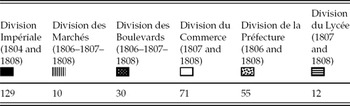
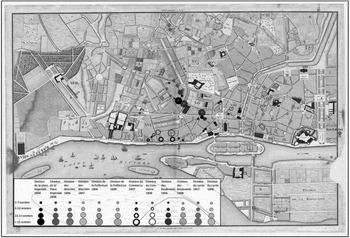
The spatial distribution of prostitutes in Nantes was determined by different socio-economic criteria, as well as historical factors which varied according to each division. From appropriation of space – continuity of usage – to economic reasons, the localization of prostitutes before and at the start of the implementation of regulation was influenced by different factors. In 1808, 348 prostitutes were recorded on these censuses. Following the administrative divisions of the police, based on former parishes, it has been possible to highlight specificities in terms of use of the space, economic development of the district and the representational identity of the divisions (see Table 1; Figures 1 and 2). When looking at the two maps representing prostitution in Nantes before and after the Revolution, it appears that most of the lodgings of prostitutes followed the same spatial distribution: this goes against what happened in other cities such as Montpellier where prostitutes in 1780 had already moved towards a virtually delimited red-light district.Footnote 25 In Nantes, however, prostitutes remained scattered about and kept moving: a shift to the west is noticeable.
Location of prostitutes by districts, Nantes, 1804–08

Source: AMN, I1 C62 D1.
Spatial distribution of prostitutes, Nantes, 1750–89 Source: AMN FF 269, 270, 272.

Spatial distribution of prostitutes according to censuses, Nantes, 1804–08 Source: AMN, I1 C62 D1.

The localization of prostitutes in the divisions of the Préfecture and Lycée followed an historical pattern: the expansion of Nantes had taken root on the western side of the Castle, and the former parishes of Ste Croix, St Pierre and Ste Nicolas were located inside the ramparts. Part of the land near the river Erdre used to be quite marshy and therefore cheaper than the rest of the city centre: cheap inns and taverns were opened in this section of the city and became places where prostitutes lived and solicited. In addition, the river Erdre was navigable, and was therefore widely used to ship goods from the hinterland to the city, with ships discharging their cargoes on the quays near the taverns and inns. This district combined the specific characteristics of open public spaces (quays) as well as more private places of entertainment and recreation; in this case, prostitutes were both living and soliciting in the same area. The similarities between the pre- and post-Revolution maps accentuate the continuity in the appropriation of the district by prostitutes, especially rue Fontenelle and rue Folard. On average in the city, two prostitutes per house were recorded and the division of the Préfecture follows this pattern with on average 1.9 women per house.Footnote 26 However, in reality the houses accommodated from one to seven women who were listed as prostitutes giving the houses the appearance of ‘bawdy houses’ offering ‘a choice of’ different women.Footnote 27
The attraction of Richebourg and the eastern part of the city (division du Lycée) can be explained by the fact that the boundaries of the city used to be along the Cours de la Liberté and the Cours de la Fédération, meaning that Richebourg was a suburb during the Middle Ages and therefore not subject to the taxes and laws of the city. Besides, Richebourg remained an interface between Nantes, the neighbouring countryside and Angers being on the main road to the east. Wine and wood were also discharged on its quays, making it a very busy suburb. The proximity of the soldiers and guards in the Castle may have also encouraged the opening of places of entertainment. In 1780, an infirm soldier told neighbours who tried to make him leave that ‘he came to enjoy the company of the servant of Mrs Marc and that they should know that soldiers are looking for pleasure and that he personally knew where to find it’.Footnote 28 The commissaire of the district on 23 vendémiaire An IV was called out to deal with complaints about ‘tapage’ at 19 rue Richebourg where three prostitutes were living; he found 12 soldiers in their house and asked them to leave the place and go back to their lodging.Footnote 29 In 1807, the average number of prostitutes per house in Richebourg reached three, whereas in 1808 it had fallen to 1.4 women per address recorded: different hypotheses can be advanced to explain this discrepancy. It may highlight a slight improvement in financial circumstances for some of the women, as fewer of them had to share a place with another prostitute: it is unlikely that the price of lodgings dropped significantly in the space of a year, particularly as Nantes had received numerous migrants from the former colonies, increasing the demand for lodgings.Footnote 30 The number of prostitutes in this division did not diminish drastically: from nine prostitutes in 1807 down to seven in 1808, making it difficult to blame record-keeping or to explain this change by a specific legal action against prostitutes in this district. By comparing the precise addresses given to the commissaires, it appears that 7 rue Rabelais remained a ‘favourite’ for prostitutes but the two other addresses given in 1807 were no longer inhabited by prostitutes in 1808: on the contrary, Marie Gilaiseau left her previous lodging to live at 28 rue Richebourg, ‘chez elle’.Footnote 31 This suggests that these figures show, in some cases, an improvement in the prostitute's economic situation. However, the type of room that was rented or owned was not described, therefore it is unclear if the lodging became more expensive. Similarly, few women remained in the same place and the background of the ‘new’ prostitutes that moved in during 1808 is unknown: they may have already owned or rented a place in the district du Lycée before becoming prostitutes and stayed there while shifting to the trade of prostitution. The possibility of impoverishment on the part of new prostitutes, rather than financial improvement of their situation, can paradoxically also be considered as an explanation for this drop in the number of prostitutes per house.
Going westward, the number of prostitutes in the division Impériale and division des Boulevards was surprisingly high: 159 prostitutes were recorded living in this district between 1804 and 1808 (excluding 1805), that is 52 per cent of the women listed by the police. The attraction of these districts for prostitutes has multiple causes. The proximity of the quays, especially La Fosse, which was the most important part of Nantes port, made it possible and easy for mariners and people coming ashore to reach these parts of the city: at Place Ste Catherine (or rue Delorme, St Nicolas), the widow Jacquette was tenant of a tavern and the neighbours claimed that ‘toutes les nuits s'y assemblent des matelots et des soldats’.Footnote 32 But the attraction of these districts remained in the entertainment they provided for inhabitants and migrants: a salle de concert in rue de la Fosse was mentioned as early as 1753 and in 1788, the Comédie opened and along with two theatres of Variétés in the vicinity and a Manège, it attracted crowds of wealthy merchants and their families but also plebeians.Footnote 33 Indeed, even if plebeians could not always afford the entrance fee to the new theatre, they could enjoy themselves in the taverns which surrounded the main places of entertainment.Footnote 34 As Hart underlines in her study of a contemporary red-light district, going to see a prostitute was often understood and accepted as an enjoyable activity and part of the construction of leisure-time.Footnote 35 The streets close to the new district of the Comédie offered the chance to mix with a wealthy crowd, which was not possible in the northern suburbs of St Similien.Footnote 36 The importance of entertainment and places of sociability in the development of prostitution becomes clear when looking at the maps of Nantes: before the Revolution, the first theatre opened on rue Bignon L'Estard around 1743 (Variétés) and in the 1750s this street was already a place where prostitutes lived.Footnote 37 With the opening of the Comédie, prostitutes’ lodgings moved slightly westward, as did the main place of entertainment; thus, the presence of inns and taverns close to theatres was expected. The growth of the average number of women in the division des Boulevards is unsurprising: from 1.5 women per house in 1806, it increased to 1.6 women in 1808. The evolution in the division Impériale appears very similar to the change in the adjacent division: from 1.7 women in 1804, it reached 1.6 in 1808, emphasizing the shift to the west side of the city and the newly built district.
The last two divisions to be analysed, du Commerce and des Marchés, were similar in their nature; indeed, both of them were structured around the port and quays and the bridges of La Fosse and of the Prairie de la Madeleine respectively, which specialized in maritime traffic.Footnote 38 The constant movement of people of different classes in these districts, making these parts of the city particularly attractive for economic reasons, could explain the presence of prostitutes; however, their similarities did not go further. La Fosse was ‘preferred’ to La Madeleine: 71 prostitutes were recorded living in the district of du Commerce whereas only 10 were living on the island. It should be remembered that the district of La Fosse was newly built and renovated in the eighteenth century as it became the business centre of the city and the place of residence for the merchants. Therefore, as explained by Bois, there was no social segregation in this district, as both wealthy and poor lived in this busy place.Footnote 39 In addition, the kind of prostitutes who lived in the division du Commerce and des Marchés differed. Indeed, the prostitutes in the Marchés section in 1806 and 1807 were financially more secure than the prostitutes in the Commerce district as all of them were listed as ‘dans leurs meubles’, i.e. the owners of their own property.Footnote 40 Whereas the average number of prostitutes in the Marchés section decreased down to one woman per lodging,Footnote 41 the situation was the opposite in the district of du Commerce: the average was 2.1 women per house in 1807 but reached 3.1 in 1808. Commerce and Prefecture offered the largest houses for prostitutes with up to seven women for a house which could be shared by at least 20 people.Footnote 42 According to Bois, in the district from the Quay Tourville (Place du Commerce) to rue Bignon L'Estard, there were 123 houses for 3,022 inhabitants, which makes an average of 25 inhabitants per house.Footnote 43 In the streets perpendicular to the quays, rue d'Ancin, de la Nation or des Trois Marins, the women were usually renting a room or sharing a room at a cheap price: women were sometimes listed living with their domestic who was also considered a prostitute.Footnote 44 These streets were reputed to be dirty, crowded and mal-fréquentées. In 1761, the police tried to evict prostitutes from a courtyard close to the quay, they said that ‘La cour des Richards est un lieu qui sert d'azile à quantité de femmes et filles débauchées; et comme si c'étoit pour elles un lieu de franchises, sitost qu'on les a chassées d'un endroit de la ville elles vont s'y réfugier.’Footnote 45 This comment reinforces the idea that the district of La Fosse was also being appropriated by prostitutes. Mariners were probably the main customers of the taverns which multiplied on these streets: the wife of Pierre Rolland, for example, was seen ‘à boire dans un cabaret, vers six heures du soir avec cinq ou six matelots’.Footnote 46 However, the records show that despite a significant number of prostitutes and mariners renting rooms and seeking entertainment in the taverns, the population of the district remained varied: a sage-femme, for example, was recorded living on the quay de la Fosse, as well as tailors and négociants.Footnote 47 These two districts are representative of the ease with which prostitutes could solicit in open spaces, near their lodgings, and where they could also meet potential clients on their way to the main quays of the city.Footnote 48
Socio-economic development of Nantes’ districts and prostitutes’ lodging
One of the most common characteristics of a red-light district in the nineteenth century was its location in a poor residential area.Footnote 49 The study of the economic independence of women in terms of lodging therefore offers the opportunity to see if certain districts were more likely to be inhabited by prostitutes. On average, 21 per cent of the prostitutes listed in the censuses were recorded as living ‘dans leurs meubles’; this means that depending on the year of the census between 30 and 32 prostitutes were householders and owned their furniture. The financial value of the furniture is difficult to ascertain, but it is certainly indicative of a measure of economic independence and represented the possibility of pawning such items as a strategy of survival. In 1856, Dr Baré counted 30 women not living in an official brothel: a number similar to the beginning of the century but in percentage terms, this equated to only 11 per cent of the total, underlining a certain success in the policy of regulation.
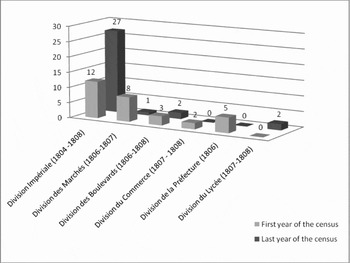
A comparison of the number of women who owned their furniture with the average number of women per house will show if there was a relationship between the poverty of a district and the number of prostitutes (see Figure 3). The highest figures of the division des Marchés corroborate what has been explained before, that the women in this district were more independent financially than the other listed prostitutes. Similarly, the district of La Madeleine was in development and did not suffer from poverty compared to older districts such as the suburb of the Marchix or the section du Commerce. Although the district of the port was rich in principle, the living conditions of prostitutes seem to have been less attractive: from 2.1 women per house, it increased to 3.1 women in 1808, accentuating the problem of poverty. Besides a more crowded environment for prostitutes, it appears that the number of prostitutes who were ‘dans leurs meubles’ fell, meaning that all the prostitutes were therefore lodgers and could be evicted more easily for tapage than if they were in an unfurnished lodging. The increased number of prostitutes ‘dans leurs meubles’ in the Impériale section and the division du Lycée is quite interesting because of the differences between both sections. In the division du Lycée, a clear fall in the average number of women appears between 1807 and 1808: from three women to 1.4 women per house. Along with the fact that in 1808 29 per cent of the women were now able to own their own furniture, it seems that the financial condition of prostitutes in this district improved. However, it is also possible that some women owned a place or some furniture and then became prostitutes, which would therefore highlight a shift towards poverty in the condition of these women; both explanations are valid as it will be explained later. A similar rise occurred in the Impériale division: the proportion of women who owned their furniture rose from 18 per cent to 37 per cent, i.e. it more than doubled in four years. Although the number of women per house did not fall sharply as in the section du Lycée (from 1.7 to 1.6), it appears that this figure of 1.6 was already below the average number of women per house. Therefore, it seems possible that the number of independent women and the average number of women per house were linked, indicating that certain districts, mainly the poorest areas, were districts where fewer prostitutes could afford a place of their own and where the density of prostitutes per house was higher.
Evolution of the number of prostitutes living ‘dans leurs meubles’ per district, Nantes, 1804–08 Source: AMN, I1 C62 D1.

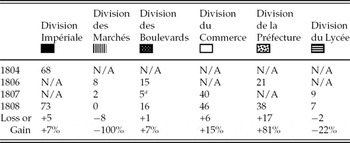
Looking at the changes over the years according to the number of women listed in each district, some discrepancies are noticeable. Each district has a specific evolution in terms of growth (see Table 2). The division du Commerce and part of the division Impériale, which would eventually become the red-light district of the city, only gained 22 per cent or 11 women in four years, whereas the division de la Préfecture, the old city, gained 81 per cent or 17 prostitutes in two years. The figures representing the changing pattern in the number of prostitutes in each district start to make sense only when compared with the number of women who remained in the same district, or who moved to another or disappeared from the lists. On a smaller scale, the analysis highlights the discrepancies between the districts: on average, 20 per cent of the women who remained prostitutes in their district managed to acquire a property. It was explained earlier that women in the division du Commerce were rather poor and, indeed, none of the women who remained in this district between 1807 and 1808 succeeded in securing lodging for themselves. In the division Impériale and the division du Lycée, however, respectively three and two women (or 33 per cent and 66 per cent) of the women who remained there managed to get their own lodging, underlining the socio-economic difference of the districts, and possibly of the customers who went to see the prostitutes.
Prostitutes’ migration between districts, Nantes, 1804–08

N/A: No record available.
a It seems that this sudden drop of the number of prostitutes in this division is due to a problem with the records and not an actual diminution of prostitutes; indeed, the commissaire seemed to have updated the inspector on the situation rather than giving him a new detailed account of prostitutes.
Source: AMN, I1 C62 D1.
Overall, only 41 women were listed twice, that is only 13 per cent of all the listed prostitutes were still recognized as prostitutes a year or two later; in other words, the increases in districts such as the Prefecture or Commerce were mainly due to the arrival of ‘new prostitutes’ in the district, between 1806 and 1808, allowing an important turn-over of 87 per cent of the women categorized as prostitutes from one year to another. However, we notice that the spatial distribution during this period had not yet evolved towards a clustering of prostitutional activities: new women entering this trade tended either to remain in the same location or even to expand the trade on adjacent streets. Knowledge of the places of prostitution and cheap lodgings must have been the reasons attracting most of the new prostitutes in these districts: but even if some landlords rented to different prostitutes in the same house, the streets remained socially varied. Analysis of the records for tapage before and after the Revolution (up to 1808) shows that the ‘places of debauchery’ continued to be located in the same streets or very close to the ones where tapage took place before the Revolution (see Figure 4). However, the number of cases brought before the commissaires increased dramatically: from 37 cases between 1752 and 1789 to 47 between 1790 and 1808, which means that the number of cases per year had almost tripled.Footnote 50 The highest number of complaints against prostitutes came from the division Impériale and the figures for the other districts of the city were much the same and the district of La Fosse was not exempt from complaints. Therefore, it seems that over a period of 60 years, no spatial division between prostitutes and the other inhabitants occurred: places of prostitution remained located mainly in the same streets whilst these districts remained socially mixed.
Accusations of tapage in Nantes, 1789–1806 Source: AMN, I1 C62 D1.

In terms of regulation, Werth asserted that both the state and the society/community had a role in initiating regulation; whilst analysing the secondary literature on Scottish and English legislation against prostitutes in the nineteenth century, he rightly came to the conclusion that the state was not ‘the fundamental locus of power’.Footnote 51 As seen in Nantes, the role of the state, or the police, had little influence on the spatial distribution of prostitutes. The police could go as far as excluding the woman from the city (if she was a foreigner) but no follow-up was instigated, meaning that the woman would usually come back and lodge somewhere else. For instance, in 1755, Navare, ‘femme debauchée et de mauvaise vie’ lived with her daughter Julie for 15 days at rue Bignon L'Estard in St Nicolas before the neighbours started complaining about noises. It was reported that before living at this place, she used to live at rue des Trois Marins in the district of La Fosse, then at petite rue près de la Croix des Capucins, and then rue Chouerie, from where she had already been evicted once.Footnote 52 The role and the influence of the community (neighbours) on the localization of prostitutes have to be acknowledged, even though the impact was limited. For example, in the case of complaints of tapage, inhabitants clearly expected the police to evict the prostitute from her room, but it should be noted that these complaints arose only if the neighbours had been disturbed by prostitutes and their customers making noises, breaking windows or behaving in a threatening manner. As long as neighbours were not threatened or disturbed in their use of their private and public space, they did not bring complaints against prostitutes. Districts such as the north of the city, the main streets of the inner city or the isle Feydeau, where prostitutes were known to reside did not receive any complaints of tapage. It can be argued that in the north of the city, which was largely populated by the working class, prostitutes were accepted as part of the community, but the case of the isle Feydeau is particularly interesting and highlights a more general attitude towards prostitutes. The island was drained and newly built in the first half of the eighteenth century and different social classes were living in these new buildings, notably rich merchants. Even prostitutes could be seen living or meeting on the island; however, only one complaint was recorded over 60 years. This suggests that an absence of complaints against prostitutes probably meant that they were not disturbing the peace and that their trade, if not invasive, was accepted or at least ignored.
One point remains to be covered when considering the role of the police in the spatial distribution of prostitutes in Nantes. It is surprising that when comparing the maps of Nantes pre- and post- Revolution, prostitutes seem to have disappeared from the main road to Rennes and from the ex-parish of St Similien in general: the commissaire Durand of the division des Agriculteurs wrote to the general inspector in 1806, 1807 and 1808 to inform him that there were no prostitutes in his division whereas before the Revolution, a dozen references to prostitutes were recorded. M. Durand claimed that no ‘femme notoirement reconnue publique’ was to be found in his district and a year later, he explained that ‘dans le cas de libertinage ou de concubinage, c'est clandestin et non apparent’.Footnote 53 This commissaire, by interpreting the law, introduced a distinction between casual prostitution by ouvrières and prostitution ‘as a trade’, on a daily basis. In 1807, he also differentiated prostitutes ‘raccrochant visiblement’ and ‘femmes entretenues, qu'on ne peut atteindre sans risqué à se faire prendre à partie attend qu'elles ont des états, qu'elles sont domiciliées et payant les taxes de l'Etat’. His comment indicates that the police could not and did not want to prosecute certain women, despite the fact that it was public knowledge that they were selling sexual favours. These women definitely had financial independence as they ‘paid taxes’ and probably owned their place and these signs of economic independence differentiated them from the poorer prostitutes.
Thus, the spatial distribution of prostitutes in Nantes followed a pattern which can be summarized around three main points. The localization of prostitutes was characterized by the density of population, the socio-economic character of the district and by the number of places of sociability, and by the movement of inhabitants and travellers through the main thoroughfares of the city and in the open public spaces (quays and bridges). Although prostitutes were seen and lived in parishes where the mobility of population was quite high (for example near the quays), prostitution remained located in these same areas for decades. Unaffected by the complaints of inhabitants, the spatial distribution of prostitutes in the city was marked by an appropriation of certain streets. However, this does not mean that the geography of prostitution in Nantes remained static or that districts could be defined as red-light areas; the geography of prostitution was subject to evolution. This is particularly noticeable in Nantes when the localization of prostitutes moved westward after the opening of new places of entertainment, and in parishes reputed to have numerous inns and taverns.
The chronology of provincial cities’ prostitution differs from capital cities; it cannot be said that there existed, at the end of the eighteenth century, a reserved district for prostitution as prostitutes’ lodgings, and therefore the practice of prostitution was scattered over the whole city. Admittedly, the district of La Fosse had distinctive parameters which influenced, over the subsequent 50 years, the development of a red-light district: an important number of prostitutes, the multiplication of places of entertainment (taverns included), making the division du Commerce and the division Impériale the location where leisure was concentrated in the city. Contrary to what Howell suggests, these districts were not ‘invariably residential districts of the working poor’.Footnote 54 These divisions were newly built or renovated in the eighteenth century and were socially mixed: Girault de St Fargeau, in 1829, claimed that ‘“le quai ou port de la Fosse feront toujours l'admiration des étrangers”’ and that the most beautiful streets of Nantes surrounded the Place Graslin.Footnote 55 The importance of entertainments and the social diversity of the districts show that the role of the police and of the community/neighbours in the initial construction of a red-light district was rather limited. Sociologists of contemporary prostitution such as Hubbard have highlighted the responsibility of the neighbourhood and of the police in modifying the geography of prostitution in cities such as Birmingham or Bradford but it was hardly the case in a provincial city such as Nantes at the end of the eighteenth century.Footnote 56 In 1804–06, when the first censuses of prostitutes were recorded, the aim of the police was to impose stricter controls over these women but there was no incentive to move them to a particular district to control them more effectively or to impose social segregation. Similarly, the complaints recorded by neighbours were punctual and personal: they targeted specific women (except in one case where a house accommodating seven prostitutes was the object of complaints) and asked for their expulsion from the community, but no general complaint by the population demanding the withdrawal of prostitutes from any given street has been recorded. Symanski argued that ‘“prostitutes have consistently been forced to live and labour among those with minimal social and political power”’;Footnote 57 however, the process of a gradual clustering of prostitutes in the district near the port seems to be down to the prostitutes themselves: economic reasons influenced the location of prostitutes across the city. Cheap lodgings explain the spread of prostitutes in most districts, but this was paralleled with the necessity of finding customers, leading to a strategic choice of location.
Conclusion
Contrary to what can be seen in the twentieth century,Footnote 58 a division between the place of work and the place of lodging was in most cases non-existent, which means that prostitutes’ lodgings had to be easily accessible and near potential customers. By moving towards the port and the places of entertainment, prostitutes were assured of finding customers, reflecting the necessity of mobility and appropriation of public space in the understanding of the spatial distribution of prostitutes. The circumstances encouraging the development of a red-light district were created by prostitutes through the way they used urban space and their social use of these different places. By an ‘economically rational’ practice of prostitution, they gradually tended to cluster into the main districts that offered them sufficient chances of exercising their trade. Subsequent policies confirmed this clustering by imposing the name quartier réservé on districts inhabited by prostitutes for more than a century.Footnote 59
This shift in attitude and policy towards prostitution and the concomitant acceptance of a red-light district and its use as a space of confinement only became part of Nantes’ system of regulation around 1850s. From 1844, the police and the municipality identified specific streets where prostitutes had to lodge and work. These changes were influenced by the hygienists and the Société Académique de Médecine de Nantes, such as Dr Baré mentioned in the introduction. It is clear that he influenced the new development in prostitutes’ control; he was a surgeon who visited prostitutes for over 25 years, knew their trade and habits and was in close correspondence with the mayor and the prefect. In a co-operative political context, the municipality was able to enforce regulation of prostitution and adapt the concept of confined space to the city and encourage preventative hygienic measures.Footnote 60 But this was a reaction to the existence of a specific district in which numerous prostitutes were concentrated; a reverse process was here in action: it was not the upper classes that dictated the location of prostitutes but the prostitutes who initially chose their quarters.
What does this study reveal in terms of relations between the lower classes, the authority and the urban space? First, it becomes apparent that the lower classes appropriated urban space according to principles of economic rationality: either because a particular district offered work or because the lodgings were cheap; in Nantes’ case, some districts offered both. A similar process can be seen to have been at work in contemporary cities over the past decades: city centres become inhabited by the lower socio-economic groups who move in as the wealthier leave the district. But the process of appropriating a district also highlights the limited capacity of the police and the authorities to supervise the mobility of the population. Regulatory policies over prostitutional space came into force only as a result of prostitutes’ clustering but the means to prevent them from moving to another district, if this became more economically viable, were limited: a move towards the train stations, for example, with the boom of the railway, could not be prevented. Similarly, with rising car-ownership, the geography of prostitution has continued to vary over timeFootnote 61 but ultimately prostitutes remain the main agents in these changes. The policing of prostitutional space nowadays should be based on a systematic review of prostitutes’ needs, which seeks to understand why the prostitutes choose or need to be in specific places; trying to ban them for certain districts considered safe and economically profitable is a policy born to fail.Footnote 62