Between 25 percent and 30 percent of infiltrating breast cancers exhibit an amplification of the c-erb2 gene, which induces abnormally elevated rates of the HER2 protein. Overexpression is associated with rapid progression, resulting in shorter life expectancy (17;18). Two diagnostic techniques have been recognized for determining HER2 status: immunohistochemistry (IHC) and molecular hybridization with fluorescent in situ hybridization (FISH) being the most commonly used. IHC is simple to perform, inexpensive, and accessible to most laboratories. It can be performed on tumor blocks embedded in paraffin, whatever the type of fixative (Bouin's fluid or formalin). However, the lack of a standardized IHC methodology leads to several inconsistencies when the assays are repeated. FISH is more reliable and reproducible than IHC, but it is complicated, time-intensive, and expensive; moreover, it cannot be performed when the tissues have been fixed or placed in contact with Bouin's fluid.
Trastuzumab, a monoclonal antibody specifically targeting HER2 (Herceptin; Genentech, San Francisco, CA), is currently indicated for patients at first metastatic relapse with an IHC score of 3+, following the European Marketing Authorization guidelines established on the basis of clinical results (19). However, the gold standard method for assessing HER2 status is still a matter of debate. IHC is less correlated with clinical response to trastuzumab than FISH, which may lead to incorrect diagnosis: either false-positives or false-negatives. The use of FISH on all patients showing metastatic relapse, or to clarify an ambiguous status as determined by IHC, could contribute to improve diagnostic strategies.
We propose a cost-effectiveness analysis based on the follow-up of a hypothetical cohort of patients with infiltrating breast cancer, comparing different diagnostic strategies for determining HER2 status as an indication for trastuzumab at metastatic relapse. Our analysis was adapted to the French context. First, the IHC technique was implemented following the French GEFPICS (Group for the Evaluation of Immunohistochemical Prognostic Factors in Breast Cancer) recommendations. We also took into account the type of fixative used in current practice (i.e., Bouin's fluid or formalin) and the possibility that the paraffin-embedded tumor samples might be inaccessible at metastatic relapse.
Our analysis examines the medicoeconomic section of a multicentric study carried out as a result of the national program referred to above in six university teaching hospitals from the Rhone–Alps region on the one hand and two cancer centers that are reference centers for HER2 testing on the other hand (24). Over 2 years, the eight centers prospectively assessed the HER2 status of infiltrating breast cancers using IHC at initial diagnosis following the GEFPICS/AFAQAP (French Association for Quality Assurance in Pathology) guidelines. All cases with IHC scores of 2+ and 3+ and 10 percent of cases scoring 0 or 1+ were controlled using FISH by the two reference centers, where the FISH technique was available. In total, the multicentric study enrolled 2,045 patients, and 171 paraffin-embedded tumor sections were simultaneously screened using both IHC and FISH.
METHODS
Decision-Analysis Model
We compared five strategies for determining HER2 status as an indication for trastuzumab at metastatic relapse: S1, IHC at first metastatic relapse, which corresponded to current practice; S2, systematic IHC at diagnosis; S3, FISH at first metastatic relapse, as a substitute for IHC (when the tumor block had been fixed in formalin); S4, FISH at first metastatic relapse, in addition to IHC to clarify the status of IHC 2+ (when the tumor block had been fixed in formalin); S5, FISH at first metastatic relapse, in addition to IHC to clarify the status of IHC 2+ and 3+ (when the tumor block had been fixed in formalin).
The decision tree was created using DATA 4.0 (TreeAge Software, Williamstown, MA). For each strategy, a simulation model represents the development of 10,000 French patients, from initial diagnosis of infiltrating breast cancer to potential metastatic relapse. The maximum duration of the simulation was 20 years from initial diagnosis.
Effectiveness
Efficacy and tolerance of trastuzumab in combination with chemotherapy were established on the basis of a phase III randomized trial in patients with metastatic relapse and HER2 overexpression (19). However, the clinical results from this randomized trial cannot be extrapolated to the French situation, because IHC was performed using the HercepTest (Dako, Carpentaria, CA), a kit that is not recommended in France by the GEFPICS because of the high rate of false-positive cases reported in several studies (14;22). We, therefore, chose two intermediate criteria selected as follows:
- Criterion 1: HER2-amplified tumor and no trastuzumab at first metastatic relapse. Two different factors may lead to this situation: (i) false-negatives, or (ii) HER2 testing impossible.
- Criterion 2: HER2-nonamplified tumor and improper trastuzumab at first metastatic relapse (false-positives).
Costs
Only direct medical costs (in 2002 € prices) likely to be influenced by the strategies were taken into consideration. Few economic studies have been found (10;12;13;23), but again, the variability of standard practices and unit costs makes it difficult to transpose results to other settings. Hence, we carried out a cost analysis within the framework of the multicentric study referred to above. This study enabled us to estimate the average cost per patient of retrieving archival tumor blocks and performing IHC and FISH analyses.
The working time of each staff category involved was recorded by the hospitals. Data regarding reagents, consumables, equipment, and maintenance were provided by both the hospitals and the manufacturers. Of note, the unit prices quoted by the manufacturers are catalogue prices, not the negotiated prices that are actually charged, which remain confidential. The life expectancy and the market prices of the equipment used were gathered from the manufacturers. The average cost per patient of performing a metastatic biopsy was estimated using the 2002 reimbursement rates for corresponding interventions (pleuroscopy, liver biopsy, or bone puncture, and so on).
Probabilities of Events
Data were mainly derived from the multicentric study, from which we created an initial database (DB1), and from the literature. However, because this multicentric study only addressed HER2 status at initial diagnosis, other sources had to be used, as specified later. Two types of events are distinguished, depending on whether they relate to morbi-mortality or to the implementation of HER2 tests.
Morbi-Mortality
We estimated the metastatic relapse rate within 10 years using data from meta-analyses (7;8;15) adapted by Bachelot et al. to take into account the clinical practice guidelines in use in France (1). We obtained tumor relapse rates over the 10-year period after initial diagnosis for subgroups of patients defined by tumor size; Scarff, Bloom, Richardson histoprognostic grade and lymph node invasion, stratified for the presence or absence of hormone receptors; and age. The percentage of patients in each subgroup was calculated using a second database (DB2) available at one of the reference centers involved in the multicentric study, the Centre Leon Berard. This database includes all new patients undergoing surgery between 1996 and 2003 (n = 1,815).
With regard to metastatic relapse rate after 10 years, we hypothesized that the rates were proportional to the rates within 10 years. According to Fisher et al. (11), approximately 13 percent of metastatic relapses seen at 20 years occurred after the first 10 years.
Data on mortality from other causes were obtained from the French Institute of Population Studies. Mortality rates were stratified into four age classes and estimated (i) within the 10 years after diagnosis and (ii) between 10 and 20 years after initial diagnosis. The DEALE method was used to convert mortality rates into probabilities (2).
Determination of HER2 Status
From DB2, we identified patients with first metastatic relapse who had been managed according to the S1 strategy. From this population, we evaluated the frequency of HER2 tests that were either (i) impossible (tumor blocks destroyed and inaccessible metastases), (ii) possible and performed (either on initial tumor block or on metastatic sample, with or without having to retrieve archival tumor tissue), or (iii) not performed due to premature death or inappropriate HER2 testing. The probabilities of all related events were calculated on the basis of these frequencies for all strategies assessed.
Concerning the quality of the techniques, FISH has been recognized as the gold standard for HER2 testing as it enables the most accurate predictions of clinical responses to trastuzumab (13;21). IHC results reported in the literature are heterogeneous because the methods use different commercialized antibodies, with different technical conditions and scores (3;5). The sensitivity and specificity of IHC as used in France (according to the GEFPICS/AFAQAP) were thus estimated using DB1.
The distribution of IHC scores at metastatic relapse was calculated using DB2. With regard to the FISH technique, the distribution between patients with and without HER2-amplified tumor at metastatic relapse was inferred from (i) the distribution of previously calculated IHC scores and (ii) the results obtained from DB1 showing concordance between IHC and FISH. Finally, as the FISH test can only be applied to formalin-fixed tissues, we conducted a postal survey among the clinical pathology laboratories of the Rhone–Alps region to estimate the distribution of fixatives used in 2002, that is, Bouin's fluid or formalin.
Discount Rate
Costs and effectiveness measures were calculated without discount, then discounted at 3 percent and 5 percent to account for the distribution over time of recurring metastases, as observed from DB2.
RESULTS
Main Parameters of the Model
The average costs per patient of using the IHC and FISH methods were estimated at 43 2002€ and 283 2002€ (2002 prices), reagents alone accounting for 61 percent of the cost of the FISH test. The average cost of retrieving a tumor section from the archive was 14 2002€. The calculated cost of performing a metastatic biopsy was 893 2002€.
At metastatic relapse, and surprisingly, HER2 testing was never reported impossible. Consequently, Criterion 1 was restricted to the number of false-negatives. Regarding IHC, we observed that 74 percent of scores were 0 or 1+, 2 percent were 2+, and 24 percent were 3+ for patients who relapsed within 10 years after diagnosis. All scores were 0 or 1+ when relapse occurred after 10 years.
Compared to FISH, IHC sensitivity/specificity were, respectively, .88 and .91 (IHC score 2+ being considered negative, on the basis of European Marketing Authorization guidelines). Of interest, FISH test could only be performed in 60 percent of the cases, as derived from information provided by the clinical pathology laboratories of the Rhone-Alps region.
Expected Costs and Effectiveness of the Strategies in the Primary Analysis
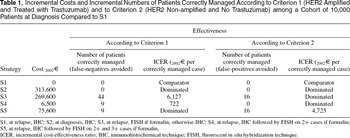
S2, S3, S4, and S5 strategies were compared with S1 in a differential analysis. The total cost of using S1 in a cohort of 10,000 patients reaches 106,400 2002€. However, this strategy leads to a certain number of inappropriate disease management decisions being made at metastatic occurrence: of 10,000 patients at diagnosis, 73 patients with HER2 amplification were not given trastuzumab, and 26 patients with no HER2 amplification were wrongly given trastuzumab.
According to Criterion 1, nondominated or, in other words, efficient strategies were S1, S4 with an incremental cost-effectiveness ratio (ICER) of 722 2002€, and S3 with an ICER of 6,127 2002€. Strategies considered efficient according to Criterion 2 were S1 and S5 with an ICER of 4,725 2002€. The results are shown in Table 1.

Sensitivity Analyses
Sensitivity analyses were performed for the three parameters: discount rate, cost of the FISH test. and proportion of samples fixed in formalin.
Sensitivity to the Choice of Discount Rate
Because most metastatic relapses occur in the first years after initial diagnosis (49 percent within the first 2 years (DB2)), the results were only slightly modified by the choice of the discount rate, which a posteriori justified the presentation of the primary analysis without discounting. The incremental cost of S2 increased slightly with the discount rate, because all the costs associated with S2 are incurred at initial diagnosis, and the costs corresponding to S1 are spread over time.
Sensitivity to the Cost of the FISH test
The expected cost of strategies using the FISH test depends on the cost of the test itself, which is high at this stage of development of the technique. Considering that this cost was calculated on the basis of catalogue prices, whereas negotiated prices might be substantially lower (up to 60 percent less), the cost of the FISH test would be reduced by over 40 percent, from 283 2002€ to 162 2002€. No variations in cost or in effectiveness affected S2. The incremental cost of S3, S4, or S5 over S1 decreased by more than 40 percent (between 43 percent and 50 percent), whereas effectiveness remained unchanged with reference to both criteria. ICERs were decreased accordingly.
Sensitivity to the Proportion of Samples Fixed in Formalin
As the FISH test can only be applied to formalin-fixed tissues, cost and effectiveness results will vary with the proportion of samples fixed in formalin (others being fixed in Bouin's fluid). As mentioned above, only 60 percent of samples included in the primary analysis were fixed in formalin. As the use of formalin is becoming more and more common in France (24), we adopted a proportion of 100 percent for the sensitivity analysis.
The performance of S2 remained unaltered. There was an increase in costs of over 60 percent (between 63 and 66 percent) for S3, S4, and S5, whereas effectiveness increased by over 50 percent (between 55 and 66 percent) according to the two criteria. The strategies considered efficient were the same as in the primary analysis: S1, S3, and S4 according to Criterion 1, and S1 and S5 according to Criterion 2. Because measurements of costs and effectiveness increased in similar proportions, ICERs of efficient strategies (in relation to S1) remained almost unchanged.
DISCUSSION AND CONCLUSIONS
We assessed the cost-effectiveness of different strategies used to determine HER2 status in invasive breast cancer patients, as an indication for trastuzumab treatment at metastatic relapse. As mentioned before, previously published data on the efficacy of trastuzumab (19) were of no help because they involved different IHC methods that are not recommended in France. For this reason, we did not use a final criterion of trastuzumab effectiveness, and we chose two intermediate criteria instead. In the absence of relevant data from the literature, a multicentric medicoeconomic study was conducted in France on 2,045 patients at initial diagnosis.
The strategy chosen as comparator S1, which was the current practice in France, consisted of determining HER2 status using IHC at metastatic relapse. All other strategies were more expensive, but at least as effective judging from the two effectiveness criteria chosen. S2, which consisted of using IHC at initial diagnosis in all patients, was dominated by all other strategies, because it was more expensive without being any more effective. This finding held true for all the simulations, whether we referred to the primary analysis or to the sensitivity analysis. For 10,000 patients at diagnosis, the cost was increased by 313,600 2002€ in the primary analysis, which corresponds to four times the cost of using S1 (106,400 2002€). All other strategies consisted of determining HER2 status at metastatic relapse. Of these strategies, the most costly was S3, which consisted of substituting the FISH test for IHC whenever possible. This result was expected, because FISH is far more expensive than IHC (283 2002€ versus 43 2002€).
Several strategies were considered efficient in the primary analysis, according to Criterion 1: S1, S3, S4. Strategies considered efficient according to Criterion 2 were S1 and S5. Of interest, the only efficient strategy in relation to the two criteria was the comparator. This finding, of course, does not provide sufficient cause for eliminating the strategies that are only efficient in terms of one of the two criteria (S3, S4, S5).
In the primary analysis, the major part of the cost of strategies using FISH resulted directly from the cost of this test, which is far more expensive than IHC. In fact, there were two reasons for testing the effect of a reduction of this cost: (i) the negotiated prices of reagents are lower than catalogue prices, and (ii) these prices should decrease as the method becomes more widely used. A reduction in the cost of the FISH test would have a mechanical impact on the cost of S3, S4, and S5 in which it participates, as well as on the corresponding ICERs. However, efficient strategies would be unchanged. Among upcoming methods for assessing HER2 status (polymerase chain reaction, chromogenic in situ hybridization (CISH), enzyme-linked immunosorbent assay), CISH could be a useful alternative to FISH for determination of HER2 amplification, especially for confirming IHC results. This method is very close to FISH but does not require the use of fluorescent microscopy or expensive digital systems and is easier to interpret for pathologists who are not trained with fluorescence (4).
Some of our conclusions echo those of Elkin et al. (9), who also proposed a cost-effectiveness analysis of strategies that involved the assessment of HER2 status using the IHC and/or FISH methods at metastatic relapse, although several differences exist between the two studies. The first one lies in the costs of the tests estimated at 85 US$ for IHC and 381 US$ for FISH, which is far higher than our own estimations, 43 and 283 2002€, respectively. These differences are not surprising, as we know that healthcare costs are far higher in the United States than in France, which makes the generalizability of economic evaluation results questionable, as emphasized in different studies (6;16;20). But the most important difference between the two studies is that Elkin et al. compared the effectiveness of the different strategies using QALYs, on the basis of clinical data compatible with the use of the HercepTest for IHC testing. From the ICERs expressed as costs per QALY, they identified two efficient strategies, which correspond to two of our own: to perform the FISH test at metastatic relapse (corresponding to our S3), or to apply the IHC test at metastatic relapse, followed by the FISH test on 2+ and 3+ cases only (corresponding to S5). Interestingly, the first strategy was efficient according to our first effectiveness criterion, whereas the second strategy was efficient according to our second criterion.
Recently, results of interim analyses of large randomized, multicenter trials in patients with HER2-positive primary breast cancer were presented at the 2005 American Society of Clinical Oncology meeting. According to these trials, adjuvant improves time to disease progression or median duration of response, response rate, and survival. However, since then, several editorials published in the British Medical Journal have emphasized that healthcare organizations should not rush into using trastuzumab for early breast cancer until the final results of the clinical trials are published and a full cost analysis can be done.
CONTACT INFORMATION
Magali Morelle, MSc (morelle@lyon.fnclcc.fr), Elodie Haslé, PharmD (contact@gresac.org), Health Economics Research Group in Oncology, 28 rue Laennec, Isabelle Treilleux, MD, PhD (treilleux@lyon.fnclcc.fr), Jean-Philippe Michot (michot@lyon.fnclcc.fr), Department of Pathology, Thomas Bachelot, MD, PhD (bachelot@lyon.fnclcc.fr), Department of Medical Oncology, Centre Léon Bérard, 28 rue Laennec, Lyon, France 69008
Frédérique Penault-Llorca, MD, PhD (fpenault@cjp.fr), Professor, Department of Pathology, Centre Jean Perrin, 58 rue Montalembert, BP 392, Clermont-Ferrand Cedex 01, France 63011
Marie-Odile Carrère, PhD (carrere@lyon.fnclcc.fr), Professor, Health Economics Research Group in Oncology, 28 rue Laennec, Lyon, France 69008
This work was funded by the French Ministry of Health as part of a project entitled Support Program for Costly Diagnostic and Therapeutic Innovations. The authors thank Sandrine Berge-Montamat and Olivier Trédan.