Introduction
A progressive decline in the blue wildebeest, Connochaetes taurinus, population in the Kruger National Park (KNP) commencing in 1970 (Whyte and Joubert, Reference Whyte and Joubert1988) prompted an investigation to determine whether infections with helminth or arthropod parasites were a contributing factor. A survey was initiated in which four wildebeest were shot and processed for parasite recovery each month from November 1977 until November 1978 (Horak et al., Reference Horak, De Vos and Brown1983). The huge knowledge gap with regard to their parasite fauna, as demonstrated by the recovery of 13 nematode species, four cestode species, one trematode, the larvae of five oestrid fly species and the adults of three louse and seven ixodid tick species from the wildebeest, motivated the Veterinary Division of the National Parks Board to conduct similar investigations in other mammalian species in the park to collect baseline data to assist in future management decisions. Consequently, in addition to the wildebeest, the helminth and arthropod burdens of impalas, Aepyceros melampus, greater kudus, Tragelaphus strepsiceros, common warthogs, Phacochoerus africanus (as Phacochoerus aethiopicus), scrub hares, Lepus saxatilis, and plains zebras, Equus quagga (as Equus burchelli), as well as the arthropod burdens of helmeted guinea fowls, Numida meleagris, were determined (Scialdo et al., Reference Scialdo, Reinecke and De Vos1982; Horak et al., Reference Horak, De Vos and Brown1983, Reference Horak, De Vos and de Klerk1984, Reference Horak, Boomker, De Vos and Potgieter1988, Reference Horak, Spickett, Braack and Williams1991, Reference Horak, Boomker, Spickett and De Vos1992, Reference Horak, Spickett, Braack and Penzhorn1993, Reference Horak, Gallivan, Braack, Boomker and De Vos2003; Krecek et al., Reference Krecek, Malan, Reinecke and De Vos1987; Boomker et al., Reference Boomker, Horak and De Vos1989, Reference Boomker, Horak and Booyse1997; Negovetich et al., Reference Negovetich, Fellis, Esch, Horak and Boomker2006).
The feeding preferences of the six mammalian species differ. Blue wildebeest are grazers that prefer feeding on areas of short, green grassland or grass that is less than 10–15 cm in height. Impalas are intermediate mixed feeders that both browse and graze, depending on the season and availability of forage. Kudus are browsers, rarely eating grass. Warthogs prefer to feed on short grasses and their rhizomes, for which they root, but will also feed on sedges, herbs and wild fruit. Zebras are predominantly grazers feeding preferably on short grasses in the growing stage, but will occasionally browse and feed on herbs, and scrub hares feed on the leaves, stems and rhizomes of green and dry grass (Skinner and Chimimba, Reference Skinner and Chimimba2005). The differences in feeding preference lead to differences in habitat use, with blue wildebeest and zebras preferring short-grass habitats, whereas impalas, kudus and warthogs prefer habitats with abundant vegetation of trees, shrubs and herbal layers (Hirst, Reference Hirst1975). The diet of guinea fowls is very varied and they feed on seeds, flowers, bulbs, insects, snails etc. They are widespread in South Africa, are found in open terrain varying from sub-desert to forest edges, and are particularly common in savannas interspersed with maize and wheat (Hockey et al., Reference Hockey, Dean and Ryan2005); the height of their bare heads and necks exposes them to the questing larvae of several tick species.
In the study devoted to scrub hares in the KNP, Boomker et al. (Reference Boomker, Horak and Booyse1997) compared the prevalence of five gastrointestinal nematode species in these animals with that in warthogs, kudus and impalas. The current paper aims to present a more extensive comparison of the ability of 16 gastrointestinal nematode species, collected by IGH and JB during the surveys listed above, to exploit different host species, as evidenced by their prevalence and burden in blue wildebeest, impalas, kudus, warthogs and scrub hares in the KNP. It also compares the suitability of these animals as well as that of plains zebras and helmeted guinea fowls as hosts of adult and immature stages of eight ixodid tick species, collected by IGH during the surveys listed above, again as indicated by the parasites' prevalence and burden.
Materials and methods
Every month, the gastrointestinal tracts and hides of at least four animals of five mammalian species (blue wildebeest, impalas, kudus, warthogs and scrub hares) and the skins of five guinea fowls were processed for parasite recovery in the KNP, as described by Horak et al. (Reference Horak, De Vos and Brown1983, Reference Horak, Sheppey, Knight and Beuthin1986, Reference Horak, Spickett, Braack and Williams1991), Horak and Fourie (Reference Horak and Fourie1991) and Boomker et al. (Reference Boomker, Horak and De Vos1989, Reference Boomker, Horak and Booyse1997). Blue wildebeest were examined from November 1977 to November 1978 (Horak et al., Reference Horak, De Vos and Brown1983), impalas from January to December 1980 (this paper), kudus from April 1981 to March 1983 (Boomker et al., Reference Boomker, Horak and De Vos1989), warthogs from January 1980 to January 1981 (Horak et al., Reference Horak, Boomker, De Vos and Potgieter1988), and scrub hares as well as helmeted guinea fowls from August 1988 to August 1990 (Horak et al., Reference Horak, Spickett, Braack and Williams1991, Reference Horak, Spickett, Braack and Penzhorn1993; Boomker et al., Reference Boomker, Horak and Booyse1997). In addition, the gastrointestinal tracts and hides of one or two plains zebras shot at 1–3 month intervals between November 1978 and September 1979, and monthly from June 1980 to June 1982, were processed for parasite recovery (Scialdo et al., Reference Scialdo, Reinecke and De Vos1982; Horak et al., Reference Horak, De Vos and de Klerk1984; Krecek et al., Reference Krecek, Malan, Reinecke and De Vos1987).
Blue wildebeest and zebras were collected to the east in the central region of the KNP in the Sclerocarya birrea/Acacia nigrescens savanna, an open, treed savanna with a dense grass layer (Gertenbach, Reference Gertenbach1983). The majority of individuals of the other species were collected to the west in the southern region, in the Thickets of the Sabie and Crocodile Rivers, a zone of thorny thickets characterized by A. nigrescens and Combretum apiculatum with a sparse grass layer, and in mixed Combretum veld, a zone of relatively dense bush savanna with a moderate to dense grass layer (Gertenbach, Reference Gertenbach1983).
Helminths recovered from all processed mammalian hosts were identified and counted by IGH or JB, and the ticks, including those recovered from the guinea fowls, were identified and counted by IGH (see Tables 1 and 2 for the number of host individuals per host species processed). Although some of the host species harboured more nematode and tick species than those considered below, we limited our analysis of host associations to those nematode species who were common parasites (≥60% prevalence) in at least one of the antelope species (blue wildebeest, impalas or kudus), with the exception of Trichostrongylus falculatus. The prevalence of T. falculatus did not exceed 50% in any host species, but it was the only nematode species present in all five hosts (antelope as well as warthogs and scrub hares). Although the prevalence of 19 of 29 gastrointestinal nematode species in the zebras was ≥60% (Krecek et al., Reference Krecek, Malan, Reinecke and De Vos1987), these were not taken into consideration in the current study, since none infected either antelope or scrub hares. Similarly, three nematode species infected ≥60% of the warthogs (Horak et al., Reference Horak, Boomker, De Vos and Potgieter1988), but did not infect the antelope or scrub hares, and Probstmayria vivipara, while infecting 96% of the zebras and all of the warthogs, did not occur in any of the other host species (Krecek et al., Reference Krecek, Malan, Reinecke and De Vos1987; Horak et al., Reference Horak, Boomker, De Vos and Potgieter1988). Species of ixodid ticks were included in the present analysis if either their adults and/or immature stages infested at least three of the seven host species examined. The terms prevalence and (mean-) intensity of infection are used in accordance with Bush et al. (Reference Bush, Lafferty, Lotz and Shostak1997).
Infection parameters of the adults of 16 gastrointestinal nematode species collected from blue wildebeest, impalas, greater kudus, common warthogs and scrub hares in the Kruger National Park, South Africa

a Range only (nematode counts for individual scrub hares no longer available).
b Based on the adults of all gastrointestinal nematode species infecting the host species, including those not listed here.
c Excluding Probstmayria vivipara, which numbered in the millions.
d Average bodyweight (kg) of the host species as provided by Gallivan and Horak (Reference Gallivan and Horak1997).
e Average bodyweight (kg) of the host species as provided by Penzhorn et al. (Reference Penzhorn, Horak, Spickett and Braack1993).
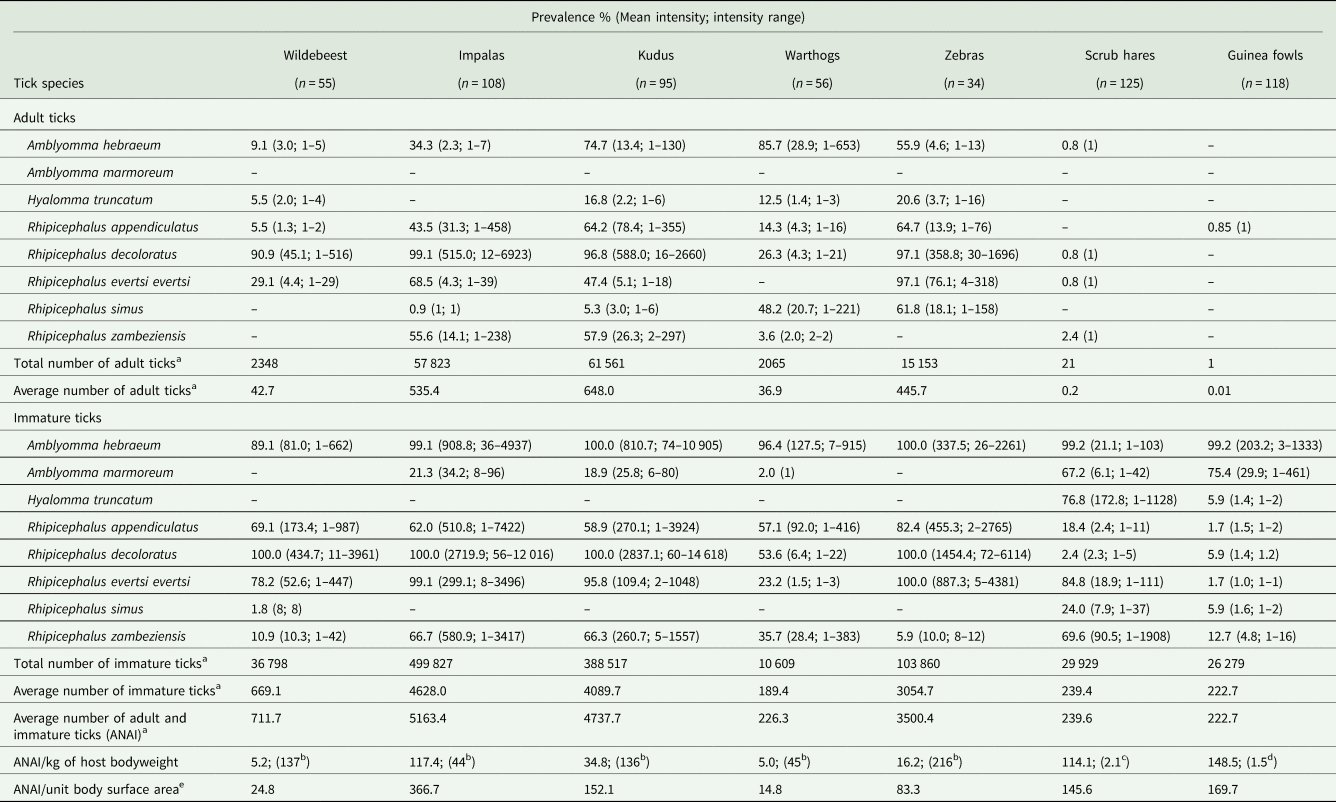
Infection parameters of eight ixodid tick species collected from blue wildebeest, impalas, greater kudus, common warthogs, plains zebras, scrub hares and helmeted guinea fowls in the Kruger National Park, South Africa

a Based on all tick species infesting the host species, including those not listed here.
b Average host bodyweight (kg) as provided by Gallivan and Horak (Reference Gallivan and Horak1997).
c Average host bodyweight (kg) as provided by Penzhorn et al. (Reference Penzhorn, Horak, Spickett and Braack1993).
d Average host bodyweight (kg) as provided by Penzhorn et al. (Reference Penzhorn, Horak, Spickett and Braack1991).
e Unit body surface area = host bodyweight0.67 (see Gallivan and Horak, Reference Gallivan and Horak1997).
Results
The prevalence and mean intensity of infection with the adults of 15 gastrointestinal nematode species that had a prevalence of 60% or more in at least one of blue wildebeest, impalas or kudus, as well as that of T. falculatus, which infected all antelope as well as warthogs and scrub hares, are listed in Table 1. Five of these 16 nematode species were present in the abomasum/stomach, ten in the small intestine, and one in the large intestine (Table 1). Four of the eight nematode species in blue wildebeest (Agriostomum gorgonis, Cooperia connochaeti, Haemonchus bedfordi and Trichostrongylus thomasi), eight of the 14 species in impalas (Cooperia hungi, Cooperioides hamiltoni, Gaigeria pachyscelis, Impalaia tuberculata, Longistrongylus sabie, Strongyloides papillosus, Trichostrongylus deflexus and T. thomasi), and three of the nine species in kudus (Cooperia acutispiculum, Cooperia neitzi and Haemonchus vegliai) had a prevalence of >75%. Warthogs were infected with five of the nematode species, but only one, T. thomasi, reached a prevalence of 75%; scrub hares were also infected with five species, with only T. deflexus infecting >75% (Table 1).
Of the 16 nematode species included here, two species, T. deflexus and T. falculatus, were generalists and infected all five host species. Trichostrongylus deflexus infected >90% of the impalas and scrub hares, 49% of the kudus, and <10% of the blue wildebeest and warthogs, while T. falculatus was found in 48% of the scrub hares, 13.9% of the impalas, and 10% or less of the remaining hosts. Three nematodes, T. thomasi, I. tuberculata and S. papillosus, each occurred in four of the five host species. The prevalence of T. thomasi was 83.3% in impalas, 78% in blue wildebeest and warthogs, and 50.4% in scrub hares. The prevalence of I. tuberculata was 80.6% in impalas, 32.0% in scrub hares, 28.1% in kudus and 10.7% in warthogs. Similarly, the prevalence of S. papillosus was highest in impalas (86.1%), with a lower prevalence in blue wildebeest (25.5%), kudus (6.3%) and warthogs (5.4%). Two nematodes (C. hungi and A. gorgonis) infected three host species, four (H. bedfordi, H.vegliai, C. connochaeti and G. pachyscelis) infected two host species, and five nematodes (Haemonchus krugeri, L. sabie, C. acutispiculum, C. neitzi and C. hamiltoni) infected a single host species. Three of the latter five nematode species, H. krugeri, L. sabie and C. hamiltoni, only occurred in impalas, while the other two, C. acutispiculum and C. neitzi, only infected kudus. In addition to the five nematode species restricted to a single host species, four species (H. bedfordi, H. vegliai, C. connochaeti and C. hungi) were 10-times more prevalent in their main hosts than in the other host species infected (Table 1).
Comparing nematode burdens, warthogs and zebras had the highest average burdens, primarily because of the presence of P. vivipara, which numbered in the millions (Krecek et al., Reference Krecek, Malan, Reinecke and De Vos1987; Horak et al., Reference Horak, Boomker, De Vos and Potgieter1988). Among the remaining hosts and when excluding P. vivipara from nematode counts in warthogs, impalas had the highest average burden, followed by warthogs, kudus, scrub hares and blue wildebeest (Table 1). However, when expressed per kilogram of bodyweight, scrub hares supported the highest nematode burdens, followed by impalas, warthogs, kudus and blue wildebeest (Table 1). The nematode burden per kg of scrub hares was 9 times that of impalas and 80 times that of blue wildebeest.
When looking at the contribution of individual nematode species to total nematode burden (based on the total number of adult gastrointestinal nematodes collected per host species, including nematode species with a prevalence of <60%; data not shown), T. deflexus accounted for the highest proportion of the nematode burden of scrub hares, followed by T. falculatus and T. thomasi. Trichostrongylus deflexus also accounted for 39.7% of the nematode burden of impalas, followed by C. hungi (18.8%) and C. hamiltoni (11.4%), two species with a strong association with impalas. The three species exhibiting a strong association with kudus were also the largest contributors to total nematode burdens in this host, namely C. neitzi (54.1%), C. acutispiculum (13.6%) and H. vegliai (11.8%). Similarly, the predominant nematodes in blue wildebeest, C. connochaeti (43.7% of the total worm burden) and H. bedfordi (22.7% of the total worm burden), showed a robust association with blue wildebeest. Contrary to this, T. thomasi, which also contributed markedly to the total worm burden in wildebeest (11.1%), infected all grazing host species, including zebras (Krecek et al., Reference Krecek, Malan, Reinecke and De Vos1987).
The adults and/or immature stages of eight ixodid tick species infested at least three of the seven host species examined. Their prevalence and mean intensity are listed in Table 2. All eight tick species had a prevalence of ≥60% in at least one of the seven hosts. Kudus were infested with the adults of seven of the eight tick species; Rhipicephalus decoloratus had the highest prevalence (>90%), followed by Amblyomma hebraeum (75%). Impalas, warthogs and zebras harboured adults of six of the eight tick species, with >90% of impalas infested with the adults of R. decoloratus, >75% of warthogs infested with the adults of A. hebraeum and >90% of zebras infested with the adults of both R. decoloratus and Rhipicephalus evertsi evertsi. Wildebeest carried the adults of five of the eight species, with >90% infested with the adults of R. decoloratus. Infestations of adult ticks on scrub hares and helmeted guinea fowls are uncommon (Horak et al., Reference Horak, Heyne, Williams, Gallivan, Spickett, Bezuidenhout and Estrada-Peña2018).
Scrub hares and guinea fowls harboured the immature stages of all eight tick species, with >75% of hares infested with A. hebraeum, Hyalomma truncatum and R. evertsi evertsi, and >75% of guinea fowls infested with A. hebraeum and Amblyomma marmoreum. Wildebeest, impalas, kudus and warthogs were infested with the immature stages of six of the eight tick species, with >75% infested with A. hebraeum, while >75% of wildebeest, impalas and kudus were also infested with R. decoloratus and R. evertsi evertsi. Zebras harboured the immature stages of five species; all the zebras harboured immature stages of A. hebraeum, R. decoloratus and R. evertsi evertsi and >75% carried immature stages of Rhipicephalus appendiculatus. The infestation of wildebeest with the immature stages of Rhipicephalus simus was likely incidental.
The adults of A. hebraeum, R. appendiculatus and R. decoloratus are generalists (Horak et al., Reference Horak, Heyne, Williams, Gallivan, Spickett, Bezuidenhout and Estrada-Peña2018), and infested the five large host species. The prevalence of A. hebraeum varied between 9.1% on wildebeest to 85.7% on warthogs, that of R. appendiculatus between 5.5% on wildebeest to 64.7% on zebras, and the prevalence of R. decoloratus varied between 26.3% on warthogs to >90% on wildebeest, impalas, kudus and zebras. The adults of R. evertsi evertsi infested wildebeest, impalas, kudus and zebras, with the highest prevalence of 97.1% on the latter host. Adults of R. simus were closely associated with zebras as well (61.8% prevalence), but also had a prevalence of 48.2% on warthogs. The seasonal activity of adult R. appendiculatus, R. simus and Rhipicephalus zambeziensis occurs during the summer months, from December to April (Horak et al., Reference Horak, Gallivan, Braack, Boomker and De Vos2003); the prevalence of these species is therefore reduced by the absence of adult ticks during several months of the year.
The immature stages of five tick species, A. hebraeum, R. appendiculatus, R. decoloratus, R. evertsi evertsi and R. zambeziensis are generalists (Horak et al., Reference Horak, Heyne, Williams, Gallivan, Spickett, Bezuidenhout and Estrada-Peña2018) and were found on all seven host species. Amblyomma hebraeum infested >85% of wildebeest and >95% of the other six host species. The immatures of R. appendiculatus had a prevalence of >55% on wildebeest, impalas, kudus, warthogs and zebras, and of 18.4% on scrub hares. We regard infestation of guinea fowls with this tick as incidental. More than 75% of wildebeest, impalas, kudus, scrub hares and zebras as well as 23.2% of warthogs harboured R. evertsi evertsi, but, as with R. appendiculatus, guinea fowls are considered incidental hosts. The highest prevalence of immature stages of R. zambeziensis was seen on impalas, kudus and scrub hares (>60%), but wildebeest, warthogs, zebras and guinea fowls were suitable hosts as well. The immature stages of R. decoloratus used wildebeest, impalas, kudus and zebras equally, with a prevalence of 100% on each of these hosts, and of 53.6% on warthogs. Given the low prevalence, the infestation of scrub hares and guinea fowls with immatures of R. decoloratus is likely incidental to the abundance of questing larvae. In contrast, the immature stages of A. marmoreum were most prevalent on scrub hares and guinea fowls, but also infested impalas, kudus and warthogs. The immatures of H. truncatum were limited to scrub hares and guinea fowls, while immatures of R. simus infested 24% of the scrub hares, and to a lesser extent guinea fowls (5.9%) and blue wildebeest (1.8%).
When looking at the contribution of individual tick species to total tick burden (based on the total number of immature and adult ticks collected per host species, including species not reflected in this paper; data not shown), the one-host tick R. decoloratus was the predominant tick on four of the large herbivores. It accounted for 51.5% of the tick burdens on zebras, 62.6% on impalas, 66.8% on blue wildebeest and 71.9% on kudus, while A. hebraeum immatures accounted for 90.5% of the ticks on guinea fowls, 54.3% on warthogs, 17.4% on impalas and 17.1% on kudus. Following R. decoloratus, the majority of tick counts on blue wildebeest (16.8%) and on zebras (10.7%) comprised immatures of R. appendiculatus. On impalas and kudus, R. appendiculatus/zambeziensis immatures accounted for 15.2 and 7.0% of the ticks, respectively. Very few R. zambeziensis immatures, and no adults, were collected from blue wildebeest and zebras. The few R. zambeziensis and lack of A. marmoreum immatures on blue wildebeest and zebras may reflect the distribution of these ticks within the KNP, as fewer questing R. zambeziensis and A. marmoreum were collected in the S. birrea/A. nigrescens savanna than in the Thickets of the Sabie and Crocodile Rivers (Horak et al., Reference Horak, Gallivan and Spickett2011). Rhipicephalus evertsi evertsi, a two-host tick, accounted for 27.5% of the ticks on zebras, approximately 6% of those on the scrub hares, blue wildebeest and impalas and 2.3% of those on kudus. The immatures of H. truncatum dominated tick numbers on scrub hares and accounted for 55.4% of the ticks on this host. Immatures of H. truncatum were at times collected from guinea fowls as well, but only the adults were occasionally collected from the larger herbivores.
Impalas harboured the highest number of ticks, followed by kudus, zebras and blue wildebeest (Table 2). However, when expressed per kilogram of bodyweight, guinea fowls supported the highest tick burdens, followed by impalas and scrub hares, and when expressed per unit body surface area, impalas again had the highest-burden, followed by guinea fowls, kudus and scrub hares (Table 2). Blue wildebeest and warthogs had the lowest burdens per kilogram bodyweight, and warthogs had the lowest burden per unit body surface area, followed by blue wildebeest.
Discussion
The extensive parasite surveys conducted on hosts in the KNP enabled us to compare host–parasite associations among several host species. The hosts examined in the present study have rich and varied nematode assemblages, including gastrointestinal as well as filarial worms. Overall, the blue wildebeest harboured a total of 13 species of nematodes, the impalas 20 species, the kudus 18, warthogs 13 and the scrub hares 6 species (Horak et al., Reference Horak, De Vos and Brown1983, Reference Horak, Boomker, De Vos and Potgieter1988; Boomker et al., Reference Boomker, Horak and De Vos1989, Reference Boomker, Horak and Booyse1997; Negovetich et al., Reference Negovetich, Fellis, Esch, Horak and Boomker2006). The zebras, although not included in our analysis of nematode host associations, harboured 30 species of nematodes (Scialdo et al., Reference Scialdo, Reinecke and De Vos1982; Krecek et al., Reference Krecek, Malan, Reinecke and De Vos1987). The tick assemblages were generally more restricted, with blue wildebeest and zebras infested with seven species of ixodid ticks, warthogs with eight species, impalas with nine, kudus and guinea fowls with ten and scrub hares with twelve species (Horak et al., Reference Horak, De Vos and Brown1983, Reference Horak, De Vos and de Klerk1984, Reference Horak, Boomker, De Vos and Potgieter1988, Reference Horak, Spickett, Braack and Williams1991, Reference Horak, Boomker, Spickett and De Vos1992, Reference Horak, Spickett, Braack and Penzhorn1993, Reference Horak, Gallivan, Braack, Boomker and De Vos2003).
The gastrointestinal nematodes exhibited more host specificity than the ticks. Only the three Trichostrongylus species infected five host species. Of the remaining 13 gastrointestinal nematode species included in this analysis, four infected a single host species, and four had a >10-fold prevalence in the main host compared to the secondary host (Table 1). In contrast, the immature ticks of five of the eight tick species infested all of the host species, and the adults of three tick species infested all of the larger hosts, and occasionally scrub hares or guinea fowls. None of the ixodid ticks was restricted to a single host species (Table 2).
The greatest degree of nematode overlap occurred among the antelope (blue wildebeest, impalas and kudus). With the exception of T. thomasi, which infected the other grazing species, and P. vivipara, which also infected warthogs (Horak et al., Reference Horak, Boomker, De Vos and Potgieter1988), the gastrointestinal nematodes of zebras did not infect the other hosts, nor did representatives of the most common gastrointestinal nematode genera of warthogs, Murshidia and Daubneyia (as Oesophagostomum mocambiquei and O. mwanzae) (Horak et al., Reference Horak, Boomker, De Vos and Potgieter1988). This suggests that evolutionary relationships play an important role. Also, the most common gastrointestinal nematodes of zebras and warthogs were found in the large intestine (Krecek et al., Reference Krecek, Malan, Reinecke and De Vos1987; Horak et al., Reference Horak, Boomker, De Vos and Potgieter1988), indicating that digestive strategy (foregut vs hindgut fermentation) is an important factor in host–parasite associations in herbivores.
Impalas harboured the highest number of gastrointestinal nematodes species (14) and of these, 11 species also infected blue wildebeest or kudus. Impalas shared eight nematode species with blue wildebeest and seven with kudus. Amongst these were the generalist species, T. deflexus and T. falculatus, as well as S. papillosus, which was found in one additional host (warthogs), and A. gorgonis, which was limited to blue wildebeest, impalas and kudus. The host range of three nematode species was restricted to blue wildebeest and impalas; of these, wildebeest was the main host of C. connochaeti and H. bedfordi, whereas G. pachyscelis did not show a greater association with either of the two hosts, despite its slightly higher prevalence in impalas. Kudus were the main hosts of H. vegliai over impalas, while impalas were the main hosts of C. hungi over kudus. Only four nematode species infected both blue wildebeest and kudus; two of these, T. deflexus and T. falculatus, were generalists and also infected impalas, warthogs and scrub hares. The differences in the nematode species infecting blue wildebeest and kudus and overlap with the species infecting impalas suggest that feeding behaviour may play an important role in nematode transmission within evolutionary lineages. Impalas, which are intermediate feeders, would be exposed to nematode species infecting both grazers and browsers. However, two common species in impalas, L. sabie and C. hamiltoni, did not infect the other antelope, and two common species in kudus, C. acutispiculum and C. neitzi, did not infect impalas.
Trichostrongylus thomasi infected all host species except kudus and was also recovered from 44% of 25 plains zebras examined (Krecek et al., Reference Krecek, Malan, Reinecke and De Vos1987), suggesting that T. thomasi infects primarily grazing animals. On the other hand, I. tuberculata was not collected from blue wildebeest, but was recovered from warthogs and scrub hares, which also prefer short grass, as well as from mixed feeding impalas and browsing kudus. This suggests that wildebeest may innately be resistant to infection with this nematode or that its free-living stages do not survive in the open S. birrea/A. nigrescens savanna habitat preferred by wildebeest. The four nematode species using both scrub hares and warthogs as hosts (I. tuberculata, T. deflexus, T. falculatus and T. thomasi), also infected at least two of the three antelope species. Two of the 16 nematode species, the hookworm G. pachyscelis and S. papillosus, infect their hosts percutaneously (Ortlepp, Reference Ortlepp1937; Pienaar et al., Reference Pienaar, Basson, Du Plessis, Collins, Naude, Boyazoglu, Boomker, Reyers and Pienaar1999), and infection may have taken place around water holes or other localities where faeces had accumulated. The same may apply to the hookworm A. gorgonis.
Although some of the nematodes found in the three wild ruminant species have been encountered in domestic livestock, only three, G. pachyscelis, S. papillosus and T. falculatus are of concern in sheep and goats. Gaigeria pachyscelis has in the past been responsible for mortality in sheep in the arid western regions of the Northern Cape Province (Ortlepp, Reference Ortlepp1937) and S. papillosus for mortality in young lambs and kids in Namibia (Pienaar et al., Reference Pienaar, Basson, Du Plessis, Collins, Naude, Boyazoglu, Boomker, Reyers and Pienaar1999). The prevalence of infection with T. falculatus exceeded 90% in sheep in each of four surveys conducted in the Karoo (Viljoen, Reference Viljoen1964, Reference Viljoen1969). Whether these three nematodes or any of the others pose a threat to the wildlife species examined in these surveys was impossible to determine because sick animals would likely have been caught by predators. None of the nematodes discussed here poses a threat to cattle.
Five tick species collected from wildlife in this study are either the vectors of the causative organisms of disease in domestic livestock or themselves a cause of disease. Amblyomma hebraeum is a vector of Ehrlichia ruminantium, the cause of heartwater in cattle sheep and goats; certain strains of H. truncatum females secrete a toxin with their saliva which leads to sweating sickness in calves; R. appendiculatus is the principal vector of Theileria parva, the cause of East Coast fever in cattle; R. decoloratus is the vector of Babesia bigemina, the cause of African redwater in cattle and R. evertsi evertsi is the vector of Babesia caballi and Theileria equi, the cause of equine piroplasmosis (Horak et al., Reference Horak, Heyne, Williams, Gallivan, Spickett, Bezuidenhout and Estrada-Peña2018).
The ixodid ticks exhibited less host specificity than the gastrointestinal nematodes. The immature stages of five tick species infested all of the hosts, and the adults of three tick species infested all of the larger ungulate hosts, and occasionally scrub hares or guinea fowl. Any of the adult ticks infesting antelope, warthogs and zebras were considered incidental infestations on scrub hares and guinea fowls. While the immature stages and adults of five tick species infested the same host species, the hosts of the immature stages and those of the adults of three of the eight tick species belong to different families. The immature stages of A. marmoreum occur on a wide range of hosts, but the adults are near host-specific parasites of tortoises, particularly leopard tortoises, Stigmochyles pardalis. Of the 63 leopard tortoises examined in the south of the KNP between September 2011 and February 2013, 88.9% harboured A. marmoreum adults (Horak et al., Reference Horak, Pearcy and Lloyd2017). The immature stages of H. truncatum infest scrub hares, whereas the adults are found on large bovids, zebras, warthogs and other large mammals with thick hides (Horak et al., Reference Horak, Heyne, Williams, Gallivan, Spickett, Bezuidenhout and Estrada-Peña2018). The immature stages of R. simus parasitise murid rodents and, in the present surveys, scrub hares, while the adults occur on zebras, warthogs, large wild carnivores and large ruminants (Horak et al., Reference Horak, Heyne, Williams, Gallivan, Spickett, Bezuidenhout and Estrada-Peña2018).
In addition to the differences in the gastrointestinal nematode and tick species infesting the host species, there were also differences in the parasite burdens. Blue wildebeest had the lowest burden of gastrointestinal nematodes and the second-lowest burden of ticks per unit surface area after warthogs. The low tick burdens of warthogs may be explained by their thicker skins and habit of wallowing. However, the gastrointestinal nematode burden per kilogram of bodyweight of blue wildebeest was one-ninth that of impalas and only 70% of that of kudus, while the tick burden per unit body surface area was one-fifteenth that of impalas and one-sixth that of kudus. One hypothesis for the relatively low tick burdens of blue wildebeest is that they are innately resistant to ticks (Horak et al., Reference Horak, de MacIvor, Petney and De Vos1987). Another is that the short grass habitat favoured by wildebeest reduces survival of the free-living stages of ticks and subsequent tick exposure (Gallivan and Horak, Reference Gallivan and Horak1997). Which of these hypotheses best explains the current observations cannot be determined with the available data. While all of the host species were sampled over at least a 12-month period, they were not all sampled in the same landscape zones at the same time. Blue wildebeest and zebras are migratory within the east-central region of the KNP (Smuts, Reference Smuts1975; Whyte and Joubert, Reference Whyte and Joubert1988) and were collected in the S. birrea/A. nigrescens savanna to the east in the central region of the KNP in the survey. This region is drier than the areas to the south and west where the other animals were sampled (MacFadyen et al., Reference MacFadyen, Zambatis, Van Teeffelen and Hui2018). Rainfall within the KNP also varies from year-to-year (MacFadyen et al., Reference MacFadyen, Zambatis, Van Teeffelen and Hui2018). This can affect the survival of the free-living stages of parasites, as well as host condition and population size, factors that can determine the susceptibility of individual hosts and the number of hosts available (Horak et al., Reference Horak, Gallivan, Braack, Boomker and De Vos2003, Reference Horak, Gallivan and Spickett2011). Collections in drought years were excluded from these analyses, but there was still variation in rainfall among collection periods. Thus, caution should be exercised in extrapolating the results of these surveys. Nevertheless, they do provide valuable insights into the parasite–host relationships in the KNP and stimulate questions for future research.
Acknowledgements
We express our thanks to the National Parks Board (currently known as SANParks) for placing the animals at our disposal. A special word of thanks to the technical and support staff at Skukuza, KNP, who assisted with the autopsies.
Author contributions
IGH, JB and GJG conceived the study. IGH and JB collected the material and identified the nematodes and ticks. IGH, GJG and KJ drafted the manuscript. All authors participated in finalizing the manuscript.
Financial support
The surveys were funded by the University of Pretoria, the Medical University of Southern Africa, the National Parks Board, and the National Research Foundation.
Conflict of interest
The authors state that they have no competing interests that preclude them from publishing this research.
Ethical standards
All applicable institutional, national and international guidelines for the care and use of animals were followed.