The ancient text known as the Testament of Abraham is preserved in Coptic in the same codex as two other works, the Testament of Isaac and the Testament of Jacob. These testaments were probably written in the late first or early second centuries CE by Jewish writers,Footnote 1 although the manuscript of the Coptic codex containing them is dated to 962.Footnote 2 These books were considered part of the “testament” literary genre, which featured a biblical hero imparting his last words of religious wisdom to his family gathered at his bedside.Footnote 3 Scholars agree that the stylistic and theological differences among these three testaments indicate that they were not written by the same author. Yet a close reading reveals that the Testament of Isaac is dependent on the Testament of Abraham, and that the Testament of Jacob is dependent on the two earlier texts.Footnote 4 Moreover, the Testament of Abraham and the Testament of Isaac share similarities that distinguish them from the Testament of Jacob: unlike the Testament of Jacob, the Testament of Abraham and the Testament of Isaac reflect a universalist worldview that depicts a God concerned for all humankind, not only for his chosen people.Footnote 5 This God reigns over all people,Footnote 6 and themes specific to the Christian and Jewish faiths are virtually absent.Footnote 7 Later Christian and Jewish literature concerning the theme of divine judgment exhibits elements that may reflect an awareness of a written or oral tradition that appears in the Testament of Abraham and the Testament of Isaac. The images of judgment and punishment, especially those in the Testament of Abraham, appear in the second-century Apocalypse of PeterFootnote 8 and the fourth-century Vision of Paul, which is also known as the Apocalypse of Paul.Footnote 9 Likewise, midrashic traditions regarding Abraham and Moses are reminiscent of traditions found in these testaments, particularly the Testament of Abraham. The possibility that early Christian apocalyptic texts were aware of these testaments is grounded in the fact that scholars give these texts a common place of origin, Egypt.Footnote 10 The provenance of the midrashic texts is more difficult to identify, but because they share literary elements and theological concerns with the Testament of Abraham and the Testament of Isaac, I suggest that the authors of these midrashic traditions had access to written or oral traditions prominent in these testaments. This paper will examine early Christian apocalyptic and early Jewish midrashic texts that modify some of the traditions prominent in these testaments in order to accommodate their nonuniversalist rabbinic or early Christian worldviews.
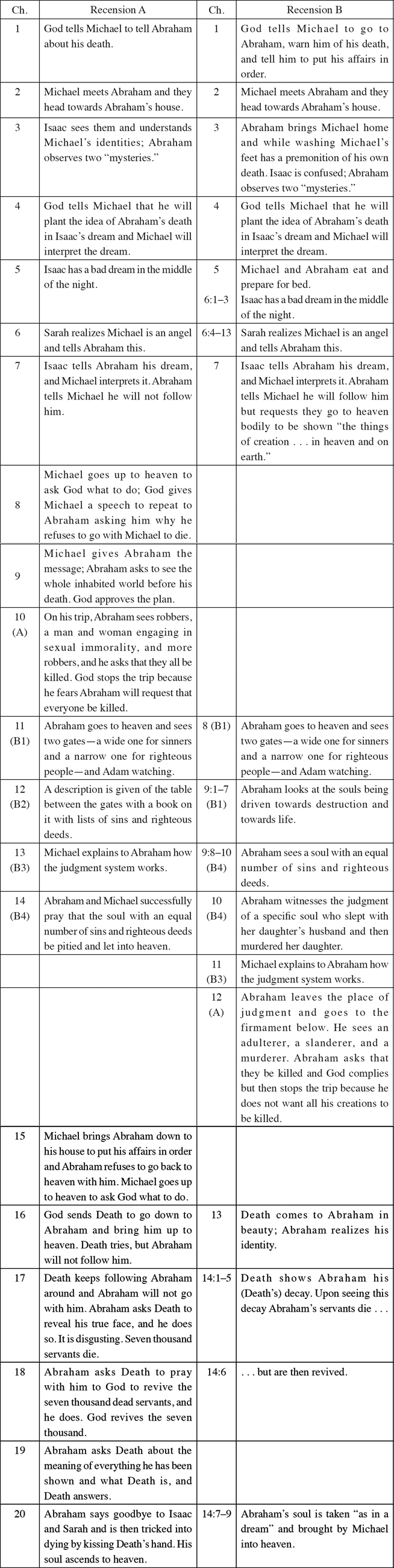
Before we examine the Christian and rabbinic sources that rely on the Testament of Abraham and the Testament of Isaac, the testaments themselves should be reviewed. The Testament of Abraham survives in two versions, known as Recension A and Recension B. Recension A is generally thought to be the older text; Recension B likely abridged and adjusted the text of Recension A with the aim of stripping it of its satiric and humorous tone.Footnote 11 Both recensions are important for this study, since some Christian sources, such as the Vision of Paul, bear literary relationships to both Recensions A and B, whereas Jewish sources, such as the midrashic text the Death of Moses (Pĕṭirat Mošeh), seem to rely only on Recension A.Footnote 12
The recensions follow almost identical plotlines: the archangel Michael is sent by God to go down to earth, inform Abraham of his imminent death, and bring Abraham's soul back up to God. Unfortunately, things do not go Michael's way: once Abraham discovers this divine plan, he refuses to comply but assures Michael that if he is shown all the world's inhabitants, he will then willingly accept his death. Michael agrees and takes Abraham on a chariot ride through the heavens to survey the whole world and even takes him to the gates of heaven to observe how souls are judged. Afterwards, however, Abraham decides that he will not follow Michael, whereupon Michael summons the Angel of Death to take Abraham's soul. Abraham continues to resist until the Angel of Death offers Abraham a kiss on his hand. Abraham accepts, and immediately his soul departs from his body. This testament parodies other testament literature, which solemnly recounts the patriarchs’ final words before their deaths. The structural change that Recension B makes to Recension A can be regarded as an attempt to improve the story line. By placing Abraham's trip across the world after the scene of divine judgment, Recension B makes the latter scene the climactic moment of Abraham's vision and of the text in general.Footnote 13
In Recension A of the Testament of Abraham, Abraham's tour of the earth leads him to see three sinners, whom Michael, the commander in chief, identifies as “robbers, who want to commit murder and rob and burn and destroy,” a “man with a woman, engaging in sexual immorality with each other,” and “men breaking into a house and carrying off the possessions of others.”Footnote 14 In Recension B, Abraham sees “a man committing adultery with a married woman,” “other men slandering (their) fellows,” and “some people leaving for a desert place to commit murder.”Footnote 15 Put succinctly, in Recension A, the sins Abraham sees being committed are robbery, intent to murder, and sexual immorality, whereas in Recension B the sins are adultery, slander, and intent to murder. In both recensions, Abraham requests that these sinners be immediately killed, and the tour is abruptly ended to prevent Abraham from continuing to request retribution against God's creatures. Recension B also includes an anecdote in which, during Abraham's visit to the divine place of judgment, a soul is accused of committing adultery with her daughter's husband and murdering her daughter. This soul denies wrongdoing and claims that her daughter falsely accused her of these sins, until the divine judge shows her that her sins were written down.Footnote 16 This sinful soul is accused of murder, adultery, and acting as a false witness as well. These same generic sins lie at the core of the sin lists found in the Apocalypse of Peter and the Vision of Paul.
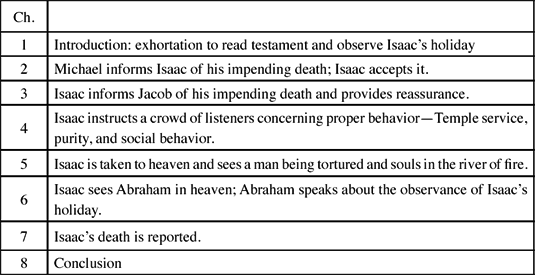
Like the Testament of Abraham, the Testament of Isaac is centered on two complementary climactic scenes that involve grave sins and a vision of divine judgment respectively. The Testament of Isaac opens in a more formulaic and conventional manner than the Testament of Abraham: when Isaac learns from the archangel Michael that he is about to die, he calmly gathers his family around his deathbed and imparts his wisdom, which includes instructions not to commit murder, fornication, or blasphemy.Footnote 17 After his speech, Isaac is taken to hell and sees condemned souls being tortured.Footnote 18 He returns, bids his family farewell, and dies. While Isaac sees multitudes of sinners being punished, only two sins are identified, and they are remarkably generic: one sinner was “in enmity with his neighbor for five hours,”Footnote 19 and others “committed the sin of Sodom.”Footnote 20 The nature of these two sins would have been considered in antiquity to be unspecific to a particular culture or religion. Sodomy was considered to be sinful in both Christian and Jewish traditions, and although it was to a degree socially accepted under the Greek and early Roman empires, it met criticism and controversy in as early as the second century CE even in pagan circles.Footnote 21 The original author of the Testament of Isaac does not envision a God who is concerned with the destiny of a chosen people who are held to different standards from the rest of humankind. In the judgment scene, neither Jews nor Christians are punished for the violation of specifically Jewish or Christian laws, although the text includes Christian interpolation.Footnote 22 In fact, the judgment scene of the Testament of Isaac is neither uniquely Jewish nor Christian, while the judgment scenes in the later texts, the Apocalypse of Peter and the Vision of Paul, consider the nature of divine punishment to be determined by one's religion and practice.
Early Christian Apocalyptic Texts
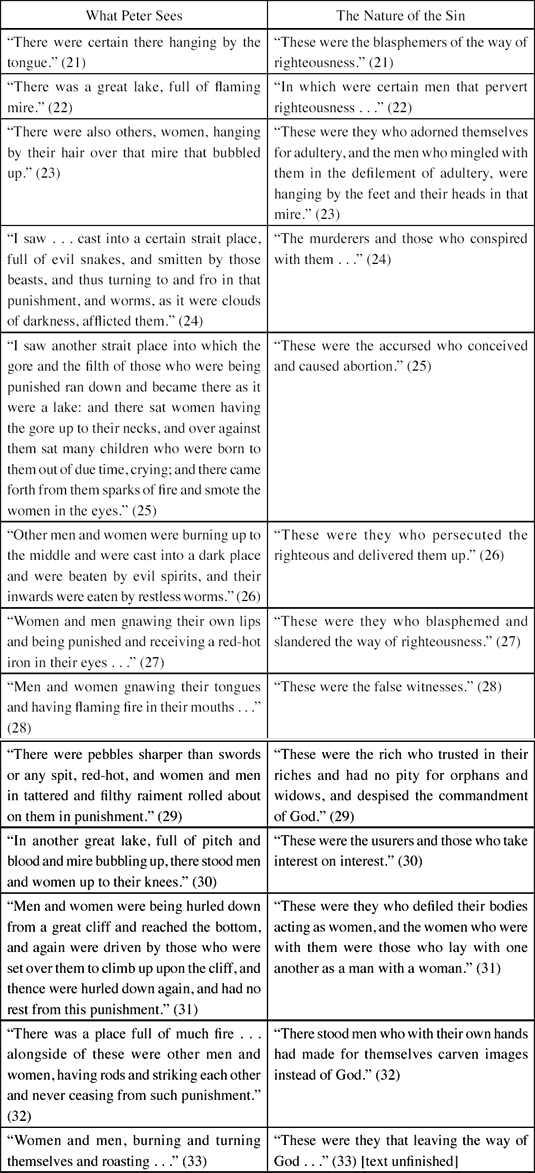
The Apocalypse of Peter is believed to contain the earliest judgment scene in Christian literature.Footnote 23 Like other apocalyptic texts, this text features a revelatory moment in which an individual has a vision featuring the divine judgment of souls that have departed from their bodies.Footnote 24 Scholars have long recognized Hellenistic influences on the Apocalypse of Peter's description of hell,Footnote 25 but none to my knowledge have linked it to the Testament of Abraham or the Testament of Isaac.Footnote 26 Yet as in these texts, the sins mentioned in the Apocalypse of Peter are not exclusive to a particular religious community. Peter sees
the blasphemers of the way of righteousness;
. . . certain men that pervert righteousness,
. . . women, hanged by their hair over that mire that bubbled up: and these were they who adorned themselves for adultery;
the men who mingled with them in the defilement of adultery,
. . . murderers and those who conspired with them,
. . . the accursed who conceived and caused abortion.
. . . they who persecuted the righteous and delivered them up.
. . . they who blasphemed and slandered the way of righteousness.
. . . the false witnesses.
. . . the rich who trusted in their riches and had no pity for orphans and
widows, and despised the commandment of God.
. . . the usurers and those who take interest on interest.
. . . they who defiled their bodies acting as women;
. . . those [women] who lay with one another as a man with a woman.
. . . men who with their own hands had made for themselves carven images instead of God.Footnote 27
The judgment scene in the Apocalypse of Peter, in which Peter sees twelve groups of sinners being punished according to their heinous deeds, can be understood as an expansion of the judgment scene in the Testament of Abraham. The sins in the Testament of Abraham, which are robbery, intent to murder, and sexual immorality in Recension A and adultery, slander, intent to murder, murder, and acting as a false witness in Recension B, are similar to those listed in the Apocalypse of Peter, particularly the first nine sins listed above, which all relate to murder, adultery, and falsehood. It is even possible that the woman's murder of her daughter in the Testament of Abraham Recension B is meant to be reminiscent of abortion, although because the author is trying to associate multiple sins with one individual, the daughter must be an adult rather than a fetus in order for it to be plausible that her mother consorted with her husband. It is striking that the first nine sins on the list in the Apocalypse of Peter appear in some form in the Testament of Abraham, while the final five groups of sinners—the rich who do not give charity, usurers, men who dress as women, women who have sex with women, and idolaters—do not appear in either recension of the Testament of Abraham. This raises the possibility that the author of the sin list in the Apocalypse of Peter was adding onto an older list.
In the Testament of Isaac, Isaac instructs his children on his deathbed to conduct themselves with proper behavior. This instruction never occurs in the Testament of Abraham, since Abraham refuses to accept his imminent death. Although the bulk of his speech concerns how properly to offer sacrifices to God, Isaac opens and closes with instruction regarding general behavior, exhorting his children:
Accordingly, do not kill with the sword, do not kill with the tongue, do not fornicate with your body, and do not remain angry until sunset. Do not let yourself receive unjustified praise, and do not rejoice at the fall of your enemies or of your brothers. Do not blaspheme; beware of slander. Do not look at a woman with a lustful eye.Footnote 28
Isaac is then shown the divine place of judgment and the place where sinners are punished. After witnessing the horrible torture of those souls who had been “in enmity with their neighbor for five hours” and those souls who had committed sodomy, Isaac asks to see no more, since watching their torture is so horrifying to him.
The sins mentioned in the Testament of Isaac include enmity toward neighbors, sodomy, murder, cursing, fornication, blasphemy, slander, and lust. This list is more expansive than that in either recension of the Testament of Abraham, but, nevertheless, it does not overlap with the last five sins mentioned in the Apocalypse of Peter. This again indicates that the author of the Apocalypse of Peter was adding onto an already existing list or already existing oral tradition that influenced both the Testament of Abraham and the Testament of Isaac. As in the Testament of Abraham, sexual violation is a focal point of the Apocalypse of Peter; adultery, abortion, and improper sexual acts are highlighted.Footnote 29 Both the Apocalypse of Peter and the Testament of Abraham are dated to the late first century CE, share concerns about judgment and the afterlife, and are linked in terms of their compositional origins to Egypt. While the literary framework of the Apocalypse of Peter is Christian, the sin list was probably borrowed from an earlier text and reframed in the Christian narrative.Footnote 30 It is probably because of its lack of specifically Christian theology that the Apocalypse of Peter fell out of favor in Christian communities and was ultimately replaced by the Vision of Paul.Footnote 31
The Vision of Paul is extant in Latin, Syriac, and Greek versions, and there exists also a parallel but not identical version in a Coptic manuscript that is usually referred to as the Apocalypse of Paul.Footnote 32 The Vision of Paul shares striking similarities to the scenes of divine judgment in the Testament of Abraham and the Testament of Isaac but presents a strictly Christian worldview. Paul receives a series of visions concerning heaven and hell, which climaxes in a lengthy vision in which sinners suffer different punishments according to the gravity of their sins. This section is followed by an angelic appeal to the archangel Michael to pity humankind. After Michael responds that he cannot save these souls, Christ intervenes with a speech that both rebukes and forgives the sinners. The Vision of Paul closes with Paul's death and entry into paradise. The structure of the text is as follows:

The text is structurally convoluted, since Paul's vision vacillates between heaven and hell. But the climax of the story is the lengthy judgment scene, which is followed by the only speech that Jesus gives in the text. Sections B, C, and D represent Paul's visions of divine judgment. Although chapters 43–51 also take place in a sort of alternate reality, they occur in “real time” and are not presented as a vision.Footnote 33 Sections B¹ and B² parallel each other in that they are both focused on sinful and righteous souls. Sections C and D contrast with each other, since in C Paul views paradise and the city of Christ, and in D Paul views hell and the punishments that sinners must endure. The fact that sections C and D are almost identical in length suggests that they were meant to be contrasted with one another.
In section B², Paul sees three souls being judged. The third soul refuses to confess his sins, which are murder, fornication, and robbery. These sins are similar to those of the three sinners whom Abraham sees in his vision of the earth in the Testament of Abraham. In Recension A, Abraham sees robbers and individuals committing illegal fornication, and in Recension B, Abraham sees an adulterer, a slanderer, and a murderer. The three sins committed by the soul in section B² of the Vision of Paul may reflect what was considered in the fourth century to represent the most basic and generic of moral violations. This does not discount the possibility, however, that the writer had one or both recensions of the Testament of Abraham at hand and used them as a springboard first to enumerate generic violations before transitioning from there to Section C², which refers to violations that are unique to a Christian community. Section C² describes the punishments of souls whose sufferings are witnessed by Paul and whose sins are identified by the angel accompanying him.Footnote 34 Bremmer notes that the Vision of Paul was usually not copied in full, but this scene of Paul's visiting hell was copied repeatedly, particularly during the medieval period.Footnote 35 This attests to the fact that Christians regarded this scene in the Vision of Paul as powerful and climactic.Footnote 36
The structure of this judgment scene comprises three main sections. Sins 1–10 concern individuals who disturb the stability of church governance. Sins 11–20 concern social behaviors that breach Christian custom and compromise the harmony of the community. The final group of sins concerns failing to believe in Christ or his resurrection. The sinners whom Abraham sees in the Testament of Abraham are robbers, would-be murderers, and illegal fornicators, but robbers and murderers are not listed among the sinners whom Paul sees. This is strange, since theft and murder are prohibited in the Decalogue and the observance of these prohibitions would have been considered basic to preserving a stable society. Sexual violations, on the other hand, are central to the Vision of Paul: the sinners in 12, 13, 16, and 17 have all committed illegal sexual acts. Likewise, the women seeking abortions in sin 19 may fall under the category of those committing sexual/reproductive violations. The reason for the emphasis on sexual sin and the absence of murderers and robbers from the Vision of Paul may be that this list is not meant to be universal. The first section concerns violations against church government, and the second section appeals to social aspects of a Christian society. The magicians who perform “evil magic arts” in sin 11 may be engaged in pagan practice. Sin 14 is concerned with not providing for the poor, and churches were known for collecting money for vulnerable members of their communities.Footnote 37 Sin 15 references the fasting that was popular among early Christians, while sin 20 alludes to those who insincerely adopt ascetic practices that were commonly observed among some Christians.Footnote 38 Finally, sexual regulation was central to the early church fathers and was presumably practiced by pious Christians. Theft and murder were likely considered by the author to be obviously sinful and irrelevant to the project of creating a specifically Christian community.
George McRae has posited that the Vision of Paul does not reflect awareness of either recension of the Testament of Abraham, but this may not be the case. In both the Vision of Paul and Recensions A and B of the Testament of Abraham, the protagonist is brought up to heaven and shown the whole world and all of human activity;Footnote 39 this vision of humankind results in the protagonist's increased awareness of the depth to which humankind is immersed in sinful activities. In both texts, the protagonist is distressed by the sinful nature of humankind.Footnote 40 Further, in both the Vision of Paul and both recensions of the Testament of Abraham, the protagonist is taken to the divine place of judgment to witness souls being judged and then taken to the place where souls are punished. In both texts, angels play a prominent role, driving sinful souls towards their places of judgment and carrying out punishments against them, while the archangel Michael ushers righteous souls into paradise.Footnote 41
In both the Vision of Paul and Recension A of the Testament of Abraham, the climactic judgment scene closes with the protagonist and Michael praying to God to have mercy on sinful souls. In the Testament of Abraham Recension A, Abraham invites Michael to pray on behalf of a soul who has an equal number of sinful and righteous deeds. Upon seeing that their prayers have been effective and that the soul has been brought into paradise, Abraham invites the archangel Michael to pray with him for a second time to save the souls whom Abraham has condemned over the course of his trip surveying the world. Abraham's vision ends with God announcing that these souls will be saved, and Abraham is consequently brought back to his house to say his final farewell to his family.Footnote 42 In the Vision of Paul, Paul sees sinful souls begging the archangel Michael to pray to God on their behalf, declaring that they “now see the judgment and acknowledge the Son of God.”Footnote 43 Michael responds that he spends all of his time praying on their behalf and will continue to do so. Upon witnessing this exchange, Paul joins Michael in praying to God to have mercy upon these souls. In response, Jesus, the Son of God, descends from heaven to assure these souls that they will be reprieved from punishment, but only because of Michael's and Paul's prayers. The Son of God admonishes the souls for not acknowledging him earlier, noting that “my blood was poured out for your sakes, and not even so did ye repent: for your sakes I wore the crown of thorns on my head.”Footnote 44 Although God in the Testament of Abraham is replaced here with Jesus, the Son of God, the passages in which Michael and Paul or Abraham pray effectively on behalf of condemned souls are similar.
Recension B of the Testament of Abraham also shares with the Vision of Paul an incident in which a soul denies its sins and is then rebuked:
And God, the just judge, saith to him: What hast thou done? For thou never didst mercy, wherefore thou wast handed over to such angels as have no mercy, and because thou didst not do uprightly, so neither did they act piously with thee in the hour of thy need. Confess therefore thy sins which thou didst commit when placed in the world. And he answered and said: Lord, I did not sin. And the Lord, the just Lord, was angered in fury when it said: I did not sin, because it lied; and God said: Dost thou think thou art still in the world? If any one of you, sinning there, conceal and hide his sin from his neighbor, here indeed nothing whatever shall be hid.Footnote 45
The soul said, “Have mercy on me, lord.” And the judge said, “How shall I have mercy on you, since you did not have mercy on the daughter whom you bore, the fruit of your womb? Why did you murder her?” And she answered, “No, lord, the murder did not come from me, but my daughter has herself lied against me.” The judge commanded the one who writes the record to come.
. . . And the judge said, “O wretched soul, how can you say that you have not committed murder? Did you not, after your husband's death, go and commit adultery with your daughter's husband and kill her?”Footnote 46
Finally, both Recension B of the Testament of Abraham and the Vision of Paul depict Enoch as a “scribe of righteousness” who takes part in the process of judgment:Footnote 47
And Abraham said to Michael, “Lord, who is this judge? And who is the other one who brings the charges of sins?” And Michael said to Abraham, “Do you see the judge? This is Abel, who first bore witness, and God brought him here to judge. And the one who produces (the evidence) is the teacher of heaven and earth and the scribe of righteousness, Enoch. For the Lord sent them here in order that they might record the sins and the righteous deeds of each person.”Footnote 48
And when I had entered the interior of the gate of Paradise, there came out to meet me an old man whose countenance shone as the sun; and when he had embraced me he said: Hail, Paul, beloved of God. And he kissed me with a cheerful countenance. . . . I asked the angel, and said: Sir, who is this? And he said to me: This is Enoch, the scribe of righteousness.Footnote 49
The possibility that the writers of the Vision of Paul and the Apocalypse of Peter had awareness of a written or oral tradition of the Testament of Abraham is strengthened by the fact that apocalyptic texts that scholars believe to be roughly contemporaneous with these texts, such as the Greek Apocalypse of Ezra, 3 Baruch, and the Apocalypse of Abraham, refer to the punishments of souls who committed sins that do not appear in the Vision of Paul or the Apocalypse of Peter. In the Greek text of the Apocalypse of Ezra, for instance, Ezra's visit to hell features those sinners who “transferred boundaries.”Footnote 50 In the Apocalypse of Abraham, fornication, theft, and idolatry are the three sins that are specified in reference to those being punished in Hades.Footnote 51 The Greek version of 3 Baruch and the Testament of Levi both list sins of evildoers in non-apocalyptic contexts; in 3 Baruch, idol worship and divination are on the author's sin lists, while the Testament of Levi includes pederasty on its sin list.Footnote 52 None of these documents contain either sin lists or images of sinners that align with those listed in the Testament of Abraham.
Just as the Vision of Paul is a fundamentally Christian document that builds on an older, more universalist tradition found in the Testament of Abraham, rabbinic literature advances an exclusively Jewish agenda that likely is constructed upon this same universalist tradition.
Early Rabbinic Texts
Unlike in the Christian tradition, there is no surviving Jewish text that is an apparent revision or expansion of the Testament of Abraham or the Testament of Isaac. Yet awareness of these two testaments is reflected in two popular midrashic streams. One is the account of Moses's resistance of the Angel of Death, and the other depicts Abraham being shown a scene of divine judgment. Like the Vision of Paul and the Apocalypse of Peter, these texts strip the universalist framework of the Testament of Abraham and the Testament of Isaac and reorient these scenes into visions that align with rabbinic theology. Oddly enough, medieval midrashim concerning Moses's death include dialogue between Moses and God in which Moses protests his death, a scene that parallels that found in the Testament of Abraham.Footnote 53 I cannot explain why medieval midrashim include this dialogue, and the scholarship on this question is currently undeveloped. Because it is not within the scope of this paper to examine these medieval texts, I will limit my analysis to Jewish and Christian texts dated between the second and sixth centuries. Midrashic sources dated to the late sixth century and onward likely relied more on earlier midrashic traditions for inspiration than on testament literature.
Of the seven rabbinic passages dated to these centuries that discuss the death of Moses, Sifrē Deuteronomy and Midrash Tannaim bear the strongest parallels to the Testament of Abraham and the Testament of Isaac. Sifrē Pisqāh 305 reads,
At the same hour, the Holy One, Blessed Be He, said to the Angel of Death, “Go and fetch Me the soul of Moses.” The Angel went and stood before Moses, and said to him, “Moses, give me your soul.” Moses retorted, “Where I sit, you have no right even to stand, and yet you dare say to me, ‘Give me your soul?!’” Moses thus rebuked him, and the Angel left with a reprimand. The Angel of Death then went back and reported to the Almighty. Whereupon the Holy One, Blessed be He, told him once more, “Go and fetch Me his soul.” The Angel went looking for him at his place, but could not find him. He went to the sea and asked it, “Moses, have you seen him?” The sea replied, “Since the day that he made Israel pass through me, I have not seen him.” He then went to the mountains and hills and asked them, “Moses, have you seen him?” They replied, “Since the day that Israel received the Torah on Mount Sinai, we have not seen him.” He thereupon went to Gehennom and asked it, “Moses, have you seen him?” She replied, “I have heard his name, but I have not seen him.” He then went to the ministering angels and asked them, “Moses, have you seen him?” They replied, “Go and ask human beings.” He finally went to Israel and asked them, “Moses, have you seen him?” They said to him, “God has fathomed his way, and has concealed him from the life of the world to come, and no creature knows his whereabouts.”Footnote 54
This midrashic passage contains striking behavior on the parts of both Moses and God. When summoned by the Angel of Death, Moses sharply rebukes the angel and declares his summoning void since Moses is superior to him. God's behavior surprises the reader as well: he betrays the Angel of Death by hiding Moses from him, even though God himself has commanded the angel to find and kill Moses. Sifrē Deuteronomy may be playing with the account in the Testament of Abraham in which God sends Michael to find Abraham, but once found, Abraham refuses to follow Michael.Footnote 55 Like the Angel of Death in this midrash, Michael responds by returning to God and asking him what to do. In the Testament of Abraham God devises a plan designed to enable Michael to complete his mission, but in this midrash God gives the Angel of Death an impossible task, refuses to help him, and makes it clear that he is on Moses's side. In this way this text reinforces an image of harmony between God and Moses.Footnote 56
In addition to the account of Moses's death, another midrashic trope shares a literary relationship with the Testament of Abraham and the Testament of Isaac. This stream, found in the third-century Mĕkhiltā’ dĕ Rabbi Ishmael and the fifth-century Genesis Rabbāh, recounts Abraham's being shown gehenna, hell.Footnote 57 The origins or early stages of development of both of these midrashim can be traced to Egypt.Footnote 58 The Mĕkhiltā’ reads,Footnote 59
Rabbi Natan says, “From where do you say that God showed Abraham our father gehenna, the [event of the] giving of the Torah, and the splitting of the sea? As it says, ‘When the sun had gone down and it was dark, a smoking fire-pot [and a flaming torch passed between these pieces.]’Footnote 60 This [fire-pot] is gehenna. . . . ‘And a flaming torch’: this is the [event of the] giving of the Torah. . . . ‘Passed between these pieces’: this is the splitting of the sea. . . . [God] showed [Abraham] the Temple and order of sacrifices, as it says, ‘And [God] said to [Abraham], “Take for me a three-year-old heifer’’ [Gen 15:9]. He showed him the four kingdoms that would subjugate his children, as it says, ‘And as the sun set a deep sleep fell upon Abraham, a great, dark terror fell upon him’ [Gen 15:12]. ‘Terror’: this is Babylon. ‘Darkness’: this is Media. ‘Great’: this is Greece. ‘Fell upon’: this is the fourth kingdom, Rome.”
This passage in the Mĕkhiltā’ opens by listing the places that God showed Abraham, presumably (although not certainly) just prior to his death. Abraham is shown gehenna, the splitting of the sea, the giving of the Torah, the Temple, the order of sacrifices, and the four kingdoms that would subjugate Israel, identified as Babylon, Media, Greece, and Rome. Unlike in the testament literature, Abraham here not only travels through space, traversing both the material and the immaterial worlds, but also travels through time.Footnote 61 In a similar tradition in Genesis Rabbāh, Abraham is shown visions of hell, kingship, the giving of the Torah, and the Temple. Here, too, the motif of the four kingdoms is featured, and the tradition reflects an awareness of apocalyptic literature. Genesis Rabbāh 15:21 reads,Footnote 62
[God] said to Abraham, “With what do you want your sons to be subjugated—with hell, or with the four kingdoms?”. . . Rabbi Huna said in the name of Rabbi Acha, “Thus Abraham sat and pondered all day. He said [to himself], ‘What shall I choose, hell or the kingdoms?’ God said to him, ‘Choose without delay.’ ”. . .Footnote 63 What was it [that Abraham decided]? We have arrived at a disagreement. Rabbi Hanina bar Pappa, Rabbi Yudin, Rabbi Idi, and Rabbi Hama bar Hanina say that Abraham chose [subjugation by] the kingdoms, as it says, “You let people ride over our heads” (Ps 66:12).Footnote 64 . . . Rabbi Yudin, Rabbi Yohanan ben Zakai, and Rabbi Akiva [disagree]: One says that [God] revealed to Abraham this world but did not reveal to him the world to come. The other [rabbis] say that he showed him both this world and the world to come. Rabbi Berakhiah says that Rabbi Elazar and Rabbi Yose [dispute]: one says that [God] revealed to Abraham everything up until the present day,Footnote 65 and the other says that [God] revealed to him everything up until his own day.
The opening section of this midrash uses the Genesis 15 story of God's forging a covenant with Abraham to create a theodicy that explains why the Jews have suffered under the dominion of ruling powers, while not excluding the possibility that more punishment may await a sinful person in the world to come. When God offers Abraham the choice to have his descendants punished by the four kingdoms or punished in hell, Abraham chooses the kingdoms but God chooses hell. This midrash bears testimony to the existence of a post-death divine judgment, which is generally endorsed in rabbinic literature, while assuring the reader that the political domination of the Jews by these kingdoms is imbued with meaning in that it fulfills a divine plan. Abraham's unusual access to all dimensions of time and space is reminiscent of how he is portrayed in the Testament of Abraham. The author was likely familiar with a tradition regarding Abraham's being given access to events that are unknowable to other men, a tradition found in the Testament of Abraham.
Finally, Genesis Rabbāh on Gen 18:8 depicts Abraham sitting by the gates of hell uncircumcising Jewish souls who have acted sinfully while in their bodies:
Rabbi Levi said: In the days to come Abraham will sit by the opening of gehenna, and he will not allow any circumcised member of Israel to descend into it. But those [among Israel] who have sinned too much, what does he do to them? He places the foreskins from the babies who died before they were circumcised and brings them down to gehenna.Footnote 66
Both the Testament of Abraham and this midrashic tradition impose Abraham onto an image of divine judgment, but these texts differ significantly. Whereas in the Testament of Abraham, Abraham requests divine intervention to kill sinners and God has to end abruptly his trip across the earth, here Abraham takes it upon himself to preserve the purity of the Jewish “soul community” by uncircumcising Jewish souls and ousting them from the covenantal Jewish community. This account is a far cry from the universalist nature of the Testament of Abraham. By having Abraham concerned with determining which Jews are essentially “non-Jewish,” the midrash associates impiety with non-Jewishness. This account may be playing with the popular tradition about Abraham's being concerned for all souls, although it cannot be determined for certain whether the writer of this midrash was familiar with a written or oral tradition of the Testament of Abraham.
Conclusion
The Testament of Abraham and the Testament of Isaac represent a now lost larger body of literature that reflects a universalist worldview that may have been held by a significant portion of the Egyptian Jewish, Christian, and even pagan populations in the first few centuries of the Common Era. This perspective did not stand the test of time, but the literature that it produced may have been an important source of influence for Christian and Jewish writers of the second to sixth centuries. The Testament of Abraham and the Testament of Isaac appealed to both Christians and Jews because these texts responded to shared questions concerning death and divine judgment. Still, Christians and Jews synthesized their specific value systems with the traditions of this universalist literature. More research remains to be done on the extent to which Jewish and Christian sources in the centuries following the composition of these texts reframed universalist literature to craft their own theodicies.
Appendix
Structure of the Testament of Abraham, Recensions A and B
Structure of the Testament of Isaac
Structure of T. Isaac 5:1–32Footnote 67
Structure of the Apocalypse of Peter 21–33Footnote 68
Structure of the Vision of Paul 31–42Footnote 69