Introduction
Ethiopia has the largest livestock population in Africa and is estimated to be 53.99 million heads of cattle. Out of this, the female cattle constitute about 55.48 percent and the remaining 44.52 percent are male cattle (CSA, 2012/2013). Livestock production constitutes to be an important sub-sector of the agricultural production in Ethiopia, contributing 45 percent of the total agricultural gross domestic product (IGAD, 2010). Livestock sector has a significant contribution to the Ethiopian economy but production per animal is extremely low (Kumar & Tkui, 2014).
Increasing the number of animals is not a desirable proposition as the land resources of the country are very limited and cannot afford allocating more land under fodder production. As a result, productive and reproductive traits are crucial factors determining the profitability of dairy production (Lobago, Reference Lobago2007). More effective approach to increase production can be improving environmental condition and management practices coupled with improving genetic potential of dairy animals (Lateef, Reference Lateef2007).
Besides their genotype, the performance of dairy animals is also affected by many environmental factors. These environmental factors may suppress the animal's true genetic ability and create a bias in the selection of animals (Lateef et al., Reference Lateef, Gondal, Younas, Sarwary, Mustafa and Bashir2008). The periodical evaluation of factors affecting productivity of animals is very important for future planning and management. Hence, there is a need to periodical evaluation of reproductive performance of dairy cattle and factors affecting their performance. Exotic dairy breeds have been introduced from time to time in Ethiopia, a herd of Holstein Friesian (HF) cattle are maintained at Alage and Ardaita dairy farms. At present both farms are the major farms consisting mainly of Holstein dairy herds established with the aim to fulfil the ever increasing demands of milk and milk products to the college and surrounding community. Performance of these animals is affected by many genetic and non-genetic factors. Production can be increased by increasing the number of animals or improving production per animal through better environment and management practices. Therefore, the main objective of this study was to evaluate comparatively the reproductive performance of HF dairy cattle maintained at the two different agro ecological systems.
Materials and methods
Description of the study area
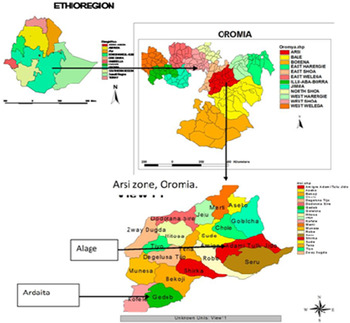
The study was conducted at Alage and Ardaita Agricultural technical vocational educational training (ATVET) Colleges (Figure 1), which is the federally administered colleges under the Ministry of Agriculture and Rural Development (MoARD) (2012).
Map of Ethiopia (top write), part of Oromia (top left) and parts of Arsi zone (bottom) indicating the study site Alage and Ardaita ATVET college.

Alage college
Alage college is located at 217 km southwest of Addis Ababa, in the vicinity of the Abijata and Shala lakes of the Ethiopian Rift Valley. The farm rests on 4 200 ha of land, at a longitude of 38° 30 east and a latitude of 7°30′ north, with an altitude of 1 600 m a.s.l. The area is characterized by mild tropical weather with a minimum and maximum temperature ranging from 11 to 32 °C and experiences a bimodal rainfall distribution with an annual average of 800 mm.
Ardaita college
Ardaita college is located about 305 km southeast of Addis Ababa in Gedeb Asasa district, West Arsi Zone of Oromia National Regional State, encircled with farmlands at an altitude of 2410–2610 m a.s.l. with 4°17′20″ north latitude and 37°11′30″ east longitude in south eastern Ethiopia of Oromia National Regional State in the high land of Arsi zone. Gedeb Asasa is bordered on the south by the Dodola, on the west by Kofele, on the North West by Kore and on the north east by Bekoji. It has a total land area of 1613 ha of land. The mean annual rain fall is 1200 mm and maximum and minimum temperature ranges between 20 and 5 °C, respectively.
Based on agro climatic condition and rainfall both area has three distinct seasons. A short rainy season, which extends from March to June, a long rainy season, which extends from July to October and a dry season that extends from November to February (NMSA, 2010).
Establishment of the farm and breed groups
Alage dairy farm started its dairying activity in 1980 with foundation stock of 300 females and four males of HF origin brought from the Stella dairy farm, Holetta and individual farms around Addis Ababa. While, the Ardaita dairy farm was established in 1984 by purchasing 50 first crosses of Friesian with Boran from Gobe agricultural development unit. The Alage dairy farm was consisted mainly of HF cattle population, while Ardaita dairy farm was engaged with HF and its crosses with Boran cattle breeds to produce milk and milk products to fulfill the ever increasing demand for milk and milk products in the area.
Animal management
Animals were maintained under intensive systems and herds are managed separately based on sex, age, pregnancy and lactation. Animals were stall fed individually with green fodders and roughages, concentrates also fed to the animals according to the daily nutrient requirements for different categories of animals. Heifers and dry cows were mainly fed on green fodder and other roughages throughout the year. At both farms artificial insemination was practiced by bringing pure HF semen from national artificial insemination center. The insemination practice was carried out by AI technicians. Detection of estrus was carried out twice a day, early in the morning and late in the afternoon.
Cows grazed on native pastures during the rainy season from 1 a.m. to 3 a.m. local time. After that the animals are tied and stall fed with required quantities of dry and green fodder, concentrates and mineral licks under the shade. Animals on both farms were stall-fed and supplemented with concentrate feeds and mineral licks during late pregnancy and lactation. In all herds lactating cows received concentrates before each milking at the rate of 1 kg of concentrate per 2.5 kg of milk produce. Concentrates are prepared by mixing maize with wheat bran, noug cake (Guizotia abyssinica), salt and limestone. Hay produced from various types of annual and perennial plants of Gramineace species, namely, Paspalum conjugatum, Digitaria ciliaris, Cyperus asculantus and Hyparrhenia species are used for feeding animals.
Pregnant cows are managed separately during the trimester; they calved in well-constructed calving pens. Lactating cows are hand-milked twice daily at all farms, early in the morning (3 a.m.–4 a.m.) and late in the afternoon (3 p.m.–4 p.m.) and daily milk yield from individual animals are weighed and recorded. Newborn calves are taken away from their dams shortly after birth and allowed to receive colostrums for the first 5 days of their age and bucket-fed until weaning; they managed in individual pens. There was regular vaccination against anthrax, pasteurellosis, blackleg, foot and mouth disease, lumpy skin disease and contagious bovine pleura pneumonia. There was regular dosing and spraying against internal and external parasites.
Data collection
Data were collected from two dairy herds, Alage and Ardaita ATVET College dairy farms. Data of all cows archived over 14 years period on Alage and Ardaita dairy farm were used for the study. The data concerning reproductive performance of HF was collected for the period from 2000 to 2015 from the history sheet maintained at the farm.
Data were collected from records kept for each individual animal in a record book. Records has identification number, sex of animal, date and reason of exit, dates of birth, Dam and Sire ID number, calf ID, service date and calving dates, parity number and drying dates. From the collected information the following variables of interest were derived, i.e. age at first service (AFS) as the time from birth dates to first service, age at first calving (AFC) as the time from birth dates to first calving, days open (DO) as the interval in days between calving and conception, calving interval (CI) as the interval in days between two consecutive calving and number of services per conception (NSC) as the number of services the cow required until she conceived were studied. The compiled record cards were checked for its completeness and unclear and incomplete data were cleaned out.
Data analysis
The data were interred into Microsoft excel spread sheet and the traits (AFS, AFC, DO, CI and NSC) analysed using general linear model (GLM) procedures of SAS version 9.2 (SAS, 2008). Abortion and still birth records were removed from analysis of age at first calving. reproductive traits; AFS, AFC, DO, CI and SPC were analysed. The model used includes fixed effects of Agro ecology, season, year and parity. From the model Ardaita characterized as highland and Alage as lowland agro ecological conditions. Months of the year were classified into three seasons based on rainfall distribution; a short rainy season, which extends from March to June, a long rainy season, which extends from July to October and a dry season that extends from November to February. Only a few number of animals completed more than 5 lactations and also the estimated least square means for parity numbers 5 and greater than 5 were almost similar. Therefore all parities above 5 were pooled together in parity 5. For DO, CI and NSC the number of observation of animals that calved during 2002 and below were too small, there for all animals that calved below 2002 were pooled together in 2002. Likewise, the number of observation of animals that calved during 2014 and all animals that calved at 2014 and above this were pooled together in 2014. For AFS and AFC cows born during 2000 and 2001 was included. The following models were used to analyse reproductive traits in both farms.
Model 1: For AFS and AFC;
 $${Y_{ijkl\;}} = {\rm} \mu + {B_i} + {S_j} + {Y_k} + {e_{ijk}},$$
where, Y ijk = n th record of i th agro ecology, j th season of birth and k th year of birth
μ = overall mean; B i , fixed effect of i th agro ecology (highland=Ardaita and lowland=Alage); S j , fixed effect of j th season of birth (long rainy, short rainy and dry season); Y k , fixed effect of k th year of birth (2000–2015 G.C); e ijk , random error associated with each observation.
Model 2: For DO, CI and NSC;
 $${Y_{ijkl}} = \mu + {B_i} + {S_j} + {Y_k} + {P_l} + {e_{ijkl}},$$
where Y ijkl , observation on CI, DO and NSC; μ, overall mean; B i , fixed effect of i th agro ecology (highland = Ardaita, lowland=Alage); S j , fixed effect of j th season of calving (long, short and dry season); Y k , fixed effect of k th year of calving (2000–2015); P p , fixed effect of l th parity (1, 2…5); e ijkl , residual random error.
Results and Discussions
Age at first service
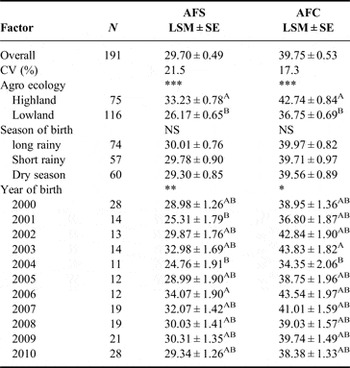
The overall least square mean and standard error of AFS was estimated to be 29.70 ± 0.49 months with coefficient of variation 21.5 percent (Table 1). The result found was in close agreement with the report of Shiferaw et al. (Reference Shiferaw, Tenhagen, Bekana and Kassa2003), which was AFS of 29.58 months for cross-bred dairy cows in central highland of Ethiopia. However, it is higher than 24.30 ± 8.01 months for Zebu × HF crossbred dairy cows in Jimma as reported by Duguma (2012) and 25.6 months for crossbred dairy cows in eastern lowlands of Ethiopia as reported by Mureda & Mekuriaw (Reference Mureda and Mekuriaw2007).
Least square means (LSM) and standard errors (SE) of age at first service (AFS) (months) and age at first calving (AFC) (months) over the fixed effects of agro ecology, season of birth and year of birth.

Means separated by different superscript letters under the same variable in one column are significantly different (P < 0.05) *** = significant (P < 0.001), ** = significant (P < 0.01),* = (P < 0.05); NS, not significant; N, number of records.
The least square means and standard errors of AFS for the fixed effects of agro ecology, season of birth and year of birth are summarized below in Table 1. The result revealed that Agro ecology (p < 0.001) and year of birth significantly (p < 0.01) influenced AFS. But, season of birth did not have significant effect on AFS. The lower (26.17 ± 0.65 months) AFS was found in Alage (lowland) dairy farm, whereas higher (33.23 ± 0.78 months) values obtained in the Ardaita dairy farm (highland). This is in agreement with Lijalem, Assefa, & Sharo (Reference Lijalem, Assefa and Sharo2015) who found that the average age at first mating is shorter in lowland areas than highland under smallholder dairy production system in Sidama zone, Ethiopia. Even though, as the heifers reared in two different agro ecological zones and had different agro-climatic conditions and environment, the management of animals in Alage were comparatively favourable for cattle production that brought shorter AFS of HF cows. These results are an indication of the high possibility for intensive heifer rearing under better management system in the Alage ATVET College dairy farm than Ardaita ATVET college. This large difference could also have resulted from the low level of management and poor feeding of calves and heifers at the earlier stages, which consequently had reduced growth rate and delayed puberty in the highlands than lowlands. It is imperative that the feeding and management of calves and heifers must be improved to achieve low AFS performance in the future.
The non-significant effect of season of birth on AFS of HF in the current study was in agreement with previous findings reported by Melaku (Reference Melaku2007); Lemma, Belihu, & Sheferaw (Reference Lemma, Belihu and Sheferaw2010); Tadesse et al. (Reference Tadesse, Thiengtham, Pinyopummin and Prasanpanich2010).
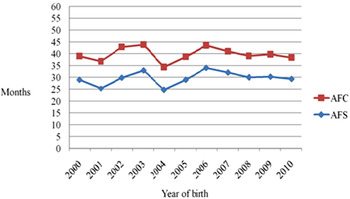
The significant effect of year of birth on AFS reported in this study is in agreement with the reports of Effa et al. (2006), Tadesse et al. (Reference Tadesse, Thiengtham, Pinyopummin and Prasanpanich2010), Fekadu, Kassa, & Belihu (Reference Fekadu, Kassa and Belihu2010) and Menale et al. (2011). But, different from the report of Tadesse et al. (2006) for HF dairy cows in Ethiopia. The highest value of AFS recorded during 2006, whereas lowest value observed during 2001 and 2004 (Figure 2). From 2000 to 2006 the trend of AFS was inconsistence (Figure 2). Given this facts the wide variations of AFS over the years and the overall improving trend indicate influence of various aspects of the environment on the animals and more specifically management practices and the climate (Ansari-Lari et al., 2009).
The trend of AFS and AFO over year of birth at Alage and Ardaita ATVET college.

Age at first calving
The overall least square mean and standard error of AFC was estimated to be 39.75 ± 0.53 months with coefficient of variation 17.3 percent. The result is in close agreement with 39.2 ± 7.5 months with coefficient of variation of 19 percent for HF cows in Ethiopia as reported by Tadesse et al. (Reference Tadesse, Thiengtham, Pinyopummin and Prasanpanich2010), 40.9 ± 0.33 months for HF herd in Holeta reported by Yalew, Lobago, & Goshu (Reference Yalew, Lobago and Goshu2011) and 40.9 ± 6.6 months for crossbreed cows in North Shoa reported by Ayalew & Asefa (Reference Ayalew and Asefa2013). The mean AFC obtained was higher than 29.3 months that was reported for Tunisian Friesian-Holstein cows reported by Ajili et al. (2007); 823 days (27.2 months) for HF cows in Pakistan reported by Niazi & Aleem (Reference Niazi and Aleem2003) and 988 ± 9.81 days (32.7 months) reported by Sattar et al. (Reference Sattar, Mirza, Niazi and Latif2005). However, the result found in this study was lower than 41 ± 6 months reported for Tunisian Friesian-Holstein by Krishantan & Sinniah (Reference Krishantan and Sinniah2014) and 54 months reported by Banga et al. (Reference Banga, Mostert, Makgahlela, Theron and van der Westhuizen2007) in Zimbabwe. The AFC was above the standard interval of 2 years expected in a well managed crossbreed cattle. The prolonged AFC of HF cows could be attributed to factors such as poor nutrition and management practices. With good nutrition it is expected that heifers would exhibit fast growth and attain higher weights at relatively younger ages (Tadesse et al., Reference Tadesse, Thiengtham, Pinyopummin and Prasanpanich2010).
The least square means and standard errors of AFC for the fixed effects of agro ecology, season of birth and year of birth are summarized in Table 1. The result revealed that agro ecology (p < 0.001) and year of birth (p < 0.05) had significant effect on AFC of HF cows, while the effect of season of birth was not significant. HF cows kept in the lowland (Alage) showed lower value of AFC than the cows that kept in the highland (Ardaita) of Ethiopia (Table 1). This might be an indication of comparatively better calf management system in Alage dairy farm. As the heifers were reared in two different agro ecological zones and had different agro-climate, environment and management conditions, the growth rate of heifers varied accordingly. This could result better potential of HF cattle with regard to AFC under lowland condition. Relatively, better AFS performance observed in this study was an indicative of lower value of AFC in the lowland agro ecological condition.
The non-significant effect of season of birth (p > 0.05) in the present study was disagreed with Chenyambuga & Mseleko (Reference Chenyambuga and Mseleko2009) in Tanzania who reported significant effect of season of birth on AFC. The significant effect of year of birth in the present study (p < 0.05) is in line with Tadesse et al. (Reference Tadesse, Thiengtham, Pinyopummin and Prasanpanich2010) who stated that period of birth significantly (p < 0.001) influenced AFC of Friesian cows in Ethiopia. Besides, Bruns et al. (2004) stated that year of calving had a significant influence on AFC of HF cattle in Malawi. The lowest value of AFC was observed during 2004, whereas the highest value of AFC was recorded during 2003 and 2006, respectively (refer Figure 2). From 2000 to 2006 the trend of AFC was inconsistence (refer Figure. 2). In other times AFC remains constant. The lowest value of AFC in this study might be well management and better adaptation of HF breed to the prevailing tropical environment, climatic condition for heifers and heat detection when heifers attain puberty during that time.
Days open
The overall least square mean and standard error of DO of 188.11 ± 7.22 days with coefficient of variation 55.3 percent found in this study was comparable with Goshu et al. (2007) for DO of 177 ± 5.4 days for HF cows in Stella Private dairy farm and Shiferaw et al. (Reference Shiferaw, Tenhagen, Bekana and Kassa2003) of 185 days for crossbred dairy cows in Ethiopia. However, Tadesse et al. (Reference Tadesse, Thiengtham, Pinyopummin and Prasanpanich2010) estimated lower mean DO of 148 ± 1.72 days with CV 11 percent for HF dairy cows in Ethiopia. While, the result in this study was lower than the results reported by Asimwe & Kifaro (Reference Asimwe and Kifaro2007) of 205 ± 2.6 days for HF in Tanzania. Such differences could have been caused by difference in environmental factors under which animals kept or management factors such as ability to detect heat signs after calving eventually influencing the number of DO.
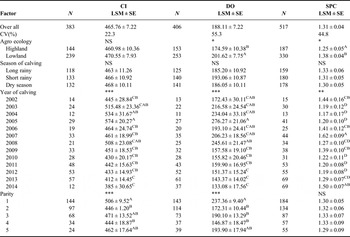
The least square means and standard errors of DO for the fixed effects of agro ecology, season of calving, year of calving and parity are summarized in Table 2. The result showed that agro ecology (p < 0.05), year of calving and parity (p < 0.001) had significant effect, while season of calving did not have a significant effect (p > 0.05) on DO of HF dairy cows. The significant effects of agro ecology on DO obtained in this study are in agreement with the reports of Bayou et al. (2015). In the current study, HF cows which calved in the highland had shorter period of (174.59 ± 10.38 days) DO than cows, which calved in lowland (201.62 ± 7.75 days). This is due to high heat stress condition in Alage may prevent the ability of animals to come in heat. Furthermore, high ambient temperature experienced in the lowland could be attributed to factors like delayed resumption of ovarian activity after calving, longer interval to first estrus and a brief shorter duration of estrus along with its silent symptoms. Comparatively favourable environment, which can influence the ovarian activities in Ardaita dairy farm may contribute better potential of HF cows with regard to DO under highland condition than lowland condition. Fertility of cattle is also reduced due to low intensity and duration of estrus caused by reduced luteinizing hormone (LH) and estradiol secretion during thermal stress (Rensis & Scaramuzzi, Reference Rensis and Scaramuzzi2003).
Least square means (LSM) and standard errors (SE) of calving interval (CI) (days), days open (DO) (days) and number of service per conception (NSC) over the fixed effects of agro ecology, season of calving, year of calving and parity.

Means separated by different superscript letters under the same variable in one column are significantly different (P < 0.05). *** = significant (P < 0.001), * = (P < 0.05); NS, not significant; N, number of records.
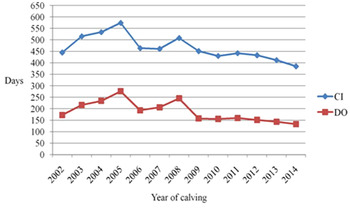
The non-significant effect of season of calving on DO is in agreement with the report of Tadesse et al. (Reference Tadesse, Thiengtham, Pinyopummin and Prasanpanich2010) who found that unlike CFSI and DO, the significant effect of season of calving on CI is not expected. The significant effect of year of calving and parity on DO obtained in this study is in agreement with Tadesse et al. (Reference Tadesse, Thiengtham, Pinyopummin and Prasanpanich2010) who reported similar significant effect of period of calving and parity on DO of HF breed in Ethiopia. The significant effects of period of calving (p < 0.001) on DO were also reported by Asimwe & Kifaro (Reference Asimwe and Kifaro2007). From the current study mean DO showed significantly increasing trend for cows that were calved from 2002 to 2005 and then a decreasing trend from cows that were calved from 2008 to 2014 (Figure 2). The highest value observed in 2005, where as the lowest value recorded during 2012–2014 and remains constant from other times, which had slight significance difference (Table 2). The highest value observed might be attributed to inadequate nutrition before and after calving, poor heat detection and other management variability as a resulted of insufficient budget allocation and negligence of herd management practices.
The significant effect of parity reported in the present study is in agreement with the reports of previous authors (Mureda & Mekuriaw, Reference Mureda and Mekuriaw2007; Chenyambuga & Mseleko, Reference Chenyambuga and Mseleko2009; Tadesse et al., Reference Tadesse, Thiengtham, Pinyopummin and Prasanpanich2010; Denbarga, Woldegebriel, & Shiferaw, Reference Denbarga, Woldegebriel and Shiferaw2012). In contrast, Menale et al. (2011) found non-significant effect of parity of dam on DO. The longest DO was recorded in parity one and parity five, respectively which had statistically difference with all other parities. While, after 1st parity DO was decreased up to 4th parity, which had no significant difference (Table 2).
Calving interval
The overall mean and standard error of CI of HF found was estimated to be 465.76 ± 7.22 days with coefficient of variation 22.3 percent. It was in close agreement with the mean CI of 462.87 ± 19.48 days for HF cows in Hosanna town, Ethiopia (Kebede, Reference Kebede2015) and 460 ± 99 days for HF dairy cows in Sri Lanka (Herath, Sivayoganathan, & Dissanayaka, Reference Herath, Sivayoganathan and Dissanayaka2002), respectively. However, it was lower than the CI of imported (449 days) and local born Friesian cows (436 days) in Pakistan reported by Niazi & Aleem (Reference Niazi and Aleem2003), 459 ± 2.4 days reported by Tadesse (2001) for HF crosses in central highland of Ethiopia, 514.33 ± 23.44 days at Alage for HF cows reported by Melaku (Reference Melaku2007). The CI in the present study is above the normal interval of 365 days expected on a commercial dairy farm. Based on the evidence obtained in this study, it appears that longer CI is mainly attributed to the result of longer DO obtained, which could be related to environmental factors, mismanagement practices like failure to detect heat, in adequate nutrition before and after calving, poor health condition, the amount of energy fed influence the percent of cows cycling. Relatively longer CI might be indicative of poor nutritional status, poor breeding management, lack of own bull and artificial insemination service, longer days open, diseases and poor management practices (Duguma et al., 2012).
The least square means and standard errors of CI for the fixed effects of agro ecology, season of calving, year of calving and parity are summarized in Table 2. The result showed that year of calving and parity (p < 0.001) had significant effect on CI of HF dairy cattle. It appears that CI was not affected by agro ecology and season of calving (p > 0.05). The non-significant effect of calving season on CI is in agreement with Mekuriaw, Ayalew, & Hegde (Reference Mekuriaw, Ayalew and Hegde2009) and Lemma, Belihu, & Sheferaw (Reference Lemma, Belihu and Sheferaw2010), but Tadesse et al. (Reference Tadesse, Thiengtham, Pinyopummin and Prasanpanich2010) found significant (p > 0.001) effect of season of calving on CI.
The significant effect of year of calving is in agreement with Tadesse et al. (Reference Tadesse, Thiengtham, Pinyopummin and Prasanpanich2010) who reported similar significant effect of year of calving (p < 0.05) on CI of HF breed in Ethiopia. The estimates of CI showed a progressively increasing trend from the cows that were calved from 2002 to 2005 and significantly, a decreasing trend from the cows that were calved in between 2008 and 2014 remains constant during 2006 and 2007 (Figure 3). The peak value of CI recorded the cows that were calved during 2005, whereas lowest value recorded during 2013 and 2014 (Figure 3). Generally, the progressive decreasing trend of CI from the current study could be a sign of improvement in the ability of the college to manage their dairy cattle and the adaptation of the breed to the prevailing environment through time. Melaku (Reference Melaku2007), Tadesse et al. (Reference Tadesse, Thiengtham, Pinyopummin and Prasanpanich2010) and Menale et al. (2011) in Ethiopia and Chenyambuga & Mseleko (Reference Chenyambuga and Mseleko2009) in Tanzania found year to year difference in CI on HF dairy cattle.
The trend of CI and DO over year of calving at Alage and Ardaita ATVET college.

Similar to the present finding, the significant effect of parity on CI were reported by Tadesse & Dessie (Reference Tadesse and Dessie2003), Goshu et al. (2007), Mekuriaw, Ayalew, & Hegde (Reference Mekuriaw, Ayalew and Hegde2009), Tadesse et al. (Reference Tadesse, Thiengtham, Pinyopummin and Prasanpanich2010) and Menale et al. (2011) in Ethiopia. Chenyambuga & Mseleko (Reference Chenyambuga and Mseleko2009) in Tanzania reported significant effect of parity on CI. On contrary to the current finding, Mulindwa et al. (2006) in Uganda found that parity did not significantly (p > 0.05) affect CI.
The highest CI was obtained in parity one which had significant difference with other parities. The lowest CI was recorded in parity two and four (Table 2). This is due to an indicative of lower value of DO recorded during this time. The trend of CI was decreased up to parity four and then increased as the parity goes beyond parity four (Table 2). This could be associated with improvement in reproductive management and physiological maturity is attained with advanced age of cows (Tadesse et al., Reference Tadesse, Thiengtham, Pinyopummin and Prasanpanich2010). The prolonged CI for first calving has been reported to be physiologically necessary to allow animals to replenish their fat reserves depleted during lactation and this allows them to put on weight prior to the next calving (Mahadevan, Reference Mahadevan1951).
Number of service per-conception
The overall mean and standard error of NSC of pure HF cows found was estimated to be 1.31 ± 0.04 with CV 44.8 percent. The result is nearly comparable with Moges (Reference Moges2012) who reported that services required for each conception was 1.3, 1.5 in urban level of precision and peri urban areas of Gonder, respectively. However, the overall mean NSC obtained in this study was lower than NSC of 2.0 reported for HF dairy cattle in Nigeria (Ngodigha, Etokeren, & Mgbere, Reference Ngodigha, Etokeren and Mgbere2009) and 2.11 for HF in Pakistan (Niazi & Aleem, Reference Niazi and Aleem2003). Furthermore, the result of the present study is lower than the report of Yosef (2006) who found that NSC of 2.01 for Holstein breed in central highland of Ethiopia, Lateef (Reference Lateef2007) who found that NSC of 3.30 for HF in Pakistan and 1.80 for HF reported by Tadesse et al. (Reference Tadesse, Thiengtham, Pinyopummin and Prasanpanich2010). However, Goshu et al. (2007) observed that the average service per conception of 1.72 ± 0.056 for HF cows at Stella private dairy farm. The promising value of NSC suggested for HF in the current study found could be due to comparatively successful service, quality of semen, skill of the inseminator, proper time of insemination and cows related factors, management, nutrition and climate conditions may also contribute better value of NSC in the study area.
The least square means and standard errors of NSC for the fixed effects of agro ecology, season of calving, year of calving and parity are summarized in Table 2. The result revealed that Agro-ecology (p < 0.05) and year of calving (p < 0.01) had significant effect on NSC, but season of calving and parity had no significant effect (p > 0.05). Mean NSC was significantly higher for cows in Alage and lower for Ardaita Holstein cows. This lower value of NSC in Ardaita farm is due to the ability of HF dairy cattle to conceive successfully in the highlands than lowlands. Thermal stress prior to and immediately after artificial insemination, causes reduction in conception rate in high producing lactating cows (Ricardo et al., 2004).
The non-significant effect of calving season found was agreed with the findings of Goshu et al. (2007) for Friesian cows in Stella private dairy farm. However, it disagreed with the findings of these authors (Tessema, Gebre-Wold, & Jayaparakash, Reference Tessema, Gebre-Wold and Jayaparakash2003; Kebede et al., Reference Kebede, Kebede, Midexa and Eshetu2011; Denbarga, Woldegebriel, & Shiferaw, Reference Denbarga, Woldegebriel and Shiferaw2012) for HF cows in Ethiopia. The non-significant effect of calving season on NSC might be associated to the zero grazing practice in the farm, which makes the effects of seasonal variation in forage developments and feed availability minimal.
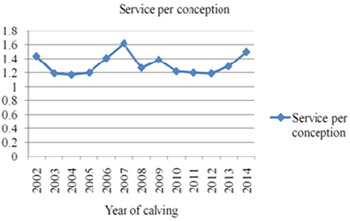
Significant effect of year of calving on NSC of HF dairy cattle in the current study was in line with previous authors (Gifawosen et al., 2003; Yifat et al., 2009; Kebede et al., Reference Kebede, Kebede, Midexa and Eshetu2011). But, Tolla & Demeke (Reference Tolla and Demeke2000) reported a non-significant effect of calving year. In general, the trend of NSC over year of insemination was inconsistence (Figure 4). This might be due to difference in inseminators, heat detection, AI service and semen quality over the years. Besides to this, difference observed in NSC between the study years could be related to the variation in feeding and management practices across the years.
The trend of SPC over year of calving at Alage and Ardaita ATVET college.

Similar to the present finding the non-significant effect of parity on NSC was reported by Ibrahim, Abraha, & Mulugeta (Reference Ibrahim, Abraha and Mulugeta2011). Besides, Goshu et al. (2007) and Denbarga, Woldegebriel, & Shiferaw (Reference Denbarga, Woldegebriel and Shiferaw2012) found significant effect of parity on NSC. Generally, a good proportion of conception cases suggested that the absence of repeat breeders in the herd, non occurrences of postpartum reproductive problems, accurate heat detection skills, and efficiency of AI and level of feeding in the herd. Proper and accurate heat detection is a key to efficient reproduction and four to five checks each day to determine the onset of true standing heat gives a better idea when to inseminate. Bekele and Yilma (2003) also noted a decrease in the NSC required for cows supplemented high level of protein.
Conclusions
The mean found for AFS, AFC, CI and DO of HF cows were not satisfactory and are below the standard expected from commercial dairy farm. However, the mean obtained for SPC is the normal that expected from modern dairy farm. Agro ecology and birth years were the main source of variation for the late AFS and AFC of HF cows. Except for CI, agro ecology showed significant effect on all traits. Year of birth and year of calving had significant effect on all traits, but season of birth and season of calving showed non-significant effect on all traits. Parity had source of variation on DO and CI of HF. Indeed, the level of management and breeding practice, variation of agro eco ecology with varied management system, management differences between year of birth and year of calving might be the reasons for poor performance of dairy animals. The results therefore provided very useful information and would assist decision making particularly regarding how to improve the low reproductive performance for future production. As a result, with a better efficient heat detection, management schemes for heat stress condition in the lowland, timely insemination, postpartum reproductive health management and feeding it is possible to improve the conception rate from first service and increase the percentage of DO and CI that fall within the accepted limits.
Acknowledgements
The Authors would like to thank Alage and Ardaita ATVET College for their co-operation and offering facilities. Special thanks is offered to Bahirdar University College of Agriculture and Environmental science especially Animal Production and technology instructors for their provision of various services during teaching learning process. The Authors also thank farm attendants, farm managers, AI technicians and veterinary professionals working in dairy farms who agreed to participate in the study.