Millions of people took refuge in neighboring countries in waves due to the internal turmoil and conflicts in Syria that started on March 15, 2011. 1 Those countries include Turkey, Lebanon, Jordan, and Iraq. Reference Abdo, Sweidan and Batieha2,Reference Sethi, Jonsson and Skaff3 Because of reasons such as being the country with the longest land border with Syria, being more reliable than other neighboring countries, and having the opportunity to pass to Europe, Turkey has been the country most preferred by immigrants. Reference Al Rousan, Schwabkey and Jirmanus4–Reference Mipatrini, Dembech and Ursu6
Since the first day, Turkey has not rejected anyone by applying the “Open Door Policy” to Syrian refugees; it has, therefore, become the most important country for Syrian refugees (SR). 7 According to the data of the Republic of Turkey and the United Nations High Commissioner for Refugees (UNHCR), Turkey is the country hosting the highest number of SR with 3,632,622. While the Lebanese population increased by 40% between 2010 and 2017, this increase was 35.8% in Jordon and 11.6% in Turkey. The Syrian crisis has caused 1 of the biggest public health problems of the 21st century. Refugees has brought serious burdens on the health system of the neighboring countries, which resulted in various legal regulations on access, scope, and use of health services.
As of March 5, 2012, the Jordanian government allowed the Syrians registered with the UNHCR to have free access to health services in the primary health-care centers and hospitals of the Ministry of Health. However, it abandoned this policy in November 2014 on the grounds that it put great pressure on the health system. After this, SR in Jordan are asked to pay fees while using health services. Reference Mansour, Al-Omari and Sultan8 This fee is as much as uninsured Jordanians pay. These fees have restricted access to health services that require heavy costs, such as cancer, for many vulnerable refugees. Reference Mansour, Al-Omari and Sultan8,Reference El Arab and Sagbakken9
During the Syrian crisis, the Lebanese health system managed to maintain primary, secondary and tertiary health care. Primary care for SR was partially financed by the UNHCR. However, support in secondary and tertiary care was limited by the UNHCR to vulnerable groups and life-threatening emergencies. This situation put a serious financial burden on refugees seeking secondary and tertiary care. Reference Chammay, Karam and Ammar10
With the “Circular on Health and Other Services” (dated August 9, 2013, and numbered 2013/8), the scope of medical services offered by Turkey was increased from 11 to 81 provinces. “The Principles Regarding Health Services to be Provided to Those Under Temporary Protection” by the General Directorate of Emergency Health Services of the Ministry of Health was published on March 25, 2015 and updated and implemented on November 4, 2015. Those under temporary protection can benefit from the following institutions and organizations 7 : (a) Migrant health centers established in temporary accommodation centers or outside temporary accommodation centers, (b) Health service providers belonging to the Ministry and its affiliates, (c) University health practice and research centers, (d) Private hospitals, and (e) Health services provided voluntarily by foundations or associations.
According to the directive, it is essential for refugee to receive health services from health institutions at their residential addresses.
The purpose of this study is to evaluate the status of the SR in Turkey in terms of using the National Health System (NHS) between 2011 and 2017.
Methods
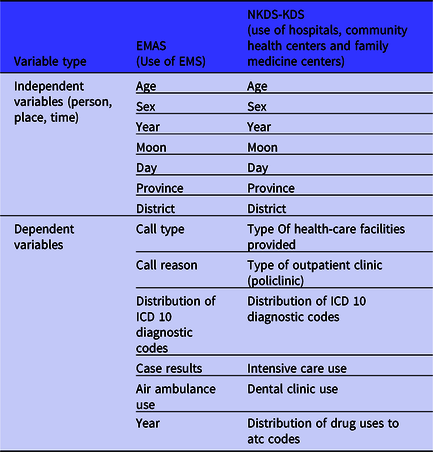
The study is a retrospective descriptive and cross-sectional epidemiological study. The universe of the study consists of the health services provided to the SR by the NHS of the Ministry of Health, Turkey between 2011 and 2017. The sample was not chosen, and we attempted to reach all the data in the records. The data on Emergency Medical Services (EMS) were obtained from the Emergency Health Automation System (EHAS). The data on hospital services were obtained from the Net Decision Support System (NDSS) (2011-2014) and the Decision Support System (DSS) (2015-2017). The research lasted 24 mo. The obtained data were transferred to ORACLE SQL Developer program and obtained by means of metadata analysis. The total Big Data size is 89 GB. Descriptive information is presented in the form of statistics regarding person, place, time, health facility type, outpatient clinic information, ICD10 diagnosis codes, intensive care, oral and dental health, prescription information (Table 1).
Basic Research variables in the database on the benefiting status of SR from the Turkish NHS

Note: Total 89 GB database.
The research only covers those services provided in health institutions affiliated to the Ministry of Health. Private sector and Non-Governmental Organizations (NGOs) are outside of the scope of the study.
Results
General Statistics
In the scope of the study, Descriptive findings are divided into 2 as EMS and NHS. Because the data on hospital services are in 2 different databases, they were taken separately and combined in a single table. According to the research, there are 3,821,284 registered patients in the NDSS system, 31,151,745 in the KDS system (as of October 27, 2018), and 34,973,029 in total. The number of cases received by the SRs from EMS in Turkey between 2011 and 2017 is 16,009,524. When the prescribing information is examined, there are 4,322,749 prescribed drug information in the NDSS, 27,362,719 in the DSS and 31,685,198 in total.
SRs’ Utilization of the National Health System
Age and Gender
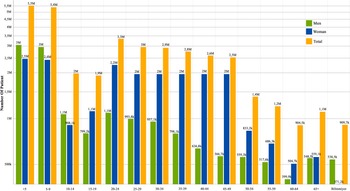
According to the data of the study, 15.8% of the SRs who received healthcare services between 2011 and 2018 (October 27) were under the age of 5, whereas 15.4% were between the ages of 5 and 9 y and 9.5% were between the ages of 20 and 24 y. The age ranges that received the least health care successively include the following: those in the age range of 60-64 with 2.6% and those aged 65 and over with 3.2%. In the study, 55.8% of those who benefited from health services between 2011 and 2018 (October 27) were women, while 44.2% were men (Figure 1).
Distribution of SR receiving service from the NHS in Turkey between 2011 and 2018 (October 27) by age and gender.

NHS Location Information
In the study, 55.8% of the SRs that received health services between 2011 and 2018 (October 27) were women and 44.2% were men. In the study, when the health services received by the SRs between 2011 and 2017 were examined by regions, 33.4% were in the Mediterranean region, 29.2% in the Southeast Anatolia Region and 19.0% in the Marmara Region.
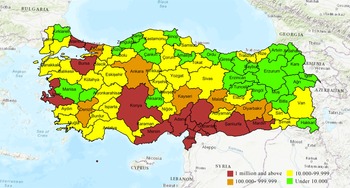
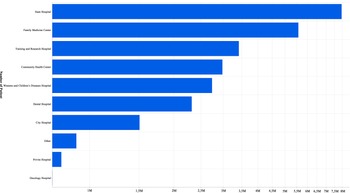
The region in which the SRs received the least healthcare services is the Black Sea Region with 0.9%. When the first 10 provinces in which the SRs received health services between 2011 and 2017 were analyzed, they were Şanlıurfa with 18.7%, Gaziantep with 15.8%, Hatay with 15.1%, İstanbul with 14.1%, Adana with 9.4%, Kilis with 6.5%, Mardin with 5.7%, Kahramanmaraş with 5.6%, and İzmir and Bursa with 4.6%, respectively (Figure 2). When the study data are examined, it is seen that the SRs mostly benefited from state hospitals with 44.0%. This is followed by Family Medicine Centers with 15.0%, Training and Research Hospitals with 13.3% and Community Health Centers with 9.8% (Figure 3).
Utilization of health services by Syrian refugees in Turkey by province.

Use of Syrian refugees By NHS health facilities between 2011 and 2017 in Turkey.

Polyclinics
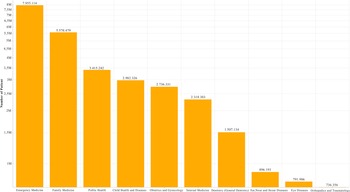
In the study, considering the 10 most frequently used polyclinics by the SRs in Turkey in the context of the National Health System, Emergency Medicine comes first with 27.5%. This is followed by the following branches. Family Medicine with 19.3%, Public Health with 11.8%, Child Health and Diseases with 10.3%, Obstetrics and Gynecology with 9.3%, Internal Medicine with 8.0%, Dentistry with 5.2%, Ear, Nose, and Throat Diseases with 3.1%, Eye Diseases with 2.7%, Orthopedics and Traumatology with 2.5% (Figure 4).
Distribution of the 10 most frequently used polyclinics by the SRs in Turkey (between 2011 and 2017).

Medical Procedures Performed
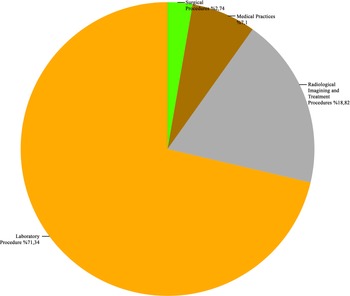
Within the scope of the study, 37,452,198 laboratory procedures (71.3), 9,879,662 radiological imaging and treatment procedures, 3,729,760 medical practices and 1,437,662 surgical procedures were performed for the SRs in Turkey between 2011 and 2017 (Figure 5).
Distribution of medical procedures performed for SR utilizing the NHS of Turkey (between 2011 and 2017).

ICD10 Diagnosis Codes
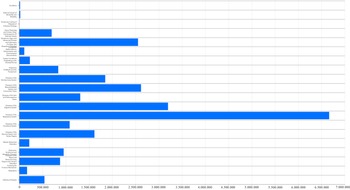
In the study, 26.0% of the refugees receiving health services from the NHS had health problems related to respiratory system diseases, whereas 12.5% had health problems related to digestive system diseases and 10.2% had health problems related to muscle, skeletal system, and connective tissue diseases (Figure 6).
Distribution of SR in Turkey by the ICD10 diagnosis codes assigned by the NHS System (between 2011 and 2017).

Intensive Care Use
Within the scope of the research, it is seen that the SRs had started to use intensive care services since 2014. When the intensive care services used by the SRs between 2011 and 2017 are examined proportionately, it is seen that 32.5% are Neonatal Intensive Care, 31.0% General Intensive Care, 13.2% Pediatric Intensive Care service. Considering some situations requiring special treatment, the following intensive care services were used by the SRs: Coronary Intensive Care with 3.7%, Burn Intensive Care with 1.2%, Cardiovascular Surgery Intensive Care with 0.4%, Neurology Intensive Care with 0.3%, Neurosurgery Intensive Care with 0.2%, Chest Diseases Intensive Care with 0.2%, Chest Surgery Intensive Care with 0.1%, and Gastroenterology Intensive Care with 0.1%
Oral and Dental Health Services Utilization
Within the scope of the study, when the utilization of the SRs in Turkey from Oral and Dental Health Services between 2011 and 2017, it is seen that they used services related to Oral and Dental Health Services 1,727,344 times. The first utilization of dental health services was in 2013. When the utilizations of the SRs are examined according to the Major of Dentistry, 87.3% of them are General Dentistry, 8.9% Oral and Maxillofacial Surgery, 2.0% Pediatric Dentistry, 1.1% Restorative Dental Treatment, 1.1% Prosthetic Dentistry, and 0.2% Oral and Maxillofacial Radiology polyclinics.
Status of Prescribed Drugs
When the polyclinics prescribing the most drugs were examined in the study, 20.3% were written in Family Medicine Centers, 17.1% in Emergency Medicine, and 16.2% in Pediatrics and Diseases Polyclinics. According to the Anatomical and Therapeutic Chemicals (ATC) Codes in the study, the drug groups most prescribed to the SRs between 2011 and 2017 were Antiphrastic Drugs, Insecticides and Repellents with 19.2%, drugs acting on Gastrointestinal System and Metabolism with 17.1%, Systemic Anti-Infective drugs with 15.6%, and drugs acting on the Musculoskeletal System with 15.2%. According to the ATC codes, the least prescribed drugs are Systemic Hormone Preparations with 0.8% and Antineoplastic and Immunomodulatory Agents with 0.1%.
SRs’ Utilization of Emergency Medical Services
Age and Gender
The EMS-related part of the research was obtained from the EHAS system. According to the data from 2011, when the Syrian humanitarian crisis began, to October 2018, the refugees over 65 who benefited from EMS are in the first place with 31.9%. This is followed by those in the 20-24 age range with 8.1% and those in the 25-29 age range with 6.6%, respectively. The refugees who used EMS the least are those in the 10-14 age range with 2.4% and those in the 5-9 age range with and 2.5%, respectively. A total of 51.5% of those who benefited from EMS between 2011 and 2018 (October 27) were men, whereas 48.5% were women.
Distribution of Provinces
In the study, the utilization of EMS by the Syrian refugees are successively in the following provinces: 10.8% in Istanbul, 8.3% in Ankara, 4.7% in Izmir, 4.1% in Bursa, 3.0% in Adana, 2.5% in Konya, 2.4% in Mersin, 2.4% in Gaziantep.
Air Ambulance Use
Considering the air ambulance utilization rates of the SRs between 2011 and 2017, the provinces in which air ambulances were used the most are Çanakkale with 12.0%, Antalya with 8.4%, and Erzurum with 8.0%, whereas the provinces in which air ambulances were used the least are Afyonkarahisar with 1.9%, Istanbul with 2.3%, and Adana with 2.6%. When the use of air ambulances over the years in the study was examined, 16 cases in 2013, 348 in 2015, 2891 in 2015, 3097 in 2016, and 1005 cases in 2017 were intervened with air ambulance vehicles. In total, 7357 air ambulance cases were occurred between 2011 and 2017.
ICD10 Diagnoses
In the study, when the diagnoses of the SRs win the context of EMS were examined according to ICD10 diagnosis groups, the diagnoses of the cases between 2011 and 2017 are as follows: Symptoms and Abnormal Clinical and Laboratory Findings Diagnoses Not Elsewhere Classified with 28.9%; Circulatory System Diseases with 15.5%; Injury, Poisoning and Some Consequences of External Causes with 14.1%; Mental and Behavioral Diseases with 7.8%; and Respiratory System Diseases with 7.5%. The diagnoses of infectious diseases are 1.4%. The least diagnosed diagnoses are Congenital Malformation, Deformation and Chromosome Anomalies, Diseases of Blood and Blood-forming Organs, and Immune System Diseases with 0.2%.
Discussion
When the distribution of the refugees benefiting from the National Health System by age is examined in the study, it is seen that approximately 16% of them are children under the age of 5. This approximately accounts for more than one-third of the refugees in the 0-14 age range. This age range is considered normal considering the dependent age range and the vulnerable nature of the refugees. Considering routine work and procedures such as regular health follow-ups and vaccination activities, especially in the Community Health Center and Family Medicine Center systems, it explains why it is higher than the other age groups. According to the age groups, it is seen that women are more than twice as likely to benefit from the National Health System in the 20-24, 25-29, and 30-34 age range compared with men. These age ranges are the most active fertile ages for women. A total of 55.8% of those benefiting from the National Health System in total are women, whereas 44.2% are men. When we look at the distribution of the refugees benefiting from the national health system by regions, it is seen that the Mediterranean region ranked first in 2011-2012-2013, that the Southeastern Anatolia region ranked first in 2014 and 2015, and that the Mediterranean region was the region that provided the highest number of health services to the refugees in 2016 and 2017. This situation is considered normal since these are the 2 regions alongside the Syrian border. It can be considered as a normal result, especially considering that all of the refugee camps are located in these regions. In line with these results, it is considered that the health services infrastructure in these regions should have a flexible structure and capacity for refugee risks. In terms of utilization of health facilities, approximately 30% are primary health services (family medicine and community health centers), approximately 50% are secondary health services (state hospitals, city hospitals) and approximately 20% are tertiary health services (training and research hospitals, branch hospitals, etc.). The utilization rate of private hospitals in the NHS is 1.3%. It is limited to private health institutions that transfer information to the database of the ministry. According to this finding, almost all of the health services provided for the SRs within the NHS are on the health institutions of the state. In order to reduce this burden, the project entitled “Improving the health status of the Syrian population under temporary protection and related services provided by Turkish authorities” (SIHHAT) was started. This project was implemented between December 1, 2016 and December 1, 2019. It basically aimed to improve the scope and quality of health services in 28 provinces where the SRs lived intensively. At the end of the project, it was aimed to establish 178 migrant health centers. A total of 790 doctors and 790 nurses were used in these centers. In this respect, it is very important in terms of reducing the refugee burden on the NHS and especially shifting it to the first level. The SIHHAT project was financially funded by the European Union. The project aimed to reduce the burden of the refugees on the NHS. According to the distribution of health institution, 4.3% of the SRs benefited from dental hospitals. Dental is a very important issue in terms of being a high-cost health-care service. In terms of demonstrating the coverage of the health services offered to the refugees, that this is thought to be an important data.
Limitations
This information also includes information on health services in private hospitals and university or training and research hospitals. However, there may be deficiencies in the data from both the private sector and university hospitals in terms of cases not notified to the Ministry of Health. However, there is no information regarding health services provided by NGOs. In this respect, it constitutes the limitation of the research. Health services provided in the camps and immigrant health centers are not included in the data used in this study. Health services provided as part of EMS also cover the refugees who used Turkey as a step to move to Europe; therefore, the data of the study also cover those other refugees as well as the refugees living in Turkey. For example, there might be some refugees who came to Turkey illegally and who were caught, rescued and found dead in boats in the Eagan Sea. Especially in emergency health services, there may be carelessness in the diagnoses in the prehospital first case registration information. There is no financial analysis in the research. In this respect, it is an issue that should be discussed regarding the financial sustainability of the health services offered to the Syrian refugees.
Conclusions
Turkey responded to the Syrian humanitarian crisis, which created the greatest wave of human suffering and immigration witnessed by human beings since the Second World War, from a humanitarian perspective. Within the framework of availability, access, scope, and utilization, which are the basic evaluation concepts of health services, Turkey can be said to have given the highest level of health care services to the Syrian refugees. The health data analyzed within the framework of the research between 2011 and 2017 reveal that Turkey, which did not discriminate between its own citizens and refugees in the provision of health services, overcame this huge problem with agile and powerful Leadership and Governance, updated its health workforce planning under extraordinary conditions, quickly integrated the health information systems used for refugees with the National System, created a supply chain of the highest quality possible in access to essential drugs, vaccines and materials, and maintained the operating efficiency and profitability of its health institutions with a sustainable central health financing model. Health services were provided in a very limited scope in Lebanon and Jordan; however, a wide range of health-care services, including air ambulance services, oral and dental health services, intensive care services, and other services that required advanced treatment, were provided in Turkey.
Over 50 million Syrian refugees in Turkey benefited from the NHS between 2011 and 2017.
Between 2011 and 2017:
-
According to the age and gender distribution of the refugees benefiting from the NHS, women between the ages of 20 and 49 received more than twice as many health services as men.
-
Half of the clinics applied to are emergency medicine centers, family medicine centers, and community health centers.
-
In the dental clinic, which is a special service area for refugees, Syrian refugees received service approximately 1.5 million times. In this respect, all health services are included in the scope.
-
Istanbul, Ankara and Izmir, and the cities bordering Syria are the provinces which provide the most healthcare services.
Acknowledgments
We thank the Ministry of Health of Turkey, Bezmialem Vakif University, Turkish Red Crescent and the names below who contributed to the research. Kıvanç Yılmaz; Expert in the Ministry of Health of Turkey, Information Management Department, Sera Yazar, Salim Selman Kesgin; Turkish Red Crescent Staff.
Ethical standards
Permissions for the study were obtained from Bezmialem Vakif University (BVU) Non-Interventional Research Ethics Committee (15 August 2017 and 15/222). A written approval was obtained from Republic of Turkey Ministry of Health (HM) in order to conduct the research (letter of Ministry of Health dated 14.12.2017 and numbered 75730711).