When, in spring 1889, a reporter from the sports weekly Pastime toured the “huge warehouse” of the shoemaker William Hickson and Sons, he was shown “lawn-tennis shoes in endless variety ready for the coming season.” This was not unusual. Visiting Hickson's rival, Manfield and Sons, the following year, he was almost overwhelmed: a “descriptive catalogue of all the varieties of lawn-tennis shoes to be found at the showrooms of this firm would more than exhaust the space at disposal,” he wrote. “Every kind of rubber sole is united with canvas, buckskin, calf, and Russia [leather], in combinations innumerable, ranging in price from under three shillings to nearly ten times that amount.” Hickson and Manfield were not alone; competition in the tennis market was fierce. As Pastime had noted in 1888, “[y]ear by year the task of visiting show-rooms and manufactories becomes more laborious, owing to the great number of makers that are continually entering the field.”Footnote 1 Now forgotten manufacturers fought for consumers’ business, driving the commercial and material development of the sports shoemaking industry.
As these reports show, in the final decades of the nineteenth century, lawn-tennis shoes were popular, widely available commodities, the ancestors of today's sneakers. Yet testimony like this tells us comparatively little about the item itself. What was a lawn-tennis shoe, and what made it distinct? How did this particular type of footwear come into being, and how did it attain such prominence? How were these shoes used? Mary Douglas and Baron Isherwood showed us that “commodities are good for thinking,” but what can we think about late-Victorian lawn-tennis shoes?Footnote 2 The past thirty years have seen a wealth of scholarship on material and consumer culture as historians and others have grappled with the meaning of goods and the processes of consumption.Footnote 3 The “lives” of products that have shaped and defined society have been traced.Footnote 4 Consumer culture has been shown as a driving force of history—a liberating and empowering phenomenon that made possible new forms of national and gender identity.Footnote 5 Scholarship in cultural studies, sociology, and science, technology and society studies has sought to disentangle the processes by which things are created and accrue meaning. The purchase and display of goods, it has been argued, is a way by which social classes are distinguished.Footnote 6 Individual products have been shown to exist as part of technological, material, commercial, social, and cultural networks.Footnote 7 To produce a comprehensive analysis of a manufactured object, we must “take into account the kinds of significance generated as [it] passes through a maze of independent but interlocking frames—drawing back at every point to consider the structures in which each individual frame is housed.”Footnote 8 Full understanding requires considering the various cultural processes through which an object passes.Footnote 9
Yet when it comes to the stuff of consumption, Frank Trentmann has suggested that historians have “primarily looked at objects to reveal processes of symbolic communication or identity formation.”Footnote 10 Scholars have adopted a methodology that focuses on cultural meaning and what things “say” about users. While these investigations into the communicative power of objects are useful, they can offer only a partial interpretation of commodities and their role in the world. Many things are acquired and used for a range of noncommunicative purposes. Others perform a mix of symbolic and more practical functions as they are integrated into human life. The Citroën DS 19 discussed by Roland Barthes, for instance, may have functioned as a “purely magical object,” but it was also a prosaic automobile, an outcome of technological development in the motor industry and shifts in French consumer society.Footnote 11 Trentmann has therefore urged historians to embrace recent scholarship that has considered “how users, things, tools, competence, and desires are coordinated.” Research on the relationship between objects and social practices has shown that things and practices are codependent, and that value is based on how a product is used. By looking to practice, he suggests, historians can expand their understanding of things, materials, technologies, and the processes of consumption.Footnote 12
The late-Victorian lawn-tennis shoe is well suited to an approach that combines symbolic and practical analysis. If we are to comprehend its significance, we must understand the practice of lawn tennis and the purpose footwear served within it. We must also consider sport's role in nineteenth-century society and culture. As Richard Holt noted recently, after occupying a marginal place, since the 1990s the study of sport has been legitimized within British history, and a rich historiography that “reflect[s] the wider social forces at work and the reciprocal impact of sport on society” has emerged.Footnote 13 Lawn-tennis shoes must also be understood as garments. Perhaps more than any other type of commodity, clothes entwine the symbolic with the everyday. Dress, as Elizabeth Wilson argued in her influential study Adorned in Dreams, can be explored “as a cultural phenomenon, as an aesthetic medium for the expression of ideas, desires and beliefs circulating in society.” It is one of the principal ways by which identities are constructed and communicated.Footnote 14 Shoes are about more than protecting the feet or allowing us to move; they are also emblems of gender, status, and sexuality. Modern sports shoes have been described as rhetorically powerful products that are able to “seduce, communicate with, and situate the identity of consumers.”Footnote 15 At the same time, these were manufactured objects, intricately connected to industrial and commercial changes. Establishing how they were affected by these wider networks is, again, crucial to coming to a full understanding of them as a product. By taking a combined approach, considering how lawn-tennis shoes fit into sporting practice but also by looking at how they were related to broader developments in fashion and consumer culture, we can therefore come to a greater understanding of the functions and meanings of these popular goods in late-Victorian life.
THE INVENTION OF LAWN TENNIS
Lawn tennis developed in Britain in the late 1860s.Footnote 16 It was at first an informal, outdoor adaptation of older bat and ball games played by aristocratic gentlemen, most obviously royal tennis; several versions were in existence by the early 1870s. Credit for the game's invention is generally ascribed to Major Walter Clopton Wingfield, a well-connected retired army officer who launched its first commercially successful incarnation in 1874. Initially called Sphairistikè (Greek for playing ball), Wingfield's game involved hitting a rubber ball over a six-foot net slung across an hourglass-shaped court marked on a lawn. Boxed sets with rackets, court markers, net, support poles, balls, and an instruction booklet were sold exclusively through Wingfield's agent, French and Co. in Pimlico, London, for between five and ten guineas—a price that put them beyond reach for most people. Sphairistikè was promoted through society magazines and newspapers, and Wingfield succeeded in creating an aristocratic fad. Its arrival has been said to mark the beginning of “the great sports craze” that characterized the final quarter of the nineteenth century.Footnote 17 Between July 1874 and June 1875, 1,050 sets were sold, and as sales continued Wingfield listed in the game's instruction booklet the aristocratic families and “titled personages” who were among his customers.Footnote 18 He could do little, however, to prevent sporting goods firms launching similar alternatives, and in lightly revised form the game soon spread to a wider, upper-middle-class public.Footnote 19 The Illustrated London News noted in summer 1880 that, “[t]his popular and fashionable game, which is readily organised in small family parties, or at social visits wherever there is a good-sized piece of open turf, players being from two to eight in number, ladies and gentlemen together if they please, seems likely to hold its place in public favour.”Footnote 20 Their predictions were correct. Three years later the author of the almanac Lawn Tennis for 1883 wrote that the game was “followed with ardour by those that move in the highest social circles,” and by “any of the thousands of well-conditioned households that can boast sufficient garden space around their country house or suburban villa to afford the luxury of a ‘court.’”Footnote 21 By the end of the century there were about 300 clubs around Britain.Footnote 22
Late-Victorian lawn tennis encompassed far more than the simple game sketched by Wingfield. It was a complex blend of physical movement, commodities and environments, and systems of social display and interaction. As Andreas Reckwitz has argued, a practice is “a routinized type of behaviour which consists of several elements, interconnected to one another: forms of bodily activities, forms of mental activities, ‘things’ and their use, a background knowledge in the form of understanding, know-how, states of emotion and motivational knowledge.”Footnote 23 The rules, court, and implements of the game on the one hand, and the social implications, conventions of behavior, and ways of thinking that surrounded it on the other, constituted lawn tennis as a practice.
During its infancy, physical and competitive play were of less significance than what the game meant socially.Footnote 24 For most Victorian players, lawn tennis was an entertaining outdoor party game redolent of lazy afternoons and comfortable, bourgeois leisure.Footnote 25 In new upper-middle-class suburbs, the relaxed tennis party quickly became a key part of the summer season.Footnote 26 It was, as one devotee claimed in 1881, best played on “a well-kept lawn [with] a bright warm sun overhead, and just sufficient breeze whispering through the trees and stirring the petals of the flowers to prevent the day from being sultry.”Footnote 27 Arthur Balfour, later to become prime minister, was an early enthusiast. Looking back, he wrote that it was “not easy … to exaggerate the importance” of the tennis party, which, he thought, “profoundly affected the social life of the period.”Footnote 28 Informality masked an event laden with symbolic meaning and social opportunity. Participation in this new ritual required an array of costly implements, sufficient space, carefully maintained playing surfaces, and often membership of exclusive clubs. As Robert J. Lake has argued, the game appealed to members of an upper-middle class keen to improve its position.Footnote 29 Participation was a demonstration of considerable resources—an example of what the American sociologist Thorstein Veblen identified in 1899 as “conspicuous consumption” and “conspicuous leisure.”Footnote 30 Social interaction and codified displays of wealth and status were integral to the game as a practice.
GENDER AND LAWN TENNIS
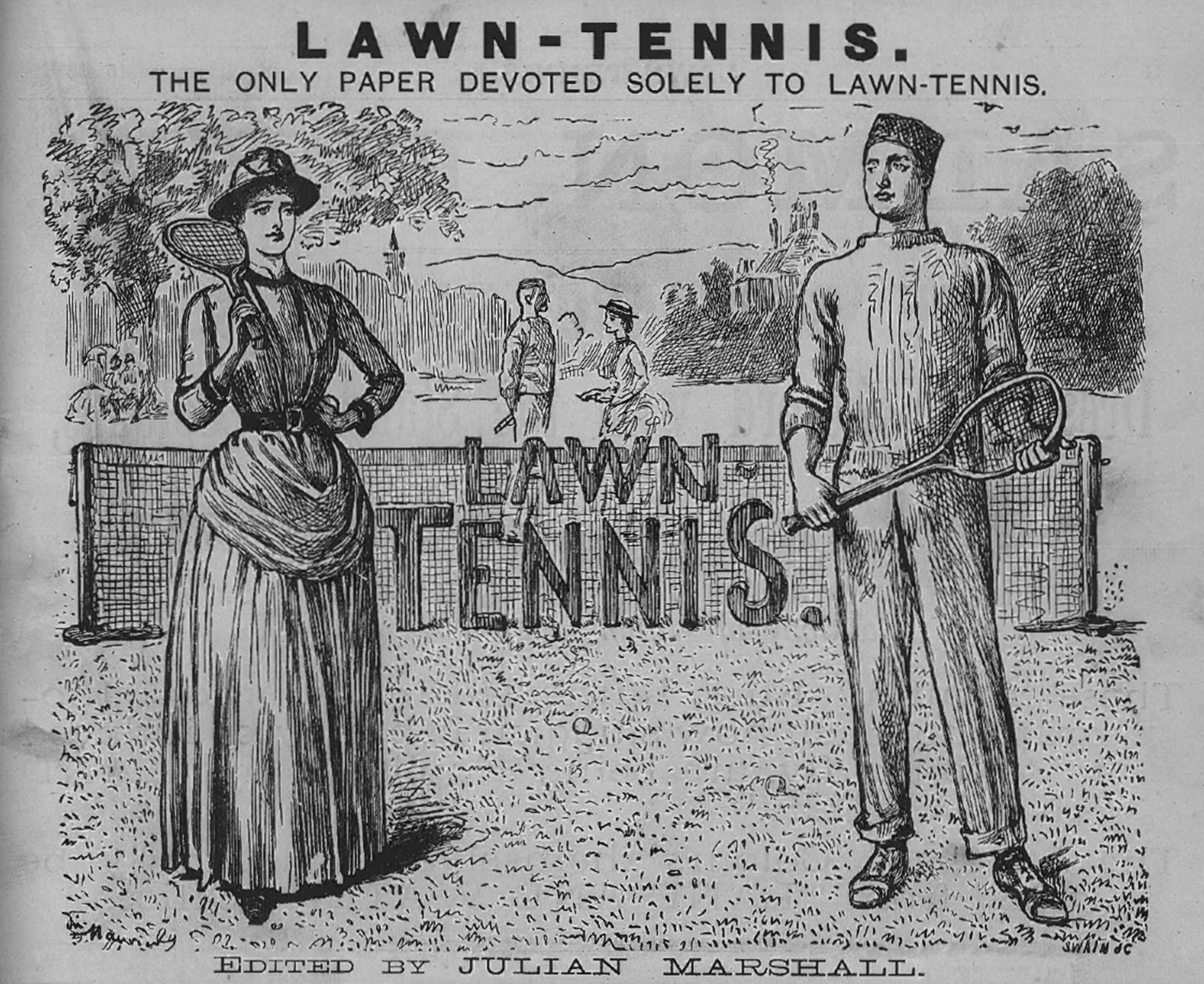
Lawn tennis was significant in that it enabled middle-class men and women to play with and against one another. The Sporting Gazette welcomed Sphairistikè because it “adds another to that too limited list of pastimes in which ladies and gentlemen can join,” and suggested it was ideal for “ordinary loungers of both sexes, who care only for something which will … enable them to enjoy fresh air and flirtation in agreeable combination.”Footnote 31 By bringing the sexes together, the game had a social culture distinct from gender-segregated sports like football and cricket. It introduced a new form of courtship, and the possibility of romance was a recognized—and frequently satirized—feature of the late-Victorian game. The Graphic claimed that women played in “the hope of finding opportunities … of exhibiting their social charms, of posing in graceful attitudes, and indulging in the intervals of the game in flirtation with their partners.”Footnote 32 The Bristol Mercury and Daily Post suggested “the chance of hearing ‘love’ from pretty lips” was part of its appeal for men.Footnote 33 Even the masthead of the sports journal Lawn-Tennis showed two young couples breaking from a game of mixed doubles, gazing coyly at one another (figure 1).Footnote 34 It was in this form that the game was most commonly played. Although the sports press focused on the competitive men's game, garden parties often revolved around the social institution of the mixed double.Footnote 35
Late-Victorian mixed doubles, showing typical male and female lawn tennis costume. Lawn-Tennis, masthead. Reproduced with kind permission of the Kenneth Ritchie Wimbledon Library, All England Lawn Tennis Club (AELTC).

Because it was played by men and women together, lawn tennis was an important setting in which gender roles and stereotypes were articulated, reinforced, and, in some instances, challenged. Victorian sport embodied traditionally “masculine” behaviors and character traits.Footnote 36 Yet the connection to the home and the frivolity of the garden party, and the fact it was played by women, gave lawn tennis a taint of femininity. Notably, it was not taken up with seriousness by male public schools, the main drivers of British sports in this period.Footnote 37 George Hillyard, a celebrated player at the turn of the century, wrote that in the 1880s there was “great prejudice against it among my cricketing friends,” who “nearly all condemned it as fit only for women and quite unworthy of the attention of a man, certainly of a cricketer!” Lawn tennis was derided as “pat-ball.”Footnote 38 However, the game also raised the possibility of a new vision of masculinity: genteel yet athletic, playful, at home with suburban domesticity, and removed from the brute physicality of Victorian team sports.
For women, the physical aspects of lawn tennis hinted at the possibility of a new, more embodied middle-class femininity. The fact that it allowed them to move with relative speed and freedom represented a break from earlier nineteenth-century body ideals and standards of feminine behavior.Footnote 39 At the same time, the social expectations around the lawn-tennis party constrained women and reinforced notions of the demure, domestic female. As Kathleen McCrone has argued, “[o]nly sports activities and behaviour that were ‘feminine’ and legitimated the male-dominated social structure were considered acceptable, and even these were to be set aside if they conflicted with established social norms.”Footnote 40 Women could play lawn tennis but were “obliged to show restraint, be refined and respectable, and confirm at all times the ‘ladylike’ modes of behaviour prescribed for them.”Footnote 41 Many played an incapacitated and inhibited game when men were present, rarely running for the ball, engaging in vigorous play, or using the most aggressive shots. While men were celebrated for their physicality, courage, and aggression, women were expected to be loyal, cooperative, fair, self-controlled, and moderate, and to behave with exemplary manners.Footnote 42 This is perhaps not surprising when the wider social function of lawn tennis is considered. Women hoping to meet potential suitors wanted to be seen to conform to prevailing notions of feminine beauty and comportment. To engage fully in the physical aspects of the game meant running the risk of being deemed unfeminine. The mixed double, in which men were expected to bear the burden of play and act with chivalrous courtesy toward their female opponents, encapsulated Victorian gender ideals and was a microcosm of the traditional marriage.Footnote 43 It was only behind the closed doors and high walls of girls’ public schools and colleges at the end of the century that through lawn tennis and other sports a more active femininity was developed.Footnote 44
LAWN-TENNIS SHOES
To participate fully in lawn tennis players required an assortment of special equipment and environments. This ranged from the obligatory racket, ball, and net to ancillary items, such as lawn mowers, benches, and gazebos. Historians have shown that commercial interests were major factors in the rise of sports, both in Britain and the United States, and lawn tennis sprung almost fully formed from the imaginations of sporting goods entrepreneurs.Footnote 45 Players were involved in a complex network of manufacturers, suppliers, and retailers, without which lawn tennis could not have survived. Pastime noted in 1887 that “no form of outdoor exercise has given so much scope to mechanical enterprise and ingenuity as lawn-tennis.” The game “owes its very existence … to the skills of the persons who have worked out the present improved and perfected forms of its necessary implements.” As the journal recognized, competition improved production and lowered prices, making the game more accessible to the middle classes.Footnote 46
Shoes were part of this world of tennis-related goods. The game arrived at a time of great change within the British footwear industry, as it moved from domestic handicraft to factory-based, mechanized mass production. Peter Mounfield's research on shoemaking in the East Midlands has shown that although subdivision of labor was well established, the introduction of American machinery in the second half of the nineteenth century was transformational. By the early 1890s industrial production was the norm.Footnote 47 The Leicester correspondent of the Times noted in 1894 that “[a]lmost all the operations in the manufacture of boots and shoes are now performed by machinery” and “hand labour is being largely and very rapidly displaced.”Footnote 48 This allowed the industry to expand and output to increase, meaning shoes were available in greater numbers at lower costs than ever before. Sports footwear was an important market segment. The novelty of many sports meant that shoemakers could not only experiment with materials and production processes as they sought to answer sporting needs but innovate without the constraints imposed by previously established products or type form.Footnote 49 Manufacturers of lawn-tennis shoes, including Hickson and Manfield, were industrialized concerns, housed in modern factories using newly developed machinery and production techniques. The Times noted that tennis shoes “proved very successful” and that large orders were placed “very freely.”Footnote 50
The shape of these lawn-tennis shoes was determined to a large extent by their purpose within the game. Lawn tennis demanded a large, flat court, usually of turf. These courts were expensive to install, and for the ball to bounce with anything approaching consistency, they had to be mown and rolled regularly with costly machinery. To play properly and avoid embarrassment, participants needed to run, turn, and stop sharply on these surfaces without falling or slipping. Players’ shoes therefore had to allow them to move effectively, but they also had to preserve the integrity of the court. This made the spiked or studded shoes worn for other grass sports unsuitable, as the soles damaged the surface. Flat leather soles, although they were easier on the turf, were slippery, and because they were porous, liable to become soaked with moisture. An alternative came in the form of vulcanized rubber (also known as “india rubber” and “red rubber”), a material that had only recently become available. Rubber had been known in Europe since it was discovered in South America in the sixteenth century, but it was not until the 1840s that Charles Goodyear in the United States and Thomas Hancock in Britain discovered it could be transformed into a stable compound if it were mixed with sulfur and heated. This process, which Goodyear named “vulcanization,” produced a durable, moldable, heat- and water-resistant material that was ideally suited to lawn tennis.Footnote 51 When molded into a flat, heelless sole, it gripped well on grass and did not damage the court. Manufacturers experimented with different molded patterns—including dimples, pyramids, ridges, and cutouts—and soles of varying thicknesses as they sought the perfect mix of flexibility, grip, and protection.Footnote 52
Rubber-soled shoes were deemed essential almost immediately. A French and Co. pricelist advertising “Tennis shoes with India-rubber soles, which will not cut up the turf” was included with Wingfield's Sphairistikè sets.Footnote 53 In 1877 a typical guidebook urged potential players to “have pity on your own body and on the turf of your friend's tennis ground, and cast aside your heels (viz., wear racquet shoes, with indiarubber soles and no heels).” The author described a player wearing “leather boots with heels,” who “makes a stroke, slips, and almost goes down, then rushes forward, strikes at a ball, misses it, and slides a foot or so, until his heels check his course, much to the detriment of the grass; thus he goes on until he really does fall, and with a wry face gets up rubbing his wrist.” A player in rubber-soled shoes, could, by contrast, “run … about on the slippery surface with the greatest of ease, never once missing his footing, or slipping an inch.” The guide recommended the shoes of “Messrs. Sparkes Hall and Co., of 308 Regent-street,” which were, conveniently, advertised on its endpaper.Footnote 54
Manufacturers, like Sparkes Hall, took advantage of developments in retailing and advertising to encourage consumption. A complex network of footwear producers and retailers had existed in England since the eighteenth century.Footnote 55 The market intensified during the nineteenth century with the creation of new urban retail environments—especially the department store—and urban spaces, such as London's West End, geared toward shopping.Footnote 56 Although contemporary discourse pitched shopping as a stereotypically feminine activity, there were ample opportunities for both men and women to embrace the pleasures of consumption.Footnote 57 Sportswear was readily available; tennis shoes were sold in the sports and games sections of department stores, by sporting goods suppliers, and in shoe shops.Footnote 58 At the same time, the expansion of popular journalism made possible by steam-powered printing increased promotional opportunities, and brought sports products to the attention of potential buyers. Journals like Pastime, sports manuals, and national and local newspapers provided space for advertisements, while cheaper printing technology enabled manufacturers and retailers to produce their own marketing material. The interconnected nature of production, promotion, and sales was shown by the firm Manfield and Sons: its tennis shoes were made in Northampton, advertised in Pastime, and sold in eight shops spread across the city of London, the West End, and other major urban centers.Footnote 59
LAWN-TENNIS SHOES FOR MEN
Lawn-tennis shoes, for men especially, were designed to facilitate movement. Yet what they said about the wearer was important. The late-Victorian male athlete was associated with a new physical aesthetic, what Richard Holt has described as “a neo-classical norm of human proportion, balancing height, weight, muscle development and mobility.”Footnote 60 Lawn tennis brought these new archetypes to the suburban garden, where they could be enjoyed by interested female spectators. Vigorous play highlighted masculine athleticism, but as the guidebooks warned, inappropriate footwear could literally upset the body's balance, undermining the poise that might otherwise be achieved.
There was more to the game, however, than physical movement and manicured lawns. Equally, there was more to the lawn-tennis shoe than its rubber sole. This much was indicated when Herbert Wilberforce, an early doubles champion and later president of the All England Lawn Tennis and Croquet Club, addressed the question of footwear. In a booklet published in 1891, he praised “shoes with thick, smooth, red rubber soles” that “last an immense time, give a sure foothold” and were “not uncomfortable.” Wilberforce was an elite player who wanted to move quickly on court. He preferred an “ordinary canvas shoe with a ribbed sole on account of its extreme lightness,” but recognized many players disliked it as it was “not ornamental.”Footnote 61 Dedicated sportsmen may have looked with derision on “garden players,” but style and aesthetics, as well as their social connotations, were considerations manufacturers could not ignore. For many late-Victorian players, how shoes looked was as important as how they performed physically.
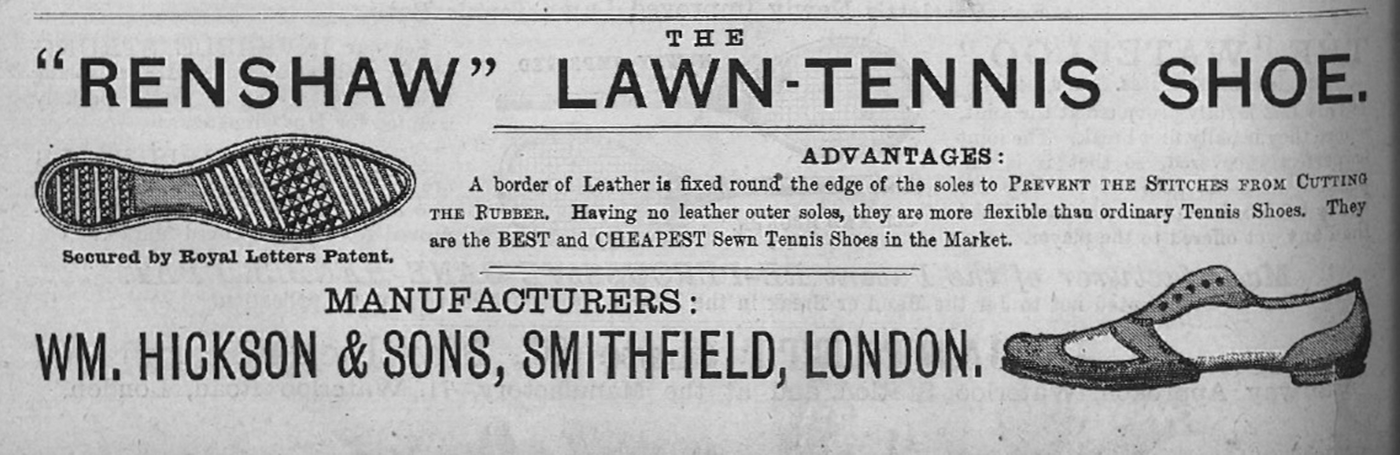
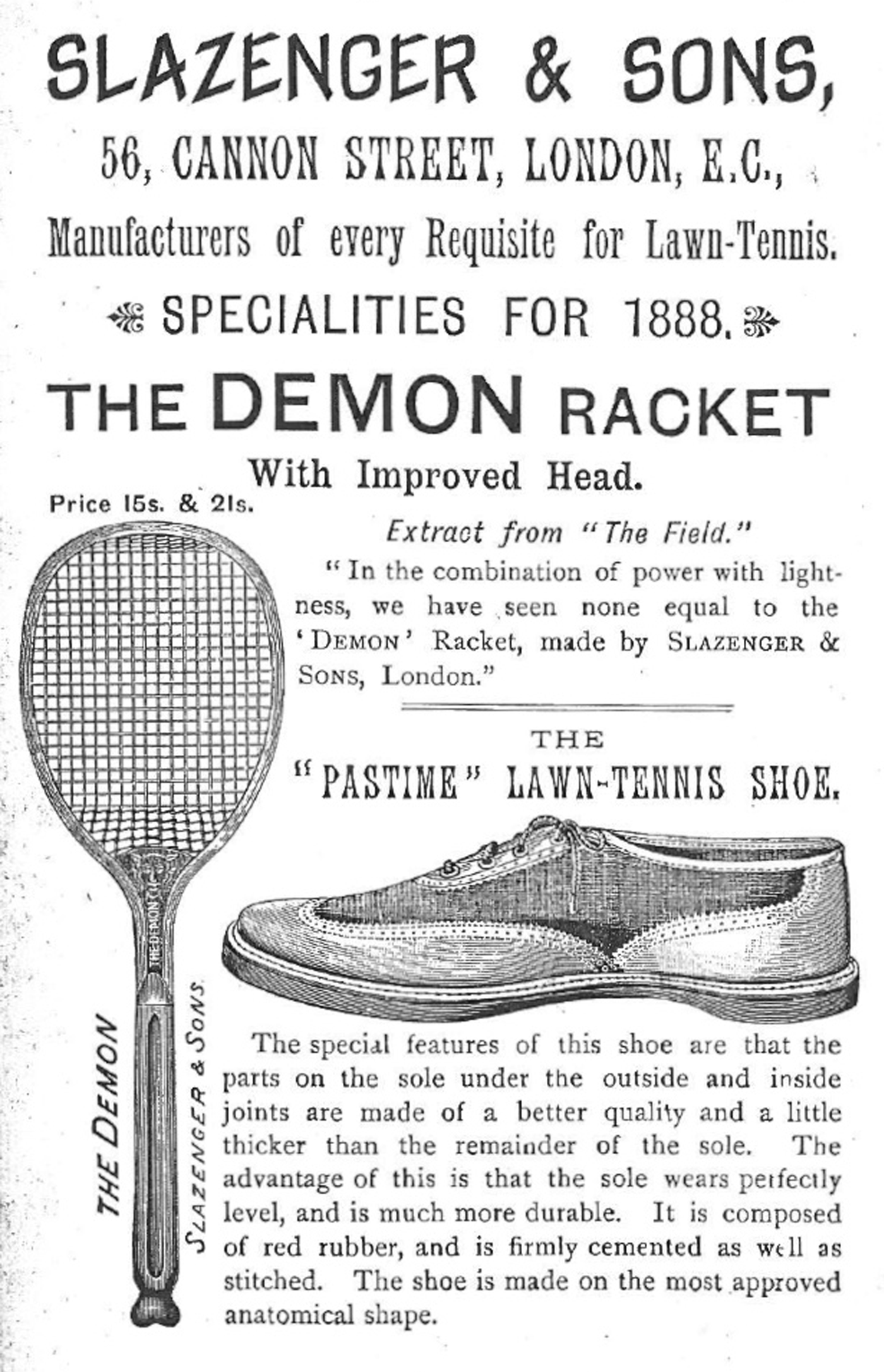
Men's shoes varied from simple canvas models to those made with fine imported leathers. Many were noticeably ornate, and several manufacturers produced models with two-tone, intricately detailed uppers. One of the most popular was Hickson and Sons’ Renshaw, a model named after William and Ernest Renshaw, the most successful players of the era (figure 2).Footnote 62 Made in Northampton and launched in 1885, it was advertised in the sports press for several years. Reviewers focused on the potential benefits of Hickson's modern soling methods but said little about the shoe's appearance. Pastime described it as “capitally finished in the usual careful style,” with rubber soles “fluted at different angles, so as to give a firm hold on the turf in every direction.” Illustrations, however, showed it offered a neat blend of practicality and style, with eye-catching, elaborately patterned uppers of different colors.Footnote 63 The Renshaw was part of a trend. Slazenger and Sons’ Pastime was similarly striking (figure 3). An 1888 advertisement explained that “the parts on the sole under the outside and inside joints are made of a better quality and a little thicker than the remainder of the sole” so that it “wears perfectly level, and is much more durable.” It was “made on the most approved anatomical shape.” A large, detailed image showed an elegant shoe with an upper of contrasting canvas and leather panels, and a wing tip with crimped edges and decorative punching.Footnote 64 In both cases, functional language provided a stereotypically masculine approach to shoes that were sold as much on aesthetics as on athletic performance.
Advertisement for William Hickson and Sons’ Renshaw lawn-tennis shoe. Pastime, 3 June 1885, 363. Reproduced with kind permission of the Kenneth Ritchie Wimbledon Library, AELTC.
Advertisement for Slazenger and Sons’ Pastime lawn-tennis shoe. Robert Durie Osborn, The Lawn-Tennis Player (London, 1888), n.p. Reproduced with kind permission of the Kenneth Ritchie Wimbledon Library, AELTC.
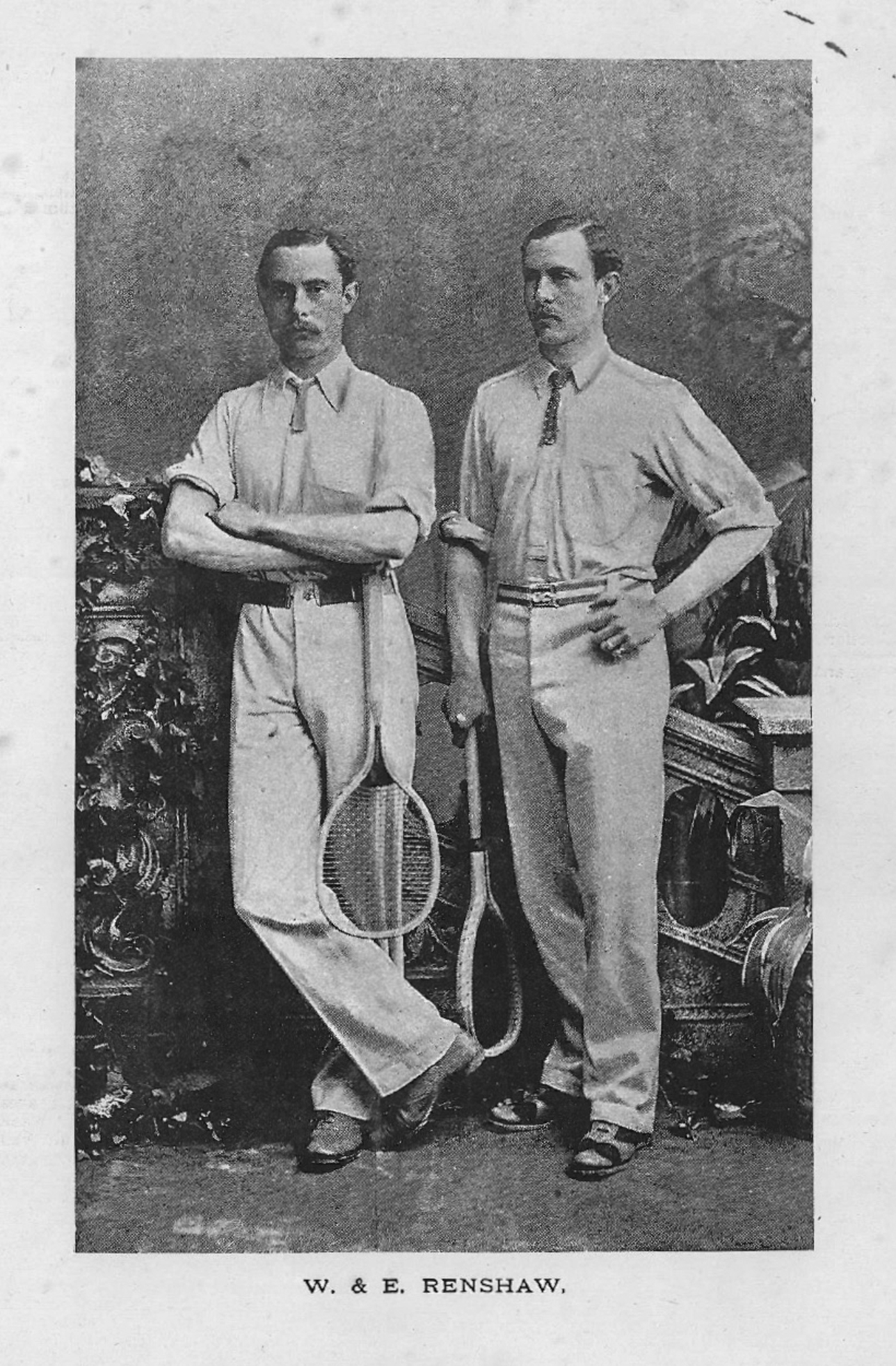
Images and advertisements for lawn tennis in the nineteenth century suggest shoes like the Renshaw and Pastime were popular with both garden players and the elite. An 1880 photograph of the Renshaw twins shows William wearing plain, probably buckskin, shoes, and Ernest in an ornate two-tone model, much like those sold by Hickson and Slazenger (figure 4).Footnote 65 By 1888 almost a quarter of a million pairs of the Renshaw had been sold.Footnote 66 On one level, the variety in price and styling in the men's lawn-tennis-shoe market was a testament to manufacturers’ technical ingenuity. On another, it was a way for male consumers to make clear their position within the complex hierarchies of wealth, taste, and social status that characterized the late-Victorian lawn-tennis party. Yet the popularity of “ornamental” footwear also shows the importance male tennis players placed upon style and aesthetics. Boots and shoes produced for other sports tended to be uniform in color: white for cricket, black or brown for football. The distinctive, dandified styling of lawn-tennis shoes highlights the game's significance as a performance of masculinity, but also the possibility inherent within it for the cultivation of novel ideas of domestic manhood. The informal, casual elegance of the masculine lawn-tennis shoe went along with new ideas of the athletic male body, and was part of a broader rejection of the stiff social codes that governed Victorian life. For an expanding constituency of young middle-class men working in city offices and living in the surrounding suburbs, sports and their associated dress provided a powerful new model of modern masculinity.Footnote 67
William Renshaw and Ernest Renshaw, 1880. “The Pastime Album,” Pastime, 2 June 1886, n.p. Reproduced with kind permission of the Kenneth Ritchie Wimbledon Library, AELTC.
LAWN-TENNIS SHOES FOR WOMEN
Women were not expected to play lawn tennis with the same athletic vigor or bodily freedom as their male counterparts (and opponents). During the garden-party era, most women therefore dressed for tennis as they would for any other summer social occasion: in long skirts, tight corsets, bustles, gloves, and hats.Footnote 68 Movement was not a primary concern. Young women who came to lawn tennis parties in the hope of romance dressed in accordance with prevailing notions of feminine beauty, in a manner that would make them appealing to men.Footnote 69 One young woman complained to Pastime that “there are nearly always young ladies who come to [tennis parties] with the object not of playing tennis, but of making the best of their opportunity.” She wrote that more active female players, likely to be “rumpled rather in dress and somewhat red in the face,” compromised on clothing and wore garments that were unsuited to the game because they did not want to be compared unfavorably by male guests against the “serenely undisturbed … sitters-out.”Footnote 70 For most female players at the end of the nineteenth century, tennis costume was about social display rather than bodily freedom. Jennifer Hargreaves has argued that the “lavish, extravagant clothes and accoutrements” favored by middle class women “were worn to afford evidence of a life of leisure.” The incapacitated female player in impractical clothing was a conspicuous “ornament” of the male wealth that afforded such a leisured lifestyle.Footnote 71 Most women conformed to gender stereotypes, preferring to look smart and dress “correctly” than to be more comfortably attired for athletic movement.
When it came to women's tennis footwear, physical practicality was less important than appearance or the need to protect the lawn. Women's shoes were as varied in style and price as those made for men, but in almost all other respects they were distinct. Women's lawn-tennis shoes were produced in stereotypically feminine designs, made with lightweight luxury materials that would have failed to hold up to anything but the daintiest of movements. Slazenger advertised shoes made of “Waterproof Black or Blue Cashmere, [with a] Canvas Lining, Strasbourg Morroco Strap and Toe Cap,” and others of “Glace Kid, [with an] Open Front, one Strap and Button.”Footnote 72 Harrod's sold women's shoes of canvas, Morocco leather, and tan leather.Footnote 73 Whereas men's footwear was considered as “equipment” by reviewers in the sports press, women's were discussed in the fashion columns of popular newspapers. A journalist in Birmingham, for instance, gushed over the “lovely … tennis shoes in willow calf, and in white buckskin and canvas” for sale to women at Bird's department store but quickly skipped over those in the “less interesting but equally necessary gent's department.”Footnote 74 Looks were deemed of far greater significance than durability or how a shoe assisted athletic performance.
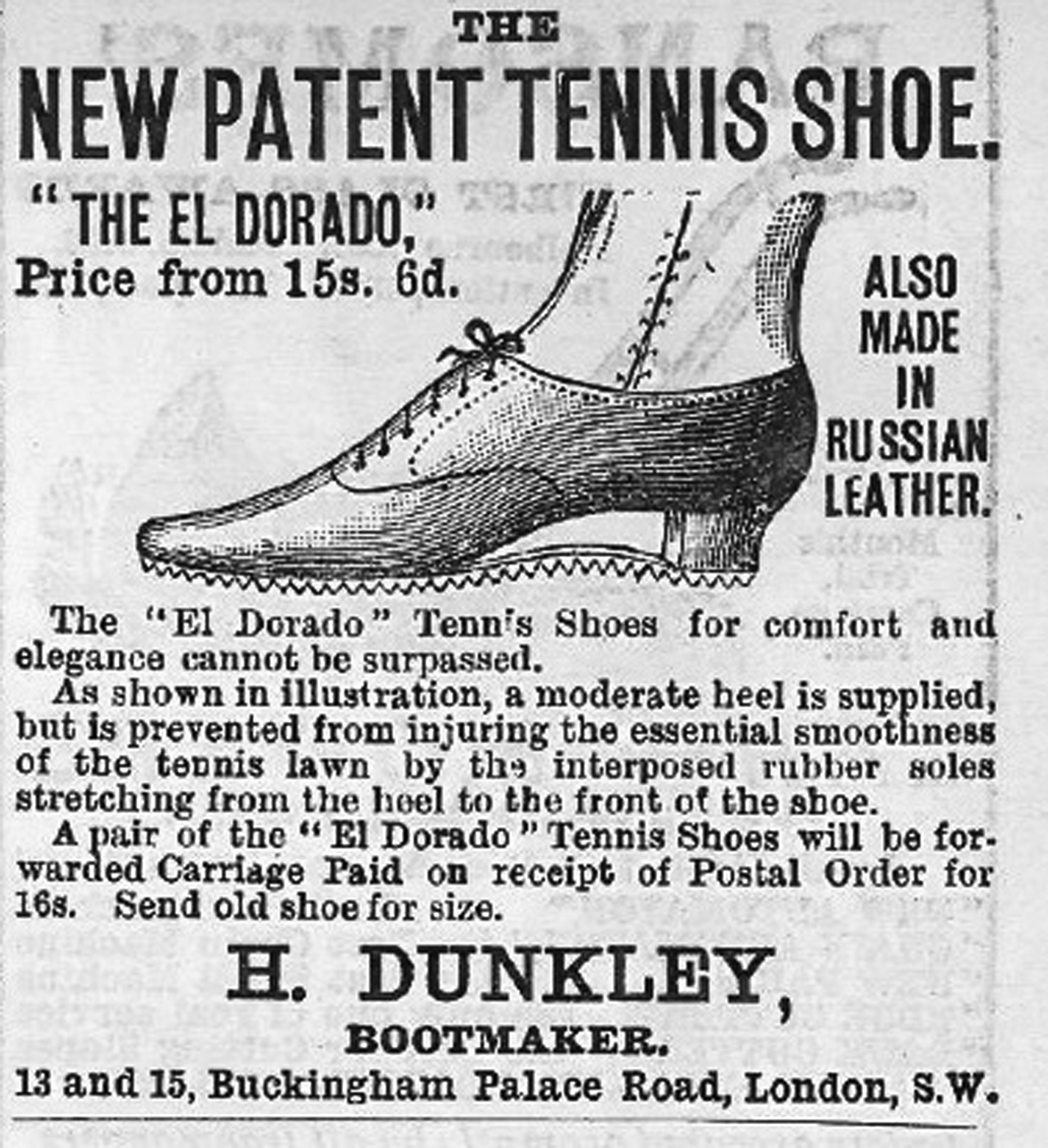
Nowhere were the importance of fashion and ideals of femininity more apparent than in the debate about heels. Many women seem to have regarded flat rubber soles as an ugly nuisance. In 1888, “Fashion's Oracle” wrote in the Hampshire Telegraph and Sussex Chronicle that, “[t]he absence of heels on tennis shoes has long been an objection to many people.”Footnote 75 High heels had reemerged as a fashion for women in the middle of the nineteenth century, and by the end of the century they were widely popular. That they were “infused with erotic significance” and signals of femininity possibly explains their appeal to female tennis players more interested in the social and romantic elements of lawn tennis.Footnote 76 So too, perhaps, does the fact that they physically enforced the inhibited style of play thought appropriate for women. Appearance and the desire to look appropriately feminine took precedence over movement or the fate of the turf. Manufacturers responded willingly. Kelsey of Oxford Street advertised “Glacé Tennis Shoes, with and without heels” in 1894, and in 1897 Harrod's listed three heeled shoes.Footnote 77 One of the most distinctive women's shoes was Dunkley's El Dorado, which had a two-inch heel and a corrugated flat rubber sole bridging the heel and the forefoot (figure 5). Advertising claimed it could not be surpassed for comfort and elegance and explained, “a moderate heel is supplied, but is prevented from injuring the essential smoothness of the tennis lawn by the interposed rubber soles stretching from the heel to the front of the shoe.”Footnote 78 The shoe's name suggested that this was something many women sought: a feminine, high-heeled shoe that would not sink into the grass. Soon after it was launched in 1888, “Fashion's Oracle” reported it was “rapidly gaining favour.”Footnote 79 The author of “Things Worth Buying” in the Ladies’ Monthly Magazine called it “[o]ne of the prettiest and most satisfactory [tennis shoes], which I have seen up to now,” “a charming combination of flat sole and moderate heel, strong and elegant-looking,” that “can be worn with the greatest of comfort.”Footnote 80 Whether it enabled women to move about with greater ease or to play the game any better was of little consequence.
Advertisement for H. Dunkley's El Dorado women's lawn-tennis shoe. Pastime, 8 May 1889, 299. Reproduced with kind permission of the Kenneth Ritchie Wimbledon Library, AELTC.
Of course not all women adopted the garden-party style of play. For red-faced, more physically active players, shoes with flat rubber soles enabled them to move in a manner that was otherwise entirely proscribed, helping cultivate new notions of what it meant to be a woman.Footnote 81 In girls’ schools and colleges, a new ideal of the physically active young woman—the female collegiate athlete—emerged, rejecting the sickly, frail femininity of the mid-Victorian period. Crucially, this occurred in an environment in which men were largely absent.Footnote 82 The small band of elite female players at the end of the nineteenth century were similarly pioneering. Lake has argued that their adoption of less restrictive, more comfortable clothing for lawn tennis cleared a sartorial path that was followed more widely after the First World War.Footnote 83 For some women, flat-soled lawn-tennis shoes were part of a new concept of female beauty. Yet these women represented a tiny subset of female lawn tennis players. As McCrone suggested, in the late-Victorian era female champions were “exceptions to the casual play of thousands of ordinary club members whose primary motives were to combine healthy exercise with pleasant encounters.”Footnote 84 In public, even the most athletic women thought tennis dress needed to conform to feminine ideals. Lottie Dod, whose youthful athleticism entertained crowds and brought her five Wimbledon titles, asked for a “practical, comfortable, and withal becoming costume. It must be becoming, or very few of us would care to wear it.”Footnote 85
Lawn tennis was not solely a British phenomenon. Wingfield's boxed sets were easy to transport, and among his first customers were British military regiments and imperial administrators stationed around the globe. Sphairistikè was introduced to the United States after Mary Ewing Outerbridge, a young New York socialite, played it with British soldiers in Bermuda and returned home with one of Wingfield's sets. The first games took place in 1874 at the Staten Island Cricket Club; the first tournament was held in 1880; and by 1887 four-hundred-and-fifty tennis clubs used courts in Brooklyn's Prospect Park.Footnote 86 Imported and American-made shoes and equipment were soon available. In the 1880s, the New York firm I. E. Horsman launched sets like Wingfield's. Its rulebook advertised prize-winning “Best Tennis Shoes, White or Coloured Canvas, with Corrugated Rubber Soles” and advised that “[b]y wearing rubber-soled shoes, the player will secure a sure footing, and save the court, since ordinary heels cut the turf.”Footnote 87 Peck and Snyder, another store in New York, sold domestic and imported models in the 1880s, and by the 1890s a variety of shoes were available by mail order from Sears, Roebuck in Chicago.Footnote 88 During this period, the game remained largely the preserve of a moneyed middle class and performed much the same social function as it did in Britain.Footnote 89 Similarly gendered ideas of sartorial and behavioral decorum governed male and female participation, and found expression in men's and women's lawn-tennis shoes.
H. E. RANDALL'S TENACIOUS LAWN-TENNIS SHOES
The connections between production and practice, producers and practitioners were illustrated by H. E. Randall of Northampton, manufacturer of one of the most popular late-Victorian tennis shoes. Founded by Henry Edward Randall, the firm adopted the latest production technologies and grew rapidly.Footnote 90 It opened its first shop in 1873 in the city of London, and during the 1880s a factory built in Northampton was the largest in Europe at the time. Randall claimed it was “the most up-to-date in the trade,” as it was “[f]itted throughout with the latest labour-saving machines, and controlled by the foremost experts in shoemaking.”Footnote 91 Another three factories existed by 1896, and by the First World War the firm had more than fifty shops, many in London's most fashionable shopping districts.Footnote 92
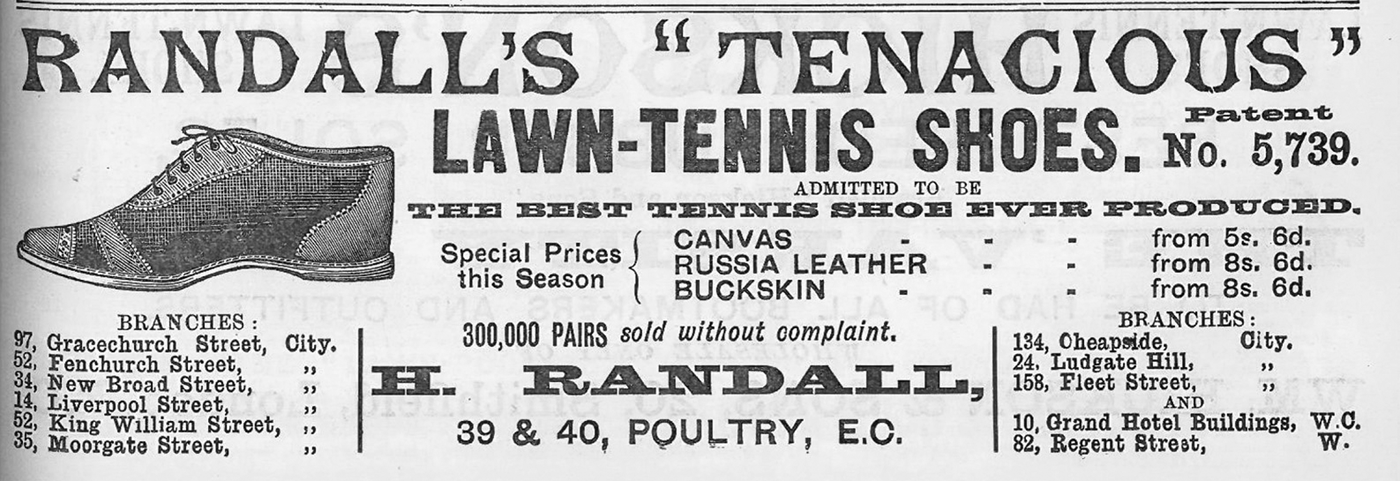
H. E. Randall was renowned for the high quality of its products, and in the early 1880s it launched the Tenacious lawn-tennis shoe. The model's patented design applied modern construction techniques to a common problem. Vigorous play caused glued soles to eventually work loose, while stitches cut through the rubber and caused the sole to come away. On their own, neither coped well with the demands of the game. Randall's solution was an extra-thick vulcanized rubber sole glued and sewn to the upper. The greater durability and sporting reliability this promised were the shoe's principal selling points, but concern was nevertheless taken to ensure it appealed to those more interested in aesthetics and display. The Tenacious was made for men and women, in “a sufficiently large assortment to satisfy the most fastidious taste.” Buyers could choose from around thirty differently styled uppers of canvas or a variety of leathers and were presented with several price options. Illustrated advertising drew attention to the shoe's “stylish appearance” and showed a low-cut man's model with fashionable contrasting panels, decorative gimping and punching, and a corrugated flat sole (figure 6).Footnote 93
Advertisement for H. E. Randall's Tenacious lawn-tennis shoe. Pastime, 21 May 1890, 337. Reproduced with kind permission of the Kenneth Ritchie Wimbledon Library, AELTC.
Lawn tennis, like other social practices, was extended and developed “through and as a result of the energy and enthusiasm of devoted practitioners, in association with an array of producers.”Footnote 94 The introduction of more reliable and durable footwear like the Tenacious, Renshaw, and Pastime allowed male participants to develop the sporting aspects of the practice. During the 1880s, inspired by the Renshaws and enabled by rule changes that lowered the net, men adopted a more aggressive, athletic playing style that distinguished lawn tennis from older bat-and-ball games.Footnote 95 This would have been difficult had they been overly concerned about the soles of their shoes. Shifts in the practice were fed back into the design process, as manufacturers responded to participants’ changing expectations and needs. The Tenacious almost immediately attracted the attention of male tennis enthusiasts, for whom it promised improved sporting performance. In spring 1884, Mr. J. W. Heaton of Tufnell Park, London, wrote to the editor of Pastime:
Sir, —I am desirous, as a tennis player, of obtaining either from you or some of your subscribers information as to whether shoes of which the soles are attached by stitching are really successful, and stand satisfactorily the wear and tear of play. I believe the correct name of the shoes I mean is the “Patent Tenacious,” and if you will be so good as to insert this short letter no doubt some who have by hard wear thoroughly tested the shoe will kindly, also through your columns, furnish me with the information I desire.Footnote 96
In response, Mr. A. Myers of Regent's Park, London, wrote, “[t]ennis shoes have not tended to bring joy to my troubled soul,” due to the “certainty … that at some untimely moment the soles and bodies will part company.” He thought the Tenacious “a good thing, and a step in the right direction” as it wore “as no shoes ever did before.”Footnote 97 Thomas Shepard of St. Edmunds similarly considered them “the best lawn-tennis shoes I have ever seen.”Footnote 98 Sports journals provided a space for readers to consider the latest products, offer guidance, and share opinions that could be placed alongside those aired in formal product reviews, and were a means by which often overblown advertising claims could be challenged.
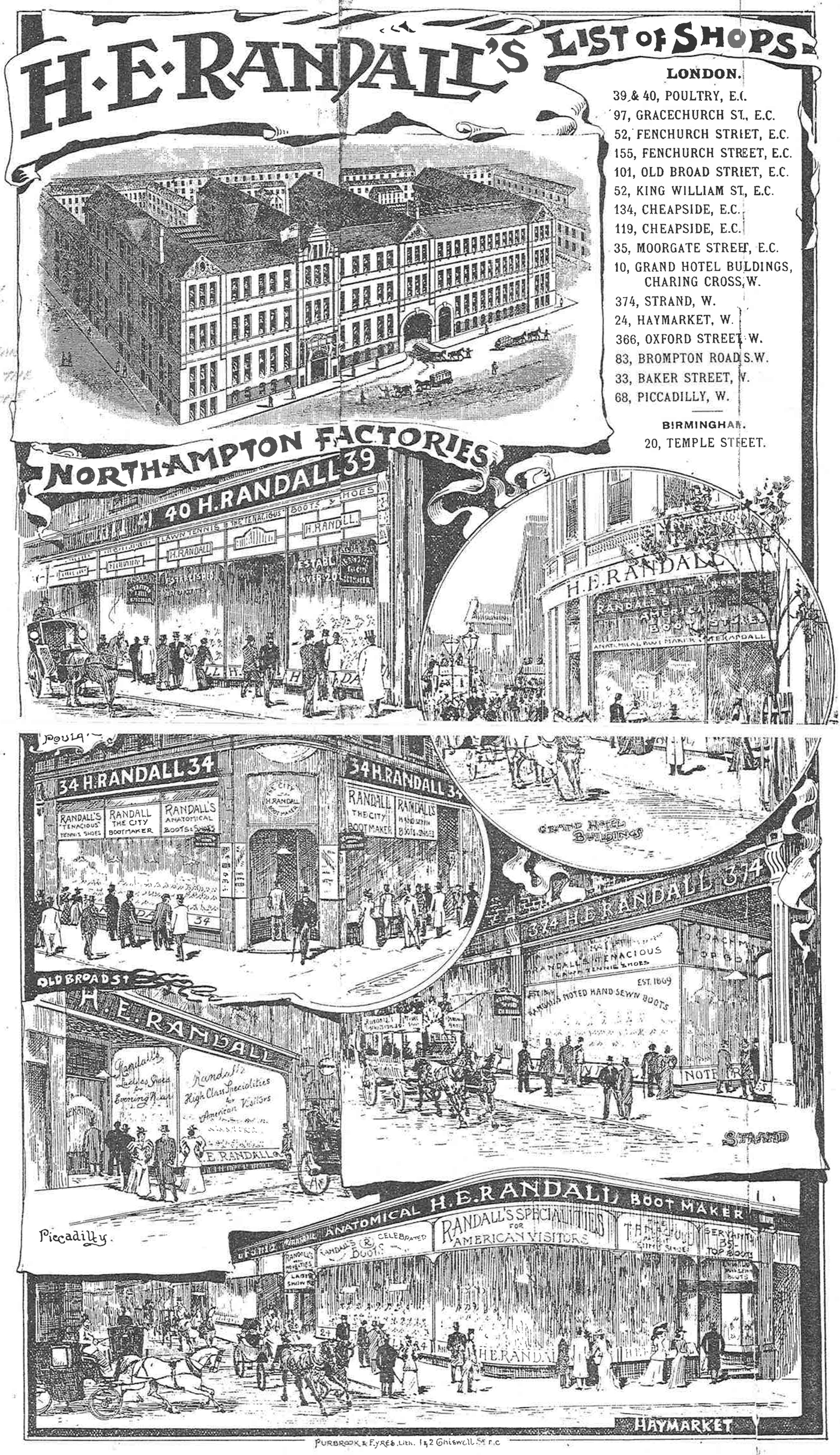
Randall seized the opportunity presented by Heaton's letter; an advertisement appeared three weeks later.Footnote 99 The firm's shoes were promoted in the sports journals and guidebooks intended for final consumers, and in the trade newspapers read by retailers and other producers.Footnote 100 In 1886 it took a prominent stand at the Sportsman's Exhibition at the Westminster Aquarium, possibly the only shoemaker to do so.Footnote 101 It adopted the new methods of product display made possible by developments in construction and glass technology. The Shoe and Leather Record described the firm's shop window displays as “unquestionably the finest … in London.” The reviewer stood amazed before a “marvel of ingenuity”: “Walking boots and shoes, tan and patent, and cycling, cricket, and tennis goods, all contribute to the fine effect produced, and interspersed in the most artful manner are cricket bats, balls, and wickets set in position, tennis rackets, balls &c.”Footnote 102 Illustrations of the firm's London stores showed male and female passersby gazing at products displayed behind enormous plate-glass windows plastered with advertising (figure 7).Footnote 103 Promotional leaflets informed potential buyers about the firm's products and reinforced notions about the unwavering grip of the Tenacious.Footnote 104
H. E. Randall's Northampton factory and London shops, c. 1890. Reproduced with kind permission of Northampton Museum and Art Gallery.
Randall's advertising was attuned to the complex mix of physical action, social aspiration, and display that characterized Victorian lawn tennis. This was most apparent in Victory of the Tenacious Lawn Tennis Shoes: A Romance, a throwaway comic strip that tells the story of Jones, a fashionable young gentleman, and his attempts to win the favor of a Miss de Ponsonby. After a successful game of mixed doubles and an intimate moment at a first tennis party, Jones faces embarrassment at a second, when the sole of his shoe—“not Randall's”—flies off and strikes Miss de Ponsonby on the nose. He is saved from social estrangement only when he takes advice from his friend and tries “RANDALL'S TENACIOUS LAWN TENNIS SHOES as peacemakers” (though how he does this is not made clear). After resolving “never again to buy Boots or Shoes elsewhere,” the final frame shows him getting married, one assumes to Miss de Ponsonby.Footnote 105 The reader is invited to laugh and the strip neatly satirizes the notion that the tennis party was a site for amorous liaisons, but it nevertheless indicates the social importance of the tennis party and the wider implications of the game as a practice. Randall understood this and tailored his products and marketing accordingly.
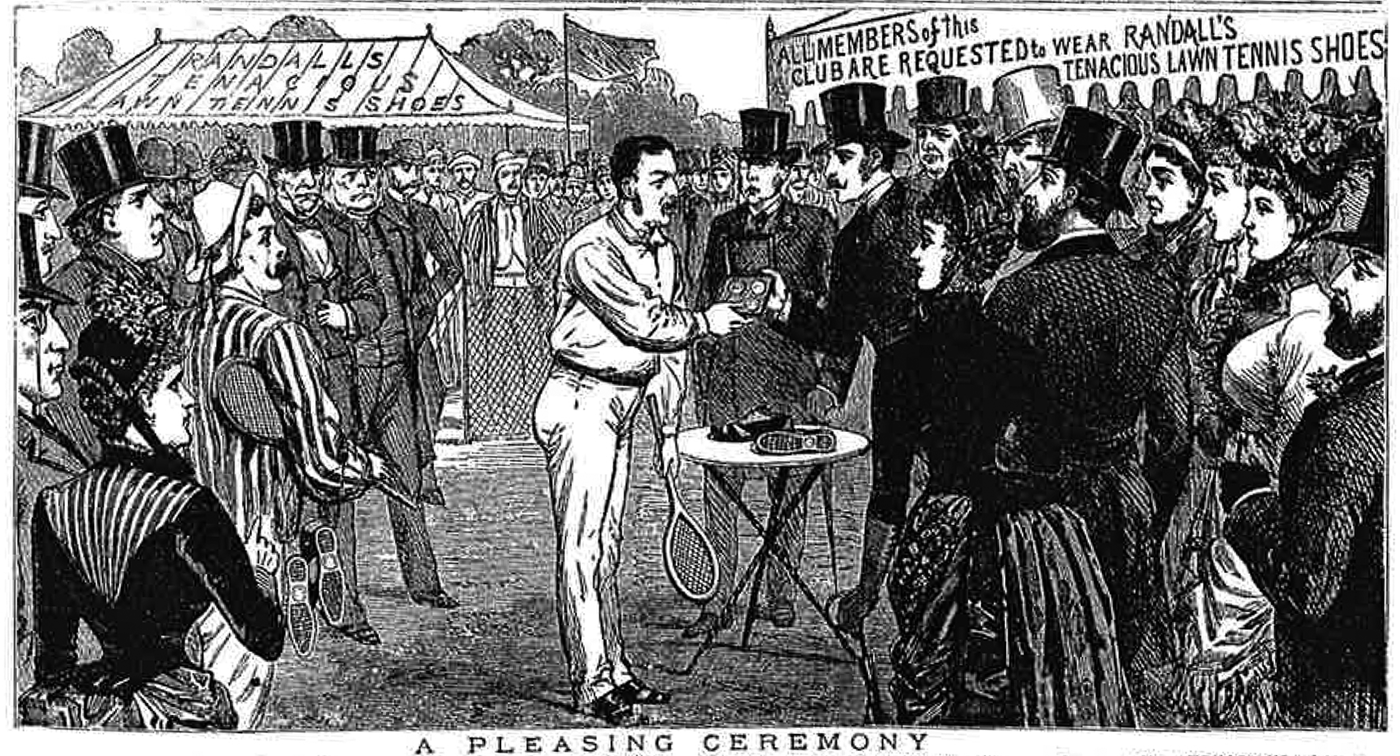
The firm's knowledge of lawn tennis and its sensitivity to players’ desires may well have stemmed from the founder's own experiences. As Tanja Kotro and Mika Pantzar have argued, “personal experience in a certain field and a feel for its culture can form an important basis both for creating and conceiving the right consumer image, and for successful product development” as it helps develop “intuitiveness and sensitivity towards that field, its values, and its product environment.”Footnote 106 An illustrated advertisement in the Graphic in 1886 (figure 8) showed Henry Randall receiving prize medals at a well-attended tennis tournament. In contrast to the frock-coated, top-hatted “leaders of Society, Politics and Art” around him, he is shown with a racket in hand, dressed in a loose-fitting white shirt, fitted trousers, and a pair of Tenacious. Extracts from a speech supposedly given by the presiding official explained that Randall was “looked upon as a benefactor to Lawn Tennis Players generally, as previous to the advent of the ‘TENACIOUS,’ they often experienced great discomfort from the soles of their shoes coming off.” The shoe was so well suited to the game that “many of the leading clubs insist upon [it] being worn by all the members.”Footnote 107 The image implies that, as a member of the commercial middle class, Randall played lawn tennis himself, and that his knowledge of the game fed into the design and construction of the Tenacious.
Henry Randall receiving prize medals “in the presence of the leaders of Society, Politics and Art,” 1886. “A Pleasing Ceremony,” H. E. Randall advertisement, Graphic, 26 June 1886, 707. Reproduced with kind permission of Northampton Museum and Art Gallery.
Randall's smart advertising and the ready availability of the firm's products no doubt contributed to the success of the Tenacious. Randall claimed over 200,000 pairs were sold between 1883 and 1886, and Pastime noted in 1890 that it had “for some time past enjoyed a well-merited popularity.”Footnote 108 Advertising declared it was “admitted to be the best tennis shoe ever produced” with “300,000 pairs sold without complaint.”Footnote 109 It is impossible to find detailed sales or production data, so these figures must be treated with caution, but nevertheless they suggest the Tenacious was among the best-selling shoes of the era.Footnote 110 Like the Renshaw, it was successful because it catered to the desire for sports footwear that looked good and was physically functional and because its marketing tapped into potential buyers’ social fears and concerns.
LAWN-TENNIS SHOES BEYOND LAWN TENNIS
Things travel in ways that practices do not. Goods can be appropriated and reconsidered, incorporated into new practices and used in ways not envisaged by their producers.Footnote 111 Mika Pantzar has argued that technologies are “domesticated” as they are absorbed into the practices of everyday life. Innovative playthings—like the lawn-tennis shoe—are transformed gradually into practical technologies as they are institutionalized within human lifestyles. Novelties become essentials.Footnote 112 Tennis shoes’ rubber soles, lightweight uppers, and aesthetic details were all determined by their function within lawn tennis, but this did not preclude them from being worn for other practices. Shoes circulated far more easily than the game. Mr. P. Hayman of Kilburn, for example, told Pastime that after two months wearing his Tenacious for tennis and walking, the soles “stood at least as well as the leather soles usually worn.” Hugh Browne from Nottingham wore his for “tennis, bicycling, tricycling, and walking … without a flaw,” and found they “proved themselves far better than the ordinary tennis shoes, whose … soles are fastened(?) [sic] with cement.”Footnote 113
As Hayman's and Browne's letters suggest, rising involvement in sport of all kinds created a need for suitable footwear, and lawn-tennis shoes, with their flat soles and lightweight, functional design, proved highly adaptable. Press reports show they were adopted for a wide variety of popular activities: boxing, fencing, cycling, golf, cross-country running, pedestrianism, big-game hunting.Footnote 114 The creation of basketball in 1891 provided another use, and as the game's popularity increased manufacturers began to sell specialty footwear derived from that designed for tennis; in 1907 the sporting goods merchant A. G. Spalding advertised rubber-soled canvas basketball shoes almost indistinguishable from high-cut tennis shoes sold in the 1880s and 1890s.Footnote 115 Tennis shoes also encouraged and enabled the development of sporting practice. As Shove and Pantzar's analysis of nordic walking suggests, “[n]ew practices consist of new configurations of existing elements or of new elements in conjunction with those that already exist.”Footnote 116 The advent of flexible shoes with soft, grippy rubber soles allowed participants in a variety of sports to increase the scope of what was possible. Ballplayers could move with confidence on wooden courts; cross-country athletes could run greater distances on hard ground; climbers were able to tackle more challenging terrain. Reports of an 1878 ascent of the Pieter Both mountain in Mauritius described how the climbers changed into tennis shoes just before the summit, “as it would have been impossible to scale the rocks in leather boots”. Rubber soles, they found, gave “a much better hold.”Footnote 117
By integrating lawn-tennis shoes into a variety of sports, consumers caused ideas about the product itself to shift. Manufacturers, perhaps concerned about the faddish nature of late-Victorian sports, reinforced consumers’ actions and soon began to promote lawn-tennis shoes as multipurpose footwear. Golding, Bexfield and Co. in 1883 described its pyramid-pattern rubber soles as suitable for “lawn-tennis, cricket, and all outdoor games,” and by 1889 Hickson advertised tennis shoes it claimed were unequalled “for mountain climbing, yachting, and boating.”Footnote 118 Lawn-tennis shoes moved from being associated with a single game to be linked to sports and physical activity more generally. Promotional material encouraged and reinforced consumers’ creative reimaginings.Footnote 119
Manufacturers may have focused on potential sporting uses for their products, but lawn-tennis shoes quickly moved beyond the sports field entirely. Looking back in 1913, William Dooley, the author of a guide to shoemaking, noted that they “have come into very general use as warm weather and vacation shoes.” The name “tennis shoes” had, he pointed out, become “a generic term … applied to all kinds of footwear having cloth tops and rubber soles.”Footnote 120 Christopher Breward has shown how a masculine style emerged in the suburbs at the end of the century that “stressed relaxation and a conscious paring down of formalities, replacing the archaic introversion of office or church decorum with the over-familiar heartiness of the playing field or promenade.” Worn during evenings, weekends, and holidays, sportswear “became synonymous with a respectable release from the daily round.”Footnote 121 Brent Shannon has similarly argued that “the mania for sports and recreation … helped fuel the radical transformation of men's fashions at the turn of the century, as well as the entire cultural ideal of the male body.” By wearing the lighter materials, more relaxed styling, and brighter colors associated with sports outside the narrow bounds of prescribed use, middle class men engaged in “overt rebellion against the social hegemony of upper class sartorial aesthetics.”Footnote 122
Lawn-tennis shoes were part of this new style, a lighter—in color, weight, and cut—and more comfortable alternative to the dark leather boots worn at other times or by older men. They represented a stylistic challenge to the stiff formality leftover from the mid-Victorian era and an assertion of new concepts of youthful, informal masculinity. The Daily News in 1884 reported that young men at Brighton, keen to impress “young ladies in sailor hats,” were, “like other young men by the seaside, much given to flannels, to boating and lawn-tennis shoes.”Footnote 123 For journalists, tennis shoes became a kind of shorthand for wealthy, carefree, middle-class youth. During the dockers’ strike of 1889, for instance, Lloyd's Weekly Newspaper noted that replacements for the striking dockers included “several young fellows in striped boating jackets, flannel trowsers [sic], and lawn tennis shoes, who appeared to think that the fun of the thing was wearing off.”Footnote 124 The symbolic value these shoes had within lawn tennis carried over into everyday life.
Sports-inspired styles may initially have been associated with youthful recreation, but they became more widespread and gained respectability during a series of hot summers in the 1890s.Footnote 125 While London sweltered in 1893, the correspondent of the Cardiff Western Mail noted the “great change” that had occurred in attitudes to masculine dress. “This is the kind of weather,” he wrote, “when we do not shy at tennis-shoes and whites in Piccadilly and Bond-street.” This was quite a revolution: “[f]our or five years ago a man about town would, even at this time of year, and with the thermometer well into three figures, as soon have thought of resorting to this form of attire as of marching into the stalls of a London theatre in a shooting coat and gaiters.”Footnote 126 The spread of informality was illustrated two years later, when the London correspondent of the Dublin Freeman's Journal was surprised to see Arthur Balfour, by then leader of the Unionist Party, taking a Saturday stroll along Piccadilly “in a light blue serge suit, a flannel shirt, a soft felt hat and tennis shoes.”Footnote 127 Balfour, like many of his generation, refused to abandon the comfortable, elegant clothing he had worn as a tennis-mad youth in the 1860s and 1870s. Shifting standards were highlighted again in June 1900, when the Leeds Mercury watched Sir Robert Peel sell his more famous grandfather's library while “[a]ttired in an easy-fitting lounge suit, with a light grey felt hat and white tennis shoes.”Footnote 128 Balfour and Peel were not social revolutionaries; their clothing showed the rise and growing acceptability of the casual style established in the 1880s by young middle-class men.
CONCLUSION
At the end of the nineteenth century, British manufacturers made and sold lawn-tennis shoes by the hundred thousand. For men especially, this type of footwear opened new sartorial possibilities. Tennis shoes moved beyond the tennis lawn to become both multipurpose sports shoes and informal casual wear. This is a shift more commonly associated with the sports shoes of the late twentieth century, dating to the 1970s at the earliest.Footnote 129 Perhaps more significantly, in the early 1900s, many of the features that made late-Victorian tennis shoes distinct began to be adopted in the boots and shoes men wore for everyday and more formal purposes. In the years after the First World War, the lawn-tennis shoe's rubber sole and comfortable low cut became common aspects of the masculine shoe, celebrated during the ensuing century as “a progressive symbol of aesthetic conservatism [and] dandified modernism.”Footnote 130 Today's mass-produced, rubber- and plastic-soled shoes are the domesticated descendants of the lawn-tennis shoes of the 1880s and 1890s.
As material products, late-Victorian lawn-tennis shoes owed their existence to the coming together of seemingly disparate historical trends. They were shaped by the social, industrial, and commercial developments that gave rise to the middle-class sporting culture of the late nineteenth century and made the production and sale of such an item a possibility. The physical and social needs created by sports were answered by commodities like the lawn-tennis shoe, which had value based not only on how they performed physically but also on what they conveyed as symbols. For men, these shoes were designed to allow the movement needed for physical play, which in turn enabled athletic body ideals to be cultivated and expressed. Rare or expensive materials and decorative detailing not only demonstrated wealth and status but also made possible expressions of new modes of suburban, middle-class masculinity. By contrast, the value of women's shoes was linked to women's less physical role within lawn tennis. For most women, looking suitably feminine took primacy over ease of movement. High heels, which today seem so entirely impractical, were thought attractive and enforced the restrained styles of play thought appropriate. In the few instances in which women played for sporting purposes, flat rubber soles granted a bodily freedom seldom enjoyed elsewhere and contributed to their physical emancipation. At the same time, the physical functionality of lawn-tennis shoes translated easily to other sports and games and offered a new level of comfort and flexibility in everyday life. The power of men's tennis shoes to convey a relaxed, modern masculinity perhaps explains why they were embraced so keenly by middle-class men eager to assert their position in late-Victorian and early twentieth-century society.
When we consider late-Victorian lawn-tennis shoes, we see the fluidity of objects, and the roles played by producers and consumers in shaping how things are used and perceived. Focusing on the role of footwear in the practice of lawn tennis, we see the intertwining of physical and symbolic function. Placing the lawn-tennis shoe into a broader cultural and historical framework—giving primacy to practice—helps demonstrate how objects are integrated into the realities of life and brings us to a better understanding of what this novel product meant to the late-Victorian consumers who embraced it so fully.