Humanitarian crises, whether due to a natural disaster or human conflict, significantly disrupt the well-being of a population. Meeting the mental health needs of populations affected by humanitarian crises has been recognized as an important component of humanitarian response. 1–4 Training first responders to administer psychological first aid (PFA) is now entrenched in multinational guidelines from the World Health Organization, the International Federation of Red Cross, and Red Crescent Societies. Reference Hansen5–Reference Vymetal, Deistler and Bering9 However, relatively little is known about the provision of mental health services for the first responders working in a crisis.
First responders to disasters are at high risk for adverse mental health effects. Prior studies have shown that between 10% and over 30% of all first responders may be diagnosed with posttraumatic stress disorder (PTSD). Reference Marmar, Weiss and Metzler10–Reference Ursano, Fullerton, Vance and Kao13 An additional 1 in 4 may be diagnosed with depression. Reference Osofsky, Osofsky and Arey14 Beyond those meeting clinical criteria for these psychiatric diagnoses, a far higher proportion of first responders experience subdiagnostic symptoms, all of which have been shown to be directly proportional to the quantity of trauma exposure. Reference Osofsky, Osofsky and Arey14–Reference Jones16 The risks of adverse mental health effects may also be greatest in those without formal medical or disaster training. These individuals often constitute a large proportion of first responders, especially in the early stages of a humanitarian crisis. Reference Fullerton, Ursano and Vance17
Numerous interventions ranging from pharmacologic supplements to mindfulness meditation to regimented debriefings have been described in the literature, and while the majority of publications come from high income countries, in 2018 alone, more than 134 million people in low- and middle-income countries (LMICs) were affected by humanitarian crises. 1 The primary objective of this systematic review was to explore the current state of evidence regarding the effectiveness of interventions provided to first responders to prevent and/or treat the mental health effects of response to a disaster. Secondary objectives included targeted analyses of mental health interventions for first responders in LMICs and pre- versus post-event interventions.
METHODS
Search Strategies
This systematic review was developed and conducted by the Global Emergency Medicine Literature Review (GEMLR) group. The systematic review protocol was registered with PROSPERO (University of York, United Kingdom National Institute for Health Research, United Kingdom of Great Britain and Northern Ireland) on January 25, 2019. A rigorous search strategy was designed in collaboration with a health sciences medical librarian with the goal of identifying all randomized controlled trials (RCTs) and observational studies that described the effectiveness of interventions provided to first responders to prevent and/or treat the mental health effects of responding to a disaster.
Three principal bibliographic databases were reviewed with computer-assisted searches: Medline, Scopus, and PsycINFO. The used terms, key words, and phrases encompassed 3 broad themes: first responders, disasters and humanitarian crises, and psychological intervention. These terms were honed based on expert consensus and accuracy of initial trial searches. These databases were searched from their inception through December 13, 2018. EMBASE, PsycEXTRA, ClinicalTrials.gov, and Google Scholar were manually reviewed for additional articles.
Data Processing
After the removal of duplicate articles, 2 teams consisting of 2 reviewers each (CB/NB and AC/SG) performed an initial screening of titles and abstracts, followed by a full-text screening employing the following exclusion criteria: (1) articles not in English, Spanish, or French; (2) articles not in the first responder or disaster population; and (3) articles with no evident, controlled psychiatric intervention (either pre- or post-event). Discrepancies were resolved by a third reviewer (WTW).
Both qualitative and quantitative studies were included and were evaluated separately. Information extracted from the final selection included author, publication date, location, study type, first responder population, methods, and relevant outcomes. Quantitative study quality was assessed using the Grading of Recommendations Assessment, Development, and Evaluation (GRADE) criteria. Reference Guyatt, Oxman and Schunemann18 Criteria proposed by the Preferred Reporting Items for Systematic Reviews and Meta-analyses (PRISMA) statement were adhered to in reporting. Reference Guyatt, Oxman and Vist19 Qualitative study quality was assessed using the Critical Appraisal Skills Programme (CASP) checklist for qualitative studies. Reference Moher, Liberati and Tetzlaff20 Based on the 10-item CASP checklist, qualitative studies received scores of 1–10, with higher scores corresponding to higher quality.
Data Analysis
Given the heterogeneous nature of the interventions, measurements, methodologies, and outcomes, a descriptive analysis was employed. Findings were organized according to study objectives, study type, and country income level per World Bank classifications as of 2018.
RESULTS
Study Characteristics
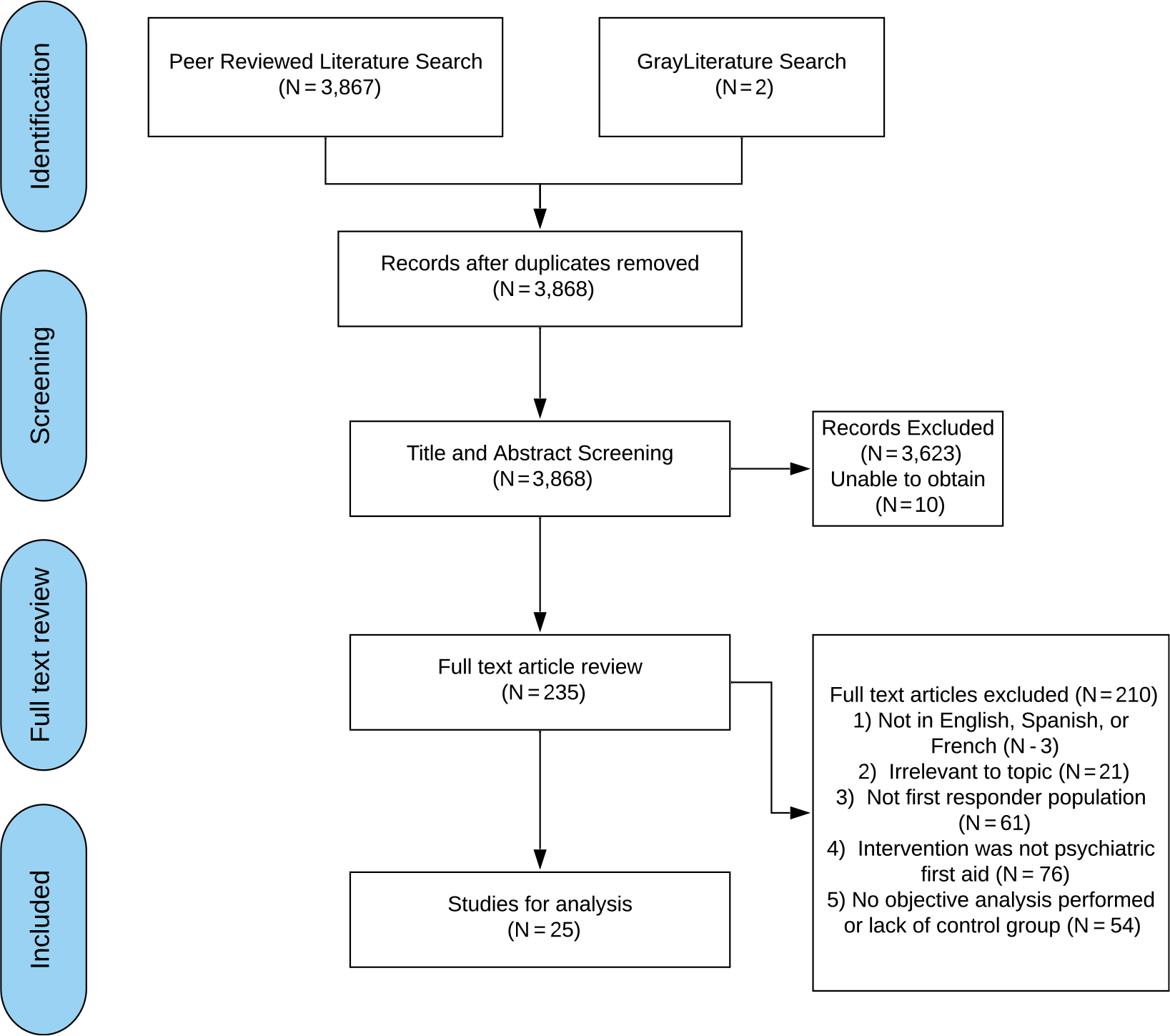
After the removal of duplicates, 3867 unique records were identified with an additional 2 records encountered via manual gray literature searches. After title and abstract screening, 235 citations were included for full-text screening. A total of 25 studies met all inclusion/exclusion criteria and underwent an in-depth analysis (Figure 1). Of the 25 studies included for a detailed review, 22 were quantitative and 3 were qualitative. The study design included 3 RCTs, 21 observational cohorts, and 1 cross-sectional survey. Two studies evaluated pharmacologic interventions. The remainder evaluated psychological or training interventions. Six total studies took place in LMICs.
Prisma Flow Chart for Selected Studies

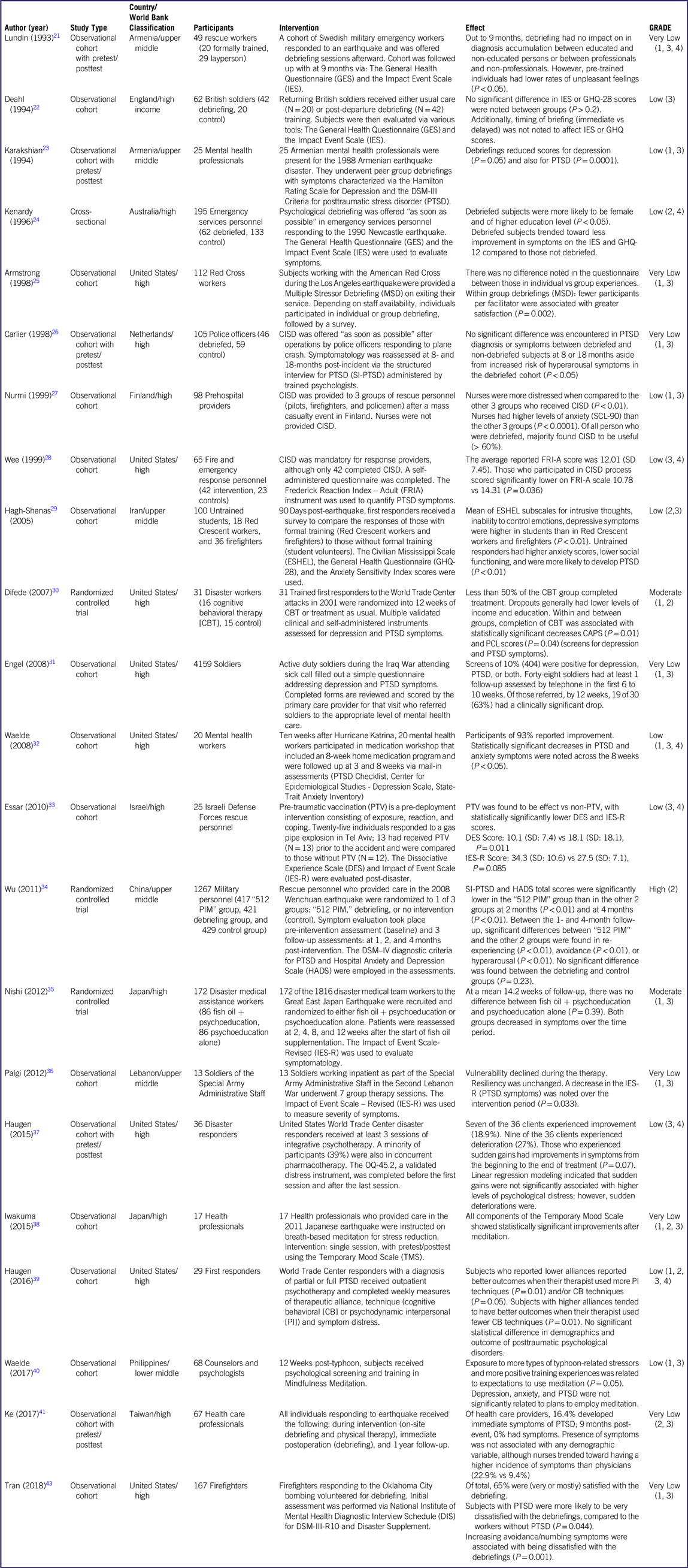
Using GRADE criteria for the quantitative studies, 12 studies were rated as “Very Low” quality, 12 as “Low” quality, 2 as “Moderate” quality, and 1 as “High” quality (Table 1).
Quantitative Studies

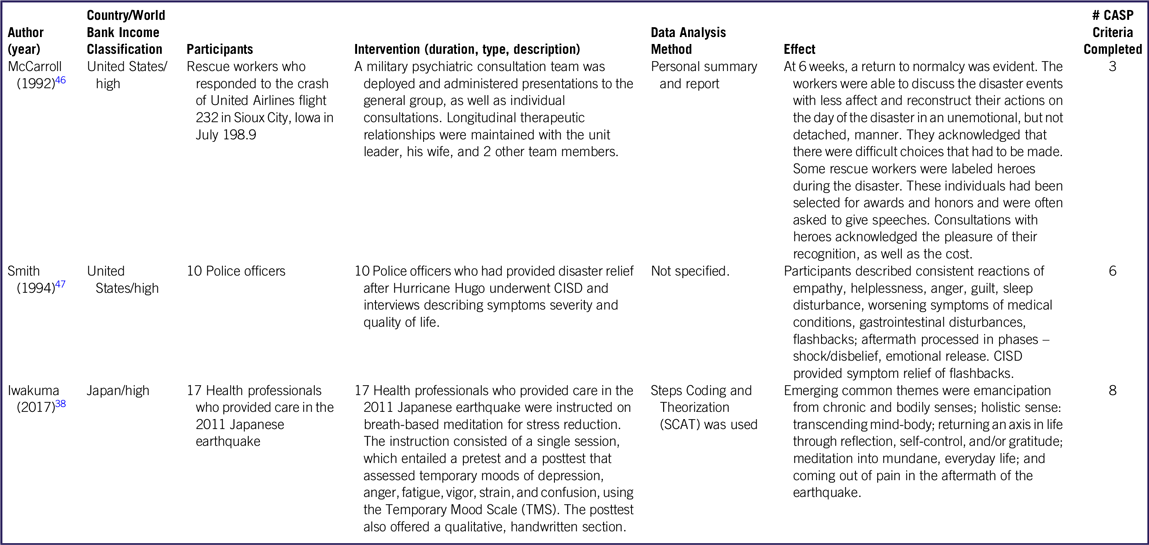
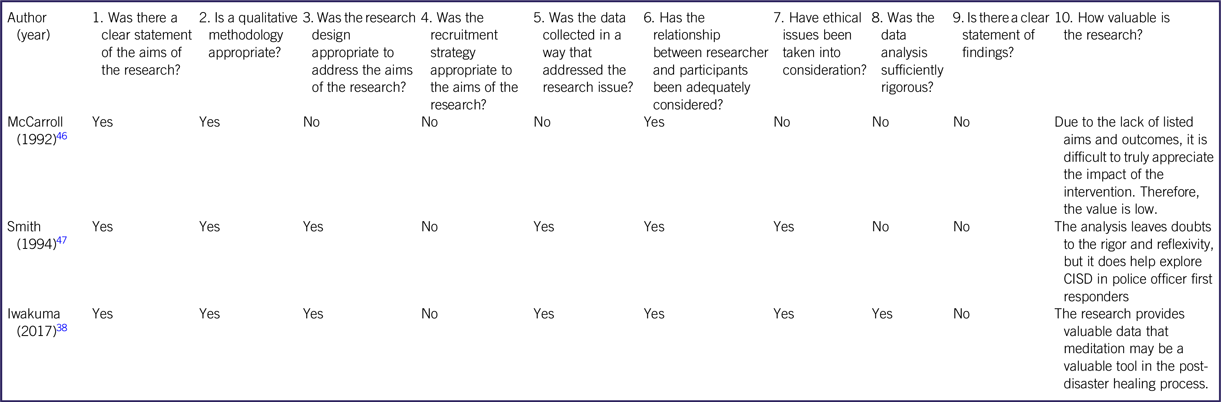
All 3 qualitative studies took place in high-income countries. Two evaluated interventions in first responders to natural disasters, and the remaining study evaluated an intervention after a plane crash. A summary of the qualitative studies included is shown in Table 2. Based on the CASP checklist, quality varied from low to high quality. The number of CASP criteria completed were 3, 6, and 8. See Table 3.
Qualitative Studies

Critical Appraisal Skills Program (CASP) Checklist

Quantitative Studies
A total of 18 studies objectively assessed the effectiveness of psychological interventions administered post-event to first responders. Specific interventions varied and included Critical Incident Stress Debriefing (CISD) (4 studies), mindful meditation (2 studies), Cognitive Behavioral Therapy (CBT) (1 study), and other forms of psychotherapy or debriefing (11 studies). Thirteen studies found clinical improvements across a variety of outcomes, including PTSD scales, anxiety scales, and depression scales.
Two RCTs Reference Hagh-shenas, Goodarzi, Dehbozorgi and Farashbandi30,Reference Essar, Palgi, Saar and Ben-ezra34 assessed the effectiveness of psychological interventions. Difede et al. evaluated 31 disaster workers who were exposed to the World Trade Center attack; 16 disaster workers received CBT, and 15 received a “debriefing as usual.” They found that, after 12 weeks of therapy, CBT was associated with a significant improvement in validated depression and PTSD scale scores compared with the control group. Reference Hagh-shenas, Goodarzi, Dehbozorgi and Farashbandi30 Wu et al. performed a 3-arm RCT comparing a novel debriefing mechanism “512 PIM” (modified CISD with an increased focus on cohesion) to debriefing and to no intervention (control group) in 1267 rescue personnel who provided care in the 2008 Wenchuan earthquake. This study found significant improvements in validated anxiety, PTSD, and depression scale scores in the 512 PIM group up to 4 months post-intervention compared with those who received debriefing or the control group. There was no difference between standard debriefing and the control group, although the authors did not fully explain what “standard debriefing” involved. Reference Essar, Palgi, Saar and Ben-ezra34 No relevant studies addressed the timing of psychological interventions.
Four observational studies evaluating debriefing and 1 evaluating integrative psychotherapy found no impact on psychological symptoms or diagnosis. 21,Reference Lundin and Bodegård22,Reference Karakshian24,Reference Armstrong, Zatzick and Metzler26,Reference Palgi, Ben-ezra and Possick37 All 5 studies involved military rescue workers in upper middle- or high-income countries. A single study by Carlier et al. demonstrated harm from debriefing; this study evaluated 105 police officers responding to a plane crash of whom 46 received CISD, and 59 received no debriefing. The study found no significant difference in a PTSD diagnosis or symptoms between debriefed and non-debriefed subjects up to18 months post-event aside from increased risk of hyperarousal symptoms in the debriefed cohort (P < 0.05). Reference Armstrong, Zatzick and Metzler26
Two studies did not assess an intervention explicitly but described characteristics of individuals more likely to use psychological interventions. Both studies found females to be significantly more likely to attend debriefing sessions. Additionally, they found that a higher level of education, higher exposure, and prior disaster experience were associated with the increased likelihood of attending debriefings. Reference Karakshian24,Reference Iwakuma, Oshita, Yamamoto and Urushibara-Miyachi39 All studies requesting feedback reported high levels of satisfaction (minimum 80%). PTSD symptoms were associated with very low levels of satisfaction in 2 studies. Reference Kenardy, Webster and Lewin25,Reference Iwakuma, Oshita, Yamamoto and Urushibara-Miyachi39 A single study evaluated group versus individual debriefing sessions and found no difference in satisfaction between group and individual sessions. Reference Lundin and Bodegård22
Three studies evaluated pre-event interventions: Interventions performed to reduce risks of adverse mental health outcomes after responding to a disaster. Two observational cohorts evaluated disaster response workers (professionally trained vs lay people) to 2 distinct earthquakes. One cohort was followed for 90 days and the other for 9 months. Both found that laypeople had significantly higher rates of unpleasant feelings and PTSD symptoms during these time frames. Reference Fullerton, Ursano and Vance17,21 The third study evaluated pretraumatic vaccination (PTV) in 25 Israeli Defense Forces rescue personnel, which involved predeployment intervention consisting of exposure, reaction, and coping. Subsequently, 25 individuals responded to a pipe explosion in Tel Aviv, and only 13 had received PTV. Within 48 hours of the event, PTV was shown to reduce the psychological impact of the disaster via several validated scales. Reference Nishi, Koido and Nakaya36
A single RCT by Nishi et al. evaluated a pharmacologic intervention, fish oil supplementation, for attenuating posttraumatic stress symptoms. Reference Wu, Zhu and Zhang35 This study assigned rescue workers responding to the Great East Japan earthquake to a group who received fish oil supplementation, as well as psychoeducation versus a group that received psychoeducation alone. This trial found no difference between the 2 groups out of 12 weeks. Reference Wu, Zhu and Zhang35
Only 6 studies, varying from “Very Low” to “High” quality, performed in LMICs met criteria for inclusion. One controlled cohort demonstrated no effect of debriefing on first responders to the 1988 Armenian earthquake. 21 Each of the remaining 5, including 4 cohorts and 1 found RCT, found debriefing to be useful for preventing or alleviating mental health symptoms in first responders to crises in the LMIC setting. Reference Deahl, Gillham and Thomas23,Reference Wee, Mills and Koehler29,Reference Essar, Palgi, Saar and Ben-ezra34,Reference Nishi, Koido and Nakaya36,Reference Haugen, Werth, Foster and Owen40
Qualitative Studies
Three qualitative study met criteria for inclusion. Iwakuma et al. offered a breath-based meditation session and evaluated a written interview post-intervention. Reference Haugen, Goldman and Owen38 The authors found the following themes: emancipation from chronic and bodily senses, holistic/transcending sensation, reflection, and self-control – and therefore concluded that meditation is a viable option for temporary relief from disaster-related mental health symptoms. McCarrol et al. evaluated the experiences of a military psychiatric consultation team that was deployed to provide care for responders after a major plane crash. Reference Te Brake, Dückers and De Vries45 This study noted that, with time, “return to normalcy was evident” and also found that individuals labeled heroes for their work, “acknowledged the pleasure of their recognition, as well as the cost.” Reference Te Brake, Dückers and De Vries45 Smith et al. evaluated interviews of 10 police officers who provided disaster relief in the aftermath of Hurricane Hugo and focused on their disaster experiences and perceived utility of CISD. Reference McCarroll, Ursano, Fullerton and Wright46 In this study, participants described consistent reactions of empathy, helplessness, anger, guilt, sleep disturbance, worsening symptoms of medical conditions, gastrointestinal disturbances, and flashbacks. They noted that CISD provided symptom relief from flashbacks. Reference McCarroll, Ursano, Fullerton and Wright46
DISCUSSION
While heterogeneity of studies limited our ability to perform formal meta-analyses, this review demonstrated that both prevention and treatment of psychiatric symptoms in first responders are possible and effective in high-income countries and LMICs.
The majority of studies focused on treatment rather than prevention. These studies varied from high quality to very low quality (GRADE criteria), and the interventions themselves ranged from CISD to meditation to multiple stressor debriefing. Yet, the studies generally demonstrated that psychological interventions were cathartic, generally well received, and effective in reducing symptoms of anxiety, hyperarousal, and depression post-disaster. However, the actual timing of delivery of psychological intervention in first responders has not been studied, and thus the optimal window for intervention remains unclear.
Given that psychological interventions likely positively impact the mental health outcomes in first responders post-disaster, it is important to consider identification of at-risk individuals to improve utilization rates of therapy. A large US military cohort study found that questionnaires combined with protocolized screening and referral effectively referred symptomatic individuals for psychological intervention who ultimately reported improvement in PTSD and anxiety symptoms from baseline. Reference Difede, Malta and Best31 Unfortunately, pre-intervention rates were not reported. In terms of recognition, training sessions have been shown to increase identification of recognition of PTSD in first responders. Reference Smith and De Chesnay47
Interestingly, a 3-armed RCT found that locally modified CISD with increased cohesion training, named “512 PIM,” significantly improved anxiety and depression symptoms, yet, debriefing (which did include CISD) was no different than no intervention at all. This study highlights that adapting a general framework (CISD) to local cultural norms is more effective than standard debriefing. The lack of difference amongst the general debriefing and no intervention groups underscores the importance for interventions to be considered in the local sociocultural context. Reference Essar, Palgi, Saar and Ben-ezra34 Additionally, this was the only study to focus on cohesion training, which emphasizes the importance of personal relationships, which have been shown to have a protective effect against psychiatric symptoms in military units. Reference Te Brake, Dückers and De Vries45
Prevention was evaluated in 3 studies. Reference Carlier, Lamberts, Van Uchelen and Gersons27,Reference Wee, Mills and Koehler29,Reference Waelde, Uddo and Marquett33 It was effective to varying degrees in all 3, most notably in the Essar et al. publication evaluating PTV. Reference Waelde, Uddo and Marquett33 These articles underscore the important nature of preventive interventions coupled with reactionary treatments. This review highlights the need for future work in the area of symptom prevention and pre-event interventions.
Pharmacotherapy is considered an important option in the treatment of disaster victims Reference Hansen5 ; yet, only 1 pharmacologic study in the first responder population was found. Reference Wu, Zhu and Zhang35 While some extrapolation from non-first responder populations may exist, there is a paucity of literature in both populations and a need for future studies to be performed regarding pharmacologic adjuncts to prevention and treatment of adverse mental health outcomes.
Finally, amongst our 25 included studies evaluating psychological interventions, 20 different symptomatology scales were used. There is a strong need for a development of standards to help guide future research.
Limitations
Based on the language skills of this study’s authors, this systematic review was limited to articles published in English, Spanish, and French; studies published in other languages addressing this topic have therefore not been included. Additionally, LMICs were underrepresented, and no studies from South America or Africa met criteria for inclusion. This may limit the generalizability of this study’s results to regions of the world that face different sets of challenges in implementing mental health interventions for disaster responders. Many of the lower quality studies have small sample sizes, lack formal control groups, and are subject to significant biases, such as observer and selection bias, simply based on study design; however, the high quality RCTs do lend credence to the overall positive findings in this review. Additionally, this study included all types of first responders, from laypeople to soldiers, and thus our findings may be challenging to generalize to any 1 specific group. Last, heterogeneity of study design, interventions, and outcomes limited the possibility of formal meta-analysis.
CONCLUSIONS
The current evidence is largely heterogeneous and low quality; yet, both pre- and post-crisis psychological interventions appear effective in reducing the mental health burden on responders working in complex humanitarian crises. There is a need for future behavioral studies, pharmacotherapy studies, studies conducted in LMICs, and consensus guidelines meant to standardize instruments used amongst investigators.