INTRODUCTION
Fusitriton magellanicus (Röding, 1798) is a conspicuous species of Ranellidae distributed along the east coast of South America from Rio Grande do Sul (Brazil) to Tierra del Fuego and the Malvinas (Falkland) Islands (Argentina) and was also cited from South Georgia and Marion Island by Carcelles (Reference Carcelles1954). On the west coast of South America it is distributed from Valparaíso (Chile) to the Straits of Magellan, south to Navarino Island (Smith, Reference Smith1970). This species is scarcely studied; the known information comprises taxonomy (Smith, Reference Smith1970; Cernohorsky, Reference Cernohorsky1977), faunistic records (i.e. Bremec & Lasta, Reference Bremec and Lasta2002; Bremec et al., Reference Bremec, Marecos, Schejter and Lasta2003) and its feeding habits, which suggest the species acts as a mesopredator in Zygochlamys patagonica (King & Broderip, 1832) fishing grounds (Botto et al., Reference Botto, Bremec, Marecos, Schejter, Lasta and Iribarne2006).
One of the most obvious characteristics of this species (shared with other members of the Ranellidae and Trichotrophidae) is a thick, hairy periostracum. The periostracum in molluscs is an outer, organic, non-calcified layer of the shell, which acts as a resistant, protective layer and also provides the initial substrate for calcium carbonate deposition (Watanabe, Reference Watanabe, Trueman and Clarke1988). Bottjer & Carter (Reference Bottjer and Carter1980) proposed a classification of bivalve periostracum types into four categories, depending on the complexity and structure. It is also possible to apply this classification to gastropods (Watanabe, Reference Watanabe, Trueman and Clarke1988), and under it F. magellanicus has a type 4 periostracum, with projecting structures exhibiting regularly formed, non-calcified shingles, hairs, thorns, and hairlets. Protection of the shell from corrosion by acidic water, provision of an initial substratum for mineral deposition of the shell edge, sealing of the extra-pallial space, isolation from the external environment, and protection from infestation by epibionts and boring organisms are the main functions of the periostracum (Bottjer & Carter, Reference Bottjer and Carter1980; Bottjer, Reference Bottjer1981; Watanabe, Reference Watanabe, Trueman and Clarke1988; Ananda Kumar & Ayyakkannu, Reference Ananda Kumar and Ayyakkannu1991; Iyengar et al., Reference Iyengar, Sitvarin and Cataldo2008).
Fusitriton magellanicus is collected frequently in the by-catch on Zygochlamys patagonica commercial fishing grounds in the Argentine Sea (Bremec & Lasta, Reference Bremec and Lasta2002; Bremec et al., Reference Bremec, Marecos, Schejter and Lasta2003). These fishing grounds are located in the shelf-break frontal area, one of the most productive ecosystems in the south-west Atlantic Ocean (Acha et al., Reference Acha, Mianzan, Guerrero, Favero and Bava2004). Preliminary results showed that F. magellanicus is the second most important living substrate colonized by encrusting organisms in this community (Schejter & Bremec, Reference Schejter and Bremec2009), a fact that highlighted its importance in the maintenance of the species richness in the exploited bottoms influenced by the shelf-break front in Argentine waters. In this paper we provide an updated inventory of the main sessile group of epibionts on F. magellanicus, not only on living specimens but also on empty and pagurized shells collected in Z. patagonica fishing grounds. Additionally, considering that the presence of the thick hairy periostracum could be an inhibitor of boring and encrusting species, as demonstrated for the related species Fusitriton oregonensis (Redfield, 1846) (Bottjer, Reference Bottjer1981) among others, we analyse the presence of periostracum in living F. magellanicus in relation to the presence of epibionts.
MATERIALS AND METHODS
Sampling area and procedure
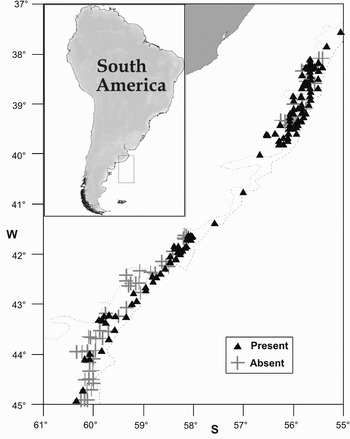
The study material was collected between 37°00.27′–45°01.70′S and 54°40.46′–60°25.62′W, along the 100 m isobath and between 81 and 150 m, as part of the epibenthic assemblage of Zygochlamys patagonica fishing grounds located in the shelf-break frontal area of the Argentine Sea. Benthic samples were frozen on board and later analysed in the laboratory at the Instituto Nacional de Investigación y Desarrollo Pesquero (INIDEP). In total, 194 benthic samples were collected using bottom otter trawls and dredges during monitoring cruises onboard the RV ‘Capitán Cánepa’ (October 2007, Northern Management Unit) and the fishing vessels ‘Miss Tide’ (July 2008) and ‘Atlantic Surf III’ (November 2008) (Southern Management Unit, both cruises) (Figure 1). Living specimens, empty shells and pagurized shells of Fusitriton magellanicus were separated from total benthic samples and carefully studied under a binocular microscope for the detection of epibionts.
Sampled sites for Fusitriton magellanicus in the shelf-break frontal area of the Argentine Sea. The square shows the location of the study area in South America.

Encrusting organisms
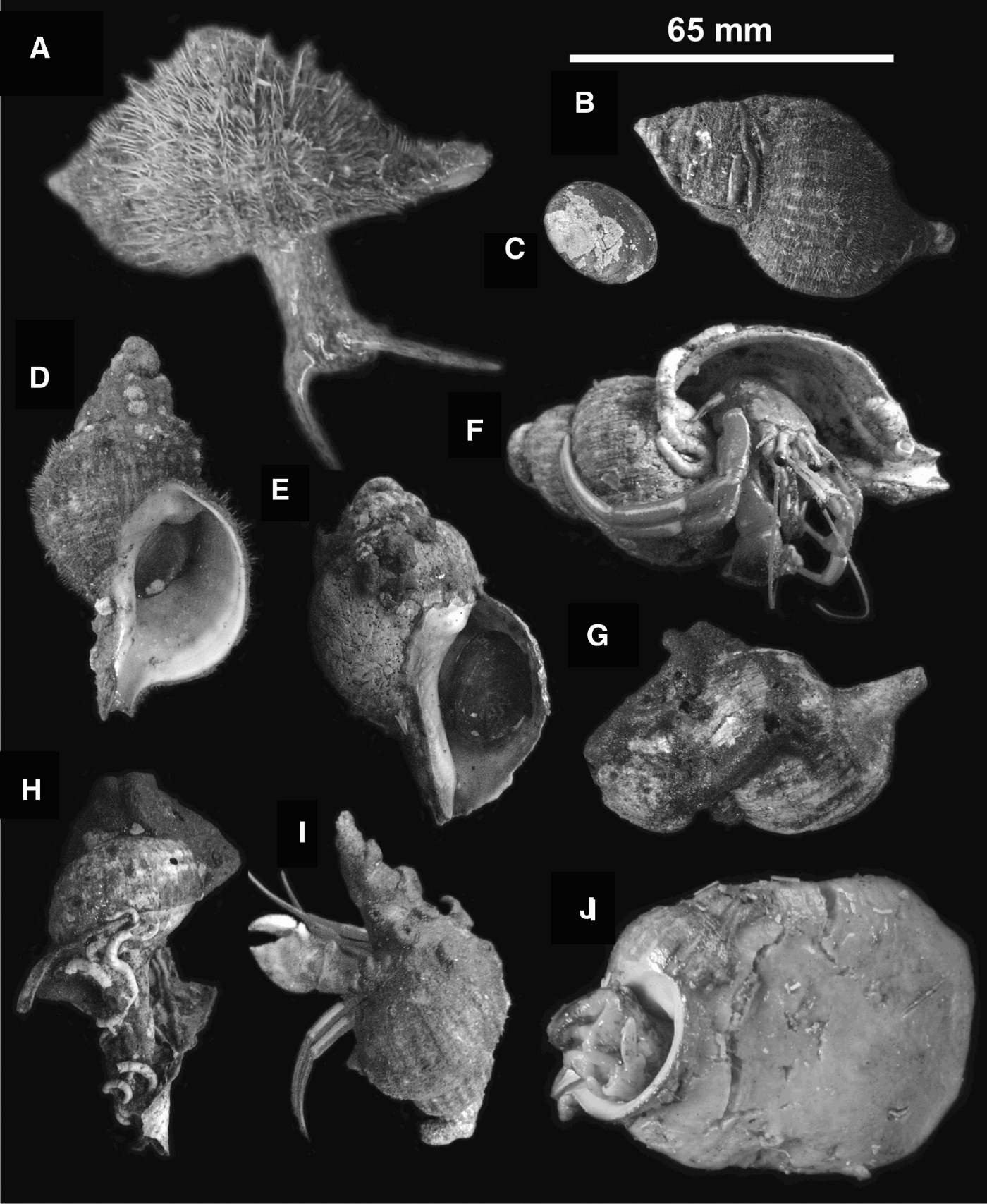
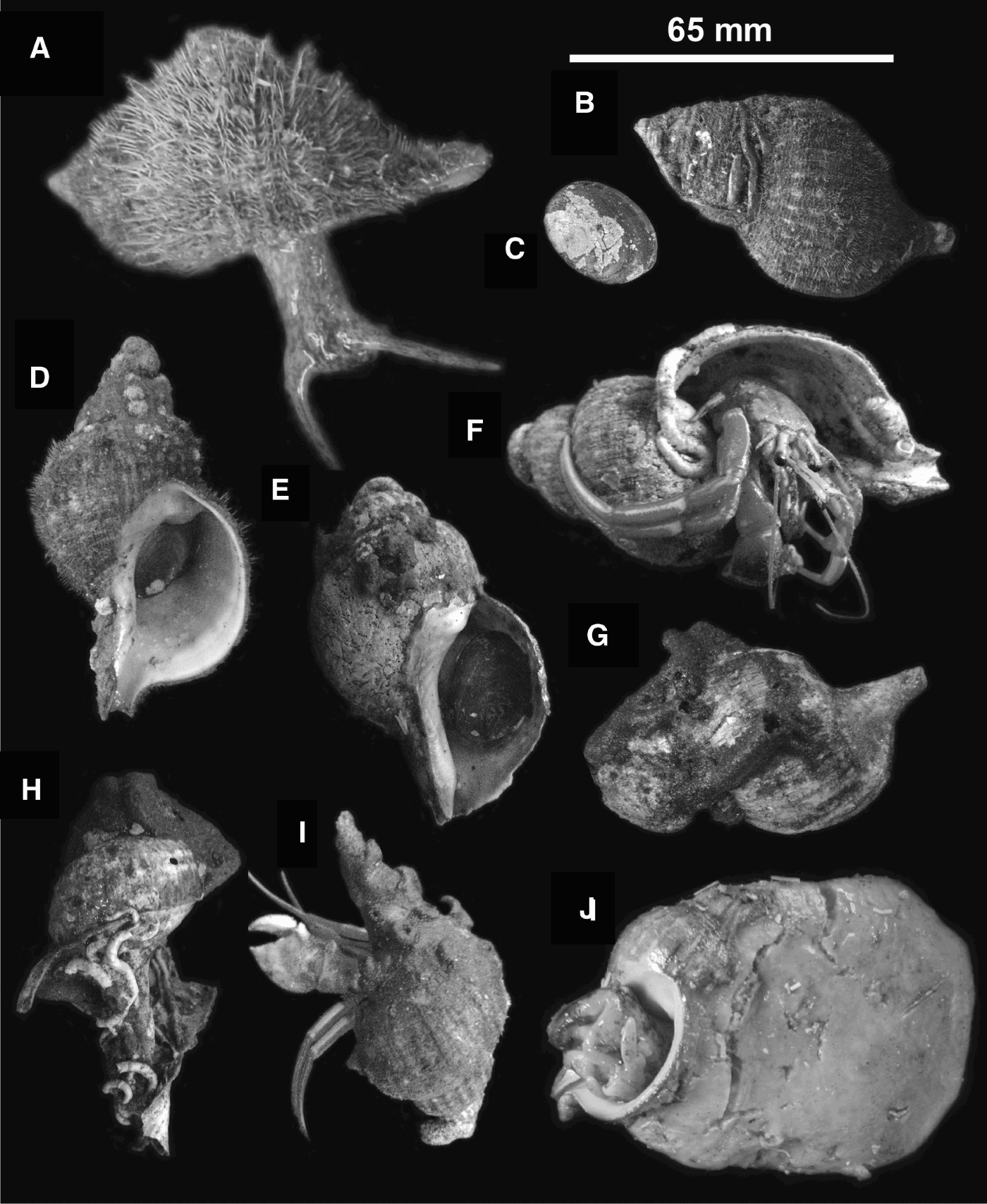
Epibiontic organisms were recorded for three categories of F. magellanicus shells: living, empty and pagurized. The presence of epibionts on the operculum of living individuals was also recorded (Figure 2C). Total shell height (size) was measured using Vernier calipers. The epibiosis level was recorded using the following relative scale: 0, without epibionts (i.e. Figure 2A); 1, weakly or moderately fouled (i.e. Figure 2B, D–G & I); and 2, heavily fouled (i.e. Figure 2H & J). We considered that a shell was heavily fouled when more than 50% of it was covered by encrusting organisms (one or many species). Differences found when comparing the degree of epibiosis with the size of the shell were evaluated using the Kruskal–Wallis test; Dunn's pairwise comparison test was used when differences were detected (significant = P ≤ 0.05) (Zar, Reference Zar1996).
Fusitriton magellanicus. (A) Living animal presenting a complete and hairy periostracum coating and no encrusting organisms; (B) living animal with a complete periostracum coating and Potamilla antarctica polychaete tubes in the suture area; (C) operculum encrusted by bryozoans; (D) living animal presenting a medium periostracum coating, spire completely encrusted by bryozoans (moderately fouled); (E) living naked animal with a bored shell and also encrusted by a sponge (low fouling level); (F) pagurized shell occupied by Sympagurus dimorphus, with no periostracum and with serpulid polychaetes encrusting the aperture of the shell; (G) living animal with a scarce periostracum coating and moderately fouled by Idanthyrsus armatus tubes and a sponge in the spire; (H) empty shell heavily encrusted with Idanthyrsus armatus and serpulid tubes; (I) pagurized shell inhabited by Sympagurus dimorphus and encrusted by Alcyonium sp. (apex) and Epizoanthus paguricola; (J) living animal with no periostracum, heavily fouled by the sponge Tedania sp.
Periostracum condition
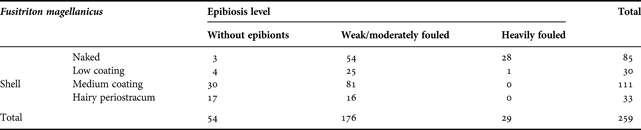
In a subsample of 259 living individuals, periostracum condition was also examined using the following relative scale: A, hairy periostracum coating the whole organism (i.e. Figure 2A, B); B, medium coating of the organism (in most specimens the spire lacks periostracum (Figure 2D); C, low coating (Figure 2G); and D, total loss of periostracum (naked shells) (i.e. Figure 2E & J). Differences found when comparing the periostracum condition with the size of the gastropod shell were evaluated using the Kruskal–Wallis test, combined with a Dunn's pairwise comparison test when differences were detected (P ≤ 0.05) (Zar, Reference Zar1996).
Relation between presence of the periostracum and encrusting organisms
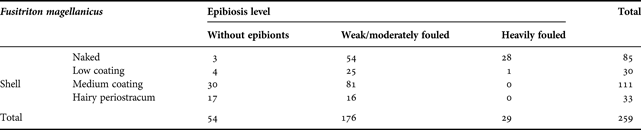
In the same subsample of 259 living individuals, we computed the number of Fusitriton shells presenting the different levels of epibionts mentioned in the previous section. This was also then compared with the presence of a periostracum, determined using the above-mentioned relative scale.
RESULTS
From the 194 sampled sites, 123 sites were positive for the presence of Fusitriton magellanicus (Figure 1). In the majority of sites, living F. magellanicus of all sizes were recorded, but in 15 sites only empty shells were collected. In total, 556 shells were studied (443 living Fusitriton magellanicus, 86 empty shells and 27 pagurized shells). Pagurized shells were found occupied by Sympagurus dimorphus (Studer, 1882) (92%, Figure 2F & I), Propagurus gaudichaudi (H. Milne-Edwards, 1836) (4%) and Pagurus comptus White, 1847 (4%). These hermit crab species are frequently collected in the study area (Bremec et al., Reference Bremec, Marecos, Schejter and Lasta2003).
Encrusting organisms
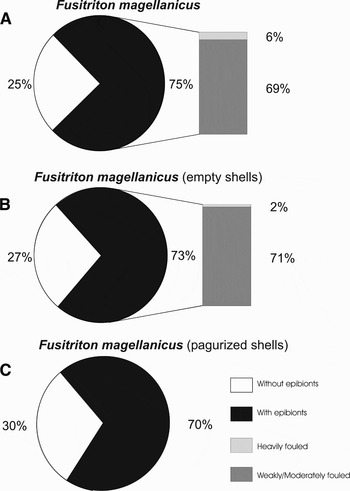
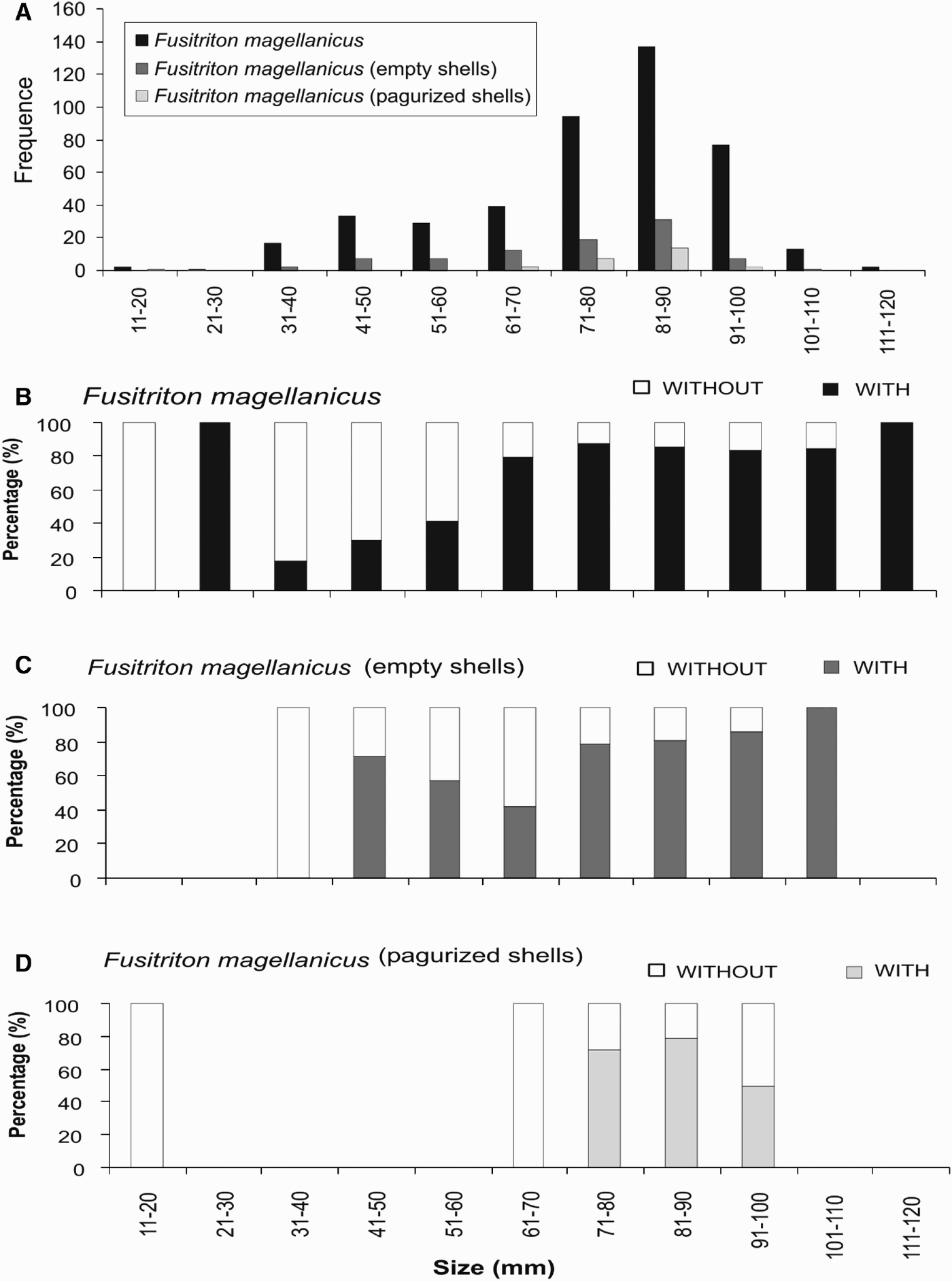
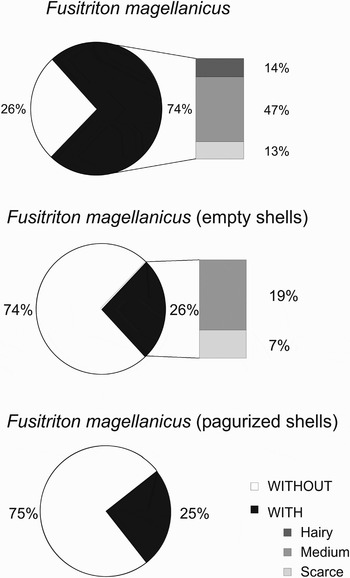
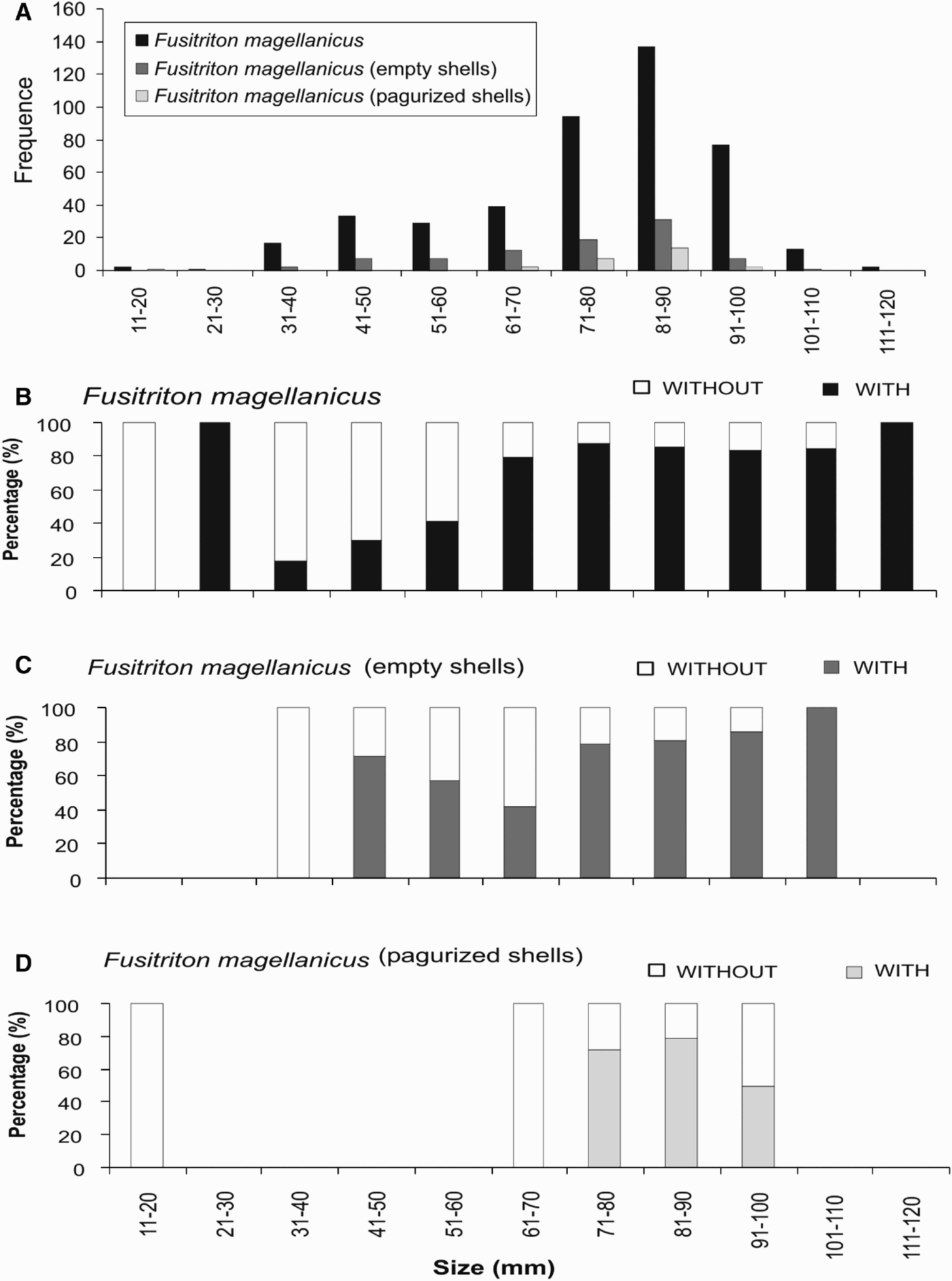
More than 70% of all the studied shells bore encrusting organisms. Only a small proportion of shells were heavily fouled, the majority of living specimens, empty shells and pagurized shells being weakly or moderately fouled (Figure 3). The proportion of fouled shells varied with size and type of shell (Figure 4). The size distribution of studied shells ranged from 17 to 116 mm total shell height (Figure 4A). More than 75% of the living individuals taller than 60 mm and more than 60% of the empty shells taller than 40 mm, carried epibionts (Figure 4B, C). Pagurized shells taller than 70 mm carried epibionts in more than 50% of samples (Figure 4D).
Epibiosis level of the three types of Fusitriton magellanicus shells. Pagurized shells presented only weak or moderate level of epibiosis.

(A) Shell size distribution (ranges) for the three types of Fusitriton magellanicus studied shells; (B) percentage of living F. magellanicus with/without epibionts by size-range; (C) percentage of empty shells of F. magellanicus with/without epibionts by size-range; (D) percentage of pagurized shells of F. magellanicus with/without epibionts by size-range.
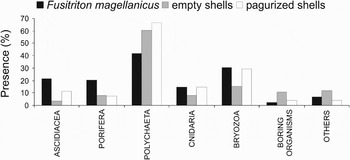
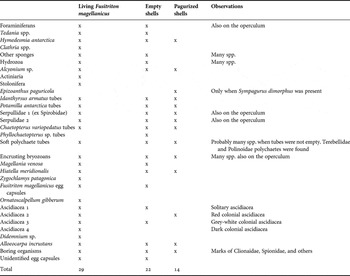
At least 30 taxa encrust living and dead shells of Fusitriton magellanicus (Table 1). The presence of boring organisms was also detected; holes of boring sponges (Clionaidae), spionid polychaetes and other marks of unidentified borers were found in the three types of shells (Figure 2E). All shell types presented the same groups of encrusting organisms, but in different occurrence frequencies (Figure 5). Polychaetes were more frequent on pagurized shells than on empty shells or on living organisms, but sponges and ascidians were more common on living shells than on the other types, although not as frequent as polychaetes. Even so, sponges and ascidians were responsible for the majority of the heavily fouled living shells found.
Presence (in %) of the main epizoic groups on the three types of Fusitriton magellanicus shells.

Epizoic organisms found encrusting Fusitriton magellanicus shells.

In general, the spire was encrusted more frequently by epibionts than the last whorl of the shell (i.e. Figure 2B & D); bryozoans coated the protoconch and the upper surface of the spire of most specimens, and small and medium-sized punctiform colonies were distributed on the spire, on the parietal wall of the aperture and on the siphonal area of many specimens (Figure 2D). The suture area of most specimens was encrusted with tubes of the polychaete Potamilla antarctica (Figure 2B) and soft sand tubes of Polynoidae, Terebellidae and other unidentified polychaete tubes. Encrustation by more than one species of serpulid in the aperture of the shell and, in many specimens, also inside the shell was recorded in 50% of the pagurized shells (Figure 2F). This special encrusting pattern was only present in pagurized shells. The epizoic zoanthidean colony of Epizoanthus paguricola (Roule, 1900) was found only on pagurized shells inhabited by Sympagurus dimorphus (Figure 2I). Pagurized shells were never found to be heavily fouled. In 85.7% of the analysed samples, living heavily fouled individuals bore a large monospecific colony, such as a sponge (in more than 50% of the shells) (i.e. Figure 2J). The presence of sponges of the genus Tedania overgrowing the shell of living F. magellanicus was noticeable, some sponges being two or three times larger than the gastropod in volume (Figure 2J). Ascidian colonies also fouled 21.4% of the shells heavily, although small encrusters were also found coexisting on the same shell. Nematodes and the small bivalve Hiatella meridionalis (d'Orbigny, 1846) were associated with many of the mentioned colonies. Hiatella meridionalis was also found in crevices between the shell and polychaete tubes (serpulids and Idanthyrsus armatus Kinberg, 1867).
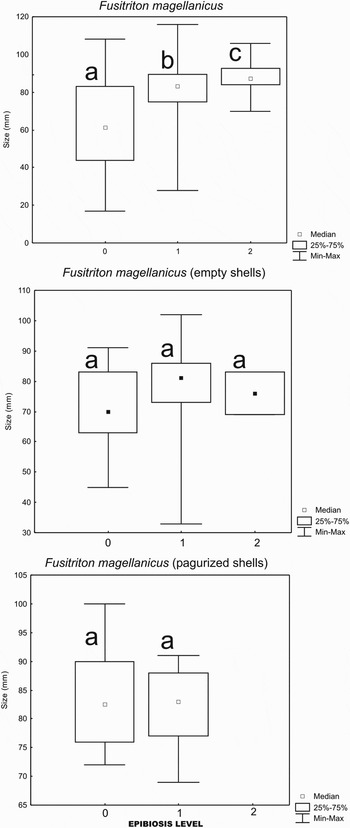
No relationship between shell size and epibiont level was detected for empty shells (H′(2,86) = 3.86; P = 0.145) or pagurized shells (H′(1,25) = 0.009; P = 0.924). However, differences were found between living individuals (H′(2,443) = 54.02; P < 0.001). Post hoc analysis (Dunn test) revealed that sizes of individuals without epibionts (epibiont level 0) differed from those with epibionts (levels 1 and 2), and individuals weakly or moderately fouled (1) and heavily fouled (2) also differed between each other in size (Figure 6).
Relation between shell size and epibiosis level for the three types of studied shells. Different letters (a, b, c) indicate significant differences (P < 0.05).

Periostracum
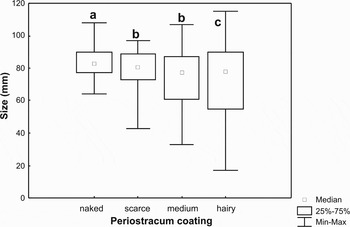
A periostracum was present on 74% of the living Fusitriton magellanicus shells, but only in 26% of the empty shells. On pagurized shells, a scarce coating was present in 25% of specimens (Figure 7). The majority of living specimens was only partially coated by periostracum, the spire being the principal area where the periostracum was lacking, even if epibionts were absent from the mentioned shell region. The remains of a periostracum were detected also in some empty shells. However, in living gastropods, only 14% bore a complete hairy periostracum. We also found differences in the periostracum coating compared with the size of the animal (H′(3,259) = 14.36; P = 0.0024; Figure 8). Post hoc analysis (Dunn test) revealed that gastropods without a periostracum were larger and significantly different from all the other animals with a different periostracal coating. Individuals with a scarce or moderate periostracal coating did not differ significantly in size, but both differed from those with a complete hairy coating (P < 0.05).
Presence of periostracum in the three types of shells, considering also the coating level. Pagurized shells only presented a scarce periostracum, if detected.

Relation between shell size and periostracum coating level. Different letters (a, b, c) indicate significant differences (P < 0.05).

Relationship between periostracum and epibionts
In Table 2 the number of living Fusitriton magellanicus that presented each condition of periostracum and level of epibionts are shown. Heavily fouled individuals lacked a periostracum (except for one gastropod that remained without encrusting animals and had a scarce periostracum evident on a small area of the shell).The majority of the sampled specimens presented a moderate level of encrustation and simultaneously a low or moderate coating of periostracum. Hairy gastropods, i.e. with a complete periostracum, bore few or no epibionts.
Number of living Fusitriton magellanicus presenting the different levels of periostracum and epibiosis, simultaneously.
DISCUSSION
More than 70% of the Fusitriton shells studied bore encrusting organisms, and empty and pagurized shells were also used as settlement substrates by a variety of sessile taxa. The extent of encrustation was related to size only in living specimens. This is not surprising, as the colonization process of a solid surface (fouling), a gastropod shell in this case, is at least intimately related to the length of time of exposure to colonizers (Wahl, Reference Wahl1989). We expected that larger (older) organisms would be more heavily encrusted than smaller (younger) ones if no mechanisms for deterrence were acting. The spire of the shell, the older part, frequently was encrusted and the protoconch of many specimens was inconspicuous under a coating of epibionts.
Polychaetes were the most frequent group on living F. magellanicus, present in more than 60% of the samples on empty and pagurized shells. Particularly in pagurized shells, the encrustation pattern of serpulid tubes around and inside the aperture was typical of shells inhabited by hermit crabs that have similar polychaete tubes attached to their chelipeds. Polychaete tubes attached to living and empty shells also promote the settlement of other organisms, such as the small byssally attached bivalve Hiatella meridionalis (d'Orbigny, 1846). Moreover, the tubes also act as sediment traps and create refuges for small organisms such as isopods, amphipods and nematodes. These interactions help to increase the benthic species richness as previously mentioned for Zygochlamys patagonica the dominant species in the shelf-break frontal area (Schejter & Bremec, Reference Schejter and Bremec2007). Bryozoans were the second most important group in % presence. Although species were not identified during this study because of their high taxonomic complexity, species present are likely to be among the 22 bryozoans identified by Lopez Gappa & Landoni (Reference López Gappa and Landoni2009) attached to Patagonian scallops in the same area.
To evaluate whether the epibionts on living individuals of F. magellanicus are beneficial or detrimental for the gastropod was not the objective of this study. However, except for the boring organisms, possibly the majority of the epibionts recorded do not cause any damage or detriment. Moreover, sponges are known to be beneficial for many molluscs and other invertebrates (see Wulff, Reference Wulff2006 for a review), providing camouflage and protection against predators and borers, although the majority of the studies were performed on the relationship between sponges and scallops (i.e. Bloom, Reference Bloom1975; Forester, Reference Forester1979; Chernoff, Reference Chernoff1987; Ward & Thorpe, Reference Ward and Thorpe1991; Burns & Bingham, Reference Burns and Bingham2002) and between sponges and other bivalves (i.e. Corriero & Pronzato, Reference Corriero and Pronzato1987; Corriero et al., Reference Corriero, Pronzato, Sarà, Reitner and Keupp1991; Marín & López Belluga, Reference Marín and López Belluga2005). The relationship between sponges and gastropod shells has been studied mainly in boring species (i.e. Smyth, Reference Smyth1990; Stefaniak et al., Reference Stefaniak, McAtee and Shulman2005), which are detrimental for molluscs, causing an increase in the vulnerability of the shell to predation by crushers (i.e. crabs and fish). Borers also provoke a potential decrease in growth and fecundity due to the diversion of energy by the gastropod to create supplemental internal layers in the shell. The other studied relationship between molluscs and other groups is a commensalism between siliquariids (irregular ‘worm snails’) and sponges (Hartman & Hubbard, Reference Hartman and Hubbard1999; Pansini et al., Reference Pansini, Cattaneo-Vietti and Shiaparelli1999). Some literature also refers to sponges living epizoically on shells inhabited by hermit crabs (referred to as ‘mobile sponges’ by van Soest, Reference van Soest1993) and studies about this complex relationship (Sandford, Reference Sandford1995, Reference Sandford2001; Sandford & Brown, Reference Sandford and Brown1997). Gastropods presumably benefit from the sponge association by acquiring camouflage and by being protected against borers and predators. The same benefits could be proposed when the gastropod is associated with colonial ascidians that also moderately or heavily fouled the shells. Sponges and ascidians gain, at least, a hard substrate, motility, protection and nutrition (Wahl, Reference Wahl1989; Wulff, Reference Wulff2006). In this work we found sponges attached to living, empty and pagurized shells of the studied gastropod. Hymedesmia antarctica Hentschel, 1914 and Tedania spp. were the main species recorded, fouling some shells heavily. Although Mycale doellojuradoi Burton, 1940 was previously recorded on F. magellanicus in the study area (Schejter et al., Reference Schejter, Calcinai, Cerrano, Bertolino, Pansini, Giberto and Bremec2006; Schejter & Bremec, Reference Schejter and Bremec2009), it was not present in the studied samples, perhaps due to its rarity or, more likely, due to detachment during manipulation and sorting of the total benthos.
Host texture preference is one important factor affecting associations between species. Clark (Reference Clark1971) found a marked preference for living Trichotropis cancellata Hinds, 1843 (a gastropod characterized by a spiny periostracum, similar to those shown by Fusitriton magellanicus in the present study) by Odostomia columbiana Dall & Bartsch, 1907, when an alternative aspinous taxon was provided, although surface characteristics alone could not explain this choice by themselves. On the other hand, Bottjer (Reference Bottjer1981) mentioned that the hairy, irregular surface of the periostracum of Fusitriton oregonensis may inhibit settling of many kinds of borers and epibionts by itself, or by trapping sediment grains, which constitute a layer not useful for larvae settlement. Alternatively, another function of the hairy periostracum could be camouflage and hence, it could have a function related to avoiding predators. According to several published papers (Scanland, Reference Scanland1979; Bottjer & Carter, Reference Bottjer and Carter1980; Bottjer, Reference Bottjer1981; Ananda Kumar & Ayyakkannu, Reference Ananda Kumar and Ayyakkannu1991; Iyengar et al., Reference Iyengar, Sitvarin and Cataldo2008), periostracal and adventitious hirsute structures discourage infestation by boring organisms and the extensive encrustation of some bivalves and gastropods. Our results for F. magellanicus agree with these statements, since shells of living F. magellanicus presented no epibionts or a low encrustation when a hairy or medium periostracal coating was present. Sediment trapped by the irregular surface of the periostracum could also contribute to preventing encrustation. Individuals with naked shells and with a low periostracal coating presented higher levels of epibiont encrustation. Boring organisms were found in a higher percentage of empty or pagurized shells (with low or no periostracal coating) than in living individuals.
Differences in epibiont composition in the different shell types of F. magellanicus could be due to the presence of a more or less developed periostracum in living specimens, as the periostracum would prevent boring and other encrusting organisms from attacking the shell. Only living specimens were fouled heavily with organisms other than polychaete tubes. A preference for the living gastropod by the epibiont species is evident, as the number of species recorded is higher than on empty or pagurized shells, although the numbers of sampled shells in the first case is greater than for the other types. However, it is possible that some of the epibiont species recorded on empty shells do not persist in time, and their presence resulted from the sampling of recently dead gastropods hosting living epibionts. As an example, some pagurized shells inhabited by Sympagurus dimorphus were found encrusted by the zoanthid Epizoanthus paguricola, which is only found in this area associated exclusively with this hermit crab species (Schejter & Mantelatto, Reference Schejter and Mantelatto2010), although rarely found encrusting small gastropod shells inhabited by Pagurus comptus White, 1847 (personal observation).
While in some soft-bottom areas seagrasses and algae are available substrates for epibionts to attach to, at Zygochlamys patagonica fishing grounds in the Argentine Sea the only alternative for larvae of sessile invertebrates is to settle on other mobile invertebrates such as crabs, bivalves, gastropods and the spines of sea urchins (Bremec et al., Reference Bremec, Marecos, Schejter and Lasta2003; Schejter & Bremec, Reference Schejter and Bremec2007, Reference Schejter and Bremec2009). Due to its high biomass, the Patagonian scallop represents the most important settlement substrate for sessile species (Schejter & Bremec, Reference Schejter and Bremec2007). Fusitriton magellanicus seems to represent the second invertebrate species in importance for the provision of a hard settlement substrate. Thirty taxa were found encrusting the shells of F. magellanicus in this study. Even so, this number underestimates the real diversity of encrusting species because we considered Bryozoa and Porifera as single taxa (except for two very conspicuous sponge species). Undoubtedly, sponges and bryozoans constitute complex taxonomic groups, consisting of many species that each have to be studied more carefully in the future to estimate better the species diversity of epibionts on this gastropod.
ACKNOWLEDGEMENTS
We would very much like to thank our technicians and colleagues (Valeria, Mónica, Ángel, Matías and Rony) at INIDEP who helped us during general sampling procedures, and Guilla, Gaby and Nancy (INIDEP librarians) for their help with literature acquisition. We would also like to thank F. Sandford, A. Beu and other authors cited in references that kindly sent us their papers and other related articles dealing with the subject of this study. We are very grateful to Alan Beu for the language revision and correction. This is INIDEP Contribution no. 1598. This study was partially supported by INIDEP, PICT -2007-02200, PICT-2008-1119 and PIP 5009.