Introduction
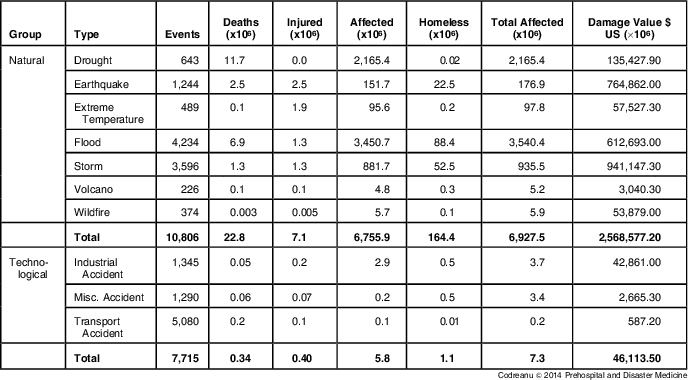
Data collected by the Centre for Research on the Epidemiology of Disasters (CRED, Brussels, Belgium), the Office of US Foreign Disaster Assistance (Washington DC USA), the United Nations, and the CRED's International Disaster Database (EM-DAT, Brussels, Belgium) 1 , 2 show an exponential increase in the number of natural disasters in parallel with the number of people affected by them (Table 1). Industrial accidents (chemical spills, gas leaks, explosions, fire, and water problems) and natural calamities (floods, storms, earthquakes, and epidemics) are responsible for most disaster-related injuries and deaths.
Summary of Selected Disasters and Their Consequences from 1900-2013 (Rounded Values, Adapted from EM-DAT)1

Abbreviation: EM-DAT: Centre for Research on the Epidemiology of Disasters’ International Disaster Database.
The reasons are multi-factorial and include: the population migration to urban areas, substandard expansion of the habitat areas around big cities, new settlements in unsafe areas such as floodplains or low-lying regions, deforestation, expansion of the built environment along shorelines, climate change, and an increase of the vulnerable population segment. Save the Children 3 (Fairfield, Connecticut USA) anticipates that in the current decade, 175 million children per year will be affected by natural disasters directly attributed to climate change. Even if fewer children are killed in these circumstances, the sharp increase in the number of those affected draws a concerning picture for their future.
Affected regions and populations may be severed from essential services (water, electricity, gas, sanitation, and health care) for an undetermined period of time either due to the effects of a disaster itself or as the result of a strategic decision during the response phase. It is envisaged that a significant disaster will delay the restoration of essential services for at least 72 hours, 4 which contradicts the population's expectation that all essential services (including the provision of water and food) function uninterrupted; this is unlikely to be the case during the initial period after a disaster.
Instead, survivors will need to rely upon their own assessment of the (new) environment, as well as on adaptive attitudes by relying on prior knowledge and skills to avoid becoming secondary victims (ie, maintain satisfactory levels of safety and security, address the need for water and food intake, and establish adequate hygiene and sanitation conditions). Equally, they will need to be able to establish communication with other survivors (or separated members of the family) to be able to reunite and to become a role model for younger people in their care.
Past experience suggests that during a mass-casualty event, one-third of the victims will be children. 5 Children are one of the well-known categories of vulnerable population with respect to their capacity to prepare for, or respond to, the effects of a disaster. Not only are their special biological, anatomical, and physiological characteristics working against them in such circumstances, but also their emotional and psychological immaturity. In some countries (eg, the US), this status is recognized at a governmental level, resulting in a greater awareness of their needs,Reference Adirim 6 while in others (eg, Indonesia), disaster education in public schools has not been introduced even after devastating events like the Banda Aceh 2004 tsunami.Reference Sugimoto, Iemura and Shaw 7
During a disaster, children are dependent on others for sustenance and safety. In a rapidly-evolving disaster or a forced fast displacement, children may easily become separated from their families or care givers, which will render them even more vulnerable. Reunification is not straightforward, as their relatives might have been killed or seriously injured. Even in the absence of death, separation can last for more than a year. For example, in the United States, more than 30 children (of the initial 5,000) were still separated from their families one year after Hurricane Katrina.Reference Luthar, Cicchetti and Becker 8
A child separated from older family members will likely become responsible for his/her own safety together with that of the younger children around. In this context, safety is a broad encompassing concept, including procurement of food and safe water, establishing communication, shelter, sanitation, and avoidance of injuries or becoming secondary victims.
The parallel increase of the number of people affected by disasters and the number of disasters, per se, have prompted a new approach to the preparation for, mitigation of, and response to disasters. In the last two decades, numerous national and international organizations have determined that the development of disaster resilience (DDR) in the disaster situation constitutes an educational priority. 9 – 14 Development of disaster resilience is defined as the concept and practice of reducing disaster risks through systematic efforts to analyze and manage the causal factors of disasters, including through reduced exposure to hazards, lessened vulnerability of people and property, wise management of land and the environment, and improved preparedness for adverse events. 15 Recognizing the pivotal roles of school education and knowledge in the formation of sustainable communities, the UNISDR slogan for 2006-07 was “Disaster risk reduction begins at school.” 16 The campaign was designed to motivate children towards a DDR behavioral change secondary to enhanced disaster knowledge.
Resilience is a dynamic process, defined as:
…the capacity of a system, community or society potentially exposed to hazards to adapt, by resisting or changing in order to reach and maintain an acceptable level of functioning and structure. This is determined by the degree to which the social system is capable of organizing itself to increase this capacity for learning from past disasters for better future protection and to improve risk reduction measures. 15 , Reference Luthar, Cicchetti and Becker 17
In young people, the dominant models of resilience are dynamic, and focus on processes that link neurobiology to behavior and to environmental conditions. Furthermore, recent studiesReference Sapienza and Masten 18 show a growing interest in gene-environment interaction, neural plasticity, and epigenetic processes in combination with the increase in global threats (early stress, extreme poverty, war, and disaster) and have yielded the most important correlations for resilience in young people: (1) intelligence and problem-solving skills (learning and thinking); (2) self-regulation skills; (3) perceived efficacy and control (mastery motivation); (4) achievement motivation; and (5) effective teachers and schools. Effective and efficient disaster preparedness uses not only theoretical knowledge but also calls for application of many forms of thinking (visual, verbal, logical, and mathematical), 19 organizational skills, spatial thinking (for the development of survival strategies), and accurate decision making.Reference Fuhrman, Stone and Casey 20 Educational efforts should result in an individual able to analyze a situation and adopt a self-thought solution to a new situation.
In addition, research on resilience has shown that neural plasticity plays a pivotal role in the development of an effectively resilient person.Reference Cicchetti 21 As such, there is a growing interest in the possibility of protecting (through prevention) and/or reprogramming (through intervention) one's adaptive system as a strategy for promoting resilience.Reference Fuhrman, Stone and Casey 20 Parenting, cognitive skills, and self-regulation are fundamental protective factors for resilience.Reference Cox, Mills-Koonce, Propper and Gariepy 22 Essential for a competent community are critical reflection, flexibility, creativity in problem solving, decision making, conflict negotiation, resource acquisition and protection, advocacy, and collaboration in community action.Reference Bajayo 23 – Reference Eng and Parker 26 In contrast, a disadvantaged community is disintegrated, disenfranchised, and lacks expertise.Reference Goodman, Speers and Mcleroy 25 , Reference Iscoe 27
Collective efficacy represents the application of the community's knowledge and skills by promoting group goal settings, strategic planning, effective resource management, and perseverance, leading to increased community resilience.Reference Benight 28
Following the Hyogo declaration, an increasing number of countries are adopting educational curricula which include risk analysis, awareness and reduction, and disaster management. 29
However, education alone is not necessarily sufficient because different population groups portray different behaviors. Disaster research is hampered by obvious design and ethical constraints. While education may provide the necessary drive, the litmus test of disaster education is not limited to receiving and storing the risk information, but the conscious effort of translating the knowledge in skills and actions towards preparation and mitigation.Reference Tanaka 30 – Reference Mileti, Fitzpatrick and Farhar 34
The most important childhood formative periods are the school years, as they provide a coherent environment where the individual can interact with the environment and solve problems. Such activities equip the child with permanent knowledge and empower active participation.Reference Gulay 35 Thus, it is reasonable to expect that the motivation for a behavioral change in the attitude towards disasters should be encouraged and expected to develop before the individual leaves compulsory education.Reference Shiwaku, Shaw, Kandel, Shrestha and Dixit 36 Such a transition will result in an individual with disaster mitigation literacy and competency comprising core knowledge and skills to cope with disasters as well as a will to contribute to society. 37 On the other hand, recent research suggests that absence of knowledge and awareness of risk, or unrealistic risk perceptions are negatively correlated with behavior during a disaster.Reference Ronan and Johnston 38 By applying disaster knowledge learned at school, hundreds of lives were saved by two children during the Sri Lankan tsunami of December 26, 2004. 16 , Reference Cyranoski 39 , Reference Gregg, Houghton and Paton 40 Tilly Smith, a young girl from Britain, recognized the early warning signs of a tsunami from her geography lessons, whereas Anto, a young boy from Simeulue Island, remembered his grandfather's stories about earthquakes and tsunamis. Additionally, a child's educational process has a proxy effect on his/her parents, leading to an increased number of hazard adjustments at home.Reference Ronan and Johnston 41
What is less clear, however, is under which organization's overarching leadership this process should occur.Reference Archer and Seynaeve 42 The aim of this systematic literature review is to seek an answer to the following questions: (1) does disaster education of teenagers enhance their knowledge and skills in a disaster situation? and (2) does their disaster education translate into a behavioral change which would improve a teenager's chances for survival post disaster?
Report
As part of this multidisciplinary systematic literature review, the authors searched published (peer reviewed) databases and grey literature (conference databases, dissertations, and theses); significant on-going research supported by public and private funds (The European Community's Research and Development Information Service, the UK Economic and Social Research Council, Current Research in Britain incorporating the Dutch Current Research Database (Nederlandse Onderzoek Databank), the Campbell Systematic Review, Higher Education and Research Opportunities, The Joseph Rowntree Foundation, The Policy Hub, Social Policy and Practice database, the Social Science Information Gateway, The Evidence Network, and the unreported trials register); and other possible sources of information (GEOBASE, British Humanities Index). Ongoing relevant research was monitored by subscribing to current awareness services (Current Contents, Web of Science, British Library Electronic table of Contents, MDRC, and various journals’ electronic alerting services).
Eligibility Criteria
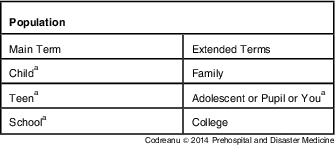
The population to which the questions were addressed was teenagers enrolled in compulsory secondary school education (Table 2).
Main and Extended Search Terms for the Population Component

a Denotes truncation wildcard.
Intervention
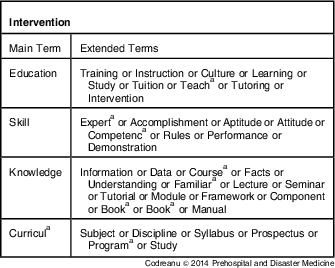
Due to the expected dearth of research on the subject matter, in the context of this review, any educational intervention, by any means and in any form, was included. Previous research has shown that survival likelihood is higher in parents with prior knowledge of earthquakes, and that this knowledge directly affects their children's understanding and knowledge.Reference Adirim 6 Thenceforth, the review included any educational intervention in which the end-point recipient was a secondary school student, for example: education of parents, teachers, and the wider community which included a compulsory educational interaction with children (Table 3).
Main and Extended Search Terms for the Intervention Component

a Denotes truncation wildcard.
Comparison
The intervention was evaluated against the overall comparison group of secondary school students.
Outcomes
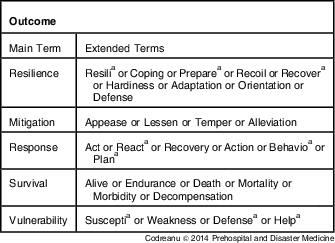
The primary outcome was a change in behavior towards preparedness and mitigation of the effects of a disaster. The secondary outcome was enhancement and retention of disaster-related knowledge and knowledge of skills, DDR, improvement of survival, or decrease in vulnerability (Table 4).
Main and Extended Search Terms for the Outcome Component

a Denotes truncation wildcard.
Types of Study
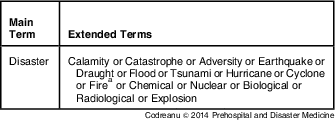
Research in disaster medicine is limited in design by the intrinsic characteristic of the environment in which such research has to be conducted. In addition, some interventions can only be evaluated through qualitative data.Reference Evans 43 Thus, in order to capture as much data as possible, the review included all types of original research articles published after January 1, 1966 and until August 12, 2013, for all common disasters (Table 5) without any language constraints.
Main and Extended Terms for Disasters

a Denotes truncation wildcard.
The synonyms used cover both text-words and keywords in the databases, cross-referenced with MEDLINE's keyword system Medical Subject Heading (MeSH, US National Library of Medicine, Bethesda, Maryland USA), as well as with the Chambers Dictionary of English Language, ed. 1999.
Information Sources
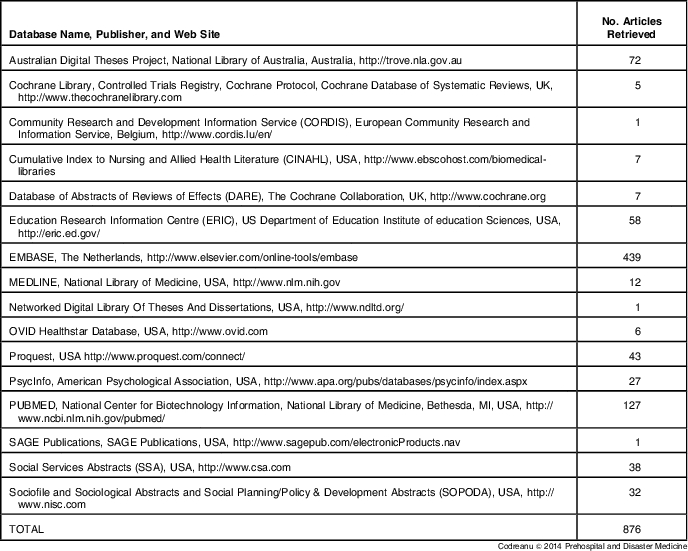
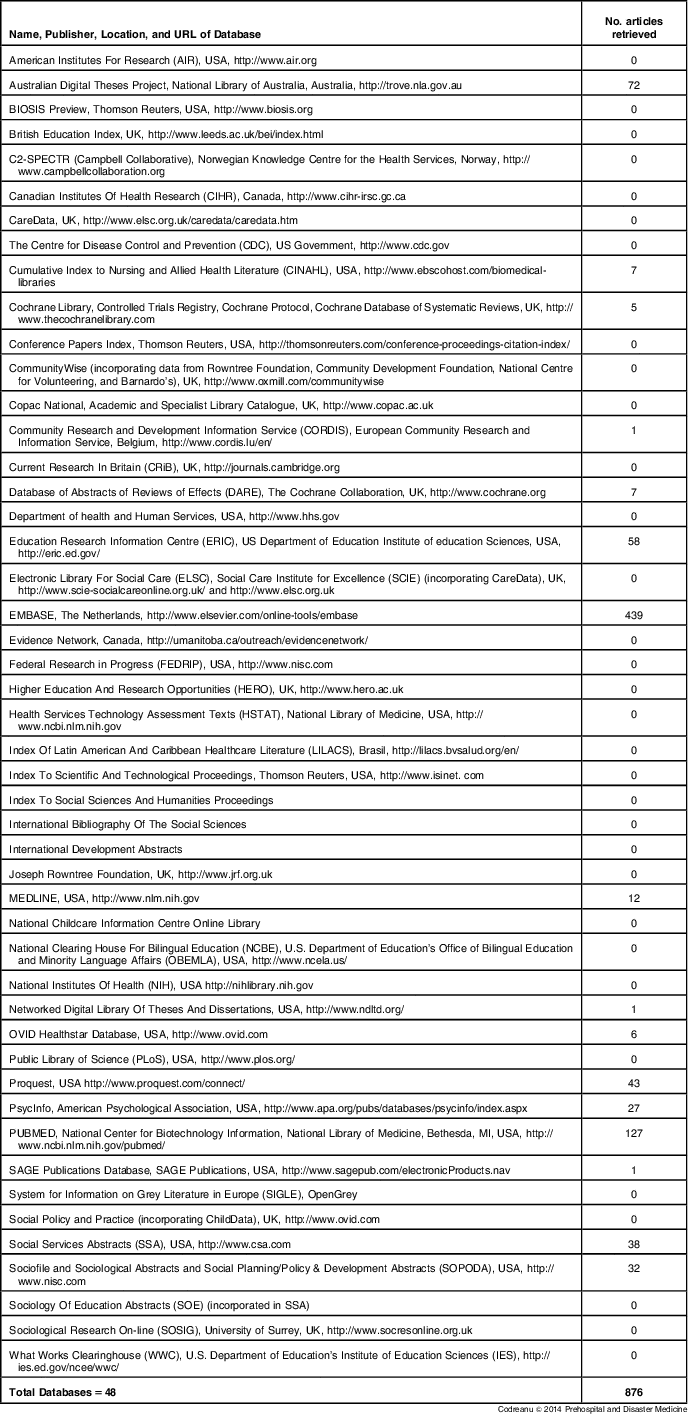
Owing to the multidisciplinary character of the research question (medicine, social sciences and education), this review was extended to the relevant scientific databases and repositories as detailed in Table 6. Due to the complex organization of some of the databases, each one is listed under only one heading, although it may contain resources pertinent to other literature resources (ie, published research and conference abstracts). The search was extended to cover unpublished primary studies by contacting the principal investigators of potentially relevant studies, studies from the grey literature (conference databases, dissertations, and theses), public or privately funded ongoing research, and the bibliographies of the relevant papers for articles missed by the initial search. All papers that cited the identified relevant studies were also reviewed.
Databases Yielding Results and Initial Number of Articles Retrieved

Pilot Trial
Before performing the review of all selected databases, one author (TC) piloted a trial search of MEDLINE. The pilot returned too many articles due to the broad meaning, and common use, of some of the search terms (ie, resilience) in contexts other than disasters. This led to adjusting the search strategy using restrictions pertaining to other common disciplines or fields into which the searched term (for example “resilience”) is also commonly used (ie, posttraumatic stress disorder, cancer, and self harm).
Trialling the new strategy on another database (PsycINFO, American Psychological Association, Washington DC USA) showed that while the core coding of the search was appropriate in retrieving the desired data, it also included a significant number of irrelevant papers, in spite of the restrictions imposed. The final strategy involved a search of each database using identical core codes, but the restrictions were adapted to fit the contents of each particular database. Therefore, the search strategies are only identical in the core content.
Study Selection
One author (TC) designed an original selection tool to fit the special characteristics of the research question (Appendix A). Articles which were not related to disasters, not involving children, and without an educational intervention were excluded. Using the agreed search strategy for each database, two authors (TC and AC) examined each citation by title, abstract, or the complete reference for its relevance to the question studied. All articles which were clearly not pertinent (by title or abstract) were rejected from the review but kept in a separate database along with the reason(s) for exclusion. All remaining articles were scanned at full text level and sorted accordingly into three categories (accept, reject, discuss). One author (IJ) independently verified the selection process. Any sorting discrepancy was resolved through consensus.
Data Collection Process
The robustness of the original selection pro forma was enhanced by combining it with a validated selection instrument (STROBE, University of Bern, Bern, Switzerland). 44 The collected data from all the included papers was independently verified for the quality of the extraction process. Consensus was used to achieve agreement on any difference in opinion.
Search Results
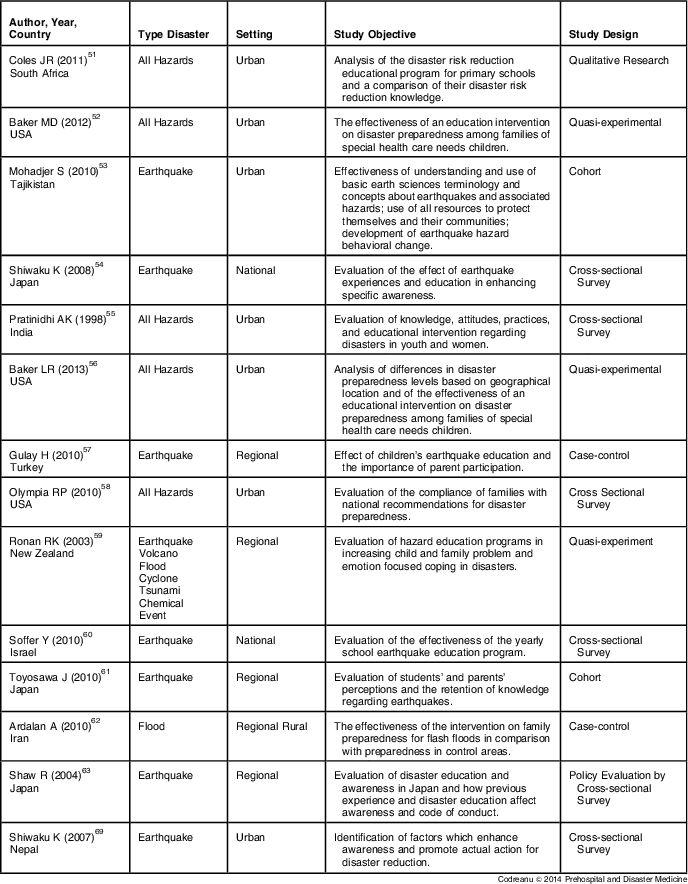
The exhaustive search strategies returned 876 individual references (Table 6; a full list of databases searched is available, Appendix B). One author (TC) scrutinized all titles and sieved them as “accept,” “reject,” or “abstract needed.” Another author (AC) independently probed the “reject” selection for accuracy. Both authors (TC and AC) independently reviewed the abstracts of selected articles and marked them as “accept,” “reject,” or “full paper needed.” One paper,Reference Toyosawa, Karasawa and Fukuwa 45 for which the title and abstract were in English but the full text in Japanese, was translated. A total of 38 articles and one thesis were selected for review by full text, of which 14 met the predefined inclusion criteria. An interobserver agreement of kappa ⩾ 0.8 is considered good. For abstract selection, kappa was 1.0, and for full text kappa was 0.92. Twenty-five articles reviewed by full text were excluded. One articleReference Baker, Baker and Flagg 46 was excluded as its content was identical to another (same author selected paperReference Baker, Baker and Flagg 47 ) in spite of a different title and publication journal. Three further citations of work presented at conferences were excluded as all attempts to receive an in extenso paper from the authors failed.Reference Cakin, Petal, Sezan and Turkmen 48 – Reference O'Brien, Nava and Arabasz 50 The final selection included fourteen publications (Table 7).
Excluded Studies
The majority of studies were excluded at title scanning stage. Subsequent exclusions were based on the absence of children from the target population, of an educational intervention, or of measurement of the effect of an intervention.
Assessment of the Limitations, Potential Bias, and Validity of the Reported Results in the Selected Studies
The limitations, potential bias, and validity of each selected study was assessed independently by TC and AC using the STROBE template and by rating the description and quality of the control for potential confounders, the inclusion of sufficient data (coded “yes,” “no,” or “n/a”), the overall impression of internal and external validity. Internal validity (coded “low,” “medium,” or “high”) was assessed based on the quality of the sampling and response, and the treatment of confounding factors, while external validity (coded “yes,” “no,” or “n/a”) by assessing the results against the study's local context, which could render generalization invalid.
While half the studies included sufficient data, evaluation was not possible in four (29.6%), whereas data was deemed insufficient in one (7.1%). Control for confounders was reported in five publications (35.7%) by using various statistical methods (multiple regression, ANOVA, LSD, and post hoc techniques), whereas the remainder (64.3%) did not report any strategy. Internal validity was rated “high” in nine studies (64.3%), “medium” in four (29.6%), and “low” in one (7.1%). External validity was achieved by twelve studies (85.7%).
Ten (71.4%) publications reported analysis of study limitations, whereas analysis of direction and magnitude of bias was performed in only six studies (42.9%).
Results
Characteristics of Included Studies
With one exception,Reference Toyosawa, Karasawa and Fukuwa 45 all papers were published in English from 1998 through 2013. The geographical representation was proteiform with three papers each from the USA and Japan (21.4%, respectively), and one each from Iran, South Africa, Turkey, Tajikistan, India, New Zealand, Nepal, and Israel (7.1%, respectively). Only one paper was published in the last decade of the 20th century, with most of them in 2010. As noted previously, research studies in disaster medicine are limited by various significant factors, resulting in the absence of the gold standard of randomized controlled studies. The selected studies employed a cross-sectional survey design in five cases (35.7%), quasi-experimental design in three cases (21.4%), case-control and cohort design in two cases, (14.3%, respectively), and qualitative and policy evaluation by cross-sectional survey in one, (7.1%, respectively). Earthquake-specific education was evaluated in seven studies (50%), all hazards education in six (28.6%), whereas floods only in one (7.1%). National preparedness was only evaluated by two studies (14.2%), in comparison with five regional (35.7%) and seven (50%) in the urban setting.
Assessment of Data Analysis
Analysis of the data presented across the selected studies showed inconsistency. One studyReference Coles 51 did not provide any tabulated frequency or integer quantified outcome data. Three studiesReference Baker, Baker and Flagg 52 – Reference Shiwaku and Shaw 54 presented the outcome data as percentage improvement in knowledge post intervention, while oneReference Pratinidhi and Gokhale 55 reported percentages correct pre- and post-test as well as percentage of change. Six studiesReference Baker and Cormier 56 – Reference Toyosawa, Karasawa and Fukuwa 61 reported means and standard deviations and, among them, twoReference Gulay 57 , Reference Soffer, Goldberg, Avisar-Shohat, Cohen and bar-Dayan 60 used analysis of variance ANOVA, and oneReference Ronan and Johnston 59 performed analysis of variance and covariance ANCOVA. Percentages and odds ratios were calculated by only one research group,Reference Ardalan, Naieni and Mahmoodi 62 while cross tabulation was preferred by another.Reference Shaw, Shiwaku, Kobayashi and Kobayashi 63
Characteristics of the Educational Interventions
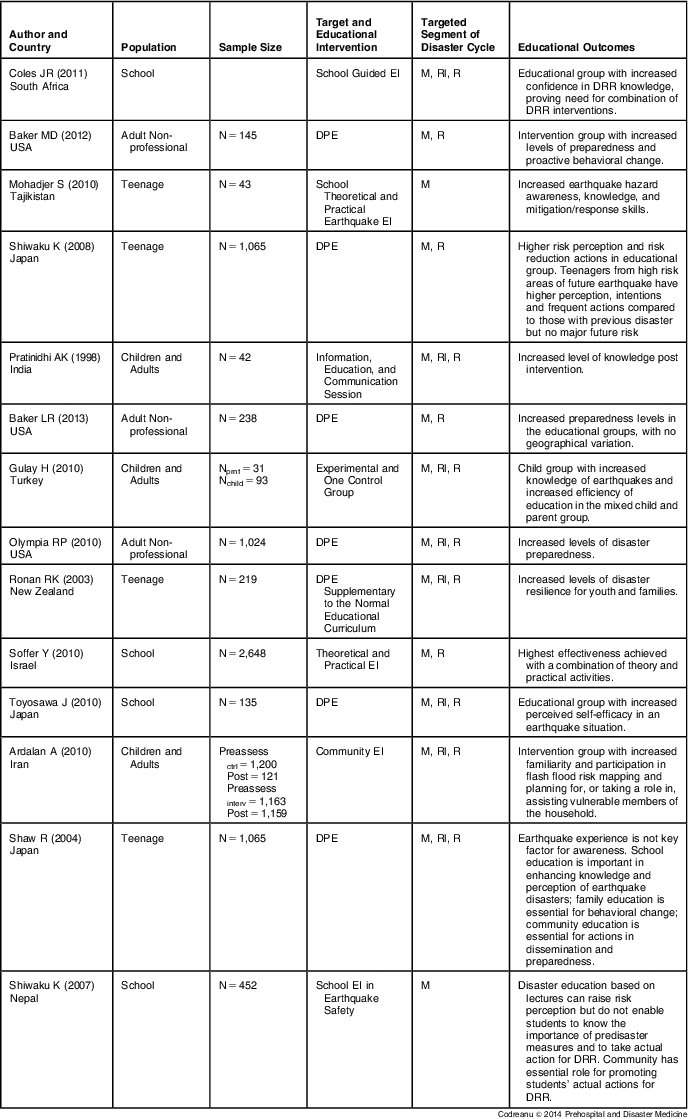
All included studies targeted children's disaster education. Two studies (14.8%) evaluated parents of a selected group of children, three studies (21.4%) looked at community interventions, whereas the majority (n = 9, 64.3%) of studies evaluated school educational programs. Theoretical-only interventions formed the basis of 11 studies (78.6%), whereas three (21.4%) looked at mixed, theoretical, and practical interventions. In terms of the targeted segment of the disaster cycle, mitigation was the focus of two studies (14.8%), mitigation and resilience the subject of four (29.6%), whereas all segments were targeted by eight (59.2%). The duration of the intervention varied from five to ten minutes to a whole academic school year.
Discussion
This systematic literature review unveiled a number of surprising results, and the characteristics of the retrieved articles are summarized in Tables 7 and 8.
Summary of Countries, Types of Disasters, Setting, Study Objectives, and Designs of the Retrieved Articles

Summary of the Population, Sample Size, Educational Intervention, Targeted Segment of the Disaster Cycle, and Educational Outcomes of Retrieved Articles

Abbreviations: DPE, disaster preparedness education; DRR, disaster and risk reduction; EI, educational intervention; M, mitigation; Rl, resilience; R, response.
First, almost 25 years since the UN declaration of the International Decade for Natural Disaster Reduction, and almost 15 since the start of the UN International Strategy for Disaster Reduction, it would be expected to see a plethora of research into the best ways and most efficient mechanisms in achieving the set goals. Instead, there is a dearth of peer-reviewed, published evidence.
Second, it is apparent that the direction of research is mismatched with the current evidence regarding most frequent and serious threats. The last hundred years have seen 4,235 floods which affected 3.5 billion people, compared to 1,244 earthquakes and 1.7 billion affected, 1 yet specific research into flood education and preparedness does not mirror this historic data. Only one study looked into specific flood disaster education and preparedness, whereas earthquakes were targeted by half of the retrieved research (Table 7).
Conceptually, disaster preparedness encompasses theoretical risk-appraisal knowledge (including the willingness to risk-appraisal), and a decision for preventative action, leading to risk-reducing behavior.Reference Shiwaku and Shaw 54 It is well known that an educational intervention is constructed on the basis that the beneficiary will, ipso facto, exhibit an enhancement in knowledge, knowledge of skills, or a change in approach and behavior towards the subject matter. Therefore, risk awareness needs to be part of early education programs which will lead, in turn, to an individual's growing civic and professional responsibility. 2 Yet, only three studies have evaluated both theoretical and practical skills (Table 8).
The relationship between a history of disaster threat or previous exposure to a disaster and disaster preparedness was explored by a number of studies.Reference Olympia, Rivera, Heverley, Anyanwu and Gregorits 58 , Reference Ardalan, Naieni and Mahmoodi 62 , Reference Shaw, Shiwaku, Kobayashi and Kobayashi 63 Interestingly, results show that different populations living in similar risk areas have a diverse approach to risk reduction. For example, exposure to floods in Iran's Golestan population was positively associated with proactive participation in disaster-mitigation planning, yet the same risk did not affect the behavior of the populations of Los Angeles (California USA) and Atlanta (Georgia USA).Reference Olympia, Rivera, Heverley, Anyanwu and Gregorits 58 Similarly, prior earthquake experience was not found to be an essential contributing factor to earthquake awareness of teenagers from the high risk areas of previous or impending severe earthquakes (Kobe and Tokai).Reference Shaw, Shiwaku, Kobayashi and Kobayashi 63 These findings are difficult to quantify as they are at odds with a matter-of-fact, common-sense approach to any hazard, and previous research in the effectiveness of school education focusing on other risks and hazards (sexual education, asthma, and environment).Reference Ballantyne and Packer 64 – Reference Christiansen, Martin and Zuraw 66 More research is needed to ascertain the background reasons behind such a population's attitude.
The contexts of education are: (1) school education (from teachers and pro-active with teachers and students); (2) self education; (3) community education; and (4) family education.Reference Shaw, Shiwaku, Kobayashi and Kobayashi 63 Various educational methods targeting informational vulnerability and intelligent use of problem-focused resources can be devised, and several of them have been detailed in the studies retrieved. A constructivist and experiment-based learning model has been shown to result in a child's knowledge accumulation and permanent retention.Reference Shin 67 Previous research has also shown that the more hazard-informed a child is, the better educated the parents also are, for the child is encouraged and empowered to share his/her knowledge within the family.Reference Bandura 68 Most studies employed an educational strategy based on a bi-univocal relationship between the educator and the recipient of the educational intervention, while a multidirectional approach was the design of others, extrapolating the benefits of individual learning to a broader beneficiary (ie, the community). Yet, the retrieved evidence does not show consensus as to which model is the most effective one, nor which educational institution is the most likely to induce permanent learning and education. Generally speaking, schools have proven to be the best place for earthquake educational programs in TurkeyReference Gulay 57 and IsraelReference Soffer, Goldberg, Avisar-Shohat, Cohen and bar-Dayan 60 and for the recognition of general disaster risks in Japan, but surprisingly not for the actual extended knowledge, where experience and school education were of a lesser importance than family and self-education.
Furthermore, behavioral change in disaster preparedness was observed to result mostly from community and family education.Reference Shaw, Shiwaku, Kobayashi and Kobayashi 63 , Reference Shiwaku, Shaw, Kandel, Shrestha and Dixit 69 There is, however, no doubt that school educational interventions are uniquely placed to provide knowledge and stimulating one's curiosity, as demonstrated in IsraelReference Soffer, Goldberg, Avisar-Shohat, Cohen and bar-Dayan 60 where theoretical lectures have been shown to increase practical skills in earthquake scenarios.
The disaster education intervention was either supplemental to a stand-alone curriculum (Geography and Earth Sciences), or an extra-curricular activity, either voluntary or compulsory. From this perspective, missed opportunities may be witnessed due to the structure of the general education curriculum in countries where students are expected to follow a limited set of subjects to the detriment of others.
Limitations
The data capture methodology was designed to allow for the multidisciplinary character of the research question, yet in a workable format. The only limitation imposed on the search strategy was related to the period of time (January 1, 1966-August 12, 2013). Where applicable, no language restriction was enforced. Every effort was made to contact the authors of potentially relevant studies which were not found in full text version (ie, conference proceedings and abstracts). Articles with abstracts in English but full text in French or Italian were not translated due to the language mix capabilities of the authors of the review. All other articles were translated as required.
Although every effort has been made to allow for the use of wildcards, the number of retrieved studies might have been limited by the choice of keywords and the resulting indexing characteristics of each original article. Although such articles might not have been captured, it is unlikely that their data would have adversely affected the final conclusions.
Conclusion
More than two decades after the United Nations’ INDNR, the published evidence regarding reducing the disaster informational vulnerability of teenagers and the related problem-solving skills and behavior is piecemeal in design, approach, and execution in spite of consensus on the detrimental effects on injury rates and survival.
There is some evidence that isolated school-based intervention enhances the theoretical disaster knowledge which may also extend to practical skills; however, disaster behavioral change is not forthcoming. It seems that the best results are obtained by combining theoretical and practical activities in school, family, community, and self-education programs.
This literature review shows that there is still a pressing need for a concerted educational drive to achieve disaster preparedness behavioral change, and that school leavers’ lack of knowledge, knowledge of skills, and adaptive behavioral change is detrimental to their chances of survival.
Appendix A Data Collection Tool