1. INTRODUCTION
The investigation of the acquisition of temporal systems by second language (L2) learners has created an impressive body of work that informs our understanding of the developing competence of L2 learners because they involve all aspects of a language – pragmatic, lexical, syntactic, morphological – as well as the mapping from one to the other (e.g., Ayoun and Salaberry, Reference Ayoun and Salaberry2005; Salaberry, Reference Salaberry2008; Salaberry and Comajoan, Reference Salaberry and Comajoan2013). However, the vast majority of empirical studies investigating the L2 acquisition of temporal systems have focused on past temporal reference (e.g., Ayoun, Reference Ayoun2001, Reference Ayoun2004, Reference Ayoun, Ayoun and Salaberry2005; Granda, Reference Granda2004), neglecting future temporal reference with a few exceptions (e.g., Benati, Reference Benati2001; Wiberg, Reference Wiberg, Salaberry and Shirai2002) aside from ESL (English as a Second Language) learners (Bardovi-Harlig, Reference Bardovi-Harlig2004a, Reference Bardovi-Harlig, Overstreet, Rott, VanPatten and Williams2004b, Reference Bardovi-Harlig, Dekydtspotter and Sprouse2005; Salsbury, Reference Salsbury2000), leaving unanswered the question of how the investigation of future temporality may inform our understanding of the acquisition of temporal systems in general. Investigating the L2 acquisition of the future expands the empirical inquiry from the domain of tense-aspect systems to the tense-mood-aspect (TMA) systems, because the future also encompasses deontic and epistemic modalities.
The present study investigates the L2 acquisition of future temporality in French by adult English NSs. After a descriptive account of the major contrastive features of the expression in futurity in English and French, previous studies with L2 French learners are reviewed, followed by learnability issues and research questions. Learnability implications specific to future temporal reference for English-speaking learners of L2 French are considered.
2. EXPRESSION OF THE FUTURITY IN FRENCH AND ENGLISH
The future can be represented as speech time preceding event time, S < E (Reichenbach, Reference Reichenbach1947). It is sometimes argued that the future is not marked as consistently as past time reference (Dahl, Reference Dahl1985: 109), while differing from the past and the present in encompassing both temporality and modality. The modal readings of the future include possibility, probability, intention and desire or volition (i.e., strong intent); intentionality is usually assumed to be the most common reading (Bybee, Reference Bybee1985; Bybee, Perkins and Pagliuca, Reference Bybee, Perkins and Pagliuca1994). Bybee et al. (Reference Bybee, Perkins and Pagliuca1994) also propose that the future expresses two main modalities in desire and obligation, and two minor modalities in ability and attempt, while Larreya (Reference Larreya2000: 120) suggests that ‘will’ expresses a ‘particular type of necessity, which is necessary consequence’. [original emphasis]
2.1. Future temporality in English
English has a variety of ways to convey future temporality as listed in (1)(e.g., Bardovi-Harlig, Reference Bardovi-Harlig2002, Reference Bardovi-Harlig2004; Bybee et al., Reference Bybee, Perkins and Pagliuca1994; Larreya, Reference Larreya2000):
(1) a. Lexical futures: semantically future predicates (e.g., want, hope)
b. Adverbials (e.g., tomorrow, next week)
c. About to (e.g., she's about to sing)
d. Will + predicate (e.g., she will sing)
e. Periphrastic future: going to + predicate (e.g., she's going to sing)
f. Present + adverbial (e.g., she sings tomorrow)
g. Present progressive (e.g., she's singing)
h. Future perfect (e.g., she will have left by the time you arrive)
‘Will’ is one the several modal auxiliaries English has (e.g., ‘might, may, can, would’; Palmer, Reference Palmer1990).
2.2. Future temporality in French
French has the following means of expressing future temporality as in (2):
(2) a. Present tense morphology (praesens pro futuro) + time adverbial: je pars ce soir ‘I leave tonight’ (Mellet, Reference Mellet2000)
b. Periphrastic future (futur proche for imminent or immediate future) (Vet, Reference Vet1993): je vais partir demain/*dans dix ans ‘I am leaving tomorrow/in ten years’
c. Synthetic future (futur simple) or inflected future: je partirai ce soir/dans dix ans ‘I will leave tonight/in ten years’
d. Futur antérieur: dès que/aussitôt que vous aurez enregistré vos bagages, vous pourrez embarquer ‘as you as you will have checked your luggage, you will be able to board’
As Bonami (Reference Bonami, van Eynde, Hellan and Beerman2002: 36) points out, the future tense is aspectually neutral in the sense that it does not express aspect morphologically, contrary to past tenses (passé composé for perfectivity and imparfait for imperfectivity) (e.g., Andrews, Reference Andrews1992; Ayoun, Reference Ayoun, Ayoun and Salaberry2005). Moreover, it combines equally well with both telic and atelic predicates in their basic interpretation. Thus, both (3) and (4) are grammatical (examples adapted from Bonami Reference Bonami, van Eynde, Hellan and Beerman2002: 36):
(3) Paul ira [atelic]
Paul go-FUT
‘Paul will go’
(4) Paul ira à la plage [telic]
Paul go-FUT to the beach
‘Paul will go to the beach’
However, as in past tense morphology, the future can express the progressive aspect with the lexical expression être en train de ‘to be in the middle of’ as in Paul sera en train de travailler quand on arrivera ‘Paul will be working when we arrive’.
2.3. Comparing French and English futurity
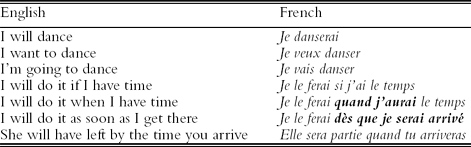
The main ways of expressing futurity in French and English are summarised in Table 1:
Futurity in English and French.

Both languages share three morphological forms: The simple future (‘I will dance’/ je danserai), the lexical future (‘I want to dance’/je veux danser), and the periphrastic future (‘I'm going to dance’/je vais danser). However, they are not necessarily equivalent in English to French and vice-versa. Thus, it is generally agreed that ‘will’ is an expression of modality, whereas the simple future in French expresses mostly temporality (but see Larreya, Reference Larreya and Suberchicot1996, Reference Larreya2000, for arguments against a purely temporal meaning of the French future simple). Both English ‘will’ and simple future in French express volition or have a predictive value (Larreya, Reference Larreya2000). Moreover, English ‘will’ often corresponds to the French periphrastic future which expresses a more immediate future.
Larreya (Reference Larreya2000) argues that the French immediate future aller + predicate has a wider range of uses than ‘be going to’, and focuses on five of these uses as in (3) (examples from Larreya, Reference Larreya2000: 116–119):
(3) a. Facts linked to a condition
Ne touche pas l'assiette, tu vas te brûler les doigts/?brûleras
Don't touch the plate, you will burn your fingers/*are going to
b. Intention/decision
Donne-moi cette boîte, je vais te l'ouvrir/??ouvrirai
Give me this box, I will open it for you/??am going to
c. Characteristic behaviour
En Amérique, c'est pas pareil, surtout sur la côte ouest. Une femme se mettra du maquillage et s'habillera bien pour elle-même, pas pour les autres/va se mettre, se met du maquillage.
A woman will make herself up and dress elegantly for herself/makes herself up/*is going to make herself up
In the case of characteristic behaviours, both languages can use the present, as well as simple future, while French also allows the periphrastic future, in contrast to English.
d. Conjecture
That will be Amelia/?is going to be
Ça sera sûrement Amélie
e. Directive uses
Linda, vous m'appellerez ce numéro s'il vous plaît/appelez/allez appeler
Linda, will you get me this number please/?are going to/?you get me
Praesens pro futuro is more common in French than in English (Le Goffic and Lab, Reference Le Goffic and Lab2001) that tends to use a present progressive instead: je pars demain soir/’I'm leaving tomorrow night’. In other words, cross-linguistic similarities are superficial. Similar morphological forms yield different semantic expressions that L2 learners must acquire.
As shown in Table 1, ‘if’/si clauses are followed by the present when the future is used in the main clause in both languages. However, French and English tense concordancing differ: a) quand + future in French, but present in English when the main clause is in the future; b) futur antérieur (future perfect) is rarely required in English, whereas it usually is in French.
Futur antérieur is a complex form with primary temporal and aspectual functions, or a ‘compound tense-aspect’ (Waugh, Reference Waugh1987: 12). In its temporal meaning, the event takes place after the speech point (S < E < R), that is, it is a past relative to the future. It is one of the rare forms on which French may rely to indicate epistemic modality (Palmer, Reference Palmer1986: 35–36). Futur antérieur has three main modal meanings: probability in the past (4a), eventuality in the future (4b), and indignation (4c):
(4) a. Paul n'est pas encore arrivé? Il se sera perdu.
Paul is not yet arrived? He be-FUT lost-PP
‘Paul hasn't arrived yet? He probably got lost’
b. Quand elles auront trouvé ce qu'elles cherchent, elles nous le diront.
When they have-FUT find-PP what they look for-PRES, they us it tell-FUT
‘When they find what they are looking for, they will tell us’
c. Elle aura encore menti!
She have-FUT again lie-PP
‘She lied again’
Gobert and Maisier (Reference Gobert and Maisier1995: 1006–1008) list 18 modal uses of futur antérieur from their analysis of a written corpus of L'Express, but explain that in 12 cases, the futur antérieur is being used instead of the passé composé, that is, to express a perfective, as in (5) (L'Express, no date, Gobert and Maisier, Reference Gobert and Maisier1995: 1007):
(5) Jamais, depuis sa nomination, M. Rocard n'aura subi pareille disgrâce dans l'opinion.
‘Never since his nomination, M. Rocard has suffered such disgrace in public opinion’
However, L2 French learners in instructed settings are unlikely to come across such examples until very advanced classes, and corpus data show that the futur antérieur has a very low frequency; in fact, it is outnumbered by all other tenses (Engel, Reference Engel2001).
2.4. Morphological forms
Will is morpho-syntactically simple in itself, and definitely simpler than the French future forms which require the stem, conjugation marker, future tense marker and person/number marker as shown in (6):
(6) dans- e -r -ai, -as, -a, -ons, -ez, -ont
[stem] [conjugation marker] [future tense marker] [person/number marker]
The future and conditional forms originate in a periphrastic construction in Latin formed by an infinitive followed by habere ‘to have’). In addition, there are numerous irregular future forms (e.g., j'aurai ‘I will have’, tu sauras ‘you-SG will know’, il pourra ‘will be able to’, nous viendrons ‘we will come’, vous enverrez ‘you-SG/PL will send, ils/elles seront ‘they-MSC-FEM will be’, etc.). Indeed, the most common predicates such as être ‘to be’, avoir ‘to have’, faire ‘to do’, vouloir ‘to want’ all have irregular paradigms. The complexity of the inflectional endings may be difficult for English-speaking L2 French learners who may acquire futurity, but struggle with its morphological mapping. Aller + predicate is similar to English ‘going to’, but it is another common predicate with the most irregular paradigm (e.g., je irai, tu iras, il ira) of all French predicates whose future form in ire originates from Vulgar latin (Gheorghiu-Gata, Reference Gheorghiu-Gata1994).
Finally, futur antérieur is a compound tense similarly to the passé composé (auxiliary in future + past participle), subjected to the same rules of person and number agreement as illustrated in (7):
(7) Marie se sera dépêchée pour ne pas arriver en retard.
Marie REFL be-FUT hurry-PP-FEM-SG to not arrive late
‘Mary will have hurried not to arrive late’
Encoding a predicate with futur antérieur thus requires the proper selection of the auxiliary, être ‘to be’ or avoir ‘to have’, and the appropriate person and number agreement(s) on past participles.
3. previous l2 french studies
Schlyter (Reference Schlyter, Bernini and Giacalone-Ramat1990) compared the L1 and the L2 acquisition of French by two untutored Swedish adult learners and three German-French bilingual children by examining a corpus of oral data. She found that her adult participants seemed to acquire lexical future and simple future at the same time, while her children participants appeared to acquire lexical future before simple future. German-French bilingual children acquired modal + infinitive before va + infinitive, whereas it has been established that in L1 French, simple future is preceded by periphrastic future (Fleischman, Reference Fleischman1982; Sabeau-Jouannet, Reference Sabeau-Jouannet1975).
Kihlstedt and Schlyter (Reference Kihlstedt and Schlyter2009) also found differences between French monolingual, French-Swedish bilingual and L2 French children in their production of the future in obligatory contexts while performing an oral sentence completion task. The monolingual and bilingual children (n = 4) consistently supplied eight to ten future forms; however, among the L2 learners, Nancy supplied only one future form, but eight futur proche forms, while Lena who produced eight future forms, did not produce any futur proche form.
In a longitudinal study, Moses (Reference Moses2002) collected oral data (interviews) and written data (compositions, judgement tasks) from 24 college students at four instructional levels. The results revealed three distinct stages in the development of futurity: a pragmatic stage, a lexical stage and a morphological stage characterised by the productive use of verbal constructions. The learners moved from the present to periphrastic future to simple future, and tended to overuse simple future while under using present and periphrastic future. The latter tendency does not correspond to their classroom input in which 60% of future forms were encoded with periphrastic future. But as Ellis (Reference Ellis1996) notes, ‘instructional input often does not reflect language use outside the classroom’ (cited in Bardovi-Harlig, Reference Bardovi-Harlig2002). Verb-to-adverb ratio significantly decreases over time in oral and written data as L2 learners gain a better mastery of morphological forms. Moses concludes that overall, the data showed a systematic and relatively uniform development of future expressions, with a clear pragmatic-lexical-morphological path.
Nadasdi, Mougeon and Rehner (Reference Nadasdi, Mougeon and Rehner2003) collected oral data from recorded interviews from 41 French immersion students (aged 13–18). They found a clear preference for the periphrastic future (used 67% of the time), followed by the simple future (10%) and the present (10%). Non target-like forms made up the remaining 14% of the corpus. Adverbial expressions correlated with the present. Moreover, it appeared that students who had spent time in other francophone countries tended to use the periphrastic future more and the simple future less. A comparison with the Québécois and Ontario French corpora identified three forms: periphrastic future (73%), simple future (20%) and present (7%). There was also an L1 effect in that non-English or Romance speakers use periphrastic future more often than other speakers.
Howard (Reference Howard2012) conducted oral interviews with English-speaking advanced learners who had been learning French. In comparing the frequency of forms used in future contexts, Howard found that the present was used the most (32% to 61%), followed by the future (28% to 48%), and the periphrastic future (0% to 31%). A strong group effect, as well as significant differences between morphological forms, were found; tense concordancing with si clauses (imparfait + conditional) appeared to be frequent (54% to 72% accuracy). However, these findings should be considered with caution as the sample sizes were small (n = 6 per group), and the data were limited to one hour of oral interviews.
Finally, in Ayoun (Reference Ayoun2013), Anglophone adult learners of L2 French at three different proficiency levels – Beginning (n = 14), Intermediate (n = 15), Advanced (n = 13) – performed two written tasks (a composition task and a cloze test) as part of a larger cross-sectional study investigating the acquisition and expression of tense, aspect and mood/modality. Although all three groups produced a wide variety of forms with great accuracy in the composition task, they were mostly limited to the simple future (rare productions of futur antérieur, futur proche were restricted to a few participants). The findings of the cloze test revealed significant differences for tense and group as well as a significant interaction between group and tense. Again, the L2 learners performed much better on the simple future than the futur antérieur, but the performance increased with proficiency.
4. LEARNABILITY ISSUES
The literature posits three general stages of the L2 development of futurity (e.g., Bardovi-Harlig, Reference Bardovi-Harlig2000, Reference Bardovi-Harlig, Dekydtspotter and Sprouse2005; Dietrich, Klein and Noyau, Reference Dietrich, Klein and Noyau1995):
a. A pragmatic stage characterised by the use of chronological order, and reliance on interlocutor's contribution for world, situational or contextual knowledge.
b. A lexical stage characterised by the use of adverbs or locatives.
c. A final morphological stage characterised by the productive use of TAM morphology.
However, these stages are based on naturalistic data (Arabic and Spanish speakers of L2 French in Dietrich et al., Reference Dietrich, Klein and Noyau1995) and elicited data from ESL learners (variety of L1 backgrounds in Bardovi-Harlig, Reference Bardovi-Harlig2000, Reference Bardovi-Harlig, Dekydtspotter and Sprouse2005), and it is unclear whether this ‘acquisitional sequence is probably universal and independent of the languages involved’ as claimed by Giacalone Ramat and Banfi (Reference Giacalone Ramat and Banfi1990). It will thus be interesting to see if instructed learners in a foreign language setting go through the same stages as observed in Moses (Reference Moses2002). In other words, do L2 learners become less dependent on lexical means as their use of tense-aspect morphology becomes more stable and reliable? However, even native speakers continue to use lexical means of temporal expression (Schumann, Reference Schumann1987). L2 learners progressively use fewer adverbs, and remaining adverbs carry a reduced functional load (Bardovi-Harlig, Reference Bardovi-Harlig1992, Reference Bardovi-Harlig2000). Lexical futures encode the future semantically rather than morphologically, so the lexical stage may be extended (Bardovi-Harlig, Reference Bardovi-Harlig, Dekydtspotter and Sprouse2005).
More specific learnability issues for English-speaking learners of French include the acquisition of: a) multiple and complex morphological forms for the futur simple because although inflectional endings are limited in number (infinitive + -ai, -as, -a, -ons, -ez, -ont) and should be acquired early on as the inflectional endings of avoir ‘to have’ in the present, they are ‘rich’, in addition to the fact that there are numerous irregular future forms (e.g., aurai, sauras, pourra, viendrons, enverrez, seront, etc.); b) past participle rules for futur antérieur forms; c) tense concordancing as in (8):
(8) a. Si j'ai le temps, je viendrai
if I have-PRES the time, I come-FUT
‘If I have time, I will come’
b. Je viendrai quand j'aurai le temps
I come-FUT when I have-FUT the time
‘I will come when I have time’
c. Je le ferai dès qu’ il m'aura donné sa réponse
I it do-FUT as soon as he me have-FUT given-PP his answer
‘I will do it as soon as he will have given/will give me his answer’
French and English share the same tenses in (8a), but L2 learners will have to acquire the use of future after quand in (8b), and futur antérieur that is more often required in French than in English.
Based on these learnability issues and the limited findings of previous research reviewed above, the following three research questions were investigated:
1. How do instructed adult learners express future temporality? Do they use all three future expressions with equal frequency, and in a way similar to NSs? Or do they tend to over-use aller + predicate as ‘going to + predicate? Or does their production reflect classroom input which tends to rely mostly on futur simple? (Moses, Reference Moses2002).
2. Does their production exemplify complex clauses with the appropriate tense concordancing? Do they use the futur antérieur at all?
3. Is there a decreasing proficiency on adverbials as proficiency increases?
A fourth research question is based on the more general empirically, but controversial, based claim that adult L2 learners struggle with inflectional morphology, and that they resort to non-finite markers as substitutes for finite inflection (e.g., Myles, Reference Myles and Dewaele2005; Prévost, Reference Prévost2009).
4. Will learners use appropriate inflectional morphology on predicates?
5. METHODOLOGY
5.1. Participants
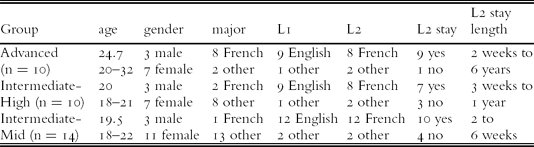
Two groups of participants were recruited for this cross-sectional study: English-speaking learners of French (n = 34) as a foreign language in an instructed setting at a major North-American university, and French NSs (n = 14) (averaged 34 years in age; range 28–56) who had been living an average of 9.42 years (range 2–25 years) in the United States at the time of the data collection. As displayed in Table 2, French was the L2 of most of the English-speaking participants, the majority of the Advanced learners were French majors, but there were only three French majors in the Intermediate groups, and although most of the participants had spent some time in France, it was only for very short stays (only one Advanced learner lived in France for several years).
Participants’ background data.
5.2. Procedure
The L2 learners came to a language laboratory once a week for three weeks in a row to participate in three consecutive sessions.Footnote 1 During the first session, they were administered two written computerised tasks as an independent measure of proficiency: a scalar grammaticality judgement task, and a preference/grammaticality judgement task. These tasks tested various structures (e.g., tense/aspect encoding, verb movement phenomena, gender agreement) to establish the participants’ overall proficiency level. For the second and third sessions, the participants wrote a composition and completed a cloze test. The second session tested past morphology (reported elsewhere), while the third session focused on future morphology.
Participants used individual computers to perform the tasks available through a web browser. They were not constrained for time and averaged 38 minutes per session. The data were saved online to be downloaded and analysed later. Online data collection offers several methodological advantages such as avoiding the pitfall of incomplete data by designing a task in such a way that a response was required for each text field corresponding to a predicate.
5.3. Results of the proficiency test
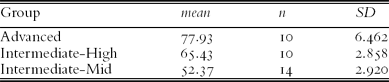
The L2 learners were assigned to one of three proficiency levels based on their combined scoresFootnote 2: the Intermediate-Mid group (n = 14), the Intermediate-High group (n = 10), or the Advanced group (n = 10) (Table 3). A one-way ANOVA revealed a significant difference between the L2 groups (F(2, 34) = 111.424, p <.0001) (Table 4).
ANOVA on proficiency test scores.

Proficiency test Scores’ Means and SDs.
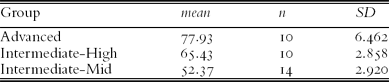
These means indicate that the L2 learners were at significantly different proficiency levels at the onset of the data collection.
5.4. Results of the composition
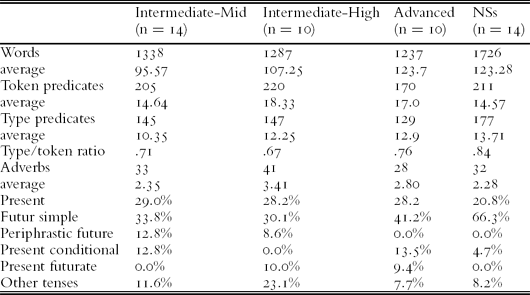
The participants were asked to write about something to which they were really looking forward, such as their college graduation or plans for the future. They were instructed to use at least ten different verbs and four adverbs (Table 5).
Composition results by groups.
NSs wrote more on average than the L2 learner groups, and their predicate type/token ratio is higher. L2 learners used a large number of morphological forms to encode the various predicates they produced: nine for the Intermediate-Mid and the Advanced groups, ten for the Intermediate High group. Contrary to the L2 learners, futur simple (66.3%) and present (20.8%) accounted for most of the predicates the NSs produced. Advanced learners also preferred futur simple (41.2%) and present (28.2%), while also producing predicates encoded with present conditional (13.5%) and futurate present (9.4%). The Intermediate-High group used futur simple (30.1%) almost as often as present (28.2%), and then futurate present (10.0%), closely followed by periphrastic future (8.6%). The Intermediate-Mid group also used futur simple (33.8%) almost as often as present (29%), then periphrastic future and present conditional equally (12.8%). However, future perfect was almost non-existent: the Intermediate-Mid group did not produce any; the Intermediate-High group produced four (two used correctly by one participant, two produced erroneously by two other participants); two participants produced two correct instances each in the Advanced group; however is was equally rare among the NSs (three NSs produced a total of four predicates).
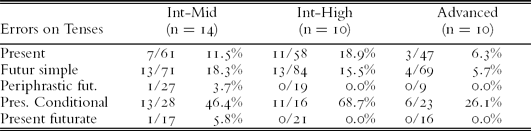
The L2 learners used a variety of morphological forms, but how successful were they in using the proper morphological form in its specific context? If a form was not appropriately used given its context (e.g., a conditional present instead of a simple future), it was classified as an error.Footnote 3Table 6 shows that the error rate varies with the morphological form and the proficiency level.
Errors rates for the most commonly used tenses.
The lowest error rates are for periphrastic future and present futurate – but they have the lowest number of tokens across all three groups – while the highest error rates are for conditional present, particularly for the Intermediate-High group who erroneously encoded 11 of the 16 predicates they produced. The error rate for futur simple is relatively low, especially considering the fact that it was used to encode the largest number of tokens (from 69 to 84 tokens): from 5.7% for the Advanced group to 15.5% for the Intermediate-High group, and 18.3% for the Intermediate-Mid group.
Examples of errors from each level of proficiency are displayed in (9)–(11):
(9) Intermediate-Low group
a. Quand je *fini mes études ici à l'université, je veux être infirmière.
When I finish-PRES my studies here at the university, I want-PRES to be nurse
‘When I finish my studies here at the university, I want to be a nurse’
b. J'arriverai chez moi vers le fin de Novembre pour celebrer avec ma famille. Ils *seraient très heureuse de me voir.
I arrive-FUT at home toward the end of November to celebrate with my family. They be-PAST COND very happy to me see
‘I'll be home towards the end of November to celebrate with my family’. They would be very happy to see me.
(10) Intermediate-High group
a. J’ habiterai donc ailleurs après que je *fini mes études à l'université.
I live-FUT so elsewhere after that I finish-PRES my studies at the university
‘So I'll live elsewhere after I finish my studies at the university’
b. Cette voyage sera la première fois que *j'aurais allé en France.
This trip be-FUT the first time that I go-PAST COND in France
‘This trip will be the first time that I would have gone to France’
(11) Advanced group
a. Quand je *suis tellement fatiguée que je ne *peux pas continuer, je m'asseoirai sur le pied d'un arbre.
When I am-PRES so tired that I can-PRES not continue, I sit-FUT at the bottom of a tree
‘When I am so tired that I cannot go on, I will sit down at the bottom of a tree’
b. Je pourrais continuer avec ce travail jusqu'au moment ou je *trouve un autre.
I can-COND to continue with this job until the moment where I find-PRES another
‘I could continue with this job until I find another one’
Table 4 indicates that the frequency of adverbial expressions did not correlate with the proficiency level: the Intermediate-High group used the most adverbs (41; average 3.41), while the Advanced group used the fewest (28; average 2.8); however, the NS group and the Intermediate-Mid group produced almost as many adverbs (32 and 33; average 2.28 and 2.35, respectively) (yielding a small negative Pearson correlation r (48) = -.071, significance (two-tailed) = .622; and χ2 (18) = 20.959, p = .252).
Finally, a qualitative analysis of the compositions reveals that the participants used futurity mostly to express volition, intentionality and prospection. They employed present conditional to convey a future probability, and the few instances of future perfect expressed eventuality, that is, a past relative to the future.
5.5. Results of the cloze task
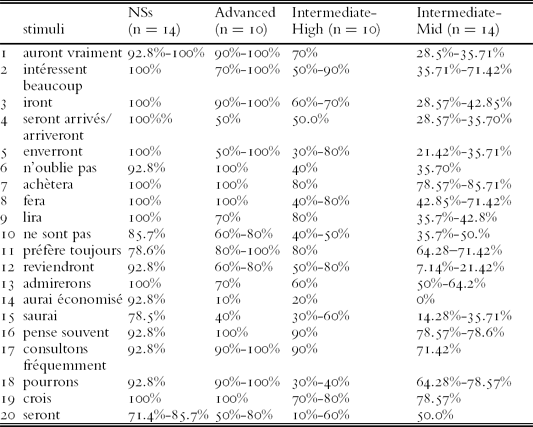
The cloze task was composed of 20 predicates (20 tokens and 19 types; see Appendix): futur simple (n = 11); futur antérieur (n = 2); present (n = 7). Four adverbs were used (vraiment, bien, beaucoup, souvent), along with two ne pas ‘not’. Participants were instructed to read the entire story before completing it by encoding the base form of the predicates with the appropriate form as required by the context. French language instructors checked the text for lexical and morpho-syntactic appropriateness. The preference was given to creating a natural, cohesive text, rather than attempting to balance the number of tokens for tense forms. Participants were given one point for each predicate encoded with the targeted form. Raw data were then computed to obtain full accuracy percentages (targeted tense was produced along with the proper inflection(s) and person/number agreement, and partial accuracy percentages (targeted tense was produced, but without the proper inflection(s) and/or person/number agreement). These results are displayed in Table 7.
Partial and full accuracy percentages on targeted morphological forms.
Note that when only one percentage appears, it means that there was no difference between partial accuracy and full accuracy (the percentage listed corresponds to full accuracy).
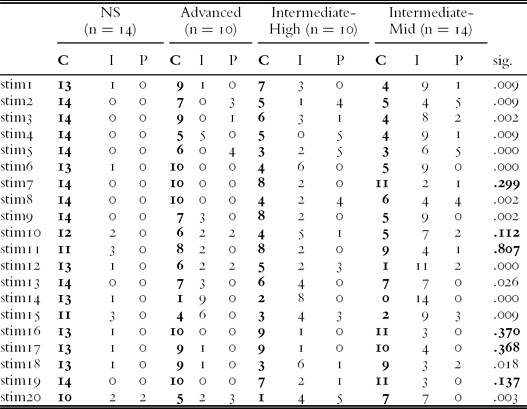
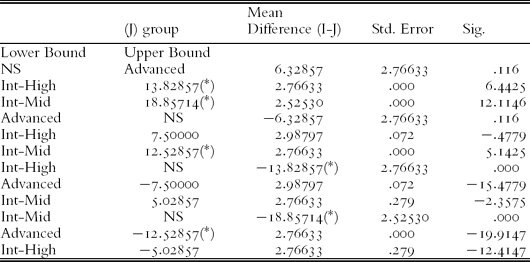
Table 8 lists the results of the Pearson chi-square analysis performed on the individual stimuli raw data. A significant difference was found for all stimuli except for stimuli 7 (achètera), 10 (ne sont pas), 11 (préfère), 16 (pense), 17 (consultons), and 19 (crois). Participants did well on all these stimuli except for stimulus 10. Then, the one-way ANOVA that was conducted on the total stimulus score is reported in Table 9 and shows a significant difference between stimuli (F (3, 44) = 20.724, p <.0001), while the results of post hoc Tukey tests are displayed in Table 10.
Chi-square analysis on raw data (cloze task).
Note. C = correct; I = incorrect; P = partial; Stim = stimulus.
One-way ANOVA on cloze task.

Post hoc Tukey on cloze task.
Note. * The mean difference is significant at the .05 level.
Table 10 shows that significant differences were found between:
- the NSs and the Intermediate-High group (mean difference = 13.8285, p <.0001)
- the NSs and the Intermediate-Mid group (mean difference = 18.8571, p <.0001)
- the Advanced group and the Intermediate-group (mean difference = 12.5285, p <.0001).
However, there was no significant difference between the NSs and the Advanced group, nor between the Advanced group and the Intermediate-High group, indicating an improvement of performance with proficiency level. Moreoever, Cronbach's Alpha was .907 (.912 based on standardised items), indicating a high reliability.
Let us consider the data in more detail. First, even the NSs do not always concur with the five NSs who tested the cloze task. For stimulus #10, a few chose ne vont pas être, for stimulus #11 it was préfèrera, for stimulus #15 sais was used instead of saurai, and for stimulus #20 a few of them produced sera (singular future instead of plural), or vont être. Futur antérieur was required in stimulus #14 and produced by all but one NS, whereas it was not required in stimulus #4 and only 35.7% of the NSs produced it. The L2 learners’ performance clearly increased with their proficiency and shows much greater variation that the NS performance, as could be expected.
None of the participants in the Intermediate-Mid group produced the futur antérieur for stimuli #4 nor #14, while 10% of the Advanced learners encoded both predicates with futur antérieur (40% chose futur simple for stimulus #4, as did 64.3% of the NSs); only 8.4% of Advanced learners selected futur antérieur for stimulus #4, but 20% did for stimulus #14. Seven predicates targeted present morphology. The L2 learners’ performance varied greatly from stimulus to stimulus. The Intermediate groups did poorly on stimuli #6 and #10. The Intermediate-Mid group performed poorly on all the predicates except for stimuli #16 (78.57%) and #19 (78.6%). The Intermediate-High group did very well on the last four stimuli (from 70% to 90%), but poorly on the first three (40% to 50%). Finally, 70% to 100% of the learners in the Advanced group encoded predicates with present tense morphology correctly.
The L2 learners’ performance on the 11 predicates that targeted futur simple seems to stress the differences between the proficiency levels even more than on the present. The Advanced group performed well with a 71.67% average. But the learners’ performance decreases below chance level with the Intermediate groups who obtained a low 49.17% average for the learners in the Intermediate-High group, and only a 37.32% average of the participants in the Intermediate-Mid group.
The L2 learners’ performance shows tremendous variation based not only on proficiency level, but also on tenses and predicates. However, the reader may recall that the percentages we examined were based on full accuracy: targeted tense had to be used along with the proper inflection(s) and person/number agreement. Table 6 above also displayed percentages for partial accuracy: the targeted tense was produced, but with erroneous inflection(s) and/or person/number agreement.
To summarise, the two elication tasks produced mixed findings: the L2 learners’ performed better on the composition than on the cloze task that revealed significant variations depending on morphological forms and predicates. There is also a clear proficiency effect from the lowest to the highest proficiency levels. However, all groups produced a variety of morphological forms to express futurity, and appear to be acquiring temporal and modal values associated with the future.
6. DISCUSSION AND CONCLUSION
Let us consider again our mixed findings in light of the research questions stated above.
1. How do instructed learners express future temporality? Do they use all three future expressions with equal frequency, and in a way similar to NSs? Or do they tend to overuse aller+ predicate as ‘going to + predicate? Or does their production reflect classroom input which tends to rely mostly on futur simple?
All participants demonstrated a growing ability to use various forms: present, futurate present, futur simple, periphrastic future and time adverbials. No, the three main expressions of futurity are not used with equal frequency based on the personal narratives, nor in a way similar to the NSs who used primarily futur simple. The L2 learners do not appear to overuse the simple future which is used along with the present; however, the periphrastic future appears to be underused compared to the other forms.
2. Do they use the futur antérieur, and respect tense concordancing?
No, very few participants produced instances of the futur antérieur, which appears to develop later than other tenses, which is not surprising given its low frequency in the input (Engel, Reference Engel2001). The participants produced few complex clauses that would have required tense concordancing, and when they did, their productions were usually not target-like as in the following examples. In the Advanced group, all productions were erroneous (the correct target form is indicated in brackets):
(12) Quand je suis-PRES [serai-FUT] tellement fatiguée que je ne peux-PRES [pourrai-FUT] pas continuer, je m'asseoirai sur le pied d'un arbre. [. . .] Quand je les ouvrai-PRES?
[ouvrirai-FUT], j'écrirai-FUT vite fait un poeme (pour ne pas perdre mes idées).
‘When I'm so tired that I cannot go on, I will sit at the bottom of a tree. When I open them, I will quickly write a poem (so that I don't lose my ideas)’.
(13) Après que je finisse-SUBJ [aurai fini-FA] à l'université, je voudrais-COND chercher un travail. Je pourrais-COND continuer avec ce travail jusqu'au moment où je trouve-PRES [trouverai-FUT] un autre.
‘After I finish the university, I would like to look for a job. I could continue with this job until I find another one’.
Thus, these learners fail to use future after quand, futur antérieur after après, and present or imparfait after si. Similar non-target-like uses of tense agreements were found in the production of the Intermediate-High group:
(14) Quand je finissai-IMP [aurai fini-FA] l'université, je pense-PRES que je vais travailler-PF [travaillerai-FUT] pour Adidas à Los Angeles.
‘When I finish the university, I think that I will work for Adidas in Los Angeles’.
(15) J'habiterai-FUT donc ailleurs après que je fini-PRES [aurai fini-FA] mes études à l'université.
‘Thus I'll live elsewhere after I finish my studies at the university’.
The following complex utterance – with two correct instances of futur antérieur – was produced by another learner in the Intermediate-High group:
(16) La semaine prochaine je serai-FUT très contente. J'aurai fini-FA tous mes devoirs et j'aurai pris-FA tous les examens de mi-semestre.
‘Next week I will be very happy. I will have finished all my homework and I will have taken all my midterm exams’.
Thus futur antérieur is not entirely absent in the L2 learners’ productions, but it is extremely rare, just as it is very infrequent in NS discourse.
3. Is there a decreasing reliance on adverbials as proficiency increases?
No, but a relatively small number of adverbs were used across all levels among the L2 learners as well as the NSs. One may speculate that even the participants in lowest level of proficiency, the Intermediate-Mid group, may have already been too advanced to rely on pragmatic and lexical means of expressing futurity instead of morphological means. There was no evidence of adverb-to-verb ratio decreasing over time as measured across three different proficiency levels. Thus, our findings do not support Moses’ (Reference Moses2002) conclusions for an overall systematic and uniform development of future expressions, following a clear pragmatic-lexical-morphological path – even the lowest proficiency L2 learners appear to dispose of a variety of morphological forms to express futurity – or did we find evidence of a present > periphrastic future > simple future sequence.
Lubbers Quesada (Reference Lubbers Quesada, Sagarra and Toribio2006) reports similar findings from an oral narration task performed by English-speaking learners of Spanish and native speakers designed to elicit past tense morphology and adverbials: there was very little difference in the ratio of adverb use among groups (0.30 to 0.39) and adverbial use is limited to marking ‘the internal temporal constituency of the event’ (Comrie, Reference Comrie1976; cited in Lubbers Quesada, Reference Lubbers Quesada, Sagarra and Toribio2006); it appears that verbal morphology does not replace adverbials, but develops along with them. However, processing studies reveal mixed findings: adverbs played a role in assigning verbal morphology in Musumeci (Reference Musumici1989), but did not affect learners’ reading performance in Lee (Reference Lee, Gutiérrez-Rexach and Martínez-Gil1999, Reference Lee2002); while Sagarra (Reference Sagarra and Han2008) reports that past temporal adverbs did not help L2 learners in processing verbal forms.
4. Will learners use appropriate inflectional morphology on predicates?
Yes. Not a single base form (infinitive or uninflected) was produced in personal narratives or in the cloze task. All the verbal forms were inflected for tense and number/person albeit with some inaccuracies. Some of the non-target forms produced show a tendency to overregularise future forms of predicates with irregular paradigms as alleraient and irent instead of iront (‘they will go’); envoyeront and enverrent instead of enverront (‘they will send’); ferra instead of fera (‘s/he will do’); serent instead of seront (‘they will be’); reveniront instead of reviendront (‘they will come back’); sacherai, saverai or savoirai instead of saurai (‘I will know’); and pouvoirons or pouvrons for pourrons (‘we will be able to’). In other words, difficulties reside in the mapping of tense to complex and multiple morphological forms, often irregular, not in acquiring the expression of futurity.
Regarding the learners’ mixed results of the two elicitation tasks, we will continue to argue that cloze tasks are more difficult than free production tasks in the form of compositions, which partially explains that learners’ performance is worse on the cloze task than on the compositions. One reason may be that participants have to process and understand the entire cloze text without the benefit of predicates marked for tense as important indications of the storyline. Second, they have to be able to adopt the same viewpoint as the narrator's, and finally, if they misinterpret the semantic value and viewpoint of even a few predicates early on in the storyline, they are likely to continue making erroneous assumptions throughout the cloze task. As it is well-known, participants’ behaviour on experimental elicitation tasks combines primary language faculties and general cognitive properties along with individual linguistic and extra-linguistic attitudes. Higher levels of proficiency will eventually lead to a more consistent performance on more demanding elicitation tasks, although the literature illustrates how empirical findings are rarely consistent across measures. A certain amount of ‘fuzziness’ or ‘indeterminacy’ (Sorace, Reference Sorace, Ritchie and Bhatia1996) seems to be a part of all grammars, non-native and native alike.
But the most important finding is that the L2 learners’ system shows contrasts and systematicity. The prospection/present relevance of future appears to be easier than the perfective/imperfective aspectual opposition of past temporal morphology, but in both cases there is a clear improvement in performance with levels of proficiency, suggesting that adult L2 learners can acquire temporal systems successfully.
Future research could address a methodological limitation of this study: several semi-guided production tasks, as opposed to the more general and open-ended production task, could be administered to elicit different future forms such as the periphrastic future and the futur antérieur, because they are used in specific contexts, as well as tense concordancing because they require complex clauses. Future research should also focus more specifically on the expression of the deontic and epistemic modalities of the future. This would allow us to address the specific learning issues stemming from the crosslinguistic differences between French and English.
APPENDIX CLOZE TASK
L'année prochaine mes parents _____(1)_____ (avoir vraiment) besoin de longues vacances pour visiter tous les pays européens qui _____(2)_____(intéresser beaucoup) ma mère! S'ils ont le temps, ils _____(3)_____(aller) non seulement en France mais aussi en Italie, en Grèce, et au Portugal. Dès qu'ils ______(4)_______(arriver), ils nous ______(5)______(envoyer) des cartes postales. Si elle ____(6)______(ne pas oublier), ma mère me ____(7)____ (acheter) un beau foulard en Italie. Elle _____(8)____(faire) du tourisme pendant que mon père ____(9)_____ (lire) les journaux à la terrasse d'un café. Pour lui, les vacances ____(10)_____(ne pas être) faites pour beaucoup marcher et faire des efforts: il ____(11)_____ (préférer toujours) la détente aux activités. Quand ils _____(12)_____(revenir), ils nous raconteront toutes leurs aventures et nous _____(13)_____ (admirer) leurs photos. Quand je ____(14)_____(économiser) assez d'argent, je ____(15)____ (savoir bien) où partir en voyage moi aussi! Je ____(16)______ (penser souvent) à mes vacances idéales. Avec mes amis, nous ____(17)_____ (consulter fréquemment) des cartes et des guides touristiques pour faire nos projets. Peut-être que dans deux ans nous ____(18)_____ (pouvoir) enfin partir tous ensemble: je ___(19)_____ (croire) que ce ____(20)_____ (être) les meilleures vacances de ma vie.