


Introduction
Obsessive-compulsive disorder (OCD) is a severe mental disorder characterized by repetitive and intrusive worries (i.e. obsessions), especially relating to taboo themes like sexuality, aggression, and blasphemy. Many patients fear that they may harm other people, particularly significant others (e.g. worry that one might stab or sexually assault one's children). Obsessive thoughts are usually followed by ritualized mental or motor actions aimed at neutralizing the obsessive contents or preventing feared consequences. A recent study (Adam, Meinlschmidt, Gloster and Lieb, Reference Adam, Meinlschmidt, Gloster and Lieb2012) found that OCD has a 12-month prevalence of only 0.7%, whereas subclinical forms are quite frequent (8.3%), suggesting that the transition from occasional (functional) OCD-like to dysfunctional OCD behaviour is gradual and quasi-dimensional rather than qualitative.
Currently, the treatment of choice is cognitive-behavioural therapy (CBT). Whereas randomized controlled studies assert the efficacy of CBT at a high effect size (Gava et al., Reference Gava, Barbui, Aguglia, Carlino, Churchill and De Vanna2007; O'Kearney, Anstey and von Sanden, Reference O'Kearney, Anstey and von Sanden2006; Rosa-Alcazar, Sanchez-Meca, Gomez-Conesa and Marin-Martinez, Reference Rosa-Alcazar, Sanchez-Meca, Gomez-Conesa and Marin-Martinez2008), up to 50% of the patients do not experience substantial symptom decline when drop-out rates are taken into account (Abramowitz, Reference Abramowitz2006; Pinard, Reference Pinard2006). Also, a considerable rate of patients are not seeking (Kohn, Saxena, Levav and Saraceno, Reference Kohn, Saxena, Levav and Saraceno2004) or even refusing (certain forms of) intervention, particularly exposure with response prevention (ERP; Kozak and Foa, Reference Kozak and Foa1997). Moreover, quality of life sometimes remains low in OCD patients after treatment (Moritz, Reference Moritz2008).
Inflated responsibility: the cognitive-behavioural viewpoint
Current cognitive models ascribe dysfunctional coping (e.g. rumination, thought suppression), cognitive biases (e.g. over-attention to threat, unrealistic pessimism) and dysfunctional beliefs (e.g. inflated responsibility, thought-action fusion) a core role for the pathogenesis of OCD (Obsessive Compulsive Cognitions Working Group, 1997, 2001, 2003, 2005). A large body of research in the domain of dysfunctional beliefs has been devoted to inflated responsibility (e.g. “I often believe I am responsible for things that other people don't think are my fault”, item from the Obsessive-Beliefs Questionnaire, (OBQ)). Some studies show higher inflated responsibility in OCD patients relative to controls (Obsessive Compulsive Cognitions Working Group, 1997, 2001; Salkovskis et al., Reference Salkovskis, Wroe, Gledhill, Morrison, Forrester and Richards2000; Steketee, Frost and Cohen, Reference Steketee, Frost and Cohen1998). However, not all studies could secure the specificity of inflated responsibility against psychiatric controls (Belloch et al., Reference Belloch, Morillo, Luciano, García-Soriano, Cabedo and Carrió2010). Salkovskis and others (Salkovskis, Shafran, Rachman and Freeston, Reference Salkovskis, Shafran, Rachman and Freeston1999; Salkovskis and Forrester, Reference Salkovskis, Forrester, Frost and Steketee2002) put forward five different pathways to inflated responsibility: 1. Heightened responsibility as a child; 2. Rigid and extreme codes of conduct as a child; 3. Overprotective and critical parenting leading to a lack of experience with responsibility as a child; 4. Incidents in which one's actions/inactions caused a serious misfortune; and 5. Incidents in which it appeared that one's actions/inactions/thoughts influenced a serious misfortune. The Pathways to Inflated Responsibility Beliefs Scale, devised by Coles and Schofield (Reference Coles and Schofield2008), aims at capturing these five aspects and the factor analytic results empirically validate Salkovskis's multidimensional causal concept, but suggest that factors 4 and 5 should be combined.
Inflated responsibility: the dynamic viewpoint
Alternatively, dynamic theories assume that moral attitudes and responsible behaviour are partly rooted in hidden anti-socialFootnote 1 attitudes. According to Freud (Reference Freud and Strachey1955), latent aggression lies at the core of the pathogenesis of OCD. This seems to contradict the aforementioned cognitive-behavioural understanding of OCD, which emphasizes the pro-social aspects of inflated responsibility. According to Whiteside and Abramowitz (Reference Whiteside and Abramowitz2005), who share a CBT-oriented understanding of OCD: “. . . clinical observations have suggested that individuals with this disorder [OCD] rarely present as angry or hostile. In fact, such patients often evidence considerable fear of being responsible for harm to the extent that even having angry thoughts about harming others provokes anxiety” (p. 106). Dynamic theorists may not fully disagree with this observation, as pro-social behaviour is interpreted as a façade concealing opposite motifs: “In fighting unconscious hostilities, the compulsion neurotic tends to be a gentle person in all his relationships and in a general way” (Fenichel, Reference Fenichel1945).
Primarily based on casuistic evidence, Freud (Reference Freud and Strachey1955) claims that OCD is the manifestation of a false compromise of the “ego” in reconciling the opposing demands of taboo (predominantly aggressive) urges (“id”) versus the individual's high moral (“super-ego”) attitudes. According to Freud, typical fears of patients with OCD, for example to commit horrible acts, and subsequent measures to banish these thoughts by means of compulsions and avoidance behaviour reflect the fundamental “id versus super-ego” conflict. Additionally, hypermorality and over-responsibility are regarded as an expression of “reaction formation” (Fenichel, Reference Fenichel1945), a defense mechanism or coping strategy aimed at concealing unacceptable wishes or impulses by adopting opposing impulses and behaviour. Kempke and Luyten (Reference Kempke and Luyten2007) write: “Hence, typical characteristics of the OCD patient, such as conscientiousness and perfectionism, are understood as attempts to control warded off hostile and sexual wishes” (p. 294). Yet, such strategies are only partly successful according to dynamic theories, and hence unwanted aggressive, sexual or blasphemous impulses return as obsessive intrusions (Fenichel, Reference Fenichel1945). Even though latent aggression represents mainly a dynamic construct, some CBT researchers have incorporated this aspect into their therapeutic models. Hand (Reference Hand and Falloon1988, Reference Hand and Pöldinger1991, Reference Hand1998) ascribes early deficits in social competence a key role for the development of aggression. Reasons for social deficits are multicausal and may reflect parental overprotection or frequent hospital stays that impede the formation of stable relationships to peers. This may first lead to social avoidance and at a later stage to the feeling that others are “bad” and should be mistrusted. In OCD, (latent) aggression serves to over-compensate low self-esteem according to Hand (Reference Hand and Pöldinger1991, p. 36).
Latent aggression and reaction formation
In the following, we will review the recent literature on (latent) aggression and reaction formation in OCD. Older studies (Manchanda, Sethi and Gupta, Reference Manchanda, Sethi and Gupta1979; Millar, Reference Millar1983) have been summarized by Stein and Hollander (Reference Stein and Hollander1993). In line with their hypothesis, Offer and colleagues (Offer, Lavie, Gothelf and Apter, Reference Offer, Lavie, Gothelf and Apter2000) found higher reaction formation in adolescents with OCD relative to clinical and nonclinical controls on the clinician-rated Ego Defense Scale (EDS; Pfeffer, Reference Pfeffer1986), whereas no difference emerged on the self-report Life Style Index (LSI; Plutchik, Kellerman and Conte, Reference Plutchik, Kellerman, Conte and Izard1979). The latter result is somewhat at odds with another study (Shoval, Zalsman, Sher, Apter and Weizman, Reference Shoval, Zalsman, Sher, Apter and Weizman2006), which found higher reaction formation (a typical item capturing reaction formation is “I try to be nice to people I don't like”) and “undoing” on the LSI in OCD patients relative to normal and several psychiatric control groups. Interestingly, OCD patients displayed higher scores on several indices of aggression and destructiveness, but had lower scores than patients with conduct disorder or anti-sociality.
Apter et al. (Reference Apter, Horesh, Gothelf, Zalsman, Erlich and Soreni2003) found that impulsiveness and violence in OCD were comparable to patient controls (with the diagnoses schizophrenia, affective disorder, eating disorder or conduct disorder), but much higher than in healthy people. The same was true for anti-social behaviour, whereby OCD patients only achieved half the score of the patient controls.
Whiteside and Abramowitz (Reference Whiteside and Abramowitz2004) found that nonclinical individuals with elevated OCD symptoms experienced more anger, with a tendency to suppress anger inwardly as measured with the Spielberger State-Trait Anger Expression Inventory (STAXI). In addition, high scoring subjects had difficulty in controlling anger relative to individuals low on OCD symptoms. When depression was controlled for, differences on the total score were diminished but still yielded a statistical trend. In their second study (Whiteside and Abramowitz, Reference Whiteside and Abramowitz2005), the authors detected elevated scores in OCD patients on the composite score of the STAXI. Differences to a control sample disappeared, however, when general distress was taken into account.
Results by Bejerot, Ekselius and van Knorring (Reference Bejerot, Ekselius and von Knorring1998) on adolescents indicate that OCD patients with personality disorders show elevated indirect aggression (e.g. slamming doors when angry) but normal levels of direct aggression (e.g. telling people off when annoyed, see also Radomsky, Ashbaugh and Gelfand, Reference Radomsky, Ashbaugh and Gelfand2007). Likewise, another study (Moscovitch, McCabe, Antony, Rocca and Swinson, Reference Moscovitch, McCabe, Antony, Rocca and Swinson2008) on four groups of psychiatric patients, including participants with OCD, found that those with panic, OCD, and social phobia reported a significantly greater propensity to experience anger. Again, depression moderated the relationship. In another study on an adolescent population (Guerrero et al., Reference Guerrero, Hishinuma, Andrade, Bell, Kurahara and Lee2003), OCD was associated with several comorbid psychopathological features, for example aggression and depression. More recently, higher aggression scores have been associated with hoarding symptoms (Storch et al., Reference Storch, Lack, Merlo, Geffken, Jacob and Murphy2007; however see Whiteside and Abramowitz, Reference Whiteside and Abramowitz2005).
In conclusion, results on overt aggression and hostility in OCD are equivocal ranging from lower-than-normal to higher-than-normal, with some but no solid evidence that latent (i.e. not openly expressed) and indirect acts of aggression are enhanced. Inconsistencies may stem from different methodologies (self-report questionnaires that often pool distinct features of aggression versus expert-rating scales) and samples (adult versus adolescent OCD patients; nonclinical subjects high versus low on OCD; comorbidities such as depression).
Interpersonal ambivalence
In two recent studies we pursued the hypothesis that the interpersonal attitudes of OCD patients are characterized by high interpersonal ambivalence: pro-social (e.g. high moral standards) co-exist with anti-social attitudes (especially calculating behaviour, distrust and latent aggression). To investigate this hypothesis, we constructed the Responsibility and Interpersonal Behaviours and Attitudes Questionnaire (RIBAQ), which consists of three subscales tapping pro-social (one subscale) and anti-social attitudes (two subscales). In line with our hypothesis and in accordance with findings from for example the Obsessive Compulsive Cognitions Working Group (1997, 2001, 2003, 2005) we found that patients with OCD displayed higher scores on items of the RIBAQ reflecting responsibility and worry for other people, particularly relating to significant others. Concurrently, latent aggression and suspiciousness/distrust were also higher than in nonclinical (Moritz, Kempke, Luyten, Randjbar and Jelinek, Reference Moritz, Kempke, Luyten, Randjbar and Jelinek2011; Moritz et al., Reference Moritz, Wahl, Ertle, Jelinek, Hauschildt and Klinge2009) as well as psychiatric controls diagnosed with anxiety disorders or depression (Moritz et al., Reference Moritz, Wahl, Ertle, Jelinek, Hauschildt and Klinge2009). To guard against the objection that latent aggression merely mirrors aggressive obsessions and thus represents a correlate or consequence rather than a prerequisite of OCD, we correlated the RIBAQ latent aggression subscale with aggressive OCD-related items which revealed no significant relationship, thus rendering a tautological relationship unlikely. In the second study (Moritz et al., Reference Moritz, Kempke, Luyten, Randjbar and Jelinek2011) distrust correlated modestly with the resistance factor of the Yale-Brown Obsessive-Compulsive Scale (Y-BOCS). Furthermore, of all the RIBAQ subscales distrust correlated most strongly with the Obsessive-Compulsive Inventory-Revised (OCI-R) total score. Adding validity to the hypothesis that inflated responsibility is partly an overcompensation of hidden negative attitudes, positive interrelationships emerged for the three RIBAQ subscales. However, these associations do not prove our theoretical model since other causal relationships remain possible. Lending further validity to the RIBAQ, the responsibility dimension was strongly correlated with the OBQ responsibility/threat subscale, whereas the RIBAQ latent aggression and distrust subscales were significantly correlated with an established measure of aggression from the revised Freiburg Personality Inventory (FPI-R; Fahrenberg, Hampel and Selg, Reference Fahrenberg, Hampel and Selg1989).
The present study
The aim of the present study was to independently replicate interpersonal ambivalence in OCD in a different clinical environment (see Method; the second author was the principal investigator). Second, we intended to provide a more fine-grained analysis of the latent aggression construct by looking at the most discriminating individual RIBAQ items. While item-wise analyses are prone to false-positive inference, they allow for more insight into the driving mechanism than subscales that marginalize specific information. We also assessed the percentage of participants with elevated interpersonal ambivalence, defined as participants who scored at least one standard deviation above the mean of the norm on both the pro-social and at least one of the two anti-social subscales. We assumed that patients with OCD display higher interpersonal ambivalence than controls, that is, a co-existence of pro-social (e.g. excessive worry for other people) and anti-social (e.g. suspiciousness, latent aggression) attitudes.
Method
Participants
Thirty-four patients with OCD were recruited from the outpatient clinic of the Psychology Department at the University Düsseldorf, Germany, as well as psychologists working in private practices. Diagnoses relied on the Structured Clinical Interview for DSM-IV (SCID; Michael, Spitzer, Gibbon and Williams, Reference Michael, Spitzer, Gibbon and Williams2002) and thorough psychological examination, respectively. None of the patients had any of the following conditions: drug/substance dependence, substantial neurological disorder (e.g. stroke, previous brain operations), current or previous episodes of schizophrenia or bipolar psychosis. Nine patients received antidepressant and/or neuroleptic agents.
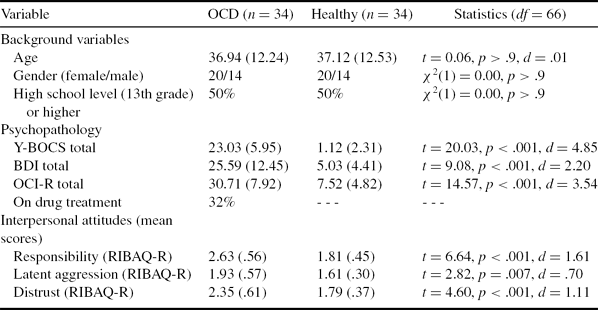
Thirty-four healthy subjects served as the control group. Participants were recruited via word-of-mouth and an existing subject pool. Subjects underwent screening for neurological and psychiatric disorders using medical charts. All participants gave written informed consent to participate after they had been fully informed about the study. Data were obtained in compliance with the Helsinki Declaration. Socio-demographic, psychopathological characteristics and RIBAQ-R scores are displayed in Table 1.
Background, psychopathological characteristics and RIBAQ-R scores

Notes: BDI = Beck Depression Inventory; OCI-R = Obsessive Compulsive Inventory-revised; RIBAQ-R = Responsibility and Interpersonal Behaviours and Attitudes Questionnaire Revised; Y-BOCS = Yale-Brown Obsessive-Compulsive Scale self-report version.
Instruments
Psychopathology
All psychopathological instruments were administered to both OCD patients and healthy controls. OCD symptom severity was determined using the self-rating version of the Yale-Brown Obsessive-Compulsive Scale (Y-BOCS; Goodman, Price, Rasmussen, Mazure, Delgado et al., Reference Goodman, Price, Rasmussen, Mazure, Delgado and Heninger1989; Goodman, Price, Rasmussen, Mazure, Fleischmann et al., Reference Goodman, Price, Rasmussen, Mazure, Fleischmann and Hill1989). The Y-BOCS has good to excellent psychometric properties (Taylor, Reference Taylor1995), which also apply for the German translation (Jacobsen, Kloss, Fricke, Hand and Moritz, Reference Jacobsen, Kloss, Fricke, Hand and Moritz2003) and the self-report version (Schaible, Armbrust and Nutzinger, Reference Schaible, Armbrust and Nutzinger2001). Subscale composition relied on a previously published algorithm (Moritz et al., Reference Moritz, Meier, Kloss, Jacobsen, Wein and Fricke2002). Depression symptom severity was determined with the Beck Depression Inventory (BDI; Beck, Reference Beck1995).
Obsessive-Compulsive Inventory-Revised (OCI-R; Foa et al., Reference Foa, Huppert, Leiberg, Langner, Kichic and Hajcak2002; German translation by Gönner, Leonhart and Ecker, Reference Gönner, Leonhart and Ecker2008). In addition to the Y-BOCS, OCD symptom severity was assessed using the OCI-R. Unlike the Y-BOCS, which measures the overall severity of obsessions and compulsions irrespective of contents, the OCI-R is a self-report scale that quantifies the severity of core symptoms across six subscales: Checking, Washing, Ordering, Hoarding, Obsessing and Neutralizing. The psychometric properties of the OCI-R are good (Abramowitz and Deacon, Reference Abramowitz and Deacon2006; Foa et al., Reference Foa, Huppert, Leiberg, Langner, Kichic and Hajcak2002; Huppert et al., Reference Huppert, Walther, Hajcak, Yadin, Foa and Simpson2007), which has been confirmed for the German version (Gönner, Leonhart and Ecker, Reference Gönner, Leonhart and Ecker2007; Gönner et al., Reference Gönner, Leonhart and Ecker2008). The German translations (Gönner et al., Reference Gönner, Leonhart and Ecker2007, Reference Gönner, Leonhart and Ecker2008) recommend a cut-off score of 18 for distinguishing OCD patients from controls.
Responsibility and Interpersonal Behaviours and Attitudes Questionnaire revised (RIBAQ-R)
At the core of the present investigation was the Responsibility and Interpersonal Behaviours and Attitudes Questionnaire (RIBAQ; Moritz et al., Reference Moritz, Kempke, Luyten, Randjbar and Jelinek2011, Reference Moritz, Wahl, Ertle, Jelinek, Hauschildt and Klinge2009). The RIBAQ was developed with the aid of clinical experts on OCD to assess responsibility-associated interpersonal attitudes and behaviours and was aimed at covering interpersonal ambivalence. Originally, the RIBAQ consisted of 10 subscales each with six items, which were further subdivided into three items relating to significant others versus three items relating to non-significant others (a 4-point Likert scale is used: do not agree at all – rather disagree – rather agree – fully agree). The long form of the RIBAQ consisting of 60 items was shortened to 32 items following factor analysis (Moritz et al., Reference Moritz, Wahl, Ertle, Jelinek, Hauschildt and Klinge2009), yielding three dimensions: “excessive worry and responsibility” (responsibility; 17 items; for example: “I am a very moral person and cannot even excuse small mistakes”; “I suffer from a strict conscience concerning my relatives”), “latent aggression and calculating behaviour” (latent aggression; 9 items; for example: “I am less moral than I pretend I am”; “Sometimes I would like to harm strangers on the street”) and “suspiciousness/distrust” (distrust; 6 items; for example: “I cannot even trust my own family”; “I rather take the burden of responsibility on myself, because I cannot rely on my friends”). Items were required to fulfill two core criteria: loadings had to be higher than 0.4 on a particular factor and showed at least a 0.2 difference to the loadings on the other two factors to ensure relative independence. The three RIBAQ subscales shared satisfactory to good internal consistency: “excessive worry and responsibility”, α = .87; “latent aggression and calculating behaviour”, α = .70; “suspiciousness/distrust”, α = .75. Speaking for the external validity of the RIBAQ, the subscale “excessive worry and responsibility” and the OBQ “inflated responsibility” subscale were highly correlated (r = .64, p < .001). The SCL-90-R aggression subscale was modestly but significantly correlated with “latent aggression and calculating behaviour” (r = .34, p < .001).
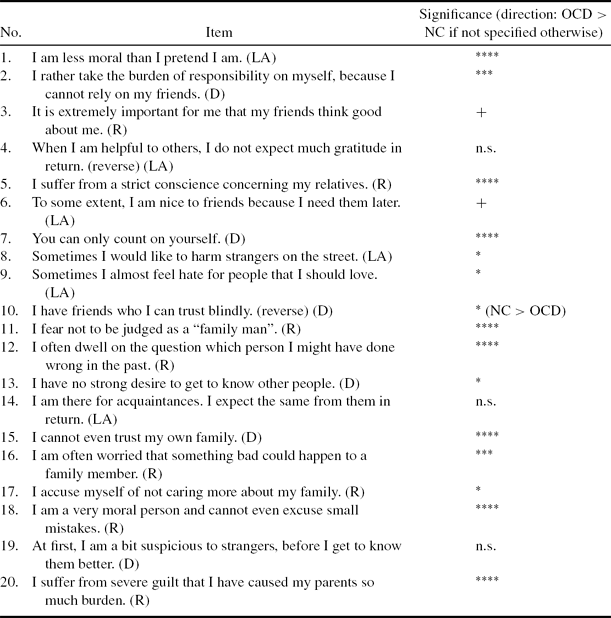
For the present study, we further shortened the RIBAQ blind to results to improve the homogeneity of the construct and deleted items not fitting the essence of the subscale based on experts’ assessment (RIBAQ-R; see Table 3). We deleted two items from the latent aggression subscale tapping “schadenfreude” (i.e. “When a little misfortune has happened to friends/relatives, I feel a bit pleasure (schadenfreude)”; “I am often a little amused/pleased, if a misfortune has happened to people who I do not know”). Another item loading on this scale in the prior factor analysis was also deleted as it shared no obvious connection with latent aggression (“I feel bad when I did not call a friend although I promised to do so” (reversed)). The excessive responsibility subscale was also shortened. Three items were judged as more relevant for perfectionism and over-estimation of threat (i.e. “I fear that people at work do not think that I am 100% reliable”; “Many friends of mine underestimate the risk of a terrorist attack or a disaster”; “My family thinks I see too many dangers and tend to paint the devil on the wall”). Six items were deleted as they appeared rather extreme (i.e. “To save the life of a relative, I would donate an organ”; “When a person is attacked, I immediately intervene”) or carried the character of items tapping social desirability (i.e. “The fate of abducted people touches me deeply”; “When there is thunder and lightning outside, I am worried that somebody is hurt”; “The victims of terrorist attacks have my deep compassion”; “I feel bad about not investing more time for welfare activities”). The distrust scale was rather homogeneous and remained the same. The short form (RIBAQ-R) consists of 20 items.
Results
Table 1 suggests that subjects were comparable on all major background variables. As expected, Y-BOCS, OCI-R and BDI total scores were significantly higher in the patient than in the control group. In accordance with our hypotheses, OCD patients showed higher scores on the RIBAQ-R subscales responsibility (very large effect size), distrust (large effect size) and latent aggression (medium to large effect size). The long form (see Moritz et al., Reference Moritz, Kempke, Luyten, Randjbar and Jelinek2011) and short form of the responsibility subscale were highly correlated at r = .91 (p < .001). For the latent aggression subscale, similar results emerged (r = .85, p < .001). The distrust subscale remained unchanged.
Interpersonal ambivalence
We calculated the degree of interpersonal ambivalence. For each scale, participants were dichotomized into low versus high scorers. Subjects were regarded as high scorers if their scores on a particular scale exceeded the mean values of the healthy control group by at least one standard deviation. For distrust, 62% of the OCD but only 23% of the healthy subjects showed increased scores, χ2 (1) = 10.16, p = .001. For latent aggression, discrepancies of similar magnitude emerged (OCD: 53% vs. healthy: 9%, χ2 (1) = 15.50, p < .001). The difference on responsibility was also significant (OCD: 71% vs. healthy: 15%; χ2 (1) = 21.70, p < .001).
Interpersonal ambivalence was assumed if participants achieved a high score on the responsibility scale and on either or both of the distrust or latent aggression subscales. A total of 59% in the OCD sample but only 12% of the healthy subjects showed this response pattern; the difference was highly significant, χ2 (1) = 16.48, p < .001. When we split the OCD group for obsessive thoughts, the degree of interpersonal ambivalence was the same (59%) in both subgroups, χ2 (1) = .00, p > .9. When we split the sample according to the Y-BOCS total score, the low (53%) and high (65%) groups were also indistinguishable, χ2 (1) = .48, p > .4.
Intercorrelations
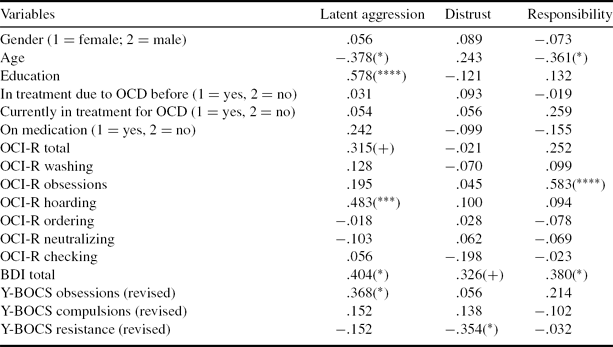
As predicted, the RIBAQ-R responsibility subscale was significantly correlated with the two negative interpersonal RIBAQ-R subscales latent aggression (r = .45, p < .001) and distrust (r = .47, p < .001), whereas the two negative subscales were not correlated (r = .19, p > .1). Latent aggression was at trend level correlated with the OCI-R total score (see Table 2). Hoarding was the single OCI-R subscale associated with latent aggression, but not with any of the other facets. The Y-BOCS obsessions score and the BDI total score also correlated with latent aggression. Distrust was only correlated with the BDI, whereas responsibility showed associations with the OCI-R obsessions subscore (but not the analogous Y-BOCS score) and the BDI. Medication with antidepressant drugs (yes/no) and gender (male/female) showed no association for any of the RIBAQ-R dimensions (nominal variables were dummy-code for correlations; r < .22, n.s.). Interestingly, education was correlated with latent aggression (r = .42, p <.001). However, this did not confound the present results as groups were indistinguishable on this background variable.
Correlations between the RIBAQ-R scales with background and psychopathological variables (OCD patients only, n = 34)
Notes: + p ≤ .1; * p ≤ .05; ** p ≤ .01; *** p ≤ .005; **** p ≤ .0001.
Individual items
A closer inspection of the individual RIBAQ-R items (see Table 3) shows that patients with OCD are generally more suspicious (item 7: “You can only count on yourself”), especially relating to significant others (e.g. Item 15: “I cannot even trust my own family”). In contrast, patients are often worried and over-caring for significant others (e.g. item 5: “I suffer from a strict conscience concerning my relatives”) but also expressed that this was partly due to selfish motifs.
Group differences on the revised Responsibility and Interpersonal Behaviours and Attitudes Questionnaire (RIBAQ-R)
Notes: OCD = obsessive-compulsive disorder; NC = normal controls
+ p ≤ .1; * p ≤ .05; ** p ≤ .01; *** p ≤ .005; **** p ≤ .001
LA = Latent aggression; D = Distrust; R = Responsibility.
Discussion
Our results largely replicate and extend findings from our previous studies (Moritz et al., Reference Moritz, Wahl, Ertle, Jelinek, Hauschildt and Klinge2009, Reference Moritz, Kempke, Luyten, Randjbar and Jelinek2011). Excessive responsibility and concern for the well-being of others was elevated in patients with OCD relative to controls at a very large effect size (d = 1.61). As shown in a previous study, this subscale is associated with the inflated responsibility construct of CBT as measured for example by the OBQ (Moritz et al., Reference Moritz, Kempke, Luyten, Randjbar and Jelinek2011). In psychoanalytic terms this facet allegedly reflects the influence of the “super-ego” hosting the moral and value system. Also in line with previous mainly dynamic-oriented research, and in seeming contradiction to the theoretical framework of CBT, distrust (especially towards significant others; large effect size: d = 1.11) as well as latent aggression (medium-to-large effect size: d = .7) were highly elevated at the same time in patients.
As expected, the pro-social and anti-social constructs were positively correlated. Although this result is in line with the hypothesis of a functional relationship, longitudinal studies are needed to ultimately confirm this causal hypothesis. We determined that 59% of the OCD patients but only 12% of the healthy controls had elevated scores on both the pro-social and on at least one anti-social subscale (defined as one standard deviation above the norm) in line with the contention that OCD patients share a high interpersonal ambivalence.
In accordance with the study by Storch and others (Reference Storch, Lack, Merlo, Geffken, Jacob and Murphy2007; however see Whiteside and Abramowitz, Reference Whiteside and Abramowitz2005), latent aggression was associated with hoarding. In contrast to our previous studies, none of the three RIBAQ-R subscales was significantly correlated with any OCD total score (for latent aggression a trend was achieved). Obsessions were correlated with latent aggression (Y-BOCS only) and responsibility (OCI-R only). Further research is needed to pinpoint the symptom correlates of interpersonal ambivalence. Interestingly, the BDI showed modest correlations with all three RIBAQ-R subscales, which is compatible with an earlier study by Whiteside and Abramowitz (Reference Whiteside and Abramowitz2004). However, we cannot yet infer whether high depression is a consequence of, for example, latent aggression inducing guilt or vice versa. Further studies should also investigate whether some frequent comorbid personality disorders such as schizotypal (including suspiciousness) and obsessive-compulsive personality disorder (OCPD; Coles, Pinto, Mancebo, Rasmussen and Eisen, Reference Coles, Pinto, Mancebo, Rasmussen and Eisen2008; Torres et al., Reference Torres, Moran, Bebbington, Brugha, Bhugra and Coid2006) moderate or even mediate the relationship between OCD and latent aggression. Latent aggression may be aggravated in cases with OCPD (de Reus and Emmelkamp, Reference de Reus and Emmelkamp2010).
In a next step, we plan to examine the causal factors that may lead to inflated responsibility and latent aggression and their functional relationships. The RIBAQ-R as well as the Pathways to Inflated Responsibility Beliefs Scale (Coles and Schofield, Reference Coles and Schofield2008) could be starting points but should be complemented by other scales tapping important moderating variables, for example thought-action fusion, levels of distress (i.e. latent aggression may partly reflect increased tension due to obsessive thoughts or exhausting compulsions) as well as thought suppression (i.e. thought suppression counter-intuitively enhances banned thoughts; this may both aggravate the frequency and the contents of aggressive thoughts as well as attempts to “undo” them by means of over-politeness and other pro-social behaviours). The course of illness also needs to be taken into account, particularly to shed light on the question of whether problems precede the outbreak of the disorder or occur afterwards. To illustrate, we regard interpersonal tensions in part as a vulnerability factor but also as a consequence of OCD (e.g. when relatives do not obey OCD rules imposed by the patient). We have recently put forward a vicious circle model attempting to explain the functional connection of responsibility and latent aggression (Moritz et al., Reference Moritz, Kempke, Luyten, Randjbar and Jelinek2011). High moral attitudes and latent aggression as well as distrust may fuel each other in yet not fully understood ways. In our view, high moral attitudes on the one hand partially serve the purpose to “undo” latent aggression (i.e. reaction formation) and may prompt the subject to choose more subtle (morally acceptable) forms of anger expression. On the other hand, high moral standards may also create tensions and latent aggression, as moral attitudes do not only evaluate, praise or punish our own actions or feelings, but also judge our social environment. Accordingly, if other people violate a strict moral value system, they may be judged negatively. Further, if over-politeness as a reflection of reaction formation is not returned as desired or at least credited by others, anger, distrust and latent aggression may (re-)surface.
Regardless of whether or not latent aggression is a vulnerability factor and/or consequence of OCD behaviour, it deserves greater consideration in research and especially intervention in view of its frequency (Hauschildt, Jelinek, Randjbar, Hottenrott and Moritz, Reference Hauschildt, Jelinek, Randjbar, Hottenrott and Moritz2010). We found that more than half of the patients disclosed interpersonal conflicts in their partnerships because of OCD; every second patient affirmed that he/she was aggressive towards their partner (Hauschildt et al., Reference Hauschildt, Jelinek, Randjbar, Hottenrott and Moritz2010). Moreover, latent aggression has been discussed as a risk factor for treatment failure (Hand, Reference Hand and Pöldinger1991).
If the core hypothesis is confirmed, the interpersonal conflicts of OCD patients may be tackled at various ends. Dysfunctional inflated responsibility should be made clear to patients; over-protective and over-caring attitudes may not only lead to one's exhaustion but may also foster resentments. Normalization may also prove beneficial as latent aggression, even towards close persons, is not uncommon in the general population (Moritz, Jelinek, Hauschildt and Naber, Reference Moritz, Jelinek, Hauschildt and Naber2010). According to an Internet survey with 100 healthy subjects, 63% disclosed that at times they feel great anger towards people they love (Moritz et al., Reference Moritz, Jelinek, Hauschildt and Naber2010). In our experience, demonstrating patients the frequency of such thoughts in the normal population leads to a major relief and decreases attempts to suppress such thoughts (which counter-intuitively often nurtures aggressive thoughts). In the framework of social competence training (Hand, Reference Hand and Pöldinger1991) the patient could be taught to express their own wishes and urges in an acceptable and socially competent manner and to allow oneself aggressive thoughts from time to time. This may also improve a tense relationship towards the therapist.
Our study faces limitations. First, the sample size was modest and we did not recruit a psychiatric control group. However, past research has shown that the interpersonal ambivalence is higher in OCD than in patients with depression or anxiety (Moritz et al., Reference Moritz, Wahl, Ertle, Jelinek, Hauschildt and Klinge2009). For future research it may also be worthwhile to investigate patients with borderline personality, where both latent and overt aggression is presumably higher than in OCD patients, whereas inflated responsibility is expected to be relatively decreased. Second, the relationship between the RIBAQ-R subscales and symptom severity was only modest. Moreover, our cross-sectional approach does not allow us to delineate causal conclusions, for example, whether latent aggression derives from a yet undetected higher-order factor or whether latent aggression is a trait rather than state factor that waxes and wanes with symptom severity. As mentioned before, these proposed relationships are only speculations and await formal verification. Path analysis may prove useful but would however require greater samples sizes and should consider factors not covered in our study (e.g. thought suppression). Case studies may also help to shed light on this issue.
To conclude, our study adds further evidence to the notion that latent aggression and interpersonal distrust, especially for significant others, play a role in OCD that is not only of interest for our theoretical understanding of the disorder but may also offer a new treatment mechanism for psychotherapeutic intervention. Further investigation may also help to overcome the traditional trenches between CBT and psychoanalysis.
Acknowledgements
The first two authors have equally contributed to the manuscript and thus share first authorship.



Comments
No Comments have been published for this article.