Coordination is considered to be a major challenge among the individuals, groups, and agencies responding to disasters and requires multi-agency and multi-jurisdictional effort with each having its own hierarchical systems for support flow of information.Reference Hossain and Uddin 1 Previous studies have documented that coordination is often insufficient among responding government agencies, volunteers, businesses, and humanitarian organizations.Reference Hossain and Uddin 1 , Reference Jackson, Buehler and Cole 2 Influenza A or A (H1N1) PDM09 and severe acute respiratory syndrome or SARS have been seen as the most severe communicable disease challenges to the public health system, causing governments of both developing and developed nations severe disruptions to normal life, business, and social intercourse at large. However, few systematic empirical studies have incorporated the relative value and contribution of multi-jurisdictional coordinated surveillance and response to the management of these outbreaks. When disease outbreak situations arise, a warning is communicated through various media, which serves as an instrument for forming coalition networks comprising multiple loosely linked organizations or ad hoc networks for responding to the outbreaks. These networks are important to successful coordinated surveillance and response because they bring the local knowledge of these disease outbreaks to the attention of the response coordination unit. The network in the affected communities can further assist in supporting local and state efforts to coordinate response and recovery. However, achieving this optimal scenario is a major challenge. The traditional approaches to coordination are to delegate maximum authority to a single actor, ie, a “coordination by command” approach.Reference Jackson, Buehler and Cole 2 - Reference Babbie 5 This approach has been contentious, mainly because of the difficulties in selecting a suitable government disaster response networking body. Therefore, creating a system in which local knowledge flows up and down the command structure most efficiently, and in particular, for the case of Australia’s complex federal system, is a major challenge.
Like many health authorities, the Australian public health system developed a flu pandemic management plan named the “Australian Health Management Plan for Pandemic Influenza”. This plan categorized 5 management phases: delay, contain, protect, sustain, and control that were later collapsed to 3: delay, contain, and protect. These plans should be updated upon the conclusion of any event for which the plan was activated for the introduction of major structural, organizational, or legislative changes in New South Wales (NSW), or at least every 5 years. New South Wales Health (NSWH) is responsible for the management effort, which starts with surveillance and passes through different components, some of which are:Reference Balicer, Omer and Barnett 4
-
∙ Various laboratories notify confirmed cases of influenza.
-
∙ The Public Health Real-time Emergency Department Surveillance System monitors in near real-time for influenza-like illness from most emergency departments in NSW.
-
∙ Public health units (PHUs) receive reports from clinicians or institutions of unusual cases.
-
∙ Samples of general practitioners (GPs) contribute data on influenza-like illness to sentinel surveillance systems.
-
∙ The Australian government supplies absenteeism data.
During the A (H1N1) PDM09 outbreak, NSWH implemented the following additional monitoring and surveillance measures:
-
∙ Active public health follow-up of possible and confirmed cases of pandemic influenza.
-
∙ Border screening for influenza-like illness in travelers from affected regions.
-
∙ Data provided through collaborative efforts of multiple hospitals (eg, national data on intensive care or pediatric admissions).
Furthermore, NSW was further divided into 8 local health districts, each with a local PHU that managed communication locally with health facilities such as hospitals, laboratories, and community health centers during the pandemic. Those laboratories and hospitals in turn communicated with NSWH directly, especially with specialized units within them, such as intensive care units. GPs in turn had different bodies to regulate them, and at the same time they communicated with the local and sometimes federal health authorities. The previous paragraphs provide just a small example of the different organizations that needed to communicate and collaborate during the A (H1N1) PDM09 2009 outbreak. All these organizations created a mesh of interconnected nodes comprising a large network of formal and informal relationships. Here, we present a study of the organizational social network structures during a disease outbreak and the performance of the network in coordinating the outbreak management.
Coordination of Disaster Medicine
The World Health Organization has defined a disease outbreak as “the occurrence of cases of disease in excess of what would normally be expected in a defined community, geographical area or season.” An outbreak may occur in a restricted geographical area or may extend over several countries. It may last for a few days or weeks or for several years. A single case of a communicable disease long absent from a population, or caused by an agent (eg, bacterium or virus) not previously recognized in that community or area, or the emergence of a previously unknown disease, may also constitute an outbreak and should be reported and investigated.Reference Kermack and McKendrick 6 Such outbreaks are usually beyond the capacity of a single jurisdiction or agency.Reference Balicer, Omer and Barnett 4 Rather, they require the collaboration of a distinctive pool of skills, resources, and authorities. The success of such coordination effort requires that “all relevant agencies be involved in the response and that effective structures are in place to coordinate them.”Reference Jackson, Buehler and Cole 2
One of the gaps in research is the application of social networks (ie, informal networks) to study inter-organizational coordination for a specific form of disaster, the disease outbreak. In such a coordination framework, different attributes of the node are used, the node being the agency or organization engaged in the coordination, and the nodes defined by its positional characteristics within the network. These network measures or attributes are those of the social network such as centrality, betweenness, and tie strength. The assessment criteria are then compared against a measured outcome. This modeling technique is based on the concept of independent variables influencing the outcomes of the process, which in turn are called the dependent variables. The independent variables are the network measures determined by the network structure. They in turn influence the dependent variables,Reference Babbie 5 which represent some type of performance or measure for the coordination process. The dependent variable should be a measurable and quantified value that can provide an outcome correlated with the independent ones.Reference Cleary and Angel 7
In coordination-related research, degree centrality was found to be an index of a position’s potential for activity in the network.Reference Freeman 8 Hossain et al showed that out-degree centrality had a stronger correlation to coordination than in-degree centrality.Reference Hossain, Wu and Chung 9 Hence, centrality has been chosen as a network-based measure to further determine its effect on coordination. Another network measure is tie strength, an important attribute for defining the quality of relationship between nodes. Several studies have focused on the strength of network ties as a source of different kinds of information exchange.Reference Granovetter 10 This relationship quality is specifically important during disasters and is directly linked to the frequency of information sharing and exchange.Reference Uddin and Hossain 11 An egocentric analysis of tie strength against coordination suggests that an increase in the quality of relationships can improve coordination attributes such as quality and accessibility of information and overall readiness for an emergency situation. That correlation may be due to the context of the data itself more than an overarching statement of tie strength.Reference Hossain and Kuti 12
The last network measure to be used is tier connectedness. Tier level refers to the layer in which an organization exists, such as federal, state, local, private, or other types. Tier connectedness can be used as a measure to assess the current state of actor involvement. It has been suggested that by increasing the efficiency of an actor’s tier connectedness within the network, an increase in the potential for the network to coordinate effectively may be found. Tier connectedness, henceforth called connectedness, works as an enabler of coordination efficiency rather than an inhibitor, by limiting the network involvement to the needs of a given tier, thus preventing the circulation of redundant or unnecessary information through the network as a product of excessive ties.Reference Burt 13 These 3 measures (ie, centrality, strength, and connectedness) are the independent variables. They are all indicators of how well an organization can coordinate and how efficient the coordination structure itself is. These measures have previously been used as independent variables to measure coordination in soft target organizations such as schools, parks, and sports facilities in disasters.Reference Hossain and Kuti 12
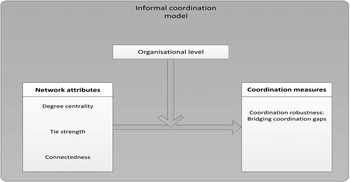
The dependent variable for disease outbreak is considered as communication robustness, which is defined in relation to the main reason for initiating informal coordination from the very beginning: bridging coordination gaps. Hence, as the dependent variable, coordination robustness is considered to be the perception of respondents as to the importance of informal coordination to bridge any gaps left by formal coordination. How effective was this form of coordination in bridging structural holes?Reference Burt 13 Structural holes give the node that is bridging them competitive advantage, because nodes at the edges of the chasm do not communicate directly with each other, as explained by Burt.Reference Burt 13 Within the context of coordination, and especially disaster coordination, it is important to cover those holes as effectively as possible during the emergence of the network structure. Hence, the informal coordination model uses the ability of informal coordination to close these gaps, as elaborated in Figure 1.
The Informal Coordination Model.

METHODS
Hypotheses Development
We present the investigation of informal communication structure during the coordination of the 2009 H1N1 pandemic. As highlighted previously, informal networks are formed when nodes (ie, agencies or individuals) find it mutually beneficial to reach out to each other to build shared understanding about issues important to the group. These networks have a tendency to grow spontaneously to satisfy personal needs.Reference Jackson, Buehler and Cole 2 In particular, these networks grow when there is a need for information to deal with the task at hand; they are fast and surprisingly accurately efficient vehicles for news and information.Reference Mintzberg 14 , Reference Waldstrøm 15 Such information needs grow when there is insufficient or inaccurate information at times of uncertainty or crisis,Reference Krackhardt and Stern 16 and thus such networks try to arbitrate information to cover these structural holes.Reference Burt 13 Hence, the coordination robustness or performance indicator for the informal network in this research is the perceived ability of these informal links to bridge the gap and cover those holes.
Hypothesis 1: Informal coordination is positively correlated with its ability to bridge coordination gaps with the degree centrality.
It is very likely that the more informal links a node creates, the more it will be able to obtain novel information otherwise unavailable via formal links. First, there must be a premeditated intention to create these links, and second, there must be awareness of the number of these needed links. In other words, the person occupying a particular organizational position reaches out to satisfy his or her information needs so as to facilitate coordination capability, hence limiting or extending the number of those links and thus controlling outbound centrality.
Hypothesis 2: Informal coordination is positively correlated with its ability to bridge coordination gaps with the tie strength.
Tie strength is related to the frequency of communication between 2 parties. Since the main reason for initiating an informal link is to obtain some required information, it is anticipated that the more the 2 parties communicate, the more they will share needed information and the more they will be able to coordinate common tasks, especially those that need extensive information sharing, such as disease outbreak coordination.
Hypothesis 3: Tier connectedness in informal coordination is positively correlated to information sharing and bridging coordination gaps.
Novel information needs tend to be from diverse resources existing in different repositories that are not necessarily defined in the standard operating procedures or able to be obtained via established links. Therefore, informal links need to extend beyond the preestablished cliques to cross jurisdictional and hierarchical levels to satisfy the need for novel information. The more a node is connected across tiers, the more it will be able to acquire varied information to coordinate complex and demanding tasks.
Moderating Variable
A moderating variable can be defined as one that affects the direction or strength or both of the relation between dependent and independent variables. In the proposed model, the moderating variable is considered as a third variable that affects the correlation between both variables. Moderating variables usually stem from the sociodemographic characteristics of actors such as their age, gender, locality, or position. It is of interest to discover whether a moderating variable might exercise an influence on the dependent variable. Since this research deals with organizational nodes, it was decided to use the organizational tier level of the respondent as the moderating variable. This would further enable us to verify whether there was influence of the organization’s tier on coordination performance. Introduction of the moderating variable gave rise to hypothesis 4:
Hypothesis 4: The relations between H1 and H2 are mediated by the moderating variable being the tier level of the organization that originates the link.
Data for this research were collected by using qualitative and quantitative methods. The qualitative part was designed to enhance and enrich understanding of the coordination process itself and to enable the researcher to have a “look behind the scenes.” The quantitative part facilitated reconstructing the networked coordination structure, and hence it was possible to apply critical validation and testing of it. Since the A (H1N1) PDM09 outbreak had occurred in 2009, the first practical step was to track the professionals who had a role in that outbreak. Then the qualitative questionnaire was administered to them for validation. After some interviews it was possible to design the quantitative questionnaire and hence to conduct follow-up interviews with those professionals.
Instrumentation and Data Collection
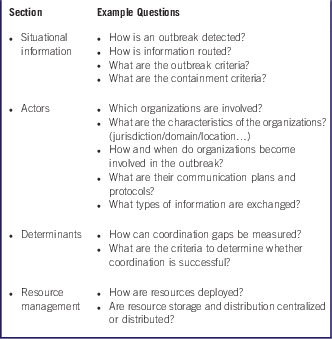
These initial questions were the foundation for developing the qualitative questionnaire, which in turn evolved to the final survey. The focal points that needed to be addressed were divided into (1) situational information, (2) actors, (3) processes, and (4) determinants and resource management. The next step was to dissect the research questions into tangible ones, which were in turn allotted to the focal points. These questions are elaborated in Table 1.
Summary of the Main Focal Points and Their Relevant Questions

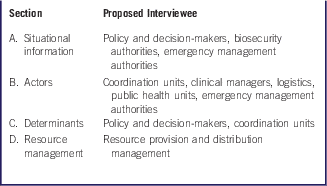
The interview questions were designed and planned carefully so that when they were executed, a systematic flow to the data collection process was achieved.Reference Miles and Huberman 17 , Reference Sudman and Bradburn 18 The questions were constructed in such a way to avoid resistance, suspicion, prejudice, and any sort of negative forces within the interview environment. The qualitative questionnaire was designed to target decision-makers, coordinators, and middle-level managers within the public health system. These people usually act as gatekeepers for incoming and outgoing communication within their organizations. They also act as policy-makers and determinants for any policy changes. Table 2 shows the proposed matrix for each section of the questions, along with the proposed interviewees. The titles have been generalized to suit different health authorities’ structures and names that might differ from one state or country to another. The responses to the qualitative questionnaire mainly established the following repositories:
-
1. Domain schema: A basic overview of the terminologies, processes, and workspace environment and sphere of the outbreak management.
-
2. Organizational matrix: A basic matrix of organizations and units that were used as a pool from which to select interviewees during the following quantitative phase.
-
3. An overview of the main determinants of the process, such as when and how an outbreak is announced.
Matrix of Proposed Interviewees for the Qualitative Questionnaire

This questionnaire was used in the first wave of interviews conducted between October and December 2010. First, we identified a group of experts, including academics and subject matter experts, with whom we engaged to capture information and obtain feedback about the survey. The positions of the persons interviewed were as follows: (1) senior public health management professional, (2) senior epidemiologist, (3) midlevel disaster management professionals working in health services functional area coordinator teams, (4) senior laboratory professional, (5) executive manager in GP division, (6) senior clinical pathology and medical research professor, and (7) midlevel health media communication unit manager.
Interviewees were chosen who had participated in the A (H1N1) PDM09 2009 pandemic. All the interviews were face-to-face; 4 were conducted in the Hunter New England Area Health Service and the rest were conducted within the greater Sydney region. The time of the interview was designed to be 1 hour only, but 3 of the interviews extended to be about 2 hours each owing to the wealth of information from some of the respondents and their willingness to share that information. The interviews were semi-structured. An advantage of the semi-structured interview was the questionnaire template that had open-ended questions that allow for the spontaneous flow of information. Semi-structured interviews have the benefit of flexibly adapting to suit the interviewee; they promote rich understanding of the data collected, which is considered to be a necessary prerequisite for building later surveys in the context of lesser known research.Reference Miles and Huberman 17 Designing a quantitative survey based on the relational quality of network methods requires a shift in thinking when it comes to research methodology. The network approach focuses on relations between nodes (organizations in this case) rather than between subjects’ attributes. Hence, study design, data collection, and data analysis incorporated this relational perspective, requiring unique approaches to each.Reference Luke and Harris 19 Data collection focused on data about nodes and their relations with each other. The survey, “A National Assessment of State and Local Law Enforcement Preparedness” prepared by RAND Corporation was adopted as the basic structure for the survey developed for this research.Reference Riley and Hoffman 20 Interestingly, RAND’s survey and the dataset it generated have been used in other research and several papers.Reference Riley and Hoffman 20 - Reference Fricker, Jacobson and Davis 22 The RAND survey contained questions developed to investigate the relationships between organizations at different jurisdictional levels and how they communicated with each other during preparation for terrorism response planning. In the present research, it was customized to suit outbreak coordination in a multi-networked environment.
RESULTS AND DISCUSSION
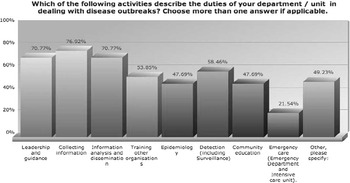
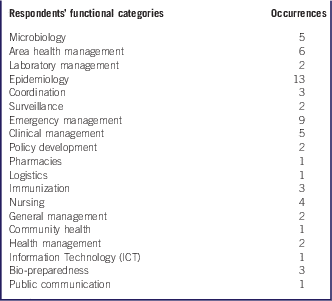
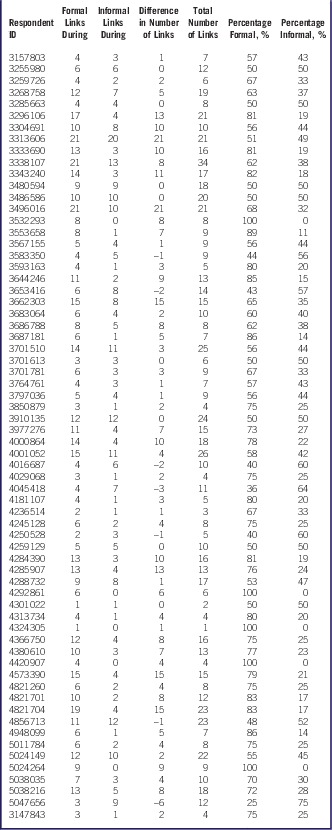
The interviews were conducted with a widely diversified group of actors whose positions and functions demonstrated the complexity of coordinating disease outbreaks. The information about the positions and tasks of the respondents was further condensed into 19 generalized functional categories, with the number of respondents identified in each category. Table 3 shows those categories and the number of respondents in each. Figure 2 highlights the tasks performed during the outbreak. This section briefly highlights some of the network-based information, such as the percentages of links. It is to be expected that organizations tend to initiate more links during a time of crisis as part of their effort to acquire more information or resources from others. Table 4 presents the comparative statistics between the formal and informal links during the outbreak.
Tasks Performed During the Outbreak.

Number of Respondents in Each Functional Category

Comparative Descriptive Analysis Between Numbers of Formal and Informal Links During Outbreak

It can be noticed that 92.54% of the respondents, that is, the overwhelming majority, used both formal and informal forms of coordination during the outbreak. Only 7.46% of them remained faithful to formal coordination only, showing strict adherence to the hierarchical structure. Two of those respondents, 5024264 and 4420907, expressed their commitment to the standard operating procedures and directly indicated that they did not branch out to any other communication channels. Respondent 5024264 worked in the NSW Ministry of Health. All other respondents stated openly that they used informal communication. Respondent 4420907 worked in the NSW State Disaster Emergency Management Center, Health Section. This center, which hosted the ambulance and other disaster management facilities, was structured on a hierarchical basis and hence informal coordination was not part of the organizational culture. Nevertheless, informal coordination was widely used across environments during the disease outbreak alongside formal coordination.
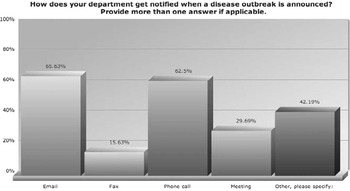
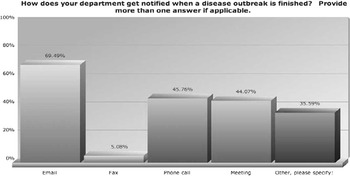
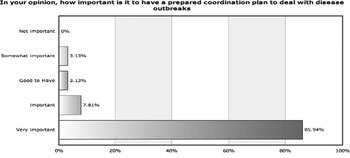
We further explored additional descriptive statistical graphs of data obtained from several questions that were not used for model analysis but nevertheless shed light on the mechanics of the coordination process. The results to question 7, “How does your department get notified when a disease outbreak is announced?” are charted in Figure 3. The responses to question 9, “How does your department get notified when a disease outbreak is finished?” are charted in Figure 4. The responses to question 11, “In your opinion, how important is it to have a prepared coordination plan?” are shown in Figure 5. The responses to question 14, “In case you provide input to policy development for other departments/units/organizations, which levels do you provide that input to?” are presented in Figure 6.
Notification of Disease Outbreak.

Notification of Disease Outbreak is Finished.

Importance of Having a Prepared Coordination Plan.

Policy Input at Jurisdictional Levels.

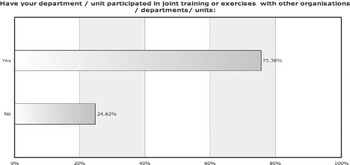
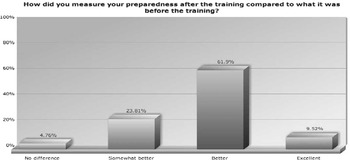
In question 21, we asked about participation in training with other organizations; Question 24 followed this: “How do you measure your preparedness after the training comparing to what it was before?” These results are charted in Figure 7 and Figure 8, respectively.
Percentage of Organizations That Participated in Joint Training With Others.

Preparedness After Training.

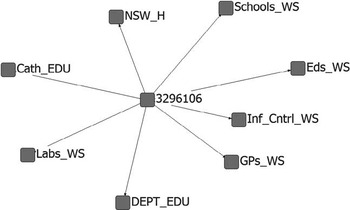
The data were downloaded in raw csv files; hence, it was first necessary to reorganize the data along each respondent’s contacts to create an ego star network for each respondent. In other words, each respondent had to be isolated along with her contacts. An example is given in Figure 9. This figure warrants some discussion, as much later information is built on top of such networks. The number in the middle, 3296106 represents the respondent or ego. All the links branching out are the communications that the respondent had with targeted organizations during the outbreak. From such a star network, network measures such as centrality can be easily deduced. To provide a broader perspective of the network, Figure 10 shows how the respondent’s network above was linked to those of other respondents.
Hypothesis 1: Degree centrality of informal coordination is positively correlated with the ability to bridge coordination gaps.
Ego Network of Respondent 3296106.

Extended Networks of Three Respondents.

This hypothesis suggests that the higher the number of informal connections of the actor, the more robust that actor’s coordination will be, because these links will enable the actor to bridge coordination gaps or structural holes. The correlation and t-test results between degree centrality during the outbreak and informal coordination (ρ=0.422 and t-test=0.006) indicated that there was a direct correlation between the number of links and the ability to bridge across structural holes, as in trying to acquire more information and resources.
Hypothesis 2: Tie strength of informal coordination is positively correlated with the ability to bridge coordination gaps.
This is where tie strength, as in the frequency of communication, was tested for any correlation. The results showed a correlation (ρ=0.319 and t-test=0.019) between tie strength during the outbreak and coordination performance in informal coordination. This means that the null hypothesis was invalid.
Hypothesis 3: Tier connectedness in informal coordination is positively correlated to information sharing and bridging coordination gaps.
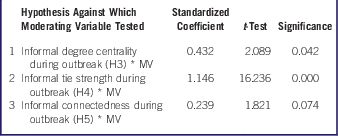
Would the existence of informal links to diverse organizations at different jurisdictional levels help to bridge the gaps? This is what this hypothesis addressed. Again, correlation was checked between the independent and dependent variables. The results indicated a direct correlation (ρ=0.417 and t-test 0.07) between tier connectedness during the outbreak and informal coordination, which means that the null hypothesis was invalid. Hence, there was an association between the ego initiating links with nodes at different jurisdictional levels and the use of these links to overcome gaps that might occur during formal coordination. The organizational tier level was used as the moderating variable and moderating variable regression results were calculated only for those hypotheses that had indicated a correlation between dependent and independent variables. The results are presented in Table 5. Tier level influenced coordination performance when combined with degree centrality and tie strength. For the following hypotheses, the moderating variables were significant (P<0.05) and affected coordination as the dependent variable: H3 (informal coordination, degree centrality, during outbreak; P=0.042) and H4 (informal coordination, tie strength, during outbreak; P=0.000).
Moderating Variable (MV) Significance Calculations

CONCLUSIONS
The informal communication network is a mapping of personnel who exchange work-related information or services outside standard formal structures. These networks are surely expected to increase during crises as the need for collaboration surges. It is important to highlight that there is no current theory in general that suggests an optimal structure for the informal relations in an organization, let alone in a crisis situation and especially in the disease outbreak context. Some research has been conducted using a different construct, and the results were corroborative with unstructured communication reducing influenza hospitalizations similar to informal communications having improved coordination robustness.Reference Streftaris and Gibson 23 The correlation results for the degree centrality of the informal network show that it is positively correlated with performance. That means that the ego’s performance is related to the number of links he or she establishes informally—outside the standard operating structure—during the outbreak. The results further show that informal networks are purposefully formed rather than being dictated by operating manuals and procedures. These links are built on the basis of need and mutuality. The ego accesses her or his requirements and needs and outreaches intentionally to satisfy that need. Hence, the more links that egos create, the more it is expected that they will be able to coordinate and acquire their needs. Using Krackhardt and Hanson’s analogy, we can suggest that formal organization is like the skeleton of the company, whereas informal organization is the central nervous system driving the collective thought process, actions, and reactions of the business units.Reference Krackhardt and Hanson 24
This explains the main difference between centrality in formal and informal coordination. In formal coordination for disaster medicine,Reference Bdeir, Hossain and Crawford 3 centrality is pre-designed and assigned on the basis of the wider organizational structure, which in many cases may be suboptimal, and carries the burden of assigning resources to communicate that might not even necessarily affect coordination. On the other hand, informal coordination is a premediated and conscious decision by the ego to increase the centrality stemming from the awareness of needs. Therefore, the ego will direct these links directly to the target (alter) that can help. Also, egos will be willing to commit resources to this communication cost since they will assess that the reward is greater than the effort or cost. For example, the complaint about repetitive messages received in formal communication was discussed. Tier connectedness in informal coordination has the same role as in formal coordination, namely, to communicate to other jurisdictional levels and acquire resources from higher-level authorities. Informal tier connections might follow the same pattern as formal ones, as discussed by Uddin and Hossain,Reference Hossain and Kuti 12 where egos will look for local resources and then try to connect to higher-level tiers as they need resources, information, and decisions. However, the difference between the 2 types of links is that informal ones are consciously built and maintained based on the health worker’s prior knowledge of alter, and through this particular alter, objectives can be achieved. Usually this requires that both nodes know each other beforehand and that a mutual trust relationship exists between them. The result for informal tier connectedness during the outbreak shows that it was correlated with coordination performance, similar to the formal coordination result. This is a logical result, especially for informal coordination, as informal networks are quick to grow and transmute according to changing circumstances.Reference Groat 25 Connecting to other tiers means that the health workers are diversifying their links due to their own needs and requirements while trying to communicate more quickly at the same time.
One important note is that in a hierarchical system, such connectedness is not desired nor allowed. Yet, in the networked organizational domain, informal tier connectedness is usually an accepted and tolerated practice to the extent that some contended that 70% of communication occurs at the informal level. One important feature that stimulates informal tier connectedness is that informal networks transmit messages faster than do formal ones. This means that information reaches its destination before formal communication does. Tie strength has been defined as the frequency of communication between 2 nodes, be it daily, weekly, or monthly, as a representation of the quality of relationship between those nodes. Informal tie strength also differs in its dynamics from formal tie strength. It is based on needs and mutual agreement between both ends of the link. A health worker who initiates a link does so only for the sake of coordinating more resources or to communicate information—outward or inward. The party on the other side of the link is willing and accepting of this form of communication, owing to mutual trust and benefit. Yet, both of them know that this channel is activated in need and hence there is no requirement for it to be active on a frequent basis, weekly or daily. This link will be used only when there is need to communicate or coordinate. Hence, increasing or decreasing the frequency of communication should be directly related to the sense of necessity for coordination and should reflect back to enhance coordination performance. Informal networks can therefore be instrumental in bringing the formal and community-based ad hoc networks with an aim to facilitate the transmission of information from the community for making the overall disaster medicine and public health preparedness strategy effective.