1. Introduction
There is a long tradition in economics that goes back to Olson (Reference Olson1982, Reference Olson1993) and North (Reference North1981), in which the state is modelled as a ruler who provides protection for revenue. The ruler extracts rents from its constituents as a discriminating monopolist, subject to constraints. One constraint is its potential rivals within or without society. Yet another is the ruler's own self-interest, for extracting onerous rents or outright expropriation can lower what it can extract in the future. In addition, high extraction risks costly retaliation or even political upheaval – especially if a ruler is dependent on its constituents for its administrative organization. In short, countervailing economic and political power raises the ruler's cost of extraction, constraining its ability to benefit from its coercive power.
The economic approach to political power has since spawned different strands of literature. One strand has embedded the maximization problem of the ruler in a more general problem of effort allocation, focusing on the welfare cost of constraining coercion and violence. Agents who are in an infinitely repeated interaction observe each other's choices, and make sequential strategic decisions in each period on how much effort to allocate to producing resources, building their coercive power to protect their own or to raid that of others, or yet expending it on consumption or leisure that cannot be expropriated. Equilibria in which rights are respected occur under different institutional configurations (e.g. with or without a ruler), distinguished by their welfare cost measured by deviation from the first-best allocation of effort with no coercive power.Footnote 1 Another strand theorizes about the rise of democracy, focusing on elites and their interaction with the wider society. Autocracies are thought to be less constrained in violating property rights than democracies (e.g. Albertus, Reference Albertus2015; Ansell and Samuels, Reference Ansell and Samuels2014; Haber, Reference Haber, Weingast and Whittman2006; North, Reference North1990), and elites are thought to have more ability to safeguard their privileges under the latter (Albertus and Menaldo, Reference Albertus and Menaldo2014; Mainwaring, Reference Mainwaring1999). However, authoritarian rule might also better serve elite interests, in which case elites accept democracy only when non-elites force them to. In their influential work, Acemoglu and Robinson (Reference Acemoglu and Robinson2006, Reference Acemoglu and Robinson2012) conflate elite and state power to argue that elites find it in their interest to concede gradual redistribution and transfer of power to non-elites when they fear the alternative can be revolution resulting in total expropriation of their wealth. In their view democratic reforms arise so that elites can commit to their promises of transfer of power and redistribution. A very different approach is taken by North et al. (Reference North, Wallis and Weingast2009), for whom democracy is the byproduct of efforts to institutionalize intra-elite coalitions based on impersonal relationships. They take issue with treating elites, as well as the state, as unitary actors: “Because they are not unified, elites cannot intentionally decide to do anything, let alone decide to share power” (p. 149). Starting out as “disparate groups that compete and cooperate, and sometimes go to war with each other” (p. 148), elites might create formal institutions and unify only after “conditions allowing impersonal relations among [them] are created” (pp. 148–9). Similarly, treating the state as a single actor, they argue, “assumes away the fundamental problem of how the state achieves a monopoly on violence,” which misses how elites commit to stop competing through violence by forming coalitions and constitute the state in the process.
The emphasis on dispersed power brings to the fore the elites’ collective action problem. Because they are locked in competition for power and resources, elites cannot show cooperative self-restraint in the absence of a unified power that can punish defectors. At the same time, a unified power can abuse its power if not deterred. The current paper discusses how elites can manage to develop capacity for collective agency through coordination. The challenge for elites is to simultaneously deter the state from abusing its power while relying on it to discipline defectors in their midst. The paper's basic insight is that the ruler's threats to the defectors have credibility when they are not too costly to carry out, which elites can control when they coordinate. Expected widespread elite (non-)compliance makes its threats less (more) costly to carry out and thus more (less) credible. At the same time, the ruler can expect elites to be (non-)compliant when its actions and threats (do not) serve their interests.
The collective action problem of the ruled, whether they are the elites or the citizens more generally, is widely recognized, though the literature focusing on its solution remains relatively thin. Barzel (Reference Barzel2002) argues that the ruled need to put in place a “collective action” mechanism before the ruler acquires power, which implies that specialization in production must precede specialization in protection. But as he also recognizes, putting in place a “collective action mechanism” implies infinite regression, which itself requires collective action. Barzel holds that the problem can be surmounted when the ruled build their capacity for acting collectively through repeated interactions with non-state third-party enforcers, and the state prefers a cooperative relationship once it faces constituents who can act collectively. Based on similar logic, Weingast's (Reference Weingast1997) approach focuses on how the state can credibly restrain itself so that it can reap the benefits of cooperation. However, neither explores in any detail the coordination dynamics that might be involved in how the ruled are unified in making the state's predatory option inferior.
A number of recent papers have focused on coalition formation. In Skaperdas (Reference Skaperdas1998) coalitions arise when they present opportunities for increasing productivity, and in Garfinkel (Reference Garfinkel2004) their size dampens the intensity of conflict because of free-rider dynamics. Closest to this paper, Van Besouw et al. (Reference Van Besouw, Ansink E. and van Bavel2016) and Van Bavel et al. (Reference Van Bavel, Ansink and van Besouw2017), model elite coalitions in natural states, as discussed in North et al. (Reference North, Wallis and Weingast2009). Conceptualizing the productive base of the economy as a common pool resource, they analyze equilibrium states where elites’ payoff in and out of coalition are equal and find that a tradeoff exists between order and resources. The current paper's approach differs mainly in its focus on punctuated equilibria that arise from changes in elite coordination. The approach yields insights not only into how elites can collectively deter power abuse but also into why coalition size tends to cumulate in either direction. A coalition not only helps contain violent competition, but also enables elites to internalize the cost of over-extracting from direct producers, where the associated benefit is higher the larger its size. However, the process can also work in reverse when elites failing at collective action see their coalition size fall below a certain threshold. Finally, at a more general level the paper's approach builds on Ostrom's (Reference Ostrom2015) insight that groups manage to cooperate by first solving coordination problems.Footnote 2
The organization of the paper is as follows. Section 2 conceptualizes the state and elites using the club theory of goods, and defines the nature of elites’ collective action problem in game theoretic terms. Section 3 shows how the state and elites can make simultaneous credible threats. The credibility of the state's threats depends on the cost of carrying them out, which is lower (higher) when elites are compliant (non-compliant). Elite counter-threats in turn are credible when their coordinated non-compliance can raise significantly the state's cost of carrying out its own threats. Section 4 focuses on elite coalitions, addressing both how they can prevent over-extraction and consolidate over time. The paper ends with a brief conclusion.
2. Elites and the state: a club in a club
North (Reference North1981) traces the state's roots to communal exclusions that made possible the gradual transition from hunting/gathering to settled agriculture in early antiquity around eight to nine thousand years ago. In his view, the need to prevent resource depletion and capture the returns from investment on land required putting in place exclusions in the form of communal property rights. He writes, “primitive agriculture, which must have been organized as exclusive common property, had the advantage over hunting in terms of the efficiency of the property rights. It is inconceivable that, from the very beginning, the first farmers did not exclude outsiders from sharing the fruits of their labors” (p. 81).Footnote 3 The state emerged to enforce communal property rights, making possible drastic productivity increases in agriculture and the population spurt it supported. While North does not use the term club, his account of the emergence of the state suggests that its very essence was to transform open resources into club goods through exclusion.Footnote 4 Outsiders had to be excluded and insiders regulated, both of which required an organized capacity to wield coercion (Tilly, Reference Tilly1990) that could be effective in safeguarding the group from outside threats and “constraining its members with taboos, rules and, almost as effectively as if property rights had been established” (p. 81).
How the club is run – i.e. the way the state provides its services in assigning and enforcing property rights – is itself a good, whose type can similarly vary. For instance, in their earlier work, North and Weingast (Reference North and Weingast1989) assume an analytical structure that includes the ruler (or the ruling or dominant faction) and the people as the two main actors. The former either makes its services freely available to all (public good) or acts as a maximizing monopolist that bestows protection when it is beneficial to do so (private good). By contrast, in their later work with John J. Wallis, the analytical topography changes with the inclusion of elites as a potential third actor (North et al., Reference North, Wallis and Weingast2009). The starting point is dispersed power where neither the public nor private good configuration holds because the ruler cannot fully discriminate in whom it bestows favors upon, or make its services available to all if it were so inclined. With constituents that can transgress with relative impunity, its services resemble more an over-extracted open resource than a private good.
Under conditions of dispersed power, elites are in a Prisoner's Dilemma whose default outcome is mutually costly non-cooperation. Escaping their dilemma requires that they can commit to acting in cooperative self-restraint. This might happen through either a durable intra-elite coalition or an all-powerful ruler who can impose order. The latter case takes us back to protection as a private good, as in North and Weingast (Reference North and Weingast1989), except here its opposite is open resource rather than the public good configuration.Footnote 5 When, alternatively, elites manage to form durable coalitions they must have a developed capacity for acting collectively, and that begs the question how they achieved this.
Elites are customarily defined in terms of their violence potential, which enables them to appropriate wealth, monopolizing income-generating assets. The “vertical” exclusion of direct producers must be self-enforced under dispersed power, requiring elites to have their own capacity to wield coercion. Elites maximize rents when they can refrain from over-extraction and mutual predation. A coalition that can check its competition ipso facto takes the form of an owner's club, one that is distinct from the state even when it might draw on it for legitimacy and organized coercive power.Footnote 6 But how do elites develop the capacity for collective agency that this implies? Conflating the state with elites or treating it as their instrument might be a convenient analytical shortcut but it begs the question; if the state is made to function as their collective organ, elites must be capable of preventing their rivalry from getting in the way. At the same time, why does the state not usurp elites’ wealth by pitting one elite against another?
Ignoring potential challenges from below, elites face two related challenges in developing capacity for collective agency: (1) disciplining defectors among their midst – and, ideally, relying on the state to do so, and (2) collectively deterring the state from abusing its power. There is a need for “third-party support of [their] coalition,” as there must be a “credible way to discipline elites” (North et al., Reference North, Wallis and Weingast2009: 20). That is, before committing to acting in cooperative self-restraint, individual elites need a commitment device that can make them confident that others will also commit. Provided its threats are credible, the state can be an effective commitment device, but of course it also needs to be deterred from power abuse. Putting the two challenges together, what resolves the elites’ dilemma is the credibility and thus the deterrence capacity of two simultaneous threats: one made by the state to deter opportunistic defection by potential elite transgressors and the other by elites to collectively deter the state from abusing its power.
The problem can be stated in stylized terms. Consider the familiar dyadic Prisoner's Dilemma payoff matrix, where it is assumed that α > β > θ > μ. Both players are better off refraining from violence and jockeying for opportunistic advantage (β1,β2) than when neither does (θ1,θ2), but Column (or Row) benefits even more if she is the only one who does not: μ 1,α 2 (α 1,μ 2). The Nash equilibrium, when neither self-restrains, is suboptimal for both. Mutual deterrence based on reprisal threats can help elites escape their dilemma, but that only produces a “fragile peace” (Bates, Reference Bates2001: 47), which is no more stable than the power balance it presupposes. Alternatively, they can rely on multilateral threats of sanction against defection enforced by their coalition (and the state as its organ) to reduce the temptation payoff below that of cooperation: $\alpha _i^{\prime} \lt \beta _i \lt \alpha _i$ (i = 1,2), which transforms the Prisoner's Dilemma into an Assurance game.
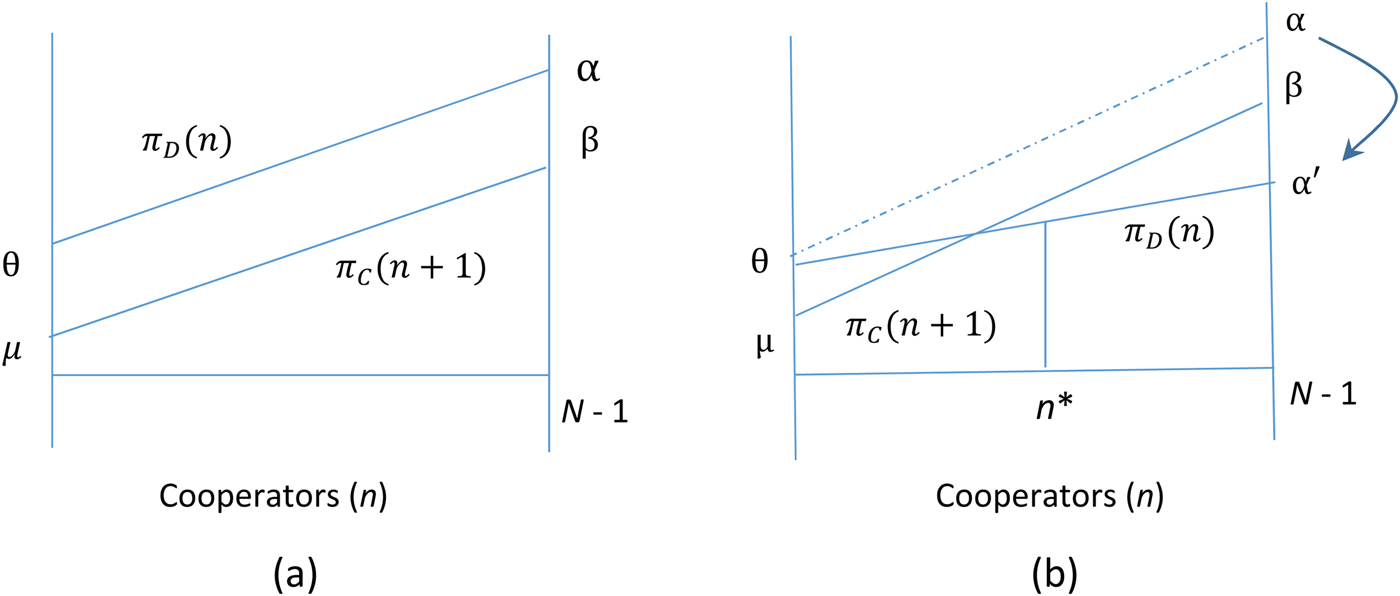
Figure 1 gives an N person extension, where n is the number of cooperating individual elites, π D(n) the expected defection payoff and π C(n + 1) is that of cooperation. In panel (a), the expected defection payoff π D(n) lies above π C(n + 1) throughout, indicating that n = 0 is the only Nash equilibrium. In panel (b), by contrast, the expected defection payoff is lowered by a punishment threat, causing mutual restraint to become self-enforcing when π C(n + 1) lies above π D(n) once the number of cooperators exceeds n*. In this latter case, three Nash equilibria exist at: n = 0, n = n* and n = N. The middle equilibrium is unstable and the other two are stable, with the expected payoff of defection higher for n < n* (and lower for n > n*). This suggests that the number of cooperators tends to diminish (increase) in the former (latter) case. Of the two possible stable Nash equilibria, mutual restraint (n = N) becomes more likely the lower the threshold value n*, since it then takes fewer initial cooperators before the expected cooperation payoff exceeds that of defection. It follows that the greater the fall in their expected defection payoff (α′ < α), the more likely elites are to escape their dilemma.
Transformation of Prisoner's Dilemma into an Assurance game

The transition from Prisoner's Dilemma (panel a) into an Assurance game (panel b) presupposes that the state disciplines the defectors among elites. But the question remains: what makes the state's threats credible and how do elites deter power abuse? Elites face a ‘chicken and egg’ problem as in North and Weingast's (Reference North and Weingast1989) famous adage. On the one hand, the state should not be too strong if it is to be kept in check, and, on the other, it should also not be too weak to punish defectors – without this, elites cannot coordinate to project a reprisal threat.
3. Simultaneous threats and elite coordination
Elites cooperate by first solving a coordination problem. As remarked above the solution to elites’ dilemma revolves around the ability of both the state and elites in making simultaneous threats to each other that are both credible. The credibility of the ruler's threats depends on the cost of carrying them out, which is higher (lower) when elites coordinate in being compliant (non-compliant). Elites choose to be compliant (non-compliant) when the ruler's threats (do not) serve their collective interest. On the other hand, what makes elites’ threats credible depends on how costly their coordinated non-compliance is for the state. The following considers first the credibility of the state's threats and then the effect that elite coordination can have.
Ruler's threats
The state enforces the rules it imposes on its constituents by threatening sanctions against their violators. But at the subgame stage following a transgression, the ruler might choose not to mete out its threatened punishment if it would be better off not to. When other transgressors realize this, they can thenceforward choose not to heed its threats, since they think the ruler is better off turning a blind eye – being lax rather than strict – when they transgress. This makes the state's deterrence strategy subgame equilibrium imperfect.
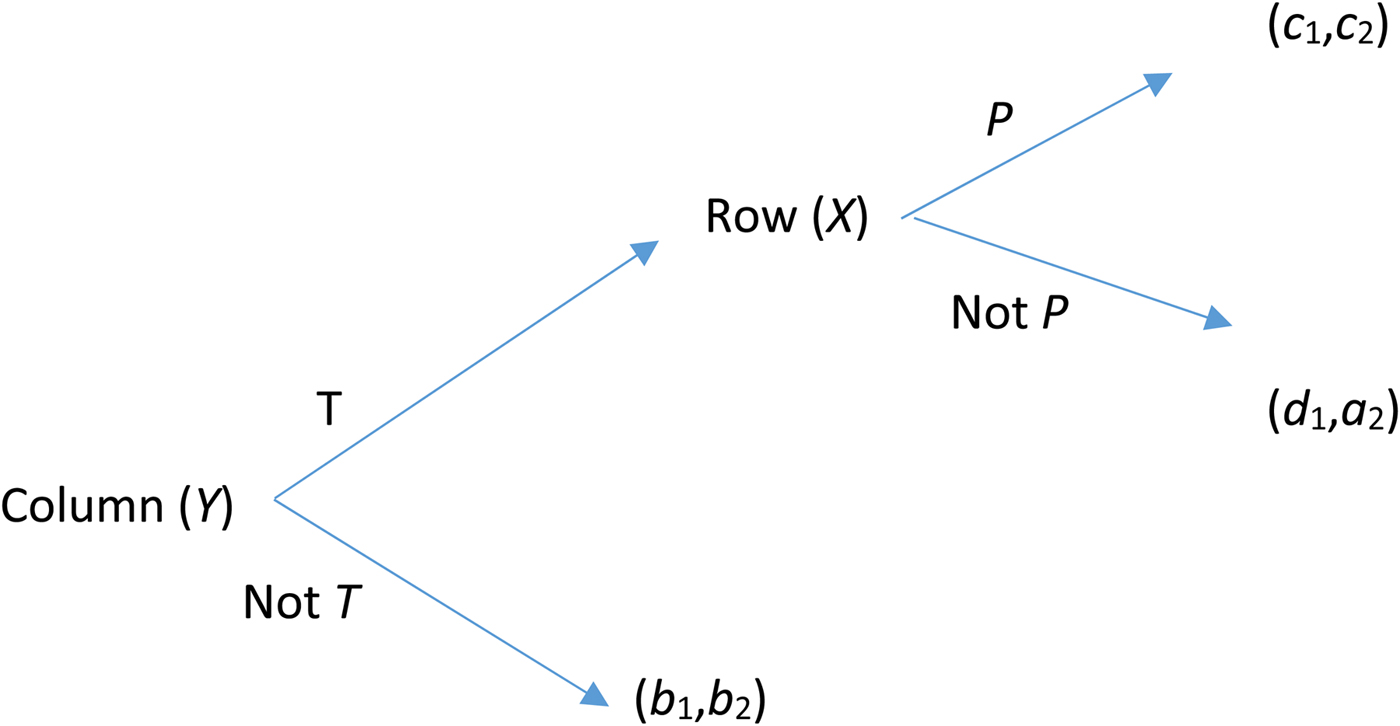
In stylized terms, consider the set of payoff combinations in sequential play in Figure 2, where the ruler (X) threatens to punish a potential transgressor (Y) if it does T. The respective payoffs remain unchanged (b 1,b 2) when Y heeds the threat; and, if it does not, X has to decide if it carries out the punishment (P) it threatened. If it chooses not to it receives the low payoff (d 1: d 1 < b 1) while Y gets away with the high temptation payoff (a 2: a 2 > b 2); and, if it does, both players end up with inferior payoffs (c 1 < b 1, c 2 < b 2). But X might not want to carry out the punishment it threatened when it is better off turning a blind eye, i.e. if its low payoff is higher than its punishment payoff (d 1 > c 1). In this situation, Y can ignore it X’s deterrence threats as cheap talk, provided it believes that X is a rational maximizer.Footnote 7
Threats with subgame imperfect equilibrium

Elite coordination
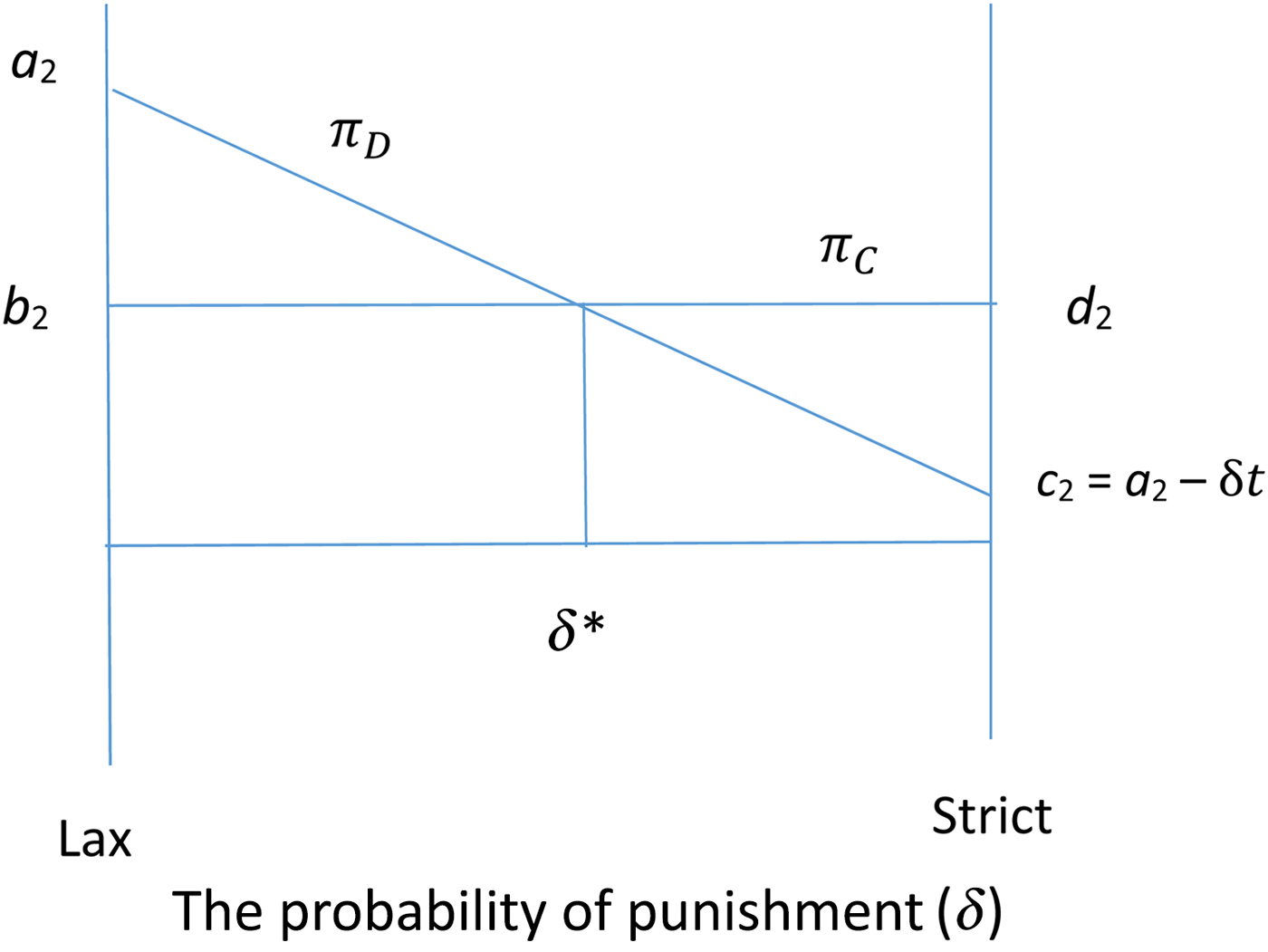
We can next look at the ruler's credibility problem from the point of view of elites. While the state's cost of carrying out its threats rises when more elites are non-compliant, the cost of non-compliance for the individual elite depends on how strict the state is. Figure 3 depicts the individual elite's expected payoffs from non-compliance (π D) and from compliance (π C), both as functions of the expected enforcement intensity (or the probability of punishment) by the ruler. The expected non-compliance payoff is at its highest (a 2) when expected enforcement is very lax (i.e. the expected probability of punishment is low) and at its lowest (c 2) when it is very strict. The ruler's threat of sanction t, which it enforces with probability δ, reduces the potential transgressor's expected non-compliance payoff to a 2 – δt. At some critical probability threshold, δ*, the two expected payoffs are equal; and,at any probability below (above) it the non-compliance payoff is higher (lower) than that of compliance: a 2 – δt > b 2 (a 2 – δt < b 2). Thus, with a given t, whether a potential elite transgressor takes the ruler's threats seriously or not depends on the value s/he assigns to δ. If s/he thinks δ is low (high), its compliance payoff might exceed the non-compliance payoff, and s/he is (un)likely to transgress.
Elite payoff from defection versus compliance

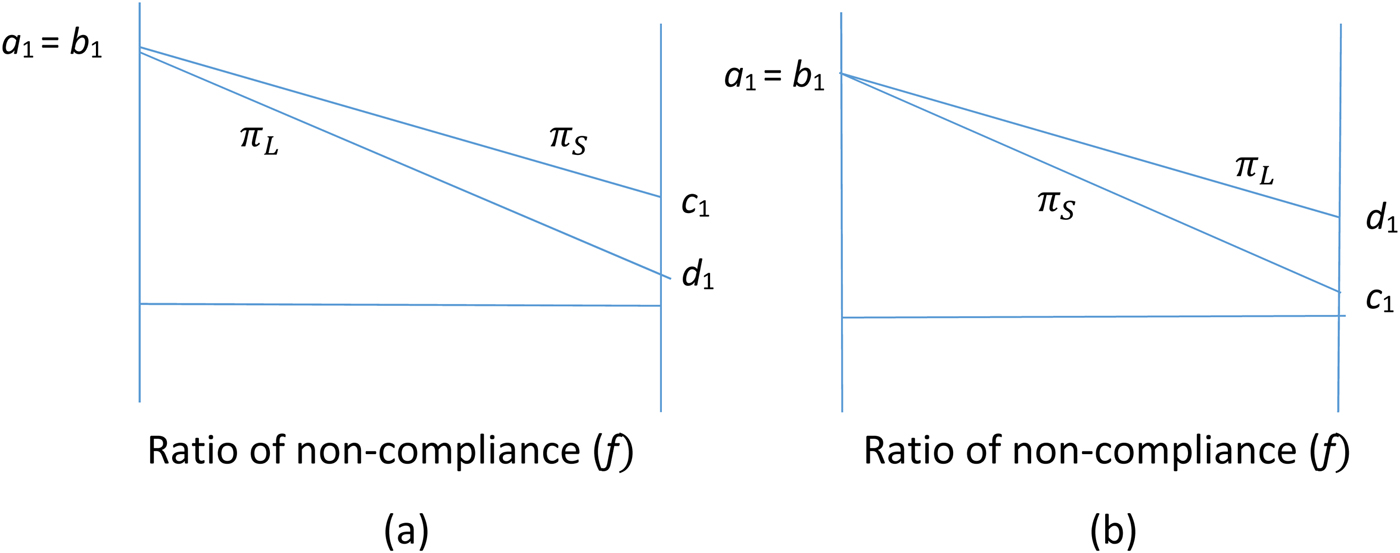
In forming an expectation about δ, the potential transgressor considers the problem from the ruler's point of view, and observes that the payoff from either strategy, being lax or strict, depends on its cost of punishment, which rises with the level of compliance. The cost of being strict is higher when non-compliance among elites is more widespread, but so is that of being lax, since the ruler can expect that small infractions will snowball when they are ignored early on. In other words, the ruler would expect both payoffs (from being lax and strict) to be decreasing in the non-compliance ratio. If the ruler's expected payoff from being strict (π S) is likely to fall faster, the potential transgressor will assign a low value for the probability of punishment by the ruler(δ), and vice versa. Figure 4 depicts these two possible cases in panels (a) and (b). Facing increasing non-compliance, the ruler prefers being strict in the former and being lax in the latter.
The ruler's payoff from being lax versus strict

The potential transgressor would know what value to assign δ if s/he could tell which case is more likely. But s/he would also need to form an expectation about what other elites will do. For if s/he were the only one who is non-compliant the ruler can punish him/her with relative ease. In other words, individual elites make their decisions based not only on what they think about the state of the world, but also based on what they expect other elites will do.
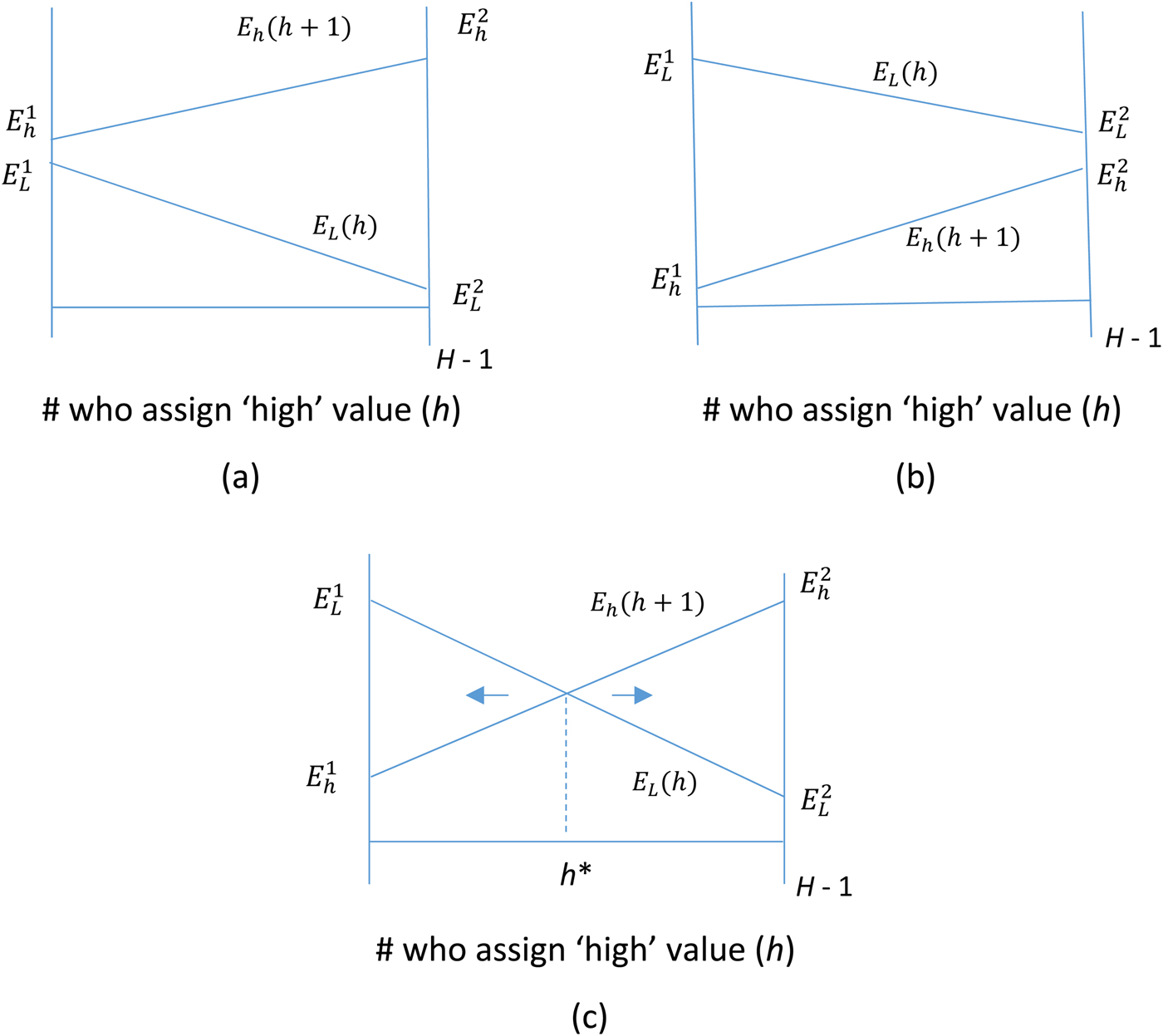
The expected payoff of assigning a high value for δ rises from $E_h^1$ to $E_h^2$
 at its highest as others do the same, while that of assigning low value (E L) falls from $E_L^1$
 to $E_L^2$
 . Three different configurations are considered in Figure 5. In panel (a) the ruler is objectively all powerful, such that all elites expect it to be able to afford to be strict in the face of rising non-compliance, which suggests that the individual elites’ expected payoff of assigning a low value to δ, even when s/he expects everyone else also to do so, might still be lower than that of assigning a high value. In this case, the expected payoff of schedule E L lies below E h throughout since $E_h^1 \gt E_L^1$
 , which suggests that the ruler can afford to lower elites’ defection payoff (α ′ < α) regardless of what they do. In this case, the state's threats are credible, and elites can escape their dilemma but only on the ruler's terms. In the other extreme case shown in panel (b), power is dispersed (open resource configuration) such that elites remain stuck in their dilemma. They are forced to invest in their own capacity to wield coercion and be prepared for costly open conflict whenever the power balance is upset. The ruler here is too weak to impose discipline, and potential defectors find it easy to assign a low value to δ. The individual elites’ expected payoff for assigning a high value even when everyone else also does so falls short of that of assigning a low value ($E_L^2 \gt E_h^2$
 ), which means that the expected payoff of schedule E L lies above E h throughout.
When do elites coordinate?

In the intermediate range between the two extremes (panel c), shifts in elite coordination give rise to punctuated equilibria. For instance, elites might coordinate behind the “good” threats they heed in one equilibrium while disregarding the “bad” ones in the other. When the ruler's threat serves elites’ collective interest, such as when it targets defectors, the individual elites assign a high value for δ expecting that others will also. With the expected payoff of assigning a low value now relatively lower, the expected non-compliance ratio is also lower. That in turn makes the ruler's threat more credible as the cost of carrying it out is now lower. By contrast, in the case of threats inimical to their interests, elites’ expected non-compliance payoff exceeds that of compliance as each one assigns a low value to δ expecting others to do so as well. This makes the threat inconsequential, as the ruler's expected cost of carrying it out becomes too high.Footnote 8 In other words, in the case of “good” threats both the ruler and the individual elites expect h > h* (and h < h* in the case of “bad” ones), and coordinate accordingly. The Nash equilibrium is then at h = H in the former case, and at h = 0 in the latter.
Violent competition between elites can thus be contained in either of two configurations. One, under conditions of balanced power where changes in elite coordination give rise to punctuated equilibria (as in panel c), and the other, when an all-powerful ruler can make credible threats that reduce their defection payoff regardless of what they do (panel a). As the discussion in the next section shows, these are also the two configurations in which the over-extraction of the productive base can be prevented. While violent competition and over-extraction are contained either way, elites remain significant actors in the first case only. In the other case, where they are not, the economic resources they control are likely to become insignificant as well – not without important consequences historically.Footnote 9
4. Elite coalition and resource extraction
As Van Bavel et al. (Reference Van Bavel, Ansink and van Besouw2017) remark, the productive base that elites extract from resembles a common pool resource where each individual elite has control over a part. Over-extraction and rent dissipation are salient problems since property rights are not secure under conditions of violent power competition. Extracting less today to have more tomorrow risks expropriation by those whose higher extraction rate gives them an edge in belligerence capacity in the present. The result is a short-run tendency for individual extraction rates to equalize, which means that elites cannot prevent over-extraction except collectively.
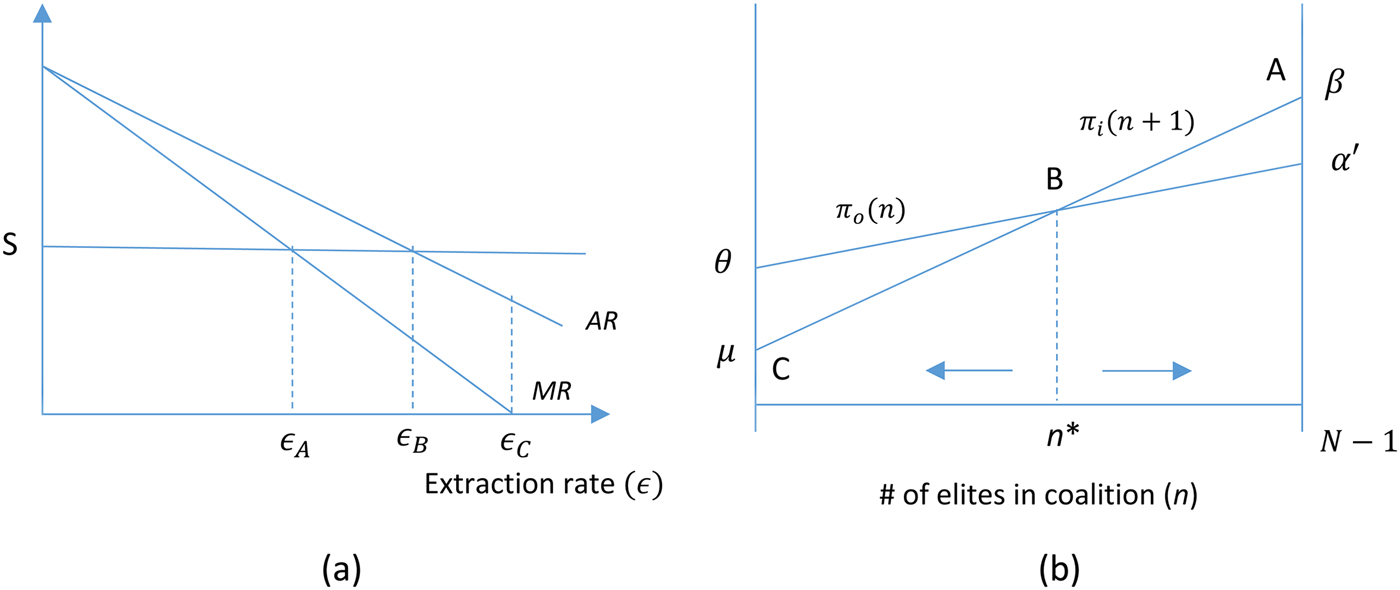
Figure 6, panel (a), depicts a common pool resource with falling average and marginal revenue in the extraction rate (ε), and where S is the subsistence level equal to the reproduction cost of direct producers. If a single agent owned the resource, the extraction rate would be optimally set equal to ε A where marginal revenue equals marginal cost (MR = S). If instead a multiple of independent agents extracted from the resource, the extraction rate would be equal to ε B resulting in dissipation, where average revenue equals subsistence (AR = S). If the intensity of competition made cost recovery of no concern, the extraction rate would be higher yet (ε C), raised until marginal revenue becomes nil (MC = 0). How well elites manage to contain their competition determines which of these three possible configurations hold in equilibrium.
Elite extraction and coalition

Figure 6, panel (b), revisits the coordination game discussed in Section 2, showing three Nash equilibria. The unstable equilibrium in the middle at point B is at the threshold value n* where the payoff of joining in (π i) and staying out of the coalition (π o) are equal. The coalition here is not big enough to lower the extraction rate to its optimal level, but still successful in keeping it at a level (ε B) that secures cost recovery. At point C, with no members in the coalition elites turn into “roving bandits” that scorch the earth, raising the extraction rate to a level (ε C) where average revenue does not cover the cost of reproducing the power base. By contrast, the coalition is at its strongest at point A where all elites are in. With more secure rights, they reap collectively the benefit of lowering extraction to its optimal level (ε A), pushing the coalition payoff above that of staying out.
An effective coalition thus gives elites the capacity to restrain their extraction to an optimal level, which implies that when successful the coalition payoff exceeds that of staying out. But when the coalition is a failure, the marginal individual elite is indifferent, between joining in or staying out in equilibrium, and the result is rent dissipation.
Consolidation
The chances of a self-enforcing coalition are higher the lower is the threshold value n* in Figure 6, panel (b), since the coalition payoff can exceed that of staying out with fewer initial members. As argued above, the more strongly defection can be penalized (by the coalition cum the state) the lower is the slope π D, which lowers n*. In this connection – and, in the spirit of Acemoglu and Robinson (Reference Acemoglu and Robinson2006, Reference Acemoglu and Robinson2012) – feared backlashes from non-elites can also be effective in lowering elites’ expected (defection) payoff from excessive extraction, which again helps coalition formation and restraint by lowering n*.Footnote 10 Once the coalition takes hold, elites can also encourage investments that improve direct producers’ marginal product of effort, lowering the relative reproduction cost, which further raises the coalition payoff.Footnote 11 In North et al. (Reference North, Wallis and Weingast2009) the emphasis is on elites’ falling coordination costs over time.Footnote 12 Elite coalitions that depend on personal relations are unstable, because coordination costs are both high and variable. Just as random political shocks can coalesce in a way that makes coalition size snowball (n > n*) in some historical periods, they can also make it go into a tailspin (n < n*) in yet others. By contrast, coordination costs become lower and less variable when coalitions are based on impersonal relationships centered on perpetually lived organizations. With a lower threshold value of n*, the probability of exogenous shocks pushing n below it is also lower.
During the “military revolution” of the late 17th century, the balance of competition between European states appears to have shifted decisively against those run by powerful despots, when intensified military competition forced them to “grow or die” (Gennaioli and Voth, Reference Gennaioli and Voth2015; Parker, Reference Parker1996; Tilly, Reference Tilly1990). This reversal of fortune is often explained by how states dealt with the challenge posed by their increased dependence on revenue when armies had to become larger and weaponry more sophisticated. For instance, in their earlier work, North and Weingast (Reference North and Weingast1989) have argued that the states that honored economic rights and privileges not only improved their borrowing terms but also fostered economic growth, which most importantly bestowed a dynamic economy on them. The illustration in section 3 above (Figure 6, panel a) is that of a static productive base, where economic growth – even with the extraction rate at its optimum under the best of circumstances – comes mainly from the size of direct producer population and gradual improvements in their marginal product of effort. By contrast, the states that pulled ahead after the 17th century's economic growth crucially came to depend on the pervasive use of capital in production and its revolutionary effect on the marginal product of labor effort. It was no accident that these were the states in which a new group of elites had significant political and economic power.
However, in their later work, North et al. (Reference North, Wallis and Weingast2009) have disputed that the “rise of the West” was fundamentally about a deal between these “new” elites and the rulers who held coercive power. They criticized the emphasis on the state's ability to make credible commitments in this earlier literature for “assuming elements that were actually end products”, though they did not dispute the facts it highlighted (p. 241). Their new argument put the emphasis on the strength of intra-elite coalitions in explaining such commitments, since “the biggest threat to elite privileges is other elites” (p. 190). Elite privileges became permanently secure, they argued, only when they were converted into rights, including the new right to form perpetually lived organizations independent of the state, which drastically lowered coordination costs. The state and elites had constituted each other in the process as they evolved together, where the evolution of political institutions in the West after the 18th century culminated in an “open system.” The crucial “side effect” was sustained economic dynamism as impersonality transformed the nature of rent seeking and competition. Because rents were now hard to hold onto through political privileges based on personal distinctions, economic innovation had to become the predominant form of rent seeking and creation (p. 22).
However, on a critical note, what North et al. (Reference North, Wallis and Weingast2009) have to say about open systems remains general. Most notably, they tend to assume that elites have little recourse to collective action in open systems, which begs the question. North et al.’s (Reference North, Wallis and Weingast2009) emphasis on political openness might be hard to dispute in broad historical perspective, but as Bates (Reference Bates2010) complains, the argument does not address modern-day forms of “political capture” and why elites continue to rely on political means to secure economic rents. Indeed, the elite euthanasia that Keynes famously discussed almost a century ago has never come to pass, and there is little in North et al. (Reference North, Wallis and Weingast2009) that helps us understand why. Yet their overall approach can be fruitfully extended to explore the question. On this, the paper might offer some clues for future extension as it suggests that elite privilege can persist without overt collusion. Independently of direct forms of influence peddling in shaping government policies and agenda – say, through political campaign donations or lobbying – elites can collectively exert disproportionate influence through “selective coordination” just as the Genoese clans once did with their podesta.
5. Conclusion
In Douglas North and Barry Weingast's later work with John Wallis (North et al. Reference North, Wallis and Weingast2009) the modality of elite cohesion plays a crucial role on how the state interacts with the rest of society. Following this approach the paper examines how elites can overcome their collective action problem through coordination. Their ability to institutionalize a cooperative bargain among themselves depends significantly on whether they can have the state function as a commitment device in enabling them to coordinate successfully, which in turn enables them to develop a collective reprisal threat to deter it from power abuse. The basic insight holds that the credibility of the state's threats depends on the cost of carrying them out, which elites can have control over when they act in tandem. Under certain states of the world, the expected coordinated non-compliance of elites makes those threats by the state they dislike too costly to carry out and thus less than credible, while their expected compliance makes the threats they approve of credible.