Since the explosion of militant-driven violence in Thailand's southern border provinces from January 2004 up until October 2008, over 3,200 people have been killed and many more injured. The casualties of this violence are mostly civilians (both Buddhist and Muslim); they are victims of an enigmatic insurgency that has resisted effective containment by the Thai state, despite considerable investment of resources. From the earliest months of the violence in 2004 (which featured the killing and beheading of Thai Buddhist monks), commentators have raised the spectre of its escalation into open strife between the region's Muslim majority and its resident minority of Thai Buddhists, notwithstanding their long history of peaceful co-existence.Footnote 1 In contrast to the separatism of previous decades, the current conflict is marked by new features of organisation and violence, which include the clandestine character of group membership, the primarily Islamic focus of insurgents' stated ideological motivations, the targeting of civilians for attack, and the clear aim to provoke ethnic confrontation and a Buddhist backlash. This is a new form of insurgent warfare, driven as much by the deployment of rumour and propaganda as by violence.Footnote 2 The southern unrest has generated a considerable literature and a host of causal narratives – among politicians, journalists, various community advocates and academics (Thai and foreign)Footnote 3 – but there has been little sustained in-situ investigation of the impact of the violence on social and inter-ethnic relationships at the local level since its outbreak.Footnote 4 Cameo portraits of villagers' responses to events in localities have been produced by journalists, but these are generally brief and unconnected.Footnote 5 On the other hand, broad and often rhetorically driven characterisations have been numerous, such as suggestions by some journalists that a state of ‘civil war’ was emerging as a result of brutal killings of Buddhists in the first half of 2007.Footnote 6 The challenge of developing an adequately detailed portrait of social and ethnic relations under conditions of violence has been further constrained by the dearth of basic research on the borderland communities over the previous decades. With only a few notable exceptions, scholars (both Thai and foreign) have shown little interest in studying neighbourhoods and inter-ethnic relations in this region.Footnote 7 Arguably, the borderland has been consigned to the status of a virtually unknown country by scholars themselves, who have generally shown interest only during periods of instability.Footnote 8
Field-based research and ethnography in its traditional village-based mode is rendered challenging by the ever-present possibility of violence facing researchers and their informants, but despite such obstacles it remains important that attempts be made to explore in greater depth the local relationships and perceptions in borderland neighbourhoods that are often simplified in broader treatments of the current unrest. This paper draws on research material from one such attempt by this author, based on the conviction that the study of small scenes can contribute to an understanding of wider issues. In this paper, I present a number of scenes and narratives based on personal stories, gossip and rumour derived from field-based research in a group of neighbouring Buddhist and Muslim villages in districts (amphoe) of the adjacent southern border provinces of Songkhla and Pattani over the period from the end of 2005 to late 2007.Footnote 9 When in late 2005 a Thai Buddhist friend of mine (a village headman) invited me to stay in his village on the edge of Pattani province to ‘come and see how things are down here’, my initial interest was couched in the fairly conventional question of ‘what is the impact of the violence on relations in the multi-ethnic borderland neighbourhoods and districts?’ But as I began observing the ways that people – and particularly local leaders – were managing their lives and roles in this threatened world, it soon became apparent to me that the original question was more meaningful if its elements were inverted to form the inquiry ‘What are the impacts of local relations and interactions on the meaning of danger and its practical negotiation?’ As Kathleen Jennings has recently emphasised in a review of field research in war zones, conflict zones need to be recognised as social spaces, sites where people act to adapt and innovate in the constraining conditions presented by the dangers (real and imagined) that surround them.Footnote 10 Together with other studies of people in areas of violent conflict, this paper addresses the ways that people attempt to order their worlds through narratives that variously emphasise difference, alienation and commonality.Footnote 11 The paper aims to show in particular that although the character of insurgent violence places strain on patterns of social relations, on the other hand some customary patterns of affiliation, leadership and negotiation also help to mitigate the forces pushing towards ethno-religious polarisation. To be sure, the current violence has generated suspicions and fears which have acted to heighten a consciousness of difference among Muslim and Buddhist neighbours. But despite this, most areas of the borderland have not seen the emergence of those mutually hostile ‘communities of fear’ that mark fully-blown ethno-nationalist conflict elsewhere in the world.Footnote 12 The tendency of academic, policy-focused and political discourse about the turbulence in the south is to categorise people of the borderland into exclusive camps of ‘Thai Buddhists’ and ‘Malay Muslims’, each with their own particular interests. Viewing local narratives and patterns of interaction at the ground level, this paper suggests that there is another identity which local people are struggling for in the current turbulence, despite all their uncertainties; it is an identity that centres on mutuality, co-existence and neighbourhood.
I begin the paper with a brief account of the emergence and mapping of violence on the fringes of Songkhla from early 2004. I then follow with a consideration of three interlinked topics surrounding the theme of trust and danger among neighbours in the southern borderland. The first part presents a selection of narratives among Buddhist and Muslim villagers and delineates the ways they represent danger, enemies and friends and deploy broader categories of identification in comprehending the current violence. The second part focuses on village headmen and their methods of managing their position vis-à-vis the state authorities and the various local relationships which they need to sustain (among both trusted friends and others they suspect as insurgents) for both status and survival. The third and final section shows how Thai Buddhists of Thamuang affirmed communal loyalty with their Muslim neighbours by resisting the pressures of conspiracy theories and divisive hyper-nationalist Buddhist propaganda. No single district can represent the full variety of experiences or the responses to violence among the neighbourhoods in the region. Nonetheless, I suggest that the examples treated here help to illuminate something about the challenges that villagers are encountering in conditions of an ongoing insurgency where ordinary people are common targets of violent attacks.
How red is red? Signs of violence and danger on Songkhla's border
Thepa (Songkhla Province) and Khok Pho (Pattani Province) are multi-ethnic amphoe where Thai Buddhists represent between 20–40 per cent of local populations, distributed in varied concentrations and settlement configurations. Songkhla is the southernmost of Thailand's Buddhist-majority provinces. Though a Buddhist-majority space before and after its formal administrative boundaries were first inscribed in the late nineteenth century, Songkhla has always encompassed a diverse ethnic population.Footnote 13 A Thai-speaking Muslim minority occupies the coast and the rim of its saltwater lake, while Malay-speaking Muslims prevail in the three southeastern districts of Thepa, Channa and Saba Yoi, that were once districts of the Muslim Malay sultanate of Pattani, defeated and dismembered by the Bangkok-based Siamese state from the late eighteenth century. Thepa (Tibo) and Channa (Cenak) were ceded to Siam's southernmost dependency of Songkhla during 1787–91, some two decades before the comprehensive division of greater Pattani into seven principalities under Siamese suzerainty.Footnote 14 Songkhla's Muslims represent just 23 per cent of its population, but they actually form a majority in the three south-eastern districts (representing some 60 per cent in Thepa, and at least 75 per cent in Saba Yoi). Pattani's ethno-religious concentration is very different, with a Muslim population averaging 80 per cent, though district-by-district, there are high variations in concentrations of ethnic Thai Buddhists. Khok Pho is a case in point, where in some tambon, Thai Buddhists represent from 40 to 60 per cent.Footnote 15 Most households in Thepa and Khok Pho maintain livelihoods based on small-scale rubber cultivation, with some rice-growing still practised in the villages close to water courses. There is a mix of other occupations and enterprises including building supply, transport, construction, vehicle repair and food vending, while many households have members working in lower-level government work. As elsewhere in the border provinces the landscape here is heavily wooded with rubber plantations. Most ‘villages’ are in fact highly dispersed settlements. Unlike the nucleated household patterns of Thailand's rice-growing northeast, in the mainly rubber-growing districts of the south, the homes are widely spread at distances of between 40 and 150 metres apart, usually depending on the size of rubber holdings. It is an ideal landscape for hit-and-run guerrilla warfare.
When compared to the notoriously violent ‘red’ districts of the three provinces such as Cho Airong, Rangae and Ruesoh (in Narathiwat), Bannang Satta and Raman (in Yala) or Nong Chik and Yarang (in Pattani), the levels of violence and the density of insurgent networks in Thepa and Khok Pho are relatively low. Nevertheless the violence has had a significant effect on the lives of local Muslims and the Thai Buddhist minority here. The Thai military's colour-coding of villages has been the dominant official means by which the intensity and distribution of violence has been summarised, though local people have also appropriated this colour ‘red’ as a metonym to designate their own dangerous places in their local landscape. The military's coding of villages (into ‘red’, ‘yellow’ and ‘green’), first undertaken in late 2004–early 2005, has been based on estimations of the number of violent events and judgements about the density of insurgent networks in localities. The first classification estimated that of the total number of 1,996 villages in the three border provinces and four districts of Songkhla, there were 257 ‘red’ villages (very violent), 572 ‘yellow’ villages (moderately violent) and 1,167 ‘green’ villages (very low violence). Notably, none of the villages in Songkhla were designated ‘red’, with only 17 of Thepa's 67 villages listed as ‘yellow’ along with 15 of 62 villages in Saba Yoi. In neighbouring Khok Pho, four villages of the district's total of 79 were designated ‘red.’Footnote 16 Interestingly enough, in a second listing made in September 2005, the number of villages in Thepa District designated as ‘yellow’ had been increased to 53 (up from the 17 six months earlier), which clearly reflected the military's recognition of an increase in the number of attacks taking place there.Footnote 17 Among villagers in Thepa, a local geography of danger had emerged by 2006 which centred on those particular places where shootings and other attacks had taken place in the district. In Tambon Thamuang, the most notorious of these places was a 1 kilometre stretch of road crossing the Thepa River on the main route between Thamuang and Lam Phlai (a section of the main route between Nathawi and Khok Pho). By mid-2006, five people had been killed on this stretch of road. It was by this time the single most dangerous part of all Thepa District, a killing field that the authorities could not make safe. Though the Buddhist villagers of Thamuang subscribed to the general view that most of the assailants were ‘outsiders’, they were also convinced that the insurgents were assisted by local Muslims. By early 2006, despite the fact that the military had not designated them as such, villagers had already labelled five of the 14 villages of their tambon as ‘red’.
Judged by press coverage and broad public perception outside the borderland, Thepa hardly featured as part of the territory affected by the ‘fire in the south’ until late 2005, nearly two years after the outbreak of violence in the three provinces in January 2004. In November 2005, the army belatedly extended martial law provisions to the Thepa and Channa districts of Songkhla, announcing as its principal justification that insurgents were storing weapons there and utilising villages as bases for launching attacks in other districts. Curiously, the army spokesman at the same time denied that this signified that violence had expanded into Songkhla; it reflected the authorities' need to preserve the image that the ‘fire in the south’ was afflicting only three of the southern provinces.Footnote 18 The claim in 2005 that the insurgency had not spread to Songkhla's border districts is contradicted both by intelligence data and the actual number of incidents that were taking place. At this time, Thai military intelligence listed 44 individuals suspected as being leading insurgents with various roles in the organisation, ranging from planning and propaganda to armed attack. Most were resident in the three border tambon of Lam Phlai, Bak Bang and Thamuang. Within a year, the list had expanded to include 76 individuals.Footnote 19 Records maintained by Thepa's Chief Clerk for Security (Palat Amphoe Khwammankhong) covering the period November 2003 to May 2007 detail a total of 107 days when events (or clusters of events) took place there. These events ranged from the distribution of insurgent leaflets, tyre burnings, the planting of fake and real bombs, through to drive-by shootings of villagers, government officials and police, as well as other attacks, such as the burning of schools. A year-by-year comparison of these dates and events shows a significant trend of escalation: for late 2003, one event was recorded; in 2004, there were 12 days and 16 events; in 2005, this increased to 28 days and 51 events; in 2006, there was a further increase to 45 days and 68 events; and for the first half of 2007 (till May), 11 days were specified with 26 events taking place.
This official list records a total of 162 separate ‘disturbance-related’ events in Thepa District over a period of three-and-a-half years.Footnote 20 Among them, a total of 63 casualties are recorded, with 36 people killed (by shooting or bombing) and 27 injured. Of these casualties of violence, 38 have been Thai Buddhists and 25 Muslims. The great majority of these recorded casualties (73 per cent) have been ordinary villagers (i.e. those without local political office or positions as village headmen or assistants), with Buddhists only slightly outnumbering Muslims. Buddhists predominated among those casualties who were government employees and security-related officials (police), while Buddhists and Muslims were equally represented among village headmen and assistants. Although Thepa has seven sub-districts, the majority of casualties were recorded in the three tambon of Lam Phlai (27), Thamuang (23) and Bak Bang (8) which are all adjacent to Pattani province (Khok Pho and Nong Chik districts) or Saba Yoi, areas which have experienced heavy insurgent activity. The listing made by Thepa's District Office is, however, incomplete. A cross-checking of this list with village headmen in Tambon Thamuang showed that this compilation omitted at least four other shootings that had taken place (one of them fatal). So too, though the compilation is informative, it does not record the numerous instances when people had narrow escapes from attackers (or at least believed they did), events which contributed greatly to the sense of anxiety that pervaded the atmosphere in Thepa. In addition, the list made no distinction between casualties caused by insurgents and those resulting from personal and political conflicts in the community, or killings carried out by state officials. Admittedly, distinguishing between attacks on the basis of motivation is sometimes difficult due to overlapping affiliations and interests of assailants and victims. Information gleaned from a variety of informants in Thamuang indicates that in this tambon alone (with a total of 27 casualties, when information was adjusted), a total of four shootings were a result of local political disputes or competition between local politicians (tambon representatives). In addition, three killings (of Muslims) were believed to be the work of police or military hit squads aiming to eliminate suspected insurgents, and another was a case of insurgents liquidating one of their own members. The mix of varied motivations and assailants in the attacks taking place in Tambon Thamuang broadly represents the same spectrum of violence throughout the border provinces. Nonetheless, there is no doubt that the majority of attacks have been mounted by insurgent groups.Footnote 21
The periods of my residence in Thamuang (in 2005, 2006 and 2007) corresponded with key changes in security arrangements in Songkhla's fringe districts. In late 2004, the first professional security forces had arrived, with two platoons of Border Patrol Police (some 40 men) stationed in Thamuang District and another at Lam Phlai (see Figure 1). By then, the police posts had already been sandbagged and festooned with barbed wire, following the burning of a police box opposite the Thamuang market in April of 2004. Following the extension of martial law to Channa and Thepa in November 2005 (the period of my first stay), the village defence volunteer system (already operating in Narathiwat, Pattani and Yala), was established. In late 2006, the Border Patrol Police unit at Thamuang was doubled to company strength (around 90 men) and a full company of Rangers (Thahan Phran) was stationed in the adjacent tambon of Lam Phlai. Finally, in June 2007 the army took control of all security forces and operations in Songkhla's four districts and a headquarters company of the 15th infantry division (from Nakhon Sithammarat) encamped next to the school sports field opposite Thamuang's market. In charge of this new ‘Task Force 4’ was a colonel with experience in commanding military units in the ‘red’ areas of Yala province. Supplemented by an additional Ranger company, ‘Task Force 4’ immediately began cordon-and-sweep operations throughout Thepa and Saba Yoi. With the benefit of the commander's own informant network, Task Force 4 succeeded in capturing a number of high-profile insurgent leaders and operatives. The results confirmed that the insurgents staging attacks in Thepa formed a network that extended from planners and indoctrinators in local villages through to highly trained fighters (commandos) and associated guerrilla forces ( RKK, or ‘Runda Kumpulan Kecil’), many of them based in the adjacent district of Saba Yoi.Footnote 22
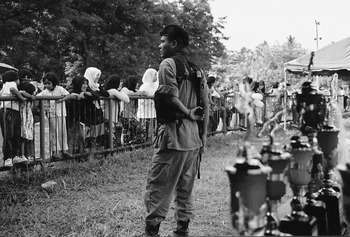
A Border Patrol Police trooper stands guard at a school sports competition in Thamuang District, Thepa, July 2006. Photo: Marc Askew

By late 2007, villagers in Thamuang acknowledged that violent incidents had declined, and they attributed this to the work of Task Force 4. They were not, however, prepared to accept that the violence had ended, and remained on their guard. Over the previous three years, as illustrated by the accounts below, Thamuang's villagers, both Buddhist and Muslim, were confronted with a new and unfamiliar environment of violence, danger and suspicion that tested their thresholds of trust, their basic social relationships and their assumptions about co-existence.
Thai Buddhists: The Compression of home
Stories in the Thai bunker
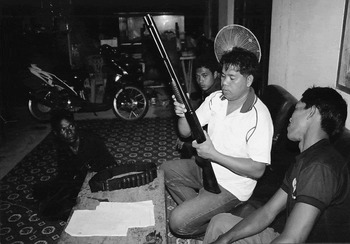
‘The bunker’ is both a physical site as well as an appropriate metaphor for the prevailing sense of besiegement and vulnerability that is felt by communities in the border provinces. The village ‘bunkers’ occupied by the village defence units (Cho Ro Bo) are sandbagged enclosures often no more than five sacks high, offering little real protection. The Cho Ro Bo units officially consist of 30 members per village, operating in shifts, from 8:00 p.m. to 1:00 a.m., supervised by village headmen, under the aegis of the Ministry of the Interior (through the district offices). The following accounts are drawn from my records of conversations with, and talk among the Thai Buddhist Cho Ro Bo members of two Thai Buddhist villages in Tambon Thamuang during my second stay in 2006 (see Figure 2). These narratives and comments reveal something of the categories that ordinary people have deployed in their effort to map friends and enemies in a home (ban) and a country (banmueang) that have become somehow strange and unfamiliar to them. During this period violent incidents were increasing both in their immediate environs and neighbouring communities.
Thai village defence volunteers checking shotguns before standing guard for the evening, Thamuang, Sept. 2006. Photo: Marc Askew

Soem's story is a narrative of alienation, anger and thorough mistrust of Muslims. Unlike some of his neighbours, Soem is not interested in making any distinctions between ‘good people’ among Muslims and the naeoruam (united front/coalition of militants). His revelation was provoked, it seems, by my enquiry about his work during that particular day, which had involved helping Sunthon, the village headman (an electrician by trade), install public broadcasting speakers in some Muslim villages of Tambon Bak Bang. Soem stressed that he didn't talk to any of the people there: ‘I don't want anything to do with Muslims anymore – they're all cheats and liars.’ Behind Soem's blanket denunciation was a concrete personal experience of intense fear, but also a lack of personal ties in the locality. Soem's personal story came out in a rush after this first negative comment against Muslims. Though kin to Sunthon's mother, Soem is a native of Nakhon Sithammarat, a province in the Buddhist-majority upper south. He had ran away from his parents' home at the age of 12 and moved to the Muslim-majority border province of Narathiwat, where he apprenticed himself to a mechanic. He eventually married, and set up his own garage business, which he continued to run after his marriage failed. Everything changed for Soem in 2004. Narathiwat province was the site of the first attack (a raid on a military camp on 4 January), and was the epicentre of the escalating bombings and militants' attacks on officials and civilians. In mid-2004, fearing for his life in Narathiwat, he sought sanctuary with his relatives here in Thamuang. He left his business in the care of two Muslim employees. He wanted to sell the garage business, but could not sell it for the price he wanted (2 million baht). A local Muslim offered him 1.3 million baht, but he decided not to sell. Soem is one of many Thai Buddhists who fled Narathiwat for safer havens in other provinces. The experience of exodus embittered him — he admitted to knowing Muslims in his former district, but he emphasised again: ‘You cannot trust them.’
That evening another defence volunteer, Uncle (Lung) Chum had his own story to tell. Uncle Chum recounted what had happened to him that day, and why he was in a bad mood.
Well, I was riding my motorbike back from Lam Phlai district [along the main road that passes the market of Thamuang] and two Muslim youths on a motorbike were following me. I was very suspicious, because while I watched them through my rear view mirror they sped up whenever I accelerated to get further in front of them. They got to within twenty metres behind me, and so I decided to pull over. I stopped my motorbike, dismounted quickly and faced them, standing with my hand holding my gun that was tucked in my belt – those young guys noticed this and drove straight past me. By standing and facing them I had less chance of getting hit because the pillion drivers usually shoot from behind their victims at a close range of one to two metres. But I was completely prepared and they knew it.
Three days later I spoke again with Uncle Chum and asked him if he had travelled on the same length of road again. He answered defiantly: ‘I go and see my friends over at Lam Phlai every day – I'm not afraid – why be scared ? – I can't be scared – if I was scared all the time, this place wouldn't be my own country [prathet].’
Condensed in the tales of Soem and Uncle Chum were a number of powerful and culturally resonant binary images that cohered around security and its connections with place, relationships and identities — identities that ramify from localised relationships to the idea of a nation. They were desperate affirmations of control in an uncontrolled environment of unpredictable danger. Uncle Chum's insistence that he would continue to visit his friends in Lam Phlai, regardless of the danger of his being shot, was a defiant affirmation of ownership, both of his immediate environment and a broader national home, which the danger threatens to annihilate. Soem, on the other hand, is a refugee from another place who, though now safe with kin, harbours resentment about sacrificing a livelihood and investment that he had nurtured in Narathiwat. Neither of them professed any interest in trusting Muslims, because they saw them all as potential enemies. Their talk was the intimate talk of Buddhists making a clear ‘us’/‘them’ distinction.
The specific setting of the Cho Ro Bo post served to enhance the mood of besiegement as these men spoke. Uncle Chum's story was about an experience that had occurred on the same day, and the shared context of its delivery clearly reflected what he thought had happened. Soem's account, on the other hand, reached back into the past to link his recent autobiography with his present outlook, and I subsequently discovered that he had omitted mentioning a key reason for his leaving Narathiwat, which was not connected to any antipathy towards Muslims. Some of Soem's relatives in the village confided to me some months later that one of the reasons for his departure from Narathiwat was because local police suspected him of supplying insurgents with tyres, which they commonly set on fire for creating disturbances. It was Soem's habit to leave used car tyres piled in front of his garage for anyone to take if they wished, but in the context of the escalating insurgent attacks, this seemingly innocent practice began to attract the attention of the police, who on several occasions came to Soem's garage and accused him of collusion with the militants. Soem had fled Narathiwat because he was as frightened by the prospect of being murdered by the Thai police as much as by insurgents. His self-censored story was crafted to highlight his solidarity with fellow Thai Buddhists as a besieged minority.
The narratives emphasised ethnic solidarity and the exclusion of Muslim neighbours from a Thai Buddhist universe of trust. They do not represent the outlook of all Thai villagers in Thamuang, but they do reflect one extreme in a continuum of positions among local Buddhists who have been trying to maintain a world of security in an environment of menacing violence.
The Morality of Thai-ness in danger
The stories recounted by Thai Buddhists were often interspersed with commentary about the character of ‘Thai-ness’ (khwampen Thai), together with expressions of frustration with the government for ignoring the plight of Thai communities and favouring borderland Muslims. Such commentaries reflect how local understandings about violence and the fear of Muslim insurgent attacks have brought latent feelings of ethno-religious difference to the fore, coming into tension with norms of inter-ethnic coexistence and village-based harmony. One evening at a guard post of Village Fourteen, Iang, one of the defence volunteers, was moved to elaborate on the character of Thai-ness in the context of the current violence. What prompted this monologue was his friend's talk about the insurgent warnings of retribution against people trading on Fridays, a move that underlined to them the insurgents' religious justifications for violence against non-Muslims. This warning had first been made through leaflets in Pattani Province in mid-August 2005, and though no leaflets had been distributed in Thepa itself, the news spread quickly and had an immediate impact on market trade in the Khok Pho municipality, only 10 kilometres from Thamuang. A Thai Buddhist vendor in Thepa had been shot selling goods on a Friday soon after, and most recently the elder brother of Sunthon, village headman of Village Three, had also been shot on a Friday while returning home after selling dumplings (sarabao).Footnote 23 He also remarked on the insurgent slogan sprayed on the road through Village Twelve in the previous year, which had pronounced: ‘This is my land, and I'm going to take back our independence’ (Ni phaendin ku, ku cha ao ekkarat khuen).Footnote 24 Highlighting that this insurgency was clearly a deliberate assault on local Buddhists, Iang was at pains to explain why local Buddhist villagers had not retaliated with concerted reprisals. The answer lay in the character of Thai Buddhists, he pronounced: Thais are ‘orn’ (soft, weak) and are not prone to seek revenge in tit-for-tat killings. As a result of this inherent character, he went on, ‘they are not good in battle’ (mai keng nai kanrop). This led him to his main point, which was to contrast Thais' high tolerance of different religions (poet kwang: ‘open wide’) with the narrow religion held by borderland Muslims. He attributed the troubles to Islamic religious leaders who were intent on insulating Muslim communities from the wider world and pressuring ordinary Muslims villagers to do their bidding.
Pervading these Thai Buddhist commentaries were expressions that highlighted their feelings that the menacing violence now pervading their lives was unnatural. They asserted their resentment of this alien state of affairs by affirming the phrase ‘Thais love peace/tranquillity’ (khon Thai rak sangop). Interestingly enough, the first time I encountered this affirmation directly was in November 2005 as I sat in a sandbagged police post in Lam Phlai — the speaker was a village defence volunteer trainee who was draped with a cartridge belt, wore a bullet proof vest and was holding an M16 rifle as he spoke, and he obviously saw no irony in the scene. In using this stock phrase (a prominent phrase in Thailand's national anthem),Footnote 25 speakers did not necessarily use the term ‘Thai’ here as an ethnic label, but as a normative statement of national values affirming coexistence and tolerance among all people in the country. Yet ‘Thai’ constantly slipped into use to refer to ‘Thai Phut’ (Thai Buddhist) when responses to violence were mentioned. Mr Dam's account of the atmosphere in Thamuang District echoed some of the peace-loving paradigms of ‘Thai-ness’ articulated by Iang, but also revealed frustration at the difficulties in containing the unpredictable attacks of insurgents who were not constrained by the law: ‘Thai Buddhists don't retaliate in revenge when Muslim insurgents kill Thai Buddhists – we are not like that, we want to live together comfortably [sabai].’ He continued by emphasising that the Thai state was currently unable to protect these cherished values, ‘because the military and police have to follow formal legal procedures (krabuankan kotmai), but the insurgent bandits use the law of mayhem (kotmu)’. Underlying this statement was the same deep frustration expressed by many other Thai villagers in the locality that the authorities were not doing enough to protect them. They argued that too many insurgents were being released after capture and that it was time for summary justice to be meted out to insurgents by the police and the military. Here, among the Thai Buddhists in Thamuang, there was no sympathy for the pronouncements of the National Reconciliation Commission (NRC, formed in early 2005) that peaceful efforts should be applied to solve the southern troubles. By mid-2006, the major concern of Thai Buddhists in Thamuang was to obtain weapons for their own protection, something that was already receiving publicity in the press, and being loudly denounced by the NRC and Muslim rights activists.
Victims, heroes and survivors: The Varied positions of Muslim villagers
The experiences and outlook of Muslim villagers and their leaders towards the prevailing environment of danger and insecurity are varied. Like their Buddhist neighbours, they have experienced demoralisation in the face of danger from unknown assailants, but their views and experiences often contrast with Thai Buddhists because government officials also represent a threat. Though the Muslim fear of state officials is commonly evoked in commentaries, it is important to recognise that Muslims families are linked to the Thai state in various ways, conspicuously through their employment, whether in the police, province or local administration or as security volunteers. The narratives of Muslim villagers below express a variety of orientations and experiences toward life under the insurgency. I group them here into three broad orientations: the victimised, the defiant, and the pragmatic.
Besieged by the state, besieged by insurgents
Ma-ae Laemor is the headman (phuyaiban) of the Malay-speaking Muslim village of Suan Nok, in the small tambon of Chang Hai Dok of Khok Pho district which abuts the southeastern boundary of Tambon Thamuang. Of the five villages of the tambon, Ma-ae's is the only one populated entirely by Malay Muslims. Like all other phuyaiban, Ma-ae has been in charge of coordinating the activities of village defence volunteers. In January 2006, an incident occurred in Suan Nok village that exposed his vulnerability and that of his community, both to the depredations of the shadowy naeoruam and to the suspicions of the Thai state. At midnight on 1 January, after the evening's roster of five defence volunteers had completed their last check of the village and were resting in front of the village children's centre, they were suddenly faced by 30 armed men clad in army uniforms and black head masks. Aiming their assault rifles (AK 47s and M16s) at the stunned volunteers and speaking in Pattani Malay dialect, the masked men warned the volunteers: ‘Don't resist!’ (‘Yange lawae!’) and took their three government-issue shotguns. After this, the attackers used a can of spray paint to write a sign in Thai language on the road passing the village: ‘Puen khong kharatchakan cha ao mot’(‘We'll take all the state officials’ guns').Footnote 26 Ma-ae and his neighbours claimed that they knew nothing about the identity of the masked assailants except that they used the Pattani dialect in their briefly uttered demand. Nobody apparently recognised their individual voices, and after the event, Ma-ae and his neighbours agreed that these assailants might have been the Thai military in disguise. Within a few hours of Ma-ae reporting the event, his village was swarming with Border Patrol Police, and Ma-ae found to his dismay that he was suspected as cooperating with the naeoruam.’ Ma-ae was not arrested, but he stated that he had been subject to continued and open suspicion by officials since then. He elaborated:
Late last May – I remember clearly – the Border Patrol Police came on a sweep through this area, there were a hundred of them and they were looking around for about two hours. I said to the captain in charge to speak nicely to the villagers, and in response to that, right in front of my neighbours, this captain tells me that he believes I am cooperating with the naeoruam! These officials (chao nathi) don't show honour to me as a village headman!
Ma-ae has been headman of this village for 21 years and believes that he has undertaken his duties as phuyaiban diligently. These suspicions are an insult: ‘I am here for the chaoban (villagers), so why should I make a plan to attack my own people like they are suggesting?’ Ma-ae is caught between a rock and a hard place. Despite doing his duty to the fullest, he could not prevent the naeoruam from entering his village and his loyalties are suspect. After the gun heist, the shotguns were not replaced by the district administration, so the Cho Ro Bo had no weapons.
After January, things began closing in on Ma-ae and his neighbours. On 27 May, the very day that the Border Patrol Police conducted their sweep of his village, Ma-ae learned that his niece has been shot four times by an assailant as she rode her motorcycle from this village to work at the health centre of Village Seven in Tha Muang sub-district, 3 kilometres away. Who were the assailants? The local people did not know, but Ma-ae feels that all Muslims appear to be suspected by soldiers and police. He denies any interest in separatism: ‘One thing's for sure’, he notes, ‘none of the Muslims around here support the idea of separatism. Islam teaches you to respect the land that you live in.’ If these attackers were ordinary bandits (Chon Krachok), then the problem could be easily solved, but when it comes to ‘bandits in uniform’ (chon nai khrueangbaep), then that is more difficult to solve, he says. In this speculation, Ma-ae reflects the common conspiratorial theorising of people throughout the border provinces, including his Buddhist counterparts in villages nearby, a reflection of the widespread folk knowledge of the dysfunctional Thai state and the engagement of maverick officials in the repeated creation of disturbances in the south. It is accepted, however that Muslims are among the killers, and Ma-sae has been deeply shocked by the gruesome killings of Buddhist monks. At that time, the most recent of these attacks had taken place at Phromphrasit monastery in Panare District, Pattani (on 16 October 2005). On this matter he was unequivocal: this was a sin in the eyes of Islam, and the people who are killing monks ‘have no religion’.
Headman Ma-ae's account shows that his field of control and trust within his environment is highly localised and built on face-to-face relationships — he believed that his own villagers were not part of the naeoruam, though he qualified this by saying that he could not vouch for the villagers living on the outer fringes of the settlement, whom he admitted may be involved. In common with villagers in Tambon Thamuang, the world of assured trust in Ban Suan Nok had contracted to enclose a finite group of known neighbours and relatives, together with friends and kin outside. Aside from these, he stated, ‘I don't know who is who.’ According to the narrative of this Muslim village headman, the villagers' enemies were more numerous and sinister than those threatening their Buddhist counterparts. Not only did they share the knowledge that their nightly efforts to watch for insurgents was often pointless, and not only was the state impotent to protect them, but they were also stigmatised as potential culprits. Yet despite this, he insisted that relations between the Muslims of this village and their Thai Buddhist neighbours remained very close. Notwithstanding Mae-ae's protestations of innocence, however, a year later, the police in Khok Pho judged that there were at least 11 leading insurgent cadre operating out of Suan Nok village.Footnote 27
Defying insurgent infiltration
Ma-ae's plight does not represent the experience and outlook of all Muslims in neighbouring settlements, and in fact some of them suspect that Ma-ae is not entirely innocent of collusion with insurgents. In the adjacent Muslim majority tambon of Ba Bon (Khok Pho), the kamnan (sub-district headman) cryptically remarked as we spoke about the arms theft at Suan Nok that the current instability in the area would not be prevalent if village headmen were efficient. Close to Suan Nok lies the predominantly Muslim village of Ban Kra-an (Village Four) in Thamuang District. Here, the headman and the villagers are determined to oppose insurgents. Suan Nok is the closest settlement to Ban Kra-an, and since the time of the gun theft in January 2006, Ban Kra-an's villagers have kept a cautious eye on their neighbour. La-tae, the headman, together with other leading villagers, did not trust Mae-ae: ‘No gun theft could have taken place in that village unless there was help from inside’, La-Tae remarked. In August, one of Ban Kra-an's village defence volunteers (a young Thai Buddhist) was badly wounded after being shot by two assailants as he was returning home on a side road that branches from Ban Suan Nok, and this boosted suspicions in Ban Kra-an that the insurgents were gaining control there. La-Tae's assistant, Kim, who heads the defence volunteers, knows Ma-ae and meets him occasionally. His view is that in an effort to survive, Mae-ae is ‘wearing a shirt of two colours’; that is, working with the state but also allowing insurgents a free hand in his village.
The views of Ban Kra-an's villagers contrast strikingly with Ma-ae's expression of helplessness and victimhood at the hands of the state and insurgents alike. Here, the village defence volunteers express united resolve to protect their ‘home’. The small number of Thai Buddhists here (representing 15 of its 232 households) also participate in the ranks of the Cho Ro Bo, which is acknowledged throughout Thamuang as the most efficient and highly organised defence unit in the tambon. It is, for example, only one of two among Thamuang's eight Muslim-majority villages that are trusted enough by the District Office to be issued with a full complement of 10 shotguns. Though individuals express different views about the underlying motivations of the insurgents, they are unanimous on two points: that insurgents' calls to Islamic unity (highlighted in leaflets) represent a clear manipulation of religion to justify violence and create communal tension; and that it is imperative for all people in the village to preserve their independence from the insurgents' control. As Ma, a leading defence volunteer, expressed it: ‘This is our home, and no-one is going to take it away from us.’ This collective resolve was re-affirmed in August 2007 when Ban Kra-an's defence volunteers successfully repulsed a night attack of assailants, though they suffered two casualties. The attackers came from the vicinity of Suan Nok village. In Ban Kra-an there are no complaints of persecution by the authorities. They do not appear to have suffered intimidation at the hands of Thai security forces; rather, their criticisms are overwhelmingly logistical — that military and police units have been far too slow in responding to their calls for assistance when needed.
Quiet resistance and the management of safety
The accounts of residents in the villages of Suan Nok and Kra-an suggest two extremes in Muslim experience and outlook. One represents a high degree of fatalism and victimhood at the hands of insurgents and the Thai state alike, while the other more positively links the interests of villagers with the state and confidently asserts a communal capacity to resist incursion and demoralisation. Somewhere in the middle of these extremes are those who probably form the majority who are simply trying to survive amidst the multiple tensions and threats generated by this enigmatic insurgency. Among them are those villagers who try to protect neighbours and village youth from exposure to the insurgent proselytisers attempting to recruit supporters. There are others who oppose militants' calls to oppose the ‘kafir’ (infidel) Siamese state and view this as a serious distortion of true Islam, but at the same time, do not dare to air their opposition in public because they know there are militant spies who might target them for assassination.
Ding, a resident of Ban Thung Don (Village Five) of Thamuang, occupies this middle ground of quiet resistance, though he is also critical of the Thai state's heavy-handed surveillance. Ding expressed no sympathy for separatist militants. He professed awareness of the methods of insurgent infiltration of Muslim communities, and with local Muslim leaders, he made efforts to limit the process of radicalisation, particularly among his community's young people. He believed that in his part of the village – a grouping of some 50 households located near the village mosque – there were no militants, because he and other members of the mosque committee did not want any association with militancy: ‘We simply wish to follow our livelihoods and raise our families.’ As with other Muslim villagers, Ding viewed the danger as lying outside his own neighbourhood: ‘The trouble happens when people go to the tea shops outside, sit around and listen to gossip – this is how the naeoruam are recruited.’ To combat this, he and his mosque committee members enjoined neighbours and village youth not to sit around the tea shops for too long, but to come straight home after conducting their business.
Ding acknowledged the dangers posed by Muslim militants, and he echoed the common distrust shown by Buddhists towards ‘strangers’ from outside. Yet he was equally adamant that local people mistrusted the security authorities, who appeared to be indiscriminate in their suspicions of Muslim villagers. He gave an example of the experience of a next-door neighbour when his house had been unexpectedly searched a few days earlier by the Border Patrol Police as he and his family were sitting watching television. ‘My neighbour was so frightened by this that he was visibly shaking’, he observed, concluding that these sudden searches were a very bad thing that frightened villagers and made them mistrust the authorities. Here was a reflection of a long-held view in the borderland that authorities were prone to arrest people indiscriminately, summarised in the common expression ‘catching goats’ (chap phae). While disapproving of security sweeps in the area, however, Ding suggested no alternative as a means of weeding out the clandestine networks of insurgents. According to Ding, the atmosphere of suspicion that pervaded the district had created a palpable distance between Buddhists and Muslims, but in common with others, he also made a clear distinction between this general wariness and his own continuing bonds with close Buddhist friends, with whom he still maintained links by visits and telephone calls. He was acutely aware of the fear of his Buddhist neighbours, and he knew that they were arming themselves with guns, in contrast to his own people.
Ma is the imam of Phlu Ching village, adjacent to Ban Kra-an on the southeastern edge of Thamuang District. Buddhist friends had discouraged me from cultivating Muslim acquaintances in what they viewed as a ‘dangerous’ area, but I was always welcome there. Imam Ma's situation, and that of his younger brother Wae, highlights the predicament of many villagers who oppose insurgent violence but need to be constantly on guard for their own safety. Ma acknowledged that insurgents were exploiting religion for their own benefit, and he vehemently opposed killing in the name of Islam. His main concern was for Muslim youth, particularly those from poor or broken families who he argued were being hired by insurgent organisers to stage events (such as the burning of tyres and the spreading of nails on roads). To protect local youth from manipulation, Ma organised a youth group among the unmarried men of the village and taught special classes at his mosque that stressed morality and the importance of law-abiding behaviour.
At our meetings during 2006, Ma spoke mainly in broad general terms about his opposition to the insurgency and the misuse of religion to legitimise the violence, but said nothing of his actual acquaintance with insurgents in the district and beyond. This he admitted only in the following year when I had come to know him better. In April 2007, during a conversation at the wedding celebration of Ma's son (at his home), I sat with his close friends as they expressed their opposition to the insurgent driven violence. Here, Ma's younger brother Wae openly declared that while his brother opposed the naeoruam, he did not dare express opposition to it outside this small circle of trusted family and friends in the seclusion of Ma's house compound. Ma later confirmed his brother's observation, confiding that ‘I know people in the naeoruam in this district, but I don't openly denounce violence or the insurgency in their presence.’
Weak state – strong society? Village headmen negotiate loyalties
The Necessity of subversion
Village and district headmen bear the brunt of the state's security policy for the border provinces. Though the military and police are the sharp edge of suppression and law enforcement, the Ministry of the Interior (MOI) is equally central to the state's security through its province and district administrative apparatus. Through MOI funding, the district administrations maintain the village defence volunteer system, employ security volunteers, and – more clandestinely – maintain informant networks. The whole structure of local administration relies on the sub district and village headmen (kamnan, phuyaiban). Not surprisingly, village headmen have been a main target for militants' killings — in the case of Buddhists, to demoralise their communities, and in the case of Muslims, to intimidate them into compliance or cooperation and eliminate those who cooperate with the Thai state. Village headmen have official responsibilities to district offices and their various departments, but they are also enmeshed in a web of local social relations and obligations. Michael Moerman's portrait of village headmen in Thailand as ‘synaptic leaders’ mediating between villages and the state portrays well the multiple roles maintained by these individuals, even though this notion was developed some 40 years ago before the considerable expansion of the Thai state's presence in communities in numerous guises and levels.Footnote 28 The tensions and dualities inherent in village headmen's lives and their roles as synaptic leaders have been brought into stark relief by the challenges imposed by the insurgency in the borderland.
This account focuses on Headman Sunthon and his ambivalent links with the state. Sunthon's strategies may not be entirely typical of the average headman, because he maintains connections well beyond his village, and his networks are strengthened by his membership of phuak (tightly knit coteries) closely affiliated with the regionally dominant Democrat Party. Nonetheless, his perspectives and his relationships highlight how informality and idioms of reciprocity and local loyalty have become the bedrock of improvised local security. While the state supplies resources and status to village headmen, its policies sometimes threaten their lives and the delicate balance of local relationships that underlie their status and leadership. Sunthon's authority and local repute are maintained by the active maintenance of numerous informal roles – as friend, protector and link-man – in his village, his tambon and beyond. In order to ensure the maintenance of local trust networks and to guarantee his own safety, Sunthon performs not only as dutiful state servant, but he also actively exploits and subverts officialdom.
An event in which Sunthon played a direct role as an intermediary for a Muslim phuyaiban highlights the ubiquity of the ceremonial state and the necessity for its subversion by local leaders. Sunthon enjoys a friendly relationship with Yusof, the Muslim headman of Village Four, Tambon Krong-I-Tam, a coastal settlement some 15 kilometres from Thamuang. In the early morning of Saturday, 12 August 2006, police radios reported that three Muslim men clad in Thai military commando uniforms had been apprehended in the Khrong-I-Tam area as they attempted to cut the main electricity lines running along the coastal highway between Thepa and Channa. Yusof was responsible for the capture of these militants. Serendipitously, Yusof had noticed the saboteurs' pickup parked suspiciously by the highway as he returned from a drinking bout in Songkhla town. He notified the police, and with his local defence volunteers conducted a search and captured the men. This capture was a publicity coup for the authorities, as it demonstrated clearly that militants were disguising themselves as Thai military (in order to implicate Thai officials in the violence and gain local Muslim support); as well, the consequences of a local electricity blackout would have been a severe blow to the authorities in Songkhla Province.
A week later, a meeting of district and village headmen of Thepa District was convened in a Hat Yai hotel, hosted by Songkhla's deputy governor. He reported to the assembled headmen that interrogations showed that the captured men were from Pattani and Narathiwat, and thus were not local people, but vigilance was needed to stem this expansion of militant activity into Songkhla province. The initiative of Yusof and his assistants was praised, and everyone present affirmed that these were Muslims who ‘loved the place of their birth’ (rak thin koet) and were truly ‘khon Thai’ (Thai people). The hitch, however, came when the deputy governor expressed his wish to arrange a ceremony and present Yusof with a letter of commendation for his bravery and service to the nation (nang sue chom choei). He also wanted to invite the commander of the Fourth Army Region to present the award to Yusof at a meeting of Thepa's village headmen scheduled early the next month. Here was a problem for Yusof. Straight after the meeting he spoke anxiously to Sunthon, telling him that he didn't want to receive this public award. ‘If I am seen to accept this award I will be identified by the naeoruam and my life will be in danger – the naeoruam watch TV like everyone else, and I don't want to be identified.’ Sunthon, who enjoyed a direct acquaintance with Songkhla's governor, contacted him to cancel the award presentation. This was successful and Yusof was quietly given a cash reward of 30,000 baht (approximately USD 750) in recognition of his efforts. Sunthon identified completely with Yusof's position — the Muslim headman had done his duty and protected his community, but he was determined not to be drawn into a state celebration of triumph that might well be a prelude to his own death. There were clear limits to public expressions of national loyalty, and Sunthon had succeeded in modifying the action of state officials so as to protect the life of a fellow headman.
The realities of the current borderland instability make the lives of headmen like Sunthon and Yusof a constant balancing act. Simultaneously, they need to carry out officially prescribed duties while they also need to maintain their status in the webs of reciprocity that constitute village social relations, as well as ensure their own personal survival against assassination. When the demands of the authorities threaten to undermine relationships and survival, then it is necessary to subvert the state. This is illustrated well by a tactic of evasion employed by Sunthon. On a day in late July 2006, Sunthon faced a conundrum. Intelligence agents connected to the district administration and the military informed him that five bombs were to be set off by militants in Thepa District, though the times and places were not specified by their informants. In response to these reports the locally stationed Border Patrol Police planned to conduct a cordon-and-sweep of all the nearby villages. Because Sunthon knew the area well he had been nominated to guide a platoon of troops in their inspection. Here was a major problem for Sunthon, because if he was seen to be leading the unpopular Border Patrol Police into his Muslim neighbours' homes, his relationships with them might be compromised and he also could be targeting for killing. The best thing to do, he explained to me, was to escape this compromising duty and fabricate an excuse to be absent from Thamuang at the time of the sweep. So that afternoon he decided to travel to the city of Pattani, pleading ‘urgent business’. As it turned out, the predicted attacks on Thepa did not come that night, but four days later. By deliberate subterfuge, Sunthon had avoided involvement in a highly compromising official task that might have earned him the animosity of Muslim neighbours and friends.
The Primacy of reciprocity: Trust in an unstable world
In their everyday activities, village headmen are positioned both in and outside their local communities. This duality, common enough in normal times, is exacerbated by the demands placed on them in this new world of danger and violence. More conspicuous than this duality, however, is the centrality of informal face-to-face relations that cut through both spheres. In multi-ethnic neighbourhoods such as those of Thamuang and its surrounds, village headmen such as Sunthon help to buffer people against the hard edge of state policy and action. Such actions serve to establish and confirm interpersonal bonds and repute that – on Sunthon's own admission – also function as a measure of insurance for their own personal safety. Clearly distinguishing between ‘self-interest/instrumental’ and ‘emotive/affective’ motivations is impossible, given the ubiquity of informal relations and the manipulation of fictive kin and reciprocal idioms in everyday life in Thai society.Footnote 29
On the northern and northeastern edges of Thamuang lies Tambon Bak Bang, comprising a group of Muslim villages that straddle the railway line running though Khok Pho into the Thepa District (and thence to Hat Yai). Sunthon had spoken of these settlements as a dangerous ‘red area’ with many key insurgents and sympathisers (a suspicion also reflected in intelligence agencies' listings of suspects for Bak Bang). During August, a number of these villages had been hit severely by a storm and eight houses were destroyed. Interestingly enough, the Muslim headmen did not seek assistance from their own Muslim kamnan but contacted Sunthon directly because they had been told he had ‘connections’ (mi sen mi sai) with the Province Administrative Organization (PAO) leadership. This was true; through his Democrat Party phuak connections that had been cemented by his activities as a vote canvasser and party branch committee member, Sunthon knew the president and vice-president of the PAO, who were members of Songkhla's comprehensive Democrat Party political machine. He contacted these men directly to make an appointment for the Muslim headmen to arrange for the release of emergency funds to rebuild their village houses. Sunthon confided to me that though he had his suspicions about these villagers, it was important to help them so as to build relationships with them (srang khwamsamphan).
Closer to home, in the Muslim settlement of Village Eight, Sunthon maintains a close connection with Khru Daeng, the religious teacher (Tok Khru) of the local pondok school, a relationship that is sustained by Sunthon's role as his protector. Khru Daeng is prominent among the authorities' list of insurgent suspects, and Sunthon knows this. In one of my own encounters with him, Khru Daeng explained to me that Sunthon had helped him when he was accused of colluding with militants in a shooting that took place in Thepa town in 2005. In response to Khru Daeng's appeal for help at that time, Sunthon had telephoned the province governor and vouched for Khru Daeng's innocence in the affair. Since that time other shootings have occurred near the pondok school, and the teacher is fully aware of suspicions surrounding him. He pointed out to me as I sat with him in the compound of his pondok school one afternoon:
I know that I'm on the list of suspects of the Border Patrol Police, but I'm innocent. Phuyai Sunthon has helped me a lot, and whenever I am in trouble with the authorities I will telephone him.
Despite his own uncertainty about the activities of some key Muslim figures in his tambon, Sunthon is determined not to distance himself too much from them.
Sunthon's disposition towards local Muslims is leavened substantially by very close personal friendships and phuak bonds. Though his relationship with Khru Daeng might be deemed primarily ‘instrumentalist’ in intent, his assistance to others is based on emotionally grounded loyalty. This is shown well in the help he extends to his Muslim friends Rohani, her family and her husband Ahmad. Rohani and her family live in Ban Phlu Ching (Village Seven), some 2 kilometres beyond Sunthon's own village, close to the border with Khok Pho. Sunthon's connection with Ahmad goes back to their school-days together, and his friendship with Rohani has been nurtured for many years, based on the friendship between Sunthon's own father (now deceased) and her elderly father Yi-ma, who was one of the early settlers of this once forested area with a reputation as a local strongman (Pattani Malay: G'debe, the equivalent of the Thai nakleng). Like Sunthon's father, Yi-ma's status in the early years of a rudimentary local state structure was derived from his role as a community advocate and facilitator. Sunthon's connection with Rohani has been reinforced by her active involvement in tambon-related development activities. Sunthon has also been of central assistance in her children's advancement: through Sunthon's connections with key Democrat Party politicians, he was able to get her son enrolled in a Songkhla university and help her daughter gain admission to a prestigious state school, which was a prelude to her later acceptance at university. Mutual assistance between Rohani's family and Sunthon is a continuing process, frequently requested and willingly given. In maintaining these relationships with close Muslim friends, Sunthon affirms a trust that has so far withstood the de-personalising discourse of ‘the dangerous Muslim’ which pervades the circuits of Thai Buddhist gossip in the locality and beyond. In this, he expresses the same close affinities with Muslim friends that are valued by other Thais in his neighbourhood. Nonetheless, under the pressure of violence and the tensions and suspicions this provokes, these close relationships need continued reinforcement through regular contact.
Confrontation, propaganda and local resistance to public discord
From the later months of 2006, the anxieties of the Thai Buddhists of Thamuang grew. They reached a peaked in early 2007 in response to dramatic events in and near the tambon, but they also reflected the general climate of tension in the region and the nation that were spurred by the worsening trend of violence. I had left Thamuang in mid-October 2006 and returned in late March 2007. During that period, nine people were killed in Thamuang and its neighbouring tambon, including four fatalities from the bombing of a tea house in Lam Phlai (in late October 2006). After the ousting of Thaksin Shinawatra by a military coup in September 2006, the junta-installed government declared its determination to solve the southern unrest with an emphasis on ‘reconciliation and justice’, a stance symbolised by Prime Minister Surayut Chulanont's public apology to borderland Muslims in November 2006. The insurgent violence not only continued but actually became more vicious and provocative, as exemplified by the execution-style killings of eight Thai Buddhists in a mini-bus in Yala on 14 March. This event provoked widespread outrage among Buddhists throughout the south and the nation, including among the Thai Buddhists of Thamuang. A few days later, leaflets which had obviously been prepared by a Thai group (probably from Yala) appeared along Thamuang's main road denouncing the brutal killings of innocent Buddhists and appealing to Muslims to recognise the barbarity of the insurgents who called themselves ‘Warriors of the Pattani state’.Footnote 30
Just after the shock of the Yala mini-bus massacre of 14 March, an event in adjacent Saba Yoi brought the Buddhist villagers of Thamuang closer than they had ever been to closing ranks against Muslims. At around midnight on 17 March, three teenage Muslim students died and seven men were injured following what was later described as a grenade and machine-gun attack on the Bamrungsat pondok school of Khuan Lan North village, a ‘red village’ on the southern edge of Thamuang, in Tambon Pian of Saba Yoi District. Border Patrol Police rushing to the scene after the reported event were prevented from entering the site by felled trees and nails. Fearing an ambush, they delayed entering the village until daylight. At the same time, the local state school was set on fire. By morning, there were an estimated 300 people angrily demonstrating in front of the pondok school and forensic investigators were prevented from entering. The crowd gathering outside the school was harangued by speakers who claimed that a nearby Ranger unit had attacked the school in retaliation against an ambush several days earlier. One of the victims was a young man from Thamuang's Village Six. At midday on 18 March (a Sunday), angry protesters formed a cavalcade of some 50 pick-up trucks and proceeded along Thamuang's main road, passing the main market and the homes of local Buddhists. They chanted ‘Kill them, Kill them’. They threw tree branches and stones as they passed, several of which struck Buddhist homes. In anger, one Thai resident ran inside his house and came out with his shotgun, but a neighbour calmed him down.Footnote 31
Somdet, who had filmed the angry Muslim cavalcade on his phone camera, was still visibly shaken by this event two weeks later when I returned to Thamuang. Like others, he disbelieved the claims that Rangers had attacked the school, arguing that there had in fact been an explosion while the students were making bombs and that the evidence had been deliberately tampered with by insurgents to disguise the real cause, which explained why officials had been stopped from entering the village for two days. After the pondok incident, killings and attacks escalated in Saba Yoi and Thamuang. Among the Thai Buddhists in Thamuang, there was a palpable increase in their sense of threat. Thai demonstrations in nearby Khok Pho and Saba Yoi opposing Muslim demands for the withdrawal of Ranger units contributed to the atmosphere of defensive Buddhist solidarity.Footnote 32 The sense of threat in Thamuang was exacerbated by the appearance of copies of an insurgent leaflet counselling Thai Buddhists to accept that they were losing in the struggle against the insurgents. Marked as a message from ‘People who know the truth in the area’, it was addressed to ‘All Thai Buddhist people’. It began with a stern injunction to Buddhists: ‘If you want to live in peace and safety you must accept the following truths.’ Three points were emphasised: (1) Buddhists were not the owners of the land, but migrants sent by the Bangkok-based Siamese state from northeastern Thailand after the Thais seized control of the territory of the Islamic state of ‘Fotani’; (2) local Thais have been mislead by the Thai government which has promised to protect them from danger, but the state is in fact incapable of doing so; (3) local Thais have to accept that they are being defeated and that ‘we Pattani Malays are going to reclaim our independence and are not afraid to die!’ Though military intelligence agencies are suspected of producing leaflets in the guise of insurgent propaganda, this particular three-point declaration, which also appeared elsewhere in the border provinces, was clearly produced by insurgents.Footnote 33 Not wanting the leaflet to promote too much gossip, Somdet counselled his neighbours not to worry and to pass all copies to him.
During March and April, a leaflet of far more questionable provenance than the three-point insurgent warning found its way to villagers in Thamuang. This was a five-page photocopied document purporting to detail a comprehensive Islamic plot to take over the country. Headed with the message ‘Urgent from the south’, the document bore the title of ‘The policy to seize power over Thailand in ten years’. It listed in 29 points various measures to infiltrate and comprehensively undermine the Thai state, the economy and the Buddhist population. The points included the aims to:
• Undermine the institutions of the monarchy and the Buddhist Sangha though propaganda
• Steal Buddhist children so they could be reared as Muslims
• Prevent the education of children in the border provinces by killing school teachers and burning schools
• Expand the population of Muslims by encouraging early marriage of Muslim girls
• Extend Muslim power by buying up Buddhist land and businesses both in the south and elsewhere in the country
• Increase the killing of Buddhists in the southern borderland to 2,000 people per day
• Indoctrinate the Muslim people of the three majority-Muslim provinces to expel soldiers out of the area and to force Buddhists civilians to flee the region
• Foment disturbances in the south so as to create grievances among Muslims and to attract assistance from the extremist Muslim organisations Al Qaeda and Jemaah Islamiah
• Radicalise Muslims throughout the country in provinces extending from Phattalung in the south to Chiang Rai in the north.
Presented as a planning document of the insurgents, this document is implausible by virtue of the outlandish scale of the plot that it catalogues, and particularly the mix of overlapping specific and general points, often interspersed with alarmist exclamations such as ‘in ten years we Muslims will have swallowed the Thai Buddhists completely’. The naming of particular groups and individuals that are part of this plan, including former Malaysian Prime Minister Mahathir as well as Shi'ah Muslims, further exposes the document as a product of poorly informed writers. The end of the document features the underlined injunction: ‘Whoever finds this document please copy it and distribute it widely for people to read – if you are a Thai Buddhist who loves the Thai nation, wake up your fellow Thais.’Footnote 34 This document is in fact an abbreviated and embellished version of several other leaflets that were appearing as far afield as the city of Hat Yai and the remoter Buddhist villages of Pattani province. They had been circulating through the border provinces since late 2006, one version comprising 33 points and another (possibly the master version) featuring 49 points. They used slightly different titles, and some included footnotes claiming that the document was a translation from an authentic insurgent document written in Jawi script. Details within these documents indicate that they began circulation after November 2006 and were connected to a group naming itself ‘Thais who love the nation’, a group who clearly opposed Surayut's apology to borderland Muslims, and regarded General Sonthi Bunyaratkalin (Muslim army commander-in-chief and coup-maker) as a tool of the insurgents.
Though the purported ‘Ten-Year Plan to Seize the Thai Nation’ is a highly suspect document, some points clearly tapped prevailing anxieties of Thais in general and southern residents in particular. Thai Buddhist experiences in the borderland could be linked to some of the realities registered in the conspiracy document, in particular the movement of fearful Buddhist residents out of the Muslim-majority provinces, as well as their concerns for their land. The strategy of the insurgents to generate terror among ordinary Buddhists can hardly be denied. The leaflet played on this reality and extended it to the national level. In Thamuang, villagers had relatives and friends who had fled their homes from a number of districts in Pattani. Some of them had reported that they were selling their land to Muslim neighbours because they did not anticipate ever returning to their old homes. In the context of insurgent violence against Buddhists, it was easy to expand such stories of mundane land transactions into the conspiratorial narrative of a coordinated Muslim plot to undermine Thai Buddhists as a group. Notably, suspicions of such a plot were given some credence by Thailand's news media.
On the evening of 26 June, the TITV television news presented a story on the case of the purchase of a large land plot in Lamphun Province which was traced to Muslim buyers from Phattalung. There was a suggestion that this land might be used as a potential settlement for indoctrination (laeng pluk radom) by southern Muslim terrorists. During this news item, the text of a version of the ‘Ten-Year Plan to Seize the Thai Nation’ leaflet was shown on screen. A month later, newspapers ran an expanded story on these concerns, encompassing cases in a number of other northern provinces, though the officials interviewed denied any movement of insurgents northward.Footnote 35 Though I never heard the conspiracy leaflet explicitly discussed among Buddhists in Thamuang, the issue of land was a topic of talk. During 2006, a number of Thai Buddhist rubber plantations and homes were burnt. This continued into the next year and had a clear impact on local people. One Buddhist resident of Village Six who put his land up for sale in mid-2007 made it known among his neighbours that he would definitely not sell the land to a Muslim. Another villager recounted a conversation with friends in Sadao District (Songkhla) who told him that provincial officials had informally enjoined them not to sell their land to Muslims for fear that it would weaken the position of Thais in the borderland.
Notwithstanding the anxieties shared by Thamuang's Thais in their intimate talk, however, they firmly resisted the increasing pressure during 2007 to align themselves with the aggressive movement to promote Buddhism as the national religion. In January, the newly installed interim government appointed a committee to draft a new constitution. It submitted its first draft in April. This period saw the emergence of a small but assertive and highly publicised movement among monks and lay people to enshrine Buddhism as the national religion in the new charter. Demonstrations by monks were held in Bangkok during April, as well as a hunger strike.Footnote 36 The insurgent violence towards the Buddhist minority in the south was tapped as a core justification for this move and it gained strong support from a group based in Yala who called themselves the ‘Naeoruam Khon Thai Rak Chat’ [The United Front for Thais who Love the Nation], evidently the same group who had disseminated the Muslim conspiracy leaflet the previous November. From early 2007, booklets and broadsheets featuring grisly coloured pictures of beheaded Thais and murdered monks were distributed to many temples in the border provinces, claiming that the insurgents were aiming to eliminate Buddhists and take over the country.Footnote 37 The literature affirmed that it was time for Thailand's Buddhists to take a stand and affirm Buddhism as the core of the nation's identity. When the proposed state religion clause was excluded from the new constitution in mid-year, this movement proceeded to push for its rejection in the August referendum.
In Thamuang, local Thais showed little sympathy for the aggressive Buddhist nationalism of the state religion movement. A month before the referendum, the ageing abbot of the district's main temple (located next to Thamuang's market) returned from a meeting of monks held at Wat Thammakai in Bangkok. He brought with him a CD with a recorded speech that affirmed Buddhism as Thailand's national religion and pronounced Islam as a threat to the country. Without notifying lay people, the abbot broadcast this lecture on the temple's public address system, clearly audible across the market. Somdet knew nothing about this until he began receiving telephone calls from concerned Buddhist and Muslim residents of the market area. Notably, one of these calls was from the senior member of the temple committee. A delegation of villagers was quickly formed and they entered the monastery and demanded that the abbot stop the broadcast in the interests of community harmony.
The incident illustrates how Buddhist villagers retained empathy for Muslim neighbours and an idea of communal unity that outweighed exclusivist calls to religious solidarity. Though we may read into this action a primarily pragmatic concern for avoiding a local Muslim backlash, it is significant that local Muslims were close enough to Buddhist community leaders to entrust them with their discomfort. Shortly after this and a week before the referendum of 19 August, broadsheets from the Naeoruam Khon Thai Rak Chat were distributed in the Thamuang area. They denounced the proposed constitution as an ‘Islamic Constitution’ and enjoined Buddhists to vote ‘No’. A major headline announced the Muslim ten-year plan to seize the country, and on the back page was a version of the alleged plan that had appeared in earlier leaflets, this time with 34 points.Footnote 38 None of the Thais to whom I spoke about this broadsheet were sympathetic to its calls. The standard response was that this group was ‘too aggressive’ (runraeng). One Thai Buddhist shopkeeper remarked openly: ‘I don't think much about this stuff, this [broadsheet] is from a group of crazy people.’ Nodding towards a group of Muslim shopkeepers nearby, he continued: ‘We have been living together for many years, we have to separate things out from religion and this violence from our own relationships.’ Though the Buddhist nationalist literature circulating in 2007 was evocative, in Thamuang, it actually had an effect that was the reverse of its aims. Radical Buddhist propaganda had clearly failed to undermine local villagers' commitment to co-existence in a plural ethnic and religious environment.
Conclusion
This article has examined idioms of trust and suspicion at the local level as Thai Buddhists and Muslims in Thailand's southern borderland confront a once-familiar world now made strange by violence and danger. The narratives and scenes treated here are selected portraits, and there are numerous other sites of interaction and local narrative that could be treated in an exploration of the multi-layered fabric of relationships in these neighbourhoods. So too, the villages and districts of the southern provinces are varied in their ethnic concentrations, their local histories and their experience of the current violence. Nevertheless, these narratives help to expose a number of critical themes touching on the broader question of how neighbourhoods and the individuals within them manage survival and trust in the face of an unseen enemy, an often ineffective state and the pressures (from both local and national contexts) to divide into ethnic and religiously polarised ‘communities of fear’.
In Thamuang and neighbouring areas, circuits of rumour and opinion – always the stuff of village life – configure the nature of danger and the image of enemies. In the face of a once commonplace human landscape that now threatens their very existence, peoples' world of certainty has shrunken. As elsewhere, events in these districts and beyond have exposed to villagers the fragility of personal security and the limits of state protection, while bringing about a new regime of official and unofficial surveillance which impacts upon Buddhists and Muslims in different ways. Resources of trust founded on traditional face-to-face relations of reciprocity help people to navigate their worlds. Village headmen, both Thai Buddhist and Malay-speaking Muslim, are the main targets of insurgents as well as the principal linchpins of state security policy at sub-district and village levels. They navigate a world shaped by the state as the dispenser of resources and policies, but also another world that is configured by their own place in a web of affiliations and obligations. To this extent, the ways we see them behave in the current circumstances reflect the negotiating practices they have long maintained. Viewing their practices at close range in the current insurgency reveals much about the character of Thailand's weak state and its strong society (to adopt Joel Migdal's well-known characterisation).Footnote 39 Idioms of reciprocity have enabled Thailand's multi-ethnic borderland settlements to co-exist for several centuries. The extent to which local actors can continue to affirm and enact these reciprocities in the face of multi-faceted forces in the current turmoil – including defensive discourses of Muslim victimhood, as well as reactive Thai Buddhist nationalism – will ultimately determine the survival of a viable plural society on the borderland.