Although George MacDonald (1824–1905) is no longer a household name, he remains one of the most persistently read and cherished of the Victorians. Even a brief encounter with MacDonald’s work reveals the quickness of his intellect and the richness of his imagination. His works both delight casual reading and reward careful study. His children’s books At the Back of the North Wind (1871) and The Princess and the Goblin (1872) have remained in print since their first publication, while readers and scholars alike admire his fairy tales and gothic fiction as exemplars of their kind. His sermons are still read and studied for what they reveal about Victorian church culture and – for many readers, most importantly – for their theological and devotional insights.
In many ways, Victorian literary culture helped create MacDonald. He was twelve years old when Victoria became queen in 1837 and seventy-six when she died in 1901. His life and his literary floruit thus encompassed the whole of Victoria’s reign, with its dramatic social, industrial, and cultural upheavals. Like many Victorian authors, he was deeply concerned with the problems of his day, writing about urban poverty, suburban sprawl, and the complex webs of Empire. He maintained friendships with literary celebrities including John Ruskin, Margaret Oliphant, Mark Twain, Lewis Carroll, and Alfred, Lord Tennyson. MacDonald pursued the bustling, prolific career of a Victorian ‘man of letters’ – writing books, poems, stories, essays, sermons, travelogues, and reviews; editing periodicals; and lecturing across Great Britain and America.
Yet it is also important to recognise MacDonald as a distinctly Scottish storyteller and tradition bearer. In the first chapter of this volume, David Robb explains the importance that Scotland and Scottish identity had in shaping MacDonald’s life and work. MacDonald grew up in Huntly, in Aberdeenshire, Scotland, the eldest son of a well-to-do farming family, and maintained a lifelong pride in his native land. The agrarian landscape of Strathbogie, where the rivers Bogie and Deveron meet in a broad mountain valley, held a powerful influence on his imagination, along with the language of the blunt-spoken farmers and merchants who lived there during his youth. There is growing awareness among scholars of Scottish literature of MacDonald’s importance as a writer of regional Aberdeenshire fiction and a stubborn advocate for Scots as a literary language. From the wellspring of Scottish education, MacDonald rooted his literary project in ‘the notion that the mind, reared on good thoughts, might gain ethical strength from contemplative reading’.1
In childhood and youth, he attended Huntly Congregational Church, where his father served as a deacon. MacDonald memorably depicts this church and its community foibles in his semi-autobiographical novel Alec Forbes of Howglen (1865). The church belonged to the evangelical faction of the Church of Scotland and would follow Thomas Chalmers in the Disruption of 1843, joining the newly formed Free Church. Its evangelistic zeal and emphasis on foreign missionary work earned it the derisive nickname ‘the Missionar Kirk’. Austere in doctrine and in ritual, it taught a robust Scottish Calvinism, rooted in a narrow interpretation of the Westminster Confession, insisting that both salvation and damnation are ‘predestined and foreordained’ through divine fiat, regardless of personal belief or effort. It urged congregants to produce ‘signs o’ a savin’ seriousness’ by cultivating fear of hell and an abhorrence of personal sinfulness (Forbes I, 224).
MacDonald came to reject this Calvinism in the strongest terms, describing its key doctrines as ‘the merest, poorest, most shameless fiction’ and ‘the meagre misshapen offspring of the legalism of a poverty-stricken mechanical fancy, unlighted by a gleam of divine imagination’ (Unspoken III, 138, 211). However, unlike other Scottish authors raised in similar religious environments – such as his younger contemporary Robert Louis Stevenson (1850–94) – MacDonald never abandoned his Christian faith. This is due partly to the generous, kindly character of his father George Sr., who was himself quietly unconvinced of Calvinism’s harsher teachings. He patiently listened to his son’s anxious theological doubts and musings and encouraged him to maintain ‘confidence in our God’ (Letters, 34). In 1850, his father wrote to MacDonald, wrote to MacDonald:
Like you, I cannot by any means give in to the extreme points either of Calvinism or Arminianism […] I see so much of mystery in nature, and so much of it in myself, that it would be a proof to my mind that the scriptures were not from God were there nothing in them beyond the grasp of my own mind.
C. S. Lewis observed that MacDonald’s lifelong confidence in divine love was profoundly shaped by the person and memory of his father.2 Ultimately, MacDonald would maintain a deep practice of Christian devotion throughout his life.
MacDonald’s faith would be repeatedly tested as he endured often painful chronic illnesses and as tuberculosis took the lives of family and friends. Yuko Tanaka writes in Chapter 2 that despite the death of his mother when he was just eight years old, the strong community of care he received – from his father, his aunts and uncles, his younger brothers, and later his stepmother and half-siblings – helped to nurture a deep sense of hope that ‘God’s in his heaven, all’s right with the world.’ To understand MacDonald, it is necessary to recognise that his Christian faith, with its attendant doubts and spiritual struggles, was not separate from his delight in fairy tales, folklore, and fantasy. MacDonald believed poetry and storytelling could challenge, subvert, and expand orthodoxy to begin to understand the radical ‘community of truth’ Christ created. In his essay ‘The Imagination: Its Functions and Its Culture’ (1865), he writes:
every new embodiment of a known truth must be a new and wider revelation. No man is capable of seeing for himself the whole of any truth; he needs it echoed back to him from every soul in the universe; and still its centre is hid in the Father of Lights.
His profound understanding of story and image thus afforded him a way to limn the complexities and contradictions of his faith.
The intellectual climate of Scotland during the early to mid nineteenth century was such that a serious, devout young man could nurture both his Christian faith and a lively academic humanism. In 1840, at just sixteen, MacDonald began university studies at King’s College, Aberdeen, in the broad-ranging fields of chemistry and natural philosophy, receiving his M.A. degree in 1845. He maintained an interest in science throughout his life. After working as a private tutor, in 1848 he proceeded to Highbury College, a theological training centre in London for Congregationalist ministers. In 1850, he accepted an invitation to serve as minster at Trinity Congregational Church in Arundel, on the south coast of England. Less than six months later, he married Louisa Powell.
It is possible that MacDonald could have enjoyed a satisfying career as a parish minister. Certainly, he had a gift for preaching and a deeply compassionate bedside manner. He seems to have been well liked by his congregation. Two factors interfered. The first was his chronic lung disease, which frequently left him feeble and bedridden for weeks at a time, rendering the vigorous duties of preaching, marrying, burying, and visiting parishioners all but impossible. The second was his restless, curious intellect, which believed, in the words of Robert Burns, ‘That what is no sense must be nonsense.’3 He called into question key tenets of nineteenth-century Reformed theology – chiefly, the eternal damnation of people who had never even heard of Christianity. His increasingly expansive theology, however, caused alarm among his more conservative congregation. In 1853, recently married and a new father, a deliberately severe reduction of his stipend compelled him to resign, bringing his career as a minister to an abrupt end. It was then that his literary career began.
Works
The sheer number and variety of MacDonald’s works can make it difficult to know where to begin reading. It is helpful, then, to recognise that his writings fall chronologically into three broad phases: early, major, and late.
Early Phase: 1846–1860
MacDonald’s early phase had two distinct emphases. First, he considered himself primarily and most importantly a poet. He had been writing poetry all his life, making up songs ever since he was a young boy (Raeper, 106–7). His juvenilia has mostly been lost, but it seems to have been ambitious and varied. As a student, he wrote poems for women he fancied. As a tutor, he wrote a two-act blank verse drama and translated the poems of his literary hero, Novalis (1772–1801). His first published poem, ‘David’, about the biblical monarch, was published in The Scottish Congregational Magazine in 1846. In 1850, convalescing from a severe outbreak of illness, he began composing what would become his first major publication, the long poem Within and Without, writing and revising it devotedly over several years. It appeared, to favourable reviews, in 1855. A complex, allusive work, the poem is a tour de force: it ranges through a variety of poetic forms, multiple character voices, and several narrative genres, pivoting from swashbuckling adventure to theological treatise to romantic lyrics. He followed this with his first full collection, Poems, in 1857, portentously adorning it with an epigraph from Dante’s Inferno, but the volume’s poor sales discouraged him.
Second, MacDonald understood his writing largely as an extension of his pastoral ministry. His publications in the 1850s mainly appeared in The Monthly Christian Spectator. There is a Sunday morning feel to many of these works. They often quote the language of Scripture or hymns directly and usually resolve with an unambiguous Bible lesson. His first published essay, ‘Browning’s Christmas Eve’ (1853), is in essence a sermon which reads Browning’s poem as a sacred text. This idiosyncratic approach, with its playful admixture of sanctity and irreverence, would provide a template for his later critical writings.
Stylistically, his early prose tends towards prolixity, frequently relying on verbosity and ornament for beauty. For instance, the opening paragraph of ‘The Castle’ describes ‘a lofty castle’ standing ‘on the top of a high cliff’, so vast and complex it is believed to be ‘constructed on some higher principle of architecture’ than anyone could understand.
What helped them to this supposition was the fact, that some part or other of the castle was always wrapt in thick folds of mist from the mountain; and when the sun shone upon this mist, the portions of the building that appeared through the vaporous veil were strangely glorified in their indistinctness, so that they seemed to belong to some aerial abode in the land of the sunset; and the beholders could hardly tell whether they had ever seen these parts before, or whether they were now for the first time partially revealed.4
MacDonald would eventually include many of his early pieces as chapters in his frame novel Adela Cathcart (1864), revising them to remove some of the cruft of his early style.
Yet amidst the residue of what C. S. Lewis memorably called ‘bad pulpit traditions’, throughout the 1850s MacDonald was discovering his ability to create images of immense power.5 His early phase clearly shows the influence of his reading, most importantly Dante’s Divina Commedia, John Bunyan’s The Pilgrim’s Progress, and Edmund Spenser’s The Faerie Queene. Despite the allusiveness of his early texts, he is seldom imitative. In the German Romantics, especially Novalis, he found a symbolic language of dream, fantasy, and hallucination which allowed him to express his own capacious imagination.
The early phase ends with two major prose works. Phantastes (1858) was his first novel, a rambling but beautiful book-length fairy tale. Critics and readers welcomed the tale, but the sudden death of MacDonald’s father in October 1858 marred his celebration. His next novel, The Portent (1860), a nightmarish Scottish gothic novella, was serialised alongside works by literary celebrities such as Thackeray and Trollope in Cornhill Magazine. From this point forward, MacDonald no longer restricted himself to expressly religious publications. Popular success, however, was still deferred.
Major Phase: 1860–1878
The 1860s began with frustration. Despite his determination to earn his living as an author, he had only a vague sense of how to advance his career and faced more rejections than publications. He destroyed at least one unpublished novel from this period, while his attempt at writing a drama – a maudlin script entitled If I Had a Father – merely demonstrates his lack of aptitude in that medium (Raeper, 163). But not all his failures were justified. In late 1861 or early 1862, he wrote ‘The Light Princess’ – destined to be one of his most perennially beloved stories. Even with illustrations by the celebrated Arthur Hughes, he could find no publisher for it. Eventually, he included it in Adela Cathcart in 1864, where it received only tepid notice.
His breakthrough came in 1863 with his novel David Elginbrod, an odd, dichotomous text which demonstrated his penchant for combining realist depictions of Scottish agrarian life – much of it written in Scots – with long transcriptions of prayers and sermons, wrapped up in a sensationalist gothic plot. Like many young Scottish authors throughout the nineteenth century, he found a champion in the formidable Margaret Oliphant (1828–97), who – although three years younger than MacDonald – had already established herself as an author and critic of some importance. Oliphant wheedled and bullied the publishers of her acquaintance until Hurst & Blackett agreed to publish David Elginbrod.6 As MacDonald’s biographer, William Raeper, reports, ‘after its publication, MacDonald never had any difficulty placing another book’ (180).
With the swirling social life of London’s arts scene and the rambunctiousness of his and Louisa’s eleven children, MacDonald’s major phase was a noisy, happy time. More books like David Elginbrod followed, including Alec Forbes of Howglen (1865), Robert Falconer (1868), and Malcolm (1875), mostly focusing on a young Scottish ‘lad o’ pairts’ setting out to find his way in life. MacDonald’s output during the mid century was prodigious. He wrote twenty-seven books, averaging one novel a year, alongside a busy schedule of editing, public lecturing, and teaching at Bedford College, England’s first higher education institution for women. He attained the height of his celebrity, toured the United States in 1873, gained personal approval from Queen Victoria, and wrote nearly all his most enduring works.
He also established himself as a literary critic, writing essays on the imagination and Shakespeare for major periodicals such as British Quarterly and The Illustrated London News. His most ambitious critical project during this phase was England’s Antiphon (1868), a historical survey of religious poetry in England, with his literary commentary intercut with copious quotation of poets from the Middle Ages through to his own present day. He also continued to write poetry of his own, both for publication and in private correspondence with friends. Much of his poetry in this period appeared as embedded lyrics in his novels and stories – perhaps most significantly in his children’s books, where he displayed facility in writing nonsense verse and poems for children.
The major phase represents MacDonald’s apex as a stylist, with his surest and most effective use of language. His novels display tight narrative control and sharp delineation of character, along with compelling fluency in Scots prose and poetry. His fairy tale ‘Little Daylight’, an embedded narrative in At the Back of the North Wind, demonstrates how he could describe a similar image to ‘The Castle’ with markedly different effect:
No house of any pretension to be called a palace is in the least worthy of the name, except it has a wood near it – very near it – and the nearer the better. Not all round it – I don’t mean that, for a palace ought to be open to the sun and wind, and stand high and brave, with weathercocks glittering and flags flying; but on one side of every palace there must be a wood. And there was a very grand wood indeed beside the palace of the king who was going to be Daylight’s father; such a grand wood, that nobody yet had ever got to the other end of it.
The wordiness of the early phase has gone, replaced with demotic lucidity and vigour, shading into unforced lyricism. MacDonald’s finest prose dates from this period. Raeper notes that MacDonald himself ‘was bewildered by the quality of what he was writing’ (269).
During this period, MacDonald began a fruitful collaboration with Alexander Strahan (1833–1918), the mercurial gentleman publisher of Tennyson’s poetry and of the popular periodical Good Words. In 1869, Strahan recruited MacDonald to take over for Norman MacLeod as editor of Good Words for the Young, a lavishly illustrated children’s magazine designed to capitalise on the galloping success of Lewis Carroll’s Alice’s Adventures in Wonderland (1865). MacDonald wrote his most enduring children’s novels for this publication, appearing in rapid succession and sometimes simultaneously: At the Back of the North Wind (1871), Ranald Bannerman’s Boyhood (1871), The Princess and the Goblin (1872), The Princess and Curdie (1883; serialised 1877), and others.
Strahan encouraged MacDonald to prepare a volume of his sermons – despite or perhaps because of the controversy MacDonald’s unconventional theology would cause – publishing the first series of Unspoken Sermons in 1867. Strahan also commissioned MacDonald to write a series of papers on the gospels for his Sunday Magazine, then gathered them together as Miracles of Our Lord (1870). Most extravagantly, Strahan published Works of Fancy and Imagination (1871), an elaborate ten-volume gift edition of MacDonald’s poems and stories, meant to position MacDonald as a literary lion. When Strahan’s firm collapsed in 1877, it marked both the end of a publishing collaboration and a significant turn in MacDonald’s life.
Late Phase: 1878–1898
By the end of the 1870s, MacDonald’s chronic lung disease compelled him to leave England for long periods, particularly winters. Several of his children were already grown and living independently by the time the family moved to the Italian Riviera, first to Porto Fino and then to Bordighera. The humid Mediterranean climate re-energised MacDonald, soothing his lungs. He maintained a regular lecture schedule and worked hard to cultivate an arts community in Bordighera. But the decade ended in tragedy. His second daughter Mary Josephine, long unwell, died in April 1878. Then his teenage son Maurice died unexpectedly in March 1879. MacDonald responded as he had throughout his life: using his writing to pour out his grief, his doubt, and his longsuffering faith. His long devotional poem A Book of Strife, in the Form of the Diary of an Old Soul (1880) dates from this period and is still cherished today for its tenderness and its spiritual honesty.
MacDonald’s publishing fortunes changed as well. In March 1880, A. P. Watt, who had previously worked for Strahan, began formally representing MacDonald as his literary agent, securing him consistently higher payments and affording him more time to write (Raeper, 351). Watt began arranging republication of MacDonald’s older works in an effort to reclaim copyrights and prevent pirated editions.
MacDonald’s fiction and poetry writing slowed during this phase and he returned his focus increasingly to study and teaching of the scriptures, frequently publishing sermons and expositions in periodicals. He gathered many of these into two additional volumes of Unspoken Sermons in 1885 and 1889, along with transcriptions of his spoken sermons as The Hope of the Gospel in 1892. He had always had some interest in Christian mysticism, and he now began to study it avidly, incorporating his mystically inflected understanding into his writing. His theological views continued to develop; many of his clearest, most valued statements of Chrisitan universalism date from this period.7
In 1891, MacDonald’s eldest daughter Lilia died at the age of forty. She had never married, instead devoting her life to caring for her younger siblings and then her parents as they entered old age. A light had gone out in MacDonald’s life; at her funeral, he returned to the graveside three times after the rest of the family had left (Raeper, 363). The sorrow of his bereavement, and the brooding sense of his own approaching death, colour his last major work – Lilith (1895), a dark fantasy novel which stands as the sinister twin to Phantastes.
The lucidity of the major phase shifted into a more ornate, florid style. His second and third series of Unspoken Sermons – like his late essay ‘The Fantastic Imagination’, included in the 1893 reissue of Orts – indulge in long, rolling sentences as the narrator answers questions posed by imaginary interlocutors. The vigour and urgency of the first series has faded. Interestingly, the following passage from Lilith again returns to the image of a castle only partly seen:
Suddenly I spied what seemed a great house or castle; but its forms were so strangely indistinct, that I could not be certain it was more than a chance combination of tree-shapes. As I drew nearer, its lines yet held together, but neither they nor the body of it grew at all more definite; and when at length I stood in front of it, I remained as doubtful of its nature as before. […] Again and again I seemed to descry what must be building, but it always vanished before closer inspection. Could it be, I pondered, that the ivy had embraced a huge edifice and consumed it, and its interlaced branches retained the shapes of the walls it had assimilated? – I could be sure of nothing concerning the appearance.
MacDonald is fully at ease in his voice and his craft, yet there is a baroque tinge to this description, an expansiveness and complexity that indicates a brooding psychological obsessiveness. The heightened style and verbal panache of the late Victorian period is present but out of step with literary concerns of the time. Aside from Lilith, one of MacDonald’s most significant novels in this phase is What’s Mine’s Mine (1886), which addresses the Highland Clearances and the start of the Crimean War – both already decades in the past.
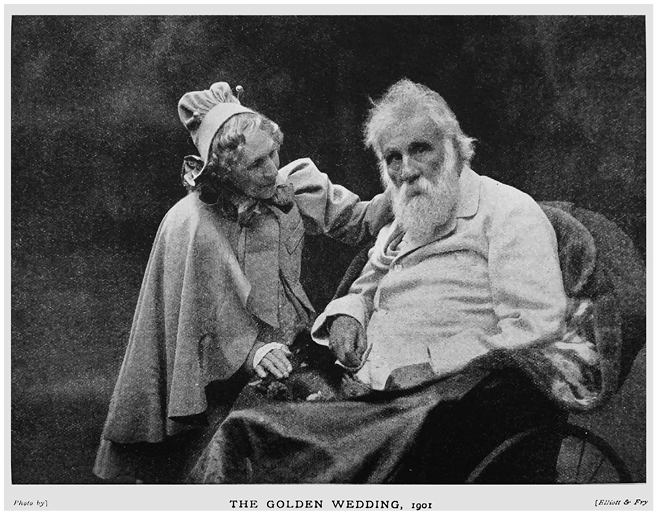
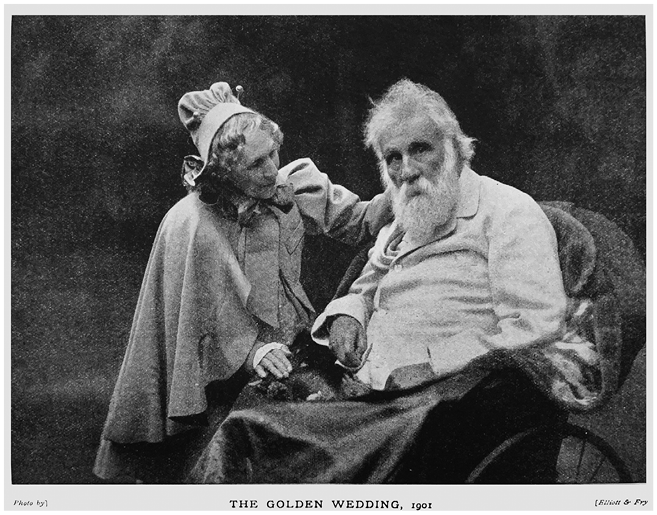
Throughout the 1890s, slowly worsening dementia frustrated MacDonald’s attempts to write and speak (Raeper, 388). He retired from public appearances but continued to write. In 1898, a severe stroke left him partially paralysed and mostly nonspeaking. Despite his illnesses, his final years were quiet and cheerful. Through Louisa, he stayed in correspondence with his grown children. In 1901, he and Louisa celebrated their fiftieth wedding anniversary together (see Figure I.1). But when Louisa died early in 1902, MacDonald’s dementia was too far advanced for him to fully understand (GMAW, 561–2). He spent the last three years of his life waiting for her to return.
Golden wedding anniversary photograph of George and Louisa MacDonald (1901).
Legacy
Ever since his first literary successes in the 1860s, MacDonald’s writings have earned him a loyal and thoughtful following. And yet readers and scholars alike have long struggled with how to classify him. How can his achievement be compellingly encapsulated so as to garner the critical and popular attention he deserves? Most writers outside the literary pantheon – Shakespeare, Wordsworth, Austen – face this challenge to a certain extent, but MacDonald’s case feels particularly awkward.
On the one hand, there is a manifest but somewhat nebulous ‘greatness’ about MacDonald. So, as Crystal L. Downing details in Chapter 16, C. S. Lewis in his preface to George MacDonald: An Anthology declares MacDonald to be his ‘master’ as well as ‘the greatest genius of [myth making] whom I know’.8 W. H. Auden echoes this, calling MacDonald ‘one of the most remarkable writers in the nineteenth century’.9 In a similar vein, G. K. Chesterton asserts that ‘George MacDonald was one of the three or four greatest men of nineteenth-century Britain’, as tested ‘by strict originality of outlook’.10
On the other hand, these same sympathetic critics seem embarrassed by aspects of MacDonald’s art. C. S. Lewis calls MacDonald ‘a difficult critical problem’ because of ‘how to classify such genius’.11 He characterises MacDonald’s writing, particularly the novels, as ‘at times fumbling’ but nonetheless states that if one perseveres one ‘can find even in the worst of them something that disarms criticism and will come to feel a queer, awkward charm in their very faults’.12 Auden thinks some of MacDonald is embarrassingly ‘shy-making’, while Chesterton notes ‘bursts of mysterious dullness or mysterious feebleness’, saying he was ‘so independent of conventions that he [became] conventional by accident’.13 Even so, all three clearly feel that a bit of ‘fumbling’, ‘shy-making’, and ‘dullness’ is a price well worth paying for access to MacDonald’s unique profundity, an imaginative vision found nearly nowhere else in the nineteenth century. Here is how Chesterton puts the puzzle:
I make no attempt here to fix his place in literature. He is in any case one of the kind that it is most difficult to fix. […] As a matter of fact, the mystics have not often been men of letters in the finished and almost professional sense. A thoughtful man will now find more to think about in Vaughan and Crashaw than in Milton, but he will also find more to criticize […] But even this allowance must not be exaggerated; and it is in exactly the same sense in which we pity a man who has missed the whole of Keats or Milton, that we can feel compassion for the critic who has not walked in the forests of Phantastes or made the acquaintance of Mr Cupples in the adventures of Alec Forbes.14
Chesterton sees this challenge as inherent to any writer who prioritises mystic vision over ‘professional’ finish. However, he shifts the burden of failure from MacDonald to the audience; it is the critic, not the mystic, who is to be pitied if demand for precise formal elegance or fear of critical embarrassment prevents them from walking ‘in the forests of Phantastes’.
The invocation of the Welsh poet Henry Vaughan (1621–95) as a parallel to MacDonald is striking, especially since MacDonald made nearly identical comments about Vaughan. Amanda B. Vernon points out in Chapter 13 how MacDonald employs ‘a generous mode of critique’ that emphasises ‘the multivalence of texts’. So, in his critical discussion of Vaughan in England’s Antiphon (1868), MacDonald transforms artistic flaws into virtues and thus provides a template for his own defence:
[Vaughan] is careless and somewhat rugged. If he can get his thought dressed, and thus made visible, he does not mind the dress fitting awkwardly, or even being a little out at elbows. And yet he has grander lines and phrases than any in Herbert. He has occasionally a daring success that strikes one with astonishment […] His movements are sometimes grand, sometimes awkward […] [he has] fine mysticism and odd embodiment.
Read multivalently – substituting MacDonald’s name for Vaughan’s – this passage proffers the terms for a more generous way of understanding MacDonald’s own ‘somewhat rugged’ artistic performances. Instead of judging him by the critical fashion of another age, what MacDonald calls ‘wise criticism’ ought to apply a writer’s own standards (Orts, 40). Apparent ruggedness may be inevitable for a writer attuned more to divine truths than worldly conventions. In this sense, his ‘carelessness’ to particular literary niceties is a ‘divine carelessness’ that prioritises ‘imagination enlightened of the spirit of truth’ over ‘intellect with the best schooling’ (Miracles, 188). His ‘daring successes’ and ‘grander lines’ are inseparable from some ‘odd embodiments’. This refusal to settle for a singular, polished voice is partially the result of MacDonald’s habit of writing in ‘communal fellowship’ with the past – as John Pennington argues in Chapter 3 – weaving texts out of diverse literary strands, making his works more like libraries than single volumes.
Just before the extract from Vaughan’s poetry, MacDonald also articulates the standard by which he would assess his own art: ‘it is not the thought that makes the poet; it is the utterance of the thought in worthy presence of speech’ (Antiphon, 252). In his essay ‘On Polish’ (1865), MacDonald explains this aesthetic more fully: ‘the most polished style will be that which most immediately and most truly flashes the meaning embodied in the utterance upon the mind of the listener or reader’ (Orts, 184). For MacDonald, this is not a matter of ‘smoothness’ or ‘ornament’ but ‘conveyance of thought’, letting the ‘inner structure’ manifest through the ‘surface’ (182–4). Nor is this a matter of dumbing down: ‘the thoughts themselves may be hard to think, and difficulty must not be confounded with obscurity’ (188). Such was MacDonald’s own aesthetic, one which even his devoted son and biographer Greville acknowledges he does not always achieve: ‘the polish actually sometimes veil[s] the brilliancy of the inherent light’ (GMAW, 540).
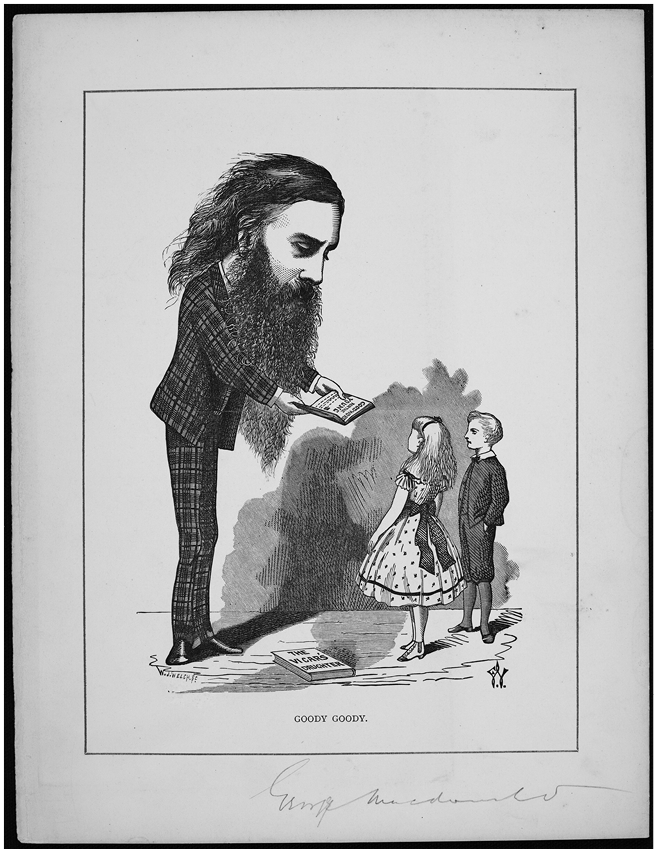
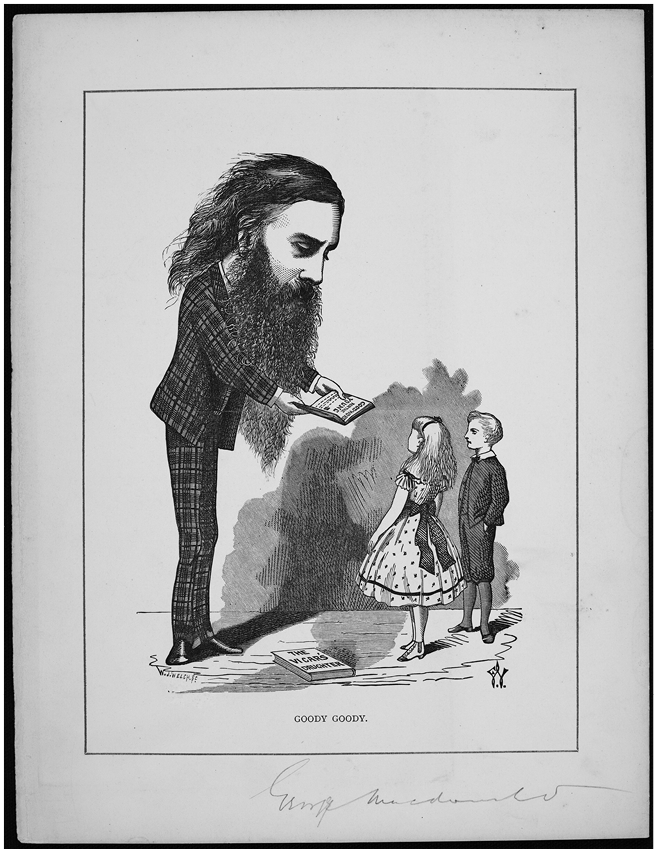
Yet, in Chesterton’s phrase, ‘even this allowance must not be exaggerated’, for what some have taken to be faults others have taken to be merits. Lewis rated Phantastes as MacDonald’s greatest achievement; Auden said Lilith, Chesterton The Princess and the Goblin. Lewis and Auden disliked his poetry; Chesterton claimed that MacDonald’s ‘celestial nonsense’ verse was better than the best of Lewis Carroll.15 In his own time, the situation was somewhat reversed, with many critics lauding his serious poetry but baffled by his fantasies. The poet–critic Gerald Massey, for example, called MacDonald’s poetry ‘half-angel, half-elfin’, but Phantastes ‘a wilderness of wilderment’.16 An 1873 sketch of MacDonald, accompanied by a cartoon of him as ‘Goody Goody’ (see Figure I.2), praises the ‘considerable originality of thought’ in his early novels like David Elginbrod but complains of his mixing genres, exhorting him to ‘call novels novels and sermons sermons’.17 In letters to MacDonald, John Ruskin said his sermons were ‘beautiful – unspeakably beautiful’ but thought parts of ‘The Light Princess’ were ‘weak’ and ‘seriously harmful’ to children.18 Such polarised reactions among his peers remind us, as Kirstin Jeffrey Johnson highlights in Chapter 4, that MacDonald was a central and provocative figure in his own day. His influence was fostered through deep relationships with individuals from diverse intellectual and spiritual communities, and he speaks into many different contexts.
Frederick Waddy, ‘Goody Goody’, cartoon of MacDonald, from Cartoon Portraits and Biographical Sketches of Men of the Day (London: Tinsley Brothers, 1873), 144.
Some of this critical divergence is, of course, a matter of personal preference or shifting fashions in taste. The rise of literary modernism in the 1920s made it harder to appreciate the Victorian sentiment of MacDonald’s poetry even as it fostered an aesthetic for valuing the fragmentation in his fantasies. The mid twentieth-century turn to psychoanalysis offered new maps for navigating MacDonald’s dream landscapes – territory Brian Atterbery deftly explores in Chapter 17 – even as those frameworks reduced some of his multivalent symbolism to more restrictive sexual or clinical categories. Yet much of this critical instability is part and parcel of MacDonald’s aesthetic vision in action.
Unrest
What has sometimes been seen as failures of craft – MacDonald’s ‘wildernesses of wilderment’ or his ‘odd embodiments’ – might more fruitfully be understood as a form of generative awkwardness resulting from the ‘conveyance’ of MacDonald’s disruptive ‘thought’. So, Tabitha Sparks argues in Chapter 9 that MacDonald’s resistance to the seamless immersion of the Victorian ‘realist’ novel was a deliberate choice, intended to heighten the reader’s experience of mutual growth and discovery. In Chapter 10, Benjamine Toussaint explores how Scotland and Scottishness in MacDonald’s works unsettle both English moral complacency and Scottish exclusive nationalism, hybridising the Scottish national tale structure of Waverley and the landscape of Scotland with fairyland.
MacDonald’s spirit of generic and cultural boundary-crossing was spurred on by a deeply ingrained intellectual habit: the investigative rigour of an empirical inquirer. As Franziska E. Kohlt elucidates in Chapter 14, MacDonald was a university-trained scientist who remained a man of science his entire life, resisting the Victorian tendency to set science in opposition to imagination or religion and reading Darwin and Dante with equal relish. Indeed, he brought the scientific method into the very heart of his literary creation. In Chapter 11, Joshua Richards calls MacDonald ‘a restless, ruthless experimenter’ in poetry, arguing that his refusal to settle into a predictable style makes him as difficult to anthologise as he is to synthesise. Similarly, in Chapter 8 John Patrick Pazdziora presents Phantastes and Lilith as products of a relentless, radical experimentation with the fantastic mode, discovering upward paths in the genre where others might have abandoned the experiments as pathless. This experimental drive extended even to the darkest corners of his imagination. Alison Milbank explains in Chapter 7 how MacDonald played with traditional tropes of transgression and terror to create a ‘fully gothic mystical theology’.
Beneath this incessant experimentation with genre was MacDonald’s radically unsettling theology. In Chapter 15, Justin Ariel Bailey describes MacDonald’s theological centre as ‘the heart of the Father revealed in the Son, waking human hearts to childlikeness’. Famously averse to ‘systems’ of all kinds, MacDonald’s theology turns from the surety and logical rigidity of formal theology to the disruptive childlikeness of Jesus. John McNeill observes in Chapter 12 how the opening of Unspoken Sermons does not focus on a conventionally key doctrinal issue – John Wesley’s first sermon, for instance, was ‘Salvation by Faith’ – but on the pastoral and affective ‘Child in the Midst’. MacDonald’s preaching was an attempt to wake the sleeping child within each person and to stimulate them on their return journey home to their heavenly Father. He believed that ‘the best thing you can do for your fellow’ is ‘not to give him things to think about’ but ‘to make him think things for himself’ (Orts, 319) – that is, to shake them out of their complacency and into Augustine’s realisation that ‘our heart is restless, until it repose in [God]’.19 In an attempt to replace God during an increasingly unbelieving age, Victorian critics like Matthew Arnold sought in literature to find a ‘high seriousness’ that ‘our spirits [can] rest upon’.20 But for MacDonald our spirits cannot ‘rest upon’ anything outside of God. Hence, ‘repose is not the end of education’ but ‘a noble unrest, an ever renewed awaking from the dead […] which had better far be accelerated into fever, than retarded into lethargy’ (Orts, 1).
Key to this ‘noble unrest’ is a childlike sense of wonder. As Daniel Gabelman argues in Chapter 6, MacDonald’s fairy tales help rekindle wonder through imaginative participation in psychological and supernatural border crossings. Moreover, as Jean Webb notes in Chapter 5, unlike Alice’s more famous adventures with wonder – which do ‘not change anything in the real world around her’ – MacDonald’s child heroes and their worlds are transformed by their wonder-filled adventures. His literature for children makes significant innovations in the genre, giving his child protagonists agency and the ability to make real progress where the commonplace adult vision is unable to see a path forward. These childlike children have a ‘divine carelessness’ and so are willing to be embarrassed by worldly standards and willing to embarrass others by holding to divine ones.
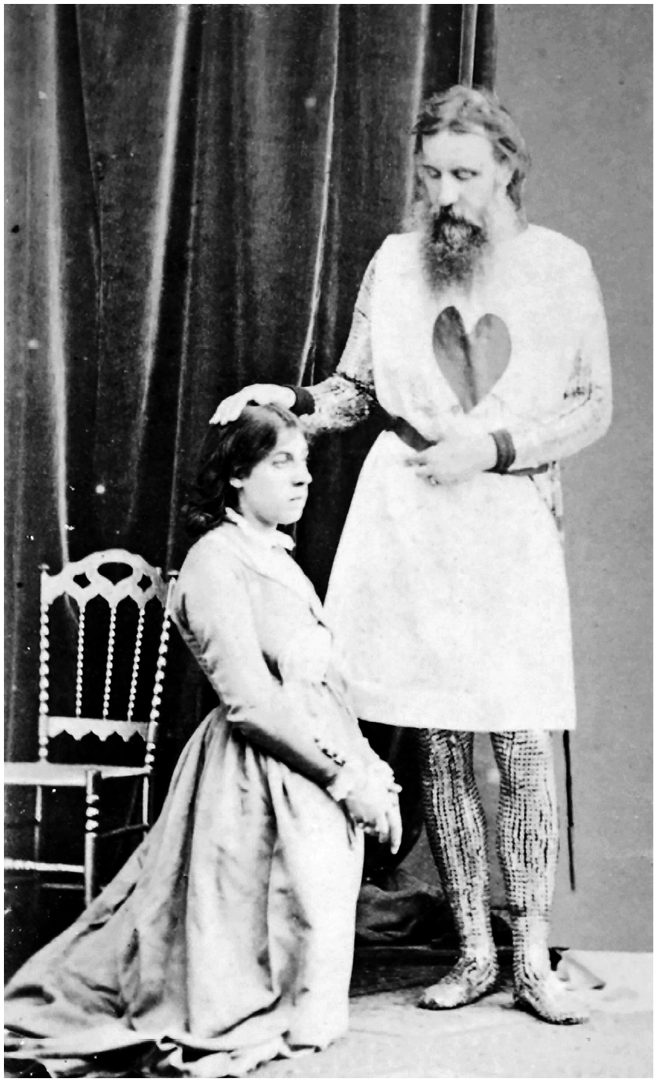
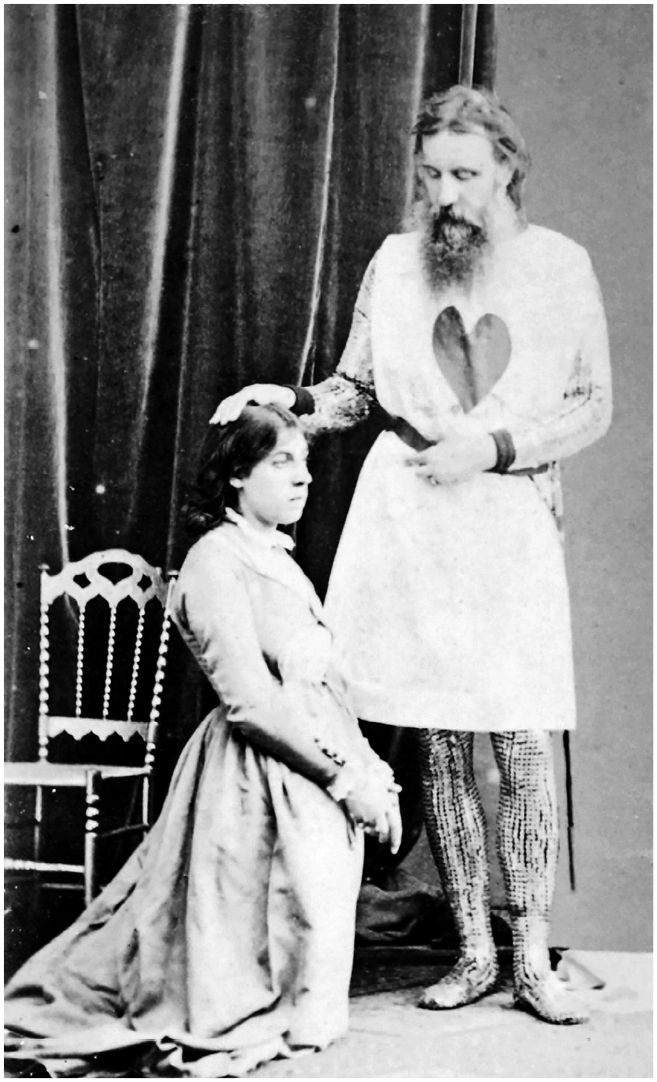
A couple of anecdotes from MacDonald’s life illustrate this willingness to embarrass and be embarrassed for the sake of awakening others ‘to be playfellows with God’ (Orts, 42). The first is MacDonald’s unabashed performances in his family’s travelling productions of The Pilgrim’s Progress, from 1877 to 1889 (photographed in Figure I.3 as Greatheart). Reflecting on the propriety of this undertaking in a letter from 1876, MacDonald comments,
What society so-called may say or do about it, I simply will not heed one straw […] We are only taking up an art that has been unjustly undervalued and left too much to unfit representations […] The time is short, and there is none for humbug, whether social or ecclesiastical – there is time only for truth and justice and graciousness and lovingkindness, and we hope to learn and teach some of all these […] What God has put in us, we will let come out, and not be ashamed.21
The second is the ‘pleasant pride of perennial childhood’ that MacDonald took in wearing his full Scottish costume (GMAW, 449). Invited to a Burns Society dinner in New York in 1871,
He accepted, and asked whether these Scots in New York followed the custom set by the Caledonian Society of London – of appearing at the annual dinner in full dress kilt. The reply was that it was de rigueur for those who were Highlanders to wear their native costume. So my father of course took his kilt with him – even sword, dirk and skian dubh. And to Delmonico’s on January 24th he went in his MacDonald tartans – and was the only guest not in black swallow-tails and white tie! He was greeted with rapturous delight.
In the ‘swallow-tail’ world of Victorian literature, MacDonald sometimes appears as a figure ‘out at elbows’, a rugged visionary whose awkward refusal to conform to genre conventions and worldly wisdom has sometimes been read as a failure of craft. Yet, as this Companion demonstrates through detailed explorations of his life, genres, and themes, MacDonald ‘let come out’ what God put in him, refusing to ‘be ashamed’ by ‘society so called’. This willingness to embarrass and be embarrassed is at the heart of his creative, spiritual project. He was a restless experimenter whose generative awkwardness is designed to shake us out of our commonplace lethargy. Readers of this Companion are invited to enter MacDonald’s works through these many doors and experience the ‘noble unrest’ of his transformative vision for themselves.
Photograph of MacDonald as ‘Greatheart’ in his family’s production of The Pilgrim’s Progress.