Introduction
While the prevalence of major depression in older adults is lower than that observed among younger adults, depression is a significant problem for older adults, and can be associated with impairments in physical and cognitive function as well as mortality (Blazer, Reference Blazer2003). Recognizing depression in older patients can present challenges as clinicians seek to disentangle medical comorbidity, sleep problems and functional difficulties associated with normal aging from depressive symptoms. In addition, a “depression without sadness” phenomenon has been noted, suggesting symptom expression may differ in older adults (Gallo et al., Reference Gallo, Rabins, Lyketsos, Tien and Anthony1997). Although recent progress has been made, late-life depression remains undiagnosed and undertreated (Charney et al., Reference Charney2003).
While the criteria for major depression are definitively set forth in DSM-IV (American Psychiatric Association, 1994), there is still considerable debate as to whether these criteria are applicable to older adults who may present with different symptoms or who often do not present with the desired number of symptoms across the relevant categories or have intermittent symptoms that may not be present for an entire two-week period (Jeste et al., Reference Jeste, Blazer and First2005). Improving diagnostic criteria for older adults could be particularly useful as the field of geriatric psychiatry readies for an expected increase in the number of older adults, a higher proportion of whom compared with current generations will bring a lifetime history of one or more psychiatric disorders, rendering them susceptible to future episodes and potentially creating a crisis in geriatric mental health (Jeste et al., Reference Jeste1999). This is particularly applicable to major depression, as the number of older adults with a lifetime history of depressive disorder will be significant over the next decades (Heo et al., Reference Heo, Murphy, Fontaine, Bruce and Alexopoulos2008).
As the field of psychiatry moves toward revisions in diagnostic nomenclature, there is both discussion concerning the discrete separation of disorders and debate concerning categorical and dimensional criteria or the possible inclusion of both (Helzer et al., Reference Helzer, Kraemer and Krueger2006; Kraemer, Reference Kraemer2007; Regier et al., Reference Regier, Narrow, Kuhl and Kupfer2009). For example, Kraemer has suggested the importance of conducting studies of heterogeneity within groups of patients with one categorical diagnosis to identify differing etiology, symptom expression, and outcomes (Kraemer, Reference Kraemer2007).
A significant body of work is emerging that can contribute to these and future discussions by exploring the underlying structure of various psychiatric syndromes using latent class analysis (LCA). These analyses have been applied to multiple disorders including posttraumatic stress disorder (Breslau et al., Reference Breslau, Reboussin, Anthony and Storr2005), eating disorders (Wade et al., Reference Wade, Crosby and Martin2006), and obsessive-compulsive disorder (Nestadt et al., Reference Nestadt2009). Using samples of depressed and nondepressed adults across all age groups, subtypes of depression have also been explored, often resulting in classifications based on symptom severity, with one class resembling major depression or more symptomatic depression and, if a general sample, a class representing the nondepressed (Sullivan et al., Reference Sullivan, Kessler and Kendler1998; Reference Sullivan, Prescott and Kendler2002; Lincoln et al., Reference Lincoln, Chatters, Taylor and Jackson2007; Carragher et al., Reference Carragher, Adamson, Bunting and McCann2009; Prisciandaro and Roberts, Reference Prisciandaro and Roberts2009). Within the sample of patients used in our analyses, subtypes of vascular/nonvascular depression have been identified using LCA (Sneed et al., Reference Sneed, Rindskopf, Steffens, Krishnan and Roose2008).
LCA allows individuals who share similar characteristics to be grouped together in classes or clusters based on underlying characteristics. These clusters can then be used to identify sources of heterogeneity within a specified group. Using LCA to identify clusters of individuals has advantages over more traditional clustering methods in that it utilizes a model-based approach which assigns members to clusters based on their posterior membership probabilities (Magidson and Vermunt, Reference Magidson and Vermunt2002; Vermunt and Magidson, Reference Vermunt, Magidson, Hagenuars and McCutcheon2002). The number of clusters is not known a priori and is specified in the model as k, resulting in a k-category latent variable as the dependent variable on the models. Models such as these can expand the research base in geriatric psychiatry and potentially lead to improved patient care and outcomes (Kupfer et al., Reference Kupfer, Kuhl and Regier2009).
Depressive symptoms can be assessed in research and clinical practice using various instruments that capture unique aspects of a depression syndrome. For example, the Hamilton Rating Scale for Depression (HAM-D) was designed to measure severity among patients with depression as well as monitor treatment response and detect recurrence and relapse (Hamilton, Reference Hamilton1967). On the other hand, the Center for Epidemiologic Studies – Depression Scale (CES-D) was designed to screen for common symptoms of depression in community samples. The list of symptoms in the CES-D is not inclusive, and symptoms such as suicidal thoughts and anhedonia that could be used to screen for major depression are not part of the scale (Radloff, Reference Radloff1977; Radloff and Locke, Reference Radloff and Locke2000). Finally, the Diagnostic Interview Schedule (DIS) was designed to determine the prevalence of psychiatric disorders in community populations and to be administered by trained lay interviewers. In all sections, including the depression section, symptoms are listed that correspond to DSM criteria for major depression and dysthymia, and the interviewers use probes to assist in establishing severity (Robins et al., Reference Robins, Helzer, Croughan and Ratcliff1981).
We recently explored the structure of symptom presentation in a sample of older adults diagnosed with major depression, and identified four homogeneous clusters of patients based on their symptom profiles at the index episode. These profiles were determined using LCA from the symptoms reported in the Montgomery-Åsberg Depression Rating Scale (MADRS), an instrument developed to measure severity and monitor treatment-sensitive changes in depressive symptoms among patients treated for depression (Montgomery and Åsberg, Reference Montgomery and Åsberg1979; Hybels et al., Reference Hybels, Blazer, Pieper, Landerman and Steffens2009). In part, these profiles reflected differing levels of severity but suggested categorical differences as well, particularly in the expression of sadness.
The purpose of the analyses performed in the present paper was first to replicate these earlier findings by exploring symptom profiles across other instruments that assess a broader range of symptoms than the MADRS. Specifically, our first objective was to identify clusters of patients within our same sample of older patients based on three other assessment tools that were administered at the time of the index episode: the CES-D, the HAM-D and the depression section of the DIS. We hypothesized that, as we found in the MADRS, a multi-cluster model would fit the data better than a one-cluster model for each of the three depression instruments. That is, we would confirm heterogeneity across different instruments to measure depressive symptoms. Because these three assessment tools capture conceptually different aspects of depression, a confirmation of heterogeneity and the identification of variables associated with cluster membership can provide relevant information as the field continues to deepen its understanding of the complexities of late life depression.
Another aim was to take these findings a step further. Within scales to measure depression, individual items are often correlated. Our second objective was to take advantage of instruments with some conceptual differences administered during the same index episode and combine the symptoms across multiple instruments to identify representative essentially uncorrelated symptoms of depression from these instruments. Using these key symptoms, our aim was to repeat our analyses to identify discrete clusters of patients within this sample to confirm our earlier findings of heterogeneity. Again, we hypothesized that a multi-cluster model would fit the data better than a one-cluster model.
Methods
Study sample
The sample was made up of 366 inpatients and outpatients aged 60 years and over who met DSM-IV criteria for major depression and were enrolled in the Neurocognitive Outcomes of Depression in the Elderly (NCODE) study conducted at Duke University (Steffens et al., Reference Steffens2007). NCODE is a prospective cohort study of older depressed patients without dementia or suspected dementia at enrollment. Other exclusion criteria included: (1) any comorbid major psychiatric illness such as schizophrenia, (2) any primary neurologic illness such as Parkinson's disease, (3) active alcohol drug abuse or dependence, or (4) metal in the body which precluded magnetic resonance imaging of the brain. Patients with comorbid anxiety disorders were included if the anxiety disorder was not the primary psychiatric illness. Patients were recruited through clinician referrals from both psychiatry and primary care clinics at Duke. Both new (incident) and recurrent (prevalent) cases of depression were included. This longitudinal study is now in its fourteenth year. All participants initially provided written consent, and the research protocol is reviewed and approved annually by the Duke University Institutional Review Board.
At the time of these analyses, a total of 382 eligible patients had been enrolled. Twelve patients had data missing on the Mini-mental State Examination (MMSE) and an additional four patients had missing baseline MADRS scores and were excluded from our original analysis (Hybels et al., Reference Hybels, Blazer, Pieper, Landerman and Steffens2009). For comparability across scales, we used the same sample in these analyses, resulting in an analysis sample of 366 patients.
Measures
At enrollment, participants were administered the Duke Depression Evaluation Schedule (DDES) (Blazer et al., Reference Blazer, Hughes and George1992), a composite instrument that included a battery of depression assessments including the CES-D (Radloff, Reference Radloff1977), the depression section of the DIS (Robins et al., Reference Robins, Helzer, Croughan and Ratcliff1981) modified for DSM-IV, and the HAM-D (Hamilton, Reference Hamilton1967). The DDES also included the MMSE (Folstein et al., Reference Folstein, Folstein and McHugh1975), questions concerning physical functioning, and general questions concerning perceived stress and social support.
Our first analyses utilized the CES-D, the 17-item HAM-D, and the depression section of the DIS. The CES-D was used in its original format listing 20 symptoms. Each symptom was scored on a range of 0 (rarely or none of the time) to 3 (most or all of the time) to indicate how frequently the symptom had been present the previous week. Four items were reverse coded so a higher score for each item indicates greater severity. Four factors had previously been identified within this scale: negative affect, positive affect, somatic symptoms, and interpersonal relationships (Weissman et al., Reference Weissman, Sholomskas, Pottenger, Prusoff and Locke1977), and for interpretation only, symptoms were grouped together in the present analysis by these factors. The 17-item version of the HAM-D was also used for this analysis. In this measure, items are assigned scores based on observed severity, either 0–4 or 0–2, with higher scores indicating greater severity.
We also used the full list of symptoms from the DIS depression section and the lead questions concerning (1) a period of two weeks feeling depressed, (2) a period of loss of interest or pleasure, and (3) a period of two years feeling depressed. Though the DIS was not created as a scale to screen for depressive symptoms but rather to identify cases of major depression, symptoms are coded 1 if not present, 2 if present but below diagnostic criteria (not discussed with a health professional and did not interfere with usual activities) and 5 if present and meets criteria (cannot be explained by medication, drugs or alcohol or physical illness, interferes with life and activities and was the subject of discussion with a health professional). Symptoms coded as a 3 or 4 indicate the symptom is likely due to medication, drugs or alcohol or due to a physical illness or injury. Only a few symptoms allowed a code of 2 and some symptoms only allowed a code of 1 or 5. For purposes of these analyses, symptoms with a code of 2, 3, 4 or 5 were coded as present for overall coding of 0/1 representing absent/present. Because the DIS probes for lifetime experience of symptoms, we then examined when the symptom was last experienced. Only symptoms present within the two weeks prior to enrollment were coded as currently present and others were coded as absent. Unlike the CES-D and the HAM-D, therefore, we have not incorporated a measure of symptom severity. The CES-D and the DIS were interviewer administered, while the HAM-D was clinician scored.
Selected variables from the baseline DDES were explored as correlates of cluster membership defined as done in our earlier paper (Hybels et al., Reference Hybels, Blazer, Pieper, Landerman and Steffens2009). Demographic variables included sex, age as a continuous variable, race (White vs. Non-White), marital status (married vs. not married), and years of education (high school or less vs. more than high school). Clinical variables included MMSE score (<28 vs. 28+, recognizing patients with moderate to severe cognitive impairment were excluded from the study), age of onset of depression used as a continuous variable, and the number of lifetime spells of depression that lasted two weeks or more (<4 vs. 4 or more). Social variables included perceived stress in response to the question “On a scale of 1 to 10 how would you rate your average stress during the preceding 6 months?” with 10 corresponding to high stress. Perception and satisfaction with social support was measured using the subjective social support domain of the Duke Social Support Index (DSSI) (Landerman et al., Reference Landerman, George, Campbell and Blazer1989). The questions in this domain included how often the patient felt lonely, understood, useful, and listened to as well as knew what was going on with family and friends, had a role, could count on others in times of trouble, talk about problems, was satisfied with relationships and whether wished for more help. Scores ranged from 9 to 28 with higher values indicating greater levels of subjective social support. For ease of interpretation, participants were coded as impaired/not impaired (Hybels et al., Reference Hybels, Blazer, Pieper, Landerman and Steffens2009). Limitations in basic and instrumental activities of daily living (ADLs) or mobility were assessed by inquiring about sixteen tasks. Basic ADLs included being able to eat, dress, take care of appearance, walk, bathe, use the toilet and bend down without help. These items were modified from those of Katz et al. (Reference Katz, Downs, Cash and Grotz1970), Branch et al. (Reference Branch, Katz, Kniepmann and Papsidero1984) and Nagi (Reference Nagi1976). Limitations in instrumental ADLs and mobility included walking a quarter of a mile, walking up and down stairs, getting around the neighborhood, shopping, keeping track of money, taking care of children, cleaning house, preparing meals and doing yardwork/gardening. These items were modified from Fillenbaum (Reference Fillenbaum1988), and Rosow and Breslau (Reference Rosow and Breslau1966). The number of ADL and IADL/mobility limitations was coded as none vs. one or more.
Statistical analysis
Each depression instrument was first studied separately. For the three models, the dependent variable was a k-category latent variable where each k category represented a separate class or cluster of patients. The predictor variables used to establish cluster membership were the symptoms that comprised the measures/scales. Each cluster represents a homogenous group of patients who shared similar responses to the scale items (the model parameters). A one-class model would suggest a similar symptom profile for all the patients with random variation around the mean for each symptom. A multi-class solution suggests heterogeneity within the sample based on latent or unobserved characteristics expressed through observed symptom profiles. LCA differs from more traditional methods of cluster analysis such as k-means clustering in that patients are assigned to clusters based on their posterior membership probabilities and assigned to the cluster for which their probability is the highest (Vermunt and Magidson, Reference Vermunt, Magidson, Hagenuars and McCutcheon2002; Reference Vermunt and Magidson2005b). Latent class cluster analysis also differs from factor analysis in that factor analysis uses the symptoms themselves to form the groups while in cluster analysis the patients or participants form the clusters. The latent class cluster analyses were run using Latent Gold analysis software (Vermunt and Magidson, Reference Vermunt and Magidson2005a).
For each of the three scales, we assessed the fit of five consecutive models with 1–5 clusters each to identify the model that best fit the data. Model fit was assessed though the L2 likelihood ratio statistic, which indicates the amount of observed relationship between the scale items that remains unexplained by the model. Significance levels p > 0.05 are generally desired. Because we had a number of model parameters for each of the scales and data in individual response categories could be sparse, we estimated the significance by bootstrapping (n = 500 iterations). The resulting p-value was then the proportion of re-estimated models with a higher L2 than in our comparison model (Vermunt and Magidson, Reference Vermunt and Magidson2005a; Reference Vermunt and Magidson2005b). To determine the final model for each instrument we used the Bayesian Information Criteria (BIC) statistic, which takes the number of model parameters into account in assessing model fit, with a smaller BIC indicating a better fit. Because these models were nested, we also used a conditional bootstrap option (n = 500 iterations) to compute the difference in the log-likelihood statistics between two models to see if adding another cluster improved model fit. For example, a model with two clusters was compared with a model with one cluster, a model with three clusters was compared with a model with two clusters, etc. for the full set of models. Finally, to improve the fit of our multi-class model, we examined the correlation between variables in the scale and included bivariate residuals as direct effects in the models for those variables that were highly correlated (Vermunt and Magidson, Reference Vermunt, Magidson, Hagenuars and McCutcheon2002; Reference Vermunt and Magidson2005a; Reference Vermunt and Magidson2005b).
We explored the symptom profiles for each cluster by comparing the mean score for each symptom within each cluster. The means do not necessarily represent the severity. That is, a higher mean could mean more patients in a particular cluster had higher symptom scores or could suggest a few patients had much higher scores while the majority of the patients within the cluster had moderate scores.
To identify covariates associated with cluster membership we ran bivariate descriptive analyses using SAS analysis software (SAS Institute, 2008). We used χ2 analyses to explore differences across groups identified by categorical variables, and for continuous variables, we compared means across the clusters using F tests. Significance was set at p<0.05 to identify characteristics potentially associated with cluster membership to assist in understanding heterogeneity within this one diagnosis. All statistical tests were two-tailed.
To achieve our second objective, we grouped together the 66 items from the three instruments presented in these analyses and the MADRS reported earlier: that is, the CES-D (20 items), HAM-D (17 items), DIS (19 items) and MADRS (10 items). Each item was then standardized. To reduce this full spectrum of symptoms to a set of uncorrelated items, we first input a polychoric correlation matrix into SAS PROC VARCLUS. The VARCLUS procedure is similar to factor analysis but offers interpretability advantages, and identifies groups of variables that are as correlated to each other among themselves and uncorrelated to other groups as possible. Each group (cluster) was split into two dimensions until each remaining cluster had a second eigenvalue of less than 1 (Nelson, Reference Nelson2001; Pasta and Suhr, Reference Pasta and Suhr2004). Within each identified dimension of variables, we then picked a representative symptom defined as the item with the lowest 1-R2 ratio within the cluster indicating a high R2 with its own cluster and a low R2 with the next closest cluster. These representative items became the parameters for our final latent cluster model. We followed the same procedures specified above. However, after determining the optimal number of clusters based on the model parameters we added sex, age, education, race, martial status, and MMSE score into the final model as covariates. The inclusion of covariates into the model can result in reassignment of some patients into a different cluster but overall can reduce measurement error. As a final step, we explored bivariate associations between selected variables and each identified cluster.
Results
The sample of 366 patients were mostly white (86%) and female (66%), and had a mean age of 69 years. Approximately 56% of the patients were taking an antidepressant at the time of study enrollment and these depression assessments. A total of 33% had no history of antidepressant use at enrollment.
Profiles of depressive symptoms in the CES-D
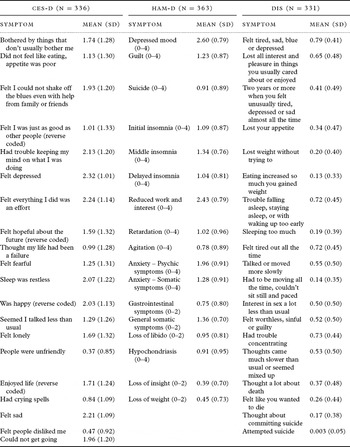
Complete CES-D data were available for 336 of the 366 patients in the analysis sample. The symptoms most frequently endorsed at some level were feeling depressed, sad, and everything was an effort. Feeling that people were unfriendly and people disliked (me) were the symptoms least likely to be endorsed. The symptoms that were most likely to be experienced most or all of the time included feeling depressed, feeling sad, having difficulty concentrating, feeling everything was an effort and sleep was restless. The mean scores for each of the 20 symptoms are shown in Table 1.
Mean symptom scores across instruments

Using the BIC statistic, we concluded a four-cluster model fit the data best. The classification error was estimated to be 8.3% for our final model. Cluster numbers are assigned by size. A total of 36% of the participants had the highest probability of being in Cluster 1, 34% in Cluster 2, 22% in Cluster 3 and 8% in Cluster 4. The symptom profiles for each cluster are shown in Figure 1 where CES-D symptoms are ordered within the four factors: negative affect (7 symptoms), positive affect (4 symptoms), somatic symptoms (7 symptoms), and interpersonal relationships (2 symptoms) previously identified. The profiles suggest the clusters differ primarily in severity. Patients in Cluster 1 appear to have moderate symptoms across most categories with the exception of the interpersonal symptoms. Those in Cluster 2 appear to have less severe symptoms on average compared with Cluster 1 but a similar response to talking less than usual and restless sleep. Patients in Cluster 3 appeared on average to have more severe symptoms compared with the other patients. Finally, those in Cluster 4 appeared to have few depressive symptoms overall as measured by the CES-D.
Profiles of depressive symptoms at enrollment by cluster for the CES-D.

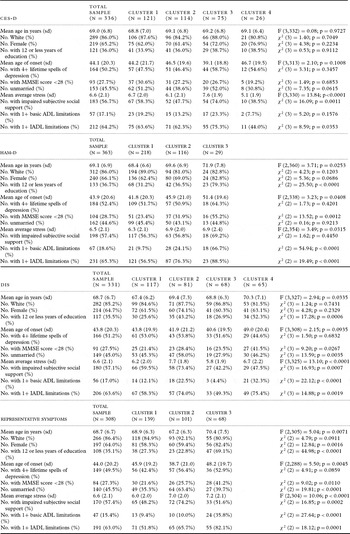
As shown in Table 2, perceived stress and subjective social support were significantly associated with cluster membership defined through responses to the CES-D items. Cluster 3 had the highest proportion of patients with impaired subjective social support, while Cluster 4 had the lowest proportion. Similarly, patients in Cluster 3 had the highest levels of perceived stress, while those in Cluster 4 had the lowest levels. These data also suggested those in Cluster 3 were more likely to have one or more IADL limitations compared with those in other clusters, particularly Cluster 4 which had the lowest percentage of patients with IADL impairment. The clusters did not appear to differ by demographic variables or depression history.
Baseline sample characteristics by cluster across instruments

We also explored cluster membership by history of antidepressant use at enrollment based on our STAGED variable (Steffens et al., Reference Steffens, McQuoid and Krishnan2002) and found significant differences by cluster (χ2 [12] = 42.8, p < 0.0001). Clusters 2 and 4 had a higher proportion of patients without a history of antidepressant use compared with Clusters 1 and 3. In addition, 19% of the patients received electroconvulsive therapy (ECT) during the course of the study, and we observed differences by cluster (χ2 [3] = 23.1, p < 0.0001), with 38% of the patients in Cluster 3 receiving ECT compared with 8% in Cluster 2. We had a significant amount of data missing for both the STAGED and ECT variables, so these results must be interpreted with caution.
Profiles of depressive symptoms in the HAM-D
Complete HAM-D data were available for 363 patients. The symptoms most frequently observed at some level were depressed mood, anxiety-psychic symptoms, and reduced work and interest. The symptoms that were least likely to be observed were loss of insight and loss of weight. The symptoms with the highest proportion of patients coded as more severe (a code 3 or 4 on a 0–4 scale) were depressed mood and reduced work and interest. The symptoms coded 0–2 with the highest proportion of patients with a code of 2 were middle insomnia and general somatic symptoms. The mean scores for each symptom are presented in Table 1.
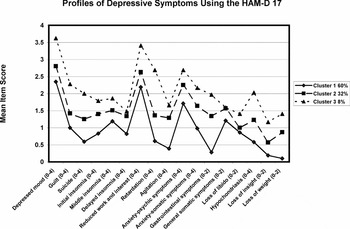
Using the BIC statistic, we determined a three-cluster model fit these data best. The classification error was estimated to be 7.5% for our final model. The symptom profiles for each cluster are shown in Figure 2. Patients appeared to differ primarily in terms of severity. Patients in Cluster 1 (60%) had the lowest mean scores across all symptoms, while those in Cluster 3 (8%) generally had the highest mean scores. Patients in Cluster 2 (32%) had mean scores that for the most part fell between the mean scores for the other clusters. Patients in Cluster 2 showed similar mean values for delayed insomnia and general somatic symptoms when compared with patients in Cluster 3. It is important to remember that all the HAM-D items do not have the same scale of measurement. For example, a mean score of 3.5 for reduced work and interest (item range 0–4) for Cluster 3 may not be significantly more severe than a mean score of 1.5 for loss of weight (item range 0–2).
Profiles of depressive symptoms at enrollment by cluster for the HAM-D.

As shown in Table 2, several variables were differentially associated with cluster membership. Patients in Cluster 3 with the highest mean scores across all symptoms were older, were less educated, had a later age of onset of depression, had lower MMSE scores, and were more likely to have impairments in basic ADLs and IADLs compared with the patients in the other two clusters. Patients in Clusters 2 and 3 had higher levels of perceived stress compared with patients in Cluster 1. Levels of subjective social support and demographic variables other than age were not significantly different across clusters.
History of antidepressant use was significantly associated with cluster membership χ2[8] = 65.9, p < 0.0001. Forty-two percent of patients in Cluster 1 did not have a history of antidepressant use compared with 33% of patients in Cluster 2, and 4% in Cluster 3. Similarly, ECT during the duration of the study was associated with cluster membership χ2[2] = 79.8, p < 0.0001. A total of 82.1% of the patients in Cluster 3 had ECT at some point during the study compared with less than ten percent for patients in Cluster 1 and 22.0% of those in Cluster 2, χ2 [2] = 79.8, p < 0.0001. Again, there was considerable missing data for these variables, so the findings must be interpreted with caution.
Profiles of depressive symptoms using the major depression module of the DIS
Complete information for all of the DIS items was available for 331 of the 366 patients. The most frequently reported symptoms were feeling depressed, having trouble falling asleep, feeling tired all the time, having trouble concentrating, and losing interest and pleasure. The least frequently reported symptoms were attempting suicide, not being able to sit still, and gaining weight. The means for each symptom are presented in Table 1.
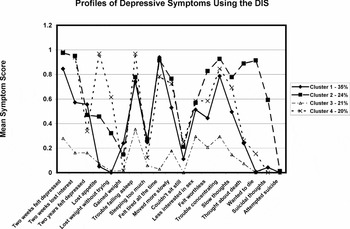
A comparison of the BIC statistics across the DIS models suggested a four-cluster model provided the best fit. The classification error in the final model was 9.3%. The symptom profiles, shown in Figure 3, reflect a complex pattern of symptom endorsement that appears to differ in ways other than severity. Over one-third of the patients (35%) had the highest probability of being in Cluster 1, 24% of being in Cluster 2, 21% of being in Cluster 3, and 20% of being in Cluster 4. As we saw with the other two measures, one cluster had the lowest mean scores across all symptoms, in this case Cluster 3. Unlike the CES-D and the HAM-D, there was not a group that had consistently highest mean scores across the symptoms. Patients in Clusters 2, 3 and 4 shared similar profiles with the exception of losing appetite and weight and thoughts of death, wanting to die and suicidal thoughts. We did not detect one cluster specifically associated with reporting two years of feeling depressed with loss of interest, which would have suggested a cluster of patients with major depression perhaps superimposed upon underlying dysthymia.
Profiles of depressive symptoms at enrollment by cluster for the DIS.

Overall, as shown in Table 2, a number of variables were differentially distributed across the clusters as defined by the items in the DIS. The mean age was highest for patients in Cluster 4 and lowest for Cluster 1. Cluster 4 had the highest proportion of patients with 12 or less years of education while Clusters 1 and 3 had the lowest. Cluster 2 had the highest proportion of patients who were not married while Cluster 3 had the lowest. The proportion of patients with lower MMSE scores was significantly higher in Cluster 4 compared with the other three clusters. Like observed with the CES-D and the HAM-D, levels of perceived stress in the previous six months also differed across clusters, with Cluster 2 reporting the highest mean score and Cluster 3 the lowest. Similarly, patients in Cluster 2 also had the highest proportion of patients reporting low levels of subjective social support. Clusters 2 and 4 had a higher proportion of patients reporting limitations in both basic as well as instrumental ADLs compared with Clusters 1 and 3.
History of antidepressant use was associated with cluster membership (χ2[12] = 27.0, p = 0.0078). A total of 69% of the patients in Cluster 4 and 62% of the patients in Cluster 2 were taking an antidepressant at the time of study enrollment, compared with 42% of the patients in Cluster 1 and 36% of the patients in Cluster 3. Only 21% of the patients in Cluster 4 had never taken an antidepressant, compared with 35% in Cluster 2, 44% in Cluster 1 and 56% in Cluster 3. Similarly, 30% of the patients in Cluster 4 and 26% of the patients in Cluster 2 received ECT at some point during the course of the study compared with 10% in Cluster 3 and 7% in Cluster 1 (χ2 [3] = 17.0, p = 0.0007).
We have chosen to include only patients with complete data for all items in the LCA given the uncertainty of missing at random and to be consistent with our earlier work. We reran the cluster models for the CES-D and the DIS including an option to impute data when missing for the indicators and the results were essentially unchanged. The number of clusters was the same and the characteristics continued to be differentially distributed across clusters (analyses available upon request).
Profiles of depressive symptoms using set of representative symptoms
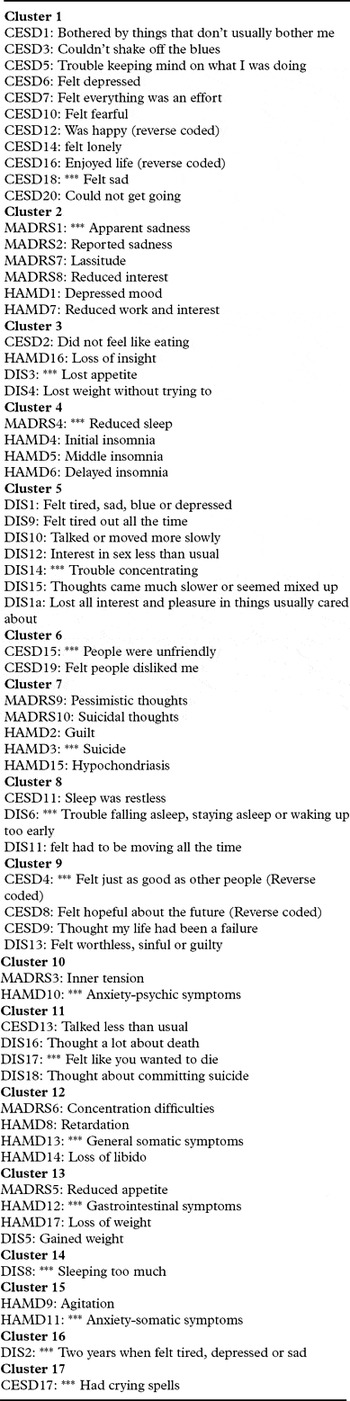
A total of 308 patients had complete data for the combined analyses. We identified 17 symptom dimensions from our 66 items. One item, attempted suicide from the DIS, was dropped from the VARCLUS procedure because no patients had endorsed this item. Table 3 lists the symptoms within each dimension as well as the identified representative symptom from that cluster. We noted some potential overlap among the clusters. There were four inter-cluster correlations greater than 0.60: Clusters 1 and 5, Clusters 1 and 9, Clusters 3 and 13 and Clusters 5 and 11.
Summary of symptoms identified from the VARCLUS Procedure (*** = representative symptom)

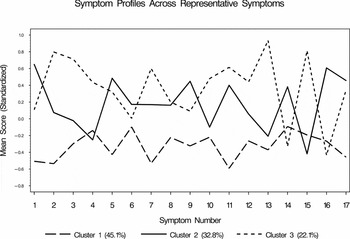
We then used the 17 representative symptoms as the (standardized) parameters for the final model. A three-cluster model provided the best fit to the data. Four local dependencies were included as direct effects: DIS3 and DIS6, MADRS4 and DIS6, DIS3 and HAMD12 and MADRS4 and DIS8. The classification error in the final model was 10.3%. A total of 43.7% of the patients were in Cluster 1, 34.1% were assigned to Cluster 2 and 22.1% were in Cluster 3. The average probabilities of class membership for each latent class were as follows: Cluster 1 = 0.897 (range 0.393–0.999), Cluster 2 = 0.896 (range 0.575–0.999) and Cluster 3 = 0.899 (range 0.352–0.999). For 14 of the 17 indicators, knowledge of that parameter significantly contributed toward discriminating between the clusters. The three symptoms which did not appear to vary across classes were lost appetite, people were unfriendly, and felt like you wanted to die. Across the covariates added to the model, sex, marital status, education and age contributed toward differentiating the clusters. Older patients and those with fewer years of education were less likely to be in Cluster 2, while those who were unmarried were more likely. Women, patients with more education, and unmarried patients were more likely to be in Cluster 3. The contributions of MMSE score and race were not significant. Figure 4 shows the symptom profiles for each cluster. We noted that these groups appear to differ in ways other than severity. That is, the profiles were not parallel. While the mean scores for patients in Cluster 1 were all below zero, there was considerable variation between symptom means for patients in Cluster 2 and 3, particularly for apparent sadness, lost appetite, reduced sleep, gastrointestinal symptoms, anxiety-somatic symptoms, and dysthymia.
Profiles of depressive symptoms at enrollment by cluster using representative symptoms (n = 308)
1 = Felt sad, 2 = Apparent sadness, 3 = Lost appetite, 4 = Reduced sleep, 5 = Trouble concentrating, 6 = People were unfriendly, 7 = Suicide, 8 = Trouble falling asleep, staying asleep or waking up too early, 9 = Felt just as good as other people (reverse coded), 10 = Anxiety-psychic symptoms, 11 = Felt like you wanted to die, 12 = General somatic symptoms, 13 = Gastrointestinal symptoms, 14 = Sleeping too much, 15 = Anxiety-somatic symptoms, 16 = Two years when felt tired, depressed or sad, 17 = Crying spells.

With the exception of race and number of lifetime depression spells, the clusters differed by the variables of interest. That is, the identified clusters of patients differed by demographic variables, age of onset, MMSE score, functional limitations and social variables including stress and social support.
As a check, we also allowed the covariates to define the number of classes and the results were essentially unchanged (analyses available upon request).
Discussion
These analyses were conducted to address two objectives: to explore heterogeneity in depressive symptoms across measures that address conceptually different aspects of depression and to identify risk profiles based on symptom endorsement. The findings presented here confirm our hypothesis favoring a multi-cluster model over a single-cluster model of symptom response for each of the three instruments studied. While a single cluster model would provide a good fit where there was random variation around the mean for the symptoms making up the profiles, the multi-cluster models suggested heterogeneity in symptom expression across clusters. The multi-cluster model also suggested that the groups of patients differ through their underlying characteristics which may be reflected in symptom reporting. These findings also confirm our earlier report using the symptom scores for the MADRS that, like these three measures, was administered at study enrollment (index episode). We found four distinct clusters based on symptom response in the CES-D and the DIS, as we had found in the MADRS, and three clusters using the HAM-D. Because the three instruments presented here measure conceptually different aspects of depression, we would not expect the clusters necessarily to be identical.
The HAM-D and the CES-D identified a cluster where the mean scores were generally lower across all symptoms but the pattern was inconsistent in the DIS. Across measures, the clusters appeared to differ primarily by severity, but there were also differences with regard to somatic symptoms and suicidal ideation or general thoughts of death. It is interesting to note that we saw evidence of much heterogeneity in the DIS which lists the symptoms from the nomenclature that goes into the diagnosis of major depression.
We also noted some similarities regarding the variables associated with cluster membership. Sex and gender were not significantly associated with particular profiles for any of the three measures. Age and education were differentially distributed across clusters identified by both the HAM-D and the DIS. Older age and fewer years of education were associated with higher mean scores across essentially all symptoms of the HAM-D. In the DIS, older age and less education were associated with loss of appetite, losing weight and sleep problems, but not necessarily with higher mean scores across all symptoms. The clusters were not for the most part differentiated by number of lifetime spells of depression or age of onset, although age of onset differed across clusters for the HAM-D. Conversely, IADL function and level of perceived stress differed across clusters for all three measures, and basic ADL limitations differed across the clusters for both the HAM-D and the DIS. In both instruments, higher mean scores across most if not all symptoms were associated with increased functional limitations. Similarly, levels of subjective social support differed across clusters for both the CES-D and the DIS. Perceived impairment in social support was associated with higher mean scores across all symptoms in the CES-D, but associated with selected symptoms in the DIS including depressed mood, somatic symptoms and thoughts of death. While level of functioning and being able to perform everyday tasks is part of criteria for depression, these relationships also provide further evidence that depression and function are interconnected in older adults (Bruce, Reference Bruce2001). That perceived stress and perception and satisfaction with social support were differentially distributed across clusters suggests clinicians and researchers should perhaps consider these factors as part of depression evaluations since impairments in social support and higher levels of stress may be associated with a more symptomatic or severe depression. These relationships may differ for older adults compared to younger adults. The HAM-D and the DIS both identified clusters that were differentially associated with MMSE score. Since patients had to be free of cognitive impairment to be eligible for the study, this association may reflect a cluster at risk for cognitive decline or a cluster where the depression affected cognitive functioning but cognition improved with depression treatment. Although the data were incomplete, all three measures showed that a history of antidepressant use and receiving ECT therapy during the course of the study were significantly associated with cluster membership, suggesting one cluster may reflect a more severe depression, perhaps resistant to treatment.
While the profiles suggested differences primarily by severity, the differential distribution of external variables across clusters is perhaps more suggestive of underlying heterogeneity, and perhaps suggests that older adults with major depression may differ primarily by variables such as functional impairment, perceived stress and subjective social support. Diagnosis of depression may be complicated in older adults with impairments in these areas, and these extraneous variables may be related to symptom expression.
Addressing our second objective was particularly informative. We identified 17 representative depressive symptoms from dimensions of symptoms that were as correlated with each other and uncorrelated with other symptoms as possible from four measures of depression. While most of these dimensions and their representative symptoms closely resembled symptoms in DSM-IV, other symptoms such as crying spells, symptoms of paranoia and anxiety, which are not essential symptoms in the nomenclature, showed significant variation within this sample of older adults with major depression. In addition, they were endorsed by a large proportion of the sample at the time of the index episode. These representative symptoms may reflect in part unique aspects of depression common to older adults. Given the high proportion of depression that goes undiagnosed in late life, an understanding of the complexity of symptom expression can be of clinical interest and use. As we found in the instrument specific analyses, demographic, clinical, functioning and social variables were differentially associated with cluster membership.
Our research is not without limitations. Our sample was predominantly White and well educated, and may not be representative of all older adults with major depression. Our patients were essentially homogeneous in age, and our symptom profiles may not reflect profiles among the oldest-old. Our patients were also generally healthy and may not reflect depressed older adults in poorer health. Patients with dementia, a neurologic illness or comorbid psychiatric disorder were excluded from the core study, so our findings may not be applicable to all older adults with depression given the prevalence of these conditions in late life. Latent class models are also primarily hypothesis generating. We have identified how these instruments and symptoms behave in this sample and these findings may not apply to other samples of depressed other adults. LCA assigns individuals to a cluster based on probability and is not without classification error. If a patient had a profile that corresponded to clusters with almost equal probability, the patient may have been misclassified. Given the number of symptoms that contributed to the profile, our models were quite complex and included some local dependencies. For each of the final models we included bivariate residuals as direct effects for some of the strongest correlations which allowed us to achieve a better fit to the data. We did not find the addition of these residuals changed overall findings for each measure. We examined a number of variables to see if they were differentially distributed across clusters. It is possible other variables not yet examined could provide more information than the variables we have chosen. Specifically, Sneed and colleagues examined clusters of patients based on imaging results and found the patients clustered into two groups – a vascular depression group and a nonvascular depression group (Sneed et al., Reference Sneed, Rindskopf, Steffens, Krishnan and Roose2008). Bogner and colleagues explored how genetic variables were associated with clusters of late life depression and cognitive impairment (Bogner et al., Reference Bogner, Richie, de Vries and Morales2009). Future work could explore how some of the biological variables are differentially distributed across the clusters modeled from the symptom profiles.
For the instrument specific analyses, we assigned each patient to a cluster based on symptom endorsement alone, and then explored bivariate relationships between selected variables and cluster membership. We could have included the external variables in the latent class model as covariates, which could potentially change cluster membership based on this additional information. These external tests of association, therefore, are subject to Type I error because of the large number of relationships assessed. But as we previously indicated, this is primarily a hypothesis generating analysis to identify potential sources of heterogeneity within a sample of patients in an index episode of major depression. In our final model we standardized the items to be able to explore beyond severity, selected representative items to reduce collinearity, and included external variables as covariates to reduce potential classification error. Our findings in this more rigorous model supported heterogeneity.
These analyses provide another step in understanding the structure of late life depression, the symptom patterns across groups, underlying characteristics that may separate patients in this age group, and the heterogeneity within the one categorical diagnosis of major depression. In addition to replicating our earlier findings of heterogeneity, the results presented here expand our previous knowledge by suggesting evidence of heterogeneity across a broad range of depressive symptoms measuring different constructs. From our final model we can identify risk profiles associated with functional, cognitive, and social impairment. Future work will explore the longitudinal outcomes associated with these clusters.
Conflict of interest
None.
Description of author's roles
Dr. Hybels was responsible for the design of the study, the conduct of the analyses, and preparation of the first draft of the manuscript. Dr. Landerman provided statistical expertise in the conduct and interpretation of the latent cluster analyses. Dr. Blazer and Dr. Steffens provided clinical expertise in the interpretation of the findings. All of the authors contributed to and approved the manuscript.
Acknowledgments
This research was supported by National Institute of Mental Health (NIMH) grants R01 MH080311, K01 MH066380, R01 MH54846, P50 MH60451 and K24 MH70027.