1. Introduction
Palaeoscolecids are ecdysozoan worms whose distinctive phosphatic sclerites are a familiar component of the early Palaeozoic fossil record; isolated plates and articulated fragments of their annulated cuticle are well documented as small shelly fossils (Müller & Hinz-Schallreuter, Reference Müller and Hinz-Schallreuter1993; Zhang & Pratt, Reference Zhang and Pratt1996; Harvey et al. Reference Harvey, Dong and Donoghue2010) and small carbonaceous fossils (Butterfield & Harvey, Reference Butterfield and Harvey2012; Slater et al. Reference Slater, Harvey, Guilbaud and Butterfield2017). The annulated nature of the cuticle and its microscopic structure was historically presumed to denote an annelid affinity (Glaessner, Reference Glaessner1979; Kraft & Mergl, Reference Kraft and Mergl1989), though potential similarities with priapulans, nematodes and chordates were briefly mooted (Kraft & Mergl, Reference Kraft and Mergl1989; van den Boogaard, Reference van den Boogaard1989).
A robust case for an ecdysozoan affinity was first made after the discovery of palaeoscolecids in the Chengjiang Lagerstätte (Hou & Bergström, Reference Hou and Bergström1994). The non-mineralized cuticle preserved in these compression fossils revealed an eversible proboscis comprising a hooked introvert (representing the anteriormost part of the trunk) and an armoured pharynx (foregut), a configuration characteristic of ecdysozoan worms (Conway Morris, Reference Conway Morris1977). Alongside the presence of posterior hooks and trunk papillae in certain ‘archaeopriapulid’ worms, the proboscis has been taken to align palaeoscolecids with priapulans (Müller & Hinz-Schallreuter, Reference Müller and Hinz-Schallreuter1993; Conway Morris, Reference Conway Morris1997), a position that found early cladistic support (Wills, Reference Wills1998; Harvey et al. Reference Harvey, Dong and Donoghue2010). On this view, palaeoscolecids may illuminate priapulan origins, but would be too derived to directly inform early ecdysozoan evolution.
Alternatively, the priapulan-like features of palaeoscolecids may simply be inherited from an ancestral ecdysozoan that was macroscopic and annulated, exhibited circumoral structures and pharyngeal teeth on an eversible proboscis, and moved by peristalsis (Budd, Reference Budd2001; Harvey et al. Reference Harvey, Dong and Donoghue2010; Smith & Caron, Reference Smith and Caron2015). If palaeoscolecids are monophyletic, they either diverged from a deep node within Ecdysozoa (Budd, Reference Budd2001) or sit in the ecdysozoan stem group (Conway Morris & Peel, Reference Conway Morris and Peel2010). These possibilities are linked to the position of the root of the Ecdysozoan tree, a factor that is difficult to establish by phylogenetic analysis: rooting a tree requires a suitable outgroup, but previous cladistic analyses (Wills, Reference Wills1998; Harvey et al. Reference Harvey, Dong and Donoghue2010; Wills et al. Reference Wills, Gerber, Ruta and Hughes2012) have employed Gastrotricha, a taxon liable to long-branch attraction given that its ecdysozoan-like features are likely convergently derived.
Finally, palaeoscolecids may represent a paraphyletic grade that straddles the base of the ecdysozoan tree, with the implication that the ancestral ecdysozoan was itself a palaeoscolecid-grade organism. This situation is supported by cladistic results that place palaeoscolecids in the stem lineages of Nematomorpha (Hou & Bergström, Reference Hou and Bergström1994) and Priapulida (Wills et al. Reference Wills, Gerber, Ruta and Hughes2012), and by the mounting evidence that palaeoscolecids with lobopodian-like paired trunk sclerites (Steiner et al. Reference Steiner, Hu, Liu and Keupp2012) may be stem-group panarthropods (Dzik, Reference Dzik, Simonetta and Conway Morris1991; Han et al. Reference Han, Yao, Zhang, Liu and Shu2007; Smith & Caron, Reference Smith and Caron2015).
Despite the relative abundance of palaeoscolecids in Burgess Shale-type deposits (Zhao et al. Reference Zhao, Caron, Bottjer, Hu, Yin and Zhu2014; Wang et al. Reference Wang, Muir, Botting, Feng, Servais and Li2014; Martin et al. Reference Martin, Lerosey-Aubril and Vannier2016; Vannier & Martin, Reference Vannier and Martin2017), and the potential value of pharyngeal and introvert armature in taxonomic and phylogenetic study (Smith et al. Reference Smith, Harvey and Butterfield2015), detailed reconstructions of palaeoscolecid proboscides are scarce. Besides the ambiguous toothed proboscis (pharynx?) of Palaeoscolex from the Ordovician Fezouata biota (Kouraiss et al. Reference Kouraiss, El Hariri, El Albani, Azizi, Mazurier and Vannier2018), a pharynx has been described in atypical members of the group, including Cricocosmia, whose dorsal plates mark it as a possible stem-panarthropod (Steiner et al. Reference Steiner, Hu, Liu and Keupp2012; Smith & Caron, Reference Smith and Caron2015); Xystoscolex, whose preservation does not allow straightforward comparison with other palaeoscolecid taxa (Conway Morris & Peel, Reference Conway Morris and Peel2010); and Tylotites (Han et al. Reference Han, Yao, Zhang, Liu and Shu2007); the latter two taxa may be close relatives of Louisella, which is no longer considered a palaeoscolecid (Smith, Reference Smith2015). Guanduscolex (Hu et al. Reference Hu, Li, Luo, Fu, You, Pang, Liu and Steiner2008), Scathascolex (Smith, Reference Smith2015) and Utahscolex (Whitaker et al. Reference Whitaker, Jamison, Schiffbauer and Kimmig2020) more closely resemble Palaeoscolex, but are excluded from the palaeoscolecids sensu stricto by the absence of tessellating microplatelets (Harvey et al. Reference Harvey, Dong and Donoghue2010); the same is likely true of Maotianshania (García-Bellido et al. Reference García-Bellido, Paterson and Edgecombe2013). As such, the only direct observations of the proboscis in Cambrian palaeoscolecids sensu stricto come from Wronascolex (García-Bellido et al. Reference García-Bellido, Paterson and Edgecombe2013) and Mafangscolex (Hu, Reference Hu2005). Previous reports have lacked detail (Hou & Bergström, Reference Hou and Bergström1994), a full written description (D. Y. Huang, unpub. Ph.D. thesis, Univ. Claude Bernard Lyon 1, 2005) or illustration (Hu, Reference Hu2005; García-Bellido et al. Reference García-Bellido, Paterson and Edgecombe2013), leaving it difficult to critically evaluate proboscis morphology.
Here we present new specimens of Mafangscolex from the Xiaoshiba biota (Yang et al. Reference Yang, Ortega-Hernández, Butterfield and Zhang2013, Reference Yang, Ortega-Hernández, Legg, Lan, Hou and Zhang2018), which provide new details of the morphology and armature of the introvert and pharynx, resolving the configuration of the archetypal palaeoscolecidan proboscis.
2. Material and methods
All fossils dealt with in this study were collected from mudstone beds within the lower part of the Hongjingshao Formation at the Xiaoshiba section, which contains the index trilobite Zhangshania typica (Hou et al. Reference Hou, Hughes, Yang, Lan, Zhang and Dominguez2017). Specimens were photographed using a Leica DFC 500 digital camera mounted to a Leica M205-C Stereoscope under bright-field illumination, a Leica DFC7000 T monochrome digital camera attached to a Leica M205 FA fluorescence stereomicroscope and a FEI Quanta 650 scanning electron microscope under low vacuum. Figure 2a is a composite image to maximize armature visibility; each pixel’s luminance has been calculated using the Grain Merge algorithm in the GNU image manipulation program (www.gimp.org) from two source images with complementary lighting directions, with the value of the blue RGB channel inverted; chroma and hue correspond to original colour values under bright-field illumination. Specimens are deposited at the Yunnan Key Laboratory for Palaeobiology (YKLP), Yunnan University, Kunming, China.
3. Systematic palaeontology
Class PALAEOSCOLECIDA Conway Morris & Robison, Reference Conway Morris and Robison1986
Family Palaeoscolecidae Whittard, Reference Whittard1953
Genus Mafangscolex Hu, Reference Hu2005
Type species. The type species of Mafangscolex, Palaeoscolex sinensis Hou & Sun, Reference Hou and Sun1988, is now regarded as a junior synonym of Sabellidites yunnanensis Luo & Zhang, Reference Luo and Zhang1986 (Luo et al. Reference Luo, Hu, Han, Zhang, Zhan, Lu and Yao2014). Note that, contra Luo et al. (Reference Luo, Hu, Han, Zhang, Zhan, Lu and Yao2014), the name of the type species remains unchanged under Article 67.1.2 of the International Code of Zoological Nomenclature. Luo et al. (Reference Luo, Hu, Han, Zhang, Zhan, Lu and Yao2014) recognized Sabellidites badaowanensis Luo & Zhang, Reference Luo and Zhang1986 as a junior synonym of S. (=M.) yunnanensis, which renders Mafangscolex monospecific.
Emended diagnosis (after D. Y. Huang, unpub. Ph.D. thesis, Univ. Claude Bernard Lyon 1, 2005; Luo et al. Reference Luo, Hu, Han, Zhang, Zhan, Lu and Yao2014). Elongate palaeoscolecid, 30 to 50 times longer than wide. Introvert narrower than trunk, bearing 12 longitudinal rows of quincuncially arranged hook-like scalids. Proximal pharynx with small cuspidate teeth; distal pharynx sparsely ornamented with larger teeth. Trunk densely annulated, with each annulus comprising two to three transverse rows of alternating plates near each edge of an annulation. Plates round, with one central node. Space between plates occupied by platelets. Gut undifferentiated. Single pair of tail hooks.
Mafangscolex cf. yunnanensis
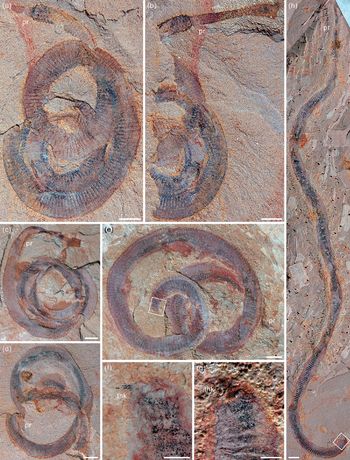
Specimens of Mafangscolex cf. yunnanensis with proboscis structure from the Xiaoshiba Lagerstätte. (a, b) YKLP 12385: (a) part; (b) counterpart. (c) YKLP 12379, complete specimen. (d) YKLP 12380, preserving part of pharyngeal teeth. (e, f) YKLP 12386: (e) almost complete specimen; (f) view of tail hook. (g, h) YKLP 12374: (g) view of tail hook; (h) complete specimen. Abbreviations: pr – proboscis; thk – tail hook. All scale bars represent 2 mm, except (f) and (g), which are 500 μm.

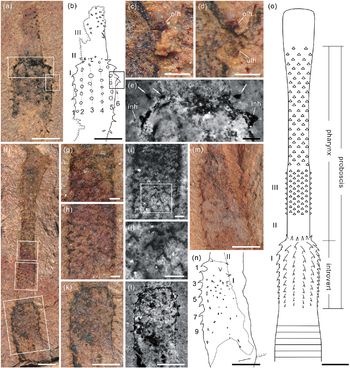
Proboscides of Mafangscolex cf. yunnanensis. (a–e) YKLP 12385a: (a) close-up of proboscis; (b) line drawing; (c) original state of (d), showing the overlying hook; (d) enlargement of the boxed area in (a), showing the underlying hook exposed after matrix around being peeled off; (e) enlargement of the boxed area in (a), fluorescence image showing the coronal spines (white arrow) and two anteriormost Zone I hooks. (f–l) YKLP 12385b: (f) close-up of proboscis; (g) enlargement of the boxed area in (f), showing the distal teeth of Zone III; (h) enlargement of the boxed area in (f), showing the proximal teeth of Zone III; (i) fluorescence image showing the proximal teeth of Zone III; (j) enlargement of the boxed area in (i); (k) enlargement of the boxed area in (f), showing Zone I; (l) fluorescence image showing the lateral introvert hooks of Zone I. (m, n) YKLP 12379: (m) close-up of proboscis; (n) line drawing of (m). (o) Reconstruction of proboscis. Abbreviations: I, II, III – armature associated with Conway Morris’s (Reference Conway Morris1977) Zone I, II and III; inh – introvert hook; olh – overlying hook; ulh – underlying hook. Scale bars represent 1 mm (a, b, f, k–o); 200 μm (c–e, g–j).

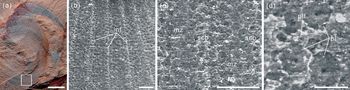
Cuticle ornamentation of Mafangscolex cf. yunnanensis. (a–d) YKLP 12381: (a) whole view; (b) enlargement of the boxed area in (a), SEM micrograph showing sclerite bands on annulations; (c) enlargement of (b); (d) details of plate and platelet. Abbreviations: inf – intersegmental furrow; mz – median zone; plt – platelet; pl – plate; scb – sclerite band. Scale bars represent 2 mm (a); 200 μm (b, c); 50 μm (d).

Material. Thirteen specimens: YKLP 12374–12386.
Description. Two specimens preserve the full length of the trunk: the trunk and introvert of YKLP 12374 (Fig. 1h) measure 98 mm in length and 2.0–2.4 mm in diameter; the everted pharynx measures an additional 6.6 mm. The respective measurements for YKLP 12379 (Fig. 1c) are 76 mm, 1.5–2.0 mm and 8.4 mm. The smallest specimen, YKLP 12376a, is 1.2 mm wide and over 52 mm long, consistent with a constant length:width ratio of ~40–50.
Five specimens display an everted proboscis (Fig. 1), whose construction follows the conventional ecdysozoan configuration (Conway Morris, Reference Conway Morris1977; Smith & Caron, Reference Smith and Caron2015; Smith et al. Reference Smith, Harvey and Butterfield2015): it comprises an introvert armed with posterior-directed hooks (Zone I of Conway Morris, Reference Conway Morris1977); an unarmed proximal pharynx (Zone II) and a distal region of the pharynx bearing anterior-directed armature (Zone III) (Fig. 2).
The introvert is slightly narrower than the trunk, ~1.5 mm wide and 3.4 mm long, representing ~4 % of the length of the trunk (Fig. 1a, c, h). It bears 12 longitudinal rows of posterior-directed hooks, arranged quincuncially: six rows can be observed on a single side of the compressed introvert (Fig. 2a, b), and excavation of the margins of the preserved introvert reveals corresponding hooks at a lower level in the matrix (Fig. 2c, d). The vertical position of these hooks, and the absence of displaced hooks elsewhere on the introvert, suggests that this hook belongs to a separate row. Consequently, each of the six visible rows corresponds to one unseen at a deeper plane within the fossil. Each row contains nine or more hooks, whose size decreases from the anterior to the posterior (Fig. 2a, b, f, k–n); the anteriormost hook is ~170 μm in height and 300 μm in width (Fig. 2e).
The fully everted pharynx extends about three times the length of the introvert (Fig. 2). Its base is encircled by a band of anterior-directed coronal spines, measuring 150 μm high and 80 μm wide (Fig. 2e). The unarmed proximal region of the pharynx (i.e. Conway Morris’s Zone II) is approximately as long as wide; the distal region (Zone III) bears quincuncially arranged teeth until it flares to form a distal bulb (Fig. 1c). The proximalmost teeth of Zone III (Fig. 2h–j), like those of Ottoia or Selkirkia, exhibit a prominent triangular arch culminating in a distinct prong (see Smith et al. Reference Smith, Harvey and Butterfield2015 for terminology), though their preservation is insufficient to establish the presence or nature of any denticles or pad. Distally, the teeth become wider, and the prong is diminished (Fig. 2g). Insofar as the limited preservation allows a meaningful comparison, the gradient of tooth morphology resembles the transition from Type B to Type D teeth in Ottoia (Smith et al. Reference Smith, Harvey and Butterfield2015).
The trunk is densely annulated with about four annulations per millimetre (Figs 1, 3a, b). Annulations are delimited by intercalary furrows (Fig. 3a–c). Each annulation is ornamented with two sclerite bands, occupying three quarters of the annulation width, separated by a median zone, occupying the remaining quarter (Fig. 3b, c). Each band comprises two to three transverse rows of alternating plates, which are round and closely spaced, 35–50 µm in diameter, with one prominent central node (Fig. 3b–d). Platelets, resembling the plates but 10–15 µm in diameter, fill the gaps between plates (Fig. 3c, d).
Most specimens are coiled (Fig. 1), presumably reflecting stress or post-mortem processes (Zhao et al. Reference Zhao, Zhu and Hu2012). The worms exhibit more coils than Cricocosmia or Maotianshania of equivalent width (D. Y. Huang, unpub. Ph.D. thesis, Univ. Claude Bernard Lyon 1, 2005), presumably reflecting the greater body length of Mafangscolex.
The gut occupies a slightly ventral position and terminates at a posterior anus flanked by a robust pair of hooks (Fig. 1e–h). The gut is generally preserved as a flat carbonaceous film, but occasional regions exhibit relief (Fig. 1d), recalling the situation in Sirius Passet palaeoscolecids (Peel, Reference Peel2017).
Remarks. The new specimens evidently belong to Mafangscolex, but the details of the pharynx differ from the situation previously described in M. yunnanensis (=Palaeoscolex sinensis). Hou & Bergström (Reference Hou and Bergström1994) described a ‘priapulid-type proboscis’, but their text, illustration and interpretative drawing do not allow a detailed evaluation of the proboscis armature. Hu (Reference Hu2005) reports 15 longitudinal rows of seven scalids each in the proximal region of Zone III, with ten further rows of seven scalids more distally, and implies an absence of armature in Zones I and II. If accurate, this would justify the erection of a separate species for our material. Unfortunately, no figures are provided in support of this interpretation, making it difficult to evaluate these claims; we suspect that these scalids may instead belong to Zone I. Two proboscides of M. yunnanensis figured elsewhere (but not described in detail) (D. Y. Huang, unpub. Ph.D. thesis, Univ. Claude Bernard Lyon 1, 2005) appear to bear introvert and possibly coronal spines, and do not obviously differ from our own material. Even if the younger age and separate provenance hint that our material may represent a separate species, we do not consider the type material of M. yunnanensis to be sufficiently well described to support the diagnosis of a separate species.
4. Discussion
Notwithstanding the tubicolous Selkirkia (Lan et al. Reference Lan, Yang, Hou and Zhang2015) and the lobopodian Collinsium (Yang et al. Reference Yang, Ortega-Hernández, Gerber, Butterfield, Hou, Lan and Zhang2015), this is the first report of a free-living ecdysozoan worm from the Xiaoshiba biota, though we note that further vermiform material from this deposit awaits formal description.
The new material of Mafangscolex is most instructive in its detailed preservation of the everted introvert and pharynx. Proboscis morphology in the Palaeoscolecida sensu stricto (Harvey et al. Reference Harvey, Dong and Donoghue2010) has hitherto been known only from Palaeoscolex cf. tenensis from the Ordovician Fezouata biota (Kouraiss et al. Reference Kouraiss, El Hariri, El Albani, Azizi, Mazurier and Vannier2018), but the details of this material are ambiguous. Whereas Kouraiss and colleagues described five longitudinal rows of sclerites on a pharynx, they observed six unarmed areas (their fig. 3f), which implies that the total number of sclerite rows around the circumference is 12. Indeed, we believe that a sixth row of sclerites is faintly visible in the lateral margins of the described structure. Rather than a pharynx, we also speculate that the organ described is an introvert: all other occurrences of sclerites in longitudinal rows occur on introverts, whereas pharyngeal teeth are quincuncially disposed (van der Land, Reference van der Land1970; Conway Morris, Reference Conway Morris1977; Adrianov & Malakhov, Reference Adrianov and Malakhov2001).
Based on current data, we therefore consider the symmetry and configuration of the Palaeoscolex pharynx to be ambiguous. The introvert and pharynx of Mafangscolex thus provide the first clear indication of proboscis morphology in Palaeoscolecida sensu stricto, establishing a six-fold symmetry and a construction that conforms to the wider ground plan shared by the majority of Cambrian ecdysozoan worms (Conway Morris, Reference Conway Morris1977): an introvert with multiple circlets of posterior-directed hooks, a ring of coronal spines, an unarmoured proximal pharynx and quincuncially arranged teeth with a gradation of morphology in the distal pharynx. The single circlet of introvert hooks reconstructed in Scathascolex (Smith, Reference Smith2015) is thus not representative of palaeoscolecids more broadly, and conceivably connects this taxon to nematomorph-like taxa with a single ring of introvert teeth (Maas et al. Reference Maas, Waloszek, Haug and Müller2007). In view of the faint preservation of the coronal spines in our material, we postulate that the reported absence of equivalent structures in Guanduscolex (Hu et al. Reference Hu, Li, Luo, Fu, You, Pang, Liu and Steiner2008) (and the type material of Mafangscolex) likely represents a lack of preservational fidelity rather than a genuine absence; this would leave the problematic Ancalagon as the only Cambrian ecdysozoan worm to lack coronal spines.
On a simplistic view, the morphological conservatism of the Mafangscolex mouthparts could be interpreted as the retention of the ancestral ecdysozoan ground plan in the Palaeoscolecida sensu stricto. This said, superficially similar introverts characterize Cambrian worms ascribed to the distantly related gastrotrichs (Chen et al. Reference Chen, Parry, Fan, Vinther and Cong2018) and sipunculans (Smith & Zhang, Reference Smith and Zhang2018), suggesting that the broad-scale morphology of the palaeoscolecid introvert may be constrained by its presumed locomotory function.
Because six-fold symmetry is not inherent to the function of the introvert, this detail is less straightforward to attribute to convergence. A hexaradially arranged introvert was likely the primitive condition for Ecdysozoa: not only does it characterize all ecdysozoans from the Fortunian (earliest Cambrian) period (Liu et al. Reference Liu, Xiao, Shao, Broce and Zhang2014, Reference Liu, Qin, Wang, Maas, Duan, Zhang, Zhang, Shao and Zhang2019), but its vestiges are apparent in the majority of extant phyla, including stem- and crown-group loriciferans (Sørensen et al. Reference Sørensen, Hebsgaard, Heiner, Glenner, Willerslev and Kristensen2008; Peel et al. Reference Peel, Stein and Kristensen2013), nematomorphs, larval nematodes (despite the lack of introvert armature) (Maas et al. Reference Maas, Waloszek, Haug and Müller2007) and certain panarthropods, in the form of the six oral papillae of Aysheaia (Whittington, Reference Whittington1978) and the six oral plates of tardigrades (Boesgaard & Kristensen, Reference Boesgaard and Kristensen2001; Biserova & Kuznetsova, Reference Biserova and Kuznetsova2012; Guidetti et al. Reference Guidetti, Peluffo, Rocha, Cesari and De Peluffo2013).
In contrast, five-fold introvert symmetry characterizes a rarefied subset of Ecdysozoa comprising the kinorhynchs (Sørensen et al. Reference Sørensen, Hebsgaard, Heiner, Glenner, Willerslev and Kristensen2008) and most fossil and modern priapulans (Adrianov & Malakhov, Reference Adrianov and Malakhov2001; Huang et al. Reference Huang, Vannier and Chen2004; Dong et al. Reference Dong, Bengtson, Gostling, Cunningham, Harvey, Kouchinsky, Val’kov, Repetski, Stampanoni, Marone and Donoghue2010; Kesidis et al. Reference Kesidis, Slater, Jensen and Budd2019). Whether or not this pentaradial pattern is derived, it militates against the close grouping of palaeoscolecids with priapulans.
Given the great disparity of Cambrian ecdysozoan worms, observations of a single taxon are not in themselves sufficient to resolve the evolutionary origins of ecdysozoans. Nevertheless, Palaeoscolecida sensu stricto ought not to be considered as a derived subset of the priapulan lineage; instead, the close correspondence between the proboscis observed in Mafangscolex and that reconstructed in the ancestral ecdysozoan is consistent with a deep phylogenetic origin of palaeoscolecid worms.
Acknowledgements
Tian Lan, Jinbo Hou, Kunsheng Du, Jifeng He and Keren Li assisted with fieldwork. Comments from Jean Vannier and an anonymous referee improved the manuscript. This study was funded by the National Natural Science Foundation of China (X.Z., 41730318, U1402232), (J.Y., 41472022); Department of Science and Technology, Yunnan Province (X.Z., 2015HA045); and the Innovative Research Fund for Graduate Students of Yunnan University (X.Y., YDY17116, 2019228).