Exposure to potentially traumatic situations in the workplace, or critical incidents (CIs), is considered a typical occupational hazard for firefighters. Across studies, a majority of firefighters sampled report experiencing on-duty trauma, including CIs they considered life-threatening.Reference Koniarek and Dudek1,Reference Guthrie and Bryant2 Correspondingly, an extensive literature exists concerning rates of trauma-related mental disorders (TRMDs) in firefighting samples, the most commonly studied of which is posttraumatic stress disorder (PTSD). Additionally, while both major depressive disorder (MDD) and anxiety disorders (ADs) can occur outside the context of traumatic exposure, these disorders are also considered TRMDs in some cases, as they can arise following traumatic exposure and are known to be highly comorbid with PTSD.3
While the literature on TRMDs in firefighters is large, it is difficult to synthesize due to a high degree of variability in prevalence outcomes across studies. There are numerous possible explanations for this variability, including methodological and geographical factors, but 1 significant factor is the scale of CI exposure. CI exposure is broadly considered unavoidable for firefighting personnel, although some forms of exposure are much more common than others, and to date the extant literature has not consistently distinguished between routine on-duty incidents and response to large-scale disaster. The present systematic review explores the prevalence of TRMDs in firefighters exposed to large-scale natural or manmade disaster.
As mentioned, PTSD has historically been the most commonly studied TRMD in firefighting samples, and prevalence outcomes across studies are highly variable. It is currently unclear the degree to which CI-related factors, such as frequency, severity, and cumulative CI exposure, impact rates of TRMDs, and thus the unique impact of disaster exposure on personnel is unknown. Several studies on routine CI exposure in firefighters have shown relationships between frequency and/or recency of routine CI exposure and PTSD,Reference Regehr, Hemsworth and Hill4-Reference Wagner, Heinrichs and Ehlert6 while others have shown no significant associations.Reference Pinto, Henriques and Jongenelen7,Reference Meyer, Zimering and Daly8
The prevalence rates of MDD and ADs have been studied much less commonly in firefighters compared with PTSD. In samples exposed to routine duty-related CIs, the prevalence of both disorders is also highly variable. Estimates of MDD prevalence in routine firefighting work range from as low as 0% up to 33%,Reference Bryant and Guthrie9,Reference Boxer and Wild10 while ADs across studies have been observed in as few as 1.4% of firefighters and as many as 19.4%.Reference Guthrie and Bryant2,Reference Carleton, Afifi and Turner11 Of significant importance within such investigations of high-risk personnel is the need to distinguish the prevalence of these disorders in general as compared to their manifestation following CI exposure. To do so, an in-depth examination of predictive factors for MDD and ADs, including evaluation of CI-related factors in relation to these disorders, is warranted. For instance, depressive symptoms in firefighters have linked to nontraumatic duty-related stressors; Roy and SteptoeReference Roy and Steptoe12 showed that daily occupational stress and social support most strongly predicted firefighters’ scores on the Beck Depression Inventory across 3 measurements taken over the course of 9 months.
It is possible that depressive symptoms occur at an elevated rate in firefighters compared with the general population outside the context of trauma, but it is also highly likely that CI exposure influences rates of MDD in a unique manner over and above the daily, nontraumatic stressors associated with firefighting service. On the other hand, Guthrie and BryantReference Guthrie and Bryant2 assessed 67 Australian firefighters during recruitment and after 2 years of service using the Beck Anxiety Inventory and demonstrated a decrease in anxiety scores over years of service. However, preliminary evidence suggests that anxiety bears a relationship to disaster exposure in firefighters. MarkowitzReference Markowitz13 reported on psychological distress in firefighters who were inadvertently exposed to dangerous chemical inhalation during a warehouse fire, fully two-thirds of whom later tested positive for abnormal pulmonary function, as compared to unexposed control firefighters. According to the Psychiatric Epidemiological Research Interview, firefighters exposed to the disaster demonstrated significantly greater anxiety scores than unexposed controls.Reference Markowitz13
Current Study
The present systematic review provides a comprehensive best-evidence narrative synthesis of the literature on TRMDs in firefighters exposed to large-scale disaster with the aim of evaluating the hypothesis that prevalence rates of PTSD, MDD, and ADs are elevated in comparison to the general population. Where possible, we also provide a synthesis of predictive factors for TRMDs commonly explored across the literature with the goal of reconciling some of the variability in outcomes across studies.
METHODS
The present systematic review comprises a subset of a broader review on TRMDs in high-risk occupational groups. The broad search terms included numerous occupational groups considered to be at high risk of CI exposure on a daily basis, such as police, corrections, and ambulance personnel, among others. Results for other occupational groups are reported elsewhere.Reference Regehr, Carey and Wagner14-Reference Wagner, White and Buys16
Search Strategy
Systematic search was conducted in accordance with the Institute of Medicine’s Standards for Systematic Reviews and the PRISMA Statement frameworks.17,Reference Moher, Liberati and Tetzlaff18 An international team of experts provided guidance in the development of the initial search strategy. The initial search was pilot tested by a research librarian and subsequently peer-reviewed by second research librarian using the PRESS review criteria.Reference McGowan, Sampson and Salzwedel19 The search was translated across the following databases: Medline (OVID), EBM Reviews (OVID), PsycINFO (EBSCO), CINAHL (EBSCO), PILOTS database, and Web of Science (ISI). We constrained our search to articles published between 1980 and 2017 to exclude any studies published before the first inclusion of PTSD as a diagnostic label in the Diagnostic and Statistical Manual of Mental Disorders (DSM).20
The completed search results were exported to DistillerSR (Evidence Partners, Ottawa, Canada) and duplicates were removed. The search was then registered in PROSPERO International Prospective Register of Systematic Reviews (Registration: CRD42017074722). Two team members individually screened the title and abstracts. Any articles reporting a clear prevalence outcome for PTSD, acute stress disorder, MDD, or ADs for a high-risk sample were considered eligible. A secondary search was also manually completed using the citation lists of eligible articles.
Data Extraction
Once the screening process for all primary and secondary search articles was complete, each article was independently read and reviewed by 2 team members according to criteria developed by team consensus. Discrepancies were resolved through discussion between the 2 reviewers and a third team member if necessary.
Quality Assessment
The quality of each article was assessed using Munn’s Prevalence Critical Appraisal Instrument.Reference Munn, Moola and Riitano21 Questions concerned issues of methodological rigor pertaining to sample, recruitment, demographics, measurement, analysis, and bias and were answered with a fixed format of yes, no, unclear, or n/a. Completion of the questionnaire in DistillerSR generated an automatically-computed quality score out of 10, which we subsequently categorized into 3 levels of quality based on standards used by the Health Evidence Quality Assessment Tool22: high quality (8-10), medium quality (5-7), and low quality (≤4).
In addition to the quality assessment form, the team developed a subjective rating scale for each article as a method of identifying the level of contribution that each article had for the research question (strong, moderate, weak, or none). The team recognized that an article may be of high quality, but it may only provide minimal contribution to the research question.
Strength of Evidence
In evaluating support for the hypothesis that prevalence of TRMDs is elevated in high-risk working groups, we developed a conservative set of criteria to rank each individual article’s strength of evidence using the Canadian general population as a standard of comparison. Prevalence estimates for the general population comparison were taken from data provided by Statistics Canada,23,24 and comprise pooled data from Canadian and American samples. By these standards, the 1-year and lifetime prevalence of PTSD in the general population is 3.5% and 8%, respectively. These standards represent a conservative benchmark for comparison, as the lifetime prevalence of PTSD in Canada is substantially higher than in many other countries.Reference Van Ameringen, Mancini and Patterson25,Reference Koenen, Ratanatharathorn and Ng26 For MDD, comparison standards for 1-year and lifetime prevalence were 4.7% and 11.3%, respectively. For ADs, we used prevalence of generalized anxiety disorder as a conservative standard, as prevalence of this disorder according to Statistics Canada is higher than that of other ADs of adulthood such as panic disorder. The 1-year and lifetime prevalence standards were 3% and 5%, respectively.
Each article’s strength of evidence was rated based on a combination of the prevalence estimate reported, study quality, and contribution to the research question. Any article where the prevalence outcome reported was lower than the 1-year prevalence in Canada was rated “no evidence” regardless of its quality and contribution. Articles where quality and contribution were both considered low/weak were also rated “no evidence” regardless of prevalence. Articles where the prevalence reported exceeded the lifetime Canadian prevalence could be rated as “strong” or “moderate” evidence depending on their quality and contribution. Articles where prevalence fell between the 1-year and lifetime estimates for the general population could be rated as “weak” or “no evidence,” again depending on their quality and contribution.
Best-Evidence Synthesis
Following the rating of individual studies’ strength of evidence, interpretation of the literature was conducted based on these ratings using best-evidence narrative synthesis.Reference Slavin27 This method is ideally suited for systematic review of highly heterogeneous literatures due to its reliance on systematic application of search and review procedures, and relative robustness against issues of interpreting statistical heterogeneity that arise in quantitative procedures such as meta-analysis.Reference Ades, Lu and Higgins28 Best-evidence narrative synthesis proceeds by weighting higher-quality evidence and reducing or eliminating the contribution of lower-quality evidence in interpreting data across the literature. The criteria we used within the present systematic review have been published elsewhere.Reference Wagner, White and Schultz29,Reference White, Wagner and Schultz30
RESULTS AND DISCUSSION
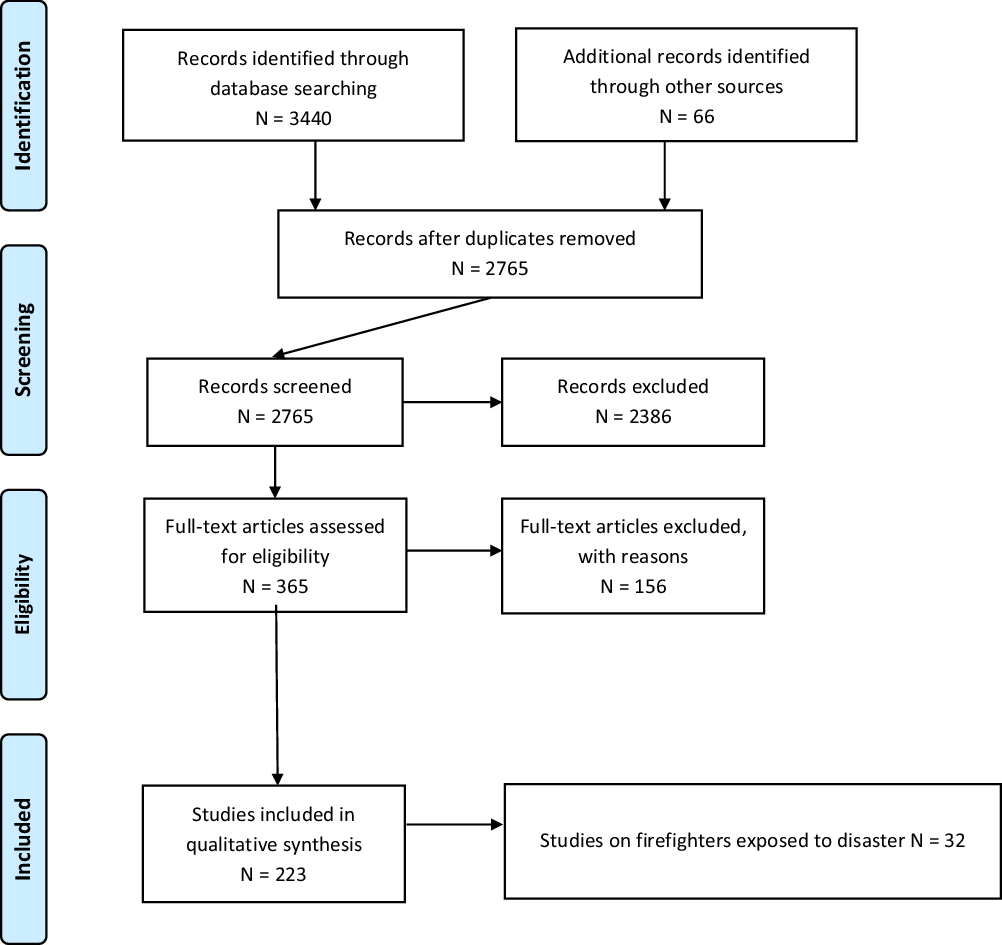
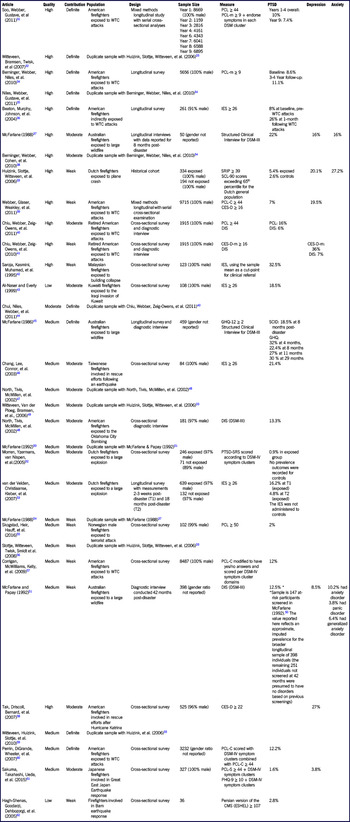
Our systematic search of the literature on TRMDs in high-risk personnel resulted in a total of 2766 original citations. Of these, 223 articles were eligible to be included for full review, 32 of which concerned firefighters exposed to large-scale natural or manmade disaster (Figure 1). Within this dataset, 10 studies reported mental health outcomes on a sample that was duplicated in another study within the dataset. Where multiple studies reported on the same sample, we included the results from either the highest-quality study, or the most recent study where quality was equal between studies. Our final dataset of articles for inclusion in the present review comprised 22 studies with unique samples, published between 1986 and 2016 (Table 1). The majority of studies collected data from samples comprising 100% firefighters, while a small number examined firefighters in concert with other first responder groups (eg, police). Prevalence was reported separately for firefighters in all eligible studies. For the sake of clarity, we present more detailed findings in concert with brief discussion for each disorder outcome separately below.
PRISMA Flow Diagram of Study Inclusion for Systematic Review.

Summary of Evidence and Prevalence of TRMDs Across Studies

PTSD Outcomes
Twenty of the 22 studies (90.1%) reviewed reported prevalence estimates for PTSD. Prevalence varied widely across studies from 0.90% to 32.5% (M = 12.3%; Median = 10.5%; see also Table 1). Despite the substantial variability in the literature, strong evidence exists in support of the hypothesis that the prevalence of PTSD is elevated in firefighters exposed to disaster relative to the general Canadian population (8%). Below, we examine several possible sources of variability in prevalence outcomes across the literature.
Methodological Factors
The prevalence outcomes reported across high-quality studies demonstrated a slight positive skew (M = 14.6%; Median = 8.8%) not observed across medium-quality studies (M = 11.0%; Median = 12.0%), suggesting a tendency for higher-quality studies to report a somewhat greater frequency of high prevalence estimates. However, no significant difference in prevalence outcomes was found between the 8 high-quality and 8 medium-quality studies by means of a 2-tailed t-test with unequal variances assumed (P = 0.43). The dataset included only 2 low-quality studies.
The selection of measurement tool used to assess PTSD appeared to be associated with prevalence outcomes in our observations of the dataset. However, measurement tools varied considerably and we did not have adequate data to conduct a statistical analysis of potential differences across all tools. The assessment of PTSD across the literature was conducted using formal diagnostic criteria (DSM-III or DSM-IV; 4 studies), the Impact of Events Scale (IES; 5 studies), the PTSD Checklist (PCL/PCL-C/PCL-m; 7 studies), the PTSD Self-Rating Scale (PTSD-SRS; 1 study), the Self-Rating Inventory for PTSD (SRIP; 1 study), the Mississippi Scale for PTSD – Civilian (CMS), and the General Health Questionnaire (GHQ; 1 study).
Observationally, diagnostic standard assessments (M = 13.5%; Median = 12.9%) produced prevalence outcomes, on average, that fell between those produced by the use of the PCL (M = 7%; Median = 9%) and the IES (M = 20.6%; Median = 21.4%). We suggest that variance in PTSD outcomes as a function of measurement tool is a critically important area of methodological focus for future study of high-risk personnel. To date, for example, a small number of studies have shown that the IES and IES-R do not share the same factor structure in civilian versus firefighting samples.Reference Smith, Paton and Habermann63,Reference Wagner64 WagnerReference Wagner64 demonstrated differences in the IES-R between firefighters (n = 94) and controls (n = 91) that although the validated 3-factor structure of the IES-R fit control data nicely, a 2-factor structure provided a better fit to the firefighting sample, with factors “general posttraumatic stress symptomology” and “sleep.”
Smith and PatonReference Smith, Paton and Habermann63 reported similar findings comparing the IES across different high-risk occupations and geographical regions, including firefighting and social services from Australia, the United Kingdom, and Japan. These authors suggest that given substantial cross-occupational and cross-cultural differences in the factor structure of the IES, this scale does not assess a universally homogeneous construct and its use in high-risk occupational groups should be closely examined. Further work remains to be done concerning the methodological issue of measurement, and indeed, cross-occupational validation of PTSD measurement tools.
One further methodological variable of interest in predicting prevalence of PTSD in firefighters was region of study. In the general population, the lifetime prevalence of PTSD varies substantially across countries,Reference Koenen, Ratanatharathorn and Ng65 and in routine firefighting work, cross-national differences in PTSD prevalence have been documented across European countries.Reference Kehl, Knuth and Hulse66 Few cross-national comparisons have been conducted for samples of high-risk personnel; thus, we aimed to provide a synthesis of regional differences. However, when we examined the studies in our dataset, grouped by continent, we noted that region of study was conflated with the type of disaster. In particular, all of the studies of PTSD conducted in North America concerned acts of terrorism, while studies conducted elsewhere were mixed with respect to event type, and more commonly examined personnel in the wake of natural disaster. As such, we elected to report on prevalence as a function of the type of event under study (below). However, the above-mentioned results of Smith and PatonReference Smith, Paton and Habermann63 point similarly to a need for better understanding of regional and cultural context in the measurement of PTSD.
PTSD and Type of Disaster Exposure
Ten studies in the present dataset examined PTSD in firefighters following response to acts of terrorism, while 11 studies investigated PTSD in the wake of other large-scale events, including both natural (earthquakes, large wildfires) and manmade (plane crash, explosion, building collapse) disasters. Of interest, there appeared to be a trend toward lower rates of PTSD in the wake of exposure to man-made disaster events (M = 11.3%; Median = 8.8%) relative to natural disasters (M = 14.6%; Median = 17%)Footnote a . However, this difference was not statistically significant when compared by means of 2-tailed t-test (P > 0.50).
The relatively higher rate of PTSD following natural disasters compared with man-made disasters was unexpected. Previous reviews of PTSD prevalence following disaster that have been conducted with mixed samples (ie, survivors, responders, and general population members) have shown that the prevalence of PTSD is typically lower following natural disasters compared with man-made disasters, particularly those involving acts of mass violence such as terrorist acts.Reference Neria, Nandi and Galea67-Reference Norris, Friedman and Watson69 Due to the small dataset, it is difficult to interpret these discrepancies. Several explanations are possible.
First, because our review focuses specifically on 1 occupational group, it is possible that this pattern of findings reflects an important difference between firefighters and other responder and/or survivor groups following disaster. Differences in PTSD prevalence between firefighters and other occupational groups have been documented in the literature. In the present dataset, Sakuma and colleagesReference Sakuma, Takahashi and Ueda61 reported that firefighters were significantly less likely to have probable PTSD as compared to municipal and hospital workers exposed to the Great East Japan Earthquake. In contrast, Perrin and colleaguesReference Perrin, DiGrande and Wheeler60 reported that firefighters exposed to the New York City World Trade Center (WTC) attacks were approximately twice as likely to have PTSD as police responders. This finding has also been supported by systematic review.Reference Berger, Coutinho and Figueira70 Taken together, these findings highlight a need for continued study of intra- and inter-occupational factors in understanding PTSD risk. It is possible that PTSD risk following different types of exposure varies across occupational and other groups.
Second, the majority of studies concerning firefighters exposed to man-made disaster in the present dataset focus on terrorist acts, with heavy focus on exposure to the WTC attacks of 9/11, which may have impacted personnel differently than other large-scale disasters. This is a question we are unable to address within the present dataset due to inadequate data across disaster categories.
A third possibility is that, related to the heavy focus of research on the WTC attacks in the present dataset, the relatively lower prevalence rates following man-made disasters observed here may reflect the organizational response to the event in addition to the impact of the event itself. Based on our preliminary observations, we speculate that the extensive organizational response to the WTC attacks may have served a protective role for responders. During and following the WTC attacks, tens of thousands of workers in multiple high-risk occupational groups were involved in rescue and recovery efforts, beginning on the day of the attacks and extending for several months. Following the attacks, the Centers for Disease Control and Prevention implemented the WTC Health Program, under which emergency responders to the attacks are eligible for screening every 18 months,71 which includes numerous metrics of both physical and mental health.
The WTC Health Program has enrolled over 70,000 emergency responders as of 2018.72 It is federally run and covers treatment for WTC-related health conditions including several TRMDs. To our knowledge, no other program exists on this scale of organizational response to work-related CI exposure. Thus, it is possible that large-scale organizational response to disaster exposure is associated with the relatively lower prevalence estimates observed in these samples relative to other large-scale disasters in the present dataset. To our knowledge, there are no extant studies that compare rates of TRMDs in personnel enrolled in the WTC Health Program with those not enrolled, likely due to feasibility and ethical issues with recruitment. Organizational response as a possible protective factor against TRMDs in firefighters exposed to large-scale events is a largely unexplored question that merits further study.
Still other alternative explanations for our findings are possible. Given adequate data, it would be informative to compare 3 categories of disaster events: terrorist acts, other man-made disasters (eg, explosions), and natural disasters in firefighters. These 3 categories of disaster have been previously documented to impact individuals differentially when mixed samples are examined.Reference Neria, Nandi and Galea67-Reference Norris, Friedman and Watson69 Additionally, some disasters (eg, hurricanes) are predictable ahead of time, while others (eg, terrorist acts, explosions, earthquakes) are not. The contribution of predictability of large-scale disaster to TRMD risk, especially within populations that receive formal training to prepare members for high-stress events, is an important question currently unexplored in the literature.
Predictive Factors for PTSD Following Disaster
We conducted a qualitative synthesis of the most commonly studied predictive factors for PTSD symptoms. Based on review of the eligible studies, we grouped predictive factors into (1) sociodemographic predictors of PTSD (eg, age, gender, years of service), and (2) exposure-related factors (eg, severity, duration of exposure).
Eight studies examined relationships between various sociodemographic factors and PTSD. The most consistently examined relationship in the present dataset was that between age at time of exposure and PTSD, examined in 7 studies conducted following multiple types of large-scale disaster, all but 1 of which showed no significant association of PTSD with age.Reference Soo, Webber and Gustave31,Reference Berninger, Webber and Niles34,Reference Chiu, Webber and Zeig-Owens40,Reference Saroja, Kasmini and Muhamad42,Reference Van der Velden, Christiaanse and Kleber53 Chang and colleaguesReference Chang, Lee and Connor46 reported on 84 firefighters in Taipei who were involved in rescue/recovery efforts following an earthquake that individuals with probable PTSD (IES ≥ 26) were more likely to be younger. Of interest, having greater than 3 years of service was also found to predict higher rates of PTSDReference Chang, Lee and Connor46; thus, these results suggest a possible need to examine age and years of service in interaction with 1 another. Broadly speaking, it does not appear that age alone is a strong predictor of PTSD risk following disaster exposure across studies.
Ten studies also examined the relationship between PTSD and various incident-related factors, including the intensity and duration of exposure, contact with deceased bodies, personal loss or injury, previous disaster experience, and others. All studies but 2 reported at least 1 significant association between exposure-related factors and PTSD. Huizink and colleaguesReference Huizink, Slottje and Witteveen33 examined rates of PTSD in Dutch firefighters following the Amsterdam Air Disaster, which resulted in 43 fatalities and large-scale property loss. The authors compared rates of probable PTSD (SRIP ≥ 39) in 334 firefighters exposed to the disaster with 194 unexposed controls and found that prevalence (5.4% vs 2.6%, respectively) did not differ significantly as a function of disaster exposure. Sakuma and colleaguesReference Sakuma, Takahashi and Ueda61 examined incident-related factors including type of work during disaster response (eg, supervisory or on-site), whether firefighters had experienced death or loss of a colleague or loved one, and near-death experiences, none of which were associated with PTSD. However, it should be noted that, in both of these studies, the number of firefighters with PTSD was small (n = 18 and n = 12, respectively), and as such the lack of association with predictive factors may be indicative of a power issue.
Four studies examining firefighters exposed to the WTC attacks reported significant associations between being in the first arrival group on-site and the development of PTSD,Reference Huizink, Slottje and Witteveen33,Reference Webber, Glaser and Weakley39 the likelihood of recovery over longitudinal studyReference Smith, Paton and Habermann63 and the likelihood of delayed onset PTSD.Reference Soo, Webber and Gustave31,Reference Berninger, Webber and Niles34 Previous disaster experience was found to be predictive of developing PTSD,Reference Berninger, Webber and Niles34 but not to the likelihood of recovery or delayed onset PTSD.Reference Soo, Webber and Gustave31,Reference Berninger, Webber and Niles34 Similarly, the duration of work at WTC sites was not associated with the onset of PTSDReference McFarlane45 but was associated with delayed onset of the disorder.Reference Berninger, Webber and Niles34 The remaining 4 studies reported on large-scale disaster unrelated to terrorism, with mixed findings. Contact with deceased bodies following an earthquake was associated with significantly higher rates of probable PTSD (IES ≥ 26) in 1 study.Reference North, Tivis and McMillen47 In others, it was reported that personal bereavement and injury during disaster response significantly predicted PTSD status,Reference McFarlane and Papay51 while intensity of exposure and property loss did not directly predict disorder diagnosis, but may have a mediated relationship to disorder status through symptoms of intrusion.Reference McFarlane50 Of interest, Van der Velden and colleaguesReference Van der Velden, Christiaanse and Kleber53 examined disaster exposure in concert with subsequent critical incident exposure in a group of firefighters who were exposed to a large explosion, contrasted with those not exposed. The results showed that disaster exposure itself predicted IES scores; furthermore, there was a significant interaction between disaster and subsequent critical incident exposure. On its own, critical incident exposure was unrelated to PTSD.Reference Van der Velden, Christiaanse and Kleber53
The consistency of relationships between factors related to disaster exposure and PTSD stands in contrast to findings concerning routine exposures in firefighters, where the relationship between incident-related factors and PTSD is more mixed, as mentioned previously. An in-depth discussion of findings concerning routine exposure is beyond the scope of the present review. However, region of study is 1 factor that varies across these outcomes. In the literature on routine exposure, Kehl and colleaguesReference Kehl, Knuth and Hulse66 have shown significant cross-national differences in IES-R scores in European firefighters, while Corneil and colleaguesReference Corneil, Beaton and Murphy73 demonstrated that different factors (eg, personal injury during a mission) predicted the likelihood of probable PTSD in Canadian versus American firefighters. In summary, it would appear that there are potential cross-national differences in the impact of routine incident exposure on the development of PTSD in firefighters, while disaster exposure appears to be more consistently linked with symptoms across both region of study and the types of large-scale events to which firefighters respond. This would not be entirely unexpected given the presumed relative magnitude of personal impact of routine duty-related incidents compared with large-scale disaster.
Depression Outcomes
Only 7 studies in the present dataset examined the prevalence of depression, which ranged from 3.8% to 36% (M = 18.7%; Median = 19.5%; see also Table 1). Based on our review criteria, strong evidence exists in support of elevated prevalence compared with the general population, but it is clear that depression is an understudied phenomenon following disaster exposure compared with PTSD.
Predictive Factors for Depression
Five of the 7 studies examined possible predictive factors for depression in disaster-exposed firefighters. Of these, 2 studies investigated MDD following the WTC attacks. Webber and colleaguesReference Webber, Glaser and Weakley39 reported that the odds of having probable MDD in the wake of the attacks were significantly higher for individuals arriving first on-site on 9/11 compared with those who arrived later. Of interest, Chiu and colleaguesReference Chiu, Webber and Zeig-Owens41 showed that this relationship, along with those of other predictors, was dependent on the method of assessing MDD and the choice of measurement threshold. The authors evaluated depressive symptoms in retired FDNY firefighters exposed to the attacks using the both the DSM-IV Diagnostic Interview Schedule (DIS) and the Center for Epidemiological Studies Depression Scale (CES-D) at both a liberal (CES-D ≥ 16) and conservative (CES-D ≥ 22) threshold. The prevalence of depression in the retired sample was 7% using the DIS, 36% using the CES-D with liberal threshold, and 23% using the conservative threshold.
Logistical hierarchical regression was performed for each method of assessment to determine possible relationship between MDD, demographic factors (age, retirement status, disability vs no disability, years of service, and marital status change), and intensity of exposure based on arrival time. When MDD status was evaluated using the DIS, only participants’ age predicted diagnostic status, such that retired firefighters under 49 years of age were significantly more likely to have MDD than those over 55. However, using the CES-D with a liberal threshold, age showed no relationship to probable MDD, while arriving early on-site, having retired with disability status, and years of service were all associated with elevated odds of probable MDD. At the more conservative CES-D threshold, age was once again a significant predictor of probable depression, as was arriving early on-site, having retired with disability status, and experiencing a change in marital status.Reference Chiu, Webber and Zeig-Owens41 These findings underscore the aforementioned significant source of cross-study variability conferred by methods of measurement. Not only did the estimated prevalence of MDD vary substantially according to measurement tool and detection threshold within 1 sample, but vastly different predictive relationships were found between MDD and other factors in concert with approach to measurement. There is a strong need for additional studies like that of Chiu and colleaguesReference Chiu, Webber and Zeig-Owens41 to further clarify the role of measurement approaches in understanding TRMD prevalence in high-risk occupational groups.
Anxiety Outcomes
Of the TRMDs we evaluated, anxiety was the least well studied, with only 3 studies reporting prevalence following disaster exposure, with prevalence outcomes ranging between 10.2% and 27.2% (Table 1). According to our synthesis criteria, there was insufficient evidence to draw conclusions regarding the hypothesis of elevated prevalence.
The exploration of predictive factors for anxiety was limited given the small number of studies. Huizink and colleagues,Reference Huizink, Slottje and Witteveen33 as described above, compared rates of anxiety in 334 Dutch firefighters exposed to the Amsterdam Air Disaster with 194 unexposed firefighters and showed that the prevalence of probable anxiety in each group as measured by the SCL-90 was not significantly different between groups at 27.7% and 20.6%, respectively. As such, disaster exposure in this sample of firefighters did not appear to influence the prevalence of anxiety. Similarly, McFarlane and PapayReference McFarlane and Papay51 reported a prevalence of 10.2% for anxiety disorders (3.8% had panic disorder, and 6.4% had GAD according to DSM-III diagnostic criteria) in 398 Australian firefighters exposed to a large wildfire, and found that there were no exposure-related factors that uniquely predicted a diagnosis of anxiety. Finally, McFarlaneReference McFarlane37 examined the prevalence of both anxiety and panic in 43 firefighters 8 months following exposure to a large wildfire. In this study, both anxiety and panic were found to be significantly more common in firefighters with PTSD than without PTSD. Seventy-eight percent of firefighters with PTSD had anxiety (n = 7) compared with 28% of those without PTSD (n = 10). For panic diagnoses, 67% of those with PTSD qualified (n = 6) compared with 15% of those without PTSD (n = 5). These results are suggestive of a possible elevation of anxiety risk in firefighters with PTSD, but this interpretation is somewhat complicated by the small number of participants with PTSD, which makes the discrepancies in the proportion of participants diagnosed less clear. Additional work on predictive factors for anxiety in firefighters should be of high priority.
LIMITATIONS
The interpretation of data within the present review is subject to several caveats. First, we have elected to focus on mental health problems in firefighting samples, as previous work has suggested that meaningful cross-occupational differences in prevalence support this approach.Reference Berger, Coutinho and Figueira70 However, this focus limits our ability to generalize our findings to other first responder groups. Second, we elected to conduct a qualitative rather than quantitative synthesis due to the aforementioned heterogeneity of the literature on firefighters. Best-evidence narrative synthesis is a robust approach in highly heterogeneous literatures.Reference Slavin27 However, despite the systematic nature of best-evidence synthesis, our reports concerning predictive factors comprise observational data based on evaluation of a heterogeneous literature. For instance, “sociodemographic factors” is a broad category where assessing TRMD risk is concerned, and this level of resolution is a limitation of both the present review and the broader literature, which should make efforts to further elucidate the role of specific risk and protective factors in relation to firefighters’ mental wellbeing. As such, our findings present a preliminary overview of the best-available evidence and a foundation for further study of both risk and protective factors for TRMDs as well as workplace prevention/intervention strategies, which are at present drastically under-studied.
Finally, our synthesis of the literature is driven by the focus of individual studies eligible for inclusion. As such, we report on a set of studies that includes many samples of firefighters who responded to the WTC attacks and includes relatively fewer samples exposed to large-scale natural disaster. As such, our conclusions regarding the relative impact of man-made versus natural disaster are preliminary and intended to stimulate future study of possible occupation-specific differences in mental health sequelae following different types of large-scale disaster.
FUTURE DIRECTIONS
The present review highlights several pressing questions for future study. First, while the literature on PTSD following disaster exposure is growing, much more focused study of depressive and anxiety symptoms in disaster-exposed firefighters is needed. We found only 7 eligible studies of depressive symptoms and 3 of anxiety symptoms. Both depression and anxiety may manifest in any population outside the context of trauma, and depressive symptoms in firefighters have been previously linked to nontraumatic job stress.Reference Roy and Steptoe12 The data in our review suggest that depressive symptoms may also be uniquely impacted by disaster exposure. The clarification of whether and when these symptoms manifest in response to CI exposure in firefighters has wide-ranging implications for workplace disability policies, prevention, and intervention strategies.
Second, a concerning degree of variability in prevalence estimates is observable as a function of how symptoms are assessed, including selection of validated measurement tools and thresholds for determining the clinical relevance of symptoms. Within-sample examinations of different measurement tools and measurement thresholds for PTSD and depression demonstrate the drastic impact that these methodological issues can have on both estimations of prevalence and on the analysis of predictive factors.Reference Huizink, Slottje and Witteveen33,Reference Perrin, DiGrande and Wheeler60,Reference Sakuma, Takahashi and Ueda61 However, while studies may report prevalence across different measurement tools and/or thresholds, the literature at present contains little discussion of which method best captures symptoms of clinical relevance; indeed, in cases where multiple thresholds are evaluated, researchers tend to rely on the most conservative estimates,Reference Sakuma, Takahashi and Ueda61 which may or may not be an optimal strategy for identifying personnel in need of mental health intervention. Moreover, evidence suggests that cross-occupational validation of measurement tools is required; for instance, the factor structure of the IES and IES-R have been shown to map uniquely to different occupational and cultural groups.Reference Smith, Paton and Habermann63,Reference Wagner64 There is a strong need for future work to consider the impact of measurement, as well as the need for cross-occupational validation of measurement tools, on understanding TRMD symptoms in firefighters.
Finally, the literature will benefit from extensive and detailed study of risk and protective factors that predict TRMD risk in firefighters. As we have mentioned above, it would be fruitful from a public health preparedness standpoint to compare TRMD symptoms following different types of disaster (eg, natural disaster vs terrorist acts; predictable disaster vs unpredictable disaster). Additionally, the prevalence of various mental health symptoms in the general population varies widely by country of study,Reference Koenen, Ratanatharathorn and Ng65 and the literature on firefighters would benefit from closer examination of regional differences as a predictor of symptoms. Lastly, we argue that it is necessary to expand the study of predictive factors for TRMD to include interactionist models. Large-sample studies are capable of exploring, for instance, whether sociodemographic factors may interact with incident-specific factors (eg, years of service × frequency of exposure) to predict TRMD symptoms in personnel. This domain of questioning is to date largely unexplored in the extant literature and would vastly enhance understanding of the impact of disaster exposure on firefighters, and in so doing, improve preparatory efforts toward maintaining a healthy and efficient workforce.
CONCLUSIONS
The present systematic review evaluated the prevalence of PTSD, MDD, and ADs in firefighters exposed to large-scale disaster. We find strong evidence that the prevalence of both PTSD and MDD is elevated in this population compared with the general population of Canada. However, there is insufficient evidence in the literature to draw conclusions regarding the prevalence of anxiety. The available literature broadly suggests that the severity of PTSD and depressive symptomology is related to specific aspects of disaster exposure over and above the stresses of firefighting in general. Finally, the literature on disaster exposure in firefighters is sorely lacking when it comes to understanding ADs; thus, more work is needed to assess prevalence of anxiety in firefighting populations.
Funding
Funding for this project was provided by WorkSafeBC grant no. RS2016-SR03.