I. INTRODUCTION
It is a substantive hedonistic hypothesis within the standard analysis of individual decision making that our greatest desire, as expressed by our preferences, always corresponds to our greatest pleasure. James Mill’s conception of the process of making a decision related to intemperance encourages us to reconsider this hypothesis.Footnote 1 This paper provides an interpretation of the way intemperance shapes individual preferences.
James Mill’s understanding of the decision process rests upon his theory of the human mind, and has an intimate connection with his theory of education. The goal of education is that individuals achieve happiness. According to Mill, achieving happiness presupposes knowledge of the properties of the human mind that are conducive to happiness. Section II of this paper outlines these properties, as understood through the workings of what he called “the real order of nature.” In the fashion of what was to become associationist psychology, Mill presented a detailed analysis of the process that leads from sensation to action. Within this process, he distinguished two steps. The first is to experience the pleasure or pain that is caused by our sensations; the second is to form, in the mind, a desire or aversion to the pleasure or pain. Mill refers to this process as forming an “idea” of the pleasure or pain. According to Mill, a relevant question is to ask whether the initial sensation corresponds to, or moves away from, the related idea. In the first case—i.e., when desire matches pleasure—there is some sort of consistency between sensation and idea. This consistency is what Mill refers to as “the real order of nature.” From a hedonistic point of view, this order is of special interest and manifests a normative dimension, since it leads us toward our greatest pleasure. However, this is not always the case. By contrast, what pleases us the most is not always what we desire the most. Section III shows that the real order of nature can be broken by what Mill called “intemperance,” a specific disposition that overestimates pleasure. I argue that intemperance is made up of two components. The first one, impatience, is familiar, referring as it does to a basic axiom of intertemporal decision theory; the second component, excess, which does not have such a clear contemporary counterpart, generates a deformation of the structure of preferences in favor of some goods—desired in excess—and to the detriment of others that are more easily sacrificed in order to obtain the goods desired in excess. Section IV examines the cause of intemperance: according to Mill, the major cause is improper education. The presence of such improper education may have both moral and physical causes. Examples of physical causes include an insufficient quantity of food, or excessive and stultifying labor, or, at the other extreme, possession of large riches, particularly in the case of aristocracy. Regarding moral causes, Mill mainly discussed cases where the domestic environment is either very poor or very rich—again, as in aristocracy. However, he did not consider that the breaking of the real order of nature provoked by intemperance would be permanent. Section V presents his conception of the role of proper education in the return to such an order. Education gives rise to a process through which our desire converges toward our pleasure. This process promotes temperance, which directly concerns both impatience and excess: both disappear under the influence of education, so that the real order of nature, which Mill praised so much, can now be reached.
II. THE WORKING OF THE REAL ORDER OF NATURE
Before Action: From Sensation to Idea
It is well known that Mill was one of the developers and propagators of what would today be understood as associationist psychology (Bain Reference Bain1882, p. 415; Cumming Reference Cumming1964; Elie Halévy [1901–1904] Reference Halévy, Toussaint and Simonet1995, vol. III, pp. 171–175; Wärneryd Reference Wärneryd2008, p. 780).Footnote 2 The associationist orientation of his writings appears in both his paper on education (1819) and his Analysis (1829). Inspired by the works of David Hume (Mill [Reference Mill, Bain, Findlater, Grote and Mill1829] 1967, vol. I, pp. 106–107) and David HartleyFootnote 3 (ibid., pp. x–xi), these writings put to the fore an understanding of the decision process in which the author distinguishes two kinds of “feelings,” representing the foundations of his understanding of human behavior. The first is a sensation, which symbolizes the actual basis of his analysis of the decision process. The second kind of feeling consists in an idea, which is a “copy” or a “trace” of the sensation,Footnote 4 and which remains after the sensation has vanished:Footnote 5
We have two classes of feelings; one, that which exists when the object of sense is present; another, that which exists after the object of sense has ceased to be present. The one class of feelings I call SENSATIONS; the other class of feelings I call IDEAS. (Mill [Reference Mill, Bain, Findlater, Grote and Mill1829] 1967, vol. I, p. 52)
It should be noted that sensation and idea are not related to time in the same way. Whereas an idea is linked to time, either backward-looking—remembering past states (ibid., p. 319)—or forward-looking—anticipating consequences from antecedents (ibid., p. 320)—a sensation, in itself, does not have such a dimension. Either sensation or idea may come before action: “actions are, in some instances, preceded by mere sensations … in other instances, they are preceded by ideas” (Mill [Reference Mill, Bain, Findlater, Grote and Mill1829] 1967, vol. II, p. 378; emphasis added).
When idea predates action, this means that there is some kind of connection between sensation and idea. Such a connection is realized thanks to what Mill called the “synchronous order” and the “successive order” (Mill [Reference Mill, Bain, Findlater, Grote and Mill1829] 1967, vol. I, p. 71). The first, which he also named the “order of simultaneous existence,” is the order in space; the other, or “the order of antecedent and consequent existence,” is the order in time. As rules of association, these two kinds of order were not new when Mill was writing. They correspond, for instance, to the “natural relation” that Hume called “contiguity” in space and time (Hume [1739–1740] Reference Hume, Selby-Bigge and Nidditch1978, vol. I, pp. 53–57).Footnote 6 The strength of this connection depends on the intensity of the sensation and the frequency of its association.
From Mill’s viewpoint, each sensation is indifferent, pleasurable, or painful:
Some sensations, probably the greater number, are what we call indifferent. They are not considered as either painful, or pleasurable. There are sensations, however, and of frequent recurrence, some of which are painful, some pleasurable. (Mill [Reference Mill, Bain, Findlater, Grote and Mill1829] 1967, vol. II, p. 184)
The acknowledgment of the part played by pleasure and pain is the first step of the decision process. Mill considered pleasure as a cardinal magnitude—that is, as giving sense to the comparison of differences between pleasures.Footnote 7 Here his conception of pleasure is then somewhat similar to that of Jeremy Bentham. However, Mill explicitly distinguishes pleasure from desire, and therefore allows the possibility that whereas action corresponds to what we desire the most, this might differ from what pleases us the most.
Although Mill noticed that the word “desire” is commonly used when associated with the future—that is, when it concerns forward pleasure—he claimed that since there is “no other name to mark the idea, when it is considered by itself, and without reference to the past, or the future,” desire and the idea of a pleasure “are convertible terms” (Mill [Reference Mill, Bain, Findlater, Grote and Mill1829] 1967, vol. II, p. 193). The specificity of this definition should be stated in relation to both the modern conception and the Humean understanding of desire—that is, as an emotional state. According to Mill, desire is not an emotion, but rather the idea of a pleasurable sensation. Desire is the last step that comes before action in this decision process.Footnote 8
The role of pleasure is therefore conclusive and justifies my consideration of Mill as a hedonist. Pleasure determines action either directly as a sensation or indirectly as an idea. In the following subsection, I characterize preferences that might be directly associated with pleasure.
Pleasure-oriented Preferences: A Characterization
Mill’s view of pleasure as a cardinal magnitude leads us to represent it by the value of a function defined on a set of alternatives X. It is therefore obvious that if, for instance, X is made up of combinations of any goods measured by a non-negative real number, this function is equivalent to a continuous and complete preorder on X, which might be interpreted as pleasure-oriented preferences.Footnote 9 Since pleasure provided by elements x ∈ X is independent from the date at which it occurs, I could extend the definition of pleasure-oriented preferences in order to take time explicitly into account as an n th dimension of the set of choice. Denoting  $X \times T \subseteq R_ + ^n$ the set of choice and R* the binary pleasure-oriented preferences relation defined on X × T, the two following conditions should be fulfilled:
 $${R^ * }\,is\,a\,complete\,\,preorde{r^{10}}\,on\,X \times T$$
 $$\forall x,y \in X,\forall t,u,v,w \in {\rm T}:\left( {x,t} \right){R^ * }\left( {y,u} \right) \Rightarrow \left( {x,v} \right){R^ * }\left( {y,w} \right)$$
Assuming (1) would guarantee that pleasure-oriented preferences might be represented by a function of pleasure, (2) is a condition of patience expressing the fact that pleasure-oriented preferences are completely disconnected from time. Such preferences would imply that any paradox concerning decision in time would be meaningless. For instance, patience excludes preference reversals: when our preferences do not depend on time, our behavior cannot be inconsistent over time.
The Matching between Desire and Pleasure: The Real Order of Nature
Pleasure as a sensation can determine action directly, but it can also, as an idea, generate action indirectly. The question of knowing whether our sensations might correspond to our ideas was discussed by Mill. This matter appears in his paper on education (1819), published in the Supplement to the Encyclopaedia Britannica, wherein he claims that “the original features” of our temperament are formed during our childhood. These original features, which are some sequences among our initial sensations, give birth to the strongest habits in our life:
It seems to be a law of human nature, that the first sensations experienced produce the greatest effects; more especially, that the earliest repetitions of one sensation after another produce the deepest habit; the strongest propensity to pass immediately from the idea of the one to the idea of the other. (Mill [1819] 1825, p. 31)
This then means that the greatest efficacy in the transition from sensations to ideas occurs when we undergo our first sensations. Mill gives many examples, such as the facility to learn a language or the remembrance of a melody, both of which we experience during childhood (ibid.). The consistency between sensations and ideas, which is the real order of nature, occurs when ideas are perfect copies of sensations:
[C]hildren ought to be made to see, and hear, and feel, and taste, in the order of the most invariable and comprehensive sequences, in order that the ideas which correspond to their impressions, and follow the same order of succession, may be an exact transcript of nature, and always lead to just anticipations of events. Especially, the pains and pleasures of the infant, the deepest impressions which he receives, ought, from the first moment of sensation, to be made as much as possible to correspond to the real order of nature. (ibid., pp. 32–33; emphasis added)
The real order of nature is therefore an effect of the existence of some sequences of sensations that prevent the existence of a possible gap between them and the ideas to which they give birth. According to Mill, the matching between pleasure and desire displays a normative dimension since it leads us toward our greatest pleasure: a consequence of the real order of nature is that our actions correspond to both what we desire the most and what pleases us the most. This consequence means that pleasure is also a decisional indicator. This way to consider pleasure—as directly determining decision—is thus somewhat similar to the Benthamite felicific calculus.
However, a major difference arises from the fact that Mill’s writings emphasize the situations in which what we desire the most is not what pleases us the most. This leads to the more general question of how the real order of nature might be broken.
III. THE ROLE OF INTEMPERANCE IN THE BREAKING OF THE REAL ORDER OF NATURE
Intemperance and the Gap between Pleasure and Desire
According to John Stuart Mill ([1873] 1981, p. 64), his father believed that during the era in which he lived, most of the major problems faced by society were due to the tendency of individuals to overvalue pleasure. In the Analysis, such an overestimation of the value of pleasure is what James Mill refers to as “intemperance”: “when the association of the pleasures is an overmatch for the pains [i.e., overestimated compared to the pains], the disposition called Intemperance exists” (Mill [1829] 1967, vol. II, p. 262).
Intemperance is a disposition. This means that intemperance is not only an overestimation of the value of pleasure, but also a tendency to overestimate such a value.Footnote 11 It follows that there is a disconnect between pleasure and desire. Our preferences are transformed by intemperance; hence, they move away from those that are pleasure-oriented: the real order of nature is broken. We follow pleasure as an idea so that our choices reflect desire-oriented preferences. Intemperance therefore leads us to focus only on motives of human action associated with desire.
Intemperance and Desire-oriented Preferences
Intemperance and Excess
Intemperance is a disposition that implies that we focus on some motives of human action to the detriment of some others. This specific disposition gives rise to excess. Mill generally illustrated excess via instances of the insatiable search for wealth:Footnote 12
How completely are the lives of most men absorbed, in the pursuits of wealth and ambition! With how many men does the love of Family, of Friend, of Country, of Mankind, appear completely impotent, when opposed to their love of Wealth, or of Power! This is an effect of misguided association, which requires the greatest attention in Education, and Morals. (Mill [Reference Mill, Bain, Findlater, Grote and Mill1829] 1967, vol. II, p. 215)
Avarice and rapacity are the motives of human action that lead to the excessive acquisition of wealth (ibid., p. 218). As cases of excess, Mill (ibid., pp. 258–259) also discusses adultery, and briefly mentions drunkenness (ibid., p. 214), sensuality (ibid., p. 215), gluttony, and lust (ibid., p. 218).
More generally, excess splits the goods in two categories: the overestimated and, conversely, the underestimated. This might be stated in a formal way.
The following characterization of excess means that two preference relations are involved. Pleasure-oriented preferences remain characterized by R*, and the preferences of the Millian intemperate, the desire-oriented preferences, are expressed by R, such that:
 $$R\,is\,a\,complete\,preorder\,on\,X \times T$$
The question is that of knowing how desire-oriented preferences R might differ from pleasure-oriented preferences R*. A closer specification of the goods “in excess” helps us to explain this difference.
Let us assume that the goods for which excess occurs belong to a set I ⊂ {1,…, n-1}. The corresponding subset of the set of choices is therefore E(I) ⊂ X × T. We can define four subsets of X × T, such that  $\forall \bar x:$
 $$\eqalign{ & {G^ + }\left( {\bar x,I} \right) = \left\{ {y \in X \times T:yR\bar x\,and\,\forall i \in I,{y_i} \ge {{\bar x}_i}} \right\}, \cr & G{*^ + }\left( {\bar x,I} \right) = \left\{ {y \in X \times T:yR*\bar x\,and\,\forall i \in I,{y_i} \ge {{\bar x}_i}} \right\}, \cr & {G^ - }\left( {\bar x,I} \right) = \left\{ {y \in X \times T:yR\bar x\,and\,\forall i \in I,{{\bar x}_i} \ge {y_i}} \right\}, \cr & G{*^ - }\left( {\bar x,I} \right) = \left\{ {y \in X \times T:yR*\bar x\,and\,\forall i \in I,{{\bar x}_i} \ge {y_i}} \right\}. \cr}$$
The meaning of G +, G*+, G -and Gs*- is rather intuitive. Either from the point of view of pleasure-oriented preferences R*, or desire-oriented preferences R, G + is the set of all the elements of X that are both preferred to  $\bar x$ and for which the goods “in excess” (belonging to I) are in a greater quantity than in
 $\bar x$. Obviously, G - is defined in the opposite way.
The property of being excessive for some goods, which I will call “I-excess,” might be expressed by relations of inclusion between the previous sets. Specifically, I-excess is expressed by the following condition:
 $$\eqalign{ & \forall \bar x\, \in \,E\left( I \right),\,G{*^ + }\left( {\bar x,I} \right) \subset {G^ + }\left( {\bar x,I} \right)\,and\,{G^ - }\left( {\bar x,I} \right) \subset G{*^ - }\left( {\bar x,I} \right) \cr & \forall \bar x \notin E\left( I \right),\,G{*^ + }\left( {\bar x,I} \right)\, = {G^ + }\left( {\bar x,I} \right)\,and\,{G^ - }\left( {\bar x,I} \right) = G{*^ - }\left( {\bar x,I} \right) \cr}$$
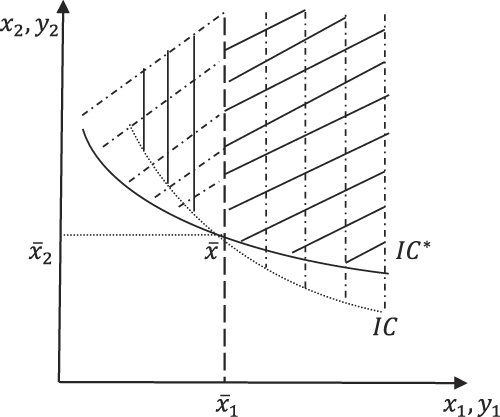
In order to illustrate I-excess, let us assume that the set of choice  $X \times T \subseteq R_ + ^3$ is composed of two goods, 1 and 2. In addition, suppose that R and R* are convex binary relations on X × T satisfying (4). Excess on x (I = {1}), for example, would mean that the marginal rate of substitution (MRS) relative to R is greater than the one relative to R* (see Figure 1):
I-Excess.
Mill did not say a lot about excess. However, one may consider that the previous representation might fit two specific situations—although Mill did not discuss them. It could be argued that
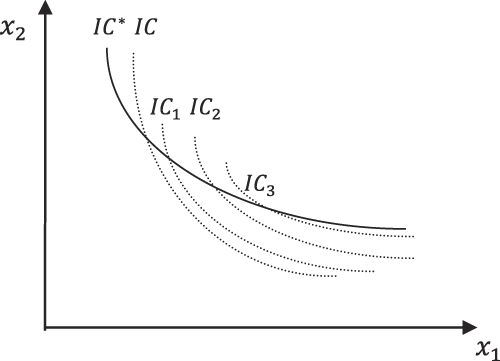
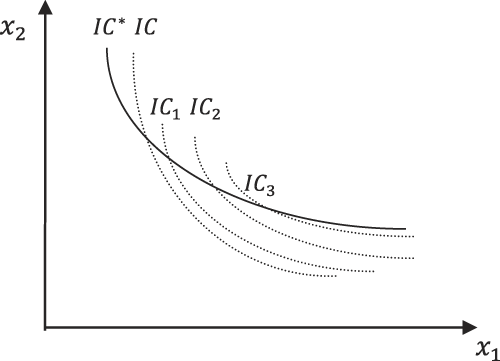
1. the excess in favor of good 1 tends to vanish when its quantity increases. The consequences would be that the MRS of the intemperate progressively converges toward the MRS of his pleasure-oriented preferences (see Figure 2).
Figure 2.A Possible Consequence of Excess.

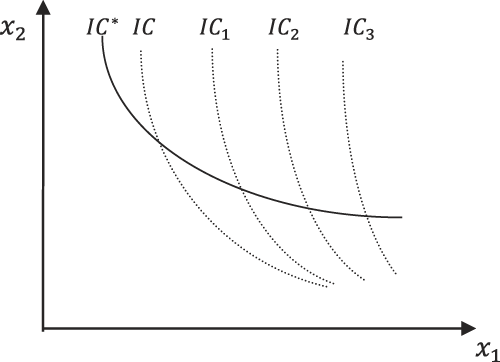
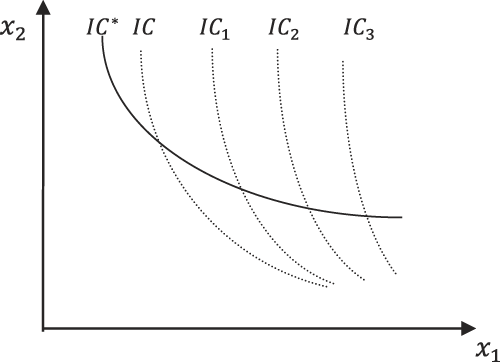
2. the excess in favor of good 1 tends to rise when its quantity increases. The consequences would be that the MRS of the intemperate increasingly diverges from the MRS of his pleasure-oriented preferences (see Figure 3).Footnote 13
Figure 3.Another Possible Consequence of Excess.
Clearly, time does not play an explicit part in “excess.” However, this does not mean that intemperance has nothing to do with it: in this case it is impatience, the second component of intemperance, that creates a distortion in relation to time.
Intemperance and Impatience
A recurrent topic in Mill’s writings corresponds to what we would today call “preferences in time.” For instance, in the Elements preferences in time constitute an essential feature that distinguishes human behaviors (Mill [Reference Mill1826a] 1995, pp. 52–53). Such is also the case in Mill’s paper on education when he dealt with intemperance:
If the early trains create a habit of over-valuing any pleasure or pain, too much will be sacrificed, during life, to obtain the one, or avoid the other, and the sum of happiness, upon the whole, will be impaired. The order in which children receive their impressions, as well as the order of the trains which they copy from others, has a tendency to create impatience under privation; in other words, to make them in prodigious haste to realize a pleasure as soon as desired, to extinguish a pain as soon as felt. (Mill [Reference Mill1819] 1825, p. 34)
Intemperance implies an increased rapidity in the satisfaction of desire. As a result, it gives rise to impatience, so that the intemperate person prefers sooner rather than later.Footnote 14 More formally, this might be expressed as follows:
 $$\forall x \in X,\forall {t_1},{t_2} \in T,(x,{t_1})R(x,{t_2})\,if\,and\,only\,if\,{t_1} \lt {t_2}$$
The time dimension of intemperance does not exclude what we would today name “time inconsistency.” We are then facing the question whether, from a Millian point of view, the intemperate might be inconsistent over time.
Intemperance and the Possibility of Time Inconsistency
A previous interpretation underlined that the Millian intemperate is prone to preference reversals (Sigot Reference Sigot1995, pp. 312–321). As an instance of time inconsistency, preference reversals lead to opposite choices between two alternatives x 1 and x 2 that might be available at dates t 1 and t 2 or s 1 and s 2, although t 2 - t 1 = s 2 - s 1:
 $$\eqalign{ & \exists {x_1},{x_2} \in X,\exists {t_1},{t_2},{s_1},{s_2} \in T:{t_2} - {t_1} = {s_2} - {s_1}, \cr & \left( {{x_1},{t_1}} \right)R\left( {{x_2},{t_2}} \right)\,whereas\,\left( {{x_2},{s_1}} \right)R\left( {{x_1},{s_2}} \right). \cr}$$
None of the conditions that characterize the intemperate—(3), (4), and (5)—seems to protect him from preference reversals, such as expressed in (6). It is well known from the standard analysis of decision in time that this would require something more. For instance, it might be the stationarity axiom.Footnote 15 However, Mill’s writings are of no help if we are looking for textual evidence that would either confirm or contradict a stationarity hypothesis. Sigot’s interpretation would therefore be acceptable, but on the sole basis that if we have no direct evidence that would favor it, we also have no direct argument that would lead to rejecting it.
Nonetheless, this basis does not seem firm enough. Arguing that the Millian intemperate displays time inconsistencies would mean either that we can identify the basic hypothesis, or that Mill provided examples of such time inconsistencies. I have argued that the basic hypothesis is missing. And, in the same way, to my knowledge, there is no instance of time inconsistency in Mill’s writings, so that the preference reversals interpretation of the intemperate seems to go beyond what Mill intended to say.Footnote 16
To sum up, intemperance is characterized by conditions (3), (4), and (5). At this point, though, I have not yet explained how, in Mill’s argument, intemperance might be caused. This is the topic of the next section.
IV. THE CAUSE OF INTEMPERANCE: AN IMPROPER EDUCATION
The End of Education
Mill’s confidence in the role of education was a typical feature of his works (W. H. Burston Reference Burston1969, Reference Burston1973; Reference CavanaghCavenagh 1931; Cumming Reference Cumming1959, Reference Cumming1961; Halévy [1901–1904] 1995, vol. II, pp. 158–175; Fenn Reference Fenn1987, pp. 56–108; Mill [Reference Mill, Robson and Stillinger1873] 1981, p. 132–164; Sigot Reference Sigot1995, pp. 257–287). Along with the Scottish Enlightenment and some influential writers like Claude Adrien Helvétius,Footnote 17 he claimed that education constitutes the sole fundamental difference between individuals (Mill [Reference Mill1819] 1825, p. 9). This means that anyone could be educated,Footnote 18 and could achieve happiness. Indeed, “THE end of education,” according to Mill, “is to render the individual, as much as possible, an instrument of happiness, first to himself, and next to other beings” (Mill [Reference Mill1819] 1825, p. 3).
This quotation deserves special attention. It highlights two important points. The first is that education makes the individual “an instrument of happiness.” Although Mill conceded that the question of knowing what happiness consists in is still unresolved (ibid., p. 17), two substantial elements seem to indicate that his understanding of happiness was hedonistic. His Analysis and his paper on education show that the role of pleasure is significant in his conception of the decision process.Footnote 19 Moreover, his paper “Government” ([1820] 1825), published in the Supplement to the Encyclopaedia Britannica, puts to the fore that his view of happiness is similar to Bentham’s insofar as it consists in pleasure: “the lot of every human being is determined by his pains and pleasures; and that his happiness corresponds with the degree in which his pleasures are great, and his pains are small” (Mill [Reference Mill1820] 1825, p. 4).
Since the educated individual is an instrument of happiness, he also appears as an instrument of pleasure. This means—and this is the second point—that education is a means of pleasure first for ourselves, and then for others. Such a view extends the scope of hedonism. Starting from psychological hedonism, Mill reaches, through education, some kind of universal hedonism.
This is obtained by means of a complicated process that shows that education exhibits two kinds of circumstances, physical and moral, which influence our association of ideas “from the first germ of existence, to the final extinction of life” (ibid., p. 3):
[E]very thing, from the first germ of existence to the final extinction of life, which operates in such a manner as to affect those qualities of the mind on which happiness in any degree depends, comes within the scope of the present inquiry. Those circumstances may be all arranged, according to the hackneyed division, under two heads: They are either physical or moral; meaning by physical, those of a material nature, which operate more immediately upon the material part of the frame; by moral, those of a mental nature, which operate more immediately upon the mental part of the frame. (Mill [Reference Mill1819] 1825, p. 6)
In fact, as Fenn (1987, p. 64) emphasizes, by “physical circumstances” Mill meant influences that result from our impersonal environment, whereas the “moral circumstances” come from human influences. Physical circumstances are either external to the body or inherent to the body. Instances of physical circumstances external to the body are “the aliment, the labour, the air, temperature, action, rest” (Mill [Reference Mill1819] 1825, p. 21). As for the physical circumstances inherent to the body, Mill mentions healthiness or sickness, strength or weakness, beauty or deformity, temperament, age, and sex (ibid.). The moral circumstances correspond to a process composed of four kinds of personal education, not independent from each other: (1) “Political education is like the key-stone of the arch” (ibid., pp. 45–46) of the process, and corresponds to the legislation implemented by the “political machine”; (2) social education (ibid., pp. 43–45) refers to the influences of society on individuals; (3) technical education (ibid., pp. 38–43) chiefly aims at transmitting manual excellence and intelligence—defined as “a knowledge of the order of those events of nature on which our pleasures and pains depend, and the sagacity which discovers the best means for the attaining of ends” (ibid., p. 38); and (4) domestic education (ibid., pp. 31–38), or “parental” education, refers to all sensations that we experience during our childhood. This last component of personal education is crucial in the shaping of our temperament, since our most established habits result from our first sensations occurring during our life. “It follows,” Mill wrote,
that, as soon as the infant, or rather the embryo, begins to feel, the character begins to be formed; and that the habits, which are then contracted, are the most pervading and operative of all. Education, then, or the care of forming the habits, ought to commence, as much as possible, with the period of sensation itself; and, at no period, is its utmost vigilance of greater importance, than the first. (ibid., p. 31; emphasis added)
According to Mill, “the business of a skilful education” (ibid., p. 35) is to arrange these two kinds of circumstances in the order most conducive to happiness. Nevertheless, he considered that such circumstances usually were far from favorable to people’s happiness, in that they might generate intemperance.
The Physical Circumstances of an Improper Education
In his paper on education, Mill asserted that there are situations in which our physical circumstances affect our association of ideas (Mill [Reference Mill1819] 1825, pp. 20–30).Footnote 20 From this theoretical basis, somewhat similar to what is today named “physicalism,” Mill maintained that intemperance results from physical circumstances external to the body that have a negative impact on our association of ideas. He mainly discussed four circumstances of this type.
The first is a deficient quantity of food:
It is easy to see a great number of ways in which deficient quantity of food operates unfavourably upon the moral temper of the mind. As people are ready to sacrifice every thing to the obtaining of a sufficient quantity of food, the want of it implies the most dreadful poverty.… If he is habitually wretched, and rarely permitted to taste a pleasure, he snatches it with an avidity, and indulges himself with an intemperance, almost unknown to any other man. (ibid., p. 28)
Such an observation is consistent with the Malthusian influence on Mill. From 1804 until the end of his life, Mill was apparently concerned by the idea of the population’s increasing faster than the means of subsistence (Mill Reference Mill1804, p. 17; [Reference Mill1818] 1825, p. 10; [1826a] 1995, pp. 46–50).
The second circumstance refers to labor that stultifies workers. On this point, Mill, quoting Smith, gave the instance of the division of labor:
Dr. Smith made the important remark, that the labour in which the great body of the people are employed, has a tendency to grow less and less favourable, as civilization and the arts proceed. The division and subdivision of labour is the principal cause.… When the greater part of a man’s life is employed in the performance of a few simple operations, in one fixed invariable course, all exercise of ingenuity, all adaptation of means to ends, is wholly excluded, and the faculty lost, as far as disuse can destroy the faculties of the mind. (Mill [Reference Mill1819] 1825, p. 30)
The third circumstance also concerns labor, but in a different way. This time it is not the quality but rather the quantity of labor that is at issue: “it operates perhaps still more rapidly; obliterating sympathy, inspiring cruelty and intemperance, rendering impossible the reception of ideas, and paralyzing the organs of the mind” (ibid.).
Mill did not explicitly describe these three circumstances as components of wretchedness; however, he likely considered that they contribute to characterize wretchedness. Mill usually claimed that wretchedness is inconsistent with virtue. Although he acknowledged there are a few extraordinary individuals who are able to display cardinal virtues “in the midst of wretchedness,” this concerns only individuals: the world has never known a both wretched and virtuous people (Mill [Reference Mill1819] 1825, p. 29). Mill even clumsily asserts “when the people are wretchedly poor, all classes are vicious, all are hateful, and all are unhappy” (ibid., p. 39). From this point of view, wretchedness—characterized by the three physical circumstances—might be considered as a cause of intemperance.
The last circumstance that generates intemperance is the possession of large riches. This appears in Mill’s Elements when he emphasized the motives of saving according to a differentiated analysis of social classes: “The possession of a large fortune generally whets the appetite for immediate enjoyment” (Mill [Reference Mill1826a] 1995, p. 52).
As Robert Fenn (1987, p. 103) noticed, “there is a slight ambiguity in Mill’s terminology” wherein he refers to the “rich.” Indeed, we do not know whether he meant the “bourgeoisie who justly earned their wealth” (ibid.) according to “the natural laws of accumulation” (Mill Reference Mill1836a, p. 285), or those in aristocracy who inherit their wealth. Yet it does not seem that the “bourgeois” belonging to the middle class is what is at stake here: Mill did in fact praise this social class. A lot of evidence suggests that he considered the middle class as exemplary in that it is the most virtuous within society.Footnote 21 However, his point of view concerning the aristocracy is far from eulogistic. In “Aristocracy,” published in the Literary Journal (Reference Mill1836a), and more explicitly in his Common Place Books (Fenn Reference Fenn2010, vol. 1, ch. 9), Mill showed his poor opinion on aristocracy as a social class: “Gross, stupid, and mischievous; beasts from their ignorance and appetites” (ibid.). This supports the idea that Mill’s argument on the effect of a possession of large riches is discussed through the particular case of aristocracy.
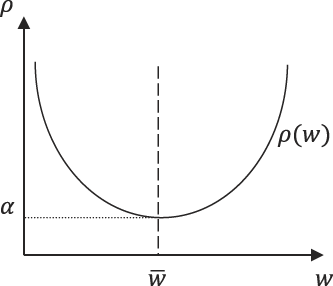
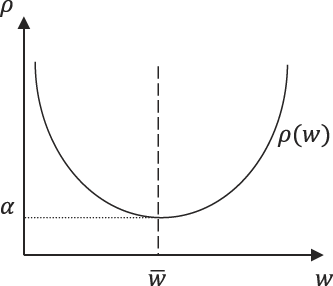
Since large riches and wretchedness generate intemperance, impatience could formally be represented in terms of time preference, like in Figure 4, by a convex function ρ(w) defined on R +, from wealth (w) to impatience ρ. The quasi patience—or quasi no impatience—situation, corresponding to ρ = α, is obtained with a moderate wealth  $w = \bar w$. The relation between wealth and impatience considered here then qualifies a possible prediction of Gary S. Becker and Casey B. Mulligan’s model of time preference (1997, p. 752), according to which wealth increases patience.
Wealth and Impatience.
Of course, Figure 4 does not fully do justice to Mill’s understanding of the causes of intemperance insofar as it only underlines the link between physical circumstances and intemperance. The sole possession of middle wealth is at best a necessary condition of not being influenced by intemperance; but it is not a sufficient one. One obviously might argue that an individual belonging to the middle class could develop his mind in improper moral circumstances so that he might be intemperate. But, to my knowledge, Mill did not consider this case. On the contrary, he considered the middle class as an independent and highly educated class allowing the progressive march of civilization. For instance, in “Government,” Mill was rather explicit about defining such a social class as “the most virtuous part of the community … which gives to science, to art, and to legislation itself, their most distinguished ornaments” (Mill [Reference Mill1820] 1825, p. 32). The proper education of the middle class was, however, more the exception than the general rule. Mill believed that the physical circumstances of the vast majority of population were not desirable at all: “The state of defective food and excessive labour, is the state in which we find the great bulk of mankind; the state in which they are either constantly existing, or into which they are every moment threatening to fall” (Mill [Reference Mill1819] 1825, p. 30). Moreover, Mill envisaged moral circumstances that could generate intemperance.
The Moral Circumstances of an Improper Education
Intemperance begins at home. Among the four moral circumstances described above, Mill mainly discussed the link between an improper domestic education and intemperance. After having outlined the real order of nature, he claimed that “the moral procedure of parents” is usually to
strive to defeat the order of nature, in accumulating pleasures for their children, and preventing the arrival of pains, when the children’s own conduct would have had very different effects … the impressions, from which ideas are copied, made, by the injudicious conduct of those to whom the destiny of infants is confided, to follow an order very different from the natural one, or that in which the grand sequences among events would naturally produce them. (Mill [Reference Mill1819] 1825, p. 33)
Such a domestic education then consists in repeatedly transmitting improper pleasurable sensations that create the habit of their own overestimation. Nevertheless, in his paper on education, Mill did not really explain why parents usually strive to accumulate pleasure for their children. The Analysis helps to clarify this point. In his discussion on family as a cause of pleasure or pain, Mill claimed that parental affection—that is, a contemplation of the idea of the cause of our pleasures, past or future (Mill [Reference Mill, Bain, Findlater, Grote and Mill1829] 1967, vol. II, p. 266)—might affect our domestic education in two extreme cases. First, parental affection fails in cases of extreme poverty (Mill [Reference Mill, Bain, Findlater, Grote and Mill1829] 1967, vol. II, p. 222–223). In such cases, parents do not have means and time to provide pleasure for their children. The children therefore lack pleasure. By referring to Mill’s claim that an insufficient quantity of foods causes intemperance, it might be argued that children’s lack of pleasure leads them to realize their pleasure with avidity and intemperance. Second, parental affection fails in cases of aristocracy (ibid., pp. 222–223). The argument developed here is that aristocrats are not a proper parental model for children. There is little hope that these children will overcome the condition of their parents’ excessive appetites. Once again, we are facing the idea that being very poor or very rich deteriorates our education. But now this is related to moral circumstances.Footnote 22
On the one hand, it is clear that an improper education constitutes an obstacle to the realization of the real order of nature. On the other hand, Mill considered the return to the real order of nature through the establishment of a particular educative plan that promotes temperance.
V. THE ROLE OF TEMPERANCE: BACK TO THE REAL ORDER OF NATURE
Temperance
Mill distinguished two definitions of “temperance” in his paper on education. The first is what he called “the temperance of the ancient philosophers”:
The temperance of the ancient philosophers had a view only to the happiness of the present life, and consisted in the power of resisting the immediate propensity, if yielding to it would lead to an overbalance of evil or prevent the enjoyment of a superior good, in whatever the good or evil of the present life consists. (Mill [Reference Mill1819] 1825, pp. 15–16)
The second definition refers to the kind of temperance that prevails in theological morality, and
which includes a certain portion (in the doctrines of some theological instructors, a very large portion) of abstinence, and not only of abstinence, or the gratuitous renunciation of pleasure, but of the infliction of voluntary pain. This is done with a view to please the God, or object of worship, and to provide, through his favour, for the happiness of a second, or future life. (ibid., p. 15)
Mill clearly favored the first definitionFootnote 23 when he claimed that “the radical meaning of temperance … is the steady habit of resisting a present desire” (Mill [Reference Mill1819] 1825, p. 37). By resisting a present desire, temperance guides us toward our greatest pleasure. In a way, this makes clear how temperance works. Temperance prevents the emergence of any gap between our sensations and our ideas. When temperate, our desires are shaped so as to match our pleasures. From a formal point of view, there would be no more difference between pleasure-oriented preferences, expressed by R* and desire-oriented preferences R:
 $$\forall x,y \in X,\forall {t_1},{t_2} \in T,\left {x,{t_1}} \rightR\left {y,{t_2}} \right\mathop \Leftrightarrow \limits^{} \left {x,{t_1}} \rightR*\left {y,{t_2}} \right.$$
As a consequence, excess (4) and impatience (5) do not affect us anymore. Temperance blocks excess since our desires are no longer overestimated. And by resisting the realization of a present desire, this moral virtue stops impatience. The matching between pleasure-oriented and desire-oriented preferences shown by (7) leads the temperate individual to approach the real order of nature.Footnote 24
The Cause of Temperance: A Proper Education
Apart from diffusing justice—that is, assuring that individuals abstain from doing people harm (Mill [Reference Mill1819] 1825, p. 16)—generosity, defined as what provides the means of pleasure to other individuals (ibid.), and intelligence, or knowledge and sagacity (ibid), a proper education plays the principal part in the transmission of temperance. Just like an improper education, it is composed of physical and moral circumstances.
The physical circumstances of a proper education are those that are favorable to our association of ideas. First and foremost, “a good diet is a necessary part of a good education…. In the great body of the people all education is impotent without it” (Mill [Reference Mill1819] 1825, p. 29). Then, a labor that is neither stultifying nor excessive, and a sufficient distance from large riches—although Mill did not refer to this case in his paper on education—appear as prerequisites of temperance.
As for the moral circumstances, Mill mainly discusses the substantial role of domestic education. An aim of domestic education is to prevent the existence of a possible disconnect between pleasure and desire. Herein explicitly lies the promotion of temperance in order that our greatest pleasure can be reached:
We can afford to say very few words on the powers of domestic education with regard to Temperance. That virtue bears a reference to pain and pleasure. The grand object evidently is, to connect with each pain and pleasure those trains of ideas which, according to the order established among events, tend most effectually to increase the sum of pleasures upon the whole, and diminish that of pains … and the skilful use of the powers we have over the impressions and trains of his infancy would lay the strongest foundation for the future happiness of himself, and of all those over whom his actions have any sway. (ibid., pp. 33–34)
Domestic education is then supposed to repeatedly implement sensations that generate temperance as a particular habit, and it is in this way, indirectly, that desires are transformed. The well-known and very particular education James Mill provided to his oldest son, John Stuart, could be considered as a practical instance of a proper domestic education, in that it is used to produce temperance. In his Autobiography, John Stuart Mill conceded that
temperance, in the large sense intended by the Greek philosophers—stopping short at the point of moderation in all indulgences—was with him [James Mill], as with them, almost the central point of educational precept. His inculcations of this virtue fill a large place in my childish remembrances. (Mill Reference Mill, Robson and Stillinger1873, p. 48)
This kind of private education, entirely devised and supervised by James Mill, was obviously not a representative case. Though Mill argued in favor of “an equal degree of justice, an equal degree of temperance, an equal degree of veracity in the poor as in the rich” (Mill [Reference Mill1819] 1825, p. 41), the improper education of the majority of the people generated intemperance rather than temperance. This makes it legitimate to question the possibility of moving from such a habit as intemperance to another habit, temperance.
Since intemperance begins at home and our first sensations produce the greatest effects on our habits, it is not obvious that moving from intemperance to temperance is in any case practicable. The key seems to come from political education, that “is like the keystone of the arch” of the moral circumstances of education.Footnote 25 After all, this is no surprise for an ardent political reformer like Mill. The author of “Government” was very confident about the bent of the progressive middle class in favor of political reform (Mill [Reference Mill1820] 1825, pp. 31–32). One of the key issues at stake in Mill’s program of political reform was to substitute the virtuous middle class for the ruling privileged class. Whereas the interests of the latter were directly opposed to that of the community, he conceived that there was an identity of interest between the middle class and the community (Mill [Reference Mill1820] 1825, p. 30). According to Mill, a “representative” government, composed of middle-class people, based on the “identity of interests between ruler and ruled” (Mill Reference Mill1825, p. 213), was the only form of government that would “prevent the predominance of the interest of any individual or of any class” (Mill Reference Mill1826b, p. 781; see also Hamburger Reference Hamburger1963, p. 22; and Milgate and Stimson Reference Milgate and Stimson1993, p. 902). Mill believed that the great body of the people—that is, the working class—would follow the lead of the middle class. If the secret ballot were established, this great body of the people would have chosen their representatives from the middle class. This is based upon a kind of identification process between the working and the middle classes. Mill suggested that workers have a strong propensity to use the middle class as “models for their imitation.” The opinions of the middle class “they hear daily repeated and account it their honour to adopt,” thus raising the moral condition of their own class (Mill [Reference Mill1820] 1825, p. 32).
It is clear, then, that the imitation of the virtuous middle class constitutes proper moral circumstances to attain temperance. Moreover, in order to reinforce this access, the representative government might promote Lancasterian schools, with which we know that Mill was very involved.Footnote 26 In the end, the representative government might embark on two ways to eradicate the physical circumstances of an improper education that would cause intemperance.
A first possible way might be the redistribution of wealth from the richest individuals to the poorest. However, on this point, Mill’s position is not entirely obvious. He distinguishes two cases. When the inequalities of wealth result from the laws of accumulation—such as inequalities between workers and the middle class—it seems he considers that legislation should not change the course of things because they are conducive to capital accumulation (1836a, p. 284). But when the inequalities of wealth come from coerced inheritance—as in aristocracy (ibid., p. 285)—it seems that legislation might tax landowners’ rent, provided the population increases faster than the means of subsistence (Mill [Reference Mill1826a] 1995, pp. 252–253).Footnote 27
Another way is more institutional. Legislation could establish banks for savings or benefit societies in order to fight wretchedness in the face of an excessive population. The first institution is “a security against the miseries of want.” By generating the disposition to accumulate capital, such an institution creates “industry and frugality.” This is supposed to facilitate the transmission of temperance (Mill Reference Mill1816a, pp. 92–93). And benefit societies contribute to the development of virtue and good conduct by encouraging the self-command and foresight that makes provision in the present for the future (Mill Reference Mill1816b, p. 265).
Like Bentham and most social reformers, Mill never imagined that institutional changes would only modify an individual’s possibilities of choice, leaving unchanged his preferences.Footnote 28 For instance, when he wrote on education, or the “liberty of the press” ([Reference Mill1821] 1825),Footnote 29 his purpose was to change human beings, and not only institutions. Although the first sensations of the individual do create the greatest effects on his habit, his continuous interaction with the external world is also a source of permanent transformation of his preferences. Consequently, as long as political or social education keeps on working, the indifference map of the Millian intemperate still keeps open the possibility of converging toward a temperate indifference map.
VI. CONCLUSION
I have reconstructed the manner in which James Mill analyzed intemperance in his understanding of the decision process. This process puts to the fore two steps that come before action: an actual magnitude provided by sensations, pleasure or pain; and the idea of this magnitude, desire or aversion. When the initial sensation corresponds to the related idea, we reach what Mill called “the real order of nature.” According to him, this order can be reached through pleasure-oriented preferences, characterized by (1) and (2), in which our choices guide us toward our greatest pleasure. However, we can also see that the real order of nature might be broken by what Mill named “intemperance,” a specific disposition caused by an improper education. When intemperate, our preferences are desire-oriented, which are expressed by (3), (4) and (5). They no longer match pleasure-oriented preferences, and our choices now do not lead us anymore toward our greatest pleasure. Nonetheless, the possibility of a return to the real order of nature was taken into account by Mill. He emphasized the part played by a proper education process that promotes temperance (7). This shows that whereas it might be admitted that Mill is a hedonist, his hedonism is far from simple. On this account, individuals are led by pleasure and pain, but not through pleasure-oriented preferences. Millian individuals follow pleasure as an idea: their choices reflect desire-oriented preferences, and these latter are consistent with pleasure-oriented preferences under the influence of temperance.