Introduction
SCHOLARS of historical institutionalism have long argued that chance and contingency play a major role in determining the course of political development and have provided a range of rich evidence for that claim.Footnote 1 Recently, some international relations scholars have argued that introducing historical institutionalist concepts and approaches would benefit the field.Footnote 2 We show that the benefits also run in the other direction: historical institutionalist approaches can benefit from considering what is different about ir. Specifically, we show that chance and contingency play a larger role in military conflicts between states than in most (perhaps all) other policy domains for systematic reasons. These reasons, in turn, imply stable differences between domains in which attention to historical contingencies will be more or less useful.
Our starting point in ir is that chance and contingency clearly play a substantial role in explaining many surprising macrolevel outcomes. The history of Prussia is illustrative. The country was in terrible shape at the end of the Thirty Years’ War (1648). Roughly a third of the prewar population had been killed or had died from war-induced famine. Yet by 1786, it was one of the great powers. This remarkable rise from 1648 to 1786 was not predetermined. Chance mattered.
Consider the monarchs of this period. Most historians agree that three of the four—The Great Elector, Frederick William I, and Frederick the Great—were very able rulers. (The fourth, Frederick I, was ordinary.) Three of four is an unusually good draw from any plausible quality distribution, and their reigns were long: 121 years in all. Such lengthy runs rarely occurred when epidemics, especially smallpox and measles, killed the high and mighty as well as common folk.Footnote 3 The average reign of European monarchs from 1545 to 1796 was approximately twenty years—less than half the average of those three capable Prussian Kings.Footnote 4 Nature kept tossing heads for the kingdom.
Chance also favored Prussia’s military activities. Two events in the Seven Years’ War highlight both the country’s good luck and the centrality of chance in determining the outcomes of interstate conflict. Badly outnumbered throughout the war, Prussian armies benefited from two strokes of good fortune. First, in what Frederick the Great called the “miracle of the House of Brandenburg,” the Russian and Austrian armies failed to pursue an obvious opportunity—laying siege to Berlin—after their decisive victory over Frederick at Kunersdorf (1759).Footnote 5 Second, the timing of the Russian Empress Elizabeth’s death, in December 1761, was a huge gift to Frederick.Footnote 6 In late 1761, his armies were depleted and the Russian and Austrian forces were, as Frederick acknowledged, in exceedingly threatening positions in and around Prussia.Footnote 7 When the Empress passed away, the armies were withdrawn. The Empress had been ill for some time, and had she hung on for another month or two, her forces plus those of Austria, Saxony, and Sweden, would have had a good chance of crushing the shrinking Prussian armies. But her successor, Peter III, reversed the country’s alliance policy, which took Russia out of the anti-Prussian coalition.Footnote 8 Thanks in large part to this unexpected withdrawal, Prussia prevailed in the conflict despite fighting a large, powerful coalition that originally included Russia, Austria, and France.Footnote 9
Although Frederick and Prussia emerged victorious, it was a nearrun thing: it was not a deterministic process, but rather a stochastic one. Indeed, Prussia’s long survival in the great power club was ex ante unlikely and therefore surprising precisely because there is systematic selection favoring large, rich countries in the international system.
Prussia is only an example, and one deliberately selected to make a point about historical contingencies in the evolution of states and their militaries. As this case illustrates, the large role of chance in the evolution of state power stems from the selection environment of international politics and from the properties of the organizational solutions that meet those pressures. Together these forces have produced a handful of tightly integrated organizations (militaries) as the domain’s key players, that is, the great powers. The small N arises from a combination of positive feedback—power often begets power—and the expense of fielding military forces, which favors large, thriving economies.Footnote 10 The tight integration of infantry and artillery, for example, has been driven by a combination of competitive pressures and the feasible organizational methods, especially command and control techniques, for solving the problems generated by the international system.Footnote 11 By the mid-twentieth century, only countries whose militaries had solved the integration problems between fire and maneuver could take and hold territory, and therefore, only they remained great powers.Footnote 12
In turn, the small N and the tightly integrated militaries created a setting in which chance played a big role in the evolution of these systems and their parent states: there are only a few key players,Footnote 13 thus even weak laws of large numbers don’t holdFootnote 14 and because these organizations are tightly integrated, micro-shocks sometimes reverberate throughout a system.Footnote 15 The effects of these shocks are amplified by the anarchical character of the international system and by the corresponding conflicting interests of the states. Hence, the widespread, informal intuition of military and ir historians that contingencies matter for their domain is correct.Footnote 16
Dynamically, the above argument implies tremendous volatility in the evolution of state power. There are big and sometimes surprising swings in near-term outcomes in militarized conflicts, which create large chance-influenced fluctuations in state power.Footnote 17
If the volatility in state power is driven by the nature of military interactions and the small number of constituent units competing for power, then an immediate implication of our argument is that contingencies should matter less in policy domains characterized by a great many organizations that form a nearly decomposable system.Footnote 18 Such domains should be highly stable and exhibit little volatility. As a clear example of such systems, we examine K–12 education in the United States below. Since our primary goal is theory development, we chose this comparison to draw a clear contrast to the evolution of state power. The next empirical step on our agenda is to engage in a series of structured evaluations of policy domains that vary along the key factors that we argue should condition the importance of historical contingency: small number of relevant units, tight integration, and comparative lack of regulatory institutions.Footnote 19
Importantly, the logic of our argument implies that the long-run evolution of state power exhibits both systematic trends, deriving from stable policy domains with enduring cross-national differences, and random aspects, rising out of policy domains, such as military affairs, which exhibit major historical contingencies. We do not say this in an attempt to make peace between scholars who emphasize patterns and those who emphasize chance. Our position is that stochastic theories of the evolution of states and their militaries imply that both systematic trends and historical contingencies are real and substantively significant.Footnote 20 Neither one is a mirage produced by data artifacts, measurement error, or cherry-picked evidence. The centrality of historical contingency is caused by fundamental, enduring institutional properties of interstate competition—in particular, by operational shocks, strategic uncertainty, and innovation turbulence (defined below)—and the handful of organizations (militaries) that are central to that competition. Our core contribution is to highlight the specific characteristics of military affairs that make them, and therefore the international system, particularly exposed to historical contingencies.Footnote 21
The remainder of this article fleshes out these arguments as follows. Section I clarifies the key concept of historical contingency. Section II briefly examines important trends in the evolution of states and their militaries that help to explain why historical contingencies are so important in war and, therefore, in the dynamics of state power. Sections III through V examine key sources of chance in military affairs: operational shocks (section III); strategic uncertainty (section IV); and innovation turbulence (section V). Section VI examines a policy system—K–12 education in the United States—that, because it has a great many organizations that form a nearly decomposable system, provides a sharp contrast to the shock-sensitive world of militaries. Section VII concludes.
I. Historical Contingencies versus Path Dependence, Black Swans, and Other Exotica
We have intentionally chosen a term, historical contingencies, familiar to historians and historically oriented social scientists.Footnote 22 We do this partly for ease of communication but more important, to indicate what our central claims are. By historical contingency we mean chance-influenced events with substantial long-term effects, that is, events which clearly take history down a different path than it otherwise would have followed.
The notion of chance and the associated idea of a chance-influenced event are fundamental in virtually all empirical sciences.Footnote 23 But the concept is distinct from the notion of path dependence that can be broadly defined as processes whereby the sequence of outcomes a system has traveled in the past constrain the set of possible outcomes in the future. Although a powerful idea, path dependence is not everywhere. For example, it does not appear in standard ir models of bargaining in the shadow of war. There is a good reason for this. Path dependence is often explicated as a property of certain kinds of stochastic processes, such as stationary Markov chains,Footnote 24 and those that exhibit increasing returns.Footnote 25
Asserting that a certain dynamic is Markovian is a significant hypothesis, as is the claim that its transition probabilities are stationary or that it demonstrates increasing returns.Footnote 26 These should not be offered lightly. In contrast, we hypothesize that a certain event was influenced by chance, that is, that contingency was important, without knowing whether the underlying process is Markovian or stationary and without making any such claims.Footnote 27 Clearly, historical contingency and path dependency are not incompatible. Indeed, probably all important historical contingencies are linked to some kind of path dependence (though not necessarily that of a Markov process or increasing returns). For example, had Empress Elizabeth died a month later, Prussia might have lost the Seven Years’ War. The chance event caused a different path to be taken.Footnote 28
It is also important to distinguish historical contingency from black swans, defined by Nassim Taleb as a surprising, improbable event that has major effects and that observers rationalize ex post.Footnote 29 Clearly, this is a special type of chance-influenced event. Some important historical contingencies might have been black swans. For example, institutional arrangements developed in the aftermath of the Great Depression—a canonical black swan—laid the foundation for the Bretton Woods system for monetary and financial exchange.Footnote 30 Others were not. Margaret MacMillan makes a good case that any one of the crises faced by European leaders between 1900 and 1914 could have sparked a general war.Footnote 31 Continue a geometric series long enough and eventually a coin will land tails. That a general European war began in August 1914 may have been quite contingent; that one started at some point in this crisis-filled period, not so much.
II. Some Systematic Politico-Military Trends and Their Causes
This section outlines several systematic trends in the evolution of states and their militaries that show up repeatedly in research across the history of international politics, political anthropology, and military history. Perhaps ironically, these systematic trends—roughly speaking, what isn’t contingent—have produced properties (see claims 1 and 4) that make aspects of the system unusually vulnerable to random shocks.
—Claim 1. War has produced a few powerful countries.
Ceteris paribus, size is an advantage in war, which implies a selection effect in state evolution. Therefore, this trend isn’t driven by highly contingent events.Footnote 32
—Claim 2. These powerful countries are governed by modern bureaucratic states, which are standing formal organizations (sfos).Footnote 33
There are no exceptions to this pattern. Here, too, strong selection pressures have been at work.
—Claim 3. Inside all these states are militaries, which are themselves sfos.
Again, selection pressures have been at work. As Otto Hintze and Max Weber note,Footnote 34 standing formal armies equipped with weapons produced by other sfos—for example, firms that make machine guns—usually defeat bands of warriors led by traditional authorities.
—Claim 4. These sfos are tightly integrated hierarchies, especially within branches and, increasingly, across them.
Integration within branches has been a systematic trend in major militaries over the past two centuries and across branches in the past sixty years. Again, selection pressures are evident.Footnote 35
These organizational properties, produced by the selective forces of the international system, make interstate conflict vulnerable to chance events. Further, due to well-known selection effects, some kinds of uncertainty (especially strategic) are endogenous to interstate conflicts that result in war. In other words, if an outcome is predictable then states would have a strong incentive to avoid the costs of armed conflict.Footnote 36
One more observation frames our discussion.
—Claim 5. Military power is far more volatile than economic power.
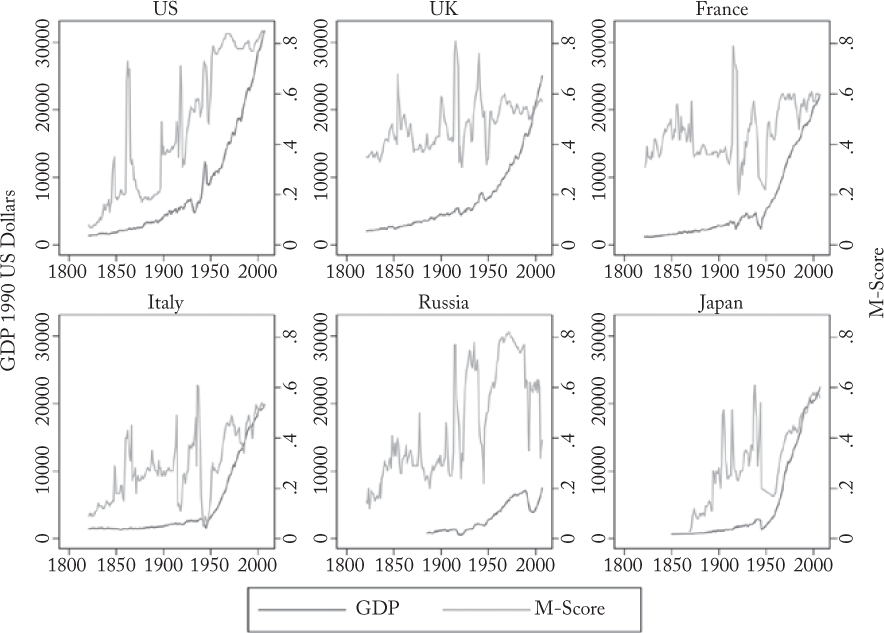
This pattern is relevant for our argument because the volatility of a time series is a quantitative index of the causal importance of underlying historical contingencies. Figure 1, which plots an annual estimate of military power, the M-Score, and gdp per capita for six major world powers since 1800, illustrates this dynamic.Footnote 37 The difference in volatility is striking.Footnote 38
Military Power (M-Score) and GDP since 1820

To be sure, some military variability reflects states’ investment decisions, for example, buying arms. But a simple analogy to investment by firms is misleading. The investment decisions of states and firms are made in fundamentally different settings. Whereas contemporary economic competition is usually regulated by third parties, interstate competition occurs, as ir theorists have long emphasized, in an anarchic environment. We believe that the absence of third-party regulation is a key reason major interstate conflicts cause so much damage, per Lewis Richardson’s discovery of the skewed distribution of war-caused deaths,Footnote 39 and lead to such great over-time volatility of military power.Footnote 40 Hence, some elaboration is warranted.
Historically, interstate competition has rarely been regulated by powerful third parties. Consequently, victors have been able to treat losers as they pleased:Footnote 41 the brutal strategy of deballatio (exterminating an enemy) is ancient. Thus, anarchy—the absence of authoritative third parties—intensifies the volatility of states’ power swings. Countries defeated in war can lose everything. Carthage, once a strong empire, had zero military power at the end of the Third Punic War.
The contrast to the rule-governed collapse of a firm is instructive. Central is bankruptcy law that precludes strategic degradation by victors to corporate collapse although, of course, there are winners and losers in economic competition. Who wins and who loses is often driven by technological innovation. So there is something to Joseph Schumpeter’s famous idea that “creative destruction” underlies economic growth in capitalist economies. But his phrase exaggerates the suffering when compared to war’s destructiveness. Today, losers of market competition are not thrown into debtors’ prisonsFootnote 42 or shot. And losing firms’ productive assets are not destroyed to prevent their reemergence; they are sold and reallocated to other uses.
Institutions that manage economic competition facilitate these processes. In particular, bankruptcy law, a rather recent innovation, is designed to promote the peaceful and not-too-inefficient reallocation of economically useful resources.Footnote 43
Furthermore, a great power has thousands of firms but only one state and one military. Hence whereas Schumpeter’s creative destruction is often contained—one firm losing an economic competition need not perturb a country’s overall growth—random shocks that affect a military can quickly influence a state’s overall fortunes.
The next sections consider three kinds of uncertainty that drive such shocks and the volatility in military power: operational, strategic, and innovation-related. Operational uncertainty refers to contingency’s effects in tactical engagements. Strategic uncertainty refers to chance’s impact on entire campaigns. Innovation-related uncertainty, which we call innovation turbulence, refers to the sudden reversals that can occur when one side or the other makes the right technological bet or innovates just a bit better or faster than its opponents. We illustrate these different kinds of uncertainty with case studies from politico-military history. This kind of historical research is a vital complement to stochastic theories of state evolution, just as natural history complements evolutionary theory in biology.
III. Operational Shocks
Two examples neatly highlight how chance operational events can have major macrolevel impacts in war and thus on state power.
Lee’s Lost Orders
In September 1862, General Robert E. Lee took the Army of Northern Virginia across the Potomac River into Maryland, a bold move that stretched his supply lines, but the timing seemed propitious.Footnote 44 The string of Southern victories up to that point had had international repercussions as British leaders had started to wonder whether it was time to recognize the Confederacy. If Lee took the offensive and smashed Union General George McClellan in a battle of maneuver in Maryland, perhaps London would take that decisive step. Such a move might have had major consequences: recognition would have strengthened the argument of Northern Democrats that the war was hopeless, thereby influencing the November elections and the entire project of restoring the Union, and recognition could have drawn the Union into a conflict with Great Britain.Footnote 45 And so the Army of Northern Virginia—threadbare in supplies but sky-high in morale—entered Maryland.
The Union Army was hunkered down near Washington. Morale was better than Lee had estimated, but the army knew little of Lee’s plans. Some reports had indicated that his forces had crossed the Potomac, but their destination was uncertain. Would they swing east, toward Baltimore, a city filled with secessionists awaiting the arrival of a Southern army? Move north and attack Pennsylvania? Or, as Henry Halleck, the top Union general, feared, was it a feint designed to strip Washington of its protection by the main Northern army, to be followed by a devastating attack on the capital? No one knew.
Facing this uncertainty, the ever-cautious McClellan slowly moved his men in the general direction of Lee’s troops—exactly what Lee wanted him to do. If the Army of the Potomac stumbled around in the open field, Lee believed that he could outmaneuver McClellan, pick a place suited to his forces, and win a big victory. Given the armies’ track records, this strategy was realistic.
Lee enacted an audacious plan. He sent several divisions to capture the garrison at Harper’s Ferry, several others north to secure the town of Hagerstown against Union forces, and retained his main force under his direct command, effectively dividing the small Army of Northern Virginia in the face of a larger foe. (This violated a standard military heuristic, but Lee knew that McClellan moved slowly.) Splitting up a command requires clear orders, and Lee had his adjutant, Robert Chilton, transcribe and distribute a precise set of orders to his senior subordinates.
Then a copy of those orders got lost. Historians aren’t sure how, but a complete packet of the orders, wrapped around three cigars, found its way on to a field. By a bizarre stroke of luck two noncommissioned officers from the Union’s 27th Indiana Infantry Regiment moving in a skirmish line stumbled upon the orders. The soldiers sent them up the chain of command where the commander of the XII Corps, Acting Adjutant General Samuel Pittman, was able to authenticate the orders by identifying Chilton’s signature.Footnote 46 In another remarkable coincidence, Pittman had been a teller at Michigan State Bank when Chilton was paymaster for the army and was thus familiar with his signature from accounts kept by Chilton at the bank. The authenticated orders were passed to McClellan.
This was a colossal random shock. An eminent Civil War historian, James McPherson, described it as “fantastic luck . . . [McClellan had] hit the all-time military jackpot.”Footnote 47
But McClellan failed to fully seize the opportunity. Governed by his habitual caution, the Army of the Potomac moved slowly: four days elapsed before it was in position to fight the Confederates at Antietam. Although McClellan lost a golden opportunity to crush the Army of Northern Virginia piece by piece, the improbable string of events ruined the Confederate plan. In the bloodiest day of a bloody war, the Battle of Antietam was fought to a tactical draw—a strategic defeat for the South. Exhausted and more than decimated, and with a staggering loss of officers, the Army of Northern Virginia retreated. Lee’s Maryland campaign was over.Footnote 48 Lincoln seized the then-unusual moment of a Confederate retreat to announce the Emancipation Proclamation, thus changing the war’s meaning and, given the prevalence of antislavery opinion in Britain, ensuring the British government would remain neutral.Footnote 49
A Close Call in the Cuban Missile Crisis
Perhaps the best example of the contingency of military outcomes starts with a tense incident during the Cuban Missile Crisis. On October 1, 1962, the B-59—a Soviet Foxtrot-class diesel-electric attack submarine—and three other submarines were ordered to sail for Cuba from their homeport in Murmansk. About three weeks later, on October 24th, the US imposed a naval blockade around Cuba after confirming the presence of short-range nuclear-armed missiles on the island.Footnote 50 That day the Pentagon sent a message to the Soviet government explaining a new signal: dropping practice depth charges meant that submerged submarines should surface and identify themselves. But “the Soviet government never acknowledged receipt of the message about the underwater signals, and never relayed the contents to the commanders of the four Foxtrots [including B-59].”Footnote 51 On October 27th, the aircraft carrier USS Randolph and its escorts, enforcing the blockade, cornered the B-59 and started dropping practice depth charges.Footnote 52
The potential for a mistake was obvious. By the 27th, the submarine had been trying to evade American warships for several days. Its crew was hot and exhausted, CO2 levels had become critical, and the boat’s batteries were dangerously low.Footnote 53 Further, it was difficult to discern the difference between practice charges and the real thing. Were it not for one particular staffing decision, the B-59 might well have launched an attack. Had it done so, matters might have escalated rapidly. The United States had no plans for a graduated response to Soviet tactical nuclear weapons; the only nuclear war plan involved a full-scale strike.Footnote 54
Fortunately for future generations, the B-59’s executive officer, Commander Vasili Arkhipov, had an unusual history. Although only second-in-command on his boat, Arkhipov had been given command of the four-submarine flotilla due to his heroism in an accident aboard the K-19 ballistic missile submarine the year before.Footnote 55
As the US practice depth charges began falling, the B-59’s captain, Valentin Grigorievitch Savitsky, inferred that war had begun and advocated forcefully for launching his boat’s nuclear torpedo at the Randolph.Footnote 56 Under established procedures, he could not fire the weapon unless the flotilla commander (Arkhipov) and his boat’s political officer agreed. Arkhipov refused. He persuaded the B-59’s captain to surface and to request further orders from Moscow.Footnote 57 On any other boat in the flotilla, the captain and political officer’s concurrence would have been sufficient.
The B-59 surfaced, the officers realized war had not started, and the boat continued on its way.Footnote 58 Had any other officer been in Arkhipov’s shoes—perhaps one without his stature and rank—or had the flotilla commander been on another vessel, our world might be a very different place.Footnote 59
As Richardson points out, the distribution of deaths from war is highly skewed. The two world wars together account for “about 60 percent of all the quarrel deaths in the 130-year period”Footnote 60 he studied. A nuclear war between the USSR and the United States would have markedly increased that skew.
IV. Strategic Uncertainty
There are two important sources of strategic uncertainty. First, as noted above, wars are often endogenously uncertain: those that would end in predictable ways are more easily avoided than those that are uncertain, and given the conflicting interests of governments it is hard to reduce uncertainty (that is, bluffing can be useful).Footnote 61 Hence, wartime military strategies are likewise causally uncertain. Such strategies are means to a hoped-for end (victory or avoiding defeat), so if outcomes are uncertain then the means-end relation must also be. Indeed, a central question for government’s military planners is how likely is their strategy to produce the desired end. Thus strategic uncertainty in war is fundamental. It does not require cognitive biases; it would exist even if decision makers were fully rational.
Second, given the enormous scale and complexity of contemporary militaries, drawing up strategic plans is a difficult endeavor. It is well known, for example, that figuring out the mobilization schedules (including train timetables) for German armies in 1914 taxed the abilities of the German General Staff. Despite its importance, logistical planning was given less attention.Footnote 62 That vital issues may be given short shrift makes it difficult to predict the effectiveness of one’s strategy even if one knows what one’s opponent is going to do—which, given the endogenous uncertainty discussed above, often doesn’t occur—and therefore makes it challenging to make long-run plans. Thus, bounded rationality can exacerbate the endogenous uncertainty that even fully rational military planners would face. And given the ways that tight integration gives chance events an outsized role in this domain—as discussed in the introduction—strategic uncertainty leads to tremendous volatility in the evolution of state power.
Not surprisingly, important examples of strategic uncertainty that could have led to such swings bookended World War I.
The Schlieffen-Moltke Plan, the First Battle of the Marne, and the Spring Offensive of 1918
World War I reshaped twentieth-century Europe. Empires collapsed, nations emerged, and the stage was set for WWII and the subsequent Cold War.Footnote 63 But the war’s outcome was far from a foregone conclusion. Indeed, when it started, no one knew what would happen.Footnote 64 Decision makers had beliefs, of course, but not real knowledge.
The paucity of real knowledge became clear in early September 1914. Initially the German invasion followed the Schlieffen-Moltke Plan—a short-war strategy focused on the envelopment and destruction of the French army—quite closely. By the fifth week vital supply lines were “stretched to the breaking point.”Footnote 65 Schlieffen had been famously casual about the campaign’s logistics and although Moltke tried to address the problem, he faced difficult constraints (in particular, he could do nothing about the length of the supply lines or the feasible transportation methods). Further, trying to keep to the plan’s tight schedule exhausted German troops. Nevertheless, the French and British armies were being thrown back in battle after battle. Moltke began to believe that Schlieffen’s core idea might work and he even started shifting troops to the Eastern Front.Footnote 66
Then all went to hell, almost literally, at the First Battle of the Marne (September 5–12). Though the outcome was touch and go—“choice, chance, and contingency lurked at every corner”Footnote 67—historians agree that it ended in a tactical draw and a major strategic setback for the Germans. We now know that the First Battle of the Marne destroyed the Schlieffen-Moltke Plan. In addition, the stress was too much for Moltke. He experienced a breakdown, “both mental and physical,”Footnote 68 and had to be replaced.
Although the Schlieffen-Moltke Plan was stymied—it said nothing about contingencies, such as a defeat in a major battle, and there was no backup plan,Footnote 69 the Germans didn’t give up; they improvised. Organization theorists argue that decision-making can be done by planning or by feedback.Footnote 70 Some generals, for example, the elder Moltke (chief of the German General Staff, 1857–87), made this point much earlier. After the Marne both sides tried a well-known heuristic: if you can’t go through an enemy, try to go around him. Thus the German and Allied armies tried to outflank each other, necessarily moving north in the so-called Race to the Sea. Move met countermove, and the race (a byproduct of the flanking efforts) ended in a draw in mid-late October.
By that point even improvised options had dwindled. About three million heavily armed men, backed by extraordinarily lethal artillery (the Western Front’s main killer), faced each other along a line that stretched from the North Sea to Switzerland. The gap between plans and actual outcomes—a good measure of ex ante uncertainty—started to sink in at every level. The German High Command realized that the Schlieffen-Moltke Plan was dead (as were scores of thousands of soldiers). Troops on both sides, still being punished by enemy artillery, realized it was time to take out their shovels and start digging. Thus began trench warfare in late 1914.
Crossing No-Man’s Land and the Spring Offensive of 1918
The challenge facing the opposed armies was how to cross the area between the trench lines, known ominously as No Man’s Land, and sustain the advance into the enemy’s rear area. Doing so required moving soldiers across a rugged, broken landscape under fire from massed machine guns. Once across, the attackers had to resist counterattack by the well-rested reserves of the other side long enough for follow-on forces to be brought forward across the same broken landscape. They then needed to advance quickly enough to prevent the enemy from establishing additional trench lines. Throughout this process the attackers’ original lines, through which the follow-on forces had to pass, remained within the defender’s artillery range.
This tactical problem was not completely new; it had been observed during the American Civil War. But the powerful artillery, repeating rifles, and machine guns wielded by armies in 1914 made it even worse. Although some military planners realized that trenches might be needed from time to time in a campaign and some governments prepared manuals for this eventuality,Footnote 71 they were tactical preparations. There is broad consensus that high commands in the great powers did not expect that trench warfare would become a strategically crucial property of the coming war,Footnote 72 so no one had figured out a way around the massive trench systems that developed after the Race to the Sea.Footnote 73 Lacking plans, trial-and-error learning became the order of the day.
Contrary to the once-common belief that generals on the Western Front mechanically repeated the same tactics, there was extensive trial- and-error learning by both sides from spring 1915 to spring 1918.Footnote 74 The British emphasized developing a new weapon, the tank, which would not be vulnerable to machine guns or squad-level weapons. They believed that if the attackers could reach enemy trenches quickly, then defensive artillery would be ineffective and the tank’s heavier weaponry would enable attackers to overcome the defenders’ relatively light infantry weapons.
Meanwhile, the Germans focused on a new tactic: infiltration. Small, dispersed infantry units were to penetrate weak points in enemy defenses after a short artillery barrage. This was the opposite of the standard tactic of long preparatory artillery fire to degrade enemy defenses followed by a massed infantry attack. The logic behind infiltration tactics was twofold. First, long preparatory barrages warned the enemy where you would attack, enabling them to prepare reserves. Hence, even if the offense managed to take the first line of trenches, the inevitable counterattack would be devastating. Second, dispersion allowed the Germans to take advantage of natural opportunities for cover and concealment offered by the terrain of No Man’s Land.Footnote 75 Using this approach, the attacker would bypass strong points and get rapidly into the enemy’s rear areas where the attacker could move more effectively and disrupt advancing reserves. Follow-on units could then move en masse through gaps created in defenses. This method required better-trained troops and innovations in command and control to coordinate dispersed units.
Although the British and German solutions matured eventually, the latter worked first. Tanks were too slow and unreliable in the spring of 1918 to travel far beyond the first line of defense and they remained vulnerable to infantry anti-tank weapons. Infiltration tactics were successful and in the Spring Offensive of 1918, the Germans broke through Allied lines across much of Northern France. The Allies recovered, partly because the Germans lacked the ability to move enough men and material through the lines to keep attacks moving before the Allies dug new trench lines that contained breakthroughs.
What would have happened had the German Army solved the tactical problem somewhat faster, say, by late 1917 instead of early 1918? What if all German forces in the East had been reassigned to the Western Front to exploit breakthroughs after the collapse of the Russian armies? What if all that happened before the substantial new American forces were in theater?Footnote 76 The rest of the twentieth century might then have been very different.Footnote 77 In contrast, it is hard to think of a situation in economic competition where a six-month difference in learning and technology development would have world-shaking consequences.
We have thus come full circle regarding the Western Front. The difficult, uncertain efforts by the Germans and the Allies in 1918 to solve the tactical problem of crossing No Man’s Land arose because the Schlieffen-Moltke Plan (the efficacy of which was also uncertain before the shooting started) was shattered by the First Battle of the Marne in September 1914. That produced tactical improvisation and the unexpected Race to the Sea, which in turn led to trench warfare. Four years of terrible stalemate were thus wrapped in excruciating strategic and tactical uncertainties at both the beginning and the end of World War I.
V. Innovation Turbulence
Innovation and uncertainty are intertwined. Karl Popper argued that the growth of knowledge is intrinsically unpredictable: if it could be foreseen, then we would know today what tomorrow’s advances will be, whence we would have them today—a self-denying prophecy. More concretely, innovation requires solving hard problems, and if we could predict which design paths will work, then success would be swift and the problems wouldn’t have been difficult after all. It took nearly two years for the French and British to figure out how to design, manufacture, and use an armored vehicle that could reliably cross No Man’s Land and engage in effective combat on the other side.Footnote 78 Had the designs that solved the subproblems of defense, locomotion in rough terrain, offensive power, and defensive security been obvious, then the Allies would have put tanks in the field well before the Battle of the Somme in September 1916.Footnote 79 Uncertainty is built into the process of innovation.
The resolution of uncertainty is slower in military innovations than elsewhere because militaries are not continuous operation organizations, as are hospitals, for example. In the latter, the impact of a process innovation, such as hand washing, can often be assessed soon after its introduction.Footnote 80 Hospitals function around the clock, so relevant data accumulates swiftly. In contrast, most of the European great powers experienced no major wars for forty years prior to World War I; it took a long time to resolve the uncertainty about the tactical implications of rifled artillery and small arms.
A paradigmatic example of ex ante technical and strategic uncertainty, as well as sudden causal impact, was the development of the atomic bomb.
Uncertainty about the Bomb’s Physics
Physicists began to think seriously about military applications of atomic theory in the 1930s. Before then, only science fiction writers (prominently, H. G. Wells in The World Set Free speculated about it. Physicists working on the relevant basic science—atomic theory—focused on foundational issues regarding the atom’s key elements and its structure.Footnote 81 Both of the leading figures in this line of work, Ernest Rutherford and Niels Bohr, were skeptical that this basic science would have any practical implications for exploiting the energy latent in atoms.Footnote 82 In 1933, Rutherford declared:
We might in these processes obtain very much more energy than the proton supplied, but on average we could not expect to obtain energy in this way. It was a very poor and inefficient way of producing energy, and anyone who looked for a source of power in the transformation of atoms was talking moonshine.”Footnote 83
Bohr’s skepticism endured well into the 1930s. In January 1936, after putting forward an important atomic model depicting separate protons and neutrons, he cast doubt on the practical utility of experimental explorations of his model. The energies required by such efforts would be
at present far beyond the reach of experiments . . . [and] such effects would scarcely bring us any nearer to the solution of the much-discussed problem of releasing the nuclear energy for practical purposes. Indeed, the more our knowledge of nuclear reactions advances the remoter this goal seems to become.Footnote 84
A few physicists were more optimistic. In 1933, Leo Szilard sketched a model of a nuclear chain reaction that could release huge amounts of energy, as had a Japanese physicist a few years earlier. In late 1938, Otto Hahn, a top German chemist, and his assistant, Fritz Strassmann, ran an experiment whose initially puzzling results theorists Lise Meitner and Otto Frisch convincingly explained as reflecting nuclear fission. Their paper, combined with the careful experimental work of Hahn and Strassman, persuaded atomic physicists that a nuclear chain reaction that could release a tremendous amount of energy was feasible. The possible military implications were clear.
But “feasible” here meant only that the project’s goal of tapping the atom’s energy was consistent with what was known in the fundamental science. Major uncertainties still had to be resolved.Footnote 85 One concerned achieving a sustained nuclear reaction, which physicists agreed was a necessary step for building a bomb. How to do so was by no means obvious in 1940–41, even for the best specialists. The process is delicate. If the key subatomic particle, neutrons, move too slowly, the reaction will fizzle out; if they move too quickly, the process will spiral out of control before it reaches critical mass. Experimentalists needed something to moderate the neutrons’ speed and they disagreed whether heavy water or graphite was preferable.Footnote 86 The choice wasn’t obvious because there were trade-offs: graphite was better at moderating neutrons, but it also built up substantial heat and was susceptible to runaway chain reactions (see Chernobyl).
Figuring out how to design the graphite moderator was a difficult problem in its own right. The leader of the German team, Werner Heisenberg, insisted on using his own design of a graphite moderator, and it turned out that his version was singularly ineffective. Had this design failure been predictable enough so that even the design’s creator would have swiftly realized it, the German team would not have spent such a long time wandering down this blind alley.Footnote 87 Needless to say, speed is vital in a wartime r and d race.Footnote 88 On the US side, Szilard was significantly more optimistic than Enrico Fermi about getting the neutrons to behave as desired, but even Fermi’s team did not succeed until December 1942.Footnote 89
Uncertainty about the Bomb’s Impact
Today almost all historians agree that the dropping of atomic bombs on Hiroshima and Nagasaki had a significant impact on the Japanese government’s willingness to surrender.Footnote 90 Before Hiroshima, the cabinet was split; most important, the inner cabinet, the Supreme War Council, was dominated by hardliners who wanted to continue the war. (The hardliners were hard at work preparing a large force in southern Japan to fight the anticipated invasion. The goal was to inflict such high losses on US forces as to induce a negotiated peace and no occupation.Footnote 91) The pragmatic faction believed the war was lost and opposed the massive bloodletting produced by resisting an invasion,Footnote 92 but pre-Hiroshima, there was no list of peace terms that was acceptable both to a decisive coalition in Japan and to the US government.
After the triple shocks in 1945 of Hiroshima (August 6), the Soviet entry into the war (August 9), and Nagasaki (August 9), Emperor Hirohito moved overtly into the pro-peace camp by accepting what was believed to be the crucial American demands.Footnote 93 His action, which involved an unusual degree of explicit position-taking by a Japanese emperor, proved decisive. It was supported by most of the military high command and, after considerable effort by the central government, was also followed by the still-large Japanese field armies in East and Southeast Asia.Footnote 94 The Japanese surrender wasn’t completely unconditional: it included an understanding that the Emperor would not be deposed.Footnote 95
To summarize, looking at both the ex ante uncertainty and the ex post consequences, we see that the innovation of atomic weapons is a clear example of an important historical contingency. The failure of the German project was also causally significant. This microevent—the failure of Heisenberg’s team—reverberated all the way up to the interstate system.Footnote 96
So the development of the atomic bomb by the United States first was really a pair of significant historical contingencies—innovation failure on the one side and innovation success on the other. One great power creating an incredibly powerful new weapon in just a few years substantially changed the balance of military power in World War II.Footnote 97 It is the very essence of volatility in military power dynamics: contingency on steroids.
VI. The Other Extreme: K–12 Education
We have argued that (1) historical contingencies are important in policy areas dominated by a few highly integrated organizations competing in anarchic environments, and (2) modern militaries have these institutional properties and domain characteristics. We now augment (1) by varying (2), that is, by examining a policy domain with different parametric values.
K–12 public education in the United States differs sharply from militaries on all of the dimensions we have emphasized: the country has thousands of school districts, they largely operate independently, and their environment is far from anarchic.Footnote 98
These institutional properties imply that a law of large numbers should (nearly) hold in this domain. Although there are random shocks, especially operational ones, in K–12 public education as there are in all policy domains, they tend to be dampened. Microshocks rarely ramify through the system. Hence, it is not surprising that the system’s performance, as measured by graduation rates, test scores, and the like, rarely changes dramatically.Footnote 99
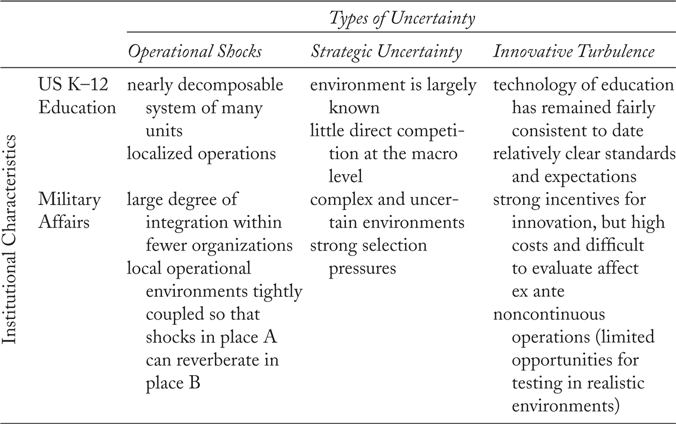
Table 1 summarizes why the three types of uncertainties examined earlier—operational, strategic, and innovation-induced—affect the K–12 educational system in the US much less than they affect modern militaries.
Uncertainty and Institutional Characteristics among Policy Domains

Operational Shocks
Operational shocks can and do hit American schools, but they usually remain localized. The core of teaching and learning has been the classroom, embedded in geographically defined and loosely coupled organizations. The system is nearly decomposable.
Strategic Uncertainty
For most of US history there hasn’t been a national strategy regarding K–12 education. And the system has functioned without one most of the time. The selection pressures from the international environment were modest, typically pertaining to literacy and basic numeracy standards that a decentralized system could and did satisfy for white males who would enter the labor force or serve in the military. Further, and obviously, because there is no direct competition between the educational systems of different countries, there is nothing really analogous to, for example, the Germans solving or not solving the problem of trench warfare in 1918.
Of course, there is strategic uncertainty at the microlevel, for example, facing the founders of a new charter school, but because the system is nearly decomposable these micro-uncertainties rarely have macroconsequences.
Military analysts since Carl von Clausewitz have argued that uncertainty is endemic in war, from the highest strategic level (the selection-bias effect analyzed by Robert Powell and colleagues)Footnote 100 all the way down to microtactics (the advantage of surprise attacks). In contrast, at the heart of K–12 education is a set of coordination problems: getting adults and children together at the same time, in the same place. Schools, classrooms, and schedules are all solutions to fundamental coordination problems. Solving coordination problems requires that people behave predictably. Hence, an essential part of K–12 education is certainty—the lack of contingency. In this important sense education is the opposite of war.Footnote 101
Because K–12 education in the US differs from modern militaries on all the key dimensions we have analyzed, we suspect that it is unusually stable, even for an educational system. A more centralized system, such as France’s, is in certain organizational respects less decomposable. Curriculum, for example, is mostly decided in Paris.Footnote 102 Hence, it is probably possible to change the curriculum more rapidly there.Footnote 103 Nevertheless, in both countries classrooms are the basic educational unit, and even in France teachers have considerable discretion about pedagogical methods.Footnote 104 (Interestingly, despite its authoritarian aspirations, the Vichy government found it difficult to change what happened in classrooms.Footnote 105) Further, it is not at all clear that center-driven changes have had much affect on the system’s functioning.Footnote 106 As in the US, the relevant applied sciences have changed slowly—discovering much better ways of teaching children to read is difficult.Footnote 107 Innovation-driven turbulence on the order of rifled artillery or jet fighters has not happened in French education either. In addition, centralized authority cannot change a fundamental property of educational systems: the lack of common fate across subunits. The shoddy performance of a school in an impoverished neighborhood in the suburbs of Paris does not affect that of a privileged school in a wealthy arrondissement in the capital’s center.Footnote 108
The above evidence indicates that educational systems are much less tightly integrated than modern militaries and that the mechanisms driving this difference exist for powerful and stable organizational reasons.Footnote 109 Given these parametric differences, our theoretical argument implies that historical contingencies impact K–12 educational systems less than they do militaries.
An Intermediate Domain: Public Health
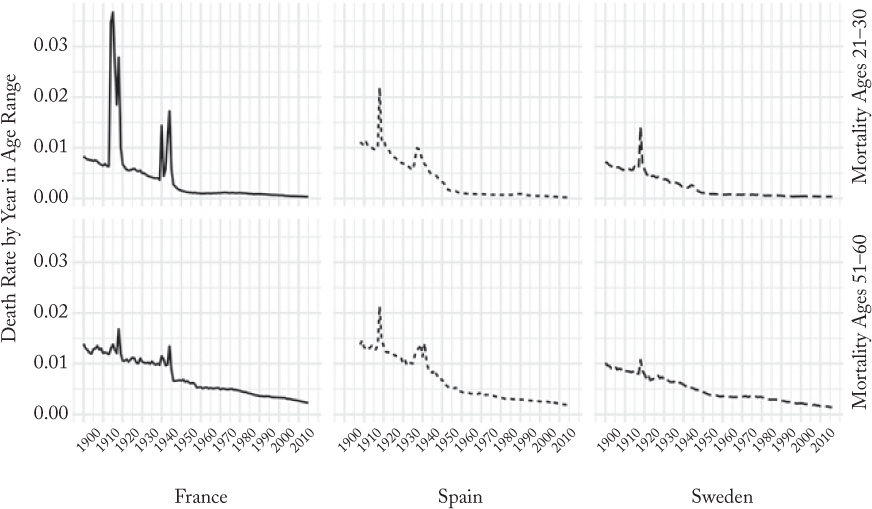
Public health dynamics in the United States provide an interesting intermediate domain. For the most part, public health dynamics as indexed by mortality time series are more placid than military-power dynamics. But they are also considerably more volatile than K–12 education in part because public health, unlike primary education, has been significantly affected by scientific and technological innovations (for example, the germ theory of disease and the carefully engineered provision of clean drinking water) for well over one hundred years. But these have not produced a volatile time series in mortality data. Instead of the big, unpredictable swings of this kind of time series, there is mostly gradual steady change, as displayed in Figure 2, which plots annual mortality figures by age group (21–30 and 51–60) for France, Spain, and Sweden.Footnote 110 As knowledge and technologies diffuse throughout these countries, there is the slow and steady progress beloved by Whig historians.
Mortality for Select Countries, 1900–2010

Note one large exception to this pattern. The 1918 spike in mortality, caused by the Great Influenza, is clearly visible for all three countries. This exception provides substantive insight. The pandemic was caused by an infectious disease (a virus), which by definition is communicable, and integrated what is normally a nearly decomposable system. Correlated shocks make laws of large numbers irrelevant.
Today, modern nation-states usually control epidemics quite well. Hence, since 1918, mortality in such countries tends to spike only when wars occur.Footnote 111 And there are clear spikes from WWI and WWII in France (one can even see the two stages of fighting in France during WWII in the time series for military-age males), and from the Spanish Civil War for Spain. But after those massive swings, all three countries return to trend. In today’s First World, militarized conflict is evidently the most dangerous of the Four Horsemen, but at least for mortality, it is a transient risk.
VII. Conclusion
Scholars of ir theory have long debated the primacy of historical contingency versus broad covering laws for explaining events in the international system. A key thesis of historical institutionalism is the importance of contingency (chance-influenced events) in politics.Footnote 112
But surely the significance of contingent history versus enduring probabilistic relationships varies over time and across issues. And neither of these literatures has dealt in detail with the sources of large systematic differences in how much microcontingencies affect macrotrajectories across different policy domains.
Our main contribution is to provide a specific explanation for why such contingencies are usually more important in military affairs than in other domains, such as economic growth (despite business cycles), education (despite pedagogical fads), or public health trajectories (despite epidemics). These domains all exhibit less sensitivity to microevents than do militaries. Indeed, American K–12 public education exhibits massive statistical smoothing at the systemic level. Put somewhat differently, there are stable differences between policy domains that determine how large the impacts of contingent events are likely to be.Footnote 113
From the perspective of historical institutionalism, our analysis suggests specific types of uncertainty that undergird the occurrence of historically important chance events. In particular, we began by breaking down three different types of uncertainty in the military domain, each of which contributes to the unusually large role contingency plays in the long-run evolution of state power. We identify different institutional characteristics that make policy domains more or less susceptible to those types of uncertainty, including the size of the constituent units, how easy it is for them to assess the impact of technological innovations, and how tightly coupled outcomes are across units. We also show that specific combinations of uncertainty and institutions within a domain can lead to very different macrolevel phenomena, that is, extreme volatility in state power versus stability in national-level education outcomes or economic growth.
This is not a stark matter of politics versus economics, the comparison Paul Pierson examines.Footnote 114 Claims such as “Politics is a far, far murkier environment . . .” are too sweeping.Footnote 115 Volatile systems tend to be murkier—less predictable—than inertial ones, and as we have seen, there are inertial policy systems in politics and volatile systems in economics. Consider, for example, the contrast between public schools and America’s financial system. Because the thousands of school districts are embedded in a decentralized structure, policy shocks are less likely to sweep through this system than, say, liquidity shocks can tear through the financial sector. But by almost any measure, public schooling is much more of a political domain than are financial markets, in particular because most of the organizations that make up the public school system are locally elected political bodies.
More fundamental than the distinction between politics and economics are: (1) the size distribution of approximately independent entities within the unit of analysis (the state, for example) whose fortunes aggregate up to the kind of systemic capacity (such as military power or education) in question, and (2) whether conflicts in a domain are effectively regulated by a third party. As the 2008 collapse of Lehman Brothers and subsequent chaos indicated, a financial system dominated by a few big banks can be quite unstable.Footnote 116
If this theory holds up, then we will understand why certain fields in political science focus more on history than do others,Footnote 117 as well as why certain outcomes gain relatively more from careful attention to history and historiography.Footnote 118 It will also suggest a natural rapprochement between historical institutionalism and the more conventionally scientific approaches in the discipline. If a few fundamental parameters explain when and why history plays a key role, we will have a basis for a more scientific history of politics and a better understanding of what scientific means.Footnote 119
Acknowledgments
The authors thank Steve Biddle, Phil Hoffman, Massimo Morelli, and our anonymous reviewers for tremendously helpful comments. We also thank the participants in the March 2013 Historical Development of Modern Political Institutions conference at Princeton University, the May 2013 Historical Working Group conference at Columbia University, and the panel on “War, Development, and the Emergence of the State” at the 2015 American Political Science Association Annual Meeting. Emefa Agawu, Ben Crisman, and Myra Khalid provided outstanding research assistance. All errors are ours.
Appendix: The Taking of Atlanta and the 1864 Election
Conventional wisdom suggests that the fall of Atlanta, on September 1, 1864, precipitated the crucial events that followed—Abraham Lincoln’s reelection in 1864 and the outcome of the war.Footnote 120 Lincoln expressed his fear that he would not win reelection to an army officer, claiming, “I am going to be beaten . . . and unless some great change takes place badly beaten.”Footnote 121 These statements and similar ones by Lincoln’s contemporaries drove the standard narrative. So the counterfactual of interest in evaluating this scenario is what would have happened had Atlanta not fallen before the election.
Although the Union victory at Atlanta may have been important to the war, there is strong evidence suggesting that its impact on Lincoln’s reelection was less so. Nathan Kalmoe offers evidence to counteract the narrative—established then and perpetuated since—that the victory in Atlanta secured Lincoln’s reelection.Footnote 122 In 1864, US House of Representatives elections took place over more than a year, unlike today when federal elections are held on the same day. Additionally, many states had annual gubernatorial elections. Kalmoe combines these conditions with the fact that strong party loyalty meant that a voter who voted Lincoln for president in 1864 would also likely vote Republican in state elections to poke holes in the narrative that Lincoln had been in trouble before Atlanta, and that the victory in Atlanta saved him. If Atlanta had been as central to Lincoln’s victory as others have claimed, Kalmoe should have found gains in Republican vote share after the fall of Atlanta. Instead, Kalmoe finds continuity in the elections before and after the fall of Atlanta. In fact, he writes, “at no point does Lincoln appear in danger of losing badly, as he worried.”
Authors
Jonathan Bendor is a professor of political economics and organizations at the Stanford Graduate School of Business. His research focuses on theories of bounded rationality, organizational problem-solving, and the evolution of modern institutions. His publications include Bounded Rationality and Politics (2010). He can be reached at jonathan.bendor@stanford.edu.
Jacob N. Shapiro is a professor of politics and international affairs at Princeton University, where he codirects the Empirical Studies of Conflict Project. His research focuses on conflict, development, and security policy. He is the author of The Terrorist’s Dilemma: Managing Violent Covert Organizations (2013), and coauthor of Small Wars, Big Data: The Information Revolution in Modern Conflict (2018), with Eli Berman and Joseph Felter. He can be reached at jns@princeton.edu.