Hospital outbreaks of coronavirus disease 2019 (COVID-19) are common Reference Meredith, Hamilton and Warne1–Reference Buchtele, Rabitsch, Knaus and Wohlfarth4 and challenge hospitals in settings of high levels of severe acute respiratory coronavirus virus 2 (SARS-CoV-2) community transmission. SARS-CoV-2 transmission occurs predominantly via respiratory droplets and/or aerosols during close or prolonged contact, 5 which is unavoidable in many healthcare settings with shared patient-care spaces. Viral loads are similar in symptomatic and asymptomatic individuals, Reference Zou, Ruan and Huang6 and viral transmission occurs despite the absence of symptoms. Reference Johansson, Quandelacy, Kada, Prasad, Steele and Brooks7
SARS-CoV-2 testing strategies to prevent hospital transmission are primarily guided by expert opinion. Reference Carrara, Ong and Hussein8 Screening of asymptomatic patients at admission is recommended when community transmission is high and for vulnerable patient groups regardless of community transmission rates. Reference Carrara, Ong and Hussein8,9 Additional risk-based testing and isolation of individuals who are contacts of SARS-CoV-2 cases is recommended. Reference Carrara, Ong and Hussein8,10,11 The impact of these measures, including routine screening of asymptomatic healthcare workers, is uncertain. Whole-genome sequencing (WGS) of SARS-CoV-2 can guide management of SARS-CoV-2 outbreaks. Several case studies of isolated hospital Reference Putri, Johor, Dewi, Indrasari and Wilandari12,Reference Ishikawa, Udaka and Oyamada13 and long-term care facility Reference Aggarwal, Myer, Hamilton, Bachrucha, Tumelty and Brown14 outbreaks have demonstrated its role in establishing the source of the outbreak, transmission dynamics, and links. The greatest benefit of WGS for SARS-CoV-2 outbreak management accrues when the result is rapidly available (ie, within 5 days). Reference Stirrup, Blackstone and Mapp15 Limited access to WGS or reliance on data sharing from centralized models of sequencing for public health greatly influence its utility and the ability to influence infection control responses at a local level. Reference Putri, Johor, Dewi, Indrasari and Wilandari12–Reference Aggarwal, Myer, Hamilton, Bachrucha, Tumelty and Brown14 The objective of this study was to demonstrate the utility of real-time, on-site SARS-CoV-2 WGS.
Methods
Local and wider community SARS-CoV-2 settings
This retrospective study was undertaken at the Royal Prince Alfred Hospital (RPAH), a quaternary-care referral hospital, and Balmain District Hospital (BDH), an affiliated rehabilitation and community hospital, in Sydney, New South Wales, Australia, between July 2021 and April 2022. In June 2021, the introduction and spread of the SARS-CoV-2 δ (delta) variant heralded the transition from ‘COVID-19 zero’ (aiming for suppression of community transmission of SARS-CoV-2 with strict social distancing, mask mandates, quarantine requirements, and closed international borders) to widespread community transmission. As SARS-CoV-2 vaccination rates increased, community measures to control SARS-CoV-2 transmission were retracted. SARS-CoV-2 screening for patients requiring admission evolved over the study period from nose and throat polymerase chain reaction (PCR) testing guided by symptoms and exposure history to routine screening of asymptomatic inpatients on days 0, 2, and 5 of admission and weekly thereafter. Routine personal protective equipment (PPE) throughout the healthcare facilities for staff included surgical mask with the addition of eye protection when providing clinical care. PPE for staff providing care to known SARS-CoV-2–positive cases and contacts included P2/N95 masks, eye protection, disposable gown, and gloves. When interacting with staff, surgical masks were required for outpatients, and although surgical masks were also encouraged for inpatients, uptake was variable apart from routine use in all patients requiring transport around the hospital, regardless of SARS-CoV-2 status. SARS-CoV-2–positive patients were managed on geographically distinct wards with enhanced ventilation and security. Visitors were not allowed, except under extenuating circumstances, from June 2021 until December 2021, and they were required to wear surgical masks throughout the facility.
Infection control responses
The cases of all inpatients who tested positive for SARS-CoV-2 after having an initial negative admission swab and who were not already a known close contact of a COVID-19 case (unexpected positive) were reviewed by the infection control team. Upstream contact tracing of community and hospital contacts within the preceding 14 days was undertaken to try to identify the source of SARS-CoV-2 transmission. Downstream contact tracing was performed to identify potential staff and patient exposures, with isolation and subsequent testing requirements based on standardized risk assessment matrices issued by the New South Wales Government Clinical Excellence Commission. 11 An outbreak was defined as 2 or more unexpected positive cases on a single ward. 11 We included only outbreaks with 2 or more suspected transmission events in which WGS was utilized to assist with outbreak assessment and management. Cases are described and numbered based on the chronology of SARS-CoV-2 diagnosis rather than transmission. We included only cases diagnosed using PCR.
Diagnostic testing and WGS
All inpatients and community presentations to the local clinic underwent SARS-CoV-2 testing at the RPAH laboratory using commercial real-time PCR platforms. Positive inpatients and a subset of positive community samples underwent WGS provided PCR cycle threshold values were <30. Long-read sequencing was performed on the Oxford Nanopore Technologies platform and consensus genomes were generated using ARTIC workflows as previously described. Reference Bull, Adikari and Ferguson16 SARS-CoV-2 genomic lineages were inferred using Phylogenetic Assignment of Named Global Outbreak Lineages (PANGOLIN). 17 All sequences pertaining to the identified outbreaks (n = 84) and a random selection of community isolates (n = 47) were included in a cluster analysis. Following masking of problematic sites, a maximum likelihood tree was generated using iqtree version 2.2.0 software (substitution model GTR+F+R2) Reference Minh, Schmidt and Chernomor18 with genomic linkages inferred using the fasttranscluster version 0.0.1 package. Reference Stimson, Gardy, Mathema, Crudu, Cohen and Colijn19 Further details regarding WGS methods are provided in the Supplementary Material (online). All data were uploaded to GISAID.
Results
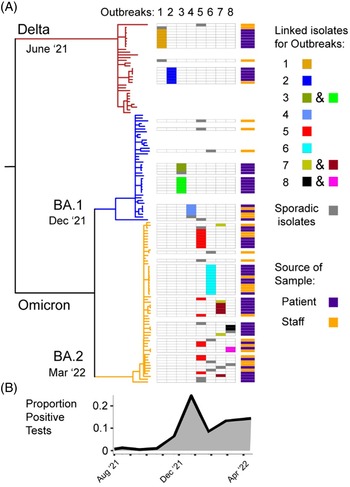
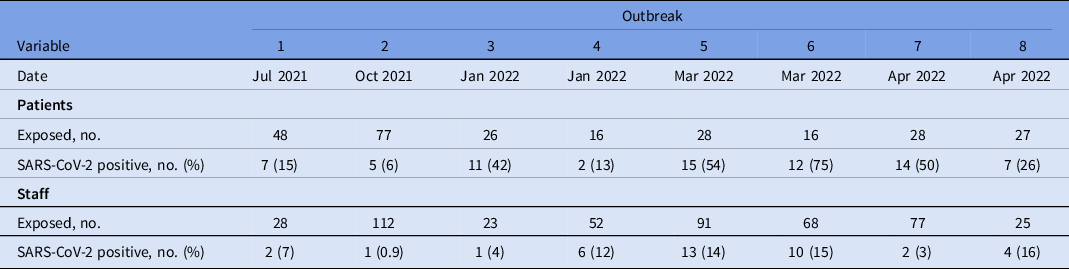
Over the study period, 1,047 SARS-CoV-2–infected patients were admitted to RPAH, and 1,472 RPAH and BDH staff infections were verified. Moreover, 174 inpatients returned an unexpected SARS-CoV-2–positive PCR result, generating 108 contact traces. We describe 8 hospital SARS-CoV-2 outbreaks involving 266 patients and 486 staff contacts (Fig. 1 and Table 1). Of these, 73 patients (27.4%) and 39 staff (8.0%) subsequently tested positive for SARS-CoV-2 on surveillance swabs performed during the outbreak management period. Of those who tested positive, 111 SARS-CoV-2 extracts were referred for sequencing, and 87 sequences were successfully obtained. WGS failed for 24 isolates due to low viral loads. The median time from swab collection to WGS result was 3 days (IQR, 2–5).
(A) Maximum likelihood phylogeny of 131 SARS-CoV-2 genomes. Phylogenetic tree with lineages colored by PANGOLIN designation: δ (delta) red; ο (omicron) BA.1 blue; and ο (omicron) BA.2 yellow. Dates when these genomes were first observed in New South Wales are indicated on the tree. Outbreak metadata are depicted to the right of the phylogeny with individual outbreaks colored (see key) by linked and sporadic isolates (grey). The last column indicates whether samples were obtained from staff or patients, respectively. Rows without any metadata signify the random community samples circulating during the outbreak. The numbers of exposed patients and staff are indicated in the table below. (B) Proportion of SARS-CoV-2 tests (n = 910,970) that were positive by month over the study period.

Summary of SARS-CoV-2 Outbreaks

Outbreak 1 occurred across 2 quarantine wards comprising patients who had returned from overseas within the preceding 14 days (the mandatory quarantine period at the time), plus patients identified as COVID-19 case contacts. Patients were transferred off the quarantine ward if they tested positive for SARS-CoV-2. At the beginning of the SARS-CoV-2 δ (delta) wave in Sydney, community transmission was low and international borders were closed. Routine asymptomatic surveillance testing was undertaken for staff caring for patients in COVID-19–associated wards. Widespread testing of staff and patients was undertaken following a positive staff surveillance result (patient 1.1) as WGS revealed a strain phylogenetically unlinked to the circulating community strain. In total, 7 new patient cases were identified. The index case was epidemiologically determined to be a returned traveler (patient 1.2), whose SARS-CoV-2 strain was phylogenetically related to that of a fellow traveler present on his inbound flight to Australia. Several phylogenetically linked cases were spread across quarantine wards. Transmission to staff member 1.1 likely occurred while caring for patient 1.3, who subsequently tested positive for SARS-CoV-2. This transmission was thought to have occurred due to breaches in PPE when the staff member repeatedly adjusted their mask and eye protection while caring for the patient. Onward transmission from patient 1.1 to another patient (patient 1.4) was suspected. This outbreak prompted reassessment of infection control infrastructure including ventilation as well as education regarding PPE use.
Outbreak 2 occurred in a surgical ward. The first case identified (patient 2.1) was a recently discharged patient, who acquired SARS-CoV-2 without a clear community source of transmission during a time of intense community contact tracing including via mobile app “check ins” and strict lockdown requirements. Hospital acquisition was suspected. Widespread epidemiologic assessment and testing of staff and patient contacts revealed 4 patients and 1 staff member with phylogenetically linked isolates. Based on WGS, the index case was likely staff member 2.2, with community-acquired SARS-CoV-2, who transmitted the virus to 2 patients while asymptomatic, with presumed onward transmission in 2 more collocated patients (including patient 2.1) and another staff member providing care to the affected patients during this time. The PPE compliance (surgical mask plus eye protection) of the staff is not known. This outbreak confirmed the importance of routine inpatient surveillance for early detection of transmission including via unsuspecting, asymptomatic staff despite universal masking.
Outbreak 3 occurred on a medical ward. The first case (patient 3.1) tested positive for SARS-CoV-2 following development of respiratory symptoms on day 11 of admission while located in a 4-bed room. All 3 patients in the room subsequently tested positive. One of the patients (patient 3.4), located in the adjacent bed bay, had recently been transferred from the COVID-19 ward after meeting time-based deisolation criteria for a positive community SARS-CoV-2 PCR result. Additional investigations confirmed a false-positive community result with an acute SARS-CoV-2 infection. This infection was likely acquired on the COVID-19 ward because the WGS results of patient 3.4 and their COVID-19 ward contact were identical. Widespread screening of the ward identified 7 more SARS-CoV-2–positive patients, including patient 3.5, who was cared for in a single room but was confused and wandered the ward, interacting with patients. WGS confirmed 2 outbreak clusters. The index case for the dominant cluster was likely patient 3.4, with spread to patients 3.1 and 3.3 and with patient 3.5 acting as the vector. The source for the second cluster, which included patient 3.2, was not established. This outbreak highlighted the risk of cohorting SARS-CoV-2–positive patients and the complexities of transmission chains. As a result, it was recommended that all patients with incidentally diagnosed SARS-CoV-2 infection admitted to the COVID-19 ward have a confirmatory SARS-CoV-2 PCR on admission.
Outbreak 4 occurred on a transplant ward and was detected when patient 4.1 tested positive for SARS-CoV-2 on surveillance screening on day 41 of admission. A point-prevalence survey of the ward was undertaken that identified 2 infected staff and a second patient with phylogenetically related strains. The epidemiologic analysis indicated that the likely index case was staff member 4.2, who attended work while asymptomatic but infectious and transmitted SARS-COV-2 to patient 4.1 due to their surgical mask becoming displaced on several occasions during the manual handling of patient 4.1. Subsequent onward transmission occurred from patient 4.1 to another staff member and patient, with whom patient 4.1 (but not staff member 4.2) had close contact. WGS confirmed that 2 further staff were infected with a community-acquired SARS-CoV-2 strain rather than the outbreak strain. This outbreak highlights the potential for transmission during a PPE breach, with transmission links supported by WGS.
Outbreak 5 occurred on a medical ward. A patient-facing staff member (patient 5.1) became symptomatic and tested positive for SARS-CoV-2 after completing their shift. Testing of patient and staff contacts unveiled 15 patients and 13 staff positive for SARS-CoV-2. Among them, 2 patients were assessed to have historical infections. WGS determined that 8 patients and 3 staff were phylogenetically linked to the outbreak strain. The remaining SARS-CoV-2 cases were not phylogenetically linked and likely reflected community acquisition. In total, 5 SARS-CoV-2 introduction events occurred, with 1 dominant cluster. WGS confirmed that staff member 5.1 was not related to the dominant outbreak strain and the index case remains unknown. This outbreak demonstrated the extent of SARS-CoV-2 positivity among staff who otherwise would not have been tested in the setting of high community transmission with relaxation of community masking and social-distancing mandates.
Outbreaks 6 and 7 consisted of 2 sequential outbreaks involving 2 geographically distinct wards at BDH: the rehabilitation ward for outbreak 6 and the geriatrics ward for outbreak 7. In outbreak 6, the apparent index case was a patient who had recently been transferred from RPAH to the facility (SARS-CoV-2 negative by PCR at the time of transfer), who subsequently tested positive on surveillance testing. The patient’s epidemiology and WGS suggested a transmission link with another patient on the same ward at RPAH. Widespread testing revealed that 5 patients and 4 staff were infected with the outbreak strain, raising concerns regarding PPE breaches at BDH. No additional cases were detected in the RPAH ward. Another 4 staff were infected with a community strain. One staff member from outbreak 6 was phylogenetically linked to 1 patient from outbreak 7, without an epidemiologic link during their infectious period, suggestive of a missing transmission link. Outbreak 7 was defined by a further 2 clusters of 5 and 2 patients each, indicating 3 sources of SARS-CoV-2 introduction to the ward.
Outbreak 8 was detected when 2 patients and 3 staff on the hematology ward tested positive on routine surveillance testing across a 3-day period. Given the vulnerable patient cohort and undefined chains of transmission, daily testing was undertaken for all staff and patients for the period of the outbreak. In total, 11 cases were detected, and WGS confirmed 2 dominant outbreak clusters. This outbreak demonstrated the transmissibility of SARS-COV-2 ο (omicron) BA.2 variant, which spread rapidly across a ward, including to patients with no clear contact with a SARS-CoV-2–positive case.
Discussion
We present our experience using on-site, real-time WGS analysis of SARS-CoV-2 isolates to confirm and guide management of hospital outbreaks of COVID-19. WGS enabled us to establish probable transmission links and clusters. When combined with epidemiologic assessment, WGS allowed us to identify deficiencies in infection control practices, to recognize or exclude transmission chains not discernable by epidemiology alone, and to modify screening protocols. As community transmission increased, we documented a greater incidence of community strains and strains unrelated to the outbreak, particularly in staff, demonstrating the porous nature of the hospital population with constant SARS-CoV-2 incursions via community acquisition. Despite high numbers of SARS-CoV-2 infection among the staff, few instances of SARS-CoV-2 transmission from staff to patients were detected. WGS-guided outbreak management directly influenced policy modification, including instituting routine inpatient SARS-CoV-2 surveillance, PPE requirements, and confirmatory SARS-CoV-2 testing prior to placing patients in cohorts.
The index case was often identified by routine surveillance testing, with subsequent diagnosis of patient and staff cases. We did not examine the severity or outcomes of COVID-19 experienced by patients with healthcare-associated SARS-CoV-2 infection. However, a systematic review and meta-analysis, which included studies prior to the omicron era, identified an increase in mortality of 1.3 times in patients with hospital- compared to community-acquired SARS-CoV-2. This risk was most pronounced for immunocompromised patients (relative risk [RR], 2.14; 95% confidence interval [CI], 1.76–2.61). Reference Carrara, Ong and Hussein8 Routine SARS-CoV-2 surveillance of inpatients coupled with outbreak management may reduce transmission to vulnerable patient groups. The role of SARS-CoV-2 surveillance for asymptomatic staff is less clear. Staff-to-patient transmission was rare, and documented transmission occurred only when there was a breach in recommended PPE. Using WGS analysis, we were able to confirm that with increased community prevalence, many cases of SARS-CoV-2 in staff were related to community rather than hospital acquisition.
In this study, we included outbreaks caused by SARS-CoV-2 δ (delta) and ο (omicron) only; prior variants were not in widespread circulation in Sydney due to local control measures and closed international borders. Although we could not determine the secondary attack rate in our outbreaks, when compared to outbreaks due to the SARS-CoV-2 δ (delta) variant, the SARS-CoV-2 ο (omicron) variant appeared to have greater propensity to spread throughout patient-care spaces, and identification of transmission chains was difficult. This finding is consistent with recent data from the United Kingdom that indicated a higher secondary attack rate for the SARS-COV-2 ο (omicron B.1.1.529) variant compared with the SARS-COV-2 δ (delta B.1.617.2) variant in both household settings (15.0% vs 10.0%) and nonhousehold settings (8.2% vs 3.7%). Reference Bouzid, Visseaux, Kassasseya, Beaune and Javaud20 We did not compare outcomes in patients infected with SARS-COV-2 ο (omicron) compared to δ (delta). Reference Stimson, Gardy, Mathema, Crudu, Cohen and Colijn19,Reference Bouzid, Visseaux, Kassasseya, Beaune and Javaud20
Local WGS capacity enabled WGS-guided outbreak management, including an assessment of transmission chains and identification of the scope of the outbreak by establishing both genomic and epidemiologic links between cases. Unlike some previous studies that described WGS to guide a single outbreak, we have reported 8 outbreaks occurring over 10 months, with varying levels of community transmission during that time, thus demonstrating the utility of WGS in various outbreak situations. We were unable to obtain sequences for all SARS-CoV-2 isolates associated with each outbreak because either WGS failed due to low viral loads or the diagnostic swab was not available (eg, external testing performed). With the increase in community SARS-CoV-2 transmission over time and the reintroduction of visitors to the hospitals, we observed greater strain diversity in outbreaks, and in some cases, we were unable to identify all transmission links and/or index case(s).
In summary, WGS combined with epidemiologic assessment can assist in the management of hospital outbreaks of SARS-CoV-2 and can be used to postulate transmission chains, which we would not have been able to understand without WGS. With the knowledge of likely transmission pathways, we were able to identify deficiencies in PPE and infection control practices, and we modified practices accordingly. In the setting of high community transmission, WGS is required to delineate between community- and healthcare-acquired infection, and prevention of the latter is the goal of COVID-19 infection control practices.
Supplementary material
To view supplementary material for this article, please visit https://doi.org/10.1017/ice.2022.220
Acknowledgments
The authors acknowledge Dr Raymond Chan and Dr Angie Pinto for their roles in outbreak management and protocol development. We acknowledge Rima Farhat for her role in WGS and Sylvia Tang, Jennie Vo, and Bernadette Crawford for their roles in outbreak assessment and management.
Financial support
No financial support was provided relevant to this article.
Conflicts of interest
All authors report no conflicts of interest relevant to this article.