INTRODUCTION
In recent years, many studies on the benthic in- and epifauna of the North Sea have been published (Basford et al., Reference Basford, Eleftheriou and Raffaelli1989, Reference Basford, Eleftheriou and Raffaelli1990; Frauenheim et al., Reference Frauenheim, Neumann, Thiel and Türkay1989; Jennings et al., Reference Jennings, Lancaster, Woolmer and Götter1999; Rees et al., Reference Rees, Pendle, Waldock, Limpenny and Boyd1999; Zühlke et al., Reference Zühlke, Alvsvåg, Boois, Cotter, Ehrich, Ford, Hinz, Jarre-Teichmann, Jennings, Kröncke, Lancaster, Piet and Prince2001; Callaway et al., Reference Callaway, Alsvåg, Boois, Cotter, Ford, Hinz, Jennings, Kröncke, Lancaster, Piet, Prince and Ehrich2002, Reference Callaway, Engelhard, Dann, Cotter and Rumohr2007; Kröncke & Bergfeld, Reference Kröncke and Bergfeld2003; Reiss & Kröncke, Reference Reiss and Kröncke2004; Neumann et al., Reference Neumann, Ehrich and Kröncke2008a, Reference Neumann, Ehrich and Krönckeb, Reference Neumann, Reiss, Rakers, Ehrich and Kröncke2009; Hinz et al., Reference Hinz, Prieto and Kaiser2009; Sonnewald & Türkay, Reference Sonnewald and Türkay2011a, Reference Sonnewald and Türkayb), with study area sizes ranging from small scale to North Sea-wide surveys, from one-time samplings to long-term studies.
Our study area, the Dogger Bank, is a sandbank in the central North Sea (Figure 1). It was chosen for long-term monitoring because of its uniform depth and sediment composition, providing an ideal place to study its epibenthic faunal assemblages and associated changes over time. Since 1991, the epifauna is monitored yearly with a 2 m beam trawl (Sonnewald & Türkay, Reference Sonnewald and Türkay2011a, Reference Sonnewald and Türkay2011b). Due to the fact that until 2009, the surveys were only undertaken during summer, the composition of the epifauna of the Dogger Bank during winter remained unclear. Therefore two winter cruises with the RV ‘Heincke’ were performed in January/February 2010 and 2011, respectively. In February 2011, the station grid was enhanced in order to sample some deeper areas around the Dogger Bank.
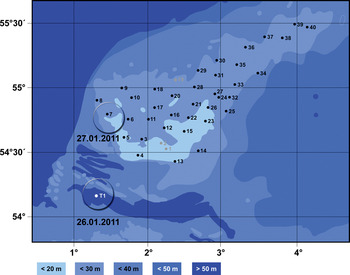
Map of the Dogger Bank with routine stations, including Station T1 (profile start: 54°9, 81′N 1°18, 38′E; profile end: 54°10, 00′N 1°19, 86′E; depth: 57.9–70.8 m) and Station 7 (profile start: 54°47, 93′N 1°27, 03′E; profile end: 54°48, 22′N 1°26,82′E; depth: 22.9–26.4 m), where Xandarovula patula was detected.

At one of these newly established stations, the gastropod Xandarovula patula (Pennant, Reference Pennant1777) was discovered on Alcyonium digitatum Linnaeus, 1758. These findings were confirmed by another detection of one specimen of X. patula on a routine station within the 30 m depth line on the main body of the Dogger Bank. Recently, a number of publications showed actual records of X. patula from diverse areas of the North Sea (Taekema, Reference Taekema2005; Reijnen et al., Reference Reijnen, Hoeksema and Gittenberger2010; Høisæter et al., Reference Høisæter, Sneli, Schander, Rapp and Berggren2011; Schrieken et al., Reference Schrieken, Gittenberger and Lengkeek2011). This paper gives an overview of all actual records of this species for the North Sea and reveals a possible link between the changes of local temperatures with the occurrence of this species.
MATERIALS AND METHODS
At the study area (Figure 1), a 2 m beam trawl with a mesh size of 1 cm2 was used for epibenthic sampling at Station T1. For semi-endobenthic sampling, we applied a ring dredge with a diameter of 1 m and a mesh size of 1 cm2. More details about the sampling methods and the study area are given in Sonnewald et al. (Reference Sonnewald and Türkay2011a).
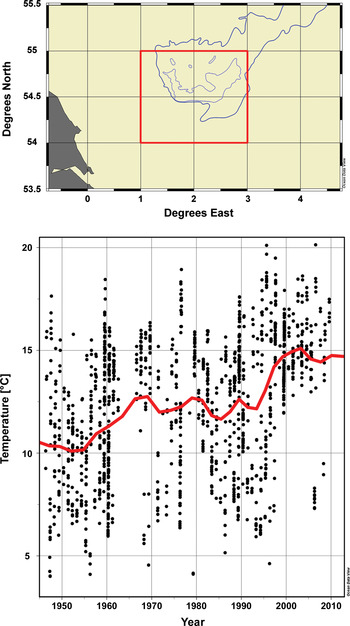
Additionally, we used the program Ocean Data View to plot the development of the local Dogger Bank water temperatures, derived from public conductivity–temperature–depth data, provided online by the International Council for the Exploration of the Sea. We plotted the water temperature data from a rectangle (54°N1°E–55°N3°E), enclosing the sampling sites where X. patula was detected for all depths, and from 1 April to 31 August 1946–2010. The winter months were excluded due to the lack of sufficient data.
RESULTS
SYSTEMATICS
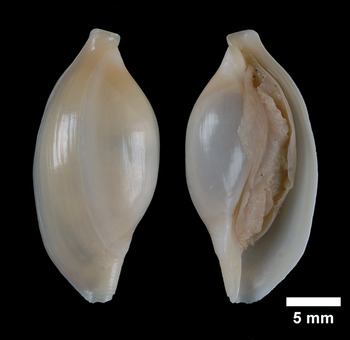
Xandarovula patula (Pennant, Reference Pennant1777) from Station T1 (SMF 336344). Photograph: Sven Tränkner (Senckenberg Research Institute).

MATERIAL
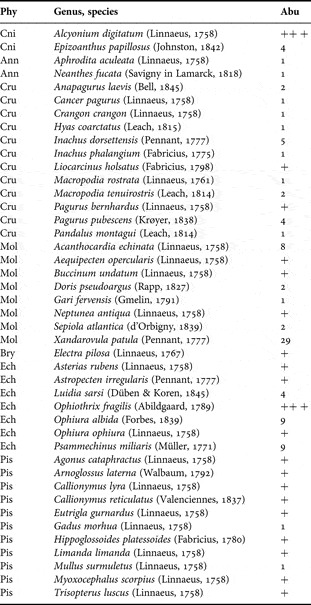
During the 2011 winter cruise, 29 individuals of X. patula were detected on colonies of A. digitatum, growing on sparse boulders and rubble at Station T1 (Figure 1), which was sampled for the first time. In addition, one individual was detected in a ring dredge sample at Station 7 (Figure 1), a routine station being sampled on every cruise, with a sediment composition being comparable with that of Station T1. A semiquantitative analysis of the fauna at Station T1 is given in Table 1.
Semi-quantitative analysis of the beam trawl sample at Station T1. Phy, phylum; Abu, abundance; Cni, Cnidaria; Ann, Annelida; Cru, Crustacea; Mol, Mollusca; Bry, Bryozoa; Ech, Echinodermata; Pis, Pisces; ++ + , dominant; +, present.

The specimens agree perfectly with the descriptions and figures in the literature (e.g. Graham, Reference Graham1988; Lorenz & Fehse, Reference Lorenz and Fehse2009; Høisæter et al., Reference Høisæter, Sneli, Schander, Rapp and Berggren2011). All specimens have been found living, they are adult and the size of the shells ranges from 16.4 to 24.9 mm length. The colour varies from dirty white to yellowish brown. In accordance with Høisæter et al. (Reference Høisæter, Sneli, Schander, Rapp and Berggren2011), we use Xandarovula as the valid genus for this species.
BIOLOGY
According to Graham (Reference Graham1988), Xandarovula patula (Pennant 1777) occurs on Alcyonium digitatum, feeding on its autozooids, using its radula and pair of jaws. Fretter & Graham (Reference Fretter and Graham1962) mention it also feeding on the gorgonian Eunicella verrucosa, where this prey is available.
In Plymouth, UK, the breeding season of X. patula seems to be February–July. The egg capsules are being attached to Alcyonium and Eunicella (Fretter & Graham, Reference Fretter and Graham1962) and laid in a single irregular, roundish layer (Lebour, Reference Lebour1932). According to Fretter & Graham (Reference Fretter and Graham1962), X. patula has its planktonic veliger phase in spring and summer (authors' observations from Plymouth).
DISTRIBUTION
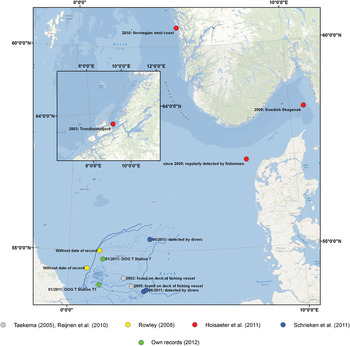
In general, X. patula is distributed from Norway down to Spain and the Canary Islands, with major occurrence at the western and south-western coast of the UK and around the coasts of Ireland. It has also been recorded from the Orkneys (Rendall, Reference Rendall1936). Without giving additional information, Lorenz & Fehse (Reference Lorenz and Fehse2009) state that the species is distributed in Norway. The first records from the central North Sea seem to be specimens detected on the deck of fishing vessels acting at the Dogger Bank in 2003 and 2005 (Taekema, Reference Taekema2005). In Rowley (Reference Rowley2008), X. patula is reported from the east coast of the UK without the time of record—the coordinates were later taken from Schrieken et al. (Reference Schrieken, Gittenberger and Lengkeek2011). Reijnen et al. (Reference Reijnen, Hoeksema and Gittenberger2010) report it from the Dutch part of the North Sea, but according to Schrieken et al. (Reference Schrieken, Gittenberger and Lengkeek2011), these records are from the British exclusive economic zone (EEZ). We suppose them to be the specimens mentioned in Taekema (Reference Taekema2005), since the coordinates appear to be the same. Høisæter et al. (Reference Høisæter, Sneli, Schander, Rapp and Berggren2011) confirm X. patula also for the coasts of Sweden and Norway, up to Trondheim, and from the EEZ of Denmark. The newest records are reported in Schrieken et al. (Reference Schrieken, Gittenberger and Lengkeek2011), who detected X. patula on SCUBA dives to parts of the Dogger Bank and Cleaver Bank in June 2011.
New records herein are: south-west and west of the Dogger Bank. These specimens are deposited in the malacological research collection of the Senckenberg Research Institute Frankfurt am Main under registration numbers SMF 336344–336346 (http://sesam.senckenberg.de/).
The distribution of X. patula in the North Sea according to the literature mentioned above can be examined in Figure 3.
Distribution of Xandarovula patula in the North Sea according to the present state of knowledge (Taekema, Reference Taekema2005; Rowley, Reference Rowley2008; Reijnen et al., Reference Reijnen, Hoeksema and Gittenberger2010; Høisæter et al., Reference Høisæter, Sneli, Schander, Rapp and Berggren2011; Schrieken et al., Reference Schrieken, Gittenberger and Lengkeek2011), including our own records.

DOCUMENTATION OF LOCAL WATER TEMPERATURE DEVELOPMENT
As described in the Materials and Methods section, we documented the development of the local water temperatures at the area of the Dogger Bank, where X. patula was detected (Figure 4). There are clear signals for a jump to a higher level of the mean temperature from the late 20th Century to the early 21st Century, coinciding with the massed appearance of X. patula.
Water temperature data from a rectangle at the Dogger Bank enclosing the sampling sites where Xandarovula patula was detected. All depths included data from 1 April to 31 August 31 1946–2010. The trend line shows the mean temperatures.

DISCUSSION
Location T1 seems to provide ideal habitat conditions for X. patula due to the solid and stony seafloor with many patches of A. digitatum, the preferred food of X. patula. Interstingly, its occurrence at Station T1 coincides with the finding of the red mullet (Mullus surmuletus) at the same location (Table 1), also being classified as ‘southern species' in the literature (Corten & van de Kamp, Reference Corten and Van de Kamp1996; Ehrich & Stransky, Reference Ehrich and Stransky2001). Location 7 shares comparable conditions with location T1 concerning its seafloor composition and incrustation with A. digitatum. As stated in the Distribution sub-section above, the gastropod seems to have been already present in the North Sea for a couple of years. Newer records verify its recent appearance in different North Sea regions (Taekema, Reference Taekema2005; Rowley, Reference Rowley2008; Reijnen et al., Reference Reijnen, Hoeksema and Gittenberger2010; Høisæter et al., Reference Høisæter, Sneli, Schander, Rapp and Berggren2011; Schrieken et al., Reference Schrieken, Gittenberger and Lengkeek2011). Since there are no reports from the eastern English Channel and the shallow parts of the southern North Sea, where the water column is mixed during winter and low bottom temperatures reach the seafloor, these are first indications towards its spreading inside the North Sea along currents with warmer Atlantic water. The locations in Figure 3 are on the main routes of residual currents from the Atlantic (Delhez, Reference Delhez1996).
Station 7, where we also detected one individual in winter 2011, is monitored yearly since 1991 (since 2010 twice a year) by our research team, indicating that X. patula recently spread here. There must have been conditions allowing the larvae of X. patula to begin the establishment of a central population of yet unknown dimensions. It is likely that X. patula prefers habitat conditions with milder water temperatures, as its centre of distribution seems to be on the southern and western coast of the UK, adjacent to the Gulf Stream. In addition to a rise of the sea surface temperatures at the North Sea (O'Brien et al., Reference O'Brien, Fox, Planque and Casey2000; Reid et al., Reference Reid, Borges and Svendsen2001) in conjunction with anomalies of the North Atlantic Oscillation Index (Stenseth et al., Reference Stenseth, Mysterud, Ottersen, Hurrell, Chan and Lima2002), we observed a recent increase of the local water temperatures at the area of the Dogger Bank (Figure 4), where we and others recently detected X. patula. It is likely that X. patula belongs to a group of species, where a habitat shift or extension of the distribution range is just in progress.
The effects of X. patula on the North Sea populations of A. digitatum have to be monitored if this species manages to spread.
ACKNOWLEDGEMENTS
The present study was prepared at the Biodiversity and Climate Research Centre (BiK-F), Frankfurt am Main, and financially supported by the research funding programme ‘LOEWE—Landes-Offensive zur Entwicklung Wissenschaftlich-ökonomischer Exzellenz' of Hesse's Ministry of Higher Education, Research, and the Arts. We hereby gratefully acknowledge that funding. Special thanks go also to the Alfred-Wegener-Institut für Polar- und Meeresforschung (AWI), as well as the captain and crew of RV ‘Heincke', who made our winter cruises possible and successful. We also thank Professor Dr Michael Türkay, head of the marine zoology department at the Senckenberg Research Institute and Natural History Museum for commenting on the first draft of this paper.