Management Implications
The arbuscular mycorrhizal fungi (AMF) have been proposed to be useful in ecologically based weed management. AMF relationships can provide crucial support for the establishment of any plant in a hostile environment. We found that the neophyte invaders had greater or equal hyphal colonization than native or archeophyte species, which highlights the importance of AMF for neophyte species. The plots invaded by neophytes from the Asteraceae family changed in the availability of primary and secondary mineral nutrients. However, the AMF of the examined native or archeophyte species did not respond to the invasion of neophytes in the study plots. Therefore, AMF could be passengers, rather than drivers, in the course of Asteraceae invasions in central European environments. Provided findings question the previously suggested role of the management to favor AMF in directing the weed community dynamics. The results should not be overinterpreted and are valid only for Asteraceae invasions, but under the conditions analyzed, the management of AMF would provide little benefit in the prevention of Asteraceae invasions. This relationship could, however, be retained in disturbed agroecosystems, as the habitats analyzed consisted of relatively stabilized ecosystems of the native or archeophyte vegetation (alliances Arrhenatherion, Festucion valesiacae, Armerion elongatae, Koelerio–Phleion phleoidis).
Introduction
Arbuscular mycorrhizal fungi (AMF, Glomeromycota) are globally distributed symbionts of plant roots (Smith and Read Reference Smith and Read2008). AMF are known as obligate symbionts of more than 60% of terrestrial plant species (Smith and Read Reference Smith and Read2008; van der Heijden et al. Reference van der Heijden, Martin, Selosse and Sanders2015), including many invasive species (Řezáčová et al. Reference Řezáčová, Konvalinková and Řezáč2020). Arbuscular mycorrhizal relationships can provide crucial support for the establishment of any plant in a hostile environment. AMF supply host plants with phosphorus or nitrogen (Bücking and Kafle Reference Bücking and Kafle2015; Lekberg et al. Reference Lekberg, Hammer and Olsson2010) and may provide protection against plant pathogens (Newsham et al. Reference Newsham, Fitter and Watkinson1995; Vigo et al. Reference Vigo, Norman and Hooker2000). This corresponds to the fact that more than 80% of neophyte species are mycotrophic (Cronk and Fuller Reference Cronk and Fuller2013). Several studies have already confirmed the significant role of AMF in the invasions of several plant species (Broadbent et al. Reference Broadbent, Stevens, Ostle and Orwin2018; Bunn et al. Reference Bunn, Ramsey and Lekberg2015; Gucwa-Przepiora et al. Reference Gucwa-Przepiora, Chmura and Sokolowska2016; Nunez and Dickie Reference Nunez and Dickie2014; Richardson et al. Reference Richardson, Allsopp, D’Antonio, Milton and Rejmanek2000).
AMF have been implicated in contributing to competitive advantages of neophytes. However, the extent to which the role of AMF in plant invasions can be generalized remains unclear, which is particularly true concerning the exploitation of AMF taxa that are native to the areas newly invaded by neophytes. Vogelsang and Bever (Reference Vogelsang and Bever2009) even proposed that neophytes can actually downregulate the abundance of native AMF and, in doing so, reduce the competitiveness of native mycotrophic plants. It was also hypothesized that the native AMF may be exploited by invading plants to a greater extent than the AMF species that were present in the native area of the neophyte; the native AMF may therefore provide a competitive advantage to the neophyte in its new distribution range (Reinhart and Callaway Reference Reinhart and Callaway2006).
The neophytes may produce secondary compounds that directly affect mycorrhizal fungal spore germination, growth, and infectivity potential and hence indirectly influence the growth of native plants (Lankau and Nodurft Reference Lankau and Nodurft2013; Lankau and Strauss Reference Lankau and Strauss2007; Lankau et al. Reference Lankau, Wheeler, Bennett and Strauss2011; Stinson et al. Reference Stinson, Campbell, Powell, Wolfe, Callaway, Thelen, Hallett, Prati and Klironomos2006). The disruption of mutualistic fungal associations with native plants by the neophytes can be mediated by multiple mechanisms, including altered soil nutrient dynamics, introduction of plant pathogens, or changed soil food webs (Allen Reference Allen1991; Ehrenfeld et al. Reference Ehrenfeld, Ravit and Elgersma2005). Sometimes, the neophytes may produce compounds that are toxic to AMF, as was documented for glucosinolates produced by garlic mustard [Alliaria petiolata (M. Bieb.) Cavara & Grande], which was shown to alter AMF of Morella faya (Aiton) Wilbur (van der Putten et al. Reference van der Putten, Klironomos and Wardle2007). The neophytes have a potential to both decrease (van der Putten et al. Reference van der Putten, Klironomos and Wardle2007; Zhang et al. Reference Zhang, Jin, Tang and Chen2009) and increase (Bozzolo and Lipson Reference Bozzolo and Lipson2013; van der Putten et al. Reference van der Putten, Klironomos and Wardle2007) AMF abundance and diversity or change the composition of AMF communities (Busby Reference Busby2011). Concerning the invasions of Asteraceae, the observations of the change of native AMF communities are related particularly to large Asteraceae species, such as Solidago spp. (Majewska et al. Reference Majewska, Rola, Stefanowicz, Nobis, Błaszkowski and Zubek2018; Zubek et al. Reference Zubek, Majewska, Błaszkowski, Stefanowicz, Nobis and Kapusta2016). This aligns with the general view that plants that have large litter layers or those that release root exudates or have quick turnover in the soil have the highest potential for the indirect shaping of native AMF communities.
In the present study, we examined the changes in AMF abundance in response to the invasion of four mycorrhizal plant species from the Asteraceae family, namely great globe-thistle (Echinops sphaerocephalus L.), New York aster [Symphyotrichum novi-belgii (L.) G. L. Nesom agg.], annual fleabane [Erigeron annuus (L.) Pers.], and Canada goldenrod (Solidago canadensis L.). All four species have established dense stands at multiple sites throughout the Czech Republic. Echinops sphaerocephalus is native to Asia and southern and eastern Europe, and its new distribution range includes nearly all of central Europe and North America. Symphyotrichum novi-belgii is native to the Atlantic Coast of North America and has been present in Europe since the 18th century. The taxon S. novi-belgii agg. in the present study includes all Symphyotrichum spp. that are known as neophytes in the Czech Republic sensu Pyšek et al. (Reference Pyšek, Sádlo and Mandák2002), namely western willow aster [Symphyotrichum lanceolatum (Willd.) G. L. Nesom], New York aster [Symphyotrichum novi-belgii (L.) G. L. Nesom], Symphyotrichum × salignum (Willd.) G.L.Nesom, and Symphyotrichum versicolor (Willd.) G. L. Nesom. Erigeron annuus is native to North America and has spread to Europe, East Asia, Oceania, and Central America. Solidago canadensis is native to the northeastern United States and southern Canada and has spread to Eurasia, Australia, and New Zealand. Data on the colonization of these four species by AMF are scarce. The AMF of neophyte E. sphaerocephalus (Majewska et al. Reference Majewska, Błaszkowski, Nobis, Rola, Nobis, Łakomiec, Czachura and Zubek2015; Štajerová et al. Reference Štajerová, Šmilauerová and Šmilauer2009), S. novi-belgii agg. (Gucwa-Przepiora et al. Reference Gucwa-Przepiora, Chmura and Sokolowska2016; Majewska et al. Reference Majewska, Błaszkowski, Nobis, Rola, Nobis, Łakomiec, Czachura and Zubek2015; Štajerová et al. Reference Štajerová, Šmilauerová and Šmilauer2009), and E. annuus (Gucwa-Przepiora et al. Reference Gucwa-Przepiora, Chmura and Sokolowska2016; Majewska et al. Reference Majewska, Błaszkowski, Nobis, Rola, Nobis, Łakomiec, Czachura and Zubek2015; Štajerová et al. Reference Štajerová, Šmilauerová and Šmilauer2009; Tawaraya Reference Tawaraya2003; Wilson and Hartnett Reference Wilson and Hartnett1998) have been addressed in only a few reports; only the AMF of S. canadensis have been subjected to more studies (Betekhtina et al. Reference Betekhtina, Mukhacheva, Kovalev, Gusev and Veselkin2016; Jin et al. Reference Jin, Gu, Xiao, Chen and Li2004; Yang et al. Reference Yang, Zhou, Zan, Guo, Su and Li2014), including experimental studies (Awaydul et al. Reference Awaydul, Zhu, Yuan, Xiao, Hu, Chen, Koide and Cheng2019; Schittko and Wurst Reference Schittko and Wurst2014; Yang et al. Reference Yang, Yu, Tang and Chen2008, Reference Yang, Zhou, Zan, Guo, Su and Li2014; Yuan et al. Reference Yuan, Tang, Leng, Hu, Yong and Chen2014; Zhang et al. Reference Zhang, Jin, Tang and Chen2009, Reference Zhang, Yang, Tang, Yang, Hu and Chen2010). The neophytes may change the levels of nutrients in invaded habitats and therefore drive changes beyond the AMF, such as the changes in the abundance and diversity of soil eukaryotes and eubacteria (Mamet et al. Reference Mamet, Lamb, Piper, Winsley and Siciliano2017; Reinhold-Hurek et al. Reference Reinhold-Hurek, Bunger, Burbano, Sabale and Hurek2015).
In this study, we hypothesized that the invasion of neophytes from the Asteraceae family is associated with the change in the colonization of native and archeophyte plants by AMF. Adverse effects of neophytes on the colonization of native plants were repeatedly reported in previous studies of multiple plant families (Bothe et al. Reference Bothe, Turnau and Regvar2010; Chmura and Guczwa-Przepióra Reference Chmura and Guczwa-Przepióra2012; Majewska et al. Reference Majewska, Rola, Stefanowicz, Nobis, Błaszkowski and Zubek2018; Zubek et al. Reference Zubek, Majewska, Błaszkowski, Stefanowicz, Nobis and Kapusta2016). Therefore, we investigated sites affected by the invasion of four neophytes from the Asteraceae family and nearby uninvaded plots. We compared AMF colonization of three local plant species that were present at both invaded and uninvaded plots within each pair of plots, analyzed the colonization of the roots of the four neophytes, quantified the AMF abundance in the soil of the paired plots, and characterized the soil properties and changes in the abundance of soil eukaryotes and eubacteria.
Materials and Methods
Sampling Design
We examined 12 pairs of sampling sites that were located in central and northern parts of the Czech Republic (49.98°N to 50.57°N, 14.28°E to 14.88°E; Supplementary Table S1). The paired sites were located within 10 to 500 m from one another, with a single exception, where they were 1 km from one another. We examined three pairs of sampling sites per analyzed neophyte species, namely, E. sphaerocephalus, S. novi-belgii agg., E. annuus, and S. canadensis. Each pair of sampling sites consisted of a 20 by 20 m plot that was invaded by the respective neophyte and a corresponding plot with the same native or archeophyte vegetation (alliances Arrhenatherion, Festucion valesiacae, Armerion elongatae, Koelerio–Phleion phleoidis) that was free of the neophyte species. The plot was considered invaded if the respective neophyte had at least 10% cover. The paired uninvaded plots were chosen to be as similar to the invaded plots as possible. In other words, they had similar edaphic and microclimatic conditions, similar plant species composition, and similar cover of the dominant plants except the neophyte. The plant cover of the dominant plants was actually slightly higher at the uninvaded plots, because the native plants were not constrained there by the examined neophytes. The examined sites were free of canopy trees.
In each plot, we analyzed four individuals of three abundant native or archeophyte plant species from three different plant families, namely yarrow (Achillea millefolium L.) or tansy (Tanacetum vulgare L.) (Asteraceae), wild carrot (Daucus carota L.) (Apiaceae), and false oatgrass [Arrhenatherum elatius (L.) P. Beauv. ex J. Presl & C. Presl] (Poaceae). In the Czech Republic, two of the analyzed species, A. millefolium and D. carota, are considered native plants; T. vulgare is a naturalized, but noninvasive, archeophyte, and A. elatius is an invasive archeophyte (Pyšek et al. Reference Pyšek, Danihelka, Sádlo, Chrtek, Chytrý, Jarošík, Kaplan, Krahulec, Moravcová, Pergl, Štajerová and Tichý2012). In addition to the native and archeophyte plants, in the invaded plots, we analyzed four individuals of the neophyte species as described (Řezáčová et al. Reference Řezáčová, Konvalinková and Řezáč2020). In each plot, we analyzed the composition of topsoil collected from a depth of 0 to 15 cm. In each of the plots, we took five individual soil subsamples, each consisting of ˜200 g; we took these samples from all four corners and a midpoint of 20 by 20 m quadrants and mixed the subsamples before further processing. We conducted all the fieldwork from May 8 to 16, 2018.
Processing of Samples
We gently washed the roots of all plants with tap water, aiming to keep only clean roots that clearly belonged to the collected plant. We considered the roots of interest to be those that were in good condition, with live tissue present in the root cortex. We excluded roots that were too thick, such as the main roots of Apiaceae or Asteraceae. We dried out the samples with paper towels, cut the samples into 1.5-cm fragments, and placed the fragments in 50% ethanol until microscopic analysis. We placed the 1.5-cm segments onto slides and checked 50 segments during the microscopic analysis of each host plant individual.
We dried out the soil specimens for three days at 65 C; removed roots, sprouts, and stones by sieving through a 2-mm mesh; and stored the material at room temperature.
DNA Extraction
We extracted the DNA from the soil collected from each study site. We mixed 175 mg of the dry soil with 30 mg of CaCO3 and 1.7 ml of cetrimonium bromide buffer, homogenized the mixture, and incubated it for 1 h at 65 C. We then added 300 μl of chloroform, vortexed the mixture, and centrifuged it for 15 min at 20,000 × g. We then collected the supernatant and employed the PowerSoil DNA Isolation kit (MO BIO Laboratories, Carlsbad, CA) protocol. We used the internal DNA standard to check for the presence of PCR inhibitors and to estimate DNA losses during extraction (Thonar et al. Reference Thonar, Erb and Jansa2012).
qPCR
To quantify the abundance of total AMF, eukaryotes (including protists), and eubacteria, we employed qPCR with standard primers. We used Luna Universal Probe qPCR Master Mix (New England Biolabs, Ipswich, MA) and white FrameStar plates (Institute of Applied Biotechnologies, Prague, Czech Republic). We used the following primer pairs: NS31 (Simon et al. Reference Simon, Lalonde and Bruns1992) and AML2 (Lee et al. Reference Lee, Lee and Young2008) (AMF); V4_F (Stoeck et al. Reference Stoeck, Bass, Nebel, Christen, Jones, Breiner and Richards2010) and V4_R (Stoeck et al. Reference Stoeck, Bass, Nebel, Christen, Jones, Breiner and Richards2010) (Eukaryota, including protists); and Eub338 (Ampe et al. Reference Ampe, Omar, Moizan, Wacher and Guyot1999) and Eub518 (Muyzer et al. Reference Muyzer, De Wall and Uitterlinden1993) (Eubacteria). The primers were synthesized and high-performance liquid chromatography-purified in Generi Biotech (Hradec Králové, Czech Republic). Internal standard reactions were included.
Microscopic Data
We estimated the colonization of roots by AMF by quantifying the abundance of hyphae, arbuscules, and vesicles (Jansa et al. Reference Jansa, Erb, Oberholzer, Šmilauer and Egli2014). We quantified the colonized fractions of root length as assessed by microscopy of the roots stained according to Hartwig et al. (Reference Hartwig, Wittmann, Braun, Hartwig-Räz, Jansa, Mozafar, Lüscher, Leuchtmann, Frossard and Nösberger2002), employing the magnified gridline intersection method (McGonigle et al. Reference McGonigle, Miller, Evans, Fairchild and Swan1990) and scoring 50 intersections per sample.
Soil Analyses
We incubated 10 g of soil with 25 ml of distilled water for 1 h in an orbital shaker, sedimented the sample for another hour, and measured the pH of the supernatant. Furthermore, we measured the levels of Ca, Mg, K, and P using the Mehlich III flame atomic absorption spectroscopy technique (EN 16170:2016; ISO 11464:1994; Zbíral Reference Zbíral2010). We also quantified the extractable nitrogen present in the form of NO3 and NH4. To perform these quantifications, we extracted 10 g of the sample for 1 h with 50 ml of 1% KCl and determined the extractable nitrogen spectrophotometrically using a San Plus analyzer (Skalar Inc., Breda, The Netherlands) and the Bertholet reaction. We further analyzed the total oxidizable carbon according to Tyurin, where the residual chromic acid is detected by titration with Mohr salt solution. We also estimated the total humus by multiplying the organic carbon by the Van Bemmelen factor of 1.724 (ISO 11464:1994, ISO 14235:1998; Němeček et al. Reference Němeček, Šimek and Ryglevicz1967).
Statistical Analyses
We tested the effects of each of the studied neophytes at the three pairs of sampling sites. The whole study had a paired design, and, because of relatively low numbers of replicates, we focused predominantly on differences within the pairs of examined plots. We used one-way ANOVA to examine the variability in the colonization of roots of native and archeophyte plants by AMF at uninvaded plots. We used paired t-tests to examine the differences in AMF and other variables between the pairs of invaded and uninvaded sampling sites. The analyses were conducted in SigmaPlot v. 12.0 (Systat Software, San Jose, CA).
Results and Discussion
Microscopic Observations of Root Colonization
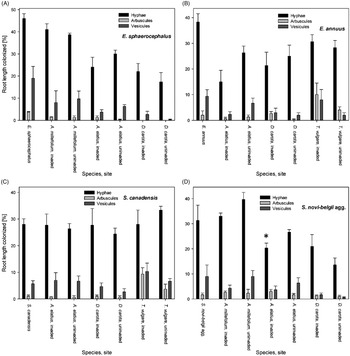
We found that all four studied neophyte species were associated with high levels of AMF. Concerning E. sphaerocephalus, we found that 46 ± 5% of roots were colonized by hyphae, 4 ± 1% of roots were colonized by arbuscules, and 19 ± 9% of roots were colonized by vesicles of AMF. In E. annuus, we found that 38 ± 7% of roots were colonized by hyphae, 2 ± 3% of roots were colonized by arbuscules, and 9 ± 3% of roots were colonized by vesicles of AMF. In S. canadensis, we found that 28 ± 4% of roots were colonized by hyphae, 1 ± 1% of roots were colonized by arbuscules, and 6 ± 1% of roots were colonized by vesicles of AMF. In S. novi-belgii agg., we found that 31 ± 12% of roots were colonized by hyphae, 2 ± 1% of roots were colonized by arbuscules, and 9 ± 9% of roots were colonized by vesicles of AMF.
We found that the invasion of neophyte species was not associated with any change in the abundance of AMF that would exceed the extent of variability found among the study sites (paired t-test for each studied native or archeophyte plant from the uninvaded and invaded sites P > 0.05, except A. elatius at sites invaded or not by S. novi-belgii agg., P = 0.04). Some native or archeophyte species displayed trends toward a decrease in AMF at invaded sites; however, the present study did not have enough statistical power to examine these rather small differences. Detailed data on the extent of root colonization by AMF are provided in Figure 1.
Colonization of roots by arbuscular mycorrhizal fungi (AMF) hyphae, arbuscules, and vesicules. (A) Echinops sphaerocephalus; (B) Erigeron annuus; (C) Solidago canadensis; (D) Symphyotrichum novi-belgii agg. An asterisk (*) indicates the only significant difference between the paired invaded and uninvaded sites (paired t-test P < 0.05).

Of note, the AMF of the native or archeophyte plants studied displayed only limited variability across the different groups of uninvaded sites despite these sites hosting different vegetation alliances (Arrhenatherion, Festucion valesiacae, Armerion elongatae, and Koelerio–Phleion phleoidis). We examined two of these species at four independent groups of uninvaded sites, and we examined another two species at two groups of uninvaded sites. In A. millefolium, the variation between groups was only 1.5, whereas the residual variation was 77.3. In A. elatius, the variation between groups was 28.6 compared with residual variation at 130.0. In D. carota, the variation between groups was relatively high at 272.9, but the in-group variability was still higher at 438.0. In T. vulgare, the variation between groups was only 37.5, whereas the residual variation was 87.3. See Table 1 for more detailed analysis outcomes.
Outputs for the analysis of differences in arbuscular mycorrhizal fungi (AMF) across the different groups of uninvaded sites.

AMF, Eubacteria, and Eukaryota Abundance in Soil
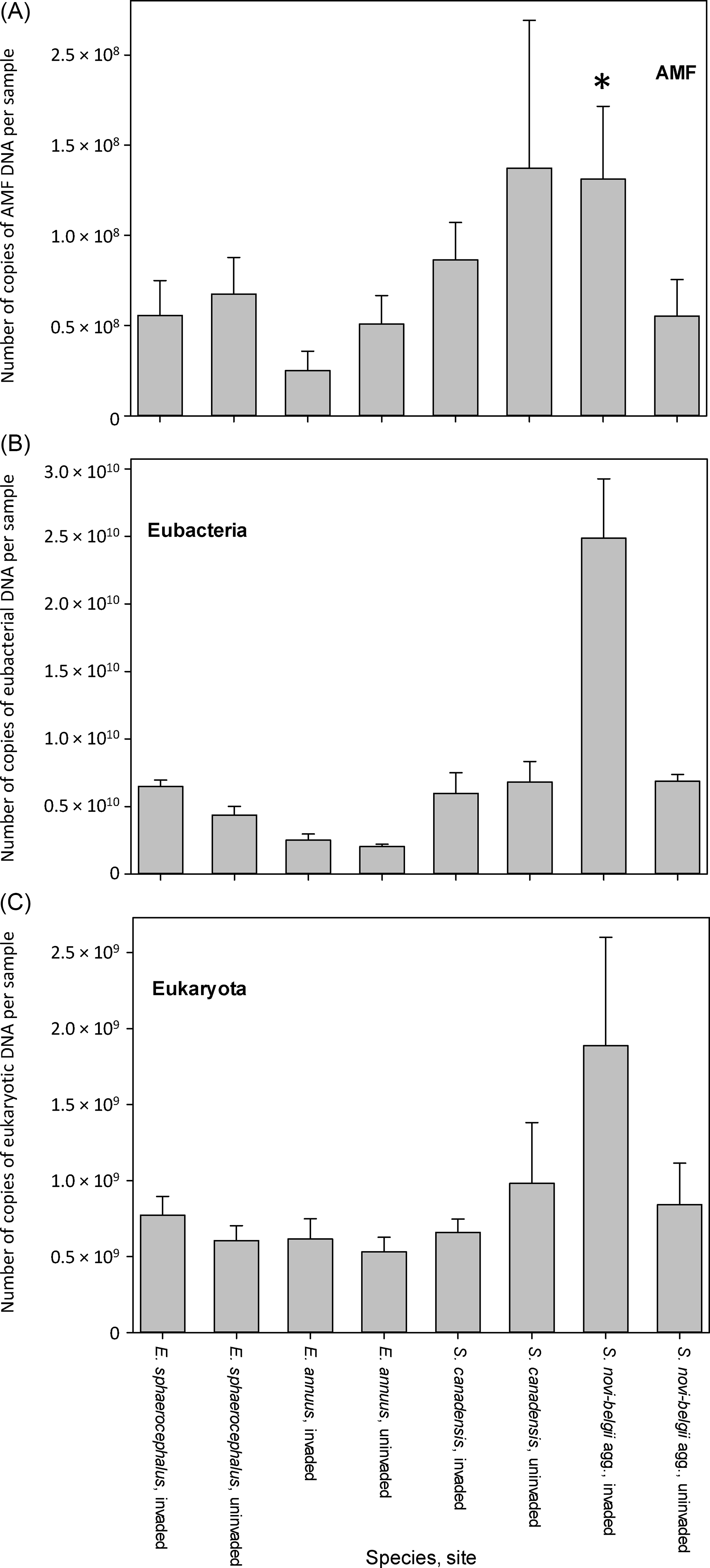
Corresponding with the negligible differences obtained using the microscopic approach, the qPCR analysis of AMF from soil revealed that the amount of AMF was similar between the invaded and uninvaded sites (paired t-test P > 0.05 for each neophyte species). Soils invaded by E. sphaerocephalus contained 5.55 × 10⁷ ± 3.36 × 10⁷ copies of AMF DNA per sample compared with 6.74 × 10⁷ ± 3.51 × 10⁷ copies of AMF DNA per sample from the corresponding paired uninvaded sites (n = 3 each). Soils invaded by E. annuus contained 2.50 × 10⁷ ± 1.86 × 10⁷ copies of AMF DNA per sample compared with 5.08 × 10⁷ ± 2.75 × 10⁷ copies of AMF DNA per sample from the corresponding paired uninvaded sites (n = 3 each). Soils invaded by S. canadensis contained 8.64 × 10⁷ ± 3.60 × 10⁷ copies of AMF DNA per sample compared with 1.37 × 10⁸ ± 1.42 × 10⁸ copies of AMF DNA per sample from the corresponding paired uninvaded sites (n = 3 each). Soils invaded by S. novi-belgii agg. contained 1.31 × 10⁸ ± 7.00 × 10⁷ copies of AMF DNA per sample compared with 5.53 × 10⁷ ± 3.49 × 10⁷ copies of AMF DNA per sample from the corresponding paired uninvaded sites (n = 3 each) (Figure 2A).
Copies of arbuscular mycorrhizal fungi (AMF) DNA in soil from invaded and uninvaded sites. (A) AMF; (B) Eubacteria; and (C) Eukaryota. An asterisk (*) indicates the only significant difference between the paired invaded and uninvaded sites (paired t-test P < 0.05).

We obtained similar results for eubacteria and eukaryotes (including protists). The amount of eubacterial amplicons was similar across all paired samples (paired t-test P > 0.05 each), except for a small but significant increase in the number of eubacteria amplicons in soils invaded by S. novi-belgii agg. (paired t-test P = 0.04). Soils invaded by S. novi-belgii agg. contained 2.49 × 10¹⁰ ± 7.61 × 10⁹ copies of eubacterial DNA per sample compared with 6.87 × 10⁹ ± 8.70 × 10⁸ copies of eubacterial DNA per sample from the corresponding paired uninvaded sites (n = 3 each) (Figure 2B). Concerning eukaryotic DNA, the amount of DNA copies did not differ when comparing the soil samples from the uninvaded sites with those from sites invaded by any of the four studied neophyte species (paired t-test P > 0.05 each) (Figure 2C).
Soil Properties
We found that the studied sites did not differ in pH, humus, or total oxidizable carbon when comparing soil samples from the uninvaded sites with those from sites invaded by any of the four studied neophyte species (paired t-test P > 0.05 each; Table 2).
Characteristics of soil from invaded and uninvaded sites with data shown (mean ± SE, n = 3 each) for pH, levels of nutrients (Ca, Mg, K, P, NO3, NH4), and humus. a

a Asterisks (*) indicate significant differences between the invaded and uninvaded sites (one-tailed t-test, P < 0.05).
Concerning mineral nutrients, we found differences in the levels of Ca, Mg, and K; only the extractable P levels remained unchanged (Table 2). Of particular interest were the higher levels of Ca and Mg at sites invaded by E. annuus. The level of Ca increased from 1,216 ± 1,004 mg kg−1 to 2,113 ± 1,304 mg kg−1, and the level of Mg increased from 45 ± 13 mg kg−1 to 76 ± 19 mg kg−1. In contrast, the levels of Ca and Mg were lower at sites invaded by S. canadensis; the level of Ca decreased from 2,009 ± 530 mg kg−1 to 1,248 ± 211 mg kg−1, and the level of Mg decreased from 187 ± 70 mg kg−1 to 121 ± 60 mg kg−1.
The extractable nitrogen present in the form of NO3 and NH4 (Table 2) increased at sites invaded by E. sphaerocephalus; we observed a similar trend at sites invaded by S. novi-belgii agg., but the trend was not significant due to the large variability in the values obtained from invaded sites. The invasion of S. canadensis did not lead to increases in these two parameters; instead, we identified a small but significant decrease in NO3 at sites invaded by this neophyte species. Soils invaded by E. sphaerocephalus contained 21.0 ± 6.5 mg NO3 kg−1 of soil compared with 3.7 ± 1.3 mg NO3 kg−1 of soil from the corresponding paired uninvaded sites (n = 3 each) (paired t-test P = 0.02). Soils invaded by E. annuus did not differ in their NO3 levels, as invaded soils contained 2.2 ± 0.5 mg NO3 kg−1 of soil compared with 1.3 ± 0.2 mg NO3 kg−1 of soil from the corresponding paired uninvaded sites (n = 3 each) (paired t-test P > 0.05). Soils invaded by S. canadensis contained 2.2 ± 1.6 mg NO3 kg−1 of soil compared with 3.7 ± 1.4 mg NO3 kg−1 of soil from the corresponding paired uninvaded sites (n = 3 each) (paired t-test P = 0.04). Soils invaded by S. novi-belgii agg. had highly variable levels of NO3 and contained 14.6 ± 7.5 mg NO3 kg−1 of soil compared with 6.9 ± 1.0 mg NO3 kg−1 of soil from the corresponding paired uninvaded sites (n = 3 each) (paired t-test P > 0.05).
Interpretations
The data obtained did not support the initial hypothesis about the previously proposed (Bothe et al. Reference Bothe, Turnau and Regvar2010; Chmura and Guczwa-Przepióra Reference Chmura and Guczwa-Przepióra2012; Majewska et al. Reference Majewska, Rola, Stefanowicz, Nobis, Błaszkowski and Zubek2018; Zubek et al. Reference Zubek, Majewska, Błaszkowski, Stefanowicz, Nobis and Kapusta2016) adverse effects of the invasion of neophyte species on the colonization of native plants by AMF. The invasion of certain neophytes from the Asteraceae family was associated with strong changes in the availability of primary and secondary mineral nutrients (Table 2), which has direct consequences for the growth and competitiveness of native plants (Baxter and Dilkes Reference Baxter and Dilkes2012; Jez et al. Reference Jez, Lee and Sherp2016; Oldroyd and Leyser Reference Oldroyd and Leyser2020). However, the extent of AMF colonization in the roots of native or archeophyte plants remained unchanged or exhibited only small changes (Figure 1). Comparative data on the colonization of native or archeophyte plants by AMF in the presence of the four studied invasive species are lacking, except in the case of S. canadensis (see more detailed discussion below). Despite strong changes in the availability of primary and secondary nutrients, the native or archeophyte plants remained equally colonized as those in nearby uninvaded sites. However, it remains to be tested whether they remained equally mycotrophic—whether the contribution of AMF to the nutrition of native or archeophyte plants at invaded sites was as high as their contribution at uninvaded sites. Therefore, changes in AMF abundance due to the invasion of the studied neophyte species from the Asteraceae family should not be considered the cause of putative resistance to reinvasion by native or archeophyte plant species. This resistance likely has other causes and has been proposed in several seminal papers from other geographic regions (Eliason and Allen Reference Eliason and Allen1997; Stromberg and Griffin Reference Stromberg and Griffin1996; Stylinski and Allen Reference Stylinski and Allen1999). Reduced arbuscular mycorrhizal colonization remains one of the classical causes of resistance to reinvasion by native or archeophyte species. However, the native or archeophyte plants within stands of the invasive neophytes of the Asteraceae family did not display any major changes in their colonization by AMF, even though some of the nutrients that are thought to be delivered by AMF were actually more abundant in the invaded stands.
Concerning the studied species, data on the effects of E. sphaerocephalus on the AMF of native or archeophyte plants are lacking, except the recent study on the suppression of ploughman’s-spikenard (Inula conyzae DC.) colonization by AMF in the presence of E. sphaerocephalus (Řezáčová et al. Reference Řezáčová, Řezáč, Gryndlerová, Wilson and Michalová2021b). Several studies have addressed the AMF of E. sphaerocephalus itself. In the present study, we found that, on average, 69% of the root length of E. sphaerocephalus was colonized by AMF, with hyphal colonization reaching 46%, arbuscular colonization reaching 4%, and vesicular colonization reaching 19% (Figure 1). In contrast, Štajerová et al. (Reference Štajerová, Šmilauerová and Šmilauer2009) reported that both arbuscular and vesicular colonization were low, in a range of 0.0% to 1.3% and 0.0% to 0.8%, respectively; only hyphae were more commonly found at some of the sampling sites, with total colonization in a range of 0.0% to 24.8% (Štajerová et al. Reference Štajerová, Šmilauerová and Šmilauer2009). Another study from Poland reported E. sphaerocephalus as having one of the highest mycorrhizal frequencies, mycorrhizal root lengths, and arbuscular richnesses among neophyte species in southern Poland, with abundant dark septate endophytes and absent Olpidium spp. (Majewska et al. Reference Majewska, Błaszkowski, Nobis, Rola, Nobis, Łakomiec, Czachura and Zubek2015). The total colonization of E. sphaerocephalus in its native range was studied in Xinjiang Province, China, where the proportion of colonized root length reached 35%, coils and arbuscules colonized 3% of the root length, and vesicles were found in 6% of samples (Shi et al. Reference Shi, Feng, Christie and Li2006).
In contrast to our findings on E. sphaerocephalus, the data on E. annuus from this study correspond to those reported previously. In the present study, on average, 49% of the root length of E. annuus was colonized by AMF, with hyphal colonization reaching 38%, arbuscular colonization reaching 2%, and vesicular colonization reaching 9% (Figure 1). Previous studies from central Europe reported similar values. A Czech study reported that E. annuus was associated with high total AMF intensity and intermediate arbuscular (0.8% to 12.5%) and vesicular (0.2% to 13.3%) colonization (Štajerová et al. Reference Štajerová, Šmilauerová and Šmilauer2009). A study from Poland reported E. annuus as having one of the highest mycorrhizal frequencies, mycorrhizal root lengths, and arbuscular richnesses among neophyte species in southern Poland, with absent dark septate endophytes and absent Olpidium spp. (Majewska et al. Reference Majewska, Błaszkowski, Nobis, Rola, Nobis, Łakomiec, Czachura and Zubek2015). Erigeron annuus was reported to be associated with Glomus etunicatum Becker & Gerdemann, with 17% of plants colonized, but showed negative mycorrhizal dependency (Tawaraya Reference Tawaraya2003; Wilson and Hartnett Reference Wilson and Hartnett1998). Another study from Poland reported a mycorrhizal frequency in E. annuus of 100%, a relative mycorrhizal root length of 53%, an intensity of colonization within individual mycorrhizal roots of 53%, an arbuscular richness in the whole root system of 48%, an arbuscular richness in root fragments where arbuscules were present of 89%, and a frequency dark septate root endophytes of 20%; all these values were among the highest for the neophyte species examined in that study (Gucwa-Przepiora et al. Reference Gucwa-Przepiora, Chmura and Sokolowska2016).
We found relatively low colonization of S. canadensis, with an average colonized root length of 35%. The hyphal colonization reached 28%, arbuscular colonization reached 1%, and vesicular colonization reached 6% (Figure 1). Previous studies from Russia reported higher values, as Betekhtina et al. (Reference Betekhtina, Mukhacheva, Kovalev, Gusev and Veselkin2016) found 93% colonization by AMF, with 46% of arbuscules, 49% of vesicles, and 44% of root hairs colonized. The colonization of S. canadensis by AMF is similarly high in its native range; see, for example, Wetzel (Reference Wetzel1996). The colonization of S. canadensis by AMF is inversely related to environmental pollution; for example, lead contamination decreases the amount of the root length that is colonized by AMF and biomass production, while spore numbers and nitrogen and phosphorus uptake are not affected (Yang et al. Reference Yang, Yu, Tang and Chen2008). In another study from China, the S. canadensis invasion time was correlated positively with the AMF colonization rate and the AMF species richness (Yang et al. Reference Yang, Zhou, Zan, Guo, Su and Li2014).
The data on S. novi-belgii agg. in the present study correspond to those reported previously. In the present study, on average, 42% of the root length of S. novi-belgii agg. was colonized by AMF, with hyphal colonization reaching 31%, arbuscular colonization reaching 2%, and vesicular colonization reaching 9% (Figure 1). Previous studies from central Europe reported similar values. The AMF of S. novi-belgii agg. were addressed by two studies from central Europe (Štajerová et al. Reference Štajerová, Šmilauerová and Šmilauer2009; Majewska et al. Reference Majewska, Błaszkowski, Nobis, Rola, Nobis, Łakomiec, Czachura and Zubek2015). The study from the Czech Republic analyzed two stands of this species with contradictory results. One of the analyzed S. novi-belgii agg. stands (with dominant hemp-agrimony [Eupatorium cannabinum L.]) was associated with low AMF intensity, and another (with dominant creeping bentgrass [Agrostis stolonifera L.]) was associated with high AMF intensity (Štajerová et al. Reference Štajerová, Šmilauerová and Šmilauer2009). The study from southern Poland concluded that the mycorrhizal frequencies, relative mycorrhizal root lengths, and relative arbuscular richnesses among neophyte species in southern Poland and the dark septate endophytes of S. novi-belgii agg. were lower than those of E. sphaerocephalus, with Olpidium spp. absent as well (Majewska et al. Reference Majewska, Błaszkowski, Nobis, Rola, Nobis, Łakomiec, Czachura and Zubek2015). Another study from Poland reported a mycorrhizal frequency in S. novi-belgii of 100%, a relative mycorrhizal root length of 49%, intensity of colonization within individual mycorrhizal root of 49%, an arbuscular richness in the whole root system of 26%, an arbuscular richness in root fragments where the arbuscules were present of 54%, and a frequency dark septate root endophytes of 50%; all these values were among the highest for the neophyte species examined in that study (Gucwa-Przepiora et al. Reference Gucwa-Przepiora, Chmura and Sokolowska2016).
In conclusion, we have shown that the AMF colonization of the Asteraceae neophytes can be high in severe monodominant invasions and that changes in plant dominance did not serve as predictors of the extent of AMF colonization of native or archeophyte plants. The present study did not argue against previous repeatedly reported observations claiming that reduced colonization by AMF is associated with reduced competitiveness of native or archeophyte plants when exposed to invasion by neophytes (Chen et al. Reference Chen, Liao, Chen and Peng2020). However, the reduced colonization by AMF was not a prerequisite for such an invasion, at least in terms of the four studied neophytes of the Asteraceae family. As we observed increased soil fertility at the invaded sites, a possible shift in the impact of AMF from beneficial to antagonistic should also be considered. The exchange of plant photosynthates for limiting nutrients, such as phosphorus or nitrogen, is beneficial as long as these nutrients are limiting. However, under high phosphorus (or high nitrogen) conditions, maintaining a high level of AMF colonization results in unnecessary carbon output and leads to growth depression (Chen et al. Reference Chen, Liao, Chen and Peng2020; Grman Reference Grman2012; Hoeksema et al. Reference Hoeksema, Chaudhary, Gehring, Johnson, Karst, Koide, Pringle, Zabinski, Bever, Moore, Wilson, Klironomos and Umbanhowar2010; Kempel et al. Reference Kempel, Nater, Fischer and Van Kleunen2013). In agreement with Luo et al. (Reference Luo, Meiners and Carlsward2019), we found that the invaded neophyte species had greater or equal hyphal colonization than native or archeophyte species, which highlights the importance of AMF for neophyte species (Lekberg et al. Reference Lekberg, Gibbons, Rosendahl and Ramsey2013). The absence of a response of the AMF colonization of the native or archeophyte plant species to the invasion of neophytes in the study plots resembles the situation reported by Shah et al. (Reference Shah, Reshi and Khasa2009), who proposed that AMF could be passengers, rather than drivers of neophyte invasions. The situation could be context dependent, and controlled laboratory studies are needed to identify context-dependent settings under which the colonization of roots by AMF serves as a gatekeeping factor.
Concerning management implications, the absence of a response of AMF colonization of native and archeophyte plant species to the invasion of neophytes suggests that AMF are passengers, rather than drivers, in the course of Asteraceae invasions in central European environments. We did not find any evidence for the previously suggested role of the management to favor AMF in directing the weed community dynamics (El Omari and El Ghachtouli Reference El Omari and El Ghachtouli2021). It is unclear whether this is a common situation and is just unnoticed due to common positive-results bias of published data, or whether the lack of interactions could be considered an exception. The results should not be overinterpreted and are valid only for Asteraceae invasions, but under the conditions analyzed, the management of AMF would provide little benefit in the prevention of Asteraceae invasions. The AMF–Asteraceae relationship could, however, be present in disturbed agroecosystems, as the analyzed habitats consisted of relatively stabilized ecosystems of the native or archeophyte vegetation (alliances Arrhenatherion, Festucion valesiacae, Armerion elongatae, Koelerio–Phleion phleoidis).
Further research should address the variations among the responses of individual AMF species, and experimental studies need to be conducted to assess changes in nutrient exchange between AMF and native or archeophyte plants with and without the pressure of invasive neophytes as well as the associated changes in soil nutrient levels. Further research should also address the major limitation of the present study, which stems from the absence of information on the species composition of analyzed AMF assemblages. It is possible that, despite the AMF abundance remaining stable, individual AMF species or strains could serve as yet uncovered AMF drivers of Asteraceae invasions as proposed by plant–soil feedback theory (Bever et al. Reference Bever, Platt and Morton2012; Klironomos Reference Klironomos2002; Reinhart et al. Reference Reinhart, Packer, Van der Putten and Clay2003; Řezáčová et al. Reference Řezáčová, Řezáč, Gryndler, Hršelová, Gryndlerová and Michalová2021a; van Grunsven et al. Reference van Grunsven, van der Putten, Bezemer, Tamis, Berendse and Veenendaal2007; Westover and Bever Reference Westover and Bever2001).
Supplementary material
To view supplementary material for this article, please visit https://doi.org/10.1017/inp.2021.17
Acknowledgments
This work was supported by the Czech Science Foundation project 18-01486S, the long-term development program RVO 61388971, and the Ministry of Agriculture of the Czech Republic project MZe RO0418. We thank Hana Gryndlerová, Hana Hršelová, Michala Mrůzková, and Miroslava Strnadová for their help with plant root harvesting. No conflicts of interest have been declared.