Introduction
Pheromones play an important role in mediating conspecific behavior and individual fitness in insects. Pheromones associated with courtship and mating, such as sex pheromones and aggregation pheromones, typically show high species-specificity in the combinations of chemical compounds (Roelofs, Reference Roelofs, Eisner and Meinwald1995). The specificity may either ensure conspecific recognition (Paterson, Reference Paterson and Vrba1985) or act as a premating reproductive isolation mechanism that reduces the likelihood of mismating and hybridization (Dobzhansky, Reference Dobzhansky1940). In addition, some pheromones are also important signals in mediating interspecific interactions. In an insect community, pheromones can reveal information about the senders, including species identity, location, abundance, and their physiological or developmental stage, which could be used by other members of the food web (competitor, natural enemies, etc.) to their own advantage (Wertheim et al., Reference Wertheim, van Baalen, Dicke and Vet2005). For instance, in some taxa, the pheromone blends of closely related species were similar, usually sharing the same chemical compounds (Greenblatt et al., Reference Greenblatt, Burkholder, Cross, Cassidy, Silverstein, Levinson and Levinson1977; Bartelt et al., Reference Bartelt, Schaner and Jackson1987; Monti et al., Reference Monti, Lalanne-Cassou, Lucas, Malosse and Silvain1995; Symonds & Wertheim, Reference Symonds and Wertheim2005; Wang et al., Reference Wang, Zhao and Wang2005), and in some cases, the frequent overlap in pheromone components between related taxa resulted in cross-attraction between species (Price et al., Reference Price, Sonenshine, Norval, Yunker and Burridge1994; Bartelt et al., Reference Bartelt, Weaver and Arbogast1995; Ayres et al., Reference Ayres, Ayres, Abrahamson and Teale2001; Tillman et al., Reference Tillman, Aldrich, Khrimian and Cottrell2010), which increased interspecific interactions. By contrast, in two bark beetle sibling species, Pityogenes quadridens and P. bidentatus, aggregation pheromone components from males of each species not only attract conspecifics but also repel the other species, reducing interspecific mating and competition for food and spatial resources (Byers et al., Reference Byers, Birgersson and Francke2013). These pheromone–mediated interactions have ecological consequences affecting population dynamics, evolutionary dynamics, and community structure (Vet, Reference Vet1999; Wertheim et al., Reference Wertheim, van Baalen, Dicke and Vet2005).
Western flower thrips, Frankliniella occidentalis (Pergande), and flower thrips, Frankliniella intonsa (Trybom), are two closely related species, both belonging to the genus Frankliniella (Thysanoptera: Thripidae). The two species are highly polyphagous insects, causing considerable losses in many greenhouse and field crops. Moreover, F. occidentalis and F. intonsa are important vectors of tospoviruses such as tomato spot wilt virus, tomato chlorotic spot virus, groundnut ring spot virus and impatiens necrotic spot virus (Wang et al., Reference Wang, Lin, Chiu and Shih2010). As two closely related species, F. occidentalis and F. intonsa have a number of similarities, including similar occurrence patterns, host range and feeding habits (Murai, Reference Murai1988; Lewis, Reference Lewis1997; Teulon & Nielsen, Reference Teulon and Nielsen2005). Previous studies have shown that the two thrips pests could occur sympatrically in the field in some area (Gai et al., Reference Gai, Zhi, Li and Jiang2010; Ullah & Lim, Reference Ullah and Lim2015), and interspecific interactions between them have also been reported (Gai et al., Reference Gai, Zhi and Yue2012).
Recently, male-produced aggregation pheromones of F. occidentalis and F. intonsa have been reported and identified (Kogel & Deventer, Reference Kogel and Deventer2003; Kirk & Hamilton, Reference Kirk and Hamilton2004; Hamilton et al., Reference Hamilton, Hall and Kirk2005; Zhang et al., Reference Zhang, Zhu and Lu2011), and which are attractive to both female and male conspecifics. The main chemical compounds of the aggregation pheromones of these two species are the same, namely (R)-lavandulyl acetate and neryl (S)-2-methylbutanoate. Comparison of aggregation pheromones between F. intonsa and F. occidentalis reveals that although the two major compounds are the same, the ratios of the two compounds are different in the two species (Zhang et al., Reference Zhang, Zhu and Lu2011). Field-trapping experiments showed that synthetic neryl (S)-2-methylbutanoate attracted both F. occidentalis (Hamilton et al., Reference Hamilton, Hall and Kirk2005) and F. intonsa (Lu et al., Reference Lu, Zhang, Li, Zhang, Bei, Zhang, Huang and Lin2015). Synthetic (R)-lavandulyl acetate alone was not attractive (Hamilton et al., Reference Hamilton, Hall and Kirk2005) but could act as a synergist when mixed with neryl (S)-2-methylbutanoate in certain ratios (Lu et al., Reference Lu, Zhang, Li, Zhang, Bei, Zhang, Huang and Lin2015). Field-trapping experiments in Zhangjiakou, Hebei, China (40°59′41″N, 115°0′40″ E) showed that the optimal blends of synthetic (R)-lavandulyl acetate and neryl (S)-2-methylbutanoate were 1:8 (1250 ng: 10,000 ng) in F. occidentalis and 1:4 (1250 ng: 5000 ng) in F. intonsa, respectively (Geng et al., Reference Geng, Li, Zhang, Zhang and Lu2017). Given the overlap in pheromone components between the two species and similar niches, it is reasonable to hypothesize that aggregation pheromones might play a role in interspecific interactions, such as cross-attraction. However, it is also possible that the difference in the ratio of these compounds is species-specific and plays a role in premating isolation.
The objectives of this study were to investigate the roles of the two major aggregation pheromone compounds mentioned above in interspecific interactions between F. occidentalis and F. intonsa in both long and short ranges. We investigated whether there were cross-attraction and cross-mating incidents between F. occidentalis and F. intonsa by olfactometer bioassays and crossing experiments, respectively. In addition, we tested the roles of optimal blends of the two aggregation pheromone compounds in the interactions of the two species in field trapping experiments and crossing tests. The results may help in the understanding the ecological and evolutionary relationships between these two closely related thrips species.
Materials and methods
Thrips
The population of F. occidentalis was collected from melon Cucumis melo L. in a greenhouse at the Institute of Vegetables and Flowers, Chinese Academy of Agricultural Sciences in Beijing, China. The population of F. intonsa was collected from cucumber Cucumis sativus (L.) at a farm in Hangzhou, China. Cultures of the two species were mass reared in separate climate rooms at 27 ± 1 °C under a LD 16: 8 h photocycle and 65–75% relative humidity. The thrips were reared on Phaseolus vulgaris L. in 4.5-L glass canning jars.
Adult thrips of mixed ages (1–5 days old) used for olfactometer bioassays were collected randomly from the cultures. To obtain virgin females and males for mating tests, large numbers of pupae were collected from the colony and transferred individually into 1.5-ml microcentrifuge tubes containing a section of the bean pod. The pupae were examined daily, and the emerged adults were sexed under a stereoscopic microscope and arranged into different mating treatments 1 day after emergence.
Synthetic aggregation pheromones
The two aggregation pheromone compounds, (R)-lavandulyl acetate (at least 98% purity, 98% enantiomeric excess) and neryl (S)-2-methylbutanoate (at least 98% purity, 99% enantiomeric excess), were synthesized at China Agricultural University according to the method described by Hamilton et al. (Reference Hamilton, Hall and Kirk2005). The synthetic pheromones were analyzed by gas chromatography-mass spectroscopy (GC-MS) using a Shimadzu GC-2010 plus GC-MS (Shimadzu, China) equipped with a Rxi-5MS (Restek Corp., Bellefonte, Pennsylvania) (length 30 m, inner diameter 0.32 mm, film thickness 0.25 µm) column. Their identity was determined by comparing the mass spectra with NIST 08 spectra (National Institute of Standards and Technology, Gaithersburg, Maryland) (Zhang et al., Reference Zhang, Zhu and Lu2011). The chirality of neryl (S)-2-methylbutanoate and (R)-lavandulyl acetate was validated by GC-MS analysis on CP-chirasil-DexCB column (25 m × 0.25 mm × 0.25 µm, Restek Corp., Bellefonte, Pennsylvania) and BGB-176SE column (30 m × 0.25 mm × 0.25 µm, (Restek Corp., Bellefonte, Pennsylvania), respectively.
Olfactometer bioassays
The response of female and male thrips to male-produced volatiles of the same thrips species as well as the other thrips species was tested in a Y-tube olfactometer. The glass Y-tube olfactometer had a stem 100 mm long, two arms 100 mm long each, separated from each other at an angle of 60°, and an internal diameter of 10 mm. Air was filtered through activated charcoal and split into two air streams, each of which was fed through a glass flask and into one arm of the olfactometer at a rate of 60 mm s−1. The two glass flasks (50 mL) provided test and control odor (clean air) sources. The glass flasks were illuminated from above by one arm of a fiber optic cold light source at a distance of 40 mm (approximately 10,000 lux). Connections between the components of the olfactometer apparatus were made with Teflon tubes.
Olfactometer experiments were carried out at 25 ± 2 °C, RH 60 ± 5%. Sixty mixed-age adult thrips were collected and checked for gender under a microscope, and then transferred into the treatment flask as the odor source. Test thrips were transferred individually to the base of the Y-tube with a fine brush. Each thrips was observed for a maximum of 3 min and its choice for one of the two odor sources was recorded when it crossed a half-length of either arm. ‘No choice’ was recorded if the test thrips did not cross a half-length of either arm after 3 min. After five thrips were tested, odor sources entering the arms of the Y-tube were swapped to avoid any influence of unrecognized asymmetries in the apparatus. Each odor comparison was repeated four to five times on different days, with 20 thrips per day. The apparatus was cleaned before each test by rinsing with pure ethanol and dried in an oven (120 °C).
Cross mating behavior observation
To investigate the effect of the species-specific blends of two major aggregation pheromone compounds [optimal blends for F. occidentalis:(R)-lavandulyl acetate and neryl (S)-2-methylbutanoate 1250 ng and 10,000 ng blended in 1μl hexane (99% purity, Scharlau, Spain); optimal blends for F. intonsa: (R)-lavandulyl acetate and neryl (S)-2-methylbutanoate 1250 ng and 5000 ng blended in hexane] on the close range interspecific interactions between F. occidentalis (WFT) and F. intonsa (FT), 12 mating treatments were set up, six conspecific interaction pairs and six interspecific pairs.
Specifically, the six conspecific interactions were: (1) WFT female × WFT male; (2) WFT female × WFT male marked by WFT aggregation pheromone blends; (3) WFT female × WFT male marked by FT aggregation pheromone blends; (4) FT female × FT male; (5) FT female × FT male marked by WFT aggregation pheromone blends; (6) FT female × FT male marked by FT aggregation pheromone blends. The six interspecific interactions were: (1) WFT female × FT male; (2) WFT female × FT male marked by WFT aggregation pheromone blends; (3) WFT female × FT male marked by FT aggregation pheromone blends; (4) FT female × WFT male; (5) FT female × WFT male marked by WFT aggregation pheromone blends; (6) FT female × WFT male marked by FT aggregation pheromone blends.
For each treatment, a virgin female and a male were paired in the dish (1.5 cm diameter) of a concave slide covered by a normal slide with a piece of filter paper (1.8 × 1.8 cm2). To mark the male, the virgin male was firstly transferred into the ditch, then the optimal synthetic aggregation pheromone compounds blends mentioned above [optimal blends for F. occidentalis: (R)-lavandulyl acetate and neryl (S)-2-methylbutanoate 1250 ng and 10,000 ng blended in 1μl hexane; optimal blends for F. intonsa: (R)-lavandulyl acetate and neryl (S)-2-methylbutanoate 1250 ng and 5000 ng blended in 1μl hexane] were applied to the abdomen of male. Afterwards, the virgin female was transferred into the ditch. The paired male and female were put under a video recorder and their mating behaviors were recorded at 25 ± 2 °C, RH 60 ± 5% for 30 min. Approximately 20–30 pairs were observed for each treatment. The mating duration and interaction times between female and male over 30 min were calculated and the mating percentage for each treatment was recorded.
Field-trapping experiments
The long-range effects of species-specific optimal blends of synthetic aggregation pheromones of the two species on interspecific interactions were tested in August 2016 in crops of sweet pepper grown in two greenhouses at Chongli, Zhangjiakou, Hebei, China (40°59′41″N, 115°0′40″E). The crops were about 110 cm high, planted in rows 1 m apart, and were naturally infested with a low level of F. occidentalis and F. intonsa. The optimal aggregation pheromone blends of the two species were determined by our previous field trials, where optimal blends for F. occidentalis were (R)-lavandulyl acetate and neryl (S)-2-methylbutanoate 1250 ng and 10,000 ng blended, and optimal blends for F. intonsa were (R)-lavandulyl acetate and neryl (S)-2-methylbutanoate 1250 ng and 5000 ng blended (Geng et al., Reference Geng, Li, Zhang, Zhang and Lu2017). The tested blends were dissolved in hexane and loaded into rubber septa (1 cm diameter × 1.5 cm long, pre-cleaned with hexane). Rubber septa loaded with hexane alone were used as the control. The rubber septa were stuck in the middle of rectangular yellow sticky traps (20 cm × 25 cm) suspended on wire hangers with the base about 10 cm above crop height.
The trapping trials were conducted in two greenhouses. In each greenhouse, three replicates of each tested blend were performed. In each replicate, four treatments (control for F. occidentalis, optimal blend for F. occidentalis, control for F. intonsa and optimal blend for F. intonsa) were randomly assigned in the same row. The traps were 1.5 m apart from each other. The traps were tested for 1 day, and the F. occidentalis and F. intonsa female adults on each trap were counted. The trapping trials were repeated three times in one greenhouse and twice in the other greenhouse (15 replicates in total for each treatment). The number of F. occidentalis female adults trapped on control traps, the optimal traps for F. occidentalis and the optimal traps for F. intonsa were compared. The same comparison was also conducted for F. intonsa.
Statistical analysis
All data analyses were performed in SPSS (SPSS Inc., 2007, Chicago, IL.). Olfactometer data were analyzed using the chi-square test to determine significant deviation (P < 0.05) from an expected 1: 1 response. Females that did not make a choice were excluded from the analysis.
In the cross-mating experiments, mating percentages and interaction times between conspecific pairs and interspecific pairs were compared by student t-test (P < 0.05). Mating percentage data were first square root and arcsine transformed, as necessary, but untransformed means are presented. To investigate the effects of species-specific aggregation pheromones on the interactions between females and conspecific or interspecific males, mating percentages, mating duration and interaction times in each female/male combination in each species were analyzed by one way analysis of variance (ANOVA). Multiple comparisons with the control pairs (without aggregation pheromone marking) were performed using Dunnett's multiple comparison tests (P < 0.05).
In the field trials, since the two species in the greenhouses were not evenly distributed, to avoid the effects of thrips distribution on the trapping results, we used trapping efficiencies instead of trap captures. Trapping efficiencies for each species on control traps (the number of female adults trapped on each control trap divided by the average number of female adults on control traps) and test traps (the number of female adults trapped on tested traps divided by the number on control traps in the same row) were calculated, square root transformed and analyzed by student t-test (P < 0.05). Untransformed means are presented. A two-way ANOVA was used to test the effects of species, blends and their interaction on the trapping efficiencies (P < 0.05).
Results
Olfactometer bioassays
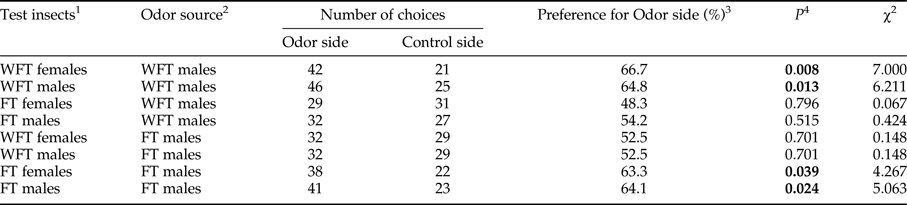
Mixed-age females and males of F. occidentalis were attracted to the odour of F. occidentalis males, and their preference for the odor side was 66.7% and 64.8%, respectively (table 1). Similarly, mixed-age females and males of F. intonsa were also attracted to the odor of F. intonsa males, and their preference for the odor side was 63.3 and 64.1%, respectively (table 1). However, no cross-attractions were observed. Mixed-age females and males of F. occidentalis were not attracted to the odor of F. intonsa males, and their preference for the odor side was 52.5 and 52.5%, respectively (table 1). The same results were found when using F. occidentalis males as odor to attract F. intonsa females and males. Mixed-age females and males of F. intonsa were not attracted to the odor of F. occidentalis males, and their preference for the odor side was 48.3% and 54.2%, respectively (table 1).
Responses of adult females and males of Frankliniella occidentalis (WFT) and Frankliniella intonsa (FT) to the volatiles produced by 60 adult males of the same or the other species in a Y-tube olfactometer.

1 All test and source insects were adults of mixed ages.
2 All odor sources consisted of 60 live adults of mixed ages.
3 The percentage of individual thrips that chose the odor side out of the total that made a choice.
4 Exact probability based on null hypothesis of equal preference for the two sides. P values in bold indicate significant differences (P < 0.05).
Cross-mating behavior observation
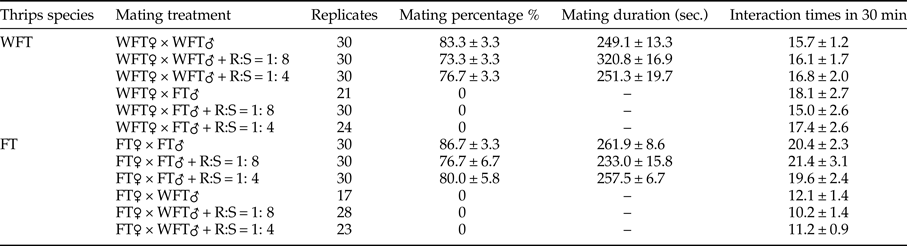
No cross-matings were observed between the two different species (table 2). The majority of F. occidentalis we tested mated with F. occidentalis males, but no F. occidentalis females mated with F. intonsa males. Similarly, the majority of F. intonsa we tested mated with F. intonsa males, but no F. intonsa females mated with F. occidentalis males. However, the interspecific interaction behaviors were different in the two species. The interaction times between F. intonsa females and F. occidentalis males were significantly lower than those between F. intonsa females and F. intonsa males (t = 2.552, d.f. = 45, P = 0.014; table 2), while the interaction times of F. occidentalis females with F. intonsa males were not significantly different from those between F. occidentalis females and males (t = −1.031, d.f. = 49, P = 0.307; table 2).
Mating percentages, mating duration and interaction times in different mating treatments.

WFT: Frankliniella occidentalis; FT: Frankliniella intonsa.
R: (R)-lavandulyl acetate; S: neryl (S)-2-methylbutanoate.
R: S = 1:8: the optimal trap for Frankliniella occidentalis, R and S 1250 ng and 10,000 ng blended.
R: S = 1:4: the optimal trap for Frankliniella intonsa, R and S 1250 ng and 5000 ng blended.
Aggregation pheromones had little effect on close range interspecific interactions between F. occidentalis and F. intonsa at tested doses and ratios. Specifically, in F. occidentalis female and F. occidentalis male pairs, marking with either F. occidentalis optimal aggregation pheromone blends or F. intonsa optimal aggregation pheromone blends had no effects on mating percentages (F 2, 6 = 2.336, P = 0.178) and interaction times (F 2, 87 = 0.111, P = 0.895), except for longer mating duration when marked by F. occidentalis optimal aggregation pheromone blends (F 2, 67 = 5.782, P = 0.005). In F. intonsa female and F. intonsa male pairs, marking with either F. occidentalis optimal aggregation pheromone blends or F. intonsa optimal aggregation pheromone blends had no effects on mating percentages (F 2, 6 = 0.804, P = 0.491), mating duration (F 2, 70 = 2.023, P = 0.140) and interaction times (F 2, 87 = 0.126, P = 0.882). In F. occidentalis female and F. intonsa male pairs, marking with either F. occidentalis optimal aggregation pheromone blends or F. intonsa optimal aggregation pheromone blends did not induce mating behavior and had no effect on interaction times (F 2, 72 = 0.419, P = 0.659). Similarly, in F. intonsa female and F. occidentalis male pairs, marking with either F. occidentalis optimal aggregation pheromone blends or F. intonsa optimal aggregation pheromone blends did not induce mating behavior and had no effect on interaction times (F 2, 64 = 0.620, P = 0.541).
Field-trapping experiments
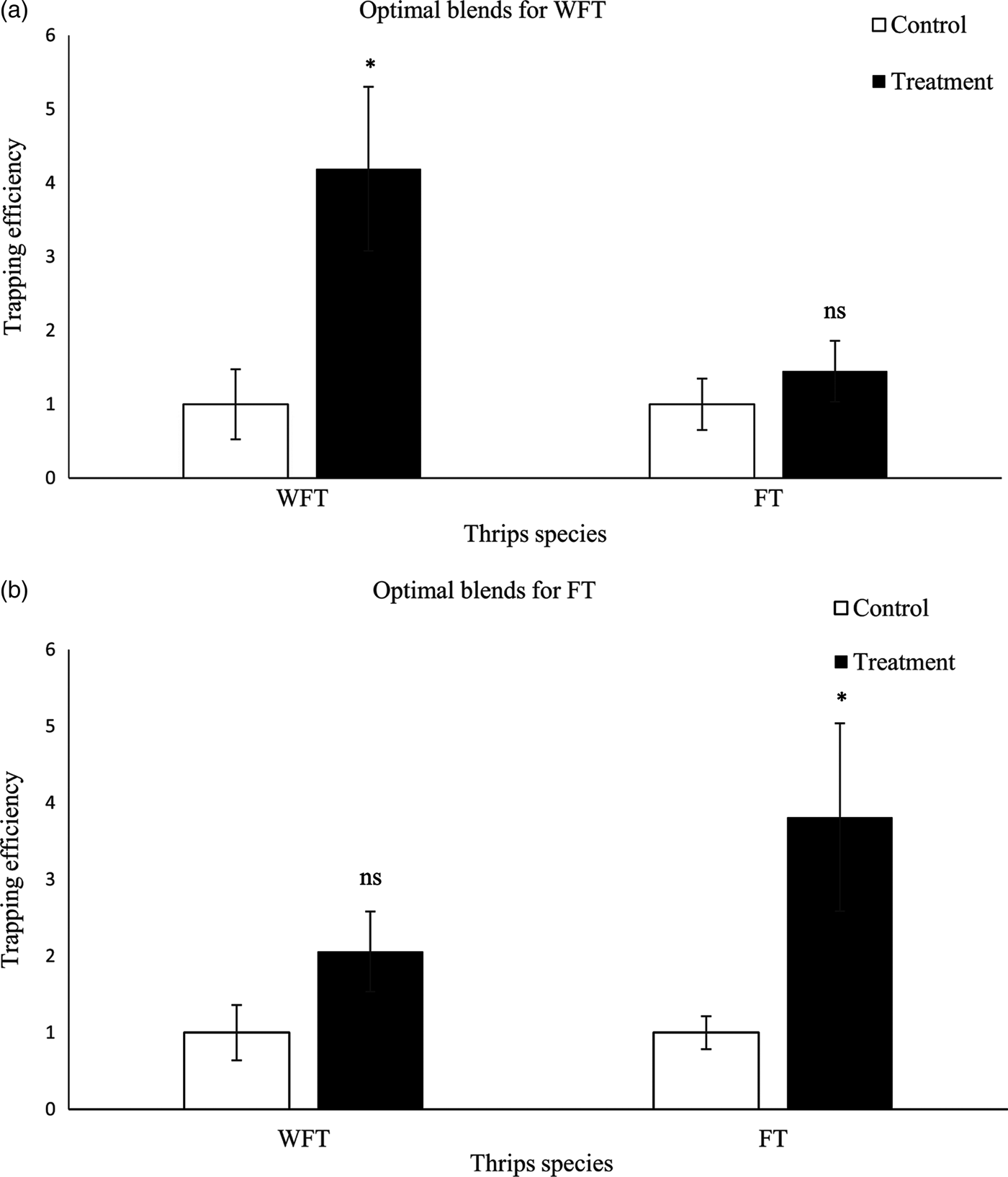
When compared with control traps, the two optimal blends for the two thrips species had significantly different trapping effects on F. occidentalis as well as on F. intonsa (fig. 1). Specifically, the optimal blends for F. occidentalis had a higher trapping efficiency for F. occidentalis (t = −3.629, d.f. = 28, P = 0.001; fig. 1a), while the optimal blends for F. intonsa had no significant trapping efficiency for F. occidentalis (t = −2.001, d.f. = 28, P = 0.055; fig. 1b). Similarly, the optimal blends for F. intonsa had a higher trapping efficiency for F. intonsa (t = −3.141, d.f. = 28, P = 0.004; fig. 1b), while the optimal blends for F. occidentalis had no significant trapping efficiency for F. intonsa (t = −0.649, d.f. = 28, P = 0.522; fig. 1a).
Trapping efficiencies of optimal traps of Frankliniella occidentalis (WFT) and Frankliniella intonsa (FT) for the two thrips species. R: (R)-lavandulyl acetate; S: neryl (S)-2-methylbutanoate. A. Optimal blends for Frankliniella occidentalis (WFT), R: S = 1250 ng: 10,000 ng; B. Optimal blends for Frankliniella intonsa (FT), R: S = 1250 ng: 5000 ng.

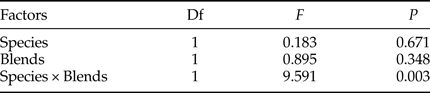
Two way ANOVA analysis indicated there were interaction effects of thrips species and aggregation pheromone blends on the trapping efficiency of aggregation pheromones (table 3). Specifically, the F. occidentalis specific blend [(R)-lavandulyl acetate and neryl (S)-2-methylbutanoate 1250 ng and 10,000 ng blended] had a higher trapping efficiency for F. occidentalis (4.19) for than F. intonsa (1.49) (P = 0.008). The F. intonsa specific blend [(R)-lavandulyl acetate and neryl (S)-2-methylbutanoate 1250 ng and 5000 ng blended] had a higher trapping efficiency for F. intonsa (3.81) than for F. occidentalis (2.06), although it did not reach statistical significance (P = 0.136).
Summary of two way ANOVA analysis of trapping efficiency among different species and blends.

Discussion
The results of Y-tube olfactometer bioassays showed that there was no cross-attraction between F. occidentalis and F. intonsa when using male-produced volatiles and control odor (clean air) as odor sources. These results are consistent with the findings of our previous work where females and males of one species chose volatiles of conspecific males rather than heterospecific males in the Y tube olfactometer when conspecific males and heterospecific males were used as odor sources (Zhu et al., Reference Zhu, Zhang and Lu2012). In this study, by using clean air as the control odor, we ruled out the possibility that volatiles of heterospecific males could repel the other species. Crossing experiments indicated that no cross-mating occurred between these two closely related thrips species. Results from both long and close ranges suggested that, although having the same aggregation pheromones compounds, F. occidentalis and F. intonsa did not have pheromone-induced interactions.
The species-specific aggregation pheromones in the two closely related thrips species might manipulate interspecific competition between the two species. F. occidentalis is an invasive species in China and has been established for around 15 years, while F. intonsa is a native species (Lu et al., Reference Lu, Zhang, Wu, Du, Zhang, Yu, Wang, Wang, Wang, Tong, Lu, Tan and Fu2011). The two species have a number of similarities, including similar occurrence patterns, host range and feeding habits (Murai, Reference Murai1988; Lewis, Reference Lewis1997; Teulon & Nielsen, Reference Teulon and Nielsen2005), leading to interspecific competition. However, the coexistence of the two species has been reported in China and other areas (Gai et al., Reference Gai, Zhi, Li and Jiang2010; Ullah & Lim, Reference Ullah and Lim2015). This phenomenon suggests that certain strategies might be involved to avoid interspecific competition. Our results demonstrated that the aggregation pheromones of the two species were species-specific and no cross-attraction occurred. This might lead to separate aggregation of each species in the field, contributing to competition reduction and coexistence. This interpretation could fit with the theory of ‘aggregation model of coexistence’ (Atkinson & Shorrocks, Reference Atkinson and Shorrocks1979), which has been demonstrated for a number of insect communities (Ives, Reference Ives1991; Sevenster & Alphen, Reference Sevenster and Alphen1996; Toda et al., Reference Toda, Kimura and Tuno1999). In this model, intraspecific aggregation and no-cross-attraction enhance independent clustering of one species in parts of the environment. The parts of the environment that are not used by one species can serve as a refuge for the other, thus reducing interspecific interactions and facilitate coexistence.
Other researchers have demonstrated that the ratios of (R)-lavandulyl acetate and neryl (S)-2-methylbutanoate affected the trap catch of F. occidentalis females, showing that traps with (R)-lavandulyl acetate and neryl (S)-2-methylbutanoate 10 µg:100 µg (1:10), 5 µg:100 µg (1:20), 1 μg:100 µg (1:100) trapped more females compared with control traps; whereas, traps with (R)-lavandulyl acetate and neryl (S)-2-methylbutanoate 50 µg:100 µg (1:2) had no significant trapping effects (Sampson, Reference Sampson2014). Field-trapping experiments in our study also showed that the trapping efficiency was affected by the ratios of the two compounds not only in F. occidentalis but also in F. intonsa. These results provide evidence that aggregation pheromones in these two species are species-specific and that the two thrips species can recognize their conspecifics by detecting a difference in the ratio of the two major aggregation pheromone components.
Differential responses to aggregation pheromones between species have also been reported in other thrips species. A commercial semiochemical product which is a synthetic version of the F. occidentalis aggregation pheromone attracted F. occidentalis, but had no effect on the capture of Thrips imaginis and Thrips tabaci (Broughton & Harrison, Reference Broughton and Harrison2012). The aggregation pheromone of another thrips species, Thrips palmi, was identified and the trapping effects of the synthetic aggregation pheromone compound (R)-lavandulyl 3-methyl-3-butenoate were tested with T. palmi and F. intonsa (Akella et al., Reference Akella, Kirk, Lu, Murai, Walters and Hamilton2014). Significantly greater numbers of T. palmi were attracted; however, although there was a trend to trap more F. intonsa, it did not reach statistical significance (Akella et al., Reference Akella, Kirk, Lu, Murai, Walters and Hamilton2014). In these two cases, the specific responses were due to different pheromone compounds in different species.
We also found that the species-specific aggregation pheromone blends we tested had no effects on the close range interactions and matings between these two species. Other studies have demonstrated that a range of lower doses (50 pg-500 ng) of neryl (S)-2-methylbutanoate could increase the activity level of females; while a range of lower doses (50 pg–500 ng) of (R)-lavandulyl acetate could reduce the walking and take-off activities of females but increase the activity level of males (Olaniran, Reference Olaniran2013; Olaniran et al., Reference Olaniran, Sudhakar, Drijfhout, Dublon, Hall, Hamilton and Kirk2013). However, they did not observe the effects of those doses on the interactions and mating behaviors between females and males. In our study, no effects on the close range interactions and matings between these two species might be due to the high doses we used (10,000 ng and 5000 ng neryl (S)-2-methylbutanoate, 1250 ng (R)-lavandulyl acetate), but it is possible that the two major aggregation pheromone components were relevant to the response of females, but not to the interactions between females and males. Nevertheless, the results from the two studies suggest that the close range specific recognition systems in F. intonsa and F. occidentalis may not be expected to develop based only on two major aggregation pheromone components. Additional minor pheromone components reported in these two species (Kirk & Hamilton, Reference Kirk and Hamilton2004; Zhang et al., Reference Zhang, Zhu and Lu2011) or some close range chemical signals (such as contact pheromone, 7-Methyltricosane reported by Olaniran et al., Reference Olaniran, Sudhakar, Drijfhout, Dublon, Hall, Hamilton and Kirk2013) may play a role in the close range response and interactions between females and males (Moore, Reference Moore2012; Olaniran et al., Reference Olaniran, Sudhakar, Drijfhout, Dublon, Hall, Hamilton and Kirk2013). In another thrips species, Echinothrips americanus, close range male pheromones have also been identified and could influence female and male interactions (Krueger et al., Reference Krueger, Moritz, Lindemann, Radisch and Tschuch2016). Further study is required to investigate how these chemical signals regulate close-range interactions and their underlying mechanisms.
Species-specific pheromone signals regulated by the ratio of pheromone components have been reported in closely related species of other insect taxa, such as attraction-aggregation-attachment pheromones in two tick species, Amblyomma hebraeum and A. variegatum (Price et al., Reference Price, Sonenshine, Norval, Yunker and Burridge1994) and sex pheromones in two sibling species, the cotton bollworm, Helicoverpa armigera and the oriental tobacco budworm, H. assulta (Lepidoptera: Noctuidae) (Ming et al., Reference Ming, Yan and Wang2007). The mechanism of specific discrimination of pheromones in insects could be due to a species-specific molecular and physiological basis of signal integration or to species-specific chemoreceptor-encoding and chemoreceptor-related genes. The antennae as an important sensory organ with many sensilla could be involved in interspecific and intraspecific marking discriminations (Romani et al., Reference Romani, Isidoro, Bin, Consoli, Parra and Zucchi2010). Comparative electroantennograms of the antennae to aggregation pheromone components could shed light on the physiological mechanisms of specific detection of quantity and ratio in two thrips species. Within the insect olfactory system, olfactory-related proteins such as odorant-binding proteins (OBPs), chemosensory proteins (CSPs), olfactory receptors (ORs) and sensory neuron membrane proteins play important roles in the specific detection of odorants (Hansson & Stensmyr, Reference Hansson and Stensmyr2011; Swarup et al., Reference Swarup, Williams and Anholt2011; Andersson et al., Reference Andersson, Löfstedt and Newcomb2015), especially in the detection of pheromones (Wojtasek et al., Reference Wojtasek, Hansson and Leal1998). In F. occidentalis, several olfactory-related proteins have been identified, including CSPs and OBPs (Zhang & Lei, Reference Zhang and Lei2015; Zhang et al., Reference Zhang, Sheng-Yong and Lei2015; Zhang et al., Reference Zhang, Wu and Lei2016). Comparative structural and functional studies of these olfactory-related proteins between F. intonsa and F. occidentalis would be useful to assist in understanding the molecular mechanisms of species-specific discrimination of different ratios of aggregation pheromone compounds.
Acknowledgements
The authors are grateful to Shufa Zhang and Yanru Zhao (Hebei North University) for their assistance in the field. This work was supported by the National Key R&D Program of China (grant number 2017YFD0200400); the National Natural Science Foundation of China (grant number 31570387); the Special Fund for Agro-scientific Research in the Public Interest of China (grant number 201303028); the Fund for Youth Scholars of Zhejiang Academy of agriculture sciences (grant number 10); and the Key Projects in the National Science & Technology Pillar Program during the Twelfth 5-year Plan Period (grant number 2012BAD19B06).