1. INTRODUCTION
It is clear that functional descriptions of technical devices are ambiguous in engineering, yet the implications are not. Engineers use the term function with more than one meaning, and this is acknowledged to hamper the use and communication of functional descriptions. However, the obvious solution of disambiguation is typically not embraced in engineering. For more than a decade, engineering researchers and design methodologists have been aware of the coexistence of the different meanings attached to the termFootnote 1 but usually avoid disputes about it or other efforts aimed at resolving it. Functional descriptions are ambiguous in engineering and effectively kept so; the maxim that consensus about key terms is beneficial to science and technology is ignored. Researchers and methodologists adopt other means to making functional descriptions useful and interoperable: precision is achieved by giving function relatively well-defined meanings, and communication is made possible by ensuring that engineers who collaborate in teams temporarily align the meanings they use or by attempts at translating functional descriptions that are based on different meanings.
The ambiguity of functional descriptions has methodological implications, and these depend on how one judges the ambiguity and responds to it. Despite the general tolerance in engineering, one may reject having coexisting meanings of function, setting the methodological task of finding ways to remove the ambiguity and to arrive at a single meaning of function. One may also accept the ambiguity of functional descriptions and take it as intrinsic to engineering. This alternative has more novel methodological implications. First, it should then be acknowledged that function is a conceptual anomaly in engineering because it is a key term, yet it is one with different meanings that are not explicitly separated. The different meanings are relatively distinct and well defined; hence, they could easily be set apart. For instance, engineers could have developed the practice to refer to “x functions” when attaching meaning x to function and to “y functions” when attaching meaning y to function. Nevertheless, engineers in general do not separate the different meanings but speak about function simpliciter. Second, methodological questions emerge of why engineers use the coexisting meanings side by side without separating them explicitly. Does this practice have particular benefits to engineering? Third, practical issues present themselves about how to manage the ambiguity. What methodological tasks does this ambiguity set to engineering research and design methodology?
In this position paper, I consider the ambiguity of functional descriptions in engineering. Complementary to the position papers by Claudia Eckert (Reference Eckert2013) on the practical consequences of this ambiguity in industry and by Ashok Goel (Reference Goel2013) on how different modeling approaches developed in response to goals of functional modeling, I explore the methodological implications of four responses to the ambiguity. Sections 2 and 3 are on two responses in which the ambiguity is rejected. In the first, a single meaning of function is to be derived on the basis of analyses of the current meanings. In the second response, this single meaning is posited. In Sections 4 and 5, two responses are considered in which one accepts the coexisting meanings. In the first, an overarching concept of function is given that has some or all of the coexisting meanings as instances. In the second response, function is taken as a family resemblance concept. The benefits of the ambiguity of functional descriptions in engineering are considered in Sections 6 and 7, and in Section 8, it is explored how the meaning of function may depend on the tasks for which functional descriptions are used. All four considered responses have their advantages and disadvantages, and in Section 9 I consider the implications of these responses for engineering research and design methodology.
2. RESPONSE 1: CONVERGING TOWARD A SINGLE MEANING
Given that functional descriptions of technical devices take a central place in engineering, it would methodologically be ideal if these descriptions were based on a single and well-defined concept of function. As in all fields in science and technology, consensus about or standardization of key concepts enables clarity and interoperability of descriptions. In engineering, such consensus about function would allow engineers working in different disciplines or at different places around the globe to unconditionally share functional descriptions, in design projects or by archives. This ideal has been acknowledged within engineering research and design methodology, and attempts have been made to remove the current ambiguity in functional descriptions. The coexistence of different meanings is then taken as a historically grown situation that is disadvantageous and has to be overcome: the methodological advantages of this situation are discarded. In the first two responses to the coexistence of different meanings of function, this ideal is embraced. The first starts from the different engineering proposals to giving functional descriptions and aims at extracting one concept of function from these proposals. The second takes distance from these proposals and imposes a concept of function; this second response is discussed in the next section.
The idea that ongoing analysis leads to conceptual convergence has been phrased succinctly by Max Planck for physics in his 1908 Leiden lecture on “The Unity of the Physical World-Picture.”Footnote 2 Planck described the developments in physics as aimed at unification through the “de-anthropomorphisation” of the concepts used. Separate branches in physics, such as magnetism and optics, have been merged, and this has been accompanied by a “withdrawal of the human-historical element from . . . physical definitions” of the concepts (1970, p. 5). Color concepts and concepts in magnetism, for instance, were originally defined with reference to the color perception of humans and to the properties of naturally found magnetic materials, but current electromagnetic concepts are defined independently of the specifics of the human senses and the local circumstances on Earth.
In technology one can envisage a similar development. Definitions of function may have their roots in individual engineering disciplines, and an increased understanding may lead to the unification of functional descriptions and to a general concept of function that abstracts from the specifics of individual disciplines. This perspective is present in the work by Erden et al. (Reference Erden, Komoto, Van Beek, D'Amelio, Echavarria and Tomiyama2008), who surveyed 18 engineering proposals to giving functional descriptions (2008, their table 1), complemented by detailed discussions of the more classical positions (e.g., De Kleer & Brown, Reference De Kleer and Brown1984; Keuneke Reference Keuneke1991) and of the main proposals that are currently developed, discussed, or employed (e.g., Gero, Reference Gero1990; Suh, Reference Suh1990; Umeda & Tomiyama, Reference Umeda and Tomiyama1995; Bracewell & Sharpe, Reference Bracewell and Sharpe1996; Umeda et al., Reference Umeda, Ishii, Yoshioka, Shimomura and Tomiyama1996; Chandrasekaran & Josephson, Reference Chandrasekaran and Josephson2000; Chakrabarti & Bligh, Reference Chakrabarti and Bligh2001; Deng, Reference Deng2002; Goel & Bhatta, Reference Goel and Bhatta2004; Kitamura & Mizoguchi, Reference Kitamura and Mizoguchi2004; Pahl et al., Reference Pahl, Beitz, Feldhusen and Grote2007).
Erden et al. introduce their survey as “aimed at establishing a common frame and understanding of functional modeling” and characterize functional modeling as a tool for producing overall system descriptions for designing in a common language that can overcome the barriers between engineering disciplines (2008, p. 147). Although they express in this way the advantages of having one concept of function, they eventually conclude that convergence among the 18 proposals is not yet available: “[N]ot all of [the proposals to functional modeling are] compatible with each other” (2008, p. 167). In addition, in their explanation of this incompatibility, Erden et al. point at historical and local roots of the meanings attached to terms, similar as Planck did for the original concepts in electromagnetism. The incompatibility of the proposed meanings of function is suggested to be “a result of the different disciplines in which the [functional modeling] engineers are educated as well as the different application domains the particular [proposals] are aimed at” (2008, p. 167). This lack of convergence raises the question “if there is any [functional modeling] representation that is applicable to all domains or that can cover all possible modeling schemes” (2008, p. 167). However, although Erden et al. see partial answers to this question, it is also suggested that research may still be “on the level of integrating/relating different modeling schemes by preserving their own existence, but not yet on a level to develop an encompassing [functional modeling] paradigm” (2008, p. 167).
This last remark immediately identifies a weakness of the first response to the coexistence of different meanings of function. Converge toward a common concept of function by ongoing analysis is attractive because it will lead in a natural way to consensus in engineering; the single concept of function is to emerge from the current meanings engineers already use. Yet, when this analysis confirms that engineers use different and incompatible meanings of function, the response backfires by showing that convergence is impossible: analysis then leads to the conclusion that the different meanings simply coexist. Hence, any claim that one meaning of function is singled out in some way or the other would then imply rejecting at least some of the current meanings, thus losing the attractiveness of the first response.
Moreover, this possibility that some of the current meanings have to be rejected for arriving at a single one is rather realistic given the state of the art in design methodology. First, new design methods that advance alternative meanings of function are still being launched (e.g., Albers et al., Reference Albers, Matthiesen, Thau, Alink, Horváth and Ruzák2008). Hence, even if Erden et al. (Reference Erden, Komoto, Van Beek, D'Amelio, Echavarria and Tomiyama2008) would have teased out a single common concept of function from the 18 proposals they considered, engineers would soon be confronted with rival ways of understanding this concept. Second, on some of the current proposals, it is explicitly defended that in functional reasoning the term function is to be used with more than one meaning. For instance, Chandrasekaran and Josephson (Reference Chandrasekaran and Josephson2000, p. 170, their section 5.4) identify a “range of meanings for the term function in engineering science” formed by a device-centric meaning, an environment-centric meaning, and mixtures thereof (see Section 4 for more detail). Chandrasekaran and Josephson then characterize designing as reasoning from functional descriptions using both the environment-centric meaning and the device-centric meaning, which implies that these meanings coexist in designing. A similar ambiguous use is proposed by Deng (Reference Deng2002, pp. 344 and 352), who distinguishes two meanings that he captures with the terms purpose function and action function. In Deng's framework for design, it can then occur that engineers map purpose functions to action functions. Chakrabarti (Reference Chakrabarti1998) makes a distinction between functions viewed as intended behavior and functions viewed more abstractly as purpose and aims at supporting designing in a way that accommodates both. Third, Srinivasan and Chakrabarti (Reference Srinivasan and Chakrabarti2009, p. 418) come up with a model in which three different meanings of function can be used together. Hence, given such “multimeaning” proposals, it is evident that a single concept of function cannot emerge from an analysis of the meanings of function advanced in current proposals; the multimeaning proposals simply deny the existence of such a single concept of function. When aiming at a single concept of function, one should rather impose it at the expense of at least some of the different meanings currently attached to function, which brings us to the second response.
3. RESPONSE 2: IMPOSING A SINGLE MEANING
In the second response, one also aims at replacing the different engineering meanings of function by a single one but now by conceptual revision. This single meaning of function is imposed on engineering at the expense of existing ones, say, as part of an effort to develop a general conceptual framework, as is done in engineering ontologies.
Any proposal in engineering for functional descriptions that contains a definition of function may in principle be taken as an instance of this revisionary response. However as said in the Introduction, disputes aimed at showing superiority of one definition over others are rare in engineering. As captured by a beautiful metaphor by Chandrasekaran (Reference Chandrasekaran2005, p. 66) in a contribution to an earlier Special Issue on functions of this journal, different streams of research on engineering functional descriptions may as ships “pass each other in the dead of night” and avoid an evaluative exchange by limiting the interaction to “a pro forma ahoy.” However, the revisionary response can be found in the discipline of formal ontology. Arp and Smith (Reference Arp and Smith2008) have included a precise concept of function of artifacts in the basic formal ontology, and Burek et al. (Reference Burek, Herre and Loebe2009) have given a specific concept of function in the ontology of function, which is a module of the general formal ontology.Footnote 3
Another effort to include functions in ontologies has been carried out by Mizoguchi and Kitamura (Kitamura & Mizoguchi, Reference Kitamura and Mizoguchi2004; Kitamura et al., Reference Kitamura, Koji and Mizoguchi2005). This effort, with both ties to engineering and to formal ontology, combines a moderate revisionary response with a moderate acceptance of at least a number of the coexisting meanings of function. Mizoguchi and Kitamura take a function as a “role played by a behaviour in a teleological context,” where the concepts of role, behavior, and teleological context are defined in their top-level ontology and their extended device ontology (Kitamura & Mizoguchi, Reference Kitamura and Mizoguchi2004; Kitamura et al., Reference Kitamura, Koji and Mizoguchi2005).Footnote 4 In less formal terms, a function of a device is said to be dependent on the way in which a device is embedded in a system related to the intentions of designers or of users. The behavior of the device is independent of the embedding of the device in such a context, but the role this behavior plays (i.e., the function of the device) depends on that context. The illustration that Mizoguchi and Kitamura give is that of a heat exchanger that can be used as a heater or as a radiator: depending on how the heat exchanger is embedded, its function is either to give heat or to remove heat (e.g., Kitamura et al., Reference Kitamura, Koji and Mizoguchi2005). This concept of function is presented by Kitamura and Mizoguchi (Reference Kitamura and Mizoguchi2004, Reference Kitamura, Mizoguchi, Galton and Mizoguchi2010) as a concept that stays close to engineering practice and that is suitable for making engineering functional descriptions precise, thus moderately pointing out advantages of their concept of function over other proposals. However, taking the work by Mizoguchi and Kitamura as merely revisionary does not do justice to their attempts to accommodate other meanings of function in their ontological framework. They even have developed a reference ontology of functions (Kitamura et al., Reference Kitamura, Takafuji and Mizoguchi2007) in which a number of other meanings of function are classified, and that is meant for translating functional descriptions using these other meanings to functional descriptions based on their own. In Okubo et al. (Reference Okubo, Koji, Sasajima, Kitamura and Mizoguchi2007), for instance, rules are given for translating functional descriptions generated by the proposal by Stone and Wood (Reference Stone and Wood2000) into descriptions using Mizoguchi and Kitamura's “role played by a behaviour” meaning. This suggests that Mizoguchi and Kitamura accept at least some other meanings of function, turning their work into also an instance of the third response to the coexistence of meanings of functions, discussed in the next section.
This combination of arguing for one meaning of function and accepting other meanings as well points at a weakness of the second revisionary response of imposing a single concept of function. Given the number of different meanings used in engineering and given that on some proposals different meanings of function can be used side by side, the most effective way of arriving at one concept of function would be by arguing for one meaning and thus rejecting the others. However, it is not evident that such an argument will be accepted in engineering. As Erden et al. (Reference Erden, Komoto, Van Beek, D'Amelio, Echavarria and Tomiyama2008, p. 167) have suggested, research on functional descriptions may still be “on the level of integrating/relating different modeling schemes by preserving their own existence, but not yet on a level to develop an encompassing [functional modeling] paradigm.” Hence, the time seems not yet right to argue in favor of accepting one concept of function in engineering; tolerance toward the coexisting meanings still rules in engineering, and it may even be part and parcel of engineering.
4. RESPONSE 3: FINDING AN OVERARCHING MEANING
A third response consists of finding an overarching concept that accommodates a number of the coexisting meanings of functions (Carrara et al., Reference Carrara, Garbacz and Vermaas2011). By giving their reference ontology of functions, as discussed in the previous section, Mizoguchi and Kitamura adopt this response partially. By this ontology, they classify some of the existing meanings of function, and by adding a general concept of function that by definition has the classified meanings of functions as instances, they arrive at an overarching concept of function.
Another example of the third response is the analysis by Chandrasekaran and Josephson (Reference Chandrasekaran and Josephson2000). They analyze the different meanings of function as used in engineering and identify two central meanings. The first is the environment-centric meaning, according to which a function is the desired effect of a device on an environment outside the device. The second meaning is the device-centric one, according to which a function is an intended or desired behavior of the device. Chandrasekaran and Josephson then observe that in the first, environment-centric meaning, a function still refers to the desired behavior of a device, though entirely in terms of elements external to the device (including the mode of deployment of the device). That allows them to finally introduce a generalized meaning of function as a behavioral constraint on a device and to argue that the environment-centric and device-centric meanings are special cases of this generalized meaning. Moreover, any meaning by which a function of a device is a desired behavior of the device singled out by any combination of environmental effects and direct behavioral features of the device is a special case of this generalized meaning, thus showing that it accommodates a whole spectrum of coexisting meanings of function (2000, their section 5).
In a later paper, Chandrasekaran (Reference Chandrasekaran2005) argues for taking this generalized meaning of function as accommodating also further meanings used in engineering. Chandrasekaran makes a distinction between two general research streams on functional descriptions, called functional representation and functional modeling, where each stream has its specific understanding and representation of function (these streams were the ones that Chandrasekaran compared with passing ships). For the functional representation stream, this understanding is given by the generalized meaning proposed in Chandrasekaran and Josephson (Reference Chandrasekaran and Josephson2000). For the functional modeling stream, Chandrasekaran refers to the work by Modarres and Cheon (Reference Modarres and Cheon1999) and by Stone and Wood (Reference Stone and Wood2000), by which functions are described by verbs and nouns, and analyzed in terms of basic, primitive functions. According to Chandrasekaran, functional descriptions in the functional modeling stream are primarily modeling the behavior of devices, thus ignoring that functions are desired behavior. Nevertheless, by their analysis of behavior in terms of primitive functions, the functional modeling perspective provides content to the functional representation stream by giving information about how functions can be described as desired behavior. The different meanings can thus again be related.
Vermaas (Reference Vermaas, Horváth, Mandorli and Ruzák2010) provides a generalized meaning that is defined to accommodate three meanings of functions architypical to engineering. These three are function as the intended behavior of devices, drawn from Stone and Wood (Reference Stone and Wood2000), function as the desired effects of behavior of devices, drawn from Lind (Reference Lind1994), and function as the purpose for which devices are designed, drawn from Gero (Reference Gero1990; these architypical meanings return in Section 6). It is then shown that a generalized notion of function can accommodate all three architypical meanings. This generalized notion of function is defined as a desired state of affairs in the world, or a desired sequence of such states of affairs, that is the result of states of affairs or sequences of states of affairs that involve the device.
This third response of finding on overarching concept of function may count as disambiguation of the different coexisting meanings. These coexisting meanings are accepted, distinguished from one another, ordered, and related, in part by the overarching concept. However, this overarching concept is not to be understood as the one and only true concept of function. If it is taken as the only true engineering concept of function, the third response becomes equivalent to the first, of arriving at a single concept on the basis of the different coexisting meanings. The third response is a separate response only if the overarching concept is not meant to replace the existing meanings; it may define yet another meaning of function in engineering, or it may be taken as simply a conceptual tool for disambiguating the coexisting meanings of function, yet it should not be seen as the true concept of function. This understanding of the overarching concept holds for the analysis by Vermaas (Reference Vermaas, Horváth, Mandorli and Ruzák2010); the overarching concept defined in that analysis is merely meant for showing what the three architypical meanings have in common. Whether this understanding is tenable for the work by Chandrasekaran and Josephson (Reference Chandrasekaran and Josephson2000) may be debated. One may argue that Chandrasekaran and Josephson do not take their generalized meaning as one that is to replace the environment-centric and device-centric meanings of function. These last two meanings, and mixtures thereof, are still the ones that engineers use side by side, and Chandrasekaran and Josephson do not require that engineers eventually use only the generalized meaning. However, one can also argue that this tolerance is absent in Chandrasekaran (Reference Chandrasekaran2005), because now there seems to be a claim that the functional representation stream gives a more correct meaning of function than the functional modeling stream.
5. RESPONSE 4: FUNCTION AS A FAMILY RESEMBLANCE CONCEPT
In the final response, the coexistence of different meanings of function is simply accepted. This acceptance turns function into an anomalous key term of engineering, though an interesting one. The general maxim in science and technology that disambiguation leads to improvement is set aside, and functional descriptions are taken as principally ambiguous. Functional descriptions may still be clear and useful in communication when the different meanings are distinct and well defined, but such descriptions have to come with a declaration of what meaning of function is used. Although tenable, this practice is methodologically disadvantageous compared to one in which function has just one meaning. The anomaly asks for an explanation that shows the advantages to engineering to having the coexisting meanings. I give such explanations in the next sections; in the current section, the fourth response toward the ambiguity is discussed, which is to take function as a family resemblance concept, as proposed by Carrara et al. (Reference Carrara, Garbacz and Vermaas2011), drawing from work by Wittgenstein (Reference Wittgenstein1953).
Wittgenstein introduced the notion of a family resemblance concept to capture the relationship between a word and the phenomena to which the word refers. This relationship is usually understood as one of commonality: all phenomena that are referred to by one word have something in common. In the first three responses, this understanding is adopted for the word function: by giving a single meaning of function or by giving a single overarching meaning, one eventually obtains the result that all properties, features, or phenomena that can be called function have one thing in common. Wittgenstein argued by means of the example of the word game that the relationship between a word and the phenomena to which that word refers need not be one of commonality; this relationship may alternatively consist of “a complicated network of similarities, overlapping and criss-crossing” (Wittgenstein, Reference Wittgenstein1953, section 66). If this relationship for a word or concept is of such a more complicated nature, Wittgenstein calls the concept a family resemblance concept. Game is such a family resemblance concept according to Wittgenstein: groups of games may share specific features (e.g., that players can win or lose, or that they involve multiple players), yet none of these features is common to all games (e.g., some games are not about winning or losing, and others concern a single player). Taking function as such a family resemblance concept means accepting the different coexisting meanings of the term, like in the third response, but denying that there is a common element in these meanings, unlike in the first three responses. Functional descriptions then display all kinds of similarities and overlaps (e.g., references to behaviors of devices; Lind, Reference Lind1994; Stone & Wood, Reference Stone and Wood2000) or references to intentions of designers (Gero, Reference Gero1990; Lind, Reference Lind1994), yet there is no common core to these functional descriptions.
For support of his analysis that game is a family resemblance concept, Wittgenstein refers to the vagueness of the concept of game: it may be impossible to draw a clear boundary around procedures such that all procedures that are games have something in common (1953, sections 68 and 71). However, this support may not be of use when arguing that function is a family resemblance concept. Function does not seem to be a vague concept; it rather is one that has well-defined though different coexisting meanings that nevertheless lack a common core.
The fourth response of understanding function as a family resemblance concept is one that stays close to engineering practice. Engineers give functional descriptions of devices using the different proposed meanings of function, and in the fourth response they are all accepted. The disadvantage is that function becomes a rather elusive concept: it has different meanings coexisting, and there is not a clear criterion that sets these meanings apart as meanings of function. Before considering in Section 8 what such a criterion might be, I first turn to the methodological advantages of having functional descriptions based on the different coexisting meanings.
6. EXPLAINING THE COEXISTENCE OF MEANINGS
What, then, are the benefits for engineering to have different meanings of function coexisting? These benefits may be isolated by looking at reasoning schemes as proposed in design methods. There are numerous such methods, and many of them have in common that they propose that function is one of the key terms in design reasoning. However, the methods differ in the precise structure they lay out for these reasoning schemes and in the meaning attached to function. The explanation consists of making plausible that both differences are related: in each design method, a specific meaning is attached that is suited to the reasoning scheme proposed. Because it is beneficial for engineers to have different design methods available, it follows that it is also beneficial for engineers to have the different meaning of function available. In the original explanation (Vermaas, Reference Vermaas2009), three specific design methods (Gero, Reference Gero1990; Lind, Reference Lind1994; Stone & Wood, Reference Stone and Wood2000) were considered and contrasted with a detailed reasoning scheme for designing, as proposed by Brown and Blessing (Reference Brown and Blessing2005). Here I present a more streamlined version of the explanation, using a rational reconstruction of design in terms of use plans (as given in Houkes & Vermaas, Reference Houkes and Vermaas2010).
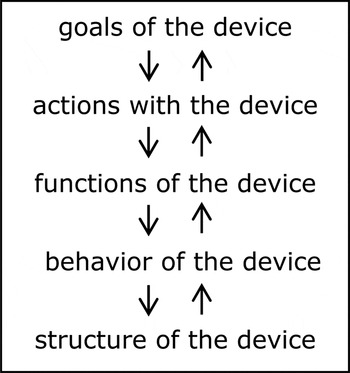
According to the schemes by Brown and Blessing (Reference Brown and Blessing2005) and Houkes and Vermaas (Reference Houkes and Vermaas2010), design reasoning about devices proceeds in terms of five key terms: goal, action, function, behavior, and structure.Footnote 5 The goal associated with a device is a state of affairs the prospective users of the device are to achieve with the device. An action is a deliberate manipulation of the device by a user. A function is a physicochemical capacity of the device that makes it so that these actions with the device are successful. Behavior is the physicochemical evolution of the device, including the evolution of its structure and the device's physicochemical interactions with its environment. Structure is the physicochemical configuration of the device. With these five key terms, design reasoning displays a conceptual layering, as given in Figure 1. First, one starts by considering a goal as given by or defined for the prospective users. Second, one then determines a set of actions by which these users can realize this goal; these actions form a use plan for the device (Houkes & Vermaas, Reference Houkes and Vermaas2010, chap. 2). Third, it is decided what functions the device to be designed has to have for letting these actions be successful. Fourth, the behavior of the device is characterized such that it has the capacities corresponding to the required functions. Fifth, the structure of the device is fixed in a way that the device exhibits the behavior. Design reasoning thus becomes an ordered sequence of steps through the five conceptual layers, as given in Figure 1, connecting first a goal description of the device with a description of the actions with the device, connecting second the description of the actions with a functional description of the device, all the way down to a structural description.Footnote 6
Reasoning from a device's goal to its structure.

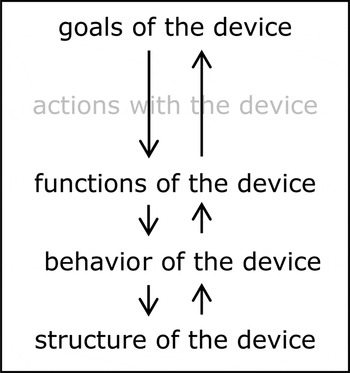
Some design methods put forward reasoning schemes that are conceptually as extensive as the just described five key terms reasoning scheme, and the description by Brown and Blessing (Reference Brown and Blessing2005) is a case in point. Other methods are less meticulous and simplify design reasoning by “bypassing” some of the conceptual layers depicted in Figure 1. Moreover, individual methods do so in different ways. In, for instance, the multilevel flow modeling (MFM) method by Lind (Reference Lind1994), actions of users with devices are not considered, leading to a reasoning scheme in which that layer is bypassed (see Fig. 2). This particular simplification of design reasoning does not have a substantial effect on the capacity meaning by which the term function is used in the five key terms reasoning scheme. In the MFM method, functions of a system are understood as representing “the roles the designer intended a system should have in the achievement of the goals of the system(s) of which it is a part.” This meaning is by and large the same as the above given meaning of physicochemical capacities of the device that make it so that the actions with the device are successful; the only difference being that in MFM functions are to refer directly to the goals of devices because actions are not considered in MFM. Other design methods propose reasoning schemes that are considerably simpler, and those simplifications do have an effect on the meaning attached to the term function.
Bypassing actions in multilevel flow modeling design reasoning about devices.

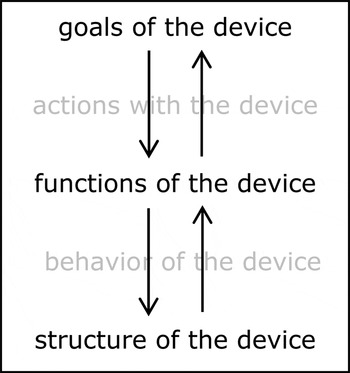
Consider, for instance, the functional basis (FB) design method proposed by Stone and Wood (Reference Stone and Wood2000). By this method, designing starts by deriving from customer needs a description of the overall product function of the device that is to be designed. This product function is captured by a verb–noun expression and represented as a black-boxed operation on flows of materials, energies, and signals. The product function is then decomposed into a network of basic functions as defined by libraries of basic operations and basic flows (Hirtz et al., Reference Hirtz, Stone, McAdams, Szykman and Wood2002). With this network of basic functions design solutions are searched and composed. (This notion of function by Stone and Wood, 2005, was already mentioned in Section 4 as an example of the functional modelling stream that Chandrasekaran, Reference Chandrasekaran2005, distinguishes.) Considered relative to the above five key terms reasoning scheme, designers reason in FB in one step from goals (i.e., the customer needs) to functions, and then in one step from functions to structure (i.e., the design solutions), bypassing thus the actions users execute with the device and the behavior devices exhibit, as in Figure 3. Function are in FB taken, or represented, as operations on flows of materials, energies, and signals, in line with the work by Pahl et al. (Reference Pahl, Beitz, Feldhusen and Grote2007), where it is assumed that the operations meet the conservation laws of physics (i.e., the incoming flows should match the outgoing flows in terms of the carried amounts of energy, matter, etc.). The meaning attached in FB to function is, therefore, different from the capacity meaning as used in the five key terms reasoning scheme, for a capacity need not be described in a manner that meets conservation laws explicitly.Footnote 7 In FB, functions are rather used in the meaning of intended behavior, for behavior does meet the conservations laws of physics. By using functions in this meaning, one could argue that in FB the concept of behavior is implicitly still employed in the descriptions of devices: FB functions, because they are used in the intended behavior meaning, refer both to the behavior for which devices are designed and to their capacities by which the devices are intended to contribute to the realization of the goals of the devices.
Bypassing actions and behavior in functional basis design reasoning about devices.

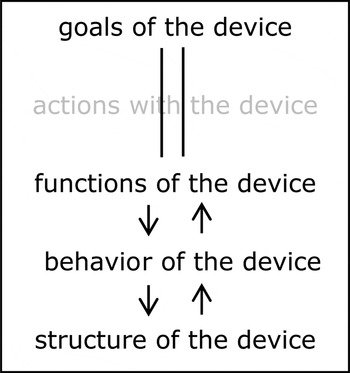
Another design method that advances a substantial simplification of the five key terms reasoning scheme and that lets the meaning of function change is the function–behavior–structure (FBS) design model of Gero (Reference Gero1990). In this model, designing is in its barest form an activity in which functions are transformed into design descriptions of devices that can perform these functions. These functions originate from clients, and the design descriptions determine how the devices can be made. The functions are transformed into design descriptions via elementary design steps in which behavior of the devices and their structure are also considered. It may seem that in the FBS model designers fully ignore the goals and actions of devices. However, Gero defines functions as the “design intentions or purposes” related to devices (Gero et al., Reference Gero, Tham, Lee, Brown, Waldron and Yoshikawa1992). If these design intentions or purposes are the purposes users have with the device, the distinction between the key terms of goal and function has disappeared. The reasoning then proceeds from functions in the meaning of purpose straight to behavior, and then to structure, leading to descriptions in which the actions of users with devices are bypassed, as in Figure 4.Footnote 8 It is evident that now function is used with the meaning of purpose.
Bypassing actions and equating goals and functions in function–behavior–structure reasoning about devices; the two vertical lines represent an “is equal to” sign, “ = ”.

The FB, MFM, and FBS examples show that design methods can advance reasoning schemes that simplify the five key terms descriptions of devices derived from the descriptions of design by Houkes and Vermaas (Reference Houkes and Vermaas2010) and Brown and Blessing (Reference Brown and Blessing2005). Moreover, design methods simplify these five key terms descriptions in different ways, depending on which key terms are bypassed. These examples also show that the meaning by which function is used in the simplified reasoning schemes depends on the simplification at hand: if actions and behavior are bypassed (as in FB), then it makes sense to opt for the intended behavior meaning of function; if only actions are bypassed (as in MFM), then one can stay with the capacity meaning; and if actions are bypassed and the key terms of goal and function are taken as one and the same, one ends up with using function with a purpose meaning. Van Eck (Reference Van Eck2011) strengthens this analysis by arguing for a number of design methods that these choices to attach specific different meanings to function are rational choices in engineering. Hence, the conclusion (as given in Vermaas, Reference Vermaas2009) is that one can explain the engineering benefits of the coexistence of different meanings of function by means of the coexistence of different ways to simplify descriptions of devices in designing: there are different ways in which engineers can simplify the elaborated five key terms descriptions of devices, and these simplifications can all be adopted because engineers can use the term function in more than one meaning.
7. FUNCTION SIMPLICITER
The explanation given in the previous section gives the benefits for engineering to have at least three of the coexisting meanings of function. Strictly speaking it is not an explanation of why engineers talk about function simpliciter. Engineers could alternatively accept the coexisting meanings and take them as defining separate concepts; the explanation given in the previous section then establishes that engineers benefit from having at their disposal the three concepts of “capacity-function,” “intended-behavior-function,” and “purpose-function.” This alternative would amount to a rather straightforward disambiguation of functional descriptions, yet it is not in accordance with engineering practice: engineers speak about function simpliciter and not about x functions, y functions, and so forth. Therefore, why do engineers take function as a single disambiguated concept?
A possible answer to this last question can be found in the previous section. In each of the design methods considered in that section, functional descriptions are used to reason from a goal to a structural description of the device to be designed. All these methods incorporate in this way the design methodological guideline that design reasoning should not proceed directly from goals to known design solutions; rather, engineers should use functional descriptions as a means to abstract from those known solutions and to consider novel and more innovative solutions as available in their own disciplines and in other disciplines. More generally, in design and elsewhere, functional descriptions can be taken methodologically as descriptions that are means to engineers to relate in a general way high-level goal descriptions of devices with low-level structural descriptions of the devices in a common language that can overcome the barriers between different engineering disciplines (Erden et al., Reference Erden, Komoto, Van Beek, D'Amelio, Echavarria and Tomiyama2008, p. 147). In the design methods considered in the previous section, functional descriptions all play this methodological role, and this role can be taken as common to functional descriptions and as defining a criterion of what descriptions are to be taken as functional descriptions: descriptions are functional descriptions when they relate goal descriptions and structural descriptions of devices in a general and interdisciplinary way. This methodological role of functional descriptions is not singling out one specific meaning for function but leaves that meaning underdetermined, as is shown by the design methods considered. The engineering practice of speaking ambiguously about function simpliciter can now be understood as due to this underdeterminateness: in engineering, there can be consensus on the methodological role of functional descriptions exactly because the different coexisting meanings are not separated. Functional descriptions can then be put on offer to engineering as a mean to relate goals and structural descriptions of devices in a general and interdisciplinary way, and the guideline for design can be formulated as that engineers should use functional descriptions in order to come up with more innovative solutions. If the coexisting meanings of function would be separated and engineers would stop to speak about function simpliciter, the methodological role would get fragmented over different types of descriptions and hard to promote in a straightforward slogan-style manner. The guideline for innovative designing would then become the rather opaque one that engineers should abstract from known design solutions by using descriptions based on x-functions, descriptions based on y-functions, or descriptions based on z-functions, and so forth.
A second answer to the question of why engineers take function as a single disambiguated concept may be that it allows engineers to let slide the meaning they attach to function during design. If design is not guided by one specific method in which this meaning is fixed, engineers may reason more freely from goal descriptions to structural descriptions, using various design tools and techniques, and adjusting the specific meaning of function accordingly.
8. FUNCTION AND TASK DEPENDENCY
Still, even when accepting that it is beneficial to engineers to gloss over the different coexisting meanings of function, one can argue that there are also benefits when they become more sensitive to these different meanings. One reason for this is that there are also constraints on the specific meaning of function that is to be used in design. A rather obvious constraint is that if one designs by means of a specific design method, one should adopt the meaning of function that comes with that method. In the reasoning scheme by Brown and Blessing (Reference Brown and Blessing2005) and in the MFM model by Lind (Reference Lind1994), one should use function in its capacity meaning. When designing by Stone and Wood's (2000) method, function is to be used in its intended behavior meaning. Hence, the term function gets its meaning depending on the design method used. Conversely, when formulating a new design method that involves functional descriptions, it becomes pertinent to also define the specific meaning that in that method has to be adopted; given the coexisting different meanings, merely stating that a designer should make a functional model of a product is highly ambiguous without such a definition.
Generalizing that the meaning of function depends on the design method used, function can be understood as a term with different coexisting meanings, where the choice of which specific meaning to adopt depends on the task at hand. For the task of design with method x, function is used with the x-meaning as defined by that method, and for the multimeaning methods by Chakrabarti (Reference Chakrabarti1998), Chandrasekaran and Josephson (Reference Chandrasekaran and Josephson2000), Deng (Reference Deng2002), and Srinivasan and Chakrabarti (Reference Srinivasan and Chakrabarti2009), that would amount to that function is used simultaneously in more than one meaning. For tasks other than design, function can be used in a meaning specific to that task. Archiving of functional descriptions and functional descriptions used in reverse engineering, for instance, may require also that function is used in meanings specifically useful to these tasks.
Ferguson's (Reference Ferguson1992) analysis of engineering drawings may provide a useful parallel for this task dependency of the meaning of function. Ferguson, when discussing sketching in design, distinguishes three kinds of sketches that each serve different tasks for engineers: thinking sketches for focusing and guiding the nonverbal thinking of engineers, prescriptive sketches for directing the making of a finished drawing, and talking sketches for explaining technical points in discussions among engineers (1992, pp. 96–97). Without going into detail, it can be envisaged that different constraints apply to such sketches depending on the thinking, prescribing, or talking task at hand, which means that sketches are adjusted to the tasks for which they are used.
The understanding of function one arrives at by this parallel is as follows. Function is a term with a number of coexisting meanings and with the common role of relating goal descriptions of devices with structural descriptions of the devices in a general and interdisciplinary way. The specific meaning that function has in a particular functional description depends on the task at hand, which can be archiving, reverse engineering, designing with method x, designing with method y, and so forth. This understanding is compatible with both the third and fourth responses to the coexistence of functional descriptions. In both these responses, one accepts the coexisting meanings of function, and in both responses one can take the methodological role of relating goal descriptions and structural descriptions of devices in a general and interdisciplinary way as the criterion that turns descriptions into functional descriptions. In the third response, one assumes additionally that there is one overarching concept of function that defines a common core to these coexisting meanings, which is an assumption that is dropped in the fourth response, in which function is taken as a family resemblance concept.
9. THE IMPLICATIONS OF THE COEXISTENCE OF MEANINGS FOR RESEARCH
Engineering functional descriptions of technical devices are ambiguous by the coexistence of different meanings of function, and with the different responses to this coexistence described in this paper, the implications of this ambiguity for engineering research and design methodology can be explored. In this final section, I revisit the responses in order to formulate some of the implications.
If engineering is eventually to arrive at one single meaning of function, either by the first response of convergence of the existing meanings or by the second revisionary response of imposing one meaning, then what seems to be needed is that an active and evaluative discussion of existing and novel meanings of function should be conducted in engineering research and design methodology. Proposals for giving functional descriptions should be assessed in the literature and explicitly compared with one another for their comparative advantages and disadvantages. This discussion may be conducted by researchers and methodologists in a dialectic manner or in a more diplomatic style, as long as the current indifference with its pro forma ahoy's comes to an end.
When adopting the first response, the result of such an evaluative discussion may be readily acceptable to engineering: because the resulting single meaning is to emerge from the existing meanings used in engineering, engineers may find themselves in this single meaning and recognize it as the single true engineering meaning of function. When adopting the second approach of imposing one meaning of function on engineering, this acceptance may be harder to achieve. For this second approach to be effective, a mechanism should be established to create commitment among engineers to accept a single meaning of function. Merely defining such a meaning in a formal ontology and then prescribing it to engineers most probably will not do; by arguing for the appropriateness of the defined meaning to engineering or by staying close to the way engineers use functional description, as Mizoguchi and Kitamura do, the chances of acceptance increase. An even better option would be to use the mechanisms of standardization processes: if the single meaning is defined by an effort of experts and with the commitment of industry and academia to adopt the resulting standard, acceptance becomes realistic. Without this commitment, any proposal for a single meaning of function to replace the coexisting meanings may be welcomed by engineers as merely another possible meaning: even if Mizoguchi and Kitamura's proposed meaning of function was meant to be a revisionary one, it now is just one of the different coexisting meanings. Erden et al. (Reference Erden, Komoto, Van Beek, D'Amelio, Echavarria and Tomiyama2008), for instance, include the proposal by Mizoguchi and Kitamura as one of the 18 proposal they listed, and they do not treat it as potentially defining the common understanding of function Erden et al. aim at.
A third implication of both these responses to arrive at a single meaning is that, in the end, engineers and design methodologists should be prepared to reassess current ways of using functional descriptions. Proposals by which the term function can be used with more than one meaning (e.g., Chakrabarti, Reference Chakrabarti1998; Chandrasekaran & Josephson, Reference Chandrasekaran and Josephson2000; Deng, Reference Deng2002; Srinivasan & Chakrabarti, Reference Srinivasan and Chakrabarti2009) are bound to be rejected when function becomes a term with a single meaning. Moreover, it seems unavoidable that some of the existing design methods should be reassessed with respect to their use of functional descriptions. When function has just one meaning, design methods cannot anymore use this term in the flexible manner as described in Section 6. If, for instance, the intended behavior of a device would be that single meaning, then the FBS model by Gero (Reference Gero1990) and the FB method by Stone and Wood (Reference Stone and Wood2000) become design methods by which engineers reason from goal descriptions, via behavior descriptions, to structural descriptions of devices; functional descriptions of the devices are then not elements of these methods. This reassessment need not have the character of a reevaluation of the worth of design methods: these methods may remain effective even if it is eventually acknowledged that they do not advance reasoning schemes for design that include functional descriptions. When function has eventually one meaning, then other descriptions than functional descriptions can also connect goal descriptions and structural descriptions of devices in a general and interdisciplinary way.
Alternatively, if the different coexisting meanings of function are to be accepted in engineering, the implications are quite different. For properly managing the ambiguity it results in, it should become clear what meanings of function are possible in the first place. If functional descriptions are defined by the methodological role of relating goal and structural descriptions of devices in a general and interdisciplinary way, then engineering research and design methodology should explore and categorize the different possible meanings that function can have. The current meanings that are used in engineering define such possible meanings, yet other meanings may be discovered as well. A categorization of these meanings may capture the relations among these meanings, and ontological analyses such as the reference ontology of functions by Kitamura et al. (Reference Kitamura, Takafuji and Mizoguchi2007) seem suitable means to this. All these meanings may be taken as having in common that they amount to descriptions that can play the methodological role of relating goal and structural descriptions of devices in a general and interdisciplinary way. In the third response to the coexistence of different meanings of function, one also aims at finding a common core to these meanings that can be added as an overarching meaning to the categorization. In the fourth family resemblance response, one aims merely at establishing pairwise similarities, overlaps, and criss-crossings among the different coexisting meanings.
For managing the effectiveness of functional descriptions given the acceptance of the coexisting meanings, functional descriptions should be accompanied with specifications of the meaning used. With such a specification, functional descriptions become clear and well defined within designing and archiving. Moreover, given that functional descriptions using different meanings are now bound to coexist as well, translation algorithms of functional descriptions using different meanings should be developed in engineering research and design methodology. Ontologies may be suitable means to finding these algorithms, as is shown by work by Okubo et al. (Reference Okubo, Koji, Sasajima, Kitamura and Mizoguchi2007) and by Borgo et al. (Reference Borgo, Carrara, Garbacz and Vermaas2009, Reference Borgo, Carrara, Garbacz, Vermaas, Horváth, Mandorli and Ruzák2010).
Finally, when the coexisting meanings of function are accepted, the constraints on the use of specific meanings can be analyzed and made explicit. If the task dependency as described in Section 8 holds, this implication can be phrased as that engineering research and design methodology should chart the constraints that specific tasks impose on the meaning attached to function. For the general task of design, conceptual tolerance is ruling because engineering practice shows that it is useful for design to adjust the meaning of function depending on the specific design method used. For the more specific task of design by a particular design method, the constraint is simply that function should be used in the meaning that is laid down by the method. For the tasks of archiving and reverse engineering, constraints may be more subtle. When functional descriptions are archived to form databases to be used in design methods, the meaning function to be used has again to be the meaning as laid down in the method. Both the methods by Gero (Reference Gero1990) and by Stone and Wood (Reference Stone and Wood2000) invoke databases in which past knowledge of design solutions are stored: Gero calls them prototypes, and Stone and Wood have a repository. It would now be counterproductive if these databases are to be filled with functional descriptions using a different meaning for function than the meaning employed in the design method at hand. Similarly, if reverse engineering is meant to provide functional descriptions that can be of direct use in design, the meaning of function used should be the same as the meaning used in the design. However, if archiving or reverse engineering is done for more general reasons than direct use in design, it may be argued that both activities should be conducted using one fixed, well-defined, and detailed meaning of function. If archiving is done for storing functional descriptions for future use or for historical or academic reasons, it seems detrimental to use the different coexisting meanings side by side. For this, the maxim that consensus on concepts is beneficial applies unconditionally. When, say, technical devices have life cycles longer than 20 years, the engineers involved in maintenance or disassembly are typically others in person and in training than the engineers who designed and produced the devices. In that case it becomes beneficial if not highly relevant (think of devices containing nuclear technology) that functional descriptions are understandable independently of traditions confined to individual firms or individual periods.
The analysis in this paper was aimed at determining the methodological implications of accepting or rejecting the coexistence of different meanings of function. It also identified work that has to be done in engineering research and design methodology on the ambiguity of functional descriptions. However, by its primarily methodological perspective, this paper did not contribute to doing this work. An overall conclusion may be that the ambiguity of functional descriptions can be accepted as inherent to engineering and, when the work is done, as manageable. A second conclusion is that, independently of whether it is accepted or rejected, the use of functional descriptions in engineering will improve when the current coexistence of different meanings of function is discussed explicitly rather than ignored by pro forma ahoy's.
ACKNOWLEDGMENTS
For the analysis given in this paper, I have drawn in part from joint work developed with coauthors, including Stefano Borgo, Massimiliano Carrara, and Pawel Garbacz. I thank Nathan Crilly, Claudia Eckert, and Norbert Roozenburg for their comments. The research for this paper was supported by the Netherlands Organisation for Scientific Research.
Pieter E. Vermaas is a Senior Researcher in the Department of Philosophy at Delft University of Technology. His research in the philosophy of technology includes analyses of the concepts of technical function and of technical artifacts, which currently broadens to the study of the structure, aims, and validation of design methods and design thinking. Pieter collaborates extensively with design researchers and formal ontologists for this research. He edits NanoEthics and Philosophy and Technology and is editor of the Philosophy of Engineering and Technology book series.