Immunization is a primary means of preventing influenza infection among healthcare personnel (HCP). Historically, influenza vaccination rates among HCP have been suboptimal, although mandatory vaccination policies have increased these rates in recent years. In 2008, the Centers for Disease Control and Prevention (CDC) estimated that only 49% of HCP in the United States received influenza vaccine. Reference Fiore, Uyeki and Broder1 By the 2015–2016 influenza season, that number had increased to 79%, Reference Black, Yun and Ball2 and during the 2018–2019 influenza season, 81% of HCP reported having been vaccinated. Reference Bardhenheier, Lindley and Yue3
A survey revealed that mandatory vaccination policies in healthcare settings increased influenza vaccination rates from 37.1% in 2013 to 61.4% in 2017. Reference Greene, Fowler and Ratz4 Furthermore, mandatory policies result in sustained increases in HCP vaccination rates. Reference Blank, Gemeinhart, Dunagan and Babcock5 However, implementation of mandatory vaccination policies are controversial and evidence of their effectiveness in reducing HCP illness, absenteeism, and secondary transmission of illness to patients is limited. Reference Pitts, Maruther and Millar6 In this study, we compared rates of influenza and other respiratory pathogens among HCP working in outpatient settings at 4 Veterans’ Affairs (VA) health systems without mandatory influenza vaccination policies versus 3 non-VA health systems with mandatory influenza vaccination policies.
Methods
Study design
The Respiratory Protection Effectiveness Clinical Trial (ResPECT) was a cluster-randomized comparision of the effectiveness of N95 respirators (N95) and medical masks (MM) at preventing workplace-acquired respiratory viral infection, including influenza A and B, across 4 respiratory viral seasons (RVSs) between 2011 and 2015. Reference Radonovich, Bessesen and Cummings7 Each year, HCP in high-risk outpatient clinics serving adult and/or pediatric patient populations across 5 geographic regions were enrolled after providing informed consent. HCP working in these clinics were permitted to participate for 1 or more seasons. Study sites set their own policies for influenza vaccination (eg, whether mandatory) and approach to respiratory illness prevention, independent of group assignment in the randomized trial as previously described. Reference Radonovich, Simberkoff and Bessesen8
Study procedures
Samples for detecting respiratory pathogens were obtained via anterior nasal and oropharyngeal swabs from HCP experiencing a symptomatic respiratory illness. Samples were also obtained from participants while asymptomatic at 2 randomly selected times each season. Swabs were collected in a standardized fashion by trained research personnel from participants in the workplace. Self-administered swabs were obtained from symptomatic participants when not in the workplace. These specimens were collected using FLOQSwabs (Diagnostic Hybrids, Athens, OH), stored at −80°C, and tested for 18 respiratory viral pathogens [ie, adenovirus, coronavirus (229E, OC43, NL63, HKU1), human metapneumovirus, influenza A and B, parainfluenza viruses 1–4, rhinovirus/enterovirus, and respiratory syncytial virus] using multiplex polymerase chain reaction (PCR) assays. Reference Radonovich, Bessesen and Cummings7 Influenza viruses were typed to A or B. Serological testing was also performed to identify influenza seroconversion, as previously described. Reference Radonovich, Simberkoff and Bessesen8 Influenza reagents used in hemagglutination inhibition assay (HAI) were obtained from the International Reagent Resource (Manassas, VA) of the CDC.
Influenza infection was defined as detection of influenza A or B virus by reverse-transcription (RT)-polymerase chain reaction (PCR) in an upper-respiratory specimen (1) collected within 7 days of symptom onset, (2) from a randomly obtained swab from an asymptomatic participant, or (3) influenza seroconversion (symptomatic or asymptomatic) defined as at least a 4-fold rise in HAI titer to influenza A or B virus between pre- and postseason serological samples deemed not attributable to vaccination. Reference Radonovich, Bessesen and Cummings7,Reference Radonovich, Simberkoff and Bessesen8
Statistical analysis
Detection of influenza by PCR and serology and of noninfluenza viral respiratory infections (NIVRI) by PCR were analyzed as aggregate outcomes. Infection rates were calculated as the number of laboratory-confirmed cases divided by the number of participants enrolled. Each influenza infection rate was reported for influenza A and B.
Binomial and Poisson multivariate regression analyses were used to examine the relationship between the primary and secondary outcomes (laboratory confirmed influenza and NIVRI, respectively) and the presence of a mandatory influenza vaccination policy, individual influenza vaccination and other covariates (year, age, and vaccination status) hypothesized to be associated with these outcomes. A random effect was used to account for clustering of outcomes in HCP that participated across multiple years as well as a separate random effect to account for clustering of outcomes within clinics. An offset was included to account for the duration of HCP participation over the course of a single season for all outcomes. Point estimates for analysis are reported using odds ratios (ORs) for binomial regression or incidence rate ratios (IRRs) for Poisson regression and 95% confidence intervals (CIs). Simulations to estimate the impact of increased vaccination rates in clinics with mandatory versus nonmandatory policies were conducted using our fitted regression models. Using coefficients estimated from the observed data on the association of vaccination and other covariates with influenza infection outcome, we explored the potential reduction in influenza to determine whether vaccination rates were higher in nonmandatory clinics and whether the association of vaccination and other covariates with influenza was consistent across data sets. We did this by randomly selecting individuals in nonmandatory clinics and reassigning their vaccine status to vaccinated while keeping all other covariate statuses the same. We reassigned randomly selected individuals in this hypothetical data set until vaccination rates in these nonmandatory clinics were raised to the levels observed in mandatory policy clinics, we then predicted the influenza infection rates using the regression model with 1,000 simulated hypothetical data sets.
All statistical analyses were performed in R version 3.6.1 software (The R Foundation, Vienna, Austria).
Ethical Review
ResPECT was registered at clinical trials.gov (no. NCT01249625) and was approved by the National Institute for Occupational Safety and Health (NIOSH) Human Subjects Review Board (protocol no. 10-NPPTL-O5XP) and the institutional review boards at the recruiting and affiliate sites where samples and data were stored.
Results
Demographics
The demographic characteristics of study participants at mandatory and nonmandatory (VA health systems) are shown in Table 1. During the first season (2011–2012) of data collection, this study was conducted at only 2 mandatory and 1 nonmandatory sites. Thereafter, 3 health systems with mandatory influenza vaccination policies and 4 health systems with nonmandatory policies participated. Study participants were predominately female at both the mandatory vaccination (87.9%) and VA nonmandatory vaccination (79.7%) sites. Particpants at the nonmandatory sites were older and fewer received influenza vaccine in each season studied.
Demographics of Study Participants

a 37 participant seasons in the 2011–2012 season had unknown vaccination status.
b 37 participant seasons in the 2012–2013 season had unknown vaccination status.
c 28 participant seasons in the 2013–2014 season had unknown vaccination status.
d 36 participant seasons in the 2014–2015 season had unknown vaccination status.
Infection rates
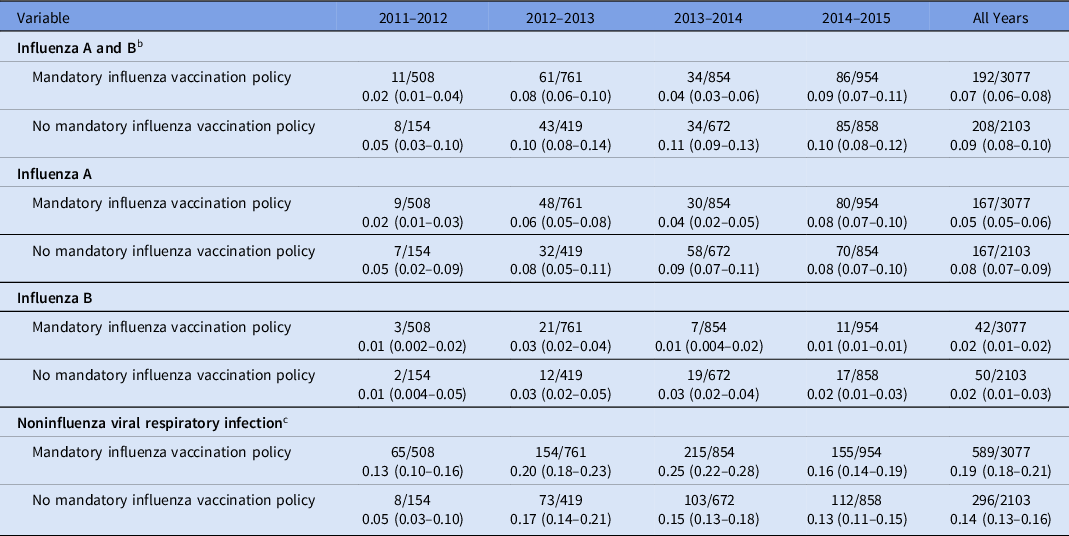
Among 1,759 HCP at 4 VA health systems and 2,304 HCP at 3 non-VA health systems, the overall (PCR- and serologically confirmed) influenza infection rate was 0.07 per participant season (95% CI, 0.06–0.08) at institutions with mandatory vaccination policies and 0.09 (95% CI, 0.08–0.10) at institutions without mandatory vaccination policies (Table 2). Influenza A infection rates were higher across all years than influenza B infection rates. The NIVRI rate was 0.19 (95% CI, 0.18–0.21) for institutions with mandatory influenza vaccination policies and 0.14 (95% CI, 0.13–0.16) for those without mandatory policies (Table 2). Both influenza and NIVRI infection rates varied by year. During the 2014–2015 viral respiratory infection season, when there was a poor match between the influenza vaccine and the circulating influenza A viruses, Reference Flannery, Lippard and Zimmerman9,Reference Appiah, Blanton and D’Mello10 we observed essentially identical influenza A infection rates in mandatory and nonmandatory vaccination sites. In that season, the NIVRI rates at institutions with mandatory and nonmandatory influenza vaccination policies were similar: 0.16 (95% CI, 0.14–0.19) and 0.13 (95% CI, 0.11–0.15), respectively.
Respiratory Virus Infection Rates per Participant-Season Among HCP in Ambulatory Settings a

a Data in this table are reported as follows: The top row of each box is no. of infections/no. at risk; the bottom row of each box is the rate per person (95% confidence intervals).
b Diagnosed by PCR and serology.
c Noninfluenza viruses were adenovirus, coronavirus (229E, OC43, NL63, HKU1), human metapneumovirus, parainfluenza viruses 1-4, rhinovirus/enterovirus, and respiratory syncytial virus.
Independent risk by multivariate analysis
Influenza vaccination significantly decreased the odds of developing influenza infection for the individual HCP (OR, 0.16; 95% CI, 0.13–0.22). Clinics with mandatory influenza vaccination policies had increased rates of vaccination (92.8%; 95% CI, 91.8%–93.7%) compared to those with nonmandatory policies (61.6%; 95% CI, 59.5%–63.7%).
To assess whether the risk of influenza was associated with a vaccination mandate beyond the individual effects of influenza vaccination, we incorporated the presence or absence of a mandatory policy into a model that included individual influenza vaccination status. After adjustment for individual effects of vaccination, we detected no significant difference in odds of developing influenza between institutions with and without mandatory and nonmandatory policies (OR, 1.08; 95% CI, 0.83–1.40) (Table 3).
Odds and Incidence Rate Ratios for Viral Respiratory Infections in Outpatient Healthcare Personnel (HCP) Including Random Effects to Adjust for Clustering of Observations Within Individuals and Clinics a

a Odds ratios are reported for multivariable binomial regression, although the incidence rate ratios are reported for multivariable Poisson regression.
b Adenovirus, coronavirus (endemic), human metapneumovirus, parainfluenza viruses 1–4, rhino/enterovirus, and respiratory syncytial virus.
c Four Veterans’ Affairs (VA) Health systems did not mandate vaccination and 3 non-VA centers did mandate vaccination.
d Vaccine efficacy was 19% in 2014–2015 when the vaccine strain did not match the circulating strain.
In every season, influenza vaccination was associated with an increased incidence rate of NIVRI (incidence rate ratio [IRR], 1.26; 95% CI, 1.02–1.57) (Table 2). Having a mandatory influenza vaccination policy was associated with higher odds of NIVRI (OR, 1.29; 95% CI, 1.07–1.55) and the NIVRI incidence rate (IRR, 1.32; 95% CI, 1.10–1.59). When conducting 2 separate analyses, one in settings with a mandatory policy and another in those without, self-reported influenza vaccination remained associated with higher risk of HCP having ≥1 NIVRI in both settings with mandatory vaccination (OR, 1.71; 95% CI, 1.04–2.81) and nonmandatory vaccination (OR, 1.32; 95% CI, 0.99–1.78). When we stratified our data to exclude clinics that saw only pediatric populations, we again detected a statistically significant association of NIVRI with mandatory policy (OR, 1.25; 95% CI, 1.02–1.53).
Year of participation in the study and age were both associated with risk of influenza infection as well as incidence rate of NIVRI. The odds of influenza infection increased with age (OR, 30–39 year olds, 1.7; 95% CI, 1.1–2.6 and OR 50–59 year olds, 2.5; 95% CI, 1.7–3.9) compared to 20–29 year olds (reference group), whereas incidence rates of NIVRI decreased with age (Table 3).
To explore the potential effects of increasing vaccination in clinics where vaccination was not mandatory, we built a hypothetical model using our estimated regression models. In a simulation we used estimated coefficients from our multivariate model of influenza infection outcome and randomly reassigned individuals in the nonmandatory clinics to ‘vaccinated’ status until we reached levels of vaccination equivalent to those of clinics with mandatory vaccination. This analysis assumed that other associations would remain the same and that the association of influenza vaccine and reduced influenza risk is causal. This analysis demonstrated that influenza infections among HCP in nonmandatory clinics would have been reduced by 52.1% (95% CI, 51.3%–53.0%) had influenza vaccination rates been increased and the assumptions noted above held.
Discussion
Implementation of mandatory influenza vaccination policies in healthcare settings remains controversial. Our study showed that influenza vaccination decreased the rate of influenza among HCP. Influenza vaccination rates were higher at sites with mandatory influenza vaccination policies (93% in mandatory settings compared to 62% in nonmandatory settings). Coupling this difference with the individual protection that vaccination provided participants compared to nonvaccinated participants (OR, 0.17; 95% CI, 0.13–0.22), we estimate that mandatory vaccination policies reduced influenza infections in our participants in mandatory compared to nonmandatory clinics. In fact, when we performed simulations of the impact of the potential change on influenza vaccination rates, we found that if the VA clinics with nonmandated influenza vaccination policies had vaccination rates similar to those who did and other covariates associated with influenza outcomes remained the same, influenza infection rates would have decreased by >50%. Furthermore, these findings were obtained from data prospectively collected over multiple sites and multiple years.
Understanding the impact on morbidity and mortality of mandatory vaccination programs is critical to weighing their health, opportunity, and financial benefits against costs. The CDC recommends influenza vaccination of all healthcare providers. Despite Society for Healthcare Epidemiology of America (SHEA) recommendations that vaccination be mandatory, evidence demonstrating the effectiveness of mandates is limited. Furthermore, questions have been raised regarding the ethics of mandating and enforcing compliance with such policies. Reference Feemaster, Prasad and Smith11,Reference Cowling, Fang and Nishiura12 Although the risk of influenza was lower at sites with mandatory vaccination polices, the rate of NIVRI at these sites was consistently higher than at those without such policies. Other authors have made similar observations. For example, Cowling et al Reference Laurie, Horman and Carolan13 reported results of a randomized trial showing that recipients of influenza vaccine reported more symptoms of acute respiratory illness caused by a noninfluenza pathogen than did placebo recipients. However, this increase has not been consistent in other studies, which may be attributable to a reporting bias among HCP more attuned to the consequences of any viral respiratory infection and/or to improved access to testing when complaining of respiratory symptoms. Alternatively, a physiologic explanation may be that decreased influenza-illness–associated viral interference occurs among vaccinated HCP and could explain the increased NIVRI that we observed. Reference van Houten, Cohen and Engelhard14 Regardless of explanation, this finding is a reminder that vaccination should be utilized along with other control measures, such as source control masking and hand hygiene, when caring for patients with respiratory viral infections.
The non-VA health systems in our study had policies mandating influenza vaccine whereas influenza vaccination was not mandated at VA facilities during this study. However, these policies were not the only differences. The non-VA hospitals included pediatric clinics, with each site having HCP working solely with pediatric populations, thus potentially increasing their risk of exposure to respiratory pathogens. Reference Van Hooste and Bekeart15 However, our findings persisted despite controlling for hospital setting (as a random effect) and in analyses done separately for mandatory settings and in nonmandatory settings suggesting that the findings are more generalizable. Furthermore, VA HCP were significantly older than non-VA hospital staff, another potential confounding variable. Age was associated with increased odds of influenza infection, but the risk of acquiring an infection from a noninfluenza respiratory virus decreased with age, suggesting that exposure does not dictate these differences. Again, this finding was independent of the type of clinic in which the HCP worked.
This study has several limitations. First, ResPECT was designed to compare the effectiveness of N95 respirators to medical masks in preventing influenza and NIVRI among HCP working in outpatient settings, not to study the effect of different influenza vaccination policies at the participating institutions. Second, during this study period, mandatory influenza vaccination policies were implemented exclusively in non-VA facilities that served a different patient population and employed younger staff than the VA. However, controlling for these differences did not alter our conclusions, indicating that these factors are not what drove our findings. Still, additional unrecognized and/or unmeasured factors were not controlled for. Third, our analysis was limited in power to detect differences given the low numbers of influenza cases observed. Finally, the first year of data collection included only 3 health systems, 1 of which was a VA facility. Although we do not believe that this affected the models, we acknowledge this limitation.
In conclusion, at the 7 health systems we studied, mandatory influenza vaccination policies were associated with higher influenza vaccination rates in HCP working in ambulatory clinics, and receipt of influenza vaccine was associated with reduced influenza infection rates. This benefit, however, was partially offset by increased NIVRI infections regardless of setting. These observations, their possible causes, and additional strategies to reduce influenza and NIVRI among HCP working in ambulatory clinics warrant further investigation.
Supplementary material
To view supplementary material for this article, please visit https://doi.org/10.1017/ice.2021.324
Acknowledgments
The findings and conclusions in this manuscript are those of the author(s) and do not necessarily represent the views of the Centers for Disease Control and Prevention, the National Institute for Occupational Safety and Health, the Veterans’ Health Administration, the Biomedical Advanced Research and Development Authority, or affiliated organizations. Mention of propriety products does not imply endorsement.
Financial support
This study was supported by the Centers for Disease Control and Prevention, the Veterans’ Health Administration, and the Biomedical Advanced Research and Development Authority.
Conflicts of interest
All authors report no conflicts of interest relevant to this article.